Munich Personal RePEc Archive
Latent separability and price variation in
the estimation of demand System
Cherif, Olfa and Ayadi, Mohamed
3 June 2010
Online at
https://mpra.ub.uni-muenchen.de/36491/
Latent Separability and price variation in the
estimation of Demand System
Olfa Cherif &
Mohamed Ayadi
1Abstract
The aim of this paper is to overcome the problems caused by insufficient price variation in estimating a large demand system. For that, we propose a new form of Stone-Lewbel (SL) cross section prices developed under latent separability that explore individual specific variation in the composition of the bundles of exclusive goods. The estimation of demand system under latent separability needs the choice of at least one exclusive good per group. We estimate Quadratic Almost Ideal Demand System (QAIDS) under weak and latent separability using traditional aggregate price indices and SL prices. Our empirical analysis is based on fifteen non durable goods of a Tunisian Family Expenditure Survey Data. The results show greater differences among effects price and estimates of price elasticities obtained under weak separability and latent separability using both traditional price indices and SL prices. We obtain higher precision of estimates of own price elasticities using SL prices under latent separability.
Classification JEL: C13-D11-D12
Key Words: Latent separability, Weak separability, Demand system, Exclusive goods, Price variation, SL prices.
1
1. Introduction
The estimation of large demand system is empirically difficult because demand functions depend on the prices of all goods. The issue is to impose strong restrictions via separability. This later has been introduced in consumer preferences to resolve the consumer's allocation problem when faced by a disaggregated demand system. Gorman (1959) showed that weak separability equivalent to two stage budgeting rule of Strotz (1957). In the first stage, total expenditure is allocated over broad groups of goods and quantities are chosen optimally given expenditures. In the second stage, group expenditures are allocated over elementary commodities. Hence, imposing weak separability have played an important role in the theoretically and empirical analysis of consumer behavior. It allows a natural grouping of related commodities that reflect the budgeting decisions of consumers. This concept presents a specific shortcoming that possible substitution effects among goods are completely hidden when a high disaggregation of commodities is used. This leads to a problem of multicolinearity that makes difficult to identify price effects and that restricts the usefulness of estimated demand systems for the analysis of consumer behavior.
Blundell and Robin (2000) proposed a new concept of separability that overcomes the problem of multicolinearity: latent separability. This later is equivalent to weak separability in latent rather than purchased goods. Only purchased goods are directly observed and these can be used by the consumer in more than one group. Latent separability supposes to construct broader aggregates that called exclusive goods. These goods could be enter one single commodity group. Their number is imposed by a rank test of an estimated parameter matrix and the decision about them is based on empirical intuition.
This paper examines an other problem caused by insufficient and measurement error ridden price variation for estimating large consumer demand systems. This problem was suggested by Lewbel (1989) are aggravated by the fact that aggregate prices exhibit extremely strong serial correlation Hoderlein and Mihaleva (2008). As a consequence, price effects are only imprecisely estimated. To overcome this problem, lewbel(1989) elaborated an older idea by Stone. It consists to construct a cross section prices that explore individual specific variation in the composition of the bundles of goods. He suppose that all individuals have identical Cobb Douglas preferences for all goods within a given bundles of goods. So, the price of the bundle is simply a linear combination of the individual prices using the some weights for all individuals. These individual specific prices are now our new cross section prices that call Stone-Lewbel (SL) cross section prices.
2. Latent separability and Stone-Lewbel cross section prices
2.1 Latent separability
The concept of latent separability has been proposed by Blundell and Robin (2000), but it was implicitly present in Gorman's paper on the theory of aggregation for capital inputs Gorman (1995) or the theory of household production Chiappori (1988). To define this concept, it is useful to start from the definition of weak separability.
Definition 1:
Suppose that household's preferences are defined over goodsqi, i=1, ,n. A direct utility function satisfies the weak separability if the preferences can be written as:
)) ( , , ) ( ( ) , , ,
(q1 q2 qn F U1 q1 Um qm
U =
in which the qk denotes the vector of consumption in group k, U be a utility function representing strictly convex preferences, F is a regular aggregator function increasing in all its arguments and Um(.) are regular intermediate utility functions.
The structure of preferences under latent separability is shown to be equivalent under weak separability in latent rather than purchased goods. This later can be used by the consumer in more than one group. Latent separability permits to observed goods to be utilized in the production of more than one intermediate good. We denote the latent input in group k as q~ withik q~k =
(
q~1k, , q~nk)
.Definition 2:
A direct utility function satisfy the property of latent separability if it can be written as
( )
(
( )
( )
)
=
=
∑
=
q q q
U q
U F q
U
m
k k m
m
1 1
1
~ ; ~ , , ~ max
Where F:IRm →IR and Uk :q∈IR+n→Uk(q)∈IR+are increasing and differentiable strictly quasi-concave functions.
The composition of the individual latent elements is determined by the choice of at least one exclusive good per group2.The idea of exclusive good was imposed to identify the composition of each latent group.
2.2 Stone-Lewbel cross section prices
We assume a latent separable utility function F
(
U1( )
q~1,z , ,Um( )
q~m,z)
where( )
q zUk ~k, is the produced intermediate utility depends on the part of the vector of total consumption goods that is devoted to kth intermediate utility production process and on a vector z of observable demographic characteristics.3 Each of the n purchased goods is shared out across the production of m intermediate goods, qi =q~i1+q~i2+ +q~imfor
n i=1, , .
2
The idea of exclusive goods is found explicitly in the work of (chiappori1988) on the collective models of household behavior
3
We consider m exclusive goods, we denote mk the number of goods in exclusive groupk.
The budget share of exclusive group k is given by
x x w k k ~ ~
= , where ~ be total expenditures on xk
exclusive group k and x be total expenditures. The within group budget share of jth good in exclusive group k, relative to total expenditures in exclusive group k is given by
k j k j k j k x q p b w ~ ~ ) (
~ = , where
j k
q~ and bkj(p)are the quantity and the price of the jth good in
exclusive group k. The vectors of all quantities and group price aggregators are given by
q~ and b(p) whereb=
(
b1(p), ,bm(p))
t.4Under latent separability the total expenditure and substitution possibilities for any non exclusive good can work through more than one channel, thus relaxing the restrictions on total expenditure and substitution possibilities for goods in the same group under homothetic weak separability. For that, our focus will be on the case of homothetic latent separability5 which implies the existence of functions vk such that π~k =vk(bk(p),z∗) where π~ are latent price k
index. Consequently, according to lewbel (1989) the equivalence scale Ekcan be written as:
) ), ( ( ) ), ( ( ∗ = z p b v z p b v E k k k
Hence, the latent Stone-Lewbel (SL~)price for the group k are defined as:
) ), ( ( ~ ~ z p b v E L
S k = kπk = k k for k=1, ,m
The within-group latent budget share demand is given by: w~kj =hkj(bk(p),z,xk)
If we assume that demands are latent homothetically separable then x k drops out of hkjand
(
~ ( ( ),)
= ( )∫
(
( ),)
( )log vk bk p z bkj p hkj bkj p z dbkj p for j=1, ,mk
From the estimation of hkj, we can construct the latent cross section prices Stone-Lewbel
denoted by SL~k(p). SinceSL~k(p)=v~k
(
bk(p),z)
, so we can use these prices in place of price aggregators bk(p)in estimation of a latent demand system.We consider that the subtechnology functions are Cobb-Douglas:
∏
=
= k kj
m j w j k k k
k q z q
u 1 ~ ~ ~ ) , ~ ( λ
Where λ~k is a scaling factor, given by
∏
=
−
∗ ∗
= k kj
m j w j k k w 1 ~ ~ ~
λ
Where w~∗kj is the latent budget share of good j in group k of the reference household, then
the SL~can be written as:
4
The vector of group price aggregators b can be grouped into m linearly homogenous price aggregators denoted by bk(p) where m the number of latent groups. We assume that the aggregate price indices have the following form lnb(p)=Πlnp where
[ ]
ki
π
=
Π a (m×n) matrix, the k i
π terms measure the latent input of good i in group
5
∏
= = = k j k m j w j k j k i k k k w p b z p b v p L S 1 ~ ~ ) ( ~ 1 ) ), ( ( ) ( ~ λThese prices can be used now in place of a group price aggregates bk(p)to estimate the between group budget share equations under latent separability.
3. Application and results 3.1 The data
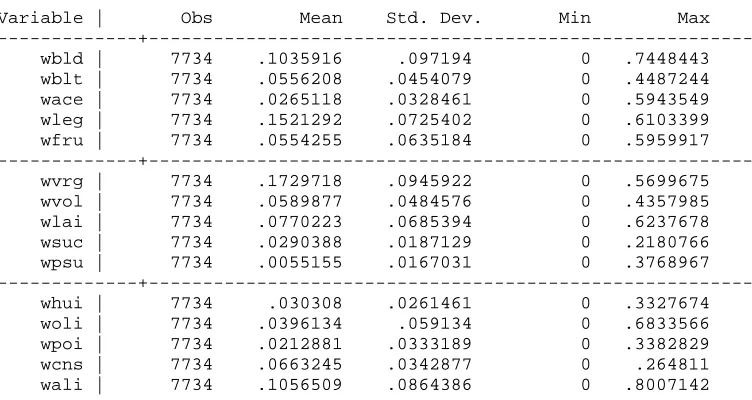
[image:6.595.69.485.497.754.2]The data we use in this study are drawn from the 1990 Tunisian Household consumption Survey published by the National Statistics Institute INS. This survey reports the expenditures and quantities for food products and non food products for 7734 households. It provides information on many demographic household characteristics. We study the purchases of fifteen food products, the statistic characteristic of shares of all goods are presented in the first table B1 in Appendix B.
The expenditures for foods are grouped into five categories. The first category “Cereals” consists of the subcategories (Hard wheat, Tender wheat and Other wheat), the second category “Vegetables” contains expenditures for Vegetables and Fruits. The third category is called “Meats” and it contains expenditures for Meat, Poultry and eggs and Fish. The four category “Oils” consists of Mix Oils and Olive Oils. Finally, the last category “Other food products” contains Milk, Sugar, Other sugar products, canned foods and other food products. 4.2 Weak separability and the effect of SL-prices
The demand model we estimate is the quadratic almost ideal demand system (QAIDS) developed by (Banks and al., 1997). It is a generalization of the almost ideal demand system (AIDS) of Deaton (1980), it allows a good to be a luxury to some income levels and to be a necessity in others income levels.
For each individual household we define wi to be the expenditure share on commodity i
with total expenditure xand the log price vectorlnp. The QAIDS model expenditure shares have the form
) ( ) ) ( ln ln ( ) ) ( ln ln ( ln 2
1 b p
p a x p a x p
w j i i
n j j i i i − + − + + =
∑
= λ β γ α Where p p p pa T ln T ln
2 1 ln )
(
ln =
α
+ Γ
∏
==
n i i ip
p
b
1)
(
β( ) ln( )
1 i n i i p p
∑
= =λ
λ
with 01 =
∑
= n i i λSuch that N T
T N T
N ) , ( ,..., ) , ( ,..., )
, . . . ,
(α1 α β β 1 β λ λ1 λ
α = = = and
As in any demand system, this model embodies theoretical restrictions as adding up which is satisfied by deleted one equation of the system to avoid a singularity in the variance and covariance matrix of residuals. Homogeneity and symmetry can be imposed and tested as restrictions on the parameter vectors and negativity can not be imposed but can be tested looking at the sign of slutsky matrix.
To deal with the problem of endogeneity of total expenditure, a generalized method of moments (GMM) estimation procedure is used. The most invoked instrument for total expenditure is income. To test and correct the problem of endogeneity, the estimation follows two stages. In the first stage, we regress the total expenditure ln on the instruments x zsuch that age, age squared, educational dummies, educational×age, relative prices, income and income squared, compute residualsνˆ . These instruments are strongly significant (the results are presented in table B2 of Appendix B. At the second stage, we regress wi on both log total expenditure and residualsνˆ . Moreover, the test of the exogeneity of total expenditure ln is x
equivalent to testing for the significance of the coefficient of the residualνˆ . We estimate the model without the homogeneity and slutsky symmetry restrictions Γ1n =0and
T
Γ =
Γ , so these restrictions can be tested.
Table1. Price and total expenditure effects under weak separability Compensated effects of price indices
Group of goods
P1 P2 P3 P4 lnx (lnx)2
Cereals -0,002
(-7,75) -0,001 (-4,07) -0,003 (-6,88) -0,001 (-3,61) 0,1027 (3,08) -.0093 (-4,22)
Vegetables 0,0023 (0,89) -0,00222 (-8,31) 0,0033 (0,69) -0,00631 (-2,29) -0,1124 (-1,51) 0,0113 (5,34)
Meats 0,00140
(7,9) 0,0024 (0,75) 0,0031 (0,55) 0,0011 (3,39) -0,2656 (-1,96) 0,0128 (5,05)
Oils -0,0019
(-11,96) -0,0058 (-3,48) 0,0045 (1,51) 0,0044 (2,57) 0,00136 (0,07) -0,00045 (-0,34)
Compensated effects of SL- prices
Group of goods
SL1 SL2 SL3 SL4 lnx (lnx)2
Cereals -0,0035 (-3,62) 0,0028 (1,82) -0,00139 (-2,62) -0,0140 (-15,46) 0,1718 (5,36) -0,0091 (-4,17)
Vegetables 0,0055 (2,59) -0,0021 (-2,31) 0,002156 (1,97) -0,00098 (-2,10) -0,1088 (-3,47) 0,0132 (6,17)
Meats -0,0022 (-3,88) 0,00803 (1,82) -0,0152 (-11,22) 0,00957 (17,61) 0,0257 (2,34) 0,00062 (2,05)
Oils -0,00453 (-4,07) -0,0068 (-3,56) -0,0165 (-6,11) -0,0025 (-2,37) -0,303 (-8,14) 0,0123 (4,86) Note: values in parentheses indicate the t-ratio
Furthermore, they are stronger than the compensated own price effects in the case of price indices. For example Cereals and Vegetables have compensated own price effects of (-0,003) and (-0,002) respectively in the case of SL- prices but in the case of price indices have compensated own price effects of (-0,012) and (-0,041) respectively.
Furthermore, the analysis of slutsky matrix in the case of SL- prices show that the compensated own price effects of Meats and Oils that are positive in the case of price indices turn to negative (-0,0152) and (-0,025). We note that all compensated cross price effects are negative. Consequently, the composite commodity slutsky matrix in the case of SL prices is negative semi definite.
Table2. Estimated price and budget elasticities
Price and budget elasticities using price indices
Group of goods Elasticities Cereals price Elasticities Vegetables price Elasticities Meats price Elasticities Oils price Elasticities totexp
Cereals -1, 187 (-1,6) 0, 405 (1,32) -0,312 (-1, 89) -0,098 (-2,56) 1,716 (1,98)
Vegetables 0,0105
(1 ,9) -1,203 (-11) 0,265 (1,62) -0, 027 (-1, 05) 0,856 (2,85)
Meats 0, 213
(1, 9) 0, 197 (2, 93) 0, 675 (1,71) 0, 215 (2,33) 1,007 (6,34)
Oils 0,254
(5,3)
-0,081 (-1, 45)
-0,084 (-1, 38)
- 0, 987 (-5,42)
0,9412
(3,01)
Price and budget elasticities using SL- prices
Group of goods Elasticities Cereals price Elasticities Vegetables price Elasticities Meats price Elasticities Oils price Elasticities totexp
Cereals -0, 988 (-13,2) -0, 203 (-2,13) 0,218 (3,18) -0,136 (-1,93) 1,3867 (1,98) Vegetables 0,066
(2,91) -0, 954 (-7,14) 0,154 (3,64) 0,062 (2, 19) 0,9913 (2,85) Meats 0, 124
(5,27) -0, 168 (-3,04) -0, 776 (-10,82) 0, 072 (1,89) 1,1342 (4,13) Oils 0,165
(6,23)
0, 014 (4, 54)
0,159 (5, 62)
- 0, 833 (-3,11)
0,9096 (2,98)
Note: values in parentheses indicate the t-ratio
Cereals and Meats are larger than one. So, they are luxuries goods but the budget share elasticities of vegetables and Oils are smaller than one, so they are both necessities.Using price indices, cereals a luxury good while in the case of SL- prices it appears to be a necessity.
4.3 Empirical results with latent separability
Using the rank test described in section 2, we find that the rank of the trimmed matrix Θ of estimates parameters is seven and thus M(the number of exclusive groups) is eight6. The value of the χ2562 test statistic was (145, 57). There fore, we were able to aggregate these
fifteen goods into eight latent separable groups. These results confirm our view that latent separability provides an interpretable and acceptable structure to place on consumer preferences.
To identify the composition of the latent groups we need a prior choice of exclusive goods. There are many row and column permutations that do not reject M=8. First, we drop those that correspond to a singular solution. Then, there remain a number of possible decompositions that give approximately the same value for the minimum chi-square criteria. In table2, we present the exclusive goods chosen: Hard Wheat, Vegetables, Meat, Poultry and Eggs, Olive Oils, Canned Foods and Milk. The results shows some interesting combination of goods, such that Mix Oils and Olive Oils, Hard wheat, Tender Wheat and Other Wheat. We note also that there are a number of goods that enter more than one group but there are some goods that are exclusive to their own groups.
The estimated results show a higher precision of the price elasticities, there are all negatives with a significant t values. But there is not surprisingly on the precision of the expenditure
elasticities estimates. So, we can conclude that latent separability improve the precision of price elasticities but does not place the restrictive structure on expenditure elasticities.
Table3.Price effects and estimates elasticities of exclusive goods
Results using price indices Results using SL prices
Exclusive goods Price effects
Elasticity
Price SL- prices effects
Elasticity
Price
Hard Wheat -0,0971
(-27, 58)
-0,841
(-34,37)
-0,084
(-4.12)
-1,214
(-12,42)
Vegetables -0,0070
(-2,57)
-0,969
(-33,59)
0,0010
(3.48)
-0,904
(-4,37)
Meats 0,0299
(9,29)
-0,672
(-17,47)
-0,0044
(-3.93)
-1,104
(-21,83)
Poultry and eggs 0,0257
(12,27)
-0,547
(-14,24)
0,0171
(7.64)
-0,764
(-5,21)
Olive oils -0,0361
(-23,06)
-0,894
(-15,35)
0,0055
(7.15)
-1,780
(-9,05)
Canned foods -0,0079
(-6,60)
-0,668
(-17,24)
-0,0028
(-3.23)
-0,696
(-3,01)
Milk 0,0224
(16,88)
-1,231
(-7,91)
-0,0024
(-4.03)
-1,342
(-17,19)
Note: values in parentheses indicate the t-ratio
6
The analysis of this table shows that the results obtained with latent SL prices are more precise than those obtained in table6. The SL price effects of exclusive goods are all significant and show a high degree of precision compared to price effects obtained with simple price indices. Under latent separability, the estimates of price elasticities are
statistically significant and theyimproves dramatically. Pice elasticities become very sensitive to the choice of exclusive goods with SL prices. We conclude that SL prices play an important role for the analysis of demand system and
L’analyse du tableau7 montre que les résultats obtenus avec les prix à la Stone-Lewbel sont plus précis que ceux obtenus dans le tableau6. Les effets prix estimés sous la base des biens exclusifs en utilisant les indices des prix à la Stone- Lewbel sont tous significatifs et montrent une grande précision par rapport aux résultats trouvés avec les indices des prix simples. Sous l’hypothèse de la séparabilité latente, les élasticités prix estimés sont statistiquement significatives et elles sont presque toutes conformes à l’intuition économique. Les élasticités prix propres deviennent très sensibles aux choix des biens exclusifs avec les indices des prix de Stone- Lewbel. La comparaison des tableaux 6 et 7 montre plus de précision aux niveaux des produits céréaliers à base de blé dur, viandes rouges, laits et dérivés et autres produis alimentaires dont leurs demandes deviennent élastiques. Par conséquent, les indices des prix à la Stone- Lewbel jouent un rôle important pour l’analyse de la demande.
5. Conclusion
This paper presents a new form of Stone-Lewbel cross section prices developed under latent separability. It provides two empirical applications: the first is to estimaite QAIDS model of five commodities under weak separability using classic price indices and SL prices. The second is to estimate QAIDS model of exclusive goods using latent price indices and latent SL prices. A grouping into height latent separable groups was found to be acceptable. The identification of these groups based on the choice of one exclusive good per group. There resulting estimates showed a considerable improvement in the precision of price elasticities. The empirical results using latent SL prices of exclusive goods seem to be reasonable. They are not just more plausible in terms of the sign of the coefficients. Also, they show a higher precision of the parameter estimates. When comparing the results, we would opt for the use of latent SL prices. They resolve the problem of insufficient and non stationary price variation in practise, and recommend their use.
References
Blackorby, C., D. Primont, And R. R. Russell (1977): “On testing separability restrictions with flexible functional forms”, Journal of Econometrics, vol 5.
Blackorby, C., D. Primont, And R. R. Russell (1978): “ Duality, Separability and Functional Structure”, Theory and Economic Applications. New York: North Holland.
Blackorby, C., And A. Shorrocks, Eds. (1995): “Separability and Aggregation, Vol. 1, Collected Works of W.M. Gorman. Oxford : Claendon Press.
Banks, J., RW. Blundell et A. Lewbel(1997): Quadratique Engel Curves, Indirect Tax Reform and Welfare Measurement” Review of Economics and Statistics ,79 , 527-539.
Blundell, R. W., and J. M. Robin (1997): Estimation in large and disaggregated demand systems: An Estimator for Conditionally Linear Systems”, UCL Discussion paper 97-2, forthcoming in Journal of Applied Econometrics.
Blackorby, C., R. R. Russel (1997): “Two –stage Budgeting: An extension of Gorman’s Theorem”, Economic Theory, 9, 185-193.
Blundell, R. W., and J-M. Robin (2000) : Latent separability: Grouping goods without weak separability” Econometrica ,68 , 53-84.
Cragg, J., and S. Donald (1996): Inferring the Rank of a Matrix, Journal of Econometrics, 76, 223-250.
Chavas J.P, Dhar T and R-W Cotterill (2003): An Economic Analysis of Product Differentiation under Latent Separability. American Agricultural Economics Association
Cherif, O, Ayadi, M and Ben Ishak, A, 2009, “Séparabilité latente et estimation d’un long système de demande: Apports de la méthode de selection SVM”, 26èmes Journées de Microéconomie Appliquée
Deaton, A. S. (1975): “ The Structure of Demand” 1920-70, Vol 6, Section 2. The Fontana Economic History of Europe, Collins : Fontana.
Deaton, A. S. (1979): “ The Distance Function in Consumer Behavior with Applications to Index Numbers and optimal Taxation”, Review of Economic Studies, 46, 391-406.
Deaton, A. S., and J. Muellbauer (1980): An Almost Ideal Demand System”, American Economic Review, 70, 312-336.
Diewert , W. E., And T. J. Wales (1995): “ Flexible Functional Forms and Tests for Homogeneous Separability”, Journal of Econometrics, 67, 259-302.
Gorman, W. M. (1981): Some Engel Curves, in Essays in the Theory and Measurement of Consumer Behavior in Honor of Richard Stone, ed.By Angus Deaton. Cambridge : Cambridge University Press.
S. Goldman and H. Uzawa (1964): “A note on separability in demand analysis”, Econometrica 32, 387-398.
Hoderlein, S. and A. Lewbel, 2007, Price Dimension Reduction in Demand Systems With Many Goods, Working Paper, Mannheim University.
Hoderlein, S. and S. Mihaleva (2008): Increasing the price variation in a repeated cross section, Journal of Econometrics vol 147, pp 316- 325.
INS : Institut National de la Statistique de la Tunisie (http//www.ins.nat.tn).
Kleinbergen, F. Paap, R. (2003): Generelized Reduced Rank Tests using the Singular Value Decomposition, Tinbergen Institute Discussion Paper TI 03-003/4.
Leontieff, W and Sono, (1947): Introduction to a theory of the internal structure of functional relationships, Econometrica, Vol 15, pp. 361-373.
Lewbel, A. (1996): “Aggregation Without Separability : A Generalized Composite Commodity Theorem”, American Economic Review, 86, 524-543.
Lewbel, A., (1989): Identification and Estimation of Equivalence Scales under Weak Separability, Review of Economic Studies 56, 311-16.
Lewbel, A., (1999): Consumer Demand Systems and Household Expenditure, in PE- SARAN, H. and M. WICKENS (Eds.), Handbook of Applied Econometrics, Blackwell Handbooks in economics.
Lewbel, A., (2001): Demand Systems With and Without Errors, American Eco-nomic Review, 611-18.
Labeaga, J. M., and J. Puig (2004): Some Practical Implications of Latent Separability with Application to Spanish Data (mimeo, Departement of Economics, UNED).
Ronald W. Anderson (1979): Perfect price aggregation and empirical demand analysis, Econometrica vol 47.
Ruiz N. (2005): « Séparabilité homothétique, échelle d’équivalence généralisée et identification des effets prix dans les systèmes de demande. Communication pour le 45ème congrès annuel de la société canadienne de science économique.
APPENDIX A A1. Rank test (Kleibergan and Paap, [2006])
Let Θbe a(k×m) matrix of parameters estimates that have singular values decomposition:
Θ=USV' (2)
Where U is a (k×k ) orthonormal matrix ( U'U =Ik ), V is a ( m×m ) orthonormal matrix
( V'V =Im ) and Sis a (k×m) matrix that contains the singular values of Θ on its main
diagonal.
The rank of the matrix Θ under under the null hypothesis H0 : rk (Θ) =q with q<min(k,m)
requires to construct a statistic based on a quadratic form of a (orthogonal) transformation of
the smallest singular values of estimate of the matrix of parameters and on the inverse of the
covariance matrix of parameters estimates. The limiting distribution of rank statistic
is
χ
2(k−q)(k−q). [image:13.595.110.486.476.676.2]APPENDIX B
Table B1: Descriptive Statistics of Budget Shares
Variable | Obs Mean Std. Dev. Min Max ---+---
wbld | 7734 .1035916 .097194 0 .7448443 wblt | 7734 .0556208 .0454079 0 .4487244 wace | 7734 .0265118 .0328461 0 .5943549 wleg | 7734 .1521292 .0725402 0 .6103399 wfru | 7734 .0554255 .0635184 0 .5959917 ---+---
wvrg | 7734 .1729718 .0945922 0 .5699675 wvol | 7734 .0589877 .0484576 0 .4357985 wlai | 7734 .0770223 .0685394 0 .6237678 wsuc | 7734 .0290388 .0187129 0 .2180766 wpsu | 7734 .0055155 .0167031 0 .3768967 ---+---
TableB2:Results of instrumental regression