PARIS RESEARCH LABORATORY
d i g i t a l
May 1991 Delia Kesner
Pattern Matching
in Order-Sorted Languages
Delia Kesner
This work was initiated by the author while she was a research intern at Digital’s Paris Research Laboratory from April to September 1990 working on her stage de DEA for the Universit´e de Paris 7. It was continued later at INRIA, Rocquencourt, and at the Laboratoire de Recherche en Informatique de l’Universit´e d’Orsay (LRI). This document appears simultaneously as LRI Rapport de Recherche No 667 (5/1991). A short version of this paper bearing the same title will appear as part of the proceedings of the 16th International Symposium on Mathematical Foundations of Computer Science (MFCS’91) to be held in Warsaw, Poland, in September 1991.
For correspondence, the author may be contacted at the following addresses:
INRIA Rocquencourt LRI and CNRS UA 410
Domaine de Voluceau, BP 105 Bˆat 490, Universit´e de Paris-Sud 78153 Le Chesnay Cedex 91405 Orsay Cedex
France France
[email protected] [email protected]
c
Digital Equipment Corporation and LRI 1991
We study the problem of pattern matching in order-sorted languages whose evaluation strategy is lazy. We propose an extension of the Puel-Su´arez compilation scheme to function definitions via order-sorted patterns. Basically, a list of ordered and possibly ambiguous linear patterns is transformed into a set of disjoint order-sorted constrained terms. This set is in turn transformed according to some normalization rules in order to build a pattern matching tree (PMT). Variables of order-sorted constrained terms now have not only structure, but also subsort constraints. Accordingly, discrimination trees are defined to have edges labeled with either structure or subsort constraints. Due to this latter kind of edge, we are not always forced to reduce terms to normal forms during the pattern matching process, taking advantage in this way of the lazy reduction scheme. For example, supposeis a sort greater than, the variable x
is a pattern and t
is a term of sort to be matched. If t
reduces to a term whose sort is a subsort of, it is already decidable that the term obtained matches x
, even if it is not in normal form. We show that the PMT is optimal if a decidable property of sequentiality holds for the sets generated during the compilation process. Our method turns out to be applicable for strict languages as well.
R ´esum ´e
Nous ´etudions le probl`eme du filtrage dans des langages avec sous-sortes et dont la strat´egie d’´evaluation est paresseuse. Nous proposons une extension d’un sch´ema d ˆu `a Puel et Su´arez pour la compilation des d´efinitions de fonctions bas´ees sur des motifs `a sortes partiellement ordonn´ees. En r´esum´e, une s´equence ordonn´ee de motifs lin´eaires potentiellement ambigus est transform´ee en un ensemble de termes contraints `a sortes ordonn´ees qui sont mutuellement exclusifs. Cet ensemble est ensuite transform´e `a l’aide de r`egles de normalisation permettant de construire un arbre de filtrage. Les variables des termes contraints `a sortes ordonn´ees sont ici soumises `a des contraintes non seulement de structure, mais aussi de sous-sortes. Pour refl´eter cela, un arbre de filtrage est dot´e d’arˆetes ´etiquet´ees par des contraintes de structure ou de sous-sorte. Grˆace `a ce dernier genre d’arˆetes, il n’est pas toujours n´ecessaire de r´eduire les termes en forme normale pendant le processus de filtrage, et donc de b´en´eficier de cette mani`ere de la r´eduction paresseuse. Par exemple, supposons que soit une sorte sup´erieure `a
, que la variable x
soit un motif et que t
, un terme de sorte, soit `a filtrer. D`es que t
est r´eduit `a un terme de sorte inf´erieure ou ´egale `a, il est d’ores et d´ej`a d´ecidable que le terme
ainsi obtenu est filtr´e par x
Order-sorted constrained term, pattern matching, discrimination tree, compilation, lazy evalu-ation, sequentiality
Acknowledgements
2 Functions Defined by Order-Sorted Patterns 3
3 Order-Sorted Constrained Terms 4
3.1 Syntax : : : : : : : : : : : : : : : : : : : : : : : : : : : : : : : : : : : 4 3.2 Semantics : : : : : : : : : : : : : : : : : : : : : : : : : : : : : : : : : 5
4 Compilation Rules 8
4.1 Simplification Rules : : : : : : : : : : : : : : : : : : : : : : : : : : : : 8 4.2 Partitioning : : : : : : : : : : : : : : : : : : : : : : : : : : : : : : : : : 10 4.3 Normalization : : : : : : : : : : : : : : : : : : : : : : : : : : : : : : : 12
5 Sequentiality and Optimality 14
5.1 Sequentiality : : : : : : : : : : : : : : : : : : : : : : : : : : : : : : : : 15 5.2 Construction of pattern matching trees : : : : : : : : : : : : : : : : : 17
6 Discussion 19
7 Conclusion 21
1 Introduction
Many programming languages use pattern matching in a many-sorted term algebra (such as those in the ML family [6]) or an order-sorted term algebra (such as those in the OBJ family [5]) for function argument-passing. Function definitions consist of an ordered set of rewrite rules. These rules are often ambiguous as some left-hand sides (LHS) of the same function definition may overlap. Thus direct access to the relevant rule based on the LHS’s structure is not possible in general. The na¨ıve operational semantics, amounting to sequential lookup until a calling term matches a rule’s LHS, obviously leads to poor performance. In addition, since a lazy evaluation strategy allows the manipulation of infinite objects (i.e. with no finite constructor normal forms), it is not clear what pattern matching means for lazy languages. For example, for a term to match a LHS term, the reduction scheme should be such that the only part of the term to be evaluated is the one required, in some sense. Recently, Puel and Su´arez [10] devised a clever compilation scheme to generate statically a PMT in lazy languages. Such a tree is then used at run-time for fast rule-indexing and takes full advantage of the nature of the LHS terms in a definition. Their work simplified and generalized seminal ideas by Huet and L´evy [7] that were in turn sharpened by Laville [9]. The gist of the Puel-Su´arez method rests on generalized notions of constructor terms and sequentiality. They called the new terms constrained terms.
Although partially ordered sorts provide a substantially improved expressiveness over many-sorted languages, in an order-many-sorted system with a lazy reduction strategy, pattern matching is more complex than with non-ordered sorts in that it necessitates two kinds of verifications. The first one, as in the conventional case, is structure matching. The other one is to ascertain that the argument’s sort is a subsort of the formal parameter’s sort. Moreover, as functions can have a non-strict semantics, they can yield a result even for some arguments whose evaluation is non-terminating. Therefore, the arguments need only be evaluated just enough so as to make either a structure or subsort verification decidable. However, it is not clear how many steps of reduction must be performed on a given term in order for its sort to become sufficiently precise.
Consider for example the classical subsort order for the integer numbers: where o is a constant
Z Z
Z Z
int
zero pos
Z Z
Z Z
zero neg
Z Z
Z Z
neg zero
pos
o :!zero
pred : zero neg!neg
suc : zero pos!pos
of sort pos.
LetCbe the characteristic function of natural numbers defined by the following rewrite rules.
C(x zero pos
)=1
C(x zero neg
)=0
Let the order of appearance of these rules be significant as specified. That is, the second rule is to be considered only if the first one is not applicable. Thus, this definition is equivalent to:
C(x zero pos
)=1
C(x neg
)=0
Now, suppose a term of sort int with non terminating evaluation given by the following sequence of reductions tint
! t zero pos
1 ! t
zero pos
2 ! t
zero pos
3 . . . With a strict evaluation
strategy, C(t int
) is not defined because t
int has no denotation. Nevertheless, with a lazy
reduction scheme,C(t int
)is defined and equal to1since t
intcan be reduced in finitely many
steps just so far as necessary to ascertain that it is of sort zero pos. Thus, there is no need always to reduce terms to normal forms during the pattern matching process and pattern matching becomes a non-trivial problem deserving careful attention.
We restrict our interest to syntactic pattern matching.1 Sorts are partially ordered. Minimal sorts are assumed to be pairwise disjoint and non-minimal sorts are assumed to be the union of their subsorts. Functions can have more than one declaration [4]. We will also restrict our attention to linear LHS terms, i.e., without repeated variables. We lose no expressive power, though we lose some notational convenience.
The order of rules defining a function is significant because LHS terms can be ambiguous; that is, they can be unifiable. Since we are considering deterministic languages, a list of terms with priority (a pattern) must be constructed. Thus, in order to avoid a more complicated syntax and a burden to the programmer, a disambiguating meta-rule will be necessary to construct such a list. Usually, this is according to the appearance of the rules in the text but any other priority will suffice [9]. This must naturally be taken into account when constructing the PMT. We propose here an extension of the Puel-Su´arez compilation scheme that accommodates order-sorted constructor-based function definitions. Our compilation method eliminates ambiguous patterns by introducing order-sorted constrained terms. Moreover, as order-sorted pattern matching consists of two kind of verifications, discrimination trees are now quite complex since some edges are now labeled with sort restrictions.
Given a pattern matching problem S, the strict set of S is the set of terms for which every PMT associated to S will fail to terminate and an optimal PMT is a PMT that will only fail to terminate on the strict set of S. We show that optimality of an order-sorted PMT is a decidable property equivalent to a generalization of the notions of strong sequentiality presented in [7] and [10]. Sequentiality of a pattern matching problem S is the possibility of systematically expanding any term step by step until either it matches a pattern of S or it is clear that a positive
matching is impossible. Our notion of sequentiality takes not only the structure of terms into account, but also the sort system. We present a more general treatment of pattern matching compilation in which the unsorted and many-sorted languages are particular cases.
The paper is organized as follows. Section 2 presents unitary signatures and function definitions by sorted equations. Section 3 defines the syntax and semantics of order-sorted constrained terms and patterns. Section 4 describes our compilation method. This consists of three kinds of rules acting on constrained terms. Invariance and completeness of these rules are given. Finally, in Section 5, the new notion of sequentiality for order-sorted constrained terms is presented. We show that sequentiality and optimality of pattern-matching problems are equivalent. A brief description of order-sorted type systems covered by our work can be found in Section 6.
2 Functions Defined by Order-Sorted Patterns
All the conventional notions regarding substitutions, instantiation, and unification of unsorted terms are readily extended to order-sorted terms [14].
A signature = hS;;F;C;V;D i consists of a set of sort symbols S = f;;;. . .g,
a partial order onS, a set of function symbolsF = fF;G;H;. . .g, a set of constructor
symbolsC=ff;g;h;. . .g, a set ofS-indexed variablesV =fx
;y
;z
;. . .gwith a countably
infinite number of variables for each sort symbol, and a set of declarationsDof the form q :1. . .n !where q2F[C. We will call1. . .nthe domain of f andits codomain.
The setsS,F,CandV are mutually disjoint. For brevity, we will write s2for any symbol s inS,F,C,V orD. We use~;~;. . . to denote possibly empty sequences of sorts. The order is extended componentwise to sequences of the same length inS
and is also denoted.
-terms are constructed in the usual manner with the additional constraint that they be
well-sorted. Formally, a variable x
2is a well-sorted-term of sortif , and q(t1. . . tn)
is a well-sorted-term of sortif and only if there exists a declaration q :1. . .n ! 2
such that and for all 1 i n, ti is a well-sorted -term of sort i. Where is
understood, we will refer simply to terms instead of-terms.
A signatureis called regular if all terms have a least sort. We may emphasize the fact that
a term t has least sortby writing it as t
. A signatureis called unitary if it is regular and:
(S;) is a boolean lattice with least upper bound operation t, greatest lower bound
operationu, greatest element>and least element?.
2
No function or constructor declaration contains the sort symbol?.
(Minimal codomain sort) If f 2C, then there exists a declaration f :~ ! 2 and
is a minimal sort (i.e., ifthen=?or=).
(Disjoint domain sort) If f 2C and f :1. . .n ! 2 and f :1. . .m !2
are two different declarations of f in, then n 6= m or n = m 1 and~ and~ are
2A lattice (
S;) is said to be boolean iff82S;9!
c
2Ssuch thatu
c
=?andt
c
disjoint (i.e.,9i;1in;iui =?).
In the sequel, we assume all signatures to be unitary. Motivations for considering such signatures are discussed in Section 6.
Constructor terms are those terms that do not contain function symbols. A term is called linear if its variables occur at most once and ground if it contains no variables.
Pattern matching is a prefix ordering, v, induced by instantiation on constructor terms
modulo variable renaming. Formally, tvt 0
iff t0
= (t), where is a substitution. We say
that t0
matches t. Note that when only linear terms are on the left-hand side, then x vt
if
, and f(t1. . . tn)vf(h1. . . hn)if and only if for all(1in)ti vhi.
Unification is a least upper bound operation forv. We will note the least upper bound of
two-terms t and t 0
as ttt 0
. Two terms are said to overlap, or to be ambiguous, if they are unifiable. Regular signatures are finitary unifying and they make order-sorted term unification well-behaved (see [14] for a discussion). If in addition the signature is unitary, then a unique unifier is produced.
A function definition is specified by a set of rewrite rulesfF(ti)=pig m i=1
, where F2F, the ti’s are (possibly mutually ambiguous) linear constructor terms (the patterns of F) and each pi is a term containing no variables not in ti. A programPis a set of function definitions.
3 Order-Sorted Constrained Terms
3.1 Syntax
For a signature, we define the syntax and semantics of constructor-terms,-constraints,
constrained-terms and-patterns. We will drop the prefixwhere it is understood.
Let t be a term, l a linear term, a sort and T and F the two logical constants denoting
truth and falsehood, respectively. Then T;F;t : and t 3 l are atoms. A constraint is
recursively defined as an atom or as C1_C2 or as C1^C2 where C1,C2 are constraints.
When f : 1. . .n ! 2 and x1. . . xn are pairwise distinct variables, we may write an
atom t3f(x 1
1 . . . xn
n )as t3f
or t3f if the sorts are clear from the context. We will write t3ff1;. . .;fng for a constraint t3f1^. . .^t3fn and A 2 C for an atom A of the constraint C. The intended interpretation of a sort constraint t :is that it is decidable that term t has
sort, and the interpretation of a structure constraint t 3 l is that it is decidable that t is
structurally different from l.
If t is a constructor term and C a constraint, then tjC is a constrained term. If t is linear
(resp. ground), then tjC is a linear (resp. ground) constrained term. A pattern is a non-empty
list of linear constructor terms p1. . . pn. A constrained pattern is a non-empty list of linear constrained terms P1. . . Pn.
of an object h, denotedV(h), is defined as expected except thatV(t3l)=V(t : )=V(t).
Substitution, denoted (h), is also defined as expected except that (t3 l)= (t)3 l and (t :)= (t):.
We will also refer to the restriction of a constraint C to a set of variables V, denoted CjV. For
atomic constraints C, CjV = C if V(C) V, otherwise CjV = T. For constraints formed
from_and^, the restriction distributes through to their arguments.
3.2 Semantics
With a lazy reduction scheme, functions can yield a result even when applied to arguments whose evaluation is non-terminating. A new element is thus necessary to give semantics to such functions. We will introduce a new symbol
for each sortin the signature. Formally,
an augmented signature
is a unitary signature without variables and without function
symbolsfF;G;H;. . .g but with a 0-ary constructor
for each sort symbol 2 different
from?.
denotes those terms of sortthat cannot be reduced to a term having a constructor
symbol at the root (so-called head-normal form). Note that all
-terms are ground.
The free order-sorted term algebra on the signatureis denoted byT
. An interpretation of
a signatureover its
-term algebraT satisfies: T
:=fsjs is a
-term of sortg
? T
is the empty set and> T
the universe ofT implies T T
If f is a constructor and f :1. . .n! 2, then f T
is a function
T
1 . . . T n ! T
such that fT
(s1. . . sn)=f(s1. . . sn)
Sorts and subsorts sometimes allow us to decide if a term matches a pattern even if its evaluation is non-terminating. We show how to characterize such nice terms.
We associate to each constructor term t three disjoint sets of
-terms such that the union of these three sets is theT
-algebra. The first one, denoted by [[t]]
T or simply by [[t]] and called
the denotation or solution of t, is the set of
-terms that are instances of t. The second one, denoted by [[t]]U and called the uncertain or strict set of t, is the set of all
-terms for which we cannot decide if they are instances of t. The last, [[t]]F, is the set of
-terms that are not instances of t. Formally,
[[t]]T
=f (t)jis a(V;
)-assignmentg
[[t]]U is defined by recursion as:
[[x
]]U
=f
ju 6=?and6g
[[f(t1. . . tn)
]]U =f
jg[ff(a1. . . an)j9i ai2[[ti]] U and
8j aj2= [[tj]] F
g
In both cases we can decide that
does not match t
when and are disjoint. In
the first case, we can decide also that
matches x
conditions, we cannot decide and then
2[[x
]]U. In the second case,
is a minimal
sort (we are dealing with unitary signatures) and so, every
with comparable with
(i.e. ) belongs to the strict set of t. Note also that we can decide that a term
with the same constructor symbol does not match if at least one of its arguments does not match.
[[t]]F =T
[[t]]
T [[t]]U
Example 3.1 Consider the following subsort order:
Z Z Z Z Z Z Z Z Z Z B B B B b :!
a :!
p :! q :!
f :!
[[f(x
;b)]] T
=ff(b;b);f(
;b);f(
;b);f(a;b);. . .g
[[f(x
;b)]] U
=ff(b;
);f(
;
);f(a;
);
;. . .g
[[f(x
;b)]] F
=fb;a;f(
;
);f(a;a);. . .g
Proposition 1 [[t]]T and [[t]]U are disjoint, [[x
]]= T
; and [[t1tt2]]=[[t1]]\[[t2]]
To each constraint C, we associate a three-valued truth value — true;false or uncertain —
under a(V(C);
)-assignment, denoted [[C]]
. The important cases are defined as follows.
The other cases follow standard three-valued logic with^being the minimum of its arguments
and_the maximum (false<uncertain<true).
[[t 3l]] = 8 > < > :
true if (t)2[[l]] F false if (t)2[[l]]
T uncertain if (t)2[[l]]
U
[[t :]] = 8 > > > < > > > :
true if (t)2 T
false if (t)is of sort
andu =? uncertain otherwise
Example 3.2 With the subsort order of Example 3.1:
[[x
:]] [x
]
=uncertain [[x :]] [x ] =true
[[f(b;b)3a]]
=true [[x
3f(b;b)]] [x
]=uncertain
To each constrained term tjC, we associate three disjoint sets of
denoted by [[tjC]]
T or simply by [[t
jC]] and called the denotation or solution of tjC, is the
set of
-terms that are instances of t and satisfy C. The second one, denoted [[tjC]] U and
called the uncertain or strict set, is the set of
-terms for which we cannot decide if they are instances of t or if they satisfy C. The third one, denoted [[tjC]]
F, is the set of
-terms that are not instances of t or do not satisfy C. Formally,
[[tjC]] T
=f (t)jis a(V(t);
)-assignment and [[Cj V(t)]]
=trueg
[[tjC]] U
=f (t)jis a(V(t);
)-assignment and [[Cj V(t)]]
=uncertaing[[[t]] U
[[tjC]] F =T [[t jC]] U [[t jC]] T
A constrained term is consistent if it denotes a nonempty set. If C1_. . ._Cnis the disjunctive
normal form of C, the denotation of tjC is the union of the denotations of tjC1. . . tjCn.
Example 3.3 Let T = f(x
;y
) j x
: ^ y
3q(a;z
). With the subsort order of
Example 3.1:
[[T]]T
=ff(b;b);f(
;b);. . .g
[[T]]U
=ff(
;b);f(b;
);. . .g
[[T]]F
=ff(a;q(a;
));b;a;. . .g
Proposition 2 The following equivalences will be used where required:
[[x
]]=[[x
jx
:]] if
[[t]]F =[[x > jx > 3t]] T
[[tjC1_C2]]=[[tjC1]][[[tjC2]] and [[tjC1^C2]]=[[tjC1]]\[[tjC2]]
[[tjF]]=fg, [[tjT]]=[[t]] and, if t is a ground constructor term, then [[t]]=ftg
To each constrained pattern P1. . . Pn(and thus in particular to each pattern), we associate three sets of
-terms. The solution or denotation of P1. . . Pn, denoted by [[P1. . . Pn]]T or simply
by [[P1. . . Pn]], is the set of
-terms t for which there exists a Pisuch that t matches Pi and it is decidable that t does not match Pk;k < i. The uncertain or strict set of a constrained
pattern P1. . . Pn, denoted [[P1. . . Pn]]U, is the set of
-terms t such that there exists a Pifor which we cannot decide whether t matches Pi and t is not in the denotation of any preceding prefix P1. . . Pk, k<i of the pattern. The last one, denoted [[P1. . . Pn]]
F, is the set of
-terms that, decidably, are not solutions of P1. . . Pn. Formally:
[[P1. . . Pn]]T
=ftj9i(1in)t2[[Pi]] T and
8k(k<i)t2[[Pk]] F
g
[[P1. . . Pn]]U
=ftj9i(1in)t2[[Pi]] U and
8k(k<i)t2= [[P1. . . Pk]] T
g
[[P1. . . Pn]]F =T
[[P1. . . Pn]]
T [[P1. . . Pn]]U
Example 3.4 Consider the constrained pattern:
P1;P2=f(x
;b)jx
: ; f(y
;z
)jz
: ^ z
With the subsort order of Example 3.1: f(
;b) 2 [[P2]]
T and f (
;b) 2= [[P1]]
F, since f (
;b) 2 [[P1]]
U. Hence, f (
;b) 2=
[[P1;P2]]
4 Compilation Rules
In this section, we describe our compilation method. This consists of three kinds of rules acting on constrained terms. The simplification rules transform restrictions on terms into restrictions on variables. Partitioning transforms an ambiguous order-sorted pattern into an equivalent set (modulo simplification) of disjoint order-sorted constrained terms. The normalization rules transform a set of disjoint order-sorted constrained terms into a set of simpler ones that facilitates the construction of the pattern discrimination tree.
4.1 Simplification Rules
The simplification rules define a reduction relation !s on constraints that transforms a
structure or sort constraint on terms into an equivalent constraint on variables, that is, eitherT,
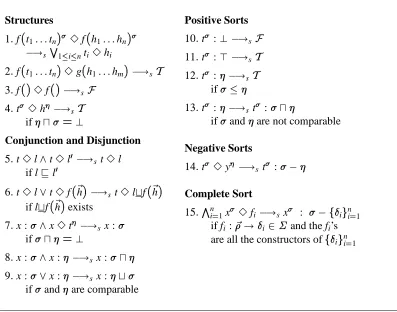
F, or of the form x3t or x :. Figure 1 presents the simplification rules. Most are derived
from [10, 3, 11] and are self-explanatory. The interesting ones are rules 14 and 15.
The complete sort rule allows us to simplify several structural constraints to a single sort constraint. It states that a term does not match any of the constructors of a sortif and only if it
is not of sort. Note that this rule is only applicable when the constructors ofare finite. The
negative sort rule states that any term t, which is of sortbut not of sort, is of sort ,
where =u
c.3 We will write as
f1;. . .;kgthe sort(. . .( 1) . . .) k.
If x
: appears in a constraint C, then the variable x
is said to be restricted by in C, otherwise it is restricted by . We shall say that a constraint C is in simplified form
(irreducible by !s), denoted C#s, if and only if it is eitherT orFor
If x
:is in C then>and6=?
If x 3t
is in C then t is not a variable and
If x3ff1;. . .;fng2C and fi :~i !i 2 (i= 1. . . n), then f1;. . .;fnare not all the
constructors off1. . .ng
Example 4.1 The constraint x
:^y
3f(a;a)is in simplified form while x
3z
and y
3fp;qgare not.
Theorem 1 (Simplification) Let tjC be a constrained term.
3Note that
Structures 1:f(t1. . . tn)
3f(h1. . . hn)
!s W
1inti 3hi
2:f(t1. . . tn)3g(h1. . . hm) !s T
3:f()3f() !sF
4:t
3h
!sT
ifu=?
Conjunction and Disjunction 5:t3l^t3l
0
!st3l
if lvl 0
6:t3l_t3f( ~h
) !st3ltf( ~h
)
if ltf( ~ h)exists
7:x :^x3t
!sx :
ifu=?
8:x :^x : !sx :u
9:x :_x : !sx :t
ifandare comparable
Positive Sorts 10:t
:? !sF
11:t
:> !sT
12:t
: !sT
if
13:t
: !st
:u
ifandare not comparable
Negative Sorts 14:t
3y
!st
:
Complete Sort 15:
V n i=1x
3fi !sx
: fig n i=1
if fi :~!i 2and the fi’s
[image:17.612.83.480.213.525.2]are all the constructors offig n i=1
(Invariance) If C !sC 0
then [[tjC]]=[[tjC 0
]]
(Termination) There are no infinite chains C1 !sC2 !s. . .
(Completeness) For each constrained term tjC where C is not in simplified form, there exists a C0
such that C !sC 0
Proof: (Sketch) The invariance claim must be verified for each rule—a tedious task, since there are
so many cases, but straightforward. Completeness can be easily shown by considering a constrained term whose constraint is not in simplified form. To prove the termination claim, we use the lexical ordering over(C1;C2;C3;C4), where:
C1= P
(t3h)2C
size(t), where size(t)is defined as one would expect,
C2is the number of structure atoms in C, C3is the number of sort atoms in C and, C4=
P (t: )2C
path( ), where path( )is the length of the maximal path from?toin the
sort lattice.
Rules1;2;3;4decrease C1; rules5;6;7;14;15decrease C2; rules8;9;10;11;12decrease C3; and
rule13decreases C4. When one rule decreases Ci, Ck(k<i)does not change. Thus, the complexity
with respect to the lexical ordering is always reduced and the length of a !sderivation is bounded.
4.2 Partitioning
The definition of a pattern’s denotation (Section 3.2) suggests splitting a pattern into an equivalent set of constrained terms, whose set denotations are disjoint, and whose union is the set denotation of the pattern.
Let T1 =t1jC1 and T2 = t2jC2 be two constrained terms. We say T2 matches T1, denoted T1 vT2, iff there exists a substitutionsuch that t1vt2(i.e. t2 = (t1))and C2 ) (C1),
where) is logical implication. A substitutionunifies two constrained terms T1and T2if
and only ifunifies t1and t2and the constrained term (t1)j (C1 ^C2)is consistent. If
unifies T1and T2, then T1tT2 = t1tt2j (C1^C2)is the least upper bound with respect tov
and we say that T1and T2are compatible constrained terms.
Let T =tjC be a constrained term. The restriction of T under a substitution, denoted Tj ,
is defined to be tjC 0
where C^t3 (t) ! s C
0
.
Proposition 3 [[T1tT2]]=[[t1jC1]]\[[t2jC2]] and [[ (T)]]\[[Tj ]]
=;
The recursive function,PART, takes a constrained term T and a pattern p1. . . pnas arguments,
and partitions T according to p1. . . pn into a set of constrained terms whose denotations are disjoint.4 To illustrate, suppose we wish to partition x>
jT according to the pattern p1. . . pn. The first set generated isfp1jTgand we go on to recursively partition the decidable x>
-complement of p1, that is, x> jx
>
3p1, according to the rest of the pattern p2. . . pn. Note
that the order of the pattern is respected.
PART(T;[])=;;
PART(T;p1. . . pn)= 8 > > > > < > > > > :
PART(T;p2. . . pn)
if T and p1jT are not unifiable;
fT t(p1jT)g [ PART(Tj
;p2. . . pn);
otherwise; whereis the mgu of T and p1jT.
Example 4.2 With the subsort order of Example 3.1, let g be a constructor whose domain sort is(t)nat, wheretand nat are disjoint sorts. Partitioning x
>
jT according to
the pattern g(x
;0);g(y ;z nat );x > yields:
fg(x
;0); g(y
;z nat
)jy
:; g(y
;z nat
)jz nat
30; x >
jx >
3g(x
;0)^x >
3g(y
;z nat
)g
Proposition 4 IfPART(x >
jT;p1. . . pn)=fP1;. . .;Png, then Pi =fpij V
j<ipi
3pjgand
[[Pi]]\[[Pj]]=;for i6=j.
Proof: (Sketch) By induction on i, using the fact that if the substitutioniis defined byi(x >
)=pi
for all1in, then(. . .(x >
jT)j 1. . .
)j n =x > jx >
3p1^. . .^x >
3pn.
Theorem 2 (Partitioning) Let p1. . . pn be a pattern such that PART(x >
jT;p1. . . pn) = fP1;. . .;Png, then
[[p1. . . pn]]T
S
1in[[Pi]] T If t2
S
1in[[Pi]] T, then
9j such that t2[[pj]] T and t
2[[pk]]
F, for k <j
[[p1. . . pn]]F
=[[P1. . . Pn]] F
Proof: (Sketch) The first claim is shown by induction on n. The second one is shown by
Proposition 4 and the second item of Proposition 2. To show the last claim, it suffices to prove that both [[p1. . . pn]]Fand [[P1. . . Pn]]Fare equal to
T 1in
[[pi]]F.
Thus, partitioning transforms an ambiguous list of order-sorted terms (a pattern) into an unambiguous set of order-sorted constrained terms. It changes neither the decidable sets associated to each pattern nor the strict one. We say that fS1;. . .;Sng is a complete
decomposition if and only if there exists a pattern p1. . . pn such that partitioning x >
jT
according to the list [p1. . . pn x >
] yieldsfS1;. . .;Sng. When x >
is appended to the list of patterns, both the success and the failure of the matching are considered. This does not change the original problem because the discrimination tree covers all the cases that may appear during the pattern matching process. It turns out that whenfS1;. . .;Sngis a complete decomposition
and t2[[Sj]]
F, there exists1
4.3 Normalization
In order to simplify the construction of the PMT, we use four normalization rules (flattening, sort, structure, empty) that operate over sets of disjoint constrained terms. Since the formalization of these rules is quite complex, while the underlying idea is rather intuitive, we first show three typical examples where such normalizations are to be performed.
The first rule decomposes a complex structural constraint into several simpler ones with only one constructor in the right hand side of each structure atom. Normalizing x>
jx >
3cons(1;z)
with the flattening rule yields x> jx
>
3cons( ; )and cons(y;z)jy31.
Now, consider the constrained term x> jx
>
3cons(y;z). Recall that, with a lazy evaluation
mechanism the sort of a well-sorted expression can be known before its structure. Thus, if x>
is substituted by a term whose sort is incompatible with that of cons(y;z), it is not necessary to
reduce the term. On the other hand, if x>
is substituted by a list expression, it is necessary to continue reduction in order to decide whether it is a “cons” term. Thus, assuming that list and int are the only sorts in the system, the sort rule transforms x>
jx >
3cons(y;z)into x > jx > : int, x> jx >
: list^x >
3cons(y;z).
If a variable has a common occurrence in more than one constrained term and is restricted by different structural constraints, then the structure rule can be applied. For example, f(a;x
int ) j x
int
3 1 and f(b;x int
) j x int
3 2, is transformed into f(a;2)jT, f(b;1)jT, f(a;x
int )j x
int
3 1 ^ x int
3 2 and f(b;x int
) jx int
3 1 ^ x int
3 2. Now, the subterm at
position2is a variable restricted by the same set of symbols or it is just one of such symbols.
We shall say that tjC is in normalized form, if and only if C is in simplified form but is
different from F and whenever x3f(t1. . . tn)
appears in C and f : 1. . .n ! 2 ,
then x is restricted by in C and t1. . . tn are mutually distinct variables of sort 1. . .n
respectively. We shall say that a set of constrained termsft1jC1;. . .;tnjCngis in normalized
form (irreducible by !n), if and only if every tijCiis in normalized form and, whenever there
exist two terms ti and tj and there exists a position u such that for all v<pos u, ti and tj have
the same structure symbol at position v, ti=u and tj=u are variables restricted by the same sort
and by nonempty sets siand sjof structure symbols in Ci and Cj respectively, then si =sj.
Example 4.3 The constrained term h(x
;y
)jy
3f(v
;w
)is in normalized form while f(x
;y
)jx
3a and h(x
;y
)jy
3f(v
;w
)are not.
Figure 2 presents the normalization rules. There, we assume f : 1. . .n ! 2 and x1
1 ;. . .;x n
n are pairwise distinct variables. When is a substitution,(tjC)hh ii denotes the
term (t) j (C) #s. When normalizing, rules are applied in the order that they appear in
Figure 2. They satisfy the properties of Theorem 1; namely, termination, invariance and completeness.
Flattening: If9i(1in)such that tiis not a variable of sorti, then
S[ftjx3f(t1. . . tn)
^Cg !n
S[ftjx3f^C; (tjx3f(t1. . . tn)
^C)hhx f(x1. . . xn)ii g
Sort: If x is restricted byin C and>, then
S[ftjx3f
^Cg !nS[ftj(x : ^C)#s; tj(x :^x3f
^C)#sg
Structure: If9u such that t1=u= fx
jx
3s1g and t2=u= fy
jy
3s2g;f
2s1,
but f =
2 s2 and 8v;v <pos u; t1 and t2 have the same constructor
symbol at position v, then
S[ft1jP1; t2jP2 g !n
S[ft1 jP1; t2j(P2^y
3f
)#s; (t2jP2)hhy
f(x1. . . xn)iig
Empty: S[ftjFg !nS
(Invariance) If S !n S 0
, then [[S]]=[[S 0
]] (Termination) There are no infinite chains S !nS
0
!n . . . (Completeness) If S is not in normalized form,9S
0
such that S( !s[ !n)S 0
Proof: (Sketch) The invariance claim is straightforward. Now, suppose S is not in normalized form.
If there exists a constrained term tjF, the empty rule can be applied. If there is tjC such that x3f
is in C and x is restricted bywith>, the sort rule can be applied. If there exists x3f(t1. . . tn)
, where f :1. . .n !2and tinot a variable of sorti, then the flattening rule can be applied.
Suppose there exist two terms tiand tj and there exists a position u such that ti=u =fx
jx
3sig,
tj=u=fy
jy
3sjg, for all v<posu, tiand tjhave the same structure symbol at position v, but si6=sj.
If f
2si or sjwith>, then the sort rule can be applied. Otherwise, the structure rule can be
applied. To prove the termination claim over a setft1jC1;. . .;tnjCngof constrained terms, note that
rules are applied in order. Flattening decreases the complexity of right-hand sides of structure atoms of Ci’s; sort decreases
P
i=1...n P
(x3f
)2Ci
distance(x3f
;Ci), where distance(x3f
;Ci)is defined
as 0 if x is restricted by in Ci, 1 otherwise; structure decreases jsi sjj+jsj sij, and empty
decreases the number of constrained terms.
5 Sequentiality and Optimality
Compiling pattern matching consists of transforming a function defined by order-sorted patterns into a case-expression presented as a discrimination tree. The tree obtained is not always optimal, that is, it could fail to terminate on some terms that are not in the strict set of the pattern. As the evaluation mechanism is sequential, we must choose an order of verification running the risk of losing some solutions. In a many-sorted framework, consider Berry’s example [1] formed by the patterns f(true;true;z), f(false;y;true), f(x;false;false). Given
a term f(; ; ), we must choose an argument position in order to start the matching. If we
start at position three, the term f(true;true; Bool
)will not be matched, even though it belongs
to the denotation of the first pattern. The same happens with the terms f(false; Bool
;true), f(
Bool
;false;false)if we start at the second or third positions, respectively.
With a strict evaluation mechanism, an optimal PMT will be faster but the solutions (that is, those terms that match or not) will remain the same as that of a non-optimal tree. On the other hand, in a lazy evaluation framework, some non-optimal trees may fail to terminate due to unnecessary verifications that try to reduce subterms that do not have a head-normal form.
In our framework, the sort of each term is examined before its structure, because the sort can be refined after usually only a few reduction steps whereas to examine the structure, more reduction steps are required to obtain head-normal form. The construction method for PMT’s that we present here chooses a direction (intuitively, a position in a term at which to start reduction) and thus decides whether a subsort or structure verification is required. At each level of the tree, the structures and sorts are more precise than those of preceding levels.
doing some look-ahead. That is, for any constrained term T not matching any pattern of S, there exists a position (so-called direction) where a reduction must be performed in order to decide the matching property. Furthermore, this position can be determined without looking at the subterms of T which are not computed yet. Our definition of sequentiality requires the set S of patterns to have also the sort property: intuitively, S has the sort property if whenever u is a position of a constrained term T to be evaluated and two different patterns of S that are compatible with T have variables x
, y
at position u respectively, then and are either
disjoint or comparable sorts. In fact, ifandhave a common subsortdifferent from?;
and, the position u cannot be taken as a direction because unnecessary reductions of T may
be performed in order to distinguish betweenand.
For example, consider the three unambiguous patterns f(true;y
;z), f(false;y
;true), f(x;y
;false), where the subsort order is that of Example 3.1. If the PMT associated
with this problem needs to know whether a term is of sort(resp. of sort) as in the case of f(false;
;true)(resp. f(true;
;true)), it will fail to terminate even though the term is in
the denotation of the second (resp. first) pattern.
Optimal PMT’s will only fail to terminate on the strict set of the problem. It turns out that sequentiality of a pattern matching problem is equivalent to optimality of its tree. Thus, sequentiality becomes a necessary and sufficient condition for the construction of an optimal tree. We shall next give an effective decision procedure for sequentiality on disjoint sets of patterns.
In reading the following section, familiarity with the work of [7] would be helpful, but the treatment is self-contained enough to be meaningful on its own.
5.1 Sequentiality
The set of positions or occurrences of a constrained term tjC, denotedO (tjC), is defined as
the set of positions of t, which is recursively defined as usual as finite sequences of positive integers such that 2 O (t)and k:u 2 O (f(t1. . . tn)) if u 2 tk. We use <pos to denote the
lexical ordering between positions. The subterm of t at position u, denoted t=u, is defined as t== t and f(t1. . . tn)=k:u=tk=u. We use(tjC)=u to denote the constrained term(t=u)jD,
where D is the constraint of all the atoms in C restricting variables of t=u. For example, (f(g(x
;a);y
)jx
:^x
3f^y
3g)=1= g(x
;a)jx
:^x
3f . If the replacement of
the subterm of t at position u by a term p is a well-sorted term, we define t[u p] to be that term. If T=tjC and P=pjD are two constrained terms and t[u p] is a well-sorted term, T[u P] is defined as t[u p]j(C^Dj
V(t[u p])
). For example, if g(x
;a)is a term of sort ,(f(g(x
;a);b)jx
:^x
3f)[1 y
jy
3g]=f(y
;b)jy
3g.
We can think of a set of disjoint patterns S as a predicate on constrained terms such that S(M)is
A position u 2 O (tjC)is said to be a direction of T = tjC in a set of disjoint constrained
patterns S=ft1jC1;. . .;tnjCngif and only if T=u has the form x
jP
For every constrained term M such that TvM and S(M)is true, M=u6vT=u
(Sort property) If9i;j such that8v;v<posu, tiand tjhave the same constructor symbol
at position v; ti=u is a variable restricted byiin Ciand tj=u is a variable restricted byj
in Cj, theniuj =?ori j orj i.
Lemma 1 Let T be a constrained term tjC. A position u is a direction of T in S=fS1;. . .;Sng if and only if T=u has the form x
jP and for every constrained pattern Si 2S compatible with T, we have that u is an occurrence of Si, Si=u6vT=u and the sort property holds.
Proof: Let u be a direction of T infS1;. . .;Sngand Sibe a constrained pattern compatible with T.
Then T=u has the form x
jP with x
restricted byin P. Suppose that u2=O (Si). Then, there exists
a position v such that u =v:w, w6=and Si=v is y
jD. Since Siis compatible with T, there exists
a constrained term M =mjF such that Si vM, TvM; that is, M=v is an instance of y
jD. Now, (M=v)[w z
jP]=M[u z
jP] is a well-sorted constrained term that is also an instance of Siand
obviously of T. Therefore M=uvT=u by construction, which contradicts the hypothesis.
Conversely, let M be a constrained term such that T vM and Si vM and suppose M=u vT=u.
Then, Si=uvM=uvT=u, which contradicts our hypothesis.
By normalization, a complete decomposition S reduces to another complete decomposition S0
and the set of directions of any term T in S is the set of directions of T in S0
.
We say that a constrained term T is compatible with a set of disjoint constrained patterns S if and only if there exists M such that T vM and S(M)is true. In particular, if S has only an
elementfPg, T is compatible with S if and only if T and P are unifiable, i.e., 9M such that T vM and PvM.
A set of disjoint constrained patterns S is sequential in a constrained term T if and only if, whenever S(T)is false but it is compatible with S, then there exists a direction of T in S. We say that S is sequential if and only if it is sequential in all constrained terms in normalized form. Sequentiality of a predicate S is the possibility of systematically expanding any constrained term step by step until either the predicate is true or it is clear that a positive answer is impossible.
The sort property enriches the known notions of sequentiality by taking into account the sort system. When a variable’s position is restricted by two sorts with nonempty and nontrivial intersection, some solutions are lost, as illustrated by the following example.
Example 5.1 With the subsort order of Example 3.1, the following set of disjoint constrained patterns is not sequential:
fh(p;y >
;z
)jy >
:; h(x
;y >
;p)jx
3p^y >
:; h(x
;y >
;q)jy >
If pattern matching starts at the first position (resp. at the third), it will fail to terminate on the term h(
;f(a;a);q)(resp. h(p;b;
)) even though it belongs to the denotation of the third
(resp. first) pattern. Now, note that the first and second constrained terms have variables at position 2 which are restricted by sorts with nonempty and nontrivial intersection. If matching starts at this position asking whether or not a term is of sort (resp. of sort), it will fail to
terminate on h(q;
;p)(resp. h(p;
;p)), even though it is in the denotation of the second
(resp. first) pattern.
5.2 Construction of pattern matching trees
A pattern matching tree (PMT) for a constrained term T and a complete decomposition S=fS1;. . .;Sngis defined as:
T is the root and each node is a constrained linear pattern in simplified form. If u is the direction of P in S and T1;. . .;Tkare the children of P, then:
T1. . . Tkare pairwise incompatible constrained terms; P=u has the form x
jT, Tiand P only differ on u and P=u<Ti=u;
for every Ti, there exists a pattern Sjsuch that Ti vSj.
If H1. . . Hmare the leaves of the tree, thenfS1;. . .;Sng !
nfH1;. . .;Hmg
A PMT of a complete decompositionfS1;. . .;Sngis a pattern matching tree for the constrained
term x>
jT and fS1;. . .;Sng. A PMT of fS1;. . .;Sng is optimal if and only if it fails to
terminate only for the strict set of S1. . . Sn.
We now describe an algorithmTREE that constructs a PMT for a constrained term T =tjC
and a complete decomposition fS1;. . .;Sng. If C is non-consistent, return the empty tree.
Otherwise, if T is an Si, return the single-node tree T. Otherwise, normalize fS1;. . .;Sng
into fH1;. . .;Hmg and search a direction u of T in fH1;. . .;Hmg. If such a direction
cannot be found, fH1;. . .;Hmg is not sequential in T so fail. Otherwise, proceed with D IR(T;fH1;. . .;Hmg;u)where T=tjC; T=u=x
jT; Hi=hijCi andD IRis defined by:
D IR(T;fH1;. . .;Hmg;u)=
Let Sorts be the maximal sorts offjT vHi; hi=u2V is restricted bygand
let Forms beffi jTvHi;hi=u=fi(. . .)gin
if Sorts=;
then (a structure step) build a tree rooted at T with children :
TREE(T[u f(. . .)]#s;fH1;. . .;Hmg)for each f in Forms and TREE(tj(C^x
3Forms)#s;fH1;. . .;Hmg))
else (a sort step) build a tree rooted at T with children:
TREE(tj(C^x
:)#s;fH1;. . .;Hmg)for each2Sorts and
TREE(tj(C^x
Example 5.2 Let us consider the subsort order of Example 3.1. Let be the sortt
and g be the constructor of whose domain sort isnat, with nat anddisjoint sorts.
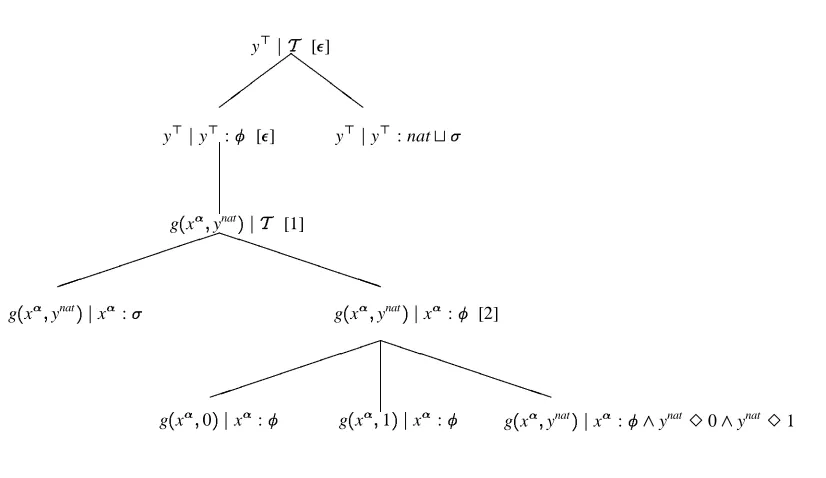
Consider the pattern g(x
;y nat
); g(x
;0); g(x
;1). Normalization yields:
g(x
;y nat
) g(x
;0)jx
: g(x
;1)jx
: y>
jy >
: natt g(x
;y
nat )jx
:^y nat
30^y nat
[image:26.612.90.503.255.494.2]31
Figure 3 shows the PMT. The directions are between square brackets.
Z Z Z Z y> jT []
y> jy
>
: [] y >
jy >
: natt
g(x
;y
nat
)jT [1] P P P P P P P PP
g(x
;y
nat
)jx
: g(x
;y
nat
)jx
: [2]
P P P P P P P P P
g(x
;0)jx
: g(x
;1)jx
: g
(x
;y
nat
)jx
:^y
nat
30^y
nat
31
Figure 3: Pattern Matching Tree
Theorem 4 A finite complete decomposition in normalized form S=fS1;. . .;Sngis sequen-tial in every normalized term if and only if it is sequensequen-tial in every node of its associated PMT.
Proof: Since nodes of the PMT are in normalized form the left to right implication is evident.
Conversely, let M be a constrained term in normalized form such that S(M) is false and M is
compatible with S. As x>
jT is the root of the pattern matching tree but M does not match any pattern
of S, there exists a node T =tjC whose children are T1. . . Tmand whose direction in S is u such that
T vM and for all1 im, Ti 6vM. We will prove that u is a direction of M in S, that is (by
Lemma 1) the sort property holds, (1) M=u has the form x
jP and for all Si2S compatible with M,
By definition of discrimination tree T=u is x
jT and so (1) holds. By construction each level is either
a sort or a structure step and since u is a direction of T in S the sort property holds.
In the sort step case, T1=u . . . Tm=u are variables x 1 1 . . . xm
m and (1) immediately holds. Since T vM
and nodes at the same level of T are defined to be incompatible, if Siis a pattern compatible with M,
then TvSiand (2) holds. By construction, for every Sjcompatible with T we have Sj=u6vT=u. In
particular we have Si=u6vT=u. Now, if T=u=M=u (3) holds. Otherwise, suppose Si=uvM=u. As
M is in normalized form andis not a minimal sort, M=u does not have any structure atom and then
M=u is of the form x
jT and>. Since Si=uvM=u, Si=u is x i
jT andi. By hypothesis for
all1jm, Tj=u6vM=u and thenj6. As T vSi, there exists Tjsuch that TjvSiand then j=i. Thenjwhich contradicts the hypothesis.
In the structure step case T1=u =f1;. . .;Tm 1=u =fm 1 and Tm=u = x
jx
3ff1. . . fm 1g. Since
T vM and for all1im, Ti6vM, T=u =M=u or M=u=x
jx
3S. In the first case, we have
u is a direction of M in S. In the second case (1) immediately holds. Let Sibe a constrained pattern
compatible with M. As in the sort step case, TvSiand (2) holds too. Now, suppose Si=uvM=u.
Then Si=u is a variable and there must be a child Tjof T such that Tj vSi. We have Tj=u is also a
variable and thus necessarily j=m andff1. . . fm 1gS. By construction, T and Tjonly differ on u
and TvM. Therefore TjvM which contradicts the hypothesis and thus (3) holds.
Theorem 5 A PMT of a complete decomposition S in normalized form is optimal iff S is sequential.
Proof: By Theorem 4,fS1;. . .;Sngis sequential if and only if there exists a discrimination tree in
which each node tjC has a direction in the setfS1;. . .;Sngand the sort property holds. The set of
terms for which the algorithm does not terminate is generated at each node tjC of the PMT by some
terms of the form(tjC)[u
], where u is the chosen direction of tjC infS1;. . .;Sng. By definition
fS1;. . .;Sngis optimal if and only if it fails to terminate only for the strict set offS1;. . .;Sng. We
must verify that the algorithm fails to terminate in(tjC)[u
] if and only if it is in the strict set offS1;. . .;Sng. The right to left implication is evident. Conversely, by construction each level is
either a sort or a structure step. If T1;. . .;Tmare the children of the node tjC, two cases are to be
considered:
In the structure level case, Ti=(tjC)[u f
i ];i=1. . . m 1and Tm=tj(C^x
3ff 1;. . .;f
m 1g).
By normalization T=u is a variable restricted byand then=. Thus,(tjC)[u
] is in the strict set of each Tiand then in the strict set of each leaf Sjsuch that TivSj. Then(tjC)[u
] is in the strict set offS1;. . .;Sng.
In the sort level case, T=u has the form x
jT and by construction each Tiis of the form tj(C^x
:i)
withi<. Since the decomposition is complete, F
i=1...m
i=and by the sort property1. . .m
are pairwise disjoint sorts. If the algorithm fails to terminate in(tjC)[u
], there exists at least one i such that6iandui6=?. We have(tjC)[u
] in the strict set of Ti. Now, for all Sj
such that TivSj, we have either Ti=u=Sj=u or Sj=u=f i
or Sj=u=x i jx i 3ff i ;g i
;. . .gand then (tjC)[u
] is in the strict set of Sj. Then(tjC)[u
] is in the strict set offS1;. . .;Sng.
6 Discussion
complements of sorts are often used during the compilation scheme we require the lattice of sorts to be boolean. On the other hand, regularity is a sufficient condition for signatures to be finitary unifying. Nevertheless, it is not very clear why we restrict our interest to unitarity ones. We present two simple transformation rules acting on signatures. A signature obtained through these rules is constructed to verify the minimal codomain sort and the disjoint domain sort properties. The transformation preserves the set of well-sorted ground constructor terms (i.e. the free order-sorted term algebra) and so, we can think of our compilation scheme as one that not only transforms patterns, but also signatures. We show in what follows how to obtain this “compiled” version.
First, let us justify the need for constructors to verify the hypothesis of minimal codomain sort (the third condition of unitarity). Let = hS;;F;C;V;D ibe a regular signature which
does not satisfy this condition and(S;)be a boolean lattice. Then, there exists a constructor f 2C such that f :~ ! 2 Dand is not a minimal sort. The downward signature
0
obtained fromis
hS[fg[f
c
g;[f>g[f
c
>j2 g;F;C;V;(D ff :~! g)[ff :~!gi
whereand
care new sort symbols and is the set of maximal sorts of
fju=?g.
Note thatis strictly greater than the new symbolwhich is now a minimal sort. Intuitively,
0
has the same structure, but constructors are in a “lower level” of the lattice. When the number of non-minimal codomain constructors is finite, this transformation terminates and the same set of ground constructor terms can be built in
0
. The new partial order set of sorts is also a boolean lattice.
Now, suppose the minimal codomain sort condition is verified whereas the disjoint domain sort is not. Let = hS;;F;C;V;D iand f a constructor with two different declarations f : 1. . .n ! and f : 1. . .m ! . If n = m = 0, then f :! and f :! implies = , because and are minimal and whenever is regular they must be comparable.
Then n=m1and~;~are not disjoint sorts. In this case there exists a term (not necessarily
a ground term) havingandas sorts. Sinceis regular and,are minimal we also have
=. The disjoint domain signature obtained from is 0
=hS;;F;C;V;D 0
i, where
the new set of declarations is defined in this way:
If~~, f :~ !is redundant and we can remove it. D 0
isD ff :~!g
Otherwise,
I
=fi2[1. . . n]ji i 6=?g 8i2I
;8j2[1. . . n]; i
j isi iif i=j,iotherwise D
=ff : i
1. . . i
n! ji2I
g
I
=fi2[1. . . n]ji i6=?g 8i2I
;8j2[1. . . n]; i
jisi iif i=j,iotherwise D
=ff : i
1. . . i
n! ji2I
g
D 0
isD ff :~ !;f :~ !g[ff :~u~ !g[D
This transformation always terminates and the obtained declarations have incompatible domains by definition of “ ” (set difference). Even now, we can build the same set of ground constructor symbols.
Comon [2] noticed that an order-sorted signatureis a finite bottom-up tree automaton where
the set of final states is the set of sortsS. It turns out that the set of well-sorted terms of sort
is the set of trees recognized by a tree automaton at the final state corresponding to. The
transformations of signatures we have proposed above are simply transformations of their tree automata. When restricting the set of final states of the new tree automaton
0
to that of,
the same set of well-sorted terms is recognized.
Unsorted and many-sorted signatures are particular cases of unitary ones, and therefore our work also remains applicable to them. There are two other interesting order-sorted type systems to be considered. The work of A¨ıt-Kaci and Smolka [13] has shown that features types and constructor types are dual concepts. In this kind of system every constructor symbol has exactly one declaration and is a constructor of a minimal sort. In addition, the set of feature terms is a prelattice, provided the sort symbols are ordered as a lattice. On the other hand, Smolka [12] proposes a discipline with polymorphic order-sorted types restricted to free constructors. Specification of the inclusion order between types is defined via special classes of terminating rewriting systems and no function symbol contains more that one declaration. He shows that the set of sort terms equipped with the order specified by the rewriting rules is a well-founded quasi-lattice having?as its least element. Reasonable algorithms to compute
the greatest common subsort and least common subsort of two sort terms are given. Our order-sorted framework also allows us to accommodate pattern matching in languages with such a type system.
7 Conclusion
The method of treating ambiguous linear order-sorted pattern matching presented in this paper generalizes previous work on non-ambiguous linear patterns [7], ambiguous linear patterns [9] and ambiguous linear patterns using constrained terms [10]. We extend several notions introduced in [10], such as constrained terms, non-reducible terms, strict sets of patterns,
sequentiality and pattern-matching trees, to the order-sorted case. We define discrimination trees to have not only edges labeled with structure constraints, but also with subsort restrictions. This feature allows to decide pattern matching without reducing terms to normal forms, taking advantage in this way of the lazy evaluation strategy. It turns out that our method constructs optimal order-sorted PMT’s for sequential order-sorted pattern matching problems and can be used either with a lazy or strict evaluation strategy. As in [10], our method can also be used for non-sequential problems.