393
APPLICATION OF UNCERTAIN NONLINEAR SYSTEMS
PARTIAL STATE VARIABLES TO SYNCHRONIZATION
CONTROL FOR RÖSSLER SYSTEMS
YANJUN LIANG,YUNTONG LIU
School of Computer and Information Engineering, An Yang Normal University, Anyang 455000, Henan, China
ABSTRACT
Partial state variables stabilization control of uncertain nonlinear systems is developed for chaos systems synchronization control. Response systems are constructed for uncertain Rössler systems. In order to make response systems track the drive systems asymptotically stable, error systems with uncertain and nonlinear factors are designed. Using partial state stability theory of nonlinear systems and adaptive control method, a Lyapunov function is constructed for the uncertain nonlinear error systems, and partial state variables stabilization controller and adaptive regulators are designed. Employing Lyapunov stability theory, we prove that our controller can guarantee the uniformly ultimate boundedness of the solution of the closed-loop system, and make the tracking error arbitrarily small for uncertain parameters. Numerical simulation results illustrate the effectiveness of the proposed controllers and adaptive regulators.
Keywords: Nonlinear Systems, Partial State Variables Synchronization, Uncertain Systems, Adaptive Control
1. INTRODUCTION
In recent years, with the development of nonlinear system control and chaos control, the study of chaos synchronization control has attracted more and more attention, and chaos synchronization has been applied to also secure communication, spread spectrum communication, information compression and storage.
Because of inaccuracy of modeling and parameters measurement, the controlled systems are subjected by the inaccuracy inevitably and the control of uncertain systems is studied by many researchers. There is not a general method for chaos synchronization control in the study of the uncertain nonlinear systems. One tries to study kinds of uncertain nonlinear systems and chaos synchronization control by many means. In [1], they present a new three-dimensional continuous autonomous chaotic system with ten terms and three quadratic nonlinearities, and the new system contains five variational parameters and exhibits Lorenz and Rössler like attractors in numerical simulations. The synchronization of spiral patterns in a drive-response Rössler system is studied in [2], and the existence of three types of synchronization is revealed by inspecting the coupling parameter space, whilst two transient stages of phase synchronization and partial synchronization are
394 technique. In [10], the Lyapunov spectra and related properties of the generalized Rössler system as a function of the dimension N are investigated, and the high-dimensional chaotic dynamics of the generalized Rössler system fundamentally differs from spatiotemporal chaos is found. In [11], they prove that the proposed nonlinear disturbance observer recovers not only the steady-state performance but also the transient performance of the nominal closed-loop system under plant uncertainties and input disturbances. If the uncertainties are bounded, while this bound is not known, in [12], a PI-adaptive fuzzy control architecture for a class of uncertain nonlinear systems is proposed that aims to provide added robustness in the presence of large and fast but bounded uncertainties and disturbances. Based on the integration of sliding mode control and adaptive fuzzy control, a novel adaptive fuzzy sliding mode control methodology is proposed in [13]. Based on the Lyapunov stability theory, in [14], a new method for synchronization of hyper chaotic Rössler system with uncertain parameters is proposed.
In this paper, in order to make certain state variables of the error systems asymptotically stable and adaptive parameters identify the uncertain parameters, using partial state stability theory and adaptive control method, a Lyapunov function is constructed, partial state variables stabilization controller and adaptive regulators are designed for a class of uncertain chaos systems. Numerical simulation results illustrate the effectiveness of the proposed controllers and adaptive regulators.
2. SYNCHRONIZATION OF UNCERTAIN
RÖSSLER SYSTEMS
In the study of chemical reaction with intermediate product, Rössler proposed the equations[15]
1 2 3
2 1 2
3 3 1
, ,
( ),
x x x
x x ax x b x x c
= − −
= +
= + −
(1)
in whichx x1, 2 and x3 are state variables, a b c, , ∈R+
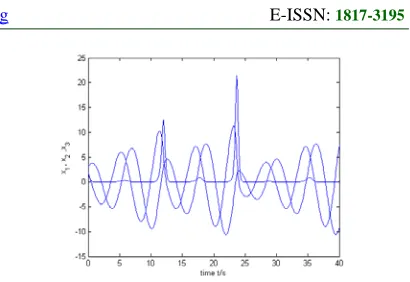
[image:2.612.319.524.74.215.2]are uncertain parameters. When a= =b 0.2 andc=5.7, it is a chaos system, and figure 1 is its time response figure.
Figure 1: Time Response Of Rössler Systems
In order to study the synchronization of the Rössler systems (1), the response systems are constructed as follows
1 2 3 1
2 1 1 2 2
3 1 3 1 1
,
( ) ,
( ) ( ( )).
y y y u
y y a t y u y b t y y c t
= − − +
= + +
= + −
(2)
Obviously, the response systems have the same structure as the drive systems (1), and the parameters a1(t),b1(t),c1(t)∈R+ are estimate for uncertain parameters a,b,c of the Rössler systems (1). In this paper, we study partial state variables stabilization control problem, and the parameter
a
is unknown,b
,
c
known.We can obtain the error systems from the drive systems (1) and the response systems (2), and they are as follows
1 2 3 1
2 1 1 2 2 2
3 1 3 1 3 1 3 1 3
,
( ) ,
( ) ( ) ,
e e e u
e e a t y ax u
e b t b y y x x y c t x c
= − − +
= + − +
= − + − − +
(3)
in which,
1 1 1
e = −y x ,
2 2 2
e =y −x ,e3=y3−x3are the errors of the state variables.
Our aim is to design appropriate controller to make partial state variables synchronization of the response systems (2) and the drive systems (1), namely,
y
1 withx
1 andy
2 withx
2 synchronization, and recognized the uncertain parametera
, it is can also described as following, 0 ) ( lim
, 0 ) ( lim
, 0 ) ( lim
2 1
= = =
∞ →
∞ →
∞ →
t t e
t e
t t t
β
(4)
395 In order to design partial state variable synchronization controller for systems, we introduce two lemmas. Consider differential equations ( , ), d f t dt = x
x
(5)
in which,
1 2 1 2
1 2
1 2
2 1/ 2 2 1/ 2
1 1
2 1/ 2 1 ( , ) [ , ], ( , ) , ( , ) ( , ,..., , , ,..., ) , ( , ,..., ) , ( , ,..., ) , ( ), : ( ) , : ( ) , : ( ) . n n n
m m m n
m m
p
m m n
n m i i i i n i i m
f t C I R R f t col y z
col x x x x x x R
col x x x R
col x x x R m p n
x x x + + + + = = = + ∈ × ≡ = = ∈ = ∈ = ∈ + = = = =
∑
∑
∑
0 0 x x y z x y zLemma 1[16] A necessary and sufficient condition of function ( , ) ( n, ),
V t x ∈C I×R R and V t( , )0 ≡0 positive definite for y is ∃ϕ(r)∈K in
: { | H}
Ω = x x ≤ satisfying
( , ) ( )
V t x ≥ϕ y
.
(6) Lemma 2[16] If function ( , ) ( n, ),V t x ∈C I×R R and
( , ) 0
V t 0 ≡ satisfies (6), and its derivative makes
(3)
d
( )( ), d
V
c c K
t ≤ − y ∈ trivial solution of differential equations (5) is stable fory.
In order to achieve the control aim (4), we design the controller and adaptive regulator as following
1 3 1
2 1 2
2 2
( ) ( ) ( ),
( ) (1 ( )) ( ),
( ) ( ) ( ),
u t e t e t u t a t e t
t x t e t β = − = − + = − (7)
then, we have the theorem as follows
Theorem The controllers and adaptive control laws described in (7) make the equations in (8) tenable. , 0 ) ( lim , 0 ) ( lim , 0 ) ( lim 2 1 = = = ∞ → ∞ → ∞ → t t e t e t t t β (8)
Proof Take a Lyapunov function
2 2 2
1 2
1 1 1
( , ) ( ) ( ) ( )
2 2 2
V t x = e t + e t + β t (9)
for the error systems (3). According lemma 1, it is positive definite for e t1( ) and e t2( ) , and its derivative along the error systems (3) is as follows
1 1 2 2
1 2 3 1 1 1
2 1 1 2 2 2
1 2 1 3 1 1
1 2 1 2 2 2 2
2 2 ( ) ( ) ( ) ( ) ( ) ( ) ( )( ( ) ( ) ( )) ( ( ) ) ( ) ( )( ( ) ( ) ( ) ( ) ( )) ( ) ( ) ( ) ( ) ( ) ( ) ( ) ( ) ( ) ( ) ( ) ( ) ( ) ( ) ( dV
e t e t e t e t t t dt
e t e t e t u t a t a a t e t e t a t y t ax t u t e t e t e t e t u t e t e t e t a t y t e t ax t e t u t e t
β β = + + = − − + + − + + − + = − − + + + − + 1 1
1 3 1 1 1 2 2
2 2 2 2
1 2 2
1 3 3 1 1
1 2 2 2 2
1 2 2
1 2 ) ( ( ) ) ( ) ( ) ( ) ( ) ( ) ( ) ( ) ( ) ( ) ( ) ( ) ( ) ( ( ) )( ( ) ( )) ( ) ( ) ( ( ) ( )) ( ) ( ) ( ) ( ) ( ) ( )
( (1 ( )) ( )) ( )
( ( ) )( (
a t a a t
e t e t u t e t a t y t e t ax t e t u t e t
a t a x t e t
e t e t e t e t e t a t y t e t ax t e t
a t e t e t a t a x t
+ + = − + + − + + + − = − + − + − + − + + + − 2 2 2 1 2 ) ( )) ( ) ( ) 0 e t
e t e t
= − −
≤
According lemma 2, the error systems (3) are asymptotically stable for errors e t1( ), e t2( ) and the adaptive regulator β( )t .
In order to further check the effectiveness of the controller and adaptive control laws described in (7), we use Matlab software to simulate the result of the control systems (3) with the effect of the controller and adaptive control laws. The results are shown in figure 2, in which the parameters and the state variables are chosen as
0.2,
a= y(0)= − − −( 5, 4, 4),
1(0) 0.01,
396
Figure 2: The Control Curves
Figure 2 is the control curves of the state variable errors e1, e2 and e3, from which we can see that the state variables e1, e2 have very good asymptotically stability with the effect of the controller and adaptive control laws, and a t1( ) can respectively recognize the values of uncertain parameters a, and have very good real-time trait and strong robustness.
3. CONCLUSION
In the practical application, the control systems often have some uncertainty, and the problems of partial variable control are paid attention to in many cases. In this paper, using Lyapunov stability theory, and employing adaptive control method, we studied the problem of designing partial state variable synchronization controllers and adaptive laws for uncertain Rössler chaos systems. Partial state variable synchronization controller was designed, and adaptive control laws were given for the uncertain parameters of uncertain Rössler chaos systems. The numerical simulation were carried out, and it shows that the controllers and adaptive control laws are simple and easy, directly perceived through the senses, and have strong robustness, good control performance, and good application.
ACKNOWLEDGEMENTS
This work was supported by the National Natural Science Foundations of China (61073065 and 41001251), Henan Province Education Department Natural Science Foundations of China (12A120001 and 12A520003), and Science and Technology Development Project of Anyang city (Research of Time-delay and Nonlinear System of Suspension Vibration Control Technology).
REFRENCES:
[1] Q. H. Alsafasfeh1, M. S. Al-Arni, “A new chaotic behavior from Lorenz and Rössler systems and its electronic circuit implementation”, Circuits and Systems, Vol. 2, No. 2, 2011, pp. 101-105.
[2] J. Z. Gao, S. X. Yang, L. L. Xie, J. H. Gao, “Synchronizing spiral waves in a coupled Rössler system”, Chinese Physics B, Vol. 20, No. 3, 2011, pp. 305051-0305057.
[3] S. S. Zhou, G. Feng, C. B. Feng, “Robust control for a class of uncertain nonlinear systems: adaptive fuzzy approach based on backstepping”, Fuzzy Sets and Systems, Vol. 151, No. 1, 2005, pp. 1-20.
[4] Z. T. Ding, “Output regulation of uncertain nonlinear systems with nonlinear exosystems”, IEEE Transactions on Automatic Control, Vol. 51, No. 3, 2006, pp. 498-503.
[5] C. H. Lien, K.W. Yu, Y. F. Lin, Y. J. Chung, L. Y. Chung, “Robust reliable H∞ control for uncertain nonlinear systems via LMI approach”, Applied Mathematics and Computation, Vol. 198, No. 1, 2008, pp. 453-462.
[6] A. Tayebi, C. J. Chien, “A unified adaptive iterative learning control framework for uncertain nonlinear systems”, IEEE Transactions on Automatic Control, Vol. 52, No. 10, 2007, pp. 1907-1913.
[7] C. M. Lin, L. Y. Chen, C. H. Chen, “RCMAC hybrid control for MIMO uncertain nonlinear systems using sliding-mode technology”, IEEE Transactions on Neural Networks, Vol. 18, No. 3, 2007, pp. 708-720.
[8] Y. J. Liu, W. Wang, “Adaptive fuzzy control for a class of uncertain nonaffine nonlinear systems”, Information Sciences, Vol. 177, No. 18, 2007, pp. 3901-3917.
[9] Y. J. Liu, S. C. Tong, W. Wang, “Adaptive fuzzy output tracking control for a class of uncertain nonlinear systems”, Fuzzy Sets and Systems, Vol. 160, No. 19, 2009, pp.2727-2754.
[10] Th. Meyer, M. J. Bünner, A. Kittel, J. Parisi, “Hyper chaos in the generalized Rössler system”, Physical Review E, Vol. 56, No. 5, 1997, pp. 5069–5082 .
397 [12] R. Shahnazi, M.- R. Akbarzadeh-T, “PI adaptive
fuzzy control with large and fast disturbance rejection for a class of uncertain nonlinear systems”, IEEE Transactions on Fuzzy Systems, Vol. 16, No. 1, 2008, pp. 187-197.
[13] M. Roopaei, M. Zolghadri, S. Meshksar, “Enhanced adaptive fuzzy sliding mode control for uncertain nonlinear systems”, Communications in Nonlinear Science and Numerical Simulation, Vol. 14, No. 9-10, 2009, pp. 3670-3681.
[14] E. Z. Dong, Z. Q. Chen, Z. Z. Yuan, “Synchronization of hyper chaotic Rössler system with uncertain parameters via nonlinear control”, Opto-Electronics Letters, Vol. 2, No. 5, 2006, pp. 389-391.
[15] O. E. Rössler, “An equation for continuous chaos”, Physics Letter A, No. 57, 1996, pp. 397-400.