2016 International Conference on Electronic Information Technology and Intellectualization (ICEITI 2016) ISBN: 978-1-60595-364-9
Automatic Sex Identification Based on
Convolution Neural Network and Least
Square Method
Rong Rong Ren, Ming Quan Zhou, Guo Hua Geng,
Xiao Ning Liu and Yu He Zhang
ABSTRACT
Sex identification has great application value in the field of forensic science and facial reconstruction. In view of the problem that traditional methods are mainly depend on plenty of artificial intervention, we present a novel automatic sex identification method based on Convolution Neural Network and Least Square Method. Firstly, multiple images of each sample are captured on the three-dimensional digitized skulls. Secondly, the probability values of sample images can be assessed by the Convolution Neural Network. Finally, we achieve sex identification using the Least Square Method to weight the probability values of sample images. This method abandons tedious manual measurement, and is easy to be applied by researchers without professional qualification. We implement our algorithm on 90 skulls and the experiments show that the method performs better than the state-of-the-art sex identification methods. es.
INTRODUCTION
Sex identification from skeletal remains of the creatures is an important step of identity recognition. The pelvic girdle and skull [1] are considered as the most sexually dimorphic bony region. Skulls are applied as our research subject because it is conducive to long-term preservation.
_________________________
Rong Rong Ren, Guo Hua Geng, Xiao Ning Liu, Yu He Zhang. School of Information Science and Technology, Northwest University, Shaanxi, China, 710127
Traditionally, observation, measurement and statistical methods are the main methods in recent years. Krogman [2] achieves 92% accuracy on the Terry collection through observation. Keen [3] combines cephalometric with observation and achieves 85% accuracy on the Cape Coloured population. Observation method is more dependent on the subjective factors and professional qualification, which may have an impact on the consistency of the results. Naikmasur [4] and Franklin [5] propose to extract the linear measurements indicators for sex identification. Santos [10] and Alunni [11] compare different classifiers, such as LR, LDA, SVM and NN, and prove LR performs better than the others. Afrianty [12] and Shui [9] propose Back-Propagation NN and stepwise Fisher discrimination analysis model to assess gender, respectively. Luo [13] constructs the statistical shape model, which requires manually cut away the back part of all the reference skulls. The preprocessing work is unwise, because the back part has a great contribution on sex identification according to the measurement indicators [6-8, 14] and relevant researching documentation. Though measurement and statistical methods can achieve high accuracy, a large amount of tedious manual operation should be completed and the unpredictable errors cannot be eliminated on account of a large number of human interference.
For resolving the problems above, a novel automatic sex identification method is proposed based on Convolution Neural Network (CNN) and Least Square Method (LSM) in this paper. Firstly, twenty of skull images are derived from every sample by the self-development software. Secondly, CNN is utilized to extract skull characteristics and the probability values of the samples are obtained by CNN. Finally, LSM based on the probability values is used to classify skulls. Compared with the traditional sex identification methods, the proposed method performs better and reduces the manual time-consuming.
The work described in this paper makes three specific research contributions. 1) Multi-angle images of the 3D digital skulls are achieved, which guarantees that the global characteristics can be obtained. The method also abandons tedious manual measurement, which reduces time-consuming and the errors caused by subjective factors. 2) The deep CNN is firstly studied in the sex identification based on skulls, which can achieve the depth information of the images and the probability values. 3) LSM is firstly utilized to assess the weight of each image, which makes it easily to identify the sex of the unknown skulls.
METHODOLOGY
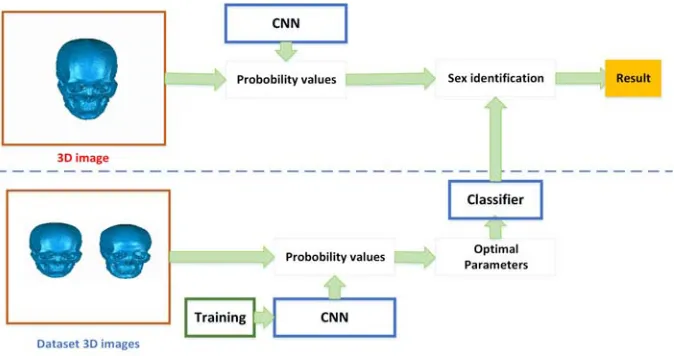
skull. The framework is shown in Figure 1. We made some deformation of the skull images in Figure 1 owing to the limitation of the box.
Figure 1. The framework.
Dataset
We resort to the Visualization Research Institute of Northwest University and obtain the originalDICOM images which are taken from Xian yang hospital.
TheDICOM images are designed to be a size of approximately512 512 250 . 90
cases with no pathology and completed skeleton are selected as the experimental subjects. According to the sex distribution for all the samples from 44 males and 46 females, we work out that the average ages of male and female are 49.24 and 49.33, the standard deviation are 14.58 and 13.21, respectively.
We firstly use the self-development software to carry out the 3D reconstruction. Secondly, in order to eliminate the effects of the samples’ scale and position, we set the samples to the same size and the uniform coordinate system. The uniform coordinate system is determinate by four landmarks [13], left porion, right porion, left orbitale and glabella (denoted asL R L Gp, p, ,o ) and the Frankfurt plane is
determinate by three pointsL R Lp, p, o. The intersection point of the line L Rp p and
the Frankfurt plane is the coordinate origin (denoted asO). We take the line
p p
L R asx axis . The yaxis is the line through the coordinate origin and
orthogonally intersects with lineL Rp p. Then zaxis is the cross product of x axis and yaxis. Once the uniform coordinate is constructed, all the 3D
subjects; each skull sample consists of 20 images. We obtain one picture at 18 angles of each rotation on zaxis, which fix x axis and yaxis.
Convolution Neural Network
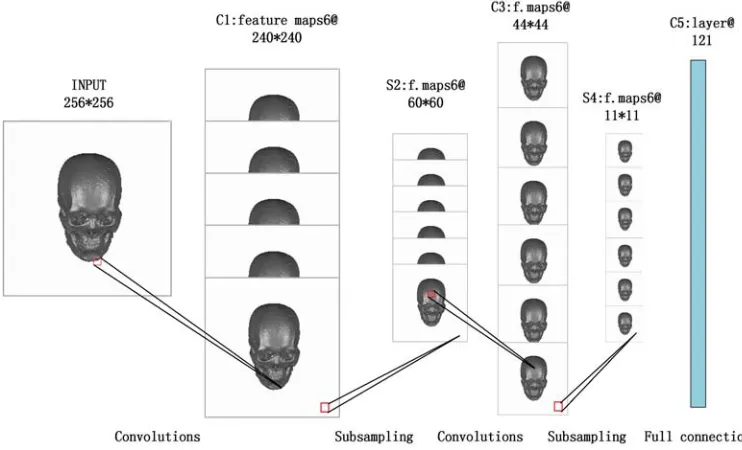
In our study, the relations of the images of each sample are a critical research content for sex assessment. The distinct advantages of the CNN are preserving the neighborhood relations and spatial locality in the latent higher-level feature representations, which is just meet our requirements. Based on the analysis of the CNN, we firstly propose that CNN is applied to sex identification based on the multi-angle images of the skulls, we also obtain the probability values of every sample belonging to male and female. Combined with the dataset’ characteristics, size and the robustness of existing model, the basic architecture of LeNET5 is chosen in our paper.
[image:4.612.98.469.428.653.2]We use the sigmoid activation function to get the probability values of each sample. The formula of the probability values is as follows [15]:
( )c ( | ) ( )
f x p yc x sigmoid WXb (1)
Where ( )f x crepresents the probability values belonging to male and female,
Xrepresents the characteristics of the full connected layer.
Least Square Method
A skull sample of 20 images is regard as a research subject, and constructs a probability vectorp= (p , p ,..., p )1 2 20 , which achieved by the CNN.
The regression model of the LSM [16] is applied. In order to get the optimal parameter of each image, we should make the total residual sum of squares to be minimal. The formula of the residual sum of squares is as follows:
2
1
1
Q ( )
2 n j j j q
p w (2)Where n denotes the number of samples, pjdenotes the probability values of
20 images of the j th sample corresponding to the true category of the training sets,
1 2
j j j
20 = (p , p ,..., p )
pj
. w denotes the weights of 20 images of each sample,
= T
1 2 20
( w ,w ,...,w )
w , j
q denotes the true category in the training sets of the
j th sample.
In order to obtain the optimal parameters and make residual sum of squares Q to be minimal, we transform the equation (2) to the following equation:
1
R min ( ) ( ) 2
T
Pw q Pw q
(3)
WhereP( ; ;...; )p p1 2 pn , q (q ,q1 2,...,qn T) .
Based on the differential geometry knowledge, the practical simplified formulae are obtained and then the partial derivation of the parameters w is taken. The
optimal parameters *
w can be calculated as follows:
1
( T ) T
*
Sex Identification
When we assess the gender of an unknown skull, we firstly obtain 20 images of the skull in different angles. Secondly, the probability values are obtained from the CNN. Finally, we assume that this unknown skull belongs to male, and then the decision value D is acquired from the following formula:
Dpw l
*
(5)
Where p denotes the probability vector of the 20 images, w* is achieved by
the equation 4, l denotes the hypothesis label. If the value of Dis larger than 0.5,
which is selected by prior knowledge, this unknown skull is male. Otherwise, it belongs to the female.
RESULTS
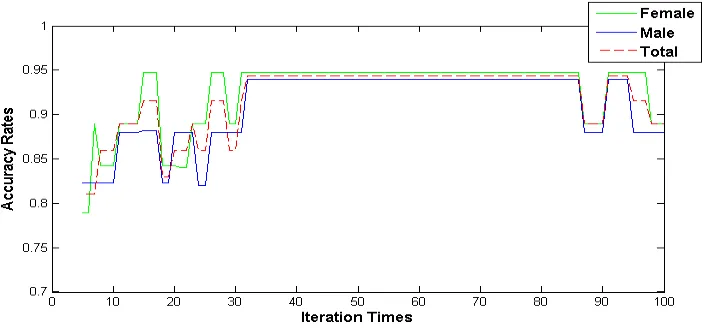
The 90 completed skulls are used for training and testing, 27 males and 27 females are randomly selected as the training set. We set different learning rates and iteration times to get the average probability values of each sample from the CNN. The codes of the CNN refer to the source codes of Deep Learn Toolbox1. Through a number of experiments and error technique, the optimal parameters can be easily obtained by the average probability values. The accuracy of the testing samples are shown in Figure 3 and Figure 4, the learning rate is equal to 0.01 and 0.001 respectively and the iteration times varies from 5 to 100.
Figure 4. The accuracy rate is a function of learning rate that equals 0.001.
Figure 3 demonstrates that the classification accuracy of the female is relatively higher compared with that of male in general. When the iteration times are set between 39 and 66, the accuracy rates of the males and females may remain higher than the other iteration times. Through numbers of experiments and analysis at different iteration times and learning rates, we can also conclude that both of the average accuracy rates for females and males are above 88%. Figure 4 shows that when the iteration times are set between 35 and 82, the average accuracy rates of the learning rate of 0.001 remain more stable than that of the learning rate of 0.01 in the females, the average correct rates of the males and the overall populations is also roughly consistent with this trend. In general, when the iteration times and the learning rates are set 60 and 0.001, the average accuracy rate is 94.7% and 94% for females and males, respectively. The overall average accuracy rate can reach 94.4%. Compared with the statistical shape model proposed by Luo [13], our method can obtain higher accuracy owing to considering the effect of the posterior part of skull on the sex identification. The result of experiments has proved the feasibility and efficiency of the algorithm.
CONCLUSION
In this paper, a novel automatic sex identification method based on the CNN and LSM is presented, which performed better than the state-of-the-art sex identification methods. The findings of the experiment results are mainly reflected in the following areas:
2. The probability values are achieved by the deep CNN, which can mine the content information of the images deeply.
3. The characteristics of the sample images are fused by using the LSM, which constructs the classifier model and realizes automatic sex identification.
ACKNOWLEDGEMENTS
This work was supported by the National Natural Science Foundation of China (no. 61373117) and Research Fund for the Doctoral Program of Higher Education of China (no. 20136101110019) and the Graduate Scientific Research Foundation of Northwest University (no. YZZ15098).
REFERENCES
1. Guyomarc’ H., P., J. Bruzek. 2011. “Accuracy and reliability in sex determination from skulls: a comparison of Fordisc® 3.0 and the discriminant function analysis, ” Forensic Sci Int, 208 (1-3) : 180.1-180.6.
2. Krogman, W.M. and M.Y. Iscan. M. 1986. The Human Skeleton in Forensic Medicine. Springfield IL: Charles C. Thomas.
3. Keen, J.A. 1997. “A study of the differences between male and female skull,” Theor Biosci, 116 (2): 118-124.
4. Naikmasur, V.D, R. Shrivastava and M. Sunil. 2010. “Determination of sex in South Indians and immigrant Tibetans from cephalometric analysis and discriminant functions,” Forensic Sci Int, 197 (1): 122. 1-122. 6.
5. Franklin, D., A. Cardini, A. Flavel and A. Kuliukas. 2013. “Estimation of sex from cranial measurements in a Western Australian population,” Forensic Sci Int, 229 (1-3): 360-369. 6. Ogawa, Y., K. Imaizumi, S. Miyasaka and M. Yoshino. 2013. “Discriminant functions for sex
estimation of modern Japanese skulls, ” J Forensic Leg Med, 20 (4): 234 - 238.
7. Kanchan, J., A. Gupta and K. Krishan. 2013. “Estimation of sex from mastoid triangle- A craniometrics analysis, ” J Forensic Leg Med, 20 (7): 855-860.
8. Stull, K.E, M.W. Kenyhercz and E.N. Labber. 2014. “Ancestry estimation in South Africa using craniometrics and geometric morphometrics,” Forensic Sci Int, 245C (206): 1-7.
9. Shui, W.Y, R.C. Yin, M.Q. Zhou and Y. Ji. 2013. “Sex determination from digital skull model for the Han People in China, ” Chin J Forensic Med, 28 (6): 461-463.(In Chinese)
10. Santos, F., P. Guyomarc’h and J. Bruzek. 2014. “Comparison of linear discriminant analysis, logistic regression, and support vector machines, ” Forensic Sci Int, 245 (204): l-8.
11. Alunni, V., P.D. Jardin, L. Nogueira, L. Buchet and G. Quatrehomme. 2015. “Comparing discriminant analysis and neural network for the determination of sex using femur head measurements, ” Forensic Sci Int 253: 81-87.
12. Afrianty, I., D. Nasien, M.R.A., Kadir and H. Haron. 2015. “Back-Propagation neural network for sex determination in forensic anthropology, ” The 21th ACM SIGKDD International Conference on Knowledge Discovery and Data Mining, New York, August 10 - 13, 575: 1524-1527.
14. Torimitsu, S., Y. Nishida, T. Takano, Y. Koizumi et.al. 2014. “Statistical analysis of biomechanical properties of the adult skull and age-related structural change by sex in a Japanese forensic sample, ” Forensic Sci Int, 234 (1): 185.1-9.
15. Bouvrie, J. 2006. “Notes on Convolutional Neural Networks, ” MITCBCL tech report. p: 38-44. 16. Marquardt, D.W. 1963. “An Algorithm for Least-Squares Estimation of Nonlinear Parameters, ”