Effect of Prepregnancy Body Mass Index and Gestational
Weight Gain on Birth Weight
Shehzad S. Merchant,Inayat A. Momin,Asif A. Sewani ( Final Year Medical Students, The Aga Khan University Medical College, Karachi. )
Nadeem F. Zuberi ( Senior Instructor, Department of Obstetrics and Gynecology, The Aga Khan University Hospital, Karachi. )
Abstract
Objective: Nutritional status of women has been considered an important prognostic indicator of birth outcome. The study aims to show the effect of various prepregnancy Body Mass Index (BM1)
categories and corresponding gestational weight gain on newborn birth weight.
Methods: Two hundred women were included in the study. These women had regular antenatal visits and later delivered at The Aga Khan University Hospital (AKUFI) between the period January 1, 1996 to December 31, 1997.
Results: For women with prepregnancy BMI<19., mean birth weight of newborns was lower for those gaining <12.5 kg than those gaining >12.5 kg (P<0.001). Women who started their pregnancy with BMI 19.8-26 and gained weight above expected range gave birth to high birth weight babies (P 0.009). Gestational weight gain did not have a significant association with birth weight for women having prepregnancy BMI>26.
Conclusion: Efforts should be made to attain adequate prepregnancy weight to reduce the likelihood of low birth weight babies. Hence, special attention should be paid to women with iow prepregnancy BMI JPMA 49:23, 1999).
Introduction
Maternal weight status both before and during pregnancy is an important determinant of birth outcome. Prepregnancy weight has been shown to be a significant determinant of birth weight in both
industrialized and developing countries. Similarly, the independent effect of the gestational weight gain has been well correlated1.
The Institute of Medicine recommended the use of BMI (weight/height2) as the preferred measure of studying the relationship betweenthe prepregnancy weight and gestational weight gain on fetal
outcome2. The recommended weight gain for women of normal built, (BMI 19.8-26) is 11.5-16kg ; for women with low BMI (<19.8) is 12.5-19.8 kg; whereas for women with high BMI (>26) is 7-11.5 k/. These guidelines have been validated by recent studies3-6 demonstrating that prenatal weight gain within the suggested ranges is associated with more favourable outcome than weight gain above or below the suggested range.
Several studies have indicated a linear relationship between birth weight and maternal weight gain at all levels of prepregnancy weights7-9 while others report that as prepregnancy weight increases, the importance of maternal weight gain diminishes10-12. Thus, although it is clear that prepregnancy weight and maternal weight gain exert some influence on birth weight, a question remains regarding the
Material and Methods
A retrospective analysis of required information was performed on 200 women, on the basis of convenient sampling, who attended antenatal clinic and delivered at AKUH fmrnJanuary 1, 1996 to December3 1, 1997. The cases included were women between 19 and 35 years of age. Women who had pnor abortions,any medical or gestational complications, i.e. chronic or pregnancy-induced
hypertension, gestational diabetes, multiple gestations and had delivered preterm or babies with congenital anomalies were excluded.
Maternal weight, height and age were recorded at the first antenatal visit. Maternal weight gain was measured routinely at each antenatal visit. Body size was estimated using the prepregnancy BMI (wI/h2). Most of the women had their first antenatal visit at 10+ weeks of gestation and since very little/no weight gain occurs during the first trimesterl3, the weight recorded at the 13th week of gestation was taken as the pmxy for prepregnancy weight. The predictor variables were prepregnancy BMI and gestational weight gain.
Neonatal birth weight was the outcome variable.
Statistical analysis was perfonned using Epilnfo 6.0. The major analytical tools used in the study were students “t” and “z” tests. To evaluate the relationship between variables, prepregnancy BMI was stratified into three groups (BMI<19.8, 19.8-26, >26), as recommendedby the Institute of Medicine. Each gmup was further divided according to the weight gain, which included low, nonnal and above range categories. Results were considered significant if p-value was <0.05.
Results
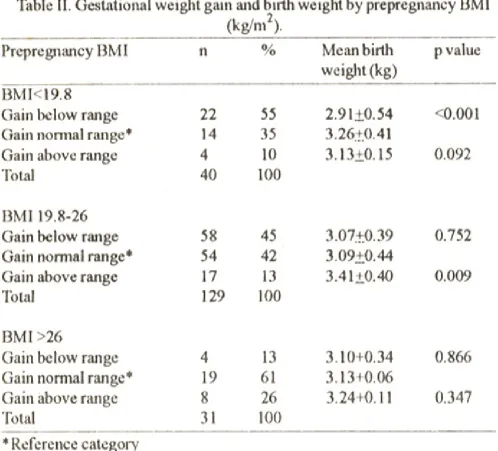
The baseline characteristics of the study population are shown in Table I.
Table II presents the distribution of weight gainby BMI categories.It shows that amongst women with prepregnancy BMI<19.8, the mean biith weight was lower forthose gaining below range han those who gained within normal range (p-value<0.001). However, no significant difference was found between women who gained weight within nonnal and above range (p value =. 0.09). For women starting their pregnancy with BMI 19.8-26 birth weight did not vaiy significantly between those who gained within normal and below range (p value = 0.75), but women gaining above range produced higher birth weight babies (p value = 0.009). The mean birth weight was similar for all three groups in women having prepregnancy BMI>26 (p value = 0.86 and 0.34).
Discussion
Western studies have proven the association ofa low maternal prepregnancy weight and alow gestational weight gain with a small birth weight fetus14, which holds true for our Pakistani
population too. The results demonstrate that women who started pregnancy with normal BMI (19.8-26), had a more favourable pregnancy outcome if they gained weight above their expected range than those gaining weight within their expected range. This is contradictory to the previously reported data, which shows that pregnancy weight gain has a more important impact on birth weight for underweight women than for women of normal weight15. As noticed by Hickey16, among women having a higher prepregnancy BMI, gestational weight gain had no significant bearing on fetal birthweight.
The mean prepregnancy weight in the study population was 55 kg. This was comparable to a prepregnancy weight of 57kg in the U.S.17 and was much higherthan the prepregnancy weight of a Taiwanese population (48.6 kg)18. Similarly, the total weight gain was 11.93±3.93 kg which was very near to the weight gain of American women (13.2 kg)19 and higher thanthe total weight gain of lndian(7 kg)20 and Taiwanese(7.6 kg) women18. These differences can be attributed to the middle/higher middle socio-economic class of the sample.
Major strengths of the study included stratification of BMI and weight gain into reconunended ranges and exclusion of confounding factors like maternal hypertension, gestational diabetes, preterm
deliveries and fetal congenital anomalies. However, generalization of the study results to the third world population may be restricted by the higher socio-economic status of the women coming to a tertiary care hospital for antenatal care and deliveries.
Since maternal malnutrition has a strong relationship with adverse pregnancy outcomes, including low birth weight babies21, aggressive prepregnancy nutritional counselling is strongly
recominendedforencouragingwornento have agood prepregnancy status (BMI>19.8). Specialemphasis should be paid towards nutritional counselling in malnourished women (BMI<19.8), which include many of the Pakistani women in their reproductive ages22.
References
1. Kramer M. Detenninants of low birth weight: Methodological assessment and mets-analysis. Bull WHO, 1987,65(5):663- 737.
2. Subcomittee on Nutritional Status and Weight Gain during Pregnancy. Institute of Medicine. Nutrition during pregnancy. Washington DC., National Academy Press, 1990.
3. Parker JD, Abrams B. Prenatal weight gain advice: An examination oftherecent prenatal weight gain recommendations of the Institute of Medicine. Obstet.Gynecol., 1992;79:664-9.
4. Hickey CA, Cliver SP, Goldenberg RL. et aL Prenatal weight gain, term birth weight and fetal growth retardation among high-risk multiparous black and white women. Obset.Gynecol., 1993;8 1:529-35.
5. Hickey CA, Cliver SP, McNeal SF, et al. Prenatal weight gain patterns and spontaneous preterm births among non-obese black and white women. Obstet.Gynecol., 1995;85 :909-14.
6. Hickey CA,CliverSP, McNea1SF, et al. Prenatal weight gain patterns and birth weight among non-obese black and white women. Obstet.Gynecol., 1996;88:490-96.
7. Harrison GG, Udall iN, Morrow G. Maternal obesity, weight gain in pregnancy and infant birth weight, Am.J.Obstet.Gynecol., 1980;1 36:411-12.
8. Gormican A, Valentine J, Satter E. Relationship of maternal weight gain, prepregnancy weight and infant birth weight. J.Am.Diet Assoc., 1980;77:662.7.
9. Luke B, Dickinson C, Petrie RH. Intrauterine growth: Correlations of maternal nutritional status and rate of gestational weight gain. Europ.J.Obstet.Gynecol. Reprod. Biol., 1981 ;12:113-21.
1003-24.
11. Niswander KR, Singer J, Westphal M, et a!. Weight gain during pregnancy and prepregnancy weight. Obstet.Gynecol., 1969;33:482-9l
12. Winikoff B, Debrovner CH. Anthropometric determinants of birth weight. Obstet.Gynecol., 1981 ; 58:678-84.
13. Tripathi AM. Nutritional status of rural pregnant women and fetal outcome. Indian Pediatr, 1987;24:703-1 2.
14. Johnson JW, LongmarkJA, Frentzen B. Excessive maternal weight and pregnancy outcome. Am.J.Obstet.Gynecol., 1992; 167:353-70.
15. Brown JE, Jacobson HN, Askue LH. Influence of pregnancy weight gain on the size of infants born to underweight women. Obstet.Gynecol., 1981 ;57: 13-17.
16. Hickey CA, McNeal SF, Menefee L, eta!. Prenatal weight gain within upper and lower
recommended ranges: Effect on birth weight of black and white infants. Obstet.Gynecol., 1997;90:489-94.
17. World Health Organization. Measuring change in nutritional status. Geneva, 1983.
18. Adair L. Maternal anthropometric changes during pregnancy and lactation in a rural Taiwanese population. Hum.Biol., 1983;55:771 -87.
19. Taffel S. Maternal weight gain and outcome of pregnancy. Vital and Health Statistics, U.S. Department of Health and Human Services, Publication (PHS), 1980;86- 1922.
20. Agarwal DK. Nutritional status in rural pregnant women in Bihar and Uttar Pradesh. Indian Pediatr., 1987;24:1 19-25.
21. Martinez H, Gonzalez CT, Flores M, et at. Anemia in women of reproductive age.The results of a national probability survey. Salud-Publica-Mex, 1995;37(2): 108-19.