Software development cost estimation approaches –
A survey
Barry Boehma, Chris Abtsa and Sunita Chulanib
a
University of Southern California, Los Angeles, CA 90089-0781, USA bIBM Research, 650 Harry Road, San Jose, CA 95120, USA
E-mail: [email protected]
This paper summarizes several classes of software cost estimation models and techniques: parametric models, expertise-based techniques, learning-oriented techniques, dynamics-based models, regression-dynamics-based models, and composite-Bayesian techniques for integrating expertise-based and regression-based models. Experience to date indicates that neural-net and dynamics-based techniques are less mature than the other classes of techniques, but that all classes of techniques are challenged by the rapid pace of change in software technology. The primary conclusion is that no single technique is best for all situations, and that a careful comparison of the results of several approaches is most likely to produce realistic estimates.
1. Introduction
Software engineering cost (and schedule) models and estimation techniques are used for a number of purposes. These include:
• Budgeting: the primary but not the only important use. Accuracy of the overall estimate is the most desired capability.
• Tradeoff and risk analysis: an important additional capability is to illuminate the cost and schedule sensitivities of software project decisions (scoping, staffing, tools, reuse, etc.).
• Project planning and control: an important additional capability is to provide cost and schedule breakdowns by component, stage and activity.
• Software improvement investment analysis: an important additional capability is to estimate the costs as well as the benefits of such strategies as tools, reuse, and process maturity.
In this paper, we summarize the leading techniques and indicate their relative strengths for these four purposes.
Significant research on software cost modeling began with the extensive 1965 SDC study of the 104 attributes of 169 software projects [Nelson 1966]. This led to some useful partial models in the late 1960s and early 1970s.
The late 1970s produced a flowering of more robust models such as SLIM [Put-nam and Myers 1992], Checkpoint [Jones 1997], PRICE-S [Park 1988], SEER [Jensen
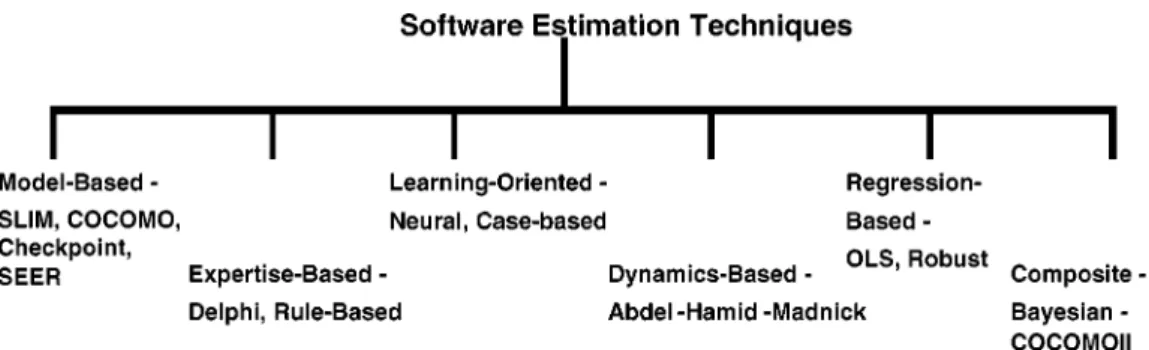
Figure 1. Software estimation techniques.
1983], and COCOMO [Boehm 1981]. Although most of these researchers started working on developing models of cost estimation at about the same time, they all faced the same dilemma: as software grew in size and importance it also grew in complexity, making it very difficult to accurately predict the cost of software devel-opment. This dynamic field of software estimation sustained the interests of these researchers who succeeded in setting the stepping-stones of software engineering cost models.
Just like in any other field, the field of software engineering cost models has had its own pitfalls. The fast changing nature of software development has made it very difficult to develop parametric models that yield high accuracy for software development in all domains. Software development costs continue to increase and practitioners continually express their concerns over their inability to accurately predict the costs involved. One of the most important objectives of the software engineering community has been the development of useful models that constructively explain the development life-cycle and accurately predict the cost of developing a software product. To that end, many software estimation models have evolved in the last two decades based on the pioneering efforts of the above mentioned researchers. The most commonly used techniques for these models include classical multiple regression approaches. However, these classical model-building techniques are not necessarily the best when used on software engineering data as illustrated in this paper.
Beyond regression, several papers [Briand et al. 1992; Khoshgoftaar et al. 1995] discuss the pros and cons of one software cost estimation technique versus another and present analysis results. In contrast, this paper focuses on the classification of existing techniques into six major categories as shown in figure 1, providing an overview with examples of each category. In section 2 it examines in more depth the first category, comparing some of the more popular cost models that fall under Model-based cost estimation techniques.
2. Model-based techniques
As discussed above, quite a few software estimation models have been developed in the last couple of decades. Many of them are proprietary models and hence cannot
be compared and contrasted in terms of the model structure. Theory or experimentation determines the functional form of these models. This section discusses seven of the popular models and table 2 (presented at the end of this section) compares and contrasts these cost models based on the life-cycle activities covered and their input and output parameters.
2.1. Putnam’s Software Life-cycle Model (SLIM)
Larry Putnam of Quantitative Software Measurement developed the Software Life-cycle Model (SLIM) in the late 1970s [Putnam and Myers 1992]. SLIM is based on Putnam’s analysis of the life-cycle in terms of a so-called Rayleigh distribution of project personnel level versus time. It supports most of the popular size estimating methods including ballpark techniques, source instructions, function points, etc. It makes use of a so-called Rayleigh curve to estimate project effort, schedule and defect rate. A Manpower Buildup Index (MBI) and a Technology Constant or Productivity factor (PF) are used to influence the shape of the curve. SLIM can record and analyze data from previously completed projects which are then used to calibrate the model; or if data are not available then a set of questions can be answered to get values of MBI and PF from the existing database.
In SLIM, Productivity is used to link the basic Rayleigh manpower distribution model to the software development characteristics of size and technology factors.
Productivity, P, is the ratio of software product size S and development effort E. That is,
P = S
E. (2.1)
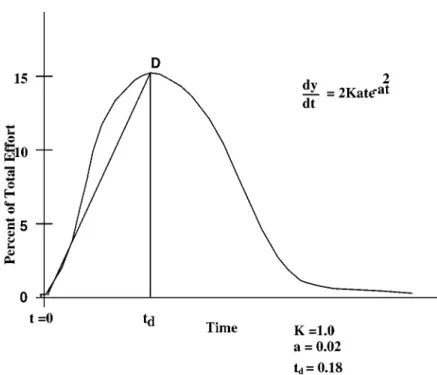
The Rayleigh curve used to define the distribution of effort is modeled by the differ-ential equation
dy
dt =2Kate −at2
. (2.2)
An example is given in figure 2, where K =1.0, a=0.02,td =0.18 where Putnam
assumes that the peak staffing level in the Rayleigh curve corresponds to development time (td). Different values of K,aand td will give different sizes and shapes of the
Rayleigh curve. Some of the Rayleigh curve assumptions do not always hold in practice (e.g., flat staffing curves for incremental development; less than t4 effort savings for
long schedule stretchouts). To alleviate this problem, Putnam has developed several model adjustments for these situations.
Recently, Quantitative Software Management has developed a set of three tools based on Putnam’s SLIM. These include Estimate, Control and SLIM-Metrics. SLIM-Estimate is a project planning tool, SLIM-Control project tracking and oversight tool, SLIM-Metrics is a software metrics repository and benchmarking tool. More information on these SLIM tools can be found at http://www.qsm.com.
2.2. Checkpoint
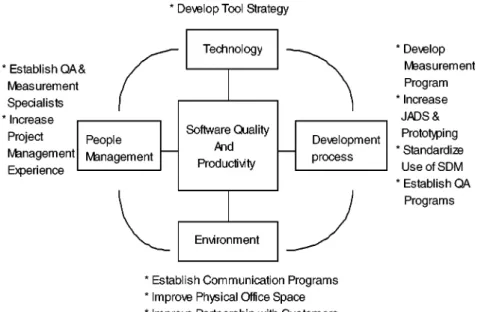
Checkpoint is a knowledge-based software project estimating tool from Software Productivity Research (SPR) developed from Capers Jones’ studies [Jones 1997]. It has a proprietary database of about 8000 software projects and it focuses on four areas that need to be managed to improve software quality and productivity. It uses Function Points (or Feature Points) [Albrecht 1979; Symons 1991] as its primary input of size. SPR’s Summary of Opportunities for software development is shown in figure 3. QA stands for Quality Assurance; JAD for Joint Application Development; SDM for Software Development Metrics.
It focuses on three main capabilities for supporting the entire software devel-opment life-cycle as discussed briefly at SPR’s website, http://www.spr.com/html/ checkpoint.htm, and outlined here:
• Estimation: Checkpoint predicts effort at four levels of granularity: project, phase, activity, and task. Estimates also include resources, deliverables, defects, costs, and schedules.
• Measurement: Checkpoint enables users to capture project metrics to perform benchmark analysis, identify best practices, and develop internal estimation knowl-edge bases (known as Templates).
• Assessment: Checkpoint facilitates the comparison of actual and estimated perfor-mance to various industry standards included in the knowledge base. Checkpoint
Figure 3. SPR’s summary of opportunities.
also evaluates the strengths and weaknesses of the software environment. Process improvement recommendations can be modeled to assess the costs and benefits of implementation.
Other relevant tools that SPR has been marketing for a few years include Knowl-edge Plan and FP Workbench. KnowlKnowl-edge Plan is a tool that enables an initial soft-ware project estimate with limited effort and guides the user through the refinement of “What if?” processes. Function Point Workbench is a tool that expedites function point analysis by providing facilities to store, update, and analyze individual counts. 2.2.1. Other functionality-based estimation models
As described above, Checkpoint uses function points as its main input parameter. There is a lot of other activity going on in the area of functionality-based estimation that deserves to be mentioned in this paper.
One of the more recent projects is the COSMIC (Common Software Measure-ment International Consortium) project. Since the launch of the COSMIC initiative in November 1999, an international team of software metrics experts has been working to establish the principles of the new method, which is expected to draw on the best features of existing IFPUG, MkII, NESMA and FFP V.1 For more information on the COSMIC project, please go to http://www.cosmicon.com.
Since function points is believed to be more useful in the MIS domain and problematic in the real-time software domain, another recent effort, in functionality-based estimation, is the Full Function Points (FFP) which is a measure specifically adapted to real-time and embedded software. The latest COSMIC-FFP version 2.0 uses a generic software model adapted for the purpose of functional size measurement,
a two-phase approach to functional size measurement (mapping and measurement), a simplified set of base functional components (BFC) and a scalable aggregation function. More details on the COSMIC-FFP can be found at http://www.lrgl.uqam.ca/ffp.html. 2.3. PRICE-S
The PRICE-S model was originally developed at RCA for use internally on software projects such as some that were part of the Apollo moon program. It was then released in 1977 as a proprietary model and used for estimating several US DoD, NASA and other government software projects. The model equations were not released in the public domain, although a few of the model’s central algorithms were published in [Park 1988]. The tool continued to become popular and is now marketed by PRICE Systems, which is a privately held company formerly affiliated with Lockheed Martin. As published on PRICE Systems website (http://www.pricesystems.com), the PRICE-S model consists of three submodels that enable estimating costs and schedules for the development and support of computer systems. These three submodels and their functionalities are outlined below:
• The acquisition submodel: This submodel forecasts software costs and schedules. The model covers all types of software development, including business systems, communications, command and control, avionics, and space systems. PRICE-S addresses current software issues such as reengineering, code generation, spiral development, rapid development, rapid prototyping, object-oriented development, and software productivity measurement.
• The sizing submodel: This submodel facilitates estimating the size of the software to be developed. Sizing can be in SLOC, Function Points and/or Predictive Ob-ject Points (POPs). POPs is a new way of sizing obOb-ject oriented development projects and was introduced in [Minkiewicz 1998] based on previous work one in Object Oriented (OO) metrics done by Chidamber et al. and others [Chidamber and Kemerer 1994; Henderson-Sellers 1996].
• The life-cycle cost submodel: This submodel is used for rapid and early costing of the maintenance and support phase for the software. It is used in conjunction with the Acquisition Submodel, which provides the development costs and design parameters.
PRICE Systems continues to update their model to meet new challenges. Re-cently, they have added Foresight 2.0, the newest version of their software solution for forecasting time, effort and costs for commercial and non-military government software projects.
2.4. ESTIMACS
Originally developed by Howard Rubin in the late 1970s as Quest (Quick Esti-mation System), it was subsequently integrated into the Management and Computer
Services (MACS) line of products as ESTIMACS [Rubin 1983]. It focuses on the development phase of the system life-cycle, maintenance being deferred to later ex-tensions of the tool.
ESTIMACS stresses approaching the estimating task in business terms. It also stresses the need to be able to do sensitivity and trade-off analyses early on, not only for the project at hand, but also for how the current project will fold into the long term mix or “portfolio” of projects on the developer’s plate for up to the next ten years, in terms of staffing/cost estimates and associated risks.
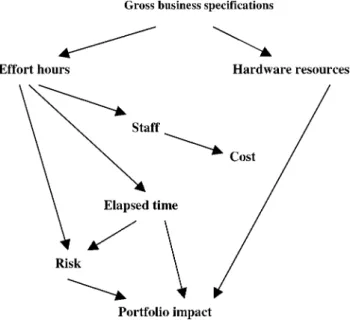
Rubin has identified six important dimensions of estimation and a map showing their relationships, all the way from what he calls the gross business specifications through to their impact on the developer’s long term projected portfolio mix.
The critical estimation dimensions are: • effort hours,
• staff size and deployment, • cost,
• hardware resource requirements, • risk,
• portfolio impact.
The basic premise of ESTIMACS is that the gross business specifications, or “project factors,” drive the estimate dimensions. Rubin defines project factors as “aspects of the business functionality of the of the target system that are well-defined early on, in
Table 1
Estimation dimensions and corresponding project factors. Estimation dimension Project factors
Effort hours Customer complexity Customer geography Developer familiarity Business function size Target system sophistication Target system complexity Staff/cost Effort hours
Staff productivity Skill level development Rate at each skill level Hardware System category
Generic system type Operating window Transaction volume
Risk System size
Project structure Target technology
Portfolio Resource needs of concurrent projects Relative project risks
a business sense, and are strongly linked to the estimate dimension.” Shown in table 1 are the important project factors that inform each estimation dimension.
The items in table 1 form the basis of the five submodels that comprise ESTI-MACS. The submodels are designed to be used sequentially, with outputs from one often serving as inputs to the next. Overall, the models support an iterative approach to final estimate development, illustrated by the following list:
1. Data input/estimate evolution. 2. Estimate summarization. 3. Sensitivity analysis.
4. Revision of step 1 inputs based upon results of step 3. The five ESTIMACS submodels in order of intended use:
• System development effort estimation: this model estimates development effort as total effort hours. It uses as inputs the answers to twenty-five questions, eight related to the project organization and seventeen related to the system structure itself. The broad project factors covered by these questions include developer knowledge of application area, complexity of customer organization, the size, sophistication and complexity of the new system being developed. Applying the answers to the
twenty-five input questions to a customizable database of life-cycle phases and work distribution, the model provides outputs of project effort in hours distributed by phase, and an estimation bandwidth as a function of project complexity. It also outputs project size in function points to be used as a basis for comparing relative sizes of systems.
• Staffing and cost estimation: this model takes as input the effort hours distributed by phase derived in the previous model. Other inputs include employee productivity and salaries by grade. It applies these inputs to an again customizable work distrib-ution life-cycle database. Outputs of the model include team size, staff distribdistrib-ution, and cost all distributed by phase, peak load values and costs, and cumulative cost. • Hardware configuration estimates: this model sizes operational resource require-ments of the hardware in the system being developed. Inputs include application type, operating windows, and expected transaction volumes. Outputs are estimates of required processor power by hour plus peak channel and storage requirements, based on a customizable database of standard processors and device characteristics. • Risk estimator: based mainly on a case study done by the Harvard Business School [Cash 1979], this model estimates the risk of successfully completing the planned project. Inputs to this model include the answers to some sixty questions, half of which are derived from use of the three previous submodels. These questions cover the project factors of project size, structure and associated technology. Out-puts include elements of project risk with associated sensitivity analysis identifying the major contributors to those risks.
• Portfolio analyzer: a long range “big picture” planning tool, this last submodel estimates the simultaneous effects of up to twenty projects over a ten year planning horizon. Inputs come from the Staffing & Cost Estimator and Risk Estimator submodels. Scheduling projects via a Gantt chart, outputs include total staffing by skill level, cumulative costs, monthly cash flows and relative risk. Comparisons between alternative portfolio or project mixes are possible.
The appeal of ESTIMACS lies in its ability to do estimates and sensitivity analy-ses of hardware as well as software, and from its business-oriented planning approach. 2.5. SEER-SEM
SEER-SEM is a product offered by Galorath, Inc. of El Segundo, California (http://www.gaseer.com). This model is based on the original Jensen model [Jensen 1983], and has been on the market some 15 years. During that time it has evolved into a sophisticated tool supporting top-down and bottom-up estimation methodologies. Its modeling equations are proprietary, but they take a parametric approach to estimation. The scope of the model is wide. It covers all phases of the project life-cycle, from early specification through design, development, delivery and maintenance. It handles a variety of environmental and application configurations, such as client–server, stand-alone, distributed, graphics, etc. It models the most widely used development methods
Figure 5. SEER-SEM Inputs and Outputs.
and languages. Development modes covered include object oriented, reuse, COTS, spiral, waterfall, prototype and incremental development. Languages covered are 3rd and 4th generation languages (C++, FORTRAN, COBOL, Ada, etc.), as well as ap-plication generators. It allows staff capability, required design and process standards, and levels of acceptable development risk to be input as constraints.
Figure 5 is adapted from a Galorath illustration and shows gross categories of model inputs and outputs, but each of these represents dozens of specific input and output possibilities and parameters. The reports available from the model covering all aspects of input and output summaries and analyses numbers in the hundreds.
Features of the model include the following:
• Allows probability level of estimates, staffing and schedule constraints to be input as independent variables.
• Facilitates extensive sensitivity and trade-off analyses on model input parameters. • Organizes project elements into work breakdown structures for convenient planning
and control.
• Displays project cost drivers.
• Allows the interactive scheduling of project elements on Gantt charts. • Builds estimates upon a sizable knowledge base of existing projects.
Model specifications include these:
• Parameters: size, personnel, complexity, environment and constraints – each with many individual parameters; knowledge base categories for platform & application, development & acquisition method, applicable standards, plus a user customizable knowledge base.
• Predictions: effort, schedule, staffing, defects and cost estimates; estimates can be schedule or effort driven; constraints can be specified on schedule and staffing. • Risk analysis: sensitivity analysis available on all least/likely/most values of output
parameters; probability settings for individual WBS elements adjustable, allowing for sorting of estimates by degree of WBS element criticality.
• Sizing methods: function points, both IFPUG sanctioned plus an augmented set; lines of code, both new and existing.
• Outputs and interfaces: many capability metrics, plus hundreds of reports and charts; trade-off analyses with side-by-side comparison of alternatives; integration with other Windows applications plus user customizable interfaces.
Aside from SEER-SEM, Galorath, Inc. offers a suite of many tools addressing hardware as well as software concerns. One of particular interest to software estimators might be SEER-SEM, a tool designed to perform sizing of software projects.
2.6. SELECT estimator
SELECT estimator by SELECT Software Tools is part of a suite of integrated products designed for components-based development modeling. The company was founded in 1988 in the UK and has branch offices in California and on the European continent. SELECT Estimator was released in 1998. It is designed for large scale distributed systems development. It is object oriented, basing its estimates on business objects and components. It assumes an incremental development life-cycle (but can be customized for other modes of development). The nature of its inputs allows the model to be used at any stage of the software development life-cycle, most significantly even at the feasibility stage when little detailed project information is known. In later stages, as more information is available, its estimates become correspondingly more reliable.
The actual estimation technique is based upon ObjectMetrix developed by The Object Factory (http://www.theobjectfactory.com). ObjectMetrix works by measuring the size of a project by counting and classifying the software elements within a project. The project is defined in terms of business applications built out of classes and sup-porting a set of use cases, plus infrastructure consisting of reusable components that provide a set of services.
The ObjectMetrix techniques begin with a base metric of effort in person-days typically required to develop a given project element. This effort assumes all the activities in a normal software development life-cycle are performed, but assumes nothing about project characteristics or the technology involved that might qualify that effort estimate.
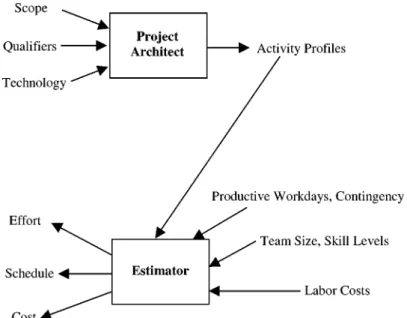
Pre-defined activity profiles covering planning, analysis, design, programming, testing, integration and review are applied according to type of project element, which splits that base metric effort into effort by activity. (These activity profiles are based upon project metric data collected and maintained by The Object Factory.)
Figure 6. SELECT estimator.
The base effort is then adjusted by using “qualifiers” to add or subtract a per-centage amount from each activity estimate.
A “technology” factor addressing the impact of the given programming environ-ment is then applied, this time adding or subtracting a percentage amount from the “qualified” estimate.
Applying the qualifier and technology adjustments to the base metric effort for each project element produces an overall estimate of effort in person-days, by activity. This total estimate represents the effort required by one person of average skill level to complete the project.
Using the total one man effort estimate, schedule is then determined as a function of the number of developers – input as an independent variable – then individual skill levels, the number of productive work days (excluding days lost to meetings, illness, etc.) per month, plus a percentage contingency.
SELECT Estimator adapts the ObjectMetrix estimation technique by refining the Qualifier and Technology factors.
The tool itself consists of two modules, Project Architect and Estimator [SELECT 1998]. Figure 6 illustrates the relationship between these modules.
Project architect. This module scopes and qualifies the major software elements of a project. This information is then fed into the Estimator module to estimate development schedule duration and cost. Scoping (or sizing) is done in terms of the following elements:
• Applications – software subsystems supporting a business area. • Classes – representing business concepts.
• User cases – business requirements defined from the user’s point of view.
• Packages – supporting frameworks with clear responsibility for an aspect of the infrastructure.
• Components – abstractions of lower lever business services.
• Services – common system features available across applications and components. Qualifiers to software elements, rated on a scale from low to high, include the following:
• Complexity – covering computations and the number of relationships. • Reuse – covers both COTS and other existing software.
• Genericity – whether the software needs to be built to be reusable. • Technology – the choice of programming language.
Activity profiles are applied to the base metric effort adjusted by the scoping and qualifying factors to arrive at the total effort estimate. Again, this is the effort required of one individual of average skill.
Estimator. This module uses the effort from the Project Architect to determine sched-ule duration and cost. Other inputs include team size and skill levels (rated as novice, competent and expert); the number of productive workdays per month and a contin-gency percentage; and the costs by skill level of the developers. The final outputs are total effort in person-days, schedule duration in months, and total development cost. 2.7. COCOMO II
The COCOMO (COnstructive COst MOdel) cost and schedule estimation model was originally published in [Boehm 1981]. It became one of most popular parametric cost estimation models of the 1980s. But COCOMO ’81 along with its 1987 Ada update experienced difficulties in estimating the costs of software developed to new life-cycle processes and capabilities. The COCOMO II research effort was started in 1994 at USC to address the issues on non-sequential and rapid development process models, reengineering, reuse driven approaches, object oriented approaches, etc.
COCOMO II was initially published in the Annals of Software Engineering in 1995 [Boehm et al. 1995]. The model has three submodels, Applications Composition, Early Design and Post-Architecture, which can be combined in various ways to deal with the current and likely future software practices marketplace.
The Application Composition model is used to estimate effort and schedule on projects that use Integrated Computer Aided Software Engineering tools for rapid ap-plication development. These projects are too diversified but sufficiently simple to be rapidly composed from interoperable components. Typical components are GUI builders, database or objects managers, middleware for distributed processing or transaction processing, etc. and domain-specific components such as financial, med-ical or industrial process control packages. The Applications Composition model is
based on Object Points [Banker et al. 1994; Kauffman and Kumar 1993]. Object Points are a count of the screens, reports and 3 GL language modules developed in the application. Each count is weighted by a three-level; simple, medium, dif-ficult; complexity factor. This estimating approach is commensurate with the level of information available during the planning stages of Application Composition projects.
The Early Design model involves the exploration of alternative system architec-tures and concepts of operation. Typically, not enough is known to make a detailed fine-grain estimate. This model is based on function points (or lines of code when available) and a set of five scale factors and 7 effort multipliers.
The Post-Architecture model is used when top level design is complete and detailed information about the project is available and as the name suggests, the software architecture is well defined and established. It estimates for the entire de-velopment life-cycle and is a detailed extension of the Early-Design model. This model is the closest in structure and formulation to the Intermediate COCOMO ’81 and Ada COCOMO models. It uses Source Lines of Code and/or Function Points for the sizing parameter, adjusted for reuse and breakage; a set of 17 effort mul-tipliers and a set of 5 scale factors, that determine the economies/diseconomies of scale of the software under development. The 5 scale factors replace the development modes in the COCOMO ’81 model and refine the exponent in the Ada COCOMO model.
The Post-Architecture Model has been calibrated to a database of 161 projects collected from Commercial, Aerospace, Government and non-profit organizations using the Bayesian approach [Chulani et al. 1998] discussed further in section 7. The Early Design Model calibration is obtained by aggregating the calibrated Effort Multipliers of the Post-Architecture Model as described in [USC-CSE 1997]. The Scale Factor calibration is the same in both the models. Unfortunately, due to lack of data, the Application Composition model has not yet been calibrated beyond an initial calibration to the [Kauffman and Kumar 1993] data.
A primary attraction of the COCOMO models is their fully-available internal equations and parameter values. Over a dozen commercial COCOMO ’81 implemen-tations are available; one (Costar) also supports COCOMO II: for details, see the COCOMO II website http://sunset.usc.edu/COCOMOII/suite.html.
2.8. Summary of model based techniques
Table 2 summarizes the parameters used and activities covered by the models discussed. Overall, model based techniques are good for budgeting, tradeoff analy-sis, planning and control, and investment analysis. As they are calibrated to past experience, their primary difficulty is with unprecedented situations.
B . B o ehm et a l. / Sof tw ar e d evel opment cost est im at io n appr oaches – A survey 191
Activities covered/factors explicitly considered by various cost models.
Group Factor SLIM Checkpoint PRICE-S ESTIMACS SEER-SEM SELECT Estimator COCOMO II
Size Source instructions YES YES YES NO YES NO YES
attributes Function points YES YES YES YES YES NO YES
OO-related metrics YES YES YES ? YES YES YES
Program Type/domain YES YES YES YES YES YES NO
attributes Complexity YES YES YES YES YES YES YES
Language YES YES YES ? YES YES YES
Reuse YES YES YES ? YES YES YES
Required reliability ? ? YES YES YES NO YES
Computer Resource constraints YES ? YES YES YES NO YES
attributes Platform volatility ? ? ? ? YES NO YES
Personnel Personnel capability YES YES YES YES YES YES YES
attributes Personnel continuity ? ? ? ? ? NO YES
Personnel experience YES YES YES YES YES NO YES
Project Tools and techniques YES YES YES YES YES YES YES
attributes Breakage YES YES YES ? YES YES YES
Schedule constraints YES YES YES YES YES YES YES
Process maturity YES YES ? ? YES NO YES
Team cohesion ? YES YES ? YES YES YES
Security issues ? ? ? ? YES NO NO
Multisite development ? YES YES YES YES NO YES
Activities Inception YES YES YES YES YES YES YES
covered Elaboration YES YES YES YES YES YES YES
Construction YES YES YES YES YES YES YES
Transition and maintenance YES YES YES NO YES NO YES
2
A question mark indicates that the authors were unable to determine from available literature whether or not a corresponding factor is considered in a given model.
3. Expertise-based techniques
Expertise-based techniques are useful in the absence of quantified, empirical data. They capture the knowledge and experience of practitioners seasoned within a domain of interest, providing estimates based upon a synthesis of the known outcomes of all the past projects to which the expert is privy or in which he or she participated. The obvious drawback to this method is that an estimate is only as good as the expert’s opinion, and there is no way usually to test that opinion until it is too late to correct the damage if that opinion proves wrong. Years of experience do not necessarily translate into high levels of competency. Moreover, even the most highly competent of individuals will sometimes simply guess wrong. Two techniques have been developed which capture expert judgement but that also take steps to mitigate the possibility that the judgment of any one expert will be off. These are the Delphi technique and the Work Breakdown Structure.
3.1. Delphi technique
The Delphi technique [Helmer 1966] was developed at The Rand Corporation in the late 1940s originally as a way of making predictions about future events – thus its name, recalling the divinations of the Greek oracle of antiquity, located on the southern flank of Mt. Parnassos at Delphi. More recently, the technique has been used as a means of guiding a group of informed individuals to a consensus of opinion on some issue. Participants are asked to make some assessment regarding an issue, individually in a preliminary round, without consulting the other participants in the exercise. The first round results are then collected, tabulated, and then returned to each participant for a second round, during which the participants are again asked to make an assessment regarding the same issue, but this time with knowledge of what the other participants did in the first round. The second round usually results in a narrowing of the range in assessments by the group, pointing to some reasonable middle ground regarding the issue of concern. The original Delphi technique avoided group discussion; the Wideband Delphi technique [Boehm 1981] accommodated group discussion between assessment rounds.
This is a useful technique for coming to some conclusion regarding an issue when the only information available is based more on “expert opinion” than hard empirical data.
The authors have recently used the technique to estimate reasonable initial values for factors which appear in two new software estimation models they are currently developing. Soliciting the opinions of a group of experienced software development professionals, Abts and Boehm used the technique to estimate initial parameter values for Effort Adjustment Factors (similar to factors shown in table 1) appearing in the glue code effort estimation component of the COCOTS (COnstructive COTS) integration cost model [Abts 1997; Abts et al. 1998].
Chulani and Boehm used the technique to estimate software defect introduction and removal rates during various phases of the software development life-cycle. These
factors appear in COQUALMO (COnstructuve QUALity MOdel), which predicts the residual defect density in terms of number of defects/unit of size [Chulani 1997]. Chulani and Boehm also used the Delphi approach to specify the prior information required for the Bayesian calibration of COCOMO II [Chulani et al. 1998].
3.2. Work Breakdown Structure (WBS)
Long a standard of engineering practice in the development of both hardware and software, the WBS is a way of organizing project elements into a hierarchy that simplifies the tasks of budget estimation and control. It helps determine just exactly what costs are being estimated. Moreover, if probabilities are assigned to the costs associated with each individual element of the hierarchy, an overall expected value can be determined from the bottom up for total project development cost [Baird 1989]. Expertise comes into play with this method in the determination of the most useful specification of the components within the structure and of those probabilities associ-ated with each component.
Expertise-based methods are good for unprecedented projects and for partici-patory estimation, but encounter the expertise-calibration problems discussed above and scalability problems for extensive sensitivity analyses. WBS-based techniques are good for planning and control.
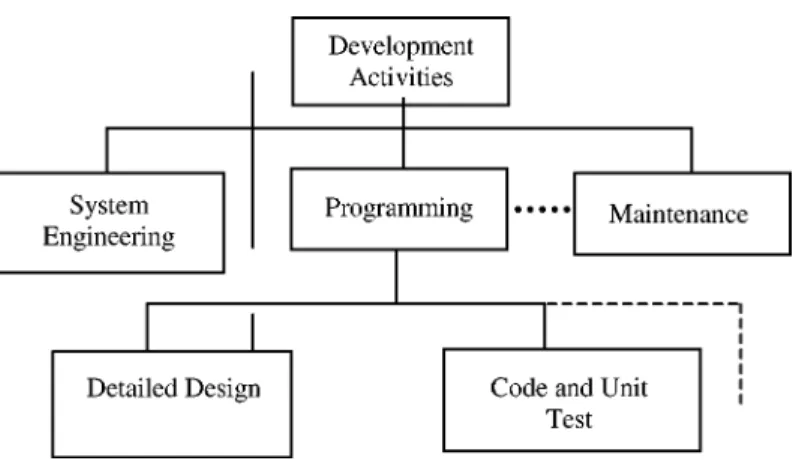
A software WBS actually consists of two hierarchies, one representing the soft-ware product itself, and the other representing the activities needed to build that prod-uct [Boehm 1981]. The prodprod-uct hierarchy (figure 7) describes the fundamental strprod-ucture of the software, showing how the various software components fit into the overall sys-tem. The activity hierarchy (figure 8) indicates the activities that may be associated with a given software component.
Aside from helping with estimation, the other major use of the WBS is cost ac-counting and reporting. Each element of the WBS can be assigned its own budget and
Figure 8. An activity work breakdown structure.
cost control number, allowing staff to report the amount of time they have spent work-ing on any given project task or component, information that can then be summarized for management budget control purposes.
Finally, if an organization consistently uses a standard WBS for all of its projects, over time it will accrue a very valuable database reflecting its software cost distribu-tions. This data can be used to develop a software cost estimation model tailored to the organization’s own experience and practices.
4. Learning-oriented techniques
Learning-oriented techniques include both some of the oldest as well as newest techniques applied to estimation activities. The former are represented by case stud-ies, among the most traditional of “manual” techniques; the latter are represented by neural networks, which attempt to automate improvements in the estimation process by building models that “learn” from previous experience.
4.1. Case studies
Case studies represent an inductive process, whereby estimators and planners try to learn useful general lessons and estimation heuristics by extrapolation from spe-cific examples. They examine in detail elaborate studies describing the environmental conditions and constraints that obtained during the development of previous software projects, the technical and managerial decisions that were made, and the final successes or failures that resulted. They try to root out from these cases the underlying links between cause and effect that can be applied in other contexts. Ideally they look for cases describing projects similar to the project for which they will be attempting to develop estimates, applying the rule of analogy that says similar projects are likely to be subject to similar costs and schedules. The source of case studies can be either internal or external to the estimator’s own organization. “Homegrown” cases are likely
to be more useful for the purposes of estimation because they will reflect the specific engineering and business practices likely to be applied to an organization’s projects in the future, but well-documented cases studies from other organizations doing similar kinds of work can also prove very useful.
Shepperd and Schofield did a study comparing the use of analogy with predic-tion models based upon stepwise regression analysis for nine datasets (a total of 275 projects), yielding higher accuracies for estimation by analogy. They developed a five-step process for estimation by analogy:
• identify the data or features to collect,
• agree data definitions and collections mechanisms, • populate the case base,
• tune the estimation method,
• estimate the effort for a new project.
For further details the reader is urged to read [Shepperd and Schofield 1997]. 4.2. Neural networks
According to Gray and McDonell [Gray and MacDonell 1996], neural networks is the most common software estimation model-building technique used as an alternative to mean least squares regression. These are estimation models that can be “trained” using historical data to produce ever better results by automatically adjusting their algorithmic parameter values to reduce the delta between known actuals and model predictions. Gray et al., go on to describe the most common form of a neural network used in the context of software estimation, a “backpropagation trained feed-forward” network (see figure 9).
The development of such a neural model is begun by first developing an appropri-ate layout of neurons, or connections between network nodes. This includes defining the number of layers of neurons, the number of neurons within each layer, and the manner in which they are all linked. The weighted estimating functions between the nodes and the specific training algorithm to be used must also be determined. Once the network has been built, the model must be trained by providing it with a set of historical project data inputs and the corresponding known actual values for project schedule and/or cost. The model then iterates on its training algorithm, automatically adjusting the parameters of its estimation functions until the model estimate and the actual values are within some pre-specified delta. The specification of a delta value is important. Without it, a model could theoretically become overtrained to the known historical data, adjusting its estimation algorithms until it is very good at predicting results for the training data set, but weakening the applicability of those estimation algorithms to a broader set of more general data.
Wittig [1995] has reported accuracies of within 10% for a model of this type when used to estimate software development effort, but caution must be exercised
Figure 9. A neural network estimation model.
when using these models as they are often subject to the same kinds of statistical problems with the training data as are the standard regression techniques used to calibrate more traditional models. In particular, extremely large data sets are needed to accurately train neural networks with intermediate structures of any complexity. Also, for negotiation and sensitivity analysis, the neural networks provide little intuitive support for understanding the sensitivity relationships between cost driver parameters and model results. They encounter similar difficulties for use in planning and control.
5. Dynamics-based techniques
Dynamics-based techniques explicitly acknowledge that software project effort or cost factors change over the duration of the system development; that is, they are dynamic rather than static over time. This is a significant departure from the other techniques highlighted in this paper, which tend to rely on static models and predictions based upon snapshots of a development situation at a particular moment in time. However, factors like deadlines, staffing levels, design requirements, training needs, budget, etc., all fluctuate over the course of development and cause corresponding fluctuations in the productivity of project personnel. This in turn has consequences for the likelihood of a project coming in on schedule and within budget – usually negative. The most prominent dynamic techniques are based upon the system dynamics approach to modeling originated by Jay Forrester nearly forty years ago [Forrester 1961].
5.1. Dynamics-based techniques
Dynamics-based techniques explicitly acknowledge that software project effort or cost factors change over the duration of the system development; that is, they are dynamic rather than static over time. This is a significant departure from the other techniques highlighted in this paper, which tend to rely on static models and predictions based upon snapshots of a development situation at a particular moment in time. However, factors like deadlines, staffing levels, design requirements, training needs, budget, etc., all fluctuate over the course of development and cause corresponding fluctuations in the productivity of project personnel. This in turn has consequences for the likelihood of a project coming in on schedule and within budget – usually negative. The most prominent dynamic techniques are based upon the system dynamics approach to modeling originated by Jay Forrester nearly forty years ago [Forrester 1961]. 5.2. System dynamics approach
System dynamics is a continuous simulation modeling methodology whereby model results and behavior are displayed as graphs of information that change over time. Models are represented as networks modified with positive and negative feedback loops. Elements within the models are expressed as dynamically changing levels or accumulations (the nodes), rates or flows between the levels (the lines connecting the nodes), and information relative to the system that changes over time and dynamically affects the flow rates between the levels (the feedback loops).
Figure 10 [Madachy 1999] shows an example of a system dynamics model demonstrating the famous Brooks’ Law, which states that “adding manpower to a late software project makes it later” [Brooks 1975]. Brooks’ rationale is that not only does effort have to be reallocated to train the new people, but the corresponding in-crease in communication and coordination overhead grows exponentially as people are added.
Madachy’s dynamic model as shown in the figure illustrates Brooks’ concept based on the following assumptions:
(1) New people need to be trained by experienced people to improve their productivity. (2) Increasing staff on a project increases the coordination and communication
over-head.
(3) People who have been working on a project for a while are more productive than newly added people.
As can be seen in figure 10, the model shows two flow chains representing software development and personnel. The software chain (seen at the top of the figure) begins with a level of requirements that need to be converted into an accumulation of developed software. The rate at which this happens depends on the number of trained personnel working on the project. The number of trained personnel in turn is a function of the personnel flow chain (seen at the bottom of the figure). New people are
Figure 10. Madachy’s system dynamics model of Brook’s law.
assigned to the project according to the personnel allocation rate, and then converted to experienced personnel according to the assimilation rate. The other items shown in the figure (nominal productivity, communication overhead, experienced personnel needed for training, and training overhead) are examples of auxiliary variables that also affect the software development rate.
Mathematically, system dynamics simulation models are represented by a set of first-order differential equations [Madachy 1994]:
x0(t)=f(x,p), (5.1)
where
x=a vector describing the levels (states) in the model,
p=a set of model parameters,
f =a nonlinear vector function,
t=time.
Within the last ten years this technique has been applied successfully in the context of software engineering estimation models. Abdel-Hamid has built models that will predict changes in project cost, staffing needs and schedules over time, as long as the initial proper values of project development are available to the estimator [Abdel-Hamid 1989a, b, 1993; Abdel-[Abdel-Hamid and Madnick 1991]. He has also applied the technique in the context of software reuse, demonstrating an interesting result. He
found that there is an initial beneficial relationship between the reuse of software com-ponents and project personnel productivity, since less effort is being spent developing new code. However, over time this benefit diminishes if older reuse components are retired and no replacement components have been written, thus forcing the abandon-ment of the reuse strategy until enough new reusable components have been created, or unless they can be acquired from an outside source [Abdel-Hamid and Madnick 1993].
More recently, Madachy used system dynamics to model an inspection-based software lifecycle process [Madachy 1994]. He was able to show that performing software inspections during development slightly increases programming effort, but decreases later effort and schedule during testing and integration. Whether there is an overall savings in project effort resulting from that traoff is a function of de-velopment phase error injection rates, the level of effort required to fix errors found during testing, and the efficiency of the inspection process. For typical industrial values of these parameters, the savings due to inspections considerably outweigh the costs. Dynamics-based techniques are particularly good for planning and control, but particularly difficult to calibrate.
6. Regression-based techniques
Regression-based techniques are the most popular ways of building models. These techniques are used in conjunction with model-based techniques and include “Standard” regression, “Robust” regression, etc.
6.1. “Standard” regression – Ordinary Least Squares (OLS) method
“Standard” regression refers to the classical statistical approach of general linear regression modeling using least squares. It is based on the Ordinary Least Squares (OLS) method discussed in many books such as [Judge et al. 1993; Weisberg 1985]. The reasons for its popularity include ease of use and simplicity. It is available as an option in several commercial statistical packages such as Minitab, SPlus, SPSS, etc.
A model using the OLS method can be written as
yt=β1+β2xt2+· · ·+Bkxtk+et, (6.1)
where xt2,. . .,xtk are predictor (or regressor) variables for the tth observation,
β2,. . .,βκ are response coefficients, β1 is an intercept parameter and yt is the
re-sponse variable for the tth observation. The error term, et is a random variable with
a probability distribution (typically normal). The OLS method operates by estimating the response coefficients and the intercept parameter by minimizing the least squares error termr2i whereri is the difference between the observed response and the model
predicted response for the ith observation. Thus all observations have an equivalent influence on the model equation. Hence, if there is an outlier in the observations then it will have an undesirable impact on the model.
The OLS method is well-suited when:
(i) A lot of data are available. This indicates that there are many degrees of freedom available and the number of observations is many more than the number of vari-ables to be predicted. Collecting data has been one of the biggest challenges in this field due to lack of funding by higher management, co-existence of several development processes, lack of proper interpretation of the process, etc.
(ii) No data items are missing. Data with missing information could be reported when there is limited time and budget for the data collection activity; or due to lack of understanding of the data being reported.
(iii) There are no outliers. Extreme cases are very often reported in software engi-neering data due to misunderstandings or lack of precision in the data collection process, or due to different “development” processes.
(iv) The predictor variables are not correlated. Most of the existing software estima-tion models have parameters that are correlated to each other. This violates the assumption of the OLS approach.
(v) The predictor variables have an easy interpretation when used in the model. This is very difficult to achieve because it is not easy to make valid assumptions about the form of the functional relationships between predictors and their distributions. (vi) The regressors are either all continuous (e.g., Database size) or all discrete vari-ables (ISO 9000 certification or not). Several statistical techniques exist to address each of these kind of variables but not both in the same model.
Each of the above is a challenge in modeling software engineering data sets to develop a robust, easy-to-understand, constructive cost estimation model.
A variation of the above method was used to calibrate the 1997 version of CO-COMO II. Multiple regression was used to estimate the b coefficients associated with the 5 scale factors and 17 effort multipliers. Some of the estimates produced by this approach gave counter intuitive results. For example, the data analysis indicated that developing software to be reused in multiple situations was cheaper than developing it to be used in a single situation: hardly a credible predictor for a practical cost estima-tion model. For the 1997 version of COCOMO II, a pragmatic 10% weighted average approach was used. COCOMO II.1997 ended up with a 0.9 weight for the expert data and a 0.1 weight for the regression data. This gave moderately good results for an interim COCOMO II model, with no cost drivers operating in non-credible ways. 6.2. “Robust” regression
Robust regression is an improvement over the standard OLS approach. It allevi-ates the common problem of outliers in observed software engineering data. Software project data usually have a lot of outliers due to disagreement on the definitions of
software metrics, coexistence of several software development processes and the avail-ability of qualitative versus quantitative data.
There are several statistical techniques that fall in the category of ‘Robust” re-gression. One of the techniques is based on Least Median Squares method and is very similar to the OLS method described above. The only difference is that this technique reduces the median of all the r2
i.
Another approach that can be classified as “Robust” regression is a technique that uses the datapoints lying within two (or three) standard deviations of the mean response variable. This method automatically gets rid of outliers and can be used only when there is a sufficient number of observations, so as not to have a significant impact on the degrees of freedom of the model. Although this technique has the flaw of eliminating outliers without direct reasoning, it is still very useful for developing software estimation models with few regressor variables due to lack of complete project data.
Most existing parametric cost models (COCOMO II, SLIM, Checkpoint etc.) use some form of regression-based techniques due to their simplicity and wide acceptance.
7. Composite techniques
As discussed above there are many pros and cons of using each of the existing techniques for cost estimation. Composite techniques incorporate a combination of two or more techniques to formulate the most appropriate functional form for estimation. 7.1. Bayesian approach
An attractive estimating approach that has been used for the development of the COCOMO II model is Bayesian analysis [Chulani et al. 1998].
Bayesian analysis is a mode of inductive reasoning that has been used in many scientific disciplines. A distinctive feature of the Bayesian approach is that it permits the investigator to use both sample (data) and prior (expert-judgement) information in a logically consistent manner in making inferences. This is done by using Bayes’ theorem to produce a ‘post-data’ or posterior distribution for the model parameters. Using Bayes’ theorem, prior (or initial) values are transformed to post-data views. This transformation can be viewed as a learning process. The posterior distribution is determined by the variances of the prior and sample information. If the variance of the prior information is smaller than the variance of the sampling information, then a higher weight is assigned to the prior information. On the other hand, if the variance of the sample information is smaller than the variance of the prior information, then a higher weight is assigned to the sample information causing the posterior estimate to be closer to the sample information.
The Bayesian approach provides a formal process by which a priori expert-judgement can be combined with sampling information (data) to produce a robust
a posteriori model. Using Bayes’ theorem, we can combine our two information sources as follows:
f(β |Y)= f(Y |β)f(β)
f(Y) , (7.1)
where β is the vector of parameters in which we are interested and Y is the vector of sample observations from the joint density function f(β |Y) . In equation (7.1),
f(β |Y) is the posterior density function forβ summarizing all the information about
β, f(Y |β) is the sample information and is algebraically equivalent to the likelihood function for β, and f(β) is the prior information summarizing the expert-judgement information aboutβ. Equation (7.1) can be rewritten as
f(β |Y)∝l(β |Y)f(β). (7.2) In words, equation (7.2) means
Posterior∝Sample·Prior.
In the Bayesian analysis context, the “prior” probabilities are the simple “uncon-ditional” probabilities associated with the sample information, while the “posterior” probabilities are the “conditional” probabilities given knowledge of sample and prior information.
The Bayesian approach makes use of prior information that is not part of the sample data by providing an optimal combination of the two sources of information. As described in many books on Bayesian analysis [Box and Tiao 1973; Leamer 1978], the posterior mean, b∗∗, and variance, Var(b∗∗), are defined as
b∗∗= 1 s2X0X+H∗ · 1 s2X0Xb+H∗b∗ (7.3) and Var b∗∗= 1 s2X0X+H∗ −1 , (7.4)
whereX is the matrix of predictor variables, sis the variance of the residual for the sample data; and H∗ andb∗ are the precision (inverse of variance) and mean of the prior information, respectively.
The Bayesian approach described above has been used in the most recent calibra-tion of COCOMO II over a database currently consisting of 161 project data points. The a posteriori COCOMO II.2000 calibration gives predictions that are within 30% of the actuals 75% of the time, which is a significant improvement over the COCOMO II.1997 calibration which gave predictions within 30% of the actuals 52% of the time as shown in table 3. (The 1997 calibration was not performed using Bayesian analysis; rather, a 10% weighted linear combination of expert prior vs. sample information was applied [Clark et al. 1998].) If the model’s multiplicative coefficient is calibrated to each of the major sources of project data, i.e., “stratified” by data source, the resulting
Table 3
Prediction Accuracy of COCOMO II.1997 vs. COCOMO II.2000. COCOMO II Prediction accuracy Before stratification After stratification
1997 PRED(0.20) 46% 49% PRED(0.25) 49% 55% PRED(0.30) 52% 64% 2000 PRED(0.20) 636% 70% PRED(0.25) 68% 76% PRED(0.30) 75% 80%
model produces estimates within 30% of the actuals 80% of the time. It is therefore recommended that organizations using the model calibrate it using their own data to in-crease model accuracy and produce a local optimum estimate for similar type projects. From table 3 it is clear that the predictive accuracy of the COCOMO II.2000 Bayesian model is better than the predictive accuracy of the COCOMO II.1997 weighted linear model illustrating the advantages of using Composite techniques.
Bayesian analysis has all the advantages of “Standard” regression and it includes prior knowledge of experts. It attempts to reduce the risks associated with imperfect data gathering. Software engineering data are usually scarce and incomplete and esti-mators are faced with the challenge of making good decisions using this data. Classical statistical techniques described earlier derive conclusions based on the available data. But, to make the best decision it is imperative that in addition to the available sample data we should incorporate nonsample or prior information that is relevant. Usually a lot of good expert judgment based information on software processes and the impact of several parameters on effort, cost, schedule, quality etc. is available. This information does not necessarily get derived from statistical investigation and hence classical sta-tistical techniques such as OLS do not incorporate it into the decision making process. Bayesian techniques make best use of relevant prior information along with collected sample data in the decision making process to develop a stronger model.
8. Conclusions
This paper has presented an overview of a variety of software estimation tech-niques, providing an overview of several popular estimation models currently available. Experience to date indicates that neural-net and dynamics-based techniques are less mature than the other classes of techniques, but that all classes of techniques are chal-lenged by the rapid pace of change in software technology. The important lesson to take from this paper is that no one method or model should be preferred over all others. The key to arriving at sound estimates is to use a variety of methods and tools and then investigating the reasons why the estimates provided by one might differ significantly from those provided by another. If the practitioner can explain such differences to a reasonable level of satisfaction, then it is likely that he or she has a good grasp of the factors which are driving the costs of the project at hand; and thus will be better
equipped to support the necessary project planning and control functions performed by management.
Acknowledgements
This research is sponsored by the Affiliates of the USC Center for Software Engi-neering: Aerospace, Air Force Cost Analysis Agency, Allied Signal, AT&T, Bellcore, EDS, Raytheon E-Systems, GDE Systems, Hughes, IDA, JPL, Litton, Lockheed Mar-tin, Loral, MCC, MDAC, Motorola, Northrop Grumman, Rational, Rockwell, SAIC, SEI, SPC, Sun, TI, TRW, USAF Rome Labs, US Army Research Labs and Xerox.
Special thanks to the model and tool vendors who provided the authors with the information required to perform this study.
References
Abdel-Hamid, T. (1989a), “The Dynamics of Software Project Staffing: A System Dynamics-based Simulation Approach,” IEEE Transactions on Software Engineering, February.
Abdel-Hamid, T. (1989b), “Lessons Learned from Modeling the Dynamics of Software Development,”
Communications of the ACM, December.
Abdel-Hamid, T. and S. Madnick (1991), Software Project Dynamics, Prentice-Hall, 1991.
Abdel-Hamid, T. (1993), “Adapting, Correcting, and Perfecting Software Estimates: A Maintenance Metaphor,” IEEE Computer, March.
Abdel-Hamid, T. and S. Madnick (1993), “Modeling the Dynamics of Software Reuse: An Integrating System Dynamics Perspective,” Presentation to the 6th Annual Workshop on Reuse, Owego, NY, November.
Abts, C. (1997), “COTS Software Integration Modeling Study,” Report prepared for USAF Electronics System Center, Contract No. F30602-94-C-1095, University of Southern California.
Abts, C., B. Bailey, and B. Boehm (1998), “COCOTS Software Integration Cost Model: An Overview,” In Proceedings of the California Software Symposium, 1998.
Albrecht, A. (1979), “Measuring Application Development Productivity,” In Proceedings of the Joint
SHARE/GUIDE/IBM Application Development Symposium, October, pp. 83–92.
Baird, B. (1989), Managerial Decisions Under Uncertainty, Wiley, New York, 1989.
Banker, R., R. Kauffman, and R. Kumar (1994), “An Empirical Test of Object-Based Output Measurement Metrics in a Computer Aided Software Engineering (CASE) Environment,” Journal of Management
Information System.
Boehm, B. (1981), Software Engineering Economics, Prentice-Hall.
Boehm, B., B. Clark, E. Horowitz, C. Westland, R. Madachy, and R. Selby (1995), “Cost Models for Future Software Life-cycle Processes: COCOMO 2.0,” Annals of Software Engineering 1, Special Volume on Software Process and Product Measurement, J.D. Arthur and S.M. Henry, Eds., 45–60. Box, G. and G. Tiao, (1973), Bayesian Inference in Statistical Analysis, Addison-Wesley, Reading, MA. Briand, L., V. Basili, and W. Thomas (1992), “A Pattern Recognition Approach for Software Engineering
Data Analysis,” IEEE Transactions on Software Engineering 18, 11, November. Brooks, F. (1975), The Mythical Man-Month, Addison-Wesley, Reading, MA. Cash, J. (1979), “Dallas Tire Case,” Harvard Business School.
Chidamber, S. and C. Kemerer (1994), “A Metrics Suite for Object Oriented Design,” CISR WP No. 249 and Sloan WP No. 3524-93, Center for Information Systems Research, Sloan School of Management, Massachusetts Institute of Technology.
Chulani, S. (1997), “Modeling Defect Introduction,” In California Software Symposium, November. Chulani, S. (1998), “Incorporating Bayesian Analysis to Improve the Accuracy of COCOMO II and
Its Quality Model Extension,” Ph.D. Qualifying Exam Report, University of Southern California, February.
Chulani, S., B. Boehm, and B. Steece (1998), “Calibrating Software Cost Models Using Bayesian Analy-sis,” Technical Report, USC-CSE-98-508, June. To appear in IEEE Transactions on Software Engi-neering, Special Issue on Empirical Methods in Software Engineering.
Clark, B., S. Chulani, and B. Boehm (1998), “Calibrating the COCOMO II Post Architecture Model,” In
International Conference on Software Engineering, April.
Forrester, J. (1961), Industrial Dynamics, MIT Press, Cambridge, MA.
Gray, A. and S. MacDonell (1996), “A Comparison of Techniques for Developing Predictive Models of Software Metrics,” Information and Software Technology 39, 1997.
Helmer, O. (1966), Social Technology, Basic Books, NY.
Henderson-Sellers, B. (1996), Object Oriented Metrics – Measures of Complexity, Prentice Hall, Upper Saddle River, NJ.
Jensen R. (1983),“An Improved Macrolevel Software Development Resource Estimation Model,” In
Proceedings of 5th ISPA Conference, April, pp. 88–92.
Jones, C. (1997), Applied Software Measurement, McGraw Hill.
Judge, G., W. Griffiths, and C. Hill (1993), Learning and Practicing Econometrics, Wiley, New York. Kauffman, R. and R. Kumar (1993), “Modeling Estimation Expertise in Object Based ICASE
Environ-ments,” Stern School of Business Report, New York University, January.
Khoshgoftaar, T., A. Pandya, and D. Lanning (1995), “Application of Neural Networks for Predicting Program Faults,” Annals of Software Engineering 1.
Leamer, E. (1978), Specification Searches, Ad hoc Inference with Nonexperimental Data, Wiley Series, Wiley, New York.
Madachy, R. (1994), “A Software Project Dynamics Model for Process Cost, Schedule and Risk Assess-ment,” Ph.D. Dissertation, University of Southern California.
Madachy, R. (1999), CS577a class notes, University of Southern California, 1999.
Minkiewicz, A. (1998), “Measuring Object Oriented Software with Predictive Object Points,” PRICE Systems.
Nelson, E. (1966), “Management Handbook for the Estimation of Computer Programming Costs,” Sys-tems Development Corporation, October.
Park R. (1988), “The Central Equations of the PRICE Software Cost Model,” In 4th COCOMO Users’
Group Meeting, November.
Putnam, L. and W. Myers (1992), Measures for Excellence, Yourdon Press Computing Series. Rubin, H. (1983), “ESTIMACS,” IEEE, 1983.
SELECT (1998), “Estimation for Component-based Development Using SELECT Estimator,” SELECT Software Tools, website: http://www.select.com.
Shepperd, M. and M. Schofield (1997), “Estimating Software Project Effort Using Analogies,” IEEE
Transactions on Software Engineering 23, 12.
Symons (1991), Software Sizing and Estimating – Mark II FPA, Wiley, UK.
USC-CSE (1997), “COCOMO II Model Definition Manual,” Center for Software Engineering, Computer Science Department, University of Southern California, Los Angeles, CA, website: http://sunset.usc. edu/COCOMOII/cocomo.html.
Weisberg, S. (1985), Applied Linear Regression, 2nd Edition, Wiley, New York, NY.
Wittig, G (1995), “Estimating Software Development Effort with Connectionist Models,” Working Paper Series 33/95, Monash University.