CHAPTER
2
Regular Expressions,
Text
Normalization, Edit Distance
User: I am unhappy.ELIZA: DO YOU THINK COMING HERE WILL HELP YOU NOT TO BE UNHAPPY User: I need some help, that much seems certain.
ELIZA: WHAT WOULD IT MEAN TO YOU IF YOU GOT SOME HELP User: Perhaps I could learn to get along with my mother. ELIZA: TELL ME MORE ABOUT YOUR FAMILY
User: My mother takes care of me.
ELIZA: WHO ELSE IN YOU FAMILY TAKES CARE OF YOU User: My father.
ELIZA: YOUR FATHER
User: You are like my father in some ways.
Weizenbaum (1966) The dialogue above is fromELIZA, an early natural language processing system ELIZA
that could carry on a limited conversation with a user by imitating the responses of a Rogerian psychotherapist(Weizenbaum, 1966). ELIZA is a surprisingly simple program that uses pattern matching to recognize phrases like “I need X” and translate them into suitable outputs like “What would it mean to you if you got X?”. This simple technique succeeds in this domain because ELIZA doesn’t actually need to knowanything to mimic a Rogerian psychotherapist. As Weizenbaum notes, this is one of the few dialogue genres where listeners can act as if they know nothing of the world. Eliza’s mimicry of human conversation was remarkably successful: many people who interacted with ELIZA came to believe that it reallyunderstoodthem and their problems, many continued to believe in ELIZA’s abilities even after the program’s operation was explained to them (Weizenbaum, 1976), and even today suchchatbotsare a fun diversion.
chatbots
Of course modern conversational agents are much more than a diversion; they can answer questions, book flights, or find restaurants, functions for which they rely on a much more sophisticated understanding of the user’s intent, as we will see in Chapter 26. Nonetheless, the simple pattern-based methods that powered ELIZA and other chatbots play a crucial role in natural language processing.
We’ll begin with the most important tool for describing text patterns: theregular expression. Regular expressions can be used to specify strings we might want to extract from a document, from transforming “I need X” in Eliza above, to defining strings like$199or$24.99for extracting tables of prices from a document.
We’ll then turn to a set of tasks collectively calledtext normalization, in which text
normalization
regular expressions play an important part. Normalizing text means converting it to a more convenient, standard form. For example, most of what we are going to do with language relies on first separating out ortokenizingwords from running text, the task oftokenization. English words are often separated from each other tokenization
by whitespace, but whitespace is not always sufficient. New Yorkandrock ’n’ roll are sometimes treated as large words despite the fact that they contain spaces, while sometimes we’ll need to separateI’minto the two wordsIandam. For processing tweets or texts we’ll need to tokenizeemoticonslike:)orhashtagslike#nlproc.
Some languages, like Japanese, don’t have spaces between words, so word tokeniza-tion becomes more difficult.
Another part of text normalization islemmatization, the task of determining lemmatization
that two words have the same root, despite their surface differences. For example, the wordssang,sung, andsingsare forms of the verbsing. The wordsingis the commonlemmaof these words, and alemmatizermaps from all of these tosing. Lemmatization is essential for processing morphologically complex languages like Arabic.Stemmingrefers to a simpler version of lemmatization in which we mainly stemming
just strip suffixes from the end of the word. Text normalization also includes sen-tence segmentation: breaking up a text into individual sensen-tences, using cues like sentence
segmentation
periods or exclamation points.
Finally, we’ll need to compare words and other strings. We’ll introduce a metric callededit distancethat measures how similar two strings are based on the number of edits (insertions, deletions, substitutions) it takes to change one string into the other. Edit distance is an algorithm with applications throughout language process-ing, from spelling correction to speech recognition to coreference resolution.
2.1 Regular Expressions
One of the unsung successes in standardization in computer science has been the regular expression(RE), a language for specifying text search strings. This prac-regular
expression
tical language is used in every computer language, word processor, and text pro-cessing tools like the Unix tools grep or Emacs. Formally, a regular expression is an algebraic notation for characterizing a set of strings. They are particularly use-ful for searching in texts, when we have a patternto search for and acorpusof corpus
texts to search through. A regular expression search function will search through the corpus, returning all texts that match the pattern. The corpus can be a single docu-ment or a collection. For example, the Unix command-line toolgreptakes a regular expression and returns every line of the input document that matches the expression. A search can be designed to return every match on a line, if there are more than one, or just the first match. In the following examples we generally underline the exact part of the pattern that matches the regular expression and show only the first match. We’ll show regular expressions delimited by slashes but note that slashes are notpart of the regular expressions.
Regular expressions come in many variants. We’ll be describingextended regu-lar expressions; different reguregu-lar expression parsers may only recognize subsets of these, or treat some expressions slightly differently. Using an online regular expres-sion tester is a handy way to test out your expresexpres-sions and explore these variations.
2.1.1 Basic Regular Expression Patterns
The simplest kind of regular expression is a sequence of simple characters. To search forwoodchuck, we type/woodchuck/. The expression/Buttercup/matches any string containing the substringButtercup;grepwith that expression would return the lineI’m called little Buttercup. The search string can consist of a single character (like/!/) or a sequence of characters (like/urgl/).
Regular expressions arecase sensitive; lower case/s/is distinct from upper case/S/(/s/matches a lower case sbut not an upper caseS). This means that the pattern/woodchucks/will not match the stringWoodchucks. We can solve this
RE Example Patterns Matched
/woodchucks/ “interesting links to woodchucks and lemurs”
/a/ “Mary Ann stopped by Mona’s”
/!/ “You’ve left the burglar behind again!” said Nori
Figure 2.1 Some simple regex searches.
problem with the use of the square braces[and]. The string of characters inside the braces specifies adisjunctionof characters to match. For example, Fig.2.2shows that the pattern/[wW]/matches patterns containing eitherworW.
RE Match Example Patterns
/[wW]oodchuck/ Woodchuck or woodchuck “Woodchuck” /[abc]/ ‘a’, ‘b’,or‘c’ “In uomini, in soldati”
/[1234567890]/ any digit “plenty of 7 to 5”
Figure 2.2 The use of the brackets[]to specify a disjunction of characters.
The regular expression/[1234567890]/specified any single digit. While such classes of characters as digits or letters are important building blocks in expressions, they can get awkward (e.g., it’s inconvenient to specify
/[ABCDEFGHIJKLMNOPQRSTUVWXYZ]/
to mean “any capital letter”). In cases where there is a well-defined sequence asso-ciated with a set of characters, the brackets can be used with the dash (-) to specify any one character in arange. The pattern/[2-5]/specifies any one of the charac-range
ters2,3,4, or5. The pattern/[b-g]/specifies one of the charactersb,c,d,e,f, or g. Some other examples are shown in Fig.2.3.
RE Match Example Patterns Matched
/[A-Z]/ an upper case letter “we should call it ‘Drenched Blossoms’ ” /[a-z]/ a lower case letter “my beans were impatient to be hoed!” /[0-9]/ a single digit “Chapter 1: Down the Rabbit Hole”
Figure 2.3 The use of the brackets[]plus the dash-to specify a range.
The square braces can also be used to specify what a single charactercannotbe, by use of the caretˆ. If the caretˆis the first symbol after the open square brace[, the resulting pattern is negated. For example, the pattern/[ˆa]/matches any single character (including special characters) excepta. This is only true when the caret is the first symbol after the open square brace. If it occurs anywhere else, it usually stands for a caret; Fig.2.4shows some examples.
RE Match (single characters) Example Patterns Matched
/[ˆA-Z]/ not an upper case letter “Oyfn pripetchik”
/[ˆSs]/ neither ‘S’ nor ‘s’ “I have no exquisite reason for’t”
/[ˆ.]/ not a period “our resident Djinn”
/[eˆ]/ either ‘e’ or ‘ˆ’ “look up ˆ now”
/aˆb/ the pattern ‘aˆb’ “look up aˆ b now”
Figure 2.4 The caretˆfor negation or just to meanˆ. See below re: the backslash for escaping the period.
How can we talk about optional elements, like an optionalsinwoodchuckand woodchucks? We can’t use the square brackets, because while they allow us to say “s or S”, they don’t allow us to say “s or nothing”. For this we use the question mark /?/, which means “the preceding character or nothing”, as shown in Fig.2.5.
RE Match Example Patterns Matched /woodchucks?/ woodchuck or woodchucks “woodchuck”
/colou?r/ color or colour “color”
Figure 2.5 The question mark?marks optionality of the previous expression.
We can think of the question mark as meaning “zero or one instances of the previous character”. That is, it’s a way of specifying how many of something that we want, something that is very important in regular expressions. For example, consider the language of certain sheep, which consists of strings that look like the following: baa! baaa! baaaa! baaaaa! . . .
This language consists of strings with ab, followed by at least twoa’s, followed by an exclamation point. The set of operators that allows us to say things like “some number ofas” are based on the asterisk or*, commonly called theKleene * (gen-Kleene *
erally pronounced “cleany star”). The Kleene star means “zero or more occurrences of the immediately previous character or regular expression”. So/a*/means “any string of zero or moreas”. This will matchaoraaaaaa, but it will also matchOff Minorsince the stringOff Minorhas zeroa’s. So the regular expression for matching one or moreais/aa*/, meaning oneafollowed by zero or moreas. More complex patterns can also be repeated. So /[ab]*/means “zero or morea’s orb’s” (not “zero or more right square braces”). This will match strings likeaaaaorabababor bbbb.
For specifying multiple digits (useful for finding prices) we can extend/[0-9]/, the regular expression for a single digit. An integer (a string of digits) is thus /[0-9][0-9]*/. (Why isn’t it just/[0-9]*/?)
Sometimes it’s annoying to have to write the regular expression for digits twice, so there is a shorter way to specify “at least one” of some character. This is the Kleene +, which means “one or more occurrences of the immediately preceding Kleene +
character or regular expression”. Thus, the expression/[0-9]+/is the normal way to specify “a sequence of digits”. There are thus two ways to specify the sheep language:/baaa*!/or/baa+!/.
One very important special character is the period (/./), awildcardexpression that matches any single character (excepta carriage return), as shown in Fig.2.6.
RE Match Example Matches
/beg.n/ any character betweenbegandn begin, beg’n, begun
Figure 2.6 The use of the period.to specify any character.
The wildcard is often used together with the Kleene star to mean “any string of characters”. For example, suppose we want to find any line in which a particular word, for example,aardvark, appears twice. We can specify this with the regular expression/aardvark.*aardvark/.
Anchorsare special characters that anchor regular expressions to particular places Anchors
in a string. The most common anchors are the caretˆand the dollar sign$. The caret ˆmatches the start of a line. The pattern/ˆThe/matches the wordTheonly at the
start of a line. Thus, the caretˆhas three uses: to match the start of a line, to in-dicate a negation inside of square brackets, and just to mean a caret. (What are the contexts that allow grep or Python to know which function a given caret is supposed to have?) The dollar sign$matches the end of a line. So the pattern $is a useful pattern for matching a space at the end of a line, and/ˆThe dog\.$/matches a line that contains only the phraseThe dog.(We have to use the backslash here since we want the.to mean “period” and not the wildcard.)
There are also two other anchors:\bmatches a word boundary, and\Bmatches a non-boundary. Thus, /\bthe\b/matches the wordthe but not the wordother. More technically, a “word” for the purposes of a regular expression is defined as any sequence of digits, underscores, or letters; this is based on the definition of “words” in programming languages. For example, /\b99\b/will match the string 99in There are 99 bottles of beer on the wall(because 99 follows a space) but not99in There are 299 bottles of beer on the wall(since 99 follows a number). But it will match99in$99(since99follows a dollar sign ($), which is not a digit, underscore, or letter).
2.1.2 Disjunction, Grouping, and Precedence
Suppose we need to search for texts about pets; perhaps we are particularly interested in cats and dogs. In such a case, we might want to search for either the stringcator the stringdog. Since we can’t use the square brackets to search for “cat or dog” (why can’t we say/[catdog]/?), we need a new operator, thedisjunctionoperator, also disjunction
called thepipesymbol|. The pattern/cat|dog/matches either the stringcator the stringdog.
Sometimes we need to use this disjunction operator in the midst of a larger se-quence. For example, suppose I want to search for information about pet fish for my cousin David. How can I specify bothguppyandguppies? We cannot simply say/guppy|ies/, because that would match only the stringsguppyandies. This is because sequences likeguppytakeprecedenceover the disjunction operator|. Precedence
To make the disjunction operator apply only to a specific pattern, we need to use the parenthesis operators(and). Enclosing a pattern in parentheses makes it act like a single character for the purposes of neighboring operators like the pipe|and the Kleene*. So the pattern/gupp(y|ies)/would specify that we meant the disjunc-tion only to apply to the suffixesyandies.
The parenthesis operator(is also useful when we are using counters like the Kleene*. Unlike the |operator, the Kleene* operator applies by default only to a single character, not to a whole sequence. Suppose we want to match repeated instances of a string. Perhaps we have a line that has column labels of the form Column 1 Column 2 Column 3. The expression/Column [0-9]+ */will not match any number of columns; instead, it will match a single column followed by any number of spaces! The star here applies only to the space that precedes it, not to the whole sequence. With the parentheses, we could write the expression /(Column [0-9]+ *)*/to match the wordColumn, followed by a number and optional spaces, the whole pattern repeated zero or more times.
This idea that one operator may take precedence over another, requiring us to sometimes use parentheses to specify what we mean, is formalized by theoperator precedence hierarchyfor regular expressions. The following table gives the order operator
precedence
Parenthesis ()
Counters * + ? {}
Sequences and anchors the ˆmy end$
Disjunction |
Thus, because counters have a higher precedence than sequences, /the*/ matchestheeeeebut notthethe. Because sequences have a higher prece-dence than disjunction,/the|any/matchestheoranybut notthanyortheny.
Patterns can be ambiguous in another way. Consider the expression/[a-z]*/ when matching against the textonce upon a time. Since/[a-z]*/matches zero or more letters, this expression could match nothing, or just the first lettero,on,onc, oronce. In these cases regular expressions always match thelargeststring they can; we say that patterns aregreedy, expanding to cover as much of a string as they can. greedy
There are, however, ways to enforcenon-greedymatching, using another mean-non-greedy
ing of the?qualifier. The operator*? is a Kleene star that matches as little text as *?
possible. The operator+?is a Kleene plus that matches as little text as possible. +?
2.1.3 A Simple Example
Suppose we wanted to write a RE to find cases of the English articlethe. A simple (but incorrect) pattern might be:
/the/
One problem is that this pattern will miss the word when it begins a sentence and hence is capitalized (i.e.,The). This might lead us to the following pattern:
/[tT]he/
But we will still incorrectly return texts withtheembedded in other words (e.g., otherortheology). So we need to specify that we want instances with a word bound-ary on both sides:
/\b[tT]he\b/
Suppose we wanted to do this without the use of/\b/. We might want this since /\b/won’t treat underscores and numbers as word boundaries; but we might want to findthein some context where it might also have underlines or numbers nearby (the orthe25). We need to specify that we want instances in which there are no alphabetic letters on either side of thethe:
/[ˆa-zA-Z][tT]he[ˆa-zA-Z]/
But there is still one more problem with this pattern: it won’t find the wordthe when it begins a line. This is because the regular expression [ˆa-zA-Z], which we used to avoid embedded instances ofthe, implies that there must be some single (although non-alphabetic) character before thethe. We can avoid this by specify-ing that before the thewe requireeitherthe beginning-of-line or a non-alphabetic character, and the same at the end of the line:
/(ˆ|[ˆa-zA-Z])[tT]he([ˆa-zA-Z]|$)/
The process we just went through was based on fixing two kinds of errors:false positives, strings that we incorrectly matched likeotherorthere, andfalse nega-false positives
tives, strings that we incorrectly missed, likeThe. Addressing these two kinds of false negatives
errors comes up again and again in implementing speech and language processing systems. Reducing the overall error rate for an application thus involves two antag-onistic efforts:
• Increasingprecision(minimizing false positives) • Increasingrecall(minimizing false negatives)
2.1.4 A More Complex Example
Let’s try out a more significant example of the power of REs. Suppose we want to build an application to help a user buy a computer on the Web. The user might want “any machine with at least 6 GHz and 500 GB of disk space for less than $1000”. To do this kind of retrieval, we first need to be able to look for expressions like6 GHzor500 GBorMacor$999.99. In the rest of this section we’ll work out some simple regular expressions for this task.
First, let’s complete our regular expression for prices. Here’s a regular expres-sion for a dollar sign followed by a string of digits:
/$[0-9]+/
Note that the$character has a different function here than the end-of-line function we discussed earlier. Most regular expression parsers are smart enough to realize that $here doesn’t mean end-of-line. (As a thought experiment, think about how regex parsers might figure out the function of$from the context.)
Now we just need to deal with fractions of dollars. We’ll add a decimal point and two digits afterwards:
/$[0-9]+\.[0-9][0-9]/
This pattern only allows $199.99 but not $199. We need to make the cents optional and to make sure we’re at a word boundary:
/(ˆ|\W)$[0-9]+(\.[0-9][0-9])?\b/
One last catch! This pattern allows prices like$199999.99which would be far too expensive! We need to limit the dollar
/(ˆ|\W)$[0-9]{0,3}(\.[0-9][0-9])?\b/
How about disk space? We’ll need to allow for optional fractions again (5.5 GB); note the use of?for making the finalsoptional, and the of/ */to mean “zero or more spaces” since there might always be extra spaces lying around:
/\b[0-9]+(\.[0-9]+)? *(GB|[Gg]igabytes?)\b/
Modifying this regular expression so that it only matches more than 500 GB is left as an exercise for the reader.
2.1.5 More Operators
Figure 2.7shows some aliases for common ranges, which can be used mainly to save typing. Besides the Kleene * and Kleene + we can also use explicit numbers as counters, by enclosing them in curly brackets. The regular expression/{3}/means “exactly 3 occurrences of the previous character or expression”. So/a\.{24}z/ will matchafollowed by 24 dots followed byz(but notafollowed by 23 or 25 dots followed by az).
RE Expansion Match First Matches
\d [0-9] any digit Party of 5
\D [ˆ0-9] any non-digit Blue moon
\w [a-zA-Z0-9_] any alphanumeric/underscore Daiyu
\W [ˆ\w] a non-alphanumeric !!!!
\s [ \r\t\n\f] whitespace (space, tab)
\S [ˆ\s] Non-whitespace in Concord
Figure 2.7 Aliases for common sets of characters.
A range of numbers can also be specified. So/{n,m}/specifies fromntom occurrences of the previous char or expression, and/{n,}/means at leastn occur-rences of the previous expression. REs for counting are summarized in Fig.2.8.
RE Match
* zero or more occurrences of the previous char or expression + one or more occurrences of the previous char or expression ? exactly zero or one occurrence of the previous char or expression {n} noccurrences of the previous char or expression
{n,m} fromntomoccurrences of the previous char or expression {n,} at leastnoccurrences of the previous char or expression {,m} up tomoccurrences of the previous char or expression
Figure 2.8 Regular expression operators for counting.
Finally, certain special characters are referred to by special notation based on the backslash (\) (see Fig.2.9). The most common of these are thenewlinecharacter Newline
\nand thetabcharacter\t. To refer to characters that are special themselves (like .,*,[, and\), precede them with a backslash, (i.e.,/\./,/\*/,/\[/, and/\\/).
RE Match First Patterns Matched
\* an asterisk “*” “K*A*P*L*A*N”
\. a period “.” “Dr. Livingston, I presume”
\? a question mark “Why don’t they come and lend a hand?”
\n a newline
\t a tab
Figure 2.9 Some characters that need to be backslashed.
2.1.6 Substitution, Capture Groups, and ELIZA
An important use of regular expressions is insubstitutions. For example, the substi-substitution
tution operators/regexp1/pattern/used in Python and in Unix commands like vimorsedallows a string characterized by a regular expression to be replaced by another string:
s/colour/color/
It is often useful to be able to refer to a particular subpart of the string matching the first pattern. For example, suppose we wanted to put angle brackets around all integers in a text, for example, changingthe 35 boxestothe<35>boxes. We’d like a way to refer to the integer we’ve found so that we can easily add the brackets. To do this, we put parentheses(and)around the first pattern and use thenumber operator\1in the second pattern to refer back. Here’s how it looks:
s/([0-9]+)/<\1>/
The parenthesis and number operators can also specify that a certain string or expression must occur twice in the text. For example, suppose we are looking for the pattern “the Xer they were, the Xer they will be”, where we want to constrain the two X’s to be the same string. We do this by surrounding the first X with the parenthesis operator, and replacing the second X with the number operator\1, as follows:
/the (.*)er they were, the \1er they will be/
Here the\1will be replaced by whatever string matched the first item in paren-theses. So this will matchthe bigger they were, the bigger they will bebut notthe bigger they were, the faster they will be.
This use of parentheses to store a pattern in memory is called acapture group. capture group
Every time a capture group is used (i.e., parentheses surround a pattern), the re-sulting match is stored in a numberedregister. If you match two different sets of register
parentheses,\2means whatever matched thesecondcapture group. Thus /the (.*)er they (.*), the \1er we \2/
will matchthe faster they ran, the faster we ranbut notthe faster they ran, the faster we ate. Similarly, the third capture group is stored in\3, the fourth is\4, and so on. Parentheses thus have a double function in regular expressions; they are used to group terms for specifying the order in which operators should apply, and they are used to capture something in a register. Occasionally we might want to use parenthe-ses for grouping, but don’t want to capture the resulting pattern in a register. In that case we use anon-capturing group, which is specified by putting the commands non-capturing
group
?:after the open paren, in the form(?: pattern ). /(?:some|a few) (people|cats) like some \1/
will matchsome cats like some catsbut notsome cats like some a few.
Substitutions and capture groups are very useful in implementing simple chat-bots like ELIZA (Weizenbaum, 1966). Recall that ELIZA simulates a Rogerian psychologist by carrying on conversations like the following:
User1: Men are all alike. ELIZA1: IN WHAT WAY
User2: They’re always bugging us about something or other. ELIZA2: CAN YOU THINK OF A SPECIFIC EXAMPLE User3: Well, my boyfriend made me come here.
ELIZA3: YOUR BOYFRIEND MADE YOU COME HERE User4: He says I’m depressed much of the time.
ELIZA4: I AM SORRY TO HEAR YOU ARE DEPRESSED
ELIZA works by having a series or cascade of regular expression substitutions each of which matches and changes some part of the input lines. Input lines are first uppercased. The first substitutions then change all instances ofMYtoYOUR, andI’MtoYOU ARE, and so on. The next set of substitutions matches and replaces other patterns in the input. Here are some examples:
s/.* I’M (depressed|sad) .*/I AM SORRY TO HEAR YOU ARE \1/ s/.* I AM (depressed|sad) .*/WHY DO YOU THINK YOU ARE \1/ s/.* all .*/IN WHAT WAY/
Since multiple substitutions can apply to a given input, substitutions are assigned a rank and applied in order. Creating patterns is the topic of Exercise 2.3, and we return to the details of the ELIZA architecture in Chapter 26.
2.1.7 Lookahead Assertions
Finally, there will be times when we need to predict the future: look ahead in the text to see if some pattern matches, but not advance the match cursor, so that we can then deal with the pattern if it occurs.
Theselookaheadassertions make use of the(?syntax that we saw in the previ-lookahead
ous section for non-capture groups. The operator(?= pattern)is true ifpattern occurs, but is zero-width, i.e. the match pointer doesn’t advance. The operator zero-width
(?! pattern)only returns true if a pattern does not match, but again is zero-width and doesn’t advance the cursor. Negative lookahead is commonly used when we are parsing some complex pattern but want to rule out a special case. For example suppose we want to match, at the beginning of a line, any single word that doesn’t start with “Volcano”. We can use negative lookahead to do this:
/ˆ(?!Volcano)[A-Za-z]+/
2.2 Words
Before we talk about processing words, we need to decide what counts as a word. Let’s start by looking at one particularcorpus(pluralcorpora), a computer-readable corpus
corpora collection of text or speech. For example the Brown corpus is a million-word col-lection of samples from 500 written English texts from different genres (newspa-per, fiction, non-fiction, academic, etc.), assembled at Brown University in 1963–64 (Kuˇcera and Francis, 1967). How many words are in the following Brown sentence?
He stepped out into the hall, was delighted to encounter a water brother. This sentence has 13 words if we don’t count punctuation marks as words, 15 if we count punctuation. Whether we treat period (“.”), comma (“,”), and so on as words depends on the task. Punctuation is critical for finding boundaries of things (commas, periods, colons) and for identifying some aspects of meaning (question marks, exclamation marks, quotation marks). For some tasks, like part-of-speech tagging or parsing or speech synthesis, we sometimes treat punctuation marks as if they were separate words.
The Switchboard corpus of American English telephone conversations between strangers was collected in the early 1990s; it contains 2430 conversations averaging 6 minutes each, totaling 240 hours of speech and about 3 million words(Godfrey et al., 1992). Such corpora of spoken language don’t have punctuation but do intro-duce other complications with regard to defining words. Let’s look at one utterance from Switchboard; anutteranceis the spoken correlate of a sentence:
utterance
I do uh main- mainly business data processing
This utterance has two kinds ofdisfluencies. The broken-off word main- is disfluency
called afragment. Words likeuhandumare calledfillersorfilled pauses. Should fragment
filled pause we consider these to be words? Again, it depends on the application. If we are building a speech transcription system, we might want to eventually strip out the disfluencies.
But we also sometimes keep disfluencies around. Disfluencies likeuh or um are actually helpful in speech recognition in predicting the upcoming word, because they may signal that the speaker is restarting the clause or idea, and so for speech recognition they are treated as regular words. Because people use different disflu-encies they can also be a cue to speaker identification. In factClark and Fox Tree (2002)showed thatuhandumhave different meanings. What do you think they are? Are capitalized tokens likeThey and uncapitalized tokens like they the same word? These are lumped together in some tasks (speech recognition), while for part-of-speech or named-entity tagging, capitalization is a useful feature and is retained. How about inflected forms likecatsversuscat? These two words have the same lemmacatbut are different wordforms. Alemmais a set of lexical forms having lemma
the same stem, the same major part-of-speech, and the same word sense. The word-formis the full inflected or derived form of the word. For morphologically complex wordform
languages like Arabic, we often need to deal with lemmatization. For many tasks in English, however, wordforms are sufficient.
How many words are there in English? To answer this question we need to distinguish two ways of talking about words.Typesare the number of distinct words word type
in a corpus; if the set of words in the vocabulary isV, the number of types is the vocabulary size|V|.Tokensare the total numberNof running words. If we ignore word token
punctuation, the following Brown sentence has 16 tokens and 14 types:
They picnicked by the pool, then lay back on the grass and looked at the stars. When we speak about the number of words in the language, we are generally referring to word types.
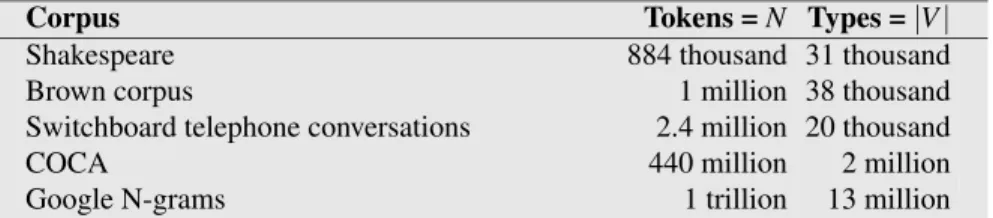
Corpus Tokens =N Types =|V|
Shakespeare 884 thousand 31 thousand
Brown corpus 1 million 38 thousand
Switchboard telephone conversations 2.4 million 20 thousand
COCA 440 million 2 million
Google N-grams 1 trillion 13 million
Figure 2.10 Rough numbers of types and tokens for some English language corpora. The largest, the Google N-grams corpus, contains 13 million types, but this count only includes types appearing 40 or more times, so the true number would be much larger.
Fig.2.10shows the rough numbers of types and tokens computed from some popular English corpora. The larger the corpora we look at, the more word types we find, and in fact this relationship between the number of types|V|and number of tokensNis calledHerdan’s Law(Herdan, 1960)orHeaps’ Law(Heaps, 1978) Herdan’s Law
Heaps’ Law after its discoverers (in linguistics and information retrieval respectively). It is shown in Eq.2.1, wherekandb are positive constants, and 0<b <1.
|V| = kNb (2.1)
The value ofb depends on the corpus size and the genre, but at least for the large corpora in Fig.2.10,b ranges from .67 to .75. Roughly then we can say that the vocabulary size for a text goes up significantly faster than the square root of its length in words.
Another measure of the number of words in the language is the number of lem-mas instead of wordform types. Dictionaries can help in giving lemma counts; dic-tionaryentriesorboldface formsare a very rough upper bound on the number of
lemmas (since some lemmas have multiple boldface forms). The 1989 edition of the Oxford English Dictionary had 615,000 entries.
2.3 Corpora
Words don’t appear out of nowhere. Any particular piece of text that we study is produced by one or more specific speakers or writers, in a specific dialect of a specific language, at a specific time, in a specific place, for a specific function.
Perhaps the most important dimension of variation is the language. NLP algo-rithms are most useful when they apply across many languages. The world has 7097 languages at the time of this writing, according to the online Ethnologue catalog (Simons and Fennig, 2018). Most NLP tools tend to be developed for the official languages of large industrialized nations (Chinese, English, Spanish, Arabic, etc.), but we don’t want to limit tools to just these few languages. Furthermore, most lan-guages also have multiple varieties, such as dialects spoken in different regions or by different social groups. Thus, for example, if we’re processing text in African American Vernacular English (AAVE), a dialect spoken by millions of people in the AAVE
United States, it’s important to make use of NLP tools that function with that dialect. Twitter posts written in AAVE make use of constructions likeiont(I don’tin Stan-dard American English (SAE)), ortalmboutcorresponding to SAEtalking about, SAE
both examples that influence word segmentation (Blodgett et al. 2016,Jones 2015). It’s also quite common for speakers or writers to use multiple languages in a single communicative act, a phenomenon called code switching. Code switch-code switching
ing is enormously common across the world; here are examples showing Spanish and (transliterated) Hindi code switching with English (Solorio et al. 2014,Jurgens et al. 2017):
(2.2) Por primera vez veo a @username actually being hateful! it was beautiful:) [For the first time I get to see @username actually being hateful! it was beautiful:) ]
(2.3) dost tha or ra- hega ... dont wory ... but dherya rakhe
[“he was and will remain a friend ... don’t worry ... but have faith”]
Another dimension of variation is the genre. The text that our algorithms must process might come from newswire, fiction or non-fiction books, scientific articles, Wikipedia, or religious texts. It might come from spoken genres like telephone conversations, business meetings, police body-worn cameras, medical interviews, or transcripts of television shows or movies. It might come from work situations like doctors’ notes, legal text, or parliamentary or congressional proceedings.
Text also reflects the demographic characteristics of the writer (or speaker): their age, gender, race, socioeconomic class can all influence the linguistic properties of the text we are processing.
And finally, time matters too. Language changes over time, and for some lan-guages we have good corpora of texts from different historical periods.
Because language is so situated, when developing computational models for lan-guage processing, it’s important to consider who produced the lanlan-guage, in what context, for what purpose, and make sure that the models are fit to the data.
2.4 Text Normalization
Before almost any natural language processing of a text, the text has to be normal-ized. At least three tasks are commonly applied as part of any normalization process:
1. Tokenizing (segmenting) words 2. Normalizing word formats 3. Segmenting sentences
In the next sections we walk through each of these tasks.
2.4.1 Unix Tools for Crude Tokenization and Normalization
Let’s begin with an easy, if somewhat naive version of word tokenization and nor-malization (and frequency computation) that can be accomplished for English solely in a single UNIX command-line, inspired byChurch (1994). We’ll make use of some Unix commands: tr, used to systematically change particular characters in the in-put;sort, which sorts input lines in alphabetical order; anduniq, which collapses and counts adjacent identical lines.
For example let’s begin with the ‘complete words’ of Shakespeare in one textfile, sh.txt. We can usetrto tokenize the words by changing every sequence of non-alphabetic characters to a newline (’A-Za-z’ means non-alphabetic, the -c option com-plements to non-alphabet, and the -s option squeezes all sequences into a single character):
tr -sc ’A-Za-z’ ’\n’ < sh.txt The output of this command will be:
THE SONNETS by William Shakespeare From fairest creatures We ...
Now that there is one word per line, we can sort the lines, and pass them touniq -cwhich will collapse and count them:
tr -sc ’A-Za-z’ ’\n’ < sh.txt | sort | uniq -c with the following output:
1945 A 72 AARON 19 ABBESS 25 Aaron 6 Abate 1 Abates 5 Abbess 6 Abbey
3 Abbot ...
Alternatively, we can collapse all the upper case to lower case:
tr -sc ’A-Za-z’ ’\n’ < sh.txt | tr A-Z a-z | sort | uniq -c whose output is 14725 a 97 aaron 1 abaissiez 10 abandon 2 abandoned 2 abase 1 abash 14 abate 3 abated 3 abatement ...
Now we can sort again to find the frequent words. The-noption tosortmeans to sort numerically rather than alphabetically, and the -roption means to sort in reverse order (highest-to-lowest):
tr -sc ’A-Za-z’ ’\n’ < sh.txt | tr A-Z a-z | sort | uniq -c | sort -n -r The results show that the most frequent words in Shakespeare, as in any other corpus, are the shortfunction wordslike articles, pronouns, prepositions:
27378 the 26084 and 22538 i 19771 to 17481 of 14725 a 13826 you 12489 my 11318 that 11112 in ...
Unix tools of this sort can be very handy in building quick word count statistics for any corpus.
2.4.2 Word Tokenization
The simple UNIX tools above were fine for getting rough word statistics but more sophisticated algorithms are generally necessary fortokenization, the task of seg-tokenization
menting running text into words.
While the Unix command sequence just removed all the numbers and punctu-ation, for most NLP applications we’ll need to keep these in our tokenization. We often want to break off punctuation as a separate token; commas are a useful piece of information for parsers, periods help indicate sentence boundaries. But we’ll often want to keep the punctuation that occurs word internally, in examples likem.p.h,, Ph.D.,AT&T,cap’n. Special characters and numbers will need to be kept in prices
($45.55) and dates (01/02/06); we don’t want to segment that price into separate to-kens of “45” and “55”. And there are URLs (http://www.stanford.edu), Twitter hashtags (#nlproc), or email addresses ([email protected]).
Number expressions introduce other complications as well; while commas nor-mally appear at word boundaries, commas are used inside numbers in English, every three digits: 555,500.50. Languages, and hence tokenization requirements, differ on this; many continental European languages like Spanish, French, and German, by contrast, use a comma to mark the decimal point, and spaces (or sometimes periods) where English puts commas, for example,555 500,50.
A tokenizer can also be used to expandcliticcontractions that are marked by clitic
apostrophes, for example, converting what’reto the two tokens what are, and we’retowe are. A clitic is a part of a word that can’t stand on its own, and can only occur when it is attached to another word. Some such contractions occur in other alphabetic languages, including articles and pronouns in French (j’ai,l’homme).
Depending on the application, tokenization algorithms may also tokenize mul-tiword expressions likeNew Yorkorrock ’n’ rollas a single token, which re-quires a multiword expression dictionary of some sort. Tokenization is thus inti-mately tied up withnamed entity detection, the task of detecting names, dates, and organizations (Chapter 18).
One commonly used tokenization standard is known as thePenn Treebank to-kenization standard, used for the parsed corpora (treebanks) released by the Lin-Penn Treebank
tokenization
guistic Data Consortium (LDC), the source of many useful datasets. This standard separates out clitics (doesn’tbecomesdoes plusn’t), keeps hyphenated words to-gether, and separates out all punctuation (to save space we’re showing visible spaces ‘ ’ between tokens, although newlines is a more common output):
Input: "The San Francisco-based restaurant," they said, "doesn’t charge $10".
Output: " The San Francisco-based restaurant , " they said , " does n’t charge $ 10 " .
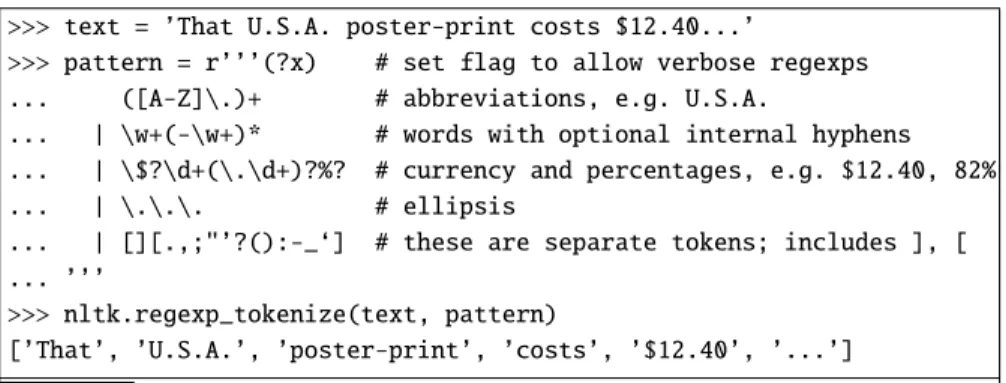
In practice, since tokenization needs to be run before any other language pro-cessing, it needs to be very fast. The standard method for tokenization is therefore to use deterministic algorithms based on regular expressions compiled into very ef-ficient finite state automata. For example, Fig.2.11shows an example of a basic regular expression that can be used to tokenize with thenltk.regexp tokenize function of the Python-based Natural Language Toolkit (NLTK) (Bird et al. 2009;
http://www.nltk.org).
Carefully designed deterministic algorithms can deal with the ambiguities that arise, such as the fact that the apostrophe needs to be tokenized differently when used as a genitive marker (as inthe book’s cover), a quotative as in‘The other class’, she said, or in clitics likethey’re.
Word tokenization is more complex in languages like written Chinese, Japanese, and Thai, which do not use spaces to mark potential word-boundaries.
In Chinese, for example, words are composed of characters (calledhanzi in hanzi
Chinese). Each character generally represents a single unit of meaning (called a morpheme) and is pronounceable as a single syllable. Words are about 2.4 charac-ters long on average. But deciding what counts as a word in Chinese is complex. For example, consider the following sentence:
(2.4) ⁄ €e;≥[
>>> text = ’That U.S.A. poster-print costs $12.40...’
>>> pattern = r’’’(?x) # set flag to allow verbose regexps
... ([A-Z]\.)+ # abbreviations, e.g. U.S.A.
... | \w+(-\w+)* # words with optional internal hyphens ... | \$?\d+(\.\d+)?%? # currency and percentages, e.g. $12.40, 82%
... | \.\.\. # ellipsis
... | [][.,;"’?():-_‘] # these are separate tokens; includes ], [ ... ’’’
>>> nltk.regexp_tokenize(text, pattern)
[’That’, ’U.S.A.’, ’poster-print’, ’costs’, ’$12.40’, ’...’]
Figure 2.11 A python trace of regular expression tokenization in the NLTK(Bird et al., 2009)Python-based natural language processing toolkit, commented for readability; the(?x)
verbose flag tells Python to strip comments and whitespace. Figure from Chapter 3 ofBird
et al. (2009).
AsChen et al. (2017)point out, this could be treated as 3 words (‘Chinese Treebank’ segmentation): (2.5) ⁄ YaoMing €e reaches ;≥[ finals
or as 5 words (‘Peking University’ segmentation): (2.6) ⁄ Yao Ming €e reaches ; overall ≥[ finals
Finally, it is possible in Chinese simply to ignore words altogether and use characters as the basic elements, treating the sentence as a series of 7 characters:
(2.7) ⁄ Yao Ming € enter e enter ; overall ≥ decision [ game
In fact, for most Chinese NLP tasks it turns out to work better to take characters rather than words as input, since characters are at a reasonable semantic level for most applications, and since most word standards result in a huge vocabulary with large numbers of very rare words(Li et al., 2019).
However, for Japanese and Thai the character is too small a unit, and so algo-rithms forword segmentationare required. These can also be useful for Chinese word
segmentation
in the rare situations where word rather than character boundaries are required. The standard segmentation algorithms for these languages use neural sequence mod-elstrained via supervised machine learning on hand-segmented training sets; we’ll introduce sequence models in Chapter 8.
2.4.3 Byte-Pair Encoding for Tokenization
There is a third option to tokenizing text input. Instead of defining tokens as words (defined by spaces in orthographies that have spaces, or more complex algorithms), or as characters (as in Chinese), we can use our data to automatically tell us what size tokens should be. Perhaps sometimes we might want tokens that are space-delimited words (likespinach) other times it’s useful to have tokens that are larger than words (likeNew York Times), and sometimes smaller than words (like the morphemes-est or-er. A morpheme is the smallest meaning-bearing unit of a language; for example the wordunlikeliesthas the morphemesun-,likely, and-est; we’ll return to this on page21.
One reason it’s helpful to havesubwordtokens is to deal with unknown words. subword
Unknown words are particularly relevant for machine learning systems. As we will see in the next chapter, machine learning systems often learn some facts about words in one corpus (atrainingcorpus) and then use these facts to make decisions about a separatetestcorpus and its words. Thus if our training corpus contains, say the words low, andlowest, but notlower, but then the wordlowerappears in our test corpus, our system will not know what to do with it.
A solution to this problem is to use a kind of tokenization in which most tokens are words, but some tokens are frequent morphemes or other subwords like-er, so that an unseen word can be represented by combining the parts.
The simplest such algorithm isbyte-pair encoding, orBPE (Sennrich et al., BPE
2016). Byte-pair encoding is based on a method for text compression(Gage, 1994), but here we use it for tokenization instead. The intuition of the algorithm is to iteratively merge frequent pairs of characters,
The algorithm begins with the set of symbols equal to the set of characters. Each word is represented as a sequence of characters plus a special end-of-word symbol . At each step of the algorithm, we count the number of symbol pairs, find the most frequent pair (‘A’, ‘B’), and replace it with the new merged symbol (‘AB’). We continue to count and merge, creating new longer and longer character strings, until we’ve donekmerges;kis a parameter of the algorithm. The resulting symbol set will consist of the original set of characters plusknew symbols.
The algorithm is run inside words (we don’t merge across word boundaries). For this reason, the algorithm can take as input a dictionary of words together with counts. Consider the following tiny input dictionary with counts for each word, which would have the starting vocabulary of 11 letters:
dictionary vocabulary 5 l o w , d, e, i, l, n, o, r, s, t, w 2 l o w e s t 6 n e w e r 3 w i d e r 2 n e w
We first count all pairs of symbols: the most frequent is the pairr because it occurs innewer(frequency of 6) andwider(frequency of 3) for a total of 9 oc-currences. We then merge these symbols, treating r as one symbol, and count again: dictionary vocabulary 5 l o w , d, e, i, l, n, o, r, s, t, w, r 2 l o w e s t 6 n e w e r 3 w i d e r 2 n e w
Now the most frequent pair ise r , which we merge; our system has learned that there should be a token for word-finaler, represented aser :
dictionary vocabulary 5 l o w ,d,e,i,l,n,o,r,s,t,w,r ,er 2 l o w e s t 6 n e w er 3 w i d er 2 n e w
dictionary vocabulary 5 l o w ,d,e,i,l,n,o,r,s,t,w,r ,er ,ew 2 l o w e s t 6 n ew er 3 w i d er 2 n ew
If we continue, the next merges are: Merge Current Vocabulary
(n, ew) ,d,e,i,l,n,o,r,s,t,w,r ,er ,ew,new (l, o’ ,d,e,i,l,n,o,r,s,t,w,r ,er ,ew,new,lo (lo, w) ,d,e,i,l,n,o,r,s,t,w,r ,er ,ew,new,lo,low (new, er ) ,d,e,i,l,n,o,r,s,t,w,r ,er ,ew,new,lo,low,newer (low, ) ,d,e,i,l,n,o,r,s,t,w,r ,er ,ew,new,lo,low,newer ,low
When we need to tokenize a test sentence, we just run the merges we have learned, greedily, in the order we learned them, on the test data. (Thus the fre-quencies in the test data don’t play a role, just the frefre-quencies in the training data). So first we segment each test sentence word into characters. Then we apply the first rule: replace every instance ofr in the test corpus withr , and then the second rule: replace every instance ofe r in the test corpus wither , and so on. By the end, if the test corpus contained the wordn e w e r , it would be tokenized as a full word. But a new (unknown) word likel o w e r would be merged into the two tokenslow er .
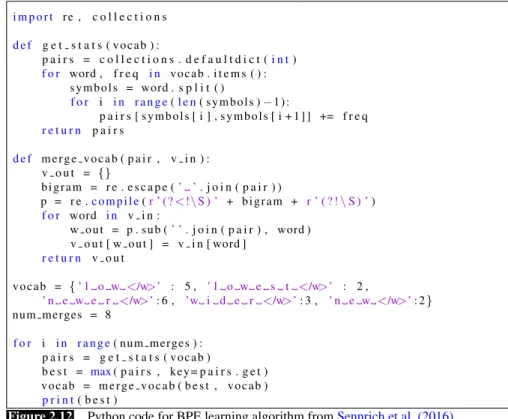
Of course in real algorithms BPE is run with many thousands of merges on a very large input dictionary. The result is that most words will be represented as full symbols, and only the very rare words (and unknown words) will have to be represented by their parts. The full BPE learning algorithm is given in Fig.2.12.
Wordpiece and Greedy Tokenization
There are some alternatives to byte pair encoding for inducing tokens. Like the BPE algorithm, thewordpiecealgorithm starts with some simple tokenization (such as wordpiece
by whitespace) into rough words, and then breaks those rough word tokens into subword tokens. Thewordpiece model differs from BPE only in that the special wordpiece
word-boundary token appears at the beginning of words rather than at the end, and in the way it merges pairs. Rather than merging the pairs that are mostfrequent, wordpiece instead merges the pairs that minimizes the language model likelihood of the training data. We’ll introduce these concepts in the next chapter, but to simplify, the wordpiece model chooses the two tokens to combine that would give the training corpus the highest probability(Wu et al., 2016).
In the wordpiece segmenter used in BERT(Devlin et al., 2019), like other word-piece variants, an input sentence or string is first split by some simple basic tokenizer (like whitespace) into a series of rough word tokens. But then instead of using a word boundary token, word-initial subwords are distinguished from those that do not start words by marking internal subwords with special symbols ##, so that we might splitunaffableinto ["un", "\#\#aff", "\#\#able"]. Then each word token string is tokenized using a greedy longest-match-first algorithm. This is dif-ferent than the decoding algorithm we introduced for BPE, which runs the merges on the test sentence in the same order they were learned from the training set.
Greedy longest-match-first decoding is sometimes calledmaximum matching maximum
matching
or MaxMatch. The maximum matching algorithm (Fig.2.13) is given a vocabu-lary (a learned list of wordpiece tokens) and a string and starts by pointing at the
i m p o r t re , c o l l e c t i o n s d e f g e t s t a t s ( vocab ) : p a i r s = c o l l e c t i o n s . d e f a u l t d i c t (i n t) f o r word , f r e q i n vocab . i t e m s ( ) : symbols = word . s p l i t ( ) f o r i i n r a n g e(l e n( symbols ) 1): p a i r s [ symbols [ i ] , symbols [ i + 1 ] ] += f r e q r e t u r n p a i r s d e f merge vocab ( p a i r , v i n ) : v o u t = {} bigram = r e . e s c a p e (’ ’. j o i n ( p a i r ) ) p = r e .c o m p i l e(r ’ (?<!\S ) ’ + bigram + r ’ ( ? !\S ) ’) f o r word i n v i n :
w out = p . sub (’ ’. j o i n ( p a i r ) , word ) v o u t [ w out ] = v i n [ word ] r e t u r n v o u t vocab = {’ l o w </w>’ : 5 , ’ l o w e s t </w>’ : 2 , ’ n e w e r </w>’: 6 , ’w i d e r </w>’: 3 , ’ n e w </w>’: 2} num merges = 8 f o r i i n r a n g e( num merges ) : p a i r s = g e t s t a t s ( vocab ) b e s t = max( p a i r s , key= p a i r s . g e t ) vocab = merge vocab ( b e s t , vocab ) p r i n t( b e s t )
Figure 2.12 Python code for BPE learning algorithm fromSennrich et al. (2016).
beginning of a string. It chooses the longest token in the wordpiece vocabulary that matches the input at the current position, and moves the pointer past that word in the string. The algorithm is then applied again starting from the new pointer position.
functionMAXMATCH(string, dictionary)returnslist of tokens T
ifstring is empty
returnempty list
fori length(sentence)downto1
firstword= firstichars ofsentence remainder= rest ofsentence ifInDictionary(firstword,dictionary)
return list(firstword, MaxMatch(remainder,dictionary) )
Figure 2.13 The MaxMatch (or ‘greedy longest-first’) algorithm for word tokenization us-ing wordpiece or other vocabularies. Assumes that all strus-ings can be successfully tokenized with the given dictionary.
Thus given the tokenintentionand the dictionary:
["in", "tent","intent","##tent", "##tention", "##tion", "#ion"] the BERT tokenizer would chooseintent(because it is longer thanin, and then ##ionto complete the string, resulting in the tokenization["intent" "##ion"]. The BERT tokenizer applied to the stringunwanted runningwill produce: (2.8) ["un", "##want", "##ed", "runn", "##ing"]
Another tokenization algorithm is calledSentencePiece(Kudo and Richardson, SentencePiece
2018). BPE and wordpiece both assume that we already have some initial tokeniza-tion of words (such as by spaces, or from some initial dictokeniza-tionary) and so we never tried to induce word parts across spaces. By contrast, the SentencePiece model works from raw text; even whitespace is handled as a normal symbol. Thus it doesn’t need an initial tokenization or word-list, and can be used in languages like Chinese or Japanese that don’t have spaces.
2.4.4 Word Normalization, Lemmatization and Stemming
Wordnormalizationis the task of putting words/tokens in a standard format, choos-normalization
ing a single normal form for words with multiple forms likeUSAandUSoruh-huh anduhhuh. This standardization may be valuable, despite the spelling information that is lost in the normalization process. For information retrieval or information extraction about the US, we might want see information from documents whether they mention theUSor theUSA.
Case foldingis another kind of normalization. Mapping everything to lower case folding
case means that Woodchuckand woodchuckare represented identically, which is very helpful for generalization in many tasks, such as information retrieval or speech recognition. For sentiment analysis and other text classification tasks, information extraction, and machine translation, by contrast, case can be quite helpful and case folding is generally not done. This is because maintaining the difference between, for example, US the country and usthe pronoun can outweigh the advantage in generalization that case folding would have provided for other words.
For many natural language processing situations we also want two morpholog-ically different forms of a word to behave similarly. For example in web search, someone may type the stringwoodchucksbut a useful system might want to also return pages that mentionwoodchuckwith nos. This is especially common in mor-phologically complex languages like Russian, where for example the wordMoscow has different endings in the phrasesMoscow,of Moscow,to Moscow, and so on.
Lemmatizationis the task of determining that two words have the same root, despite their surface differences. The wordsam,are, andishave the shared lemma be; the wordsdinneranddinnersboth have the lemmadinner. Lemmatizing each of these forms to the same lemma will let us find all mentions of words in Russian like Moscow. The lemmatized form of a sentence likeHe is reading detective stories would thus beHe be read detective story.
How is lemmatization done? The most sophisticated methods for lemmatization involve completemorphological parsingof the word.Morphologyis the study of the way words are built up from smaller meaning-bearing units calledmorphemes. morpheme
Two broad classes of morphemes can be distinguished: stems—the central mor-stem
pheme of the word, supplying the main meaning— andaffixes—adding “additional” affix
meanings of various kinds. So, for example, the wordfoxconsists of one morpheme (the morphemefox) and the wordcatsconsists of two: the morphemecatand the morpheme-s. A morphological parser takes a word likecatsand parses it into the two morphemescat ands, or a Spanish word like amaren(‘if in the future they would love’) into the morphemesamar‘to love’,3PL, andfuture subjunctive.
The Porter Stemmer
Lemmatization algorithms can be complex. For this reason we sometimes make use of a simpler but cruder method, which mainly consists of chopping off word-final affixes. This naive version of morphological analysis is calledstemming. One of stemming
the most widely used stemming algorithms is thePorter (1980). The Porter stemmer Porter stemmer
applied to the following paragraph:
This was not the map we found in Billy Bones’s chest, but an accurate copy, complete in all things-names and heights and soundings-with the single exception of the red crosses and the written notes.
produces the following stemmed output:
Thi wa not the map we found in Billi Bone s chest but an accur copi complet in all thing name and height and sound with the singl except of the red cross and the written note The algorithm is based on series of rewrite rules run in series, as acascade, in cascade
which the output of each pass is fed as input to the next pass; here is a sampling of the rules:
ATIONAL ! ATE (e.g., relational!relate)
ING ! ✏ if stem contains vowel (e.g., motoring!motor) SSES ! SS (e.g., grasses!grass)
Detailed rule lists for the Porter stemmer, as well as code (in Java, Python, etc.) can be found on Martin Porter’s homepage; see also the original paper(Porter, 1980). Simple stemmers can be useful in cases where we need to collapse across differ-ent variants of the same lemma. Nonetheless, they do tend to commit errors of both over- and under-generalizing, as shown in the table below(Krovetz, 1993):
Errors of Commission Errors of Omission organization organ European Europe
doing doe analysis analyzes
numerical numerous noise noisy
policy police sparse sparsity
2.4.5 Sentence Segmentation
Sentence segmentationis another important step in text processing. The most use-Sentence
segmentation
ful cues for segmenting a text into sentences are punctuation, like periods, question marks, and exclamation points. Question marks and exclamation points are rela-tively unambiguous markers of sentence boundaries. Periods, on the other hand, are more ambiguous. The period character “.” is ambiguous between a sentence bound-ary marker and a marker of abbreviations likeMr.orInc.The previous sentence that you just read showed an even more complex case of this ambiguity, in which the final period ofInc. marked both an abbreviation and the sentence boundary marker. For this reason, sentence tokenization and word tokenization may be addressed jointly.
In general, sentence tokenization methods work by first deciding (based on rules or machine learning) whether a period is part of the word or is a sentence-boundary marker. An abbreviation dictionary can help determine whether the period is part of a commonly used abbreviation; the dictionaries can be hand-built or machine-learned (Kiss and Strunk, 2006), as can the final sentence splitter. In the Stan-ford CoreNLP toolkit (Manning et al., 2014), for example sentence splitting is rule-based, a deterministic consequence of tokenization; a sentence ends when a sentence-ending punctuation (., !, or ?) is not already grouped with other charac-ters into a token (such as for an abbreviation or number), optionally followed by additional final quotes or brackets.
2.5 Minimum Edit Distance
Much of natural language processing is concerned with measuring how similar two strings are. For example in spelling correction, the user typed some erroneous string—let’s saygraffe–and we want to know what the user meant. The user prob-ably intended a word that is similar tograffe. Among candidate similar words, the wordgiraffe, which differs by only one letter fromgraffe, seems intuitively to be more similar than, saygrailorgraf, which differ in more letters. Another example comes fromcoreference, the task of deciding whether two strings such as the following refer to the same entity:
Stanford President John Hennessy
Stanford University President John Hennessy
Again, the fact that these two strings are very similar (differing by only one word) seems like useful evidence for deciding that they might be coreferent.
Edit distancegives us a way to quantify both of these intuitions about string sim-ilarity. More formally, theminimum edit distancebetween two strings is defined minimum edit
distance
as the minimum number of editing operations (operations like insertion, deletion, substitution) needed to transform one string into another.
The gap betweenintentionandexecution, for example, is 5 (delete ani, substi-tuteeforn, substitutexfort, insertc, substituteuforn). It’s much easier to see this by looking at the most important visualization for string distances, analignment alignment
between the two strings, shown in Fig.2.14. Given two sequences, analignmentis a correspondence between substrings of the two sequences. Thus, we sayIaligns with the empty string,NwithE, and so on. Beneath the aligned strings is another representation; a series of symbols expressing anoperation listfor converting the top string into the bottom string:dfor deletion,sfor substitution,ifor insertion.
I N T E * N T I O N
| | | | | | | | | |
* E X E C U T I O N
d s s i sFigure 2.14 Representing the minimum edit distance between two strings as analignment. The final row gives the operation list for converting the top string into the bottom string: d for deletion, s for substitution, i for insertion.
We can also assign a particular cost or weight to each of these operations. The Levenshtein distance between two sequences is the simplest weighting factor in which each of the three operations has a cost of 1(Levenshtein, 1966)—we assume that the substitution of a letter for itself, for example,tfort, has zero cost. The Lev-enshtein distance betweenintentionandexecutionis 5. Levenshtein also proposed an alternative version of his metric in which each insertion or deletion has a cost of 1 and substitutions are not allowed. (This is equivalent to allowing substitution, but giving each substitution a cost of 2 since any substitution can be represented by one insertion and one deletion). Using this version, the Levenshtein distance between intentionandexecutionis 8.
2.5.1 The Minimum Edit Distance Algorithm
How do we find the minimum edit distance? We can think of this as a search task, in which we are searching for the shortest path—a sequence of edits—from one string to another.
n t e n t i o n i n t e c n t i o n i n x e n t i o n
del ins subst
i n t e n t i o n
Figure 2.15 Finding the edit distance viewed as a search problem
The space of all possible edits is enormous, so we can’t search naively. However, lots of distinct edit paths will end up in the same state (string), so rather than recom-puting all those paths, we could just remember the shortest path to a state each time we saw it. We can do this by usingdynamic programming. Dynamic programming dynamic
programming
is the name for a class of algorithms, first introduced byBellman (1957), that apply a table-driven method to solve problems by combining solutions to sub-problems. Some of the most commonly used algorithms in natural language processing make use of dynamic programming, such as theViterbi algorithm (Chapter 8) and the CKYalgorithm for parsing (Chapter 13).
The intuition of a dynamic programming problem is that a large problem can be solved by properly combining the solutions to various sub-problems. Consider the shortest path of transformed words that represents the minimum edit distance between the stringsintentionandexecutionshown in Fig.2.16.
n t e n t i o n i n t e n t i o n e t e n t i o n e x e n t i o n e x e n u t i o n e x e c u t i o n delete i substitute n by e substitute t by x insert u substitute n by c
Figure 2.16 Path fromintentiontoexecution.
Imagine some string (perhaps it isexention) that is in this optimal path (whatever it is). The intuition of dynamic programming is that ifexention is in the optimal operation list, then the optimal sequence must also include the optimal path from intentiontoexention. Why? If there were a shorter path fromintentiontoexention, then we could use it instead, resulting in a shorter overall path, and the optimal sequence wouldn’t be optimal, thus leading to a contradiction.
Theminimum edit distancealgorithm was named byWagner and Fischer (1974) minimum edit
distance
but independently discovered by many people (see the Historical Notes section of Chapter 8).
Let’s first define the minimum edit distance between two strings. Given two strings, the source stringXof lengthn, and target stringY of lengthm, we’ll define D[i,j]as the edit distance betweenX[1..i]andY[1..j], i.e., the firsticharacters ofX
We’ll use dynamic programming to computeD[n,m]bottom up, combining so-lutions to subproblems. In the base case, with a source substring of lengthibut an empty target string, going fromi characters to 0 requiresi deletes. With a target substring of length jbut an empty source going from 0 characters to jcharacters requires j inserts. Having computedD[i,j]for small i,j we then compute larger D[i,j]based on previously computed smaller values. The value ofD[i,j]is com-puted by taking the minimum of the three possible paths through the matrix which arrive there: D[i,j] =min 8 < : D[i 1,j] +del-cost(source[i]) D[i,j 1] +ins-cost(target[j])
D[i 1,j 1] +sub-cost(source[i],target[j])
If we assume the version of Levenshtein distance in which the insertions and dele-tions each have a cost of 1 (ins-cost(·) = del-cost(·) = 1), and substitutions have a cost of 2 (except substitution of identical letters have zero cost), the computation for D[i,j]becomes: D[i,j] =min 8 > > < > > : D[i 1,j] +1 D[i,j 1] +1 D[i 1,j 1] + ⇢2; if source [i]6=target[j] 0; if source[i] =target[j] (2.9)
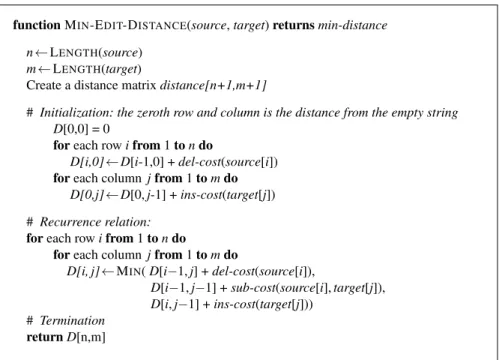
The algorithm is summarized in Fig.2.17; Fig.2.18shows the results of applying the algorithm to the distance betweenintentionandexecutionwith the version of Levenshtein in Eq.2.9.
Knowing the minimum edit distance is useful for algorithms like finding poten-tial spelling error corrections. But the edit distance algorithm is important in another way; with a small change, it can also provide the minimum costalignmentbetween two strings. Aligning two strings is useful throughout speech and language process-ing. In speech recognition, minimum edit distance alignment is used to compute the word error rate (Chapter 28). Alignment plays a role in machine translation, in which sentences in a parallel corpus (a corpus with a text in two languages) need to be matched to each other.
To extend the edit distance algorithm to produce an alignment, we can start by visualizing an alignment as a path through the edit distance matrix. Figure 2.19 shows this path with the boldfaced cell. Each boldfaced cell represents an alignment of a pair of letters in the two strings. If two boldfaced cells occur in the same row, there will be an insertion in going from the source to the target; two boldfaced cells in the same column indicate a deletion.
Figure2.19also shows the intuition of how to compute this alignment path. The computation proceeds in two steps. In the first step, we augment the minimum edit distance algorithm to store backpointers in each cell. The backpointer from a cell points to the previous cell (or cells) that we came from in entering the current cell. We’ve shown a schematic of these backpointers in Fig.2.19. Some cells have mul-tiple backpointers because the minimum extension could have come from mulmul-tiple previous cells. In the second step, we perform abacktrace. In a backtrace, we start backtrace
from the last cell (at the final row and column), and follow the pointers back through the dynamic programming matrix. Each complete path between the final cell and the initial cell is a minimum distance alignment. Exercise 2.7 asks you to modify the minimum edit distance algorithm to store the pointers and compute the backtrace to output an alignment.
functionMIN-EDIT-DISTANCE(source,target)returnsmin-distance
n LENGTH(source)
m LENGTH(target)
Create a distance matrixdistance[n+1,m+1]
# Initialization: the zeroth row and column is the distance from the empty string D[0,0] = 0
foreach rowifrom1tondo
D[i,0] D[i-1,0] +del-cost(source[i])
foreach column jfrom1tomdo
D[0,j] D[0,j-1] +ins-cost(target[j]) # Recurrence relation:
foreach rowifrom1tondo
foreach column jfrom1tomdo
D[i, j] MIN(D[i 1,j] +del-cost(source[i]),
D[i 1,j 1] +sub-cost(source[i],target[j]),
D[i,j 1] +ins-cost(target[j])) # Termination
returnD[n,m]
Figure 2.17 The minimum edit distance algorithm, an example of the class of dynamic
programming algorithms. The various costs can either be fixed (e.g., 8x,ins-cost(x) =1)
or can be specific to the letter (to model the fact that some letters are more likely to be in-serted than others). We assume that there is no cost for substituting a letter for itself (i.e., sub-cost(x,x) =0). Src\Tar # e x e c u t i o n # 0 1 2 3 4 5 6 7 8 9 i 1 2 3 4 5 6 7 6 7 8 n 2 3 4 5 6 7 8 7 8 7 t 3 4 5 6 7 8 7 8 9 8 e 4 3 4 5 6 7 8 9 10 9 n 5 4 5 6 7 8 9 10 11 10 t 6 5 6 7 8 9 8 9 10 11 i 7 6 7 8 9 10 9 8 9 10 o 8 7 8 9 10 11 10 9 8 9 n 9 8 9 10 11 12 11 10 9 8
Figure 2.18 Computation of minimum edit distance betweenintentionandexecutionwith
the algorithm of Fig.2.17, using Levenshtein distance with cost of 1 for insertions or
dele-tions, 2 for substitutions.
While we worked our example with simple Levenshtein distance, the algorithm in Fig.2.17allows arbitrary weights on the operations. For spelling correction, for example, substitutions are more likely to happen between letters that are next to each other on the keyboard. TheViterbialgorithm is a probabilistic extension of minimum edit distance. Instead of computing the “minimum edit distance” between two strings, Viterbi computes the “maximum probability alignment” of one string with another. We’ll discuss this more in Chapter 8.
# e x e c u t i o n # 0 1 2 3 4 5 6 7 8 9 i "1 - "2 - "3 - "4 - "5 - "6 - "7 -6 7 8 n "2 - "3 - "4 - "5 - "6 - "7 - "8 "7 - "8 -7 t "3 - "4 - "5 - "6 - "7 - "8 -7 "8 - "9 "8 e "4 -3 4 - 5 6 7 "8 - "9 - "10 "9 n "5 "4 - "5 - "6 - "7 - "8 - "9 - "10 - "11-"10 t "6 "5 - "6 - "7 - "8 - "9 -8 9 10 "11 i "7 "6 - "7 - "8 - "9 - "10 "9 -8 9 10 o "8 "7 - "8 - "9 - "10 - "11 "10 "9 -8 9 n "9 "8 - "9 - "10 - "11 - "12 "11 "10 "9 -8
Figure 2.19 When entering a value in each cell, we mark which of the three neighboring
cells we came from with up to three arrows. After the table is full we compute analignment
(minimum edit path) by using abacktrace, starting at the8in the lower-right corner and
following the arrows back. The sequence of bold cells represents one possible minimum cost
alignment between the two strings. Diagram design afterGusfield (1997).
2.6 Summary
This chapter introduced a fundamental tool in language processing, theregular ex-pression, and showed how to perform basic text normalizationtasks including word segmentationandnormalization,sentence segmentation, andstemming. We also introduce the importantminimum edit distancealgorithm for comparing strings. Here’s a summary of the main points we covered about these ideas:
• Theregular expressionlanguage is a powerful tool for pattern-matching. • Basic operations in regular expressions includeconcatenationof symbols,
disjunctionof symbols ([],|, and.),counters(*,+, and{n,m}),anchors (ˆ,$) and precedence operators ((,)).
• Word tokenization and normalizationare generally done by cascades of simple regular expressions substitutions or finite automata.
• ThePorter algorithmis a simple and efficient way to dostemming, stripping off affixes. It does not have high accuracy but may be useful for some tasks. • Theminimum edit distancebetween two strings is the minimum number of
operations it takes to edit one into the other. Minimum edit distance can be computed bydynamic programming, which also results in analignmentof the two strings.
Bibliographical and Historical Notes
Kleene (1951)and (1956) first defined regular expressions and the finite automaton, based on the McCulloch-Pitts neuron. Ken Thompson was one of the first to build regular expressions compilers into editors for text searching(Thompson, 1968). His editoredincluded a command “g/regular expression/p”, or Global Regular Expres-sion Print, which later became the Unixgreputility.
Text normalization algorithms have been applied since the beginning of the field. One of the earliest widely-used stemmers was Lovins (1968). Stemming was also applied early to the digital humanities, byPackard (1973), who built an affix-stripping morphological parser for Ancient Greek. Currently a wide
vari-ety of code for tokenization and normalization
![Figure 2.2 The use of the brackets [] to specify a disjunction of characters.](https://thumb-us.123doks.com/thumbv2/123dok_us/941058.2622274/3.918.208.711.164.236/figure-use-brackets-specify-disjunction-characters.webp)