Extracting drug–drug interactions from literature using a rich
feature-based linear kernel approach
Sun Kim
1, Haibin Liu
⇑,1, Lana Yeganova
1, W. John Wilbur
National Center for Biotechnology Information (NCBI), Bethesda, MD, USAa r t i c l e
i n f o
Article history:
Received 21 October 2014 Revised 21 January 2015 Accepted 11 March 2015 Available online 19 March 2015
Keywords:
Drug–drug interaction Biomedical literature Linear kernel approach
a b s t r a c t
Identifying unknown drug interactions is of great benefit in the early detection of adverse drug reactions. Despite existence of several resources for drug–drug interaction (DDI) information, the wealth of such information is buried in a body of unstructured medical text which is growing exponentially. This calls for developing text mining techniques for identifying DDIs. The state-of-the-art DDI extraction methods use Support Vector Machines (SVMs) with non-linear composite kernels to explore diverse contexts in literature. While computationally less expensive, linear kernel-based systems have not achieved a comparable performance in DDI extraction tasks. In this work, we propose an efficient and scalable sys-tem using a linear kernel to identify DDI information. The proposed approach consists of two steps: identifying DDIs and assigning one of four different DDI types to the predicted drug pairs. We demon-strate that when equipped with a rich set of lexical and syntactic features, a linear SVM classifier is able to achieve a competitive performance in detecting DDIs. In addition, theone-against-onestrategy proves vital for addressing an imbalance issue in DDI type classification. Applied to the DDIExtraction 2013 cor-pus, our system achieves anF1 score of 0.670, as compared to 0.651 and 0.609 reported by the top two participating teams in the DDIExtraction 2013 challenge, both based on non-linear kernel methods.
Published by Elsevier Inc. This is an open access article under the CC BY-NC-ND license ( http://creative-commons.org/licenses/by-nc-nd/4.0/).
1. Introduction
New drugs are generally studied on relatively small and homogeneous patient populations. As a result, pharmaceuticals often have side effects that remain unnoticed until they are already available to the public. This is especially true of side effects that emerge when two drugs are co-administered. A change in the effect of one drug in the presence of another drug is known as a drug–drug interaction (DDI)[1]. It is characterized as an increase or decrease in the action of either substance, or it may be an adverse effect that is not normally associated with either drug. Understanding these drug–drug interactions and their down-stream effects is of significant importance, leading to reduced number of drug-safety incidents and reduced healthcare costs.
To address the DDI problem, a number of drug databases such as DrugBank[2]and Stockley’s Drug Interactions[1]have been cre-ated. Yet, they cover only a fraction of knowledge available. A large amount of up-to-date information is still hidden in the text of jour-nal articles, technical reports and adverse event reporting systems,
and this body of unstructured published literature is growing rapidly. MEDLINEÒ, for example, has doubled in size within the last
decade and currently contains about 23 million documents. This creates an urgent need for text mining techniques to extract DDI information.
Using text mining techniques for DDI extraction has received less attention compared to other biomedical relation extraction tasks (e.g., protein–protein interactions), possibly due to the lack of gold standard sets[3–6]. The DDIExtraction challenges are the first community-wide competition addressing the DDI extraction problem[7,8] and a series of studies have been reported at the 2011 and 2013 challenge workshops[9–11].
Top performing systems in the DDIExtraction challenges use Support Vector Machines (SVMs) with non-linear kernels[12,13]. To handle structural representations of input instances, such as dependency graphs, non-linear kernels directly calculate similari-ties between two graphs by comparing embedded subgraphs[14]. While non-linear kernels are theoretically capable of implicitly searching a high dimensional feature space of subgraphs, existing methods generally exploit only a partial feature space because of the exponential number of subgraphs[15]. In addition, non-linear kernels are frequently combined into composite kernels [12,11]. Composite kernels, however, incur more computational cost because the complexity of the underlying kernels accumulates
http://dx.doi.org/10.1016/j.jbi.2015.03.002 1532-0464/Published by Elsevier Inc.
This is an open access article under the CC BY-NC-ND license (http://creativecommons.org/licenses/by-nc-nd/4.0/). ⇑ Corresponding author.
E-mail addresses:[email protected](S. Kim),[email protected](H. Liu),lana. [email protected](L. Yeganova),[email protected](W.J. Wilbur).
1 These authors contributed equally to this work.
Contents lists available atScienceDirect
Journal of Biomedical Informatics
j o u r n a l h o m e p a g e : w w w . e l s e v i e r . c o m / l o c a t e / y j b i nand additional learning is required to optimize the weights for individual kernels.
Despite the popularity of non-linear kernel methods, linear ker-nels are a good alternative for relation extraction tasks[16–18]. Linear kernels with word-level features alone provide a strong baseline performance [11,12]. Moreover, they can explicitly include nodes, edges and path structures of the dependency graphs
[17]. Also, the straightforward representation of linear kernels enables the intuitive interpretation of obtained results. Most importantly, when training large-scale datasets, it has been demonstrated that often linear kernels are the only practical choice
[19,20]. However, the performance of linear kernel systems in DDI extraction tasks has a noticeable gap from that of the top systems using non-linear kernels[7,8,21].
We conjecture that linear kernel-based systems may benefit from a rich set of lexical and syntactic features. With the goal to build a simple and scalable system, we develop a DDI extraction system based on a single linear SVM classifier. We define five types of features to capture the complexity of data: word features with position information, pairs of non-adjacent words, dependency relations, parse tree structures and tags for differentiating DDI pairs within the same noun phrase. Unlike other state-of-the-art systems [13,21] which incorporate external, domain-specific resources, our features originate exclusively from training data.
We evaluate our system on the DDIExtraction 2013 corpus[22]. Consistent with other studies [11–13], we adopt a two-phase approach, where DDI pairs are identified first, and then classified into specific DDI types. The proposed method achieves an overall
F-score of 67% which outperforms the best performing system by 1.9%. We believe that the strength of our method comes from using a diverse set of features. In addition, theone-against-onestrategy
[23]used in the DDI type classification contributes to the higher performance. As the first linear kernel method that achieves the state-of-the-art performance on both DDI detection and classifica-tion tasks, we consider it a strong alternative to the nonlinear, composite kernel-based approaches. The inherent simplicity of the method adds transparency to the overall system, which could be especially beneficial if the system is used as a part of a more complicated schema. The source code for generating the features proposed in this article is available at http://www.ncbi.nlm.nih. gov/IRET/DDI.
2. Methods
Fig. 1illustrates the overall architecture of our DDI extraction system. A binary classifier is trained first to extract interacting drug pairs from all candidate interactions. A DDI type classifier is then built to classify the interacting pairs into predefined relation cate-gories. Our approach focuses on interactions expressed within the boundaries of a single sentence, and also assumes that drug enti-ties involved in the target interactions have been annotated.
In this section, we first elaborate the five types of features used, including two novel features proposed for the DDI problem: word pair and noun phrase-constrained coordination (NPC) features. Then, we briefly introduce the preprocessing steps completed on both training and test data. Next, we describe our linear SVM clas-sifier with a modified Huber loss function[24]. In the end, we com-pare our method with existing DDI extraction systems.
2.1. Features 2.1.1. Word features
Word-level features such as individual words in a sentence and sequences of words have been demonstrated to provide a strong performance baseline in extracting relational knowledge
[11,17,25]. Hence, in our system, we usen-gram features of size up to 3, i.e., unigrams, bigrams and trigrams. Includingn-grams of larger size does not always lead to a performance increase due to the data sparseness problem[25]. Similar to the works of He et al. [11] and Giuliano et al. [26], the position information is appended to each word feature according to positions of words in a sentence relative to an investigated drug pair:before (BF),
between(BE) and after (AF). For instance, ‘‘Interaction_BF of_BF
ketamine and_BE halothane in_AF rats_AF’’ where ‘‘ketamine’’ and ‘‘halothane’’ are two drug names.
2.1.2. Word pair features
While word features may capture repetitive expression patterns in neighboring words, they are not able to discover patterns involv-ing distant words in a sentence. A simple solution to capture dis-tant word patterns is to extract all possible word combinations from a training set. However, this approach increases the number of features considerably, and it also may degrade classification per-formance. To address this issue, we here propose a novel technique for selecting significant word pairs.
First, unigram word features are paired and only those pairs with a minimum frequencyk are selected. Second, for selected word pairs, p-values are calculated using the hypergeometric distribution[27]. The p-value reflects how strongly a feature is represented in the positive set as compared to the negative set. It relates to the null hypothesis that the co-occurrence of two words is randomly distributed between positive and negative sets. If the co-occurrence is randomly distributed, the word pair will have a highp-value. If thep-value is low, this indicates a 1pprobability that the co-occurrence is not random and is likely indicative for positive DDIs.
To obtain the most useful word pairs, we need the least restric-tive frequency and the most restricrestric-tivep-value. In this work, we set
k¼200 andp-value = 0.01 based onF1 scores via 10-fold docu-ment-level cross validation on the training set. This significantp -value helps select 588 word pairs from a total of 449,826 pairs with
kabove 200. This feature set contains certain informative word pairs such as ‘‘drug1 drug2 increase level’’ and Fig. 1.Two-phase DDI extraction framework. DDI detection (r) decides whether a drug pair interacts. DDI type classification (s) assigns DDI types to interacting pairs.
‘‘interaction drug1 with drug2’’, which provide a strong
signal indicating DDIs.
2.1.3. Dependency graph features
Dependency graphs use nodes to represent words in a sentence and edges to describe governor-dependent relations between the words. Thus, they can capture long-range dependencies among sentential constituents by considerably narrowing the linear order distance between target entities[19]. Since the syntactic depen-dencies closely approximate the underlying semantic relation-ships, they have been effectively used by biomedical knowledge extraction systems[28,16,29–31].
While some approaches use an all-inclusive approach to explore paths of all possible lengths between any two nodes in a depen-dency graph[32,15], the shortest path between two nodes is par-ticularly likely to carry the most valuable information about their mutual relationship[33–36]. Given the dependency graph of each sentence, therefore, the shortest dependency path connecting the target drugs in the undirected version of the graph is selected. If there exist multiple shortest paths, we randomly choose one. The extracted path is then transformed into an ordered sequence of individual dependency relations, in which original relation labels and edge orientations are appropriately preserved. For instance, a dependency path ‘‘ketamine nsubjinteracts prep with! halothane’’ is encoded as ‘‘nsubj(interacts,ketamine); prep_with(inter-acts,halothane)’’. We further split a dependency path inton-grams of up to size 3. Compared to the vertex-walks basedq-grams pro-posed by Kuboyama et al.[37], our dependency features are equiva-lent toq-bigrams in their work.
2.1.4. Parse tree features
We have observed in the training data of the DDIExtraction 2013 challenge [8] that the textual descriptions of more than 25% of the total 4023 interacting drug–drug pairs involve different subordinate clauses of a sentence such as ‘‘If additionaladrenergic drugsare to be administered by any route, they should be used with caution because the pharmacologically predictable sympathetic effects ofBROVANAmay be potentiated.’’, or appear in the main sentence and its subordinate clause for instance ‘‘Whencarbamazepineis withdrawn from the combination therapy,aripiprazoledose should then be reduced.’’ Capturing these grammatical patterns is thus important to the successful extraction of these interactions. Compared to constituent parse trees which inherently retain phra-sal and clauphra-sal structures, dependency graphs do not explicitly pre-serve this rich syntactic information.
It has been shown that systems exclusively relying on parse trees obtain inferior results to using dependency graphs in infor-mation extraction tasks[31,16]. However, combining information from both representations improves the overall performance
[38,11]. To supplement our dependency features, we extracted the shortest path connecting the two investigated drugs in the parse tree. The resulting path is a sequence of grammatical tags such as ‘‘NP S VP VP SBAR S VP PP NP’’, representing a concise tactic traverse from one drug to the other. To capture frequent syn-tactic patterns,n-grams over individual tags of size 3 are used as our parse tree features. Unlike word features and dependency graph features, unigrams and bigrams are not used for parse tree features because these patterns are too short to represent syntactic structures.
2.1.5. Noun phrase-constrained coordination features
Linguistically, relationships are rarely discussed among entities in syntactic constituents where 3 or more target entities appear in a coordination. For instance, in the sentence ‘‘Clidiniummay decrease the effect ofphenothiazines,levodopa,andketoconazole.’’, the
coordination structure ‘‘phenothiazines, levodopa, and ketocona-zole’’ is used to enumerate a list of drugs that potentially interact with ‘‘Clidinium’, with no indication of interactions among the drugs inside the coordination.
In this work, we use base noun phrases to constrain the scope of the coordinated drug mentions, and propose a novel, noun phrase-constrained coordination feature to indicate if the target drugs are coordinated in a noun phrase. Suppose the total number of drug mentions in a base noun phraseNPbisn, the new featurefcfor each
candidate DDI pair (d1;d2) is defined as follows:
fcðd1;d2Þ ¼
1; ifðd1;d2Þ 2NPband nP3; 0; otherwise:
ð1Þ
Because of the cascaded structure, candidate noun phrases are recursively extracted from the constituent parse trees. A base noun phraseNPbis defined to be the longest noun phrase that does not
contain any prepositional phrases (PP), verb phrases (VP), sub-ordinate clauses (SBAR) or sentences (S). We observed only 16 interacting drug–drug pairs (0.2%) among the total 8045 pairs satisfyingfc= 1 in the DDIExtraction 2013 training data.
2.2. Preprocessing
Several standard preprocessing steps are first completed on both training and test data. These include sentence segmentation and tokenization, Part-of-Speech (POS) tagging and syntactic pars-ing that produces constituent parse trees and dependency graphs for sentences[39,40]. To ensure generalization of the features, drug mentions are anonymized using ‘‘DRUG’’ for target drugs and ‘‘DRUG_OTHER’’ for other drugs. Numbers are replaced by a generic tag ‘‘NUM’’, and other tokens normalized into their corresponding lemmas by the BioLemmatizer[41].
The same drug mentions can appear multiple times in a sen-tence. Considering that drugs are unlikely to interact with them-selves, candidate pairs with both drugs referring to the same name are removed[42,12]. This helps reduce candidate drug pairs. In addition, we notice that drug names are sometimes separated by a colon from the detailed description on their interactions with other drugs. For instance, ‘‘Morphine:Combinationhormonal con-traceptivesmay increase the clearance ofmorphine.’’ In such cases, as the description itself is an independent sentence, pairing ‘‘Morphine’’ on the left of the colon with drug mentions in the description may interfere with the narrative flow of the descrip-tion. Thus, we remove the drug mentions on the left of the colon from further consideration.
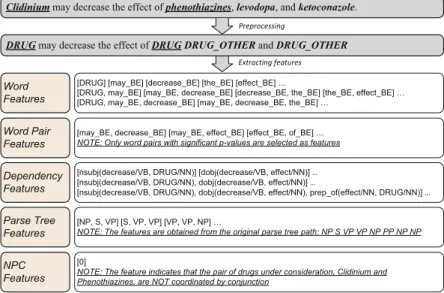
Fig. 2 shows the preprocessing step and the feature vector obtained for an example sentence.
2.3. SVM classifier
For DDI detection and classification, we use an SVM classifier with the modified Huber loss function[24]. We have observed that the modified Huber loss function has consistently achieved better performance than the hinge loss function used in traditional SVMs for biomedical classification problems [43,25,44]. Let T
denote the size of the training set. Let the binary feature vector of theith pair in the training set be denoted byXi. Let yi¼1 if
the pair is annotated as positive and yi¼ 1 otherwise. Let w
denote a vector of feature weights, of the same length asXi. Leth
denote a threshold parameter, and let kdenote a regularization parameter. Then the cost function is given by:
C¼1 2kjwj 2 þ1 T XT i¼1 hðyiðhþwXiÞÞ; ð2Þ
where the functionhis the modified Huber loss function defined as follows: hðzÞ ¼ 4z; if z61; ð1zÞ2; if 1<z<1; 0; if 16z: 8 > < > : ð3Þ
The values of the parameters,wandhminimizingCare deter-mined using a gradient descent algorithm. The regularization parameterkis computed from the training set as follows:
k¼k0hjxji2; ð4Þ
wherehjxjiis the average Euclidean norm of the feature vectors in the training set. The parameterk0is set to 0.00001 for the DDI task.
2.4. Comparison with existing DDI extraction systems
Our linear SVM classifier relies on a set of general features to achieve the state-of-the-art performance. Word-level features, dependency graphs and parse trees are commonly used by relation extraction systems[31,17,12,11]. Compared to the implicit use in non-linear kernel systems[11,12], features extracted from depen-dency graphs and parse trees are represented as linearn-grams in our system. As the only linear kernel system of the top 3 DDIExtraction 2013 teams, UTurku [21] makes intensive use of dependency graph features, but does not take advantage of the rich syntactic information in parse trees. In our system, both are used to complement each other for multiple aspects of structural analysis of sentences.
The noun phrase-constrained coordination and word pair fea-tures are novel in our DDI extraction approach. He et al.[11]aimed for general conjunction structures around investigated drugs by encoding relative distances into features. However, our coordina-tion feature is able to explicitly capture the coordinacoordina-tion structure of enumerated drugs, and semantically constrain the scope of the structure by noun phrases. Also, even though Bobic´ et al.[45] com-bined non-adjacent tokens across sections (‘‘BF’’, ‘‘BE’’ and ‘‘AF’’), they used all the combinations without any feature selection. We find that the feature selection usingp-values is effective for reduc-ing the data complexity and for improvreduc-ing the DDI extraction performance.
In addition, Björne et al.[21]took advantage of domain knowl-edge derived from DrugBank [2] and MetaMap [46]. Besides
domain-specific resources, He et al. [11] additionally asked domain experts to manually compile keyword and semantic type features. Considering that our features originate exclusively from training data and their extraction is domain independent, our fea-ture types may be more generalizable to other relation extraction tasks.
3. Results and discussion 3.1. Dataset
We train and evaluate the proposed approach on the DDI corpus from the DDIExtraction 2013 challenge [8]. The DDI corpus includes 905 manually annotated documents from the DrugBank database and MEDLINE abstracts, which are split into 714 and 191 documents for training and test sets, respectively. The DDI set provides examples by sentences and, for each sentence, all drug mentions and DDI pairs are annotated. There are four different types of DDI relationships in the set[22];mechanism,effect,advice
andint.Mechanism is used for DDIs that are described by their pharmacokinetic (PK) mechanism.2Effectis for DDIs describing an
effect or a pharmacodynamic (PD) mechanism.3Adviceis used when
a recommendation or advice related to a DDI is given.Intis used when a DDI appears in a sentence without providing any additional information.
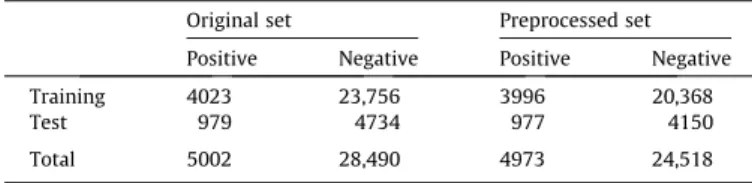
Non-interacting drug pairs are not explicitly provided in the DDI corpus. Hence, all drug pairs that do not overlap with positives are considered as negatives.Table 1shows the number of positive and negative pairs before and after preprocessing. Removing pairs with the same drug mentions and the colon case described in Preprocessing filters out 29 positive and 3972 negative pairs. The removed positive pairs constitute 0.58% of the positive set. We find the fraction to be negligible compared to the advantage of not showing nearly 14% negative pairs to SVM classifiers. In a basic set-ting where only word features are used, this step improvesF1 by 4% using 10-fold document-level cross validation on the training set.
Fig. 2.An example of preprocessing and feature extraction. The underlined drug pair,clidiniumandphenothiazines, is the candidate DDI. ‘NPC’ means noun phrase-constrained coordination and ‘BE’ denotesbetweencandidate drugs.
2
What the body does to the drug; absorption, distribution, metabolism, elimination.
3
Table 2shows the number of positive DDI pairs in the training and test sets for each DDI type.Mechanismandeffectare dominant classes, whileadviceandintcontain many fewer instances com-prising about 25% of the positive set. This unbalanced size in the training data may be problematic, in particular, for a machine learning solution because it may lead to poor classification perfor-mance [47]. To address the issue, we apply the one-against-one
approach for the DDI type classification task. Compared to the
one-against-allstrategy which takes negative examples from all non-positive classes, the one-against-one strategy uses only one negative class for each classifier; it alleviates the imbalance.
3.2. Performance comparison
Eight teams participated in the DDIExtraction 2013 challenge, and the official performance ranged from 21.4% to 65.1%F1[8].
Table 3compares our method with the top three ranking teams in the DDIExtraction task based on F1 scores. Our approach achieves 67% F1 for detection and classification performance (‘CLA’), whereas FBK-irst, WBI and UTurku produced 65.1%, 60.9% and 59.4%F1, respectively. For DDI detection performance (DEC), i.e. before applying the one-against-one strategy, the proposed approach performs second best by achieving 77.5%F1.
FBK-irst[12]uses a hybrid kernel for combining linear features, shallow linguistic and path-enclosed tree kernels. WBI[13]utilizes an ensemble approach to combine outputs from other DDI predic-tion tools. UTurku[21]uses a linear kernel with domain knowl-edge from external resources as well as word and dependency graph features. For DDI type classification, FBK-irst uses binary SVMs with a one-against-all strategy. WBI and UTurku use a multi-class SVM, which does not require choosing either one-against-oneorone-against-all. Our method, on the other hand, uses a simple binary SVM classifier with linear kernel for identifying DDIs and the one-against-one strategy for assigning DDI types. We choose the one-against-one strategy to reduce the negative effect of unbalanced classes. InTable 3, our approach performs best for mechanism, effect and advice types. In contrast, the same approach does not perform well forint. This is different from the 10-fold document-level cross validation results for the training set (Refer toSection 3.4). By definition,intcontains DDIs which cannot be assigned to other three types. Thus, either the general description ofintor insufficient evidence from the small number of training (188 examples) and testing (96 examples) sets may play a role.
Furthermore,Table 4shows the separate performance of our system on DrugBank and MEDLINE test documents. While the DDI detection and classification (‘CLA’) performance on the DrugBank set shows 69.8%F1, the performance on the MEDLINE set is substantially lower (38.2%F1). This difference is consistent with the results from the DDIExtraction 2013 challenge [8]. It may be due to the small number of training examples provided for MEDLINE. The 232 DDI pairs in the MEDLINE training set con-stitute only 6% of the overall training data. In addition, the DrugBank and MEDLINE documents may have different character-istics[12].
In the following subsections, we discuss the contribution of each feature type and the effect of the one-against-onestrategy compared to theone-against-allstrategy.
3.3. Feature analysis
Table 5presents changes of DDI detection performance by add-ing each feature type to the baseline (word features). For the results, 10-fold document-level cross validation was performed ten times and the scores were averaged. Relative positions attached to word features improve theF1 performance by 24.1%. This significant improvement is understandable because relative position is a good indicator whether an individual word is used in describing DDIs.
Using word features with positions as a baseline, word pairs, dependency relations, parse trees and NPC are added and evalu-ated individually. From the table, word pairs and parse trees con-tribute the most by increasingF1 by 1.9% and 1.4%, respectively. Dependency relations and NPC have less impact on the perfor-mance, however, dependency relations help get higher precision and NPC helps the recall. While word features cover neighboring words, syntactic structure and word pair features seem to help with the overall picture of DDI sentences. It is understandable, yet remarkable that using words with relative positions alone achieves such high performance for identifying DDIs. Integrating position information into word features is important because one sentence often involves multiple drug mentions and the position information helps differentiate the context of interacting pairs from that of non-interacting ones. It would be interesting to see how the same strategy would work on other entity–entity relation-ship extraction tasks.
An advantage of using the linear kernel approach is that obtained results have an intuitive interpretation. Although
Table 1
Number of positive and negative pairs in the dataset. 29 positive and 3972 negative pairs were removed through preprocessing.
Original set Preprocessed set
Positive Negative Positive Negative
Training 4023 23,756 3996 20,368
Test 979 4734 977 4150
Total 5002 28,490 4973 24,518
Table 2
Positive drug pairs used for training and testing. The preprocessed set is compared with the original set.
Class Original set Preprocessed set
Training Test Training Test
Mechanism 1321 302 1309 301 Effect 1688 360 1675 359 Advice 826 221 824 221 Int 188 96 188 96 Total 4023 979 3996 977 Table 3
Performance comparison between the proposed method and top-ranking approaches on the DDIExtraction 2013 test data. The performance is measured based onF1 scores. ‘CLA’ indicates detection and classification performance for all classes. ‘DEC’ indicates detection performance. ‘MEC’, ‘EFF’, ‘ADV’ and ‘INT’ are formechanism,effect,advice
andinttypes respectively. The highest scores are highlighted in bold.
Method CLA DEC MEC EFF ADV INT
Our method 0.670 0.775 0.693 0.662 0.725 0.483
FBK-irst 0.651 0.800 0.679 0.628 0.692 0.547
WBI 0.609 0.759 0.618 0.610 0.632 0.510
UTurku 0.594 0.696 0.582 0.600 0.630 0.507
Table 4
Performance comparison between DrugBank and MEDLINE test sets in DDIExtraction 2013. The performance is measured based onF1 scores. ‘CLA’ indicates detection and classification performance for all classes. ‘DEC’ indicates detection performance. ‘MEC’, ‘EFF’, ‘ADV’ and ‘INT’ are formechanism,effect,adviceandinttypes respectively.
Dataset CLA DEC MEC EFF ADV INT
DrugBank 0.698 0.804 0.714 0.706 0.736 0.497
Table 5provides some information, it still lacks in explaining what features contribute to identify a particular DDI in a sentence.Fig. 3
shows a simple visual aid, where significant words are highlighted based on the weights of word and word pair features from the SVM classifier. The features listed are the ones that classify the example as positive. The words with higher weights are emphasized by thicker lines and darker gray. From the highlighted words, one can understand that ‘‘DRUGwithDRUG’’ and ‘‘not recommended’’ are the key elements for detecting a DDI in the sentence.
3.4. DDI type detection
Our approach to DDI extraction has two steps. First, drug pairs are classified whether they interact or not. Second, one of four DDI types (mechanism,effect,adviceandint) is assigned to interacting pairs.
Two popular ways to address multi-class classification using binary classifiers are theone-against-oneandone-against-all strate-gies [23]. The one-against-allmethod builds a classifier for each class vs. all other classes. Theone-against-onestrategy, however, builds a binary classifier for each pair of classes, and the output of the classifiers is aggregated using majority voting. DDI type clas-sification requires 4 and 12 classifiers forone-against-alland one-against-one, respectively.
A critical issue for the DDI type classification is that the number of training examples differs significantly among the four classes (Table 2). For theone-against-allstrategy, this imbalance may lead to poor performance on the small classes. Therefore, we use the
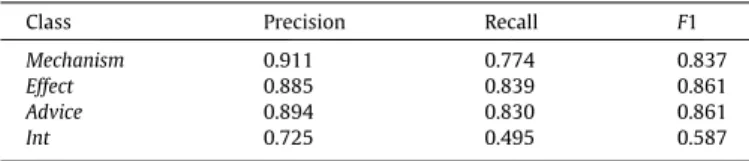
one-against-onestrategy for the DDI classification task. Tables 6 and 7present the performance difference betweenone-against-all
andone-against-one. The performance is better and more balanced
with theone-against-onestrategy.Table 8showsF1 scores for one-against-allandone-against-oneon the test set. Although there is a slight performance decrease oneffect,F1 scores increase on other DDI types.
3.5. Annotation inconsistency
The proposed method is completely data-driven. Even though SVM classifiers are robust to noisy training examples to some degree, our approach is sensitive to the quality of the training set. During algorithm development, we found that the DDI corpus contained irregularly formatted sentences. In one case, section titles are concatenated with the next sentence as shown inFig. 4. A more severe problem can occur when tables are converted to text. Sentences derived from tables can cause false positive and
Table 5
Performance changes by varying feature types in DDI detection. The baseline performance was measured by using word features with position (‘pos’) information. ‘Change’ shows theF1 score difference between the baseline and the performance in each row. 10-fold document-level cross-validation was performed ten times for the training set and scores were averaged.
Features Precision Recall F1 Change
Baseline (w/o pos) 0.544 0.427 0.478 24.1%
Baseline 0.774 0.670 0.719 – + Word pairs 0.780 0.700 0.738 +1.9% + Dependency 0.791 0.669 0.725 +0.6% + Parse trees 0.783 0.688 0.733 +1.4% + NPC 0.771 0.681 0.723 +0.4% All features 0.798 0.711 0.752 +3.3%
Fig. 3.A solution for presenting drug pairs with significant word and word pair features. Highly weighted words are highlighted in the sentence and emphasized according to all the weights they receive in the feature list. ‘BF’, ‘BE’ and ‘AF’ meanbefore,betweenandafter, respectively.DRUGindicates a target drug.
Table 6
Performance comparison on the one-against-allstrategy. 10-fold document-level cross-validation was performed ten times for the training set and scores were averaged.
Class Precision Recall F1
Mechanism 0.911 0.774 0.837
Effect 0.885 0.839 0.861
Advice 0.894 0.830 0.861
Int 0.725 0.495 0.587
Table 7
Performance comparison on theone-against-onestrategy. 10-fold document-level cross-validation was performed ten times for the training set and scores were averaged.
Class Precision Recall F1
Mechanism 0.941 0.964 0.952
Effect 0.943 0.979 0.960
Advice 0.921 0.960 0.940
Int 0.912 0.953 0.932
Table 8
Performance comparison (F1 scores) of the one-against-all and one-against-one
strategies on the test set.
Class One-against-all One-against-one
Mechanism 0.673 0.693
Effect 0.671 0.662
Advice 0.718 0.725
false negative drug pairs. Positive drug pairs from a table are not useful because the proposed approach is designed for grammati-cally well-formed text. In our experiments, we kept the table-derived sentences because no rules could be found to remove them. We presume that DrugBank sentences were automatically extracted from HTML or XML data prior to annotation, or curators annotated the dataset in a structured form and it was later flat-tened by an automatic extraction process.
Another problem in the dataset is that not all drug mentions are annotated. InFig. 5, ‘‘calcium’’ in the first sentence and the second ‘‘corticosteroids’’ in the second sentence are not annotated as drug names. It is obvious that ‘‘corticosteroids’’ in the second example is overlooked by curators. However, it is difficult to decide whether ‘‘calcium’’ is a drug name here. While ‘‘calcium’’ is often annotated as a drug in the dataset, there are also exceptions where ‘‘calcium’’ is not considered a drug. We assume that it is either overlooked or not considered a drug.
4. Conclusion
We present a two-step classification algorithm for identifying DDIs from biomedical literature. Unlike other state-of-the-art approaches, the proposed method focuses on word and syntactic features in a linear SVM. For assigning DDI types to drug pairs, positive DDI pairs are first identified by a single SVM classifier, and multiple SVM classifiers are used to decide DDI types through theone-against-onestrategy in the second step. The features used in our approach are words with relative positions, pairs of non-adjacent words, dependency relations, syntactic structures and noun phrase-constrained coordination tags. Applied to the DDIExtraction corpus, the proposed method showed competitive performance to top-ranking teams in the DDIExtraction 2013 chal-lenge by obtaining 67%F1.
The main contribution of the proposed method is the rich-feature based approach using linear SVMs. Non-linear, composite kernel approaches can directly use structural information. However, they tend to be complex and may not be readily applicable to a large-scale dataset. Our feature-based approach, on the other hand, is more flexible. Feature types can be easily evaluated, hence an intuitive interpretation is readily available. The linear kernel approach is also a practical alternative for large-scale problems. Moreover, theone-against-onestrategy used in the DDI type classi-fication is found to be useful for achieving higher classiclassi-fication performance. It addresses some difficulties of solving multi-class
classification with binary classifiers. As future work, we plan to extend our system by integrating it with named entity recognition tools. We also would like to evaluate the end-to-end DDI extraction system for PubMedÒabstracts in a large-scale setting.
Acknowledgments
The authors thank Isabel Segura-Bedmar for her help evaluating our preliminary results on the DDIExtraction 2013 dataset.
Funding: This research was supported by the Intramural Research Program of the NIH, National Library of Medicine.
References
[1]K. Baxter, C.L. Preston (Eds.), Stockley’s Drug Interactions, Pharmaceutical Press, London, UK, 2013.
[2]C. Knox, V. Law, T. Jewison, P. Liu, S. Ly, A. Frolkis, et al., DrugBank 3.0: a comprehensive resource for ‘Omics’ research on drugs, Nucl. Acids Res. 39 (Suppl 1) (2011) D1035–D1041.
[3] S. Duda, C. Aliferis, R. Miller, A. Statnikov, K. Johnson, Extracting drug–drug interaction articles from MEDLINE to improve the content of drug databases, in: AMIA Annual Symposium Proceedings, 2005, pp. 216–220.
[4]D.L. Rubin, C.F. Thorn, T.E. Klein, R.B. Altman, A statistical approach to scanning the biomedical literature for pharmacogenetics knowledge, J. Am. Med. Inform. Assoc. 12 (2) (2005) 121–129.
[5]I. Segura-Bedmar, P. Martínez, C. de Pablo-Sánchez, A linguistic rule-based approach to extract drug–drug interactions from pharmacological documents, BMC Bioinformatics 12 (Suppl 2) (2011) S1.
[6] I. Segura-Bedmar, P. Martínez, C. de Pablo-Sánchez, Using a shallow linguistic kernel for drugdrug interaction extraction, J. Biomed. Inform. 44 (5) (2011) 789–804.http://dx.doi.org/10.1016/j.jbi.2011.04.005.
[7] I. Segura-Bedmar, P. Martínez, D. Sánchez-Cisneros, The 1st DDIExtraction-2011 challenge task: extraction of drug–drug interactions from biomedical texts, in: Proceedings of the 1st Challenge Task on Drug–Drug Interaction Extraction (DDIExtraction 2011), 2011, pp. 1–9.
[8] I. Segura-Bedmar, P. Martinez, M. Herrero-Zazo, SemEval-2013 task 9: extraction of drug–drug interactions from biomedical texts, in: Proceedings of the 7th International Workshop on Semantic Evaluation (SemEval 2013), 2013, pp. 341–350.
[9] P. Thomas, M. Neves, I. Solt, D. Tikk, U. Leser, Relation extraction for drug–drug interactions using ensemble learning, in: Proceedings of the 1st Challenge Task on Drug–Drug Interaction Extraction (DDIExtraction 2011), 2011, pp. 11–18. [10] M.F.M. Chowdhury, A. Lavelli, Drug–drug interaction extraction using
composite kernels, in: Proceedings of the 1st Challenge Task on Drug–Drug Interaction Extraction (DDIExtraction 2011), 2011, pp. 27–33.
[11]L. He, Z. Yang, Z. Zhao, H. Lin, Y. Li, Extracting drug–drug interaction from the biomedical literature using a stacked generalization-based approach, PLoS One 8 (6) (2013) e65814.
[12] M.F.M. Chowdhury, A. Lavelli, FBK-irst: a multi-phase kernel based approach for drug–drug interaction detection and classification that exploits linguistic information, in: Proceedings of the 7th International Workshop on Semantic Evaluation (SemEval 2013), 2013, pp. 351–355.
Corticosteroids: Concomitant administration of aspirin and corticosteriods may decrease salicylate plasma levels.
Theophylline:
As with some other quinolones, concurrent administration of ciprofloxacin withtheophylline may lead to elevated serum concentrations of
theophylline and prolongation of its elimination half-life.
Fig. 4.Example sentences which start with ‘‘[drug name]:’’. ‘‘[drug name]:’’ is a section title which is concatenated with the next sentence in the DDIExtraction set.
Corticosteroids: A relationship of functional antagonism exists between vitamin D analogues, which promote calcium absorption, and corticosteroids, which inhibit calcium absorption.
Corticosteroids: Concomitant administration of aspirin and corticosteroids may decrease salicylate plasma levels.
Fig. 5.Example sentences, where some drug names are not annotated. ‘‘calcium’’ in the first sentence and the second ‘‘corticosteroids’’ in the second sentence are not annotated as drug names.
[13] P. Thomas, M. Neves, T. Rocktäschel, U. Leser, WBI-DDI: drug–drug interaction extraction using majority voting, in: Proceedings of the 7th International Workshop on Semantic Evaluation (SemEval 2013), 2013, pp. 628–635. [14] M. Collins, N. Duffy, Convolution kernels for natural language, in: Advances in
Neural Information Processing Systems (NIPS 2001), 2001, pp. 625–632. [15]Y. Zhang, H. Lin, Z. Yang, J. Wang, Y. Li, A single kernel-based approach to
extract drug–drug interactions from biomedical literature, PLoS One 7 (11) (2012) e48901.
[16]D. Tikk, P. Thomas, P. Palaga, J. Hakenberg, U. Leser, A comprehensive benchmark of kernel methods to extract protein–protein interactions from literature, PLoS Comput. Biol. 6 (2010) e1000837.
[17] J. Björne, T. Salakoski, Generalizing biomedical event extraction, in: Proceedings of BioNLP Shared Task 2011 Workshop, Association for Computational Linguistics, Portland, Oregon, USA, 2011, pp. 183–191. [18] J. Björne, T. Salakoski, TEES 2.1: automated annotation scheme learning in the
BioNLP 2013 shared task, in: Proceedings of the BioNLP Shared Task 2013 Workshop, Association for Computational Linguistics, Sofia, Bulgaria, 2013, pp. 16–25.
[19]J. Björne, J. Heimonen, F. Ginter, A. Airola, T. Pahikkala, T. Salakoski, Extracting complex biological events with rich graph-based feature sets, in: Proceedings of the Workshop on BioNLP (BioNLP ’09), Association for Computational Linguistics, 2009, pp. 10–18.
[20]J. Björne, F. Ginter, S. Pyysalo, J. Tsujii, T. Salakoski, Scaling up biomedical event extraction to the entire PubMed, in: Proceedings of the 2010 Workshop on Biomedical Natural Language Processing (BioNLP ’10), ACL, 2010, pp. 28–36. [21] J. Björne, S. Kaewphan, T. Salakoski, UTurku: drug named entity recognition
and drug–drug interaction extraction using SVM classification and domain knowledge, in: Proceedings of the 7th International Workshop on Semantic Evaluation (SemEval 2013), 2013, pp. 651–659.
[22] M. Herrero-Zazo, I. Segura-Bedmar, P. Martnez, T. Declerck, The DDI corpus: an annotated corpus with pharmacological substances and drugdrug interactions, J. Biomed. Inform. 46 (5) (2013) 914–920.http://dx.doi.org/10.1016/j.jbi.2013. 07.011.
[23] C.-W. Hsu, C.-J. Lin, A comparison of methods for multiclass support vector machines, IEEE Trans. Neural Netw. 13 (2) (2002) 415–425,http://dx.doi.org/ 10.1109/72.991427.
[24] T. Zhang, Solving large scale linear prediction problems using stochastic gradient descent algorithms, in: Proceedings of the 21st International Conference on Machine Learning (ICML 2004), 2004, pp. 919–926.
[25] S. Kim, W.J. Wilbur, Classifying protein–protein interaction articles using word and syntactic features, BMC Bioinformatics 12 (Suppl 8) (2011) S9,http:// dx.doi.org/10.1186/1471-2105-12-S8-S9.
[26] C. Giuliano, A. Lavelli, L. Romano, Exploiting shallow linguistic information for relation extraction from biomedical literature, in: Proceedings of the 11th Conference of the European Chapter of the Association for Computational Linguistics (EACL 2006), 2006, pp. 401–408.
[27]W. Kim, W.J. Wilbur, Corpus-based statistical screening for content-bearing terms, J. Am. Soc. Inform. Sci. Technol. 52 (3) (2001) 247–259.
[28]K. Fundel, R. Küffner, R. Zimmer, Relex—relation extraction using dependency parse trees, Bioinformatics 23 (3) (2007) 365–371.
[29]D. McClosky, E. Charniak, M. Johnson, Automatic domain adaptation for parsing, in: Proceedings of the 2010 Annual Conference of the North American Chapter of the Association for Computational Linguistics (NAACL 2010), Association for Computational Linguistics, 2010, pp. 28–36.
[30] K. Sagae, Y. Miyao, T. Matsuzaki, J. Tsujii, Challenges in mapping of syntactic representations for framework-independent parser evaluation, in: Proceedings
of the Workshop on Automated Syntactic Annotations for Interoperable Language Resources, 2008.
[31]Y. Miyao, K. Sagae, R. Saetre, T. Matsuzaki, J. Tsujii, Evaluating contributions of natural language parsers to protein–protein interaction extraction, Bioinformatics 25 (3) (2009) 394–400.
[32] A. Airola, S. Pyysalo, J. Björne, T. Pahikkala, F. Ginter, T. Salakoski, All-paths graph kernel for protein–protein interaction extraction with evaluation of cross-corpus learning, BMC Bioinformatics 9 (Suppl 11) (2008) 1–12,http:// dx.doi.org/10.1186/1471-2105-9-S11-S2.
[33] R.C. Bunescu, R.J. Mooney, A shortest path dependency kernel for relation extraction, in: Proceedings of the Conference on Human Language Technology and Empirical Methods in Natural Language Processing, 2005, pp. 724–731. [34]F. Rinaldi, G. Schneider, K. Kaljurand, S. Clematide, T. Vachon, M. Romacker,
OntoGene in BioCreative II.5, IEEE/ACM Trans. Comput. Biol. Bioinf. 7 (3) (2010) 472–480.
[35]H. Liu, L. Hunter, V. Keselj, K. Verspoor, Approximate subgraph matching-based literature mining for biomedical events and relations, PLoS One 8 (4) (2013) e60954.
[36] H. Liu, K. Verspoor, D.C. Comeau, A. MacKinlay, W.J. Wilbur, Generalizing an approximate subgraph matching-based system to extract events in molecular biology and cancer genetics, in: Proceedings of the BioNLP Shared Task 2013 Workshop, 2013, pp. 76–85.
[37]T. Kuboyama, K. Hirata, H. Kashima, K.F. Aoki-Kinoshita, H. Yasuda, A spectrum tree kernel, Inform. Media Technol. 2 (1) (2007) 292–299.
[38]L. Qian, G. Zhou, Tree kernel-based protein–protein interaction extraction from biomedical literature, J. Biomed. Inform. 45 (3) (2012) 535–543.
[39]D. McClosky, E. Charniak, Self-training for biomedical parsing, in: Proceedings of the 46th Annual Meeting of the Association for Computational Linguistics on Human Language Technologies, The Association for Computer Linguistics, 2008, pp. 101–104.
[40]M.-C. de Marneffe, C.D. Manning, The Stanford typed dependencies representation, in: CrossParser ’08: Coling 2008: Proceedings of the Workshop on Cross-Framework and Cross-Domain Parser Evaluation, Association for Computational Linguistics, 2008, pp. 1–8.
[41]H. Liu, T. Christiansen, W.A. Baumgartner, K. Verspoor, Biolemmatizer: a lemmatization tool for morphological processing of biomedical text, J. Biomed. Semantics 3 (2012) 3.
[42] M.F.M. Chowdhury, A. Lavelli, Impact of less skewed distributions on efficiency and effectiveness of biomedical relation extraction, in: Proceedings of the 24th International Conference on Computational Linguistics (COLING 2012), 2012, pp. 205–216.
[43]L.H. Smith, W.J. Wilbur, Finding related sentence pairs in MEDLINE, Inform. Ret. 13 (6) (2010) 601–617.
[44]L. Yeganova, D.C. Comeau, W. Kim, W.J. Wilbur, Text mining techniques for leveraging positively labeled data, in: Proceedings of the 2011 Workshop on Biomedical Natural Language Processing (BioNLP ’11), Association for Computational Linguistics, 2011, pp. 155–163.
[45] T. Bobic´, J. Fluck, M. Hofmann-Apitius, SCAI: extracting drug–drug interactions using a rich feature vector, in: Proceedings of the 7th International Workshop on Semantic Evaluation (SemEval 2013), 2013, pp. 675–683.
[46] A.R. Aronson, Effective mapping of biomedical text to the UMLS Metathesaurus: the MetaMap program, in: AMIA Annual Symposium Proceedings, 2001, pp. 17–21.
[47]N.V. Chawla, Data Mining for Imbalanced Datasets: An Overview, Springer, New York, USA, 2005.