M
ULTI
-T
HREADED
P
ROCESSORS
José Carlos Ruiz Luque
(Carlos Luque)
Barcelona, 2014
A thesis submitted in fulfillment of the requirements for the degree of
DOCTOR OF PHILOSOPHY / DOCTOR PER LA UPC Department of Computer Architecture
CPU A
CCOUNTING IN
M
ULTI
-T
HREADED
P
ROCESSORS
José Carlos Ruiz Luque
(Carlos Luque)
Barcelona, 2014
Thesis director: Francisco J. Cazorla Almeida
Barcelona Supercomputing Center Spanish National Research Council Universitat Politècnica de Catalunya
Thesis co-directors: Miquel Moretó Planas
Universitat Politècnica de Catalunya Barcelona Supercomputing Center
Mateo Valero Cortés
Universitat Politècnica de Catalunya Barcelona Supercomputing Center
A thesis submitted in fulfillment of the requirements for the degree of
DOCTOR OF PHILOSOPHY / DOCTOR PER LA UPC Department of Computer Architecture
Abstract
In recent years, multi-threaded processors popularity has raised in industry in order to increase the system aggregated performance and per-application performance, over-coming the limitations imposed by the limited instruction-level parallelism, and by power and thermal constraints.However, multi-threaded processors introduce complexities when accounting CPU (computation) capacity (CPU accounting), since the CPU capacity accounted to an application not only depends upon the time that the application is scheduled onto a CPU, but also on the amount of hardware resources it receives during that period. And given that in a multi-threaded processor hardware resources are dynam-ically shared between applications, the CPU capacity accounted to an application in these processors depends upon the workload in which it executes. This is inconveni-ent because the CPU accounting of the same application with the same input data set may be accounted significantly different depending upon the workload in which it executes. Deploying systems with accurate CPU accounting mechanisms is neces-sary to increase fairness among running applications. Moreover, it will allow users to be fairly charged on a shared data center, facilitating server consolidation in future systems.
This Thesis analyses the concepts of CPU capacity and CPU accounting for multi-threaded processors. This study demonstrates that current CPU accounting mechan-isms are not as accurate as they should be in multi-threaded processors. For this reason, we present two novel CPU accounting mechanisms that improve the accuracy in measuring the CPU capacity for multi-threaded processors with low hardware over-head. We focus our attention on several current multi-threaded processors, including chip multiprocessors and simultaneous multithreading processors. Finally, we analyse the impact of shared resources in multi-threaded processors in operating system CPU scheduler and we propose several schedulers that improve the knowledge of shared hardware resources at the software level.
Acknowledgements
It is a great pleasure to find oneself at this stage of research life when the real adventure with science just begins, yet already with a clear taste of it. It is even a greater pleasure to be able to thank to all those that have contributed in some way to the completion of this Thesis.In the first place, I would like to express my sincere gratitude to my advisor Fran-cisco Javier Cazorla and my co-advisors Miquel Moretó and Mateo Valero for their dedication, encouragement and guidance throughout my Ph.D. adventure. Also, their criticism and encouragement has been a great inspiration for me. I have enjoyed every single discussion with them and I believe it will continue in the future. I will always be thankful for their valuable comments and remarkable patience. It has been an honour to be their Ph.D. student. Thanks to them I have learnt whatresearchtruly means!
I am also greatly indebted to Enriquez Fernández for his excellent guidance at the early stage of my career. He introduced me to the computer architecture. I would also like to thank my collaborators, Roberto Gioiosa, Alper Buyuktosunoglu and Alexan-dra Fedorova for great interactions and endless discussions.
Special thanks go to my colleagues from the group ‘CAOS’ in Barcelona Super-computing Center for an overwhelming support and a great encouragement at the very last stage of this Thesis.
This work would not have been possible without the financial support of Bar-celona Supercomputing Center, Universitat Politècnica de Catalunya, Generalitat de Catalunya and the Spanish Ministry of Education and Science.
Last but not least, I wish to thank my Family for their love, for patience, and for their understanding and gigantic encouragement through difficult moments. If it had not been them, this Thesis would not come into existence.
Contents
Abstract i
Acknowledgements iii
Index viii
1 Introduction 1
1.1 Challenges for Accurate CPU Accounting in Multi-Threaded Processors 2
1.2 Thesis Contributions . . . 6
1.2.1 Concept of CPU Capacity and CPU Accounting for Multi-Threaded Processors . . . 7
1.2.2 CPU Accounting for Multi-Core Processors . . . 8
1.2.3 CPU Accounting for CMP+SMT Processors . . . 8
1.2.4 CPU Capacity-Aware Scheduling in Multi-Core Processors . . 9
1.3 Thesis Structure . . . 10
2 Platform, Tools, and Benchmarks 13 2.1 Introduction . . . 13
2.2 MPsim Simulator . . . 14
2.3 Benchmarks . . . 16
2.3.1 Simulation Time Reduction . . . 18
2.3.2 Workload Selection . . . 22
2.4 Comparison Metrics . . . 22
3 Concept of CPU Capacity and CPU Accounting for Multi-Threaded Pro-cessors 25 3.1 Defining CPU Capacity . . . 25
3.1.1 Abstracting CPU Capacity in MT processor . . . 26 v
3.1.2 CPU Capacity . . . 27
3.1.3 Fair Share of CPU Capacity . . . 28
3.1.3.1 Putting It All Together . . . 29
3.2 Defining CPU Accounting . . . 30
3.3 Summary . . . 31
4 CPU Accounting for Multi-Core Processors 33 4.1 Introduction . . . 33
4.2 Background . . . 34
4.2.1 The Classical Approach . . . 35
4.3 InterTask Conflict-Aware Accounting . . . 37
4.3.1 Hardware Implementation . . . 38
4.3.2 CPU Accounting in ITCA . . . 39
4.4 Evaluation Results . . . 41
4.4.1 Accuracy Results . . . 42
4.4.2 Reducing the ATD’s Overhead . . . 43
4.4.3 Memory Bandwidth Sensitivity . . . 45
4.4.4 ITCA and Cache Partitioning Algorithms . . . 45
4.5 Improved ITCA Accounting . . . 48
4.6 Even-Share Accounting . . . 52 4.6.1 Hardware requirements . . . 54 4.6.2 Accuracy Results . . . 56 4.7 Other Considerations . . . 56 4.7.1 Performance Counters . . . 56 4.7.1.1 Results . . . 57
4.7.2 Other Proposals Providing Fairness . . . 58
4.7.3 Parallel Tasks . . . 59
4.8 Summary . . . 60
5 CPU Accounting for CMP+SMT Processors 61 5.1 Introduction . . . 61
5.2 Background . . . 62
5.2.1 Processor Utilization of Resources Register . . . 62
5.2.2 Processor Utilization Recording Register . . . 66
5.2.3 Cycle Accounting Architecture . . . 66
Contents vii
5.3.1 MIBTA for SMT Processors . . . 69
5.3.1.1 Hardware Implementation . . . 71
5.3.2 MIBTA for CMP processors . . . 72
5.3.3 CPU Accounting in MIBTA . . . 74
5.4 Evaluation Results . . . 74
5.4.1 Sensitivity Analysis for Single-Core Architectures . . . 75
5.4.2 MIBTA Storage Overhead . . . 78
5.4.3 Shared Register File . . . 79
5.4.4 MIBTA on CMP+SMT Architectures . . . 80
5.4.5 Memory Bandwidth Sensitivity . . . 82
5.4.6 Comparison with Other Accounting Mechanisms . . . 83
5.5 Other Considerations . . . 85
5.5.1 System-level Considerations . . . 85
5.5.2 Virtualized Environments . . . 87
5.5.3 Dynamic Voltage and Frequency Scaling . . . 87
5.5.4 Parallel Tasks . . . 87
5.5.5 Scalability . . . 89
5.6 Summary . . . 89
6 CPU Capacity-Aware Scheduling in Multi-Core Processors 91 6.1 Introduction . . . 91
6.2 Background . . . 93
6.2.1 Completely Fair Scheduler . . . 93
6.2.2 Functioning and Implementation Aspects of CFS . . . 94
6.3 Effective CPU Capacity Share in CMP Processors . . . 96
6.4 CPU Capacity-Aware CFS . . . 97
6.4.1 Balanced CPU Capacity Scheduler (BCCS) . . . 98
6.4.2 Equal CPU Capacity Scheduler (ECCS) . . . 100
6.4.3 Integrating BCCS and ECCS in CFS . . . 101
6.5 Evaluation Results . . . 101
6.5.1 Experimental Setup . . . 102
6.5.2 CPU Capacity-based Schedulers Self-Evaluation . . . 104
6.5.3 Time-based vs. CPU Capacity-based Schedulers . . . 106
6.5.4 Scalability Analysis to Large Core Counts . . . 108
6.5.5 Case Studies . . . 109
6.5.5.2 Different Priorities . . . 110 6.5.6 Discussion . . . 111 6.6 Related Work . . . 112 6.7 Summary . . . 114 7 Conclusions 117 7.1 Thesis Contributions . . . 118
7.1.1 Concept of CPU Capacity and CPU Accounting for Multi-Threaded Processors . . . 118
7.1.2 CPU Accounting for Multi-Core Processors . . . 118
7.1.3 CPU Accounting for CMP+SMT Processors . . . 119
7.1.4 CPU Capacity-Aware Scheduling in Multi-Core Processors . . 119
7.2 Future Work . . . 120 7.3 Publications . . . 121 7.3.1 Conferences . . . 121 7.3.2 Journals . . . 122 7.3.3 Posters . . . 122 7.3.4 Video . . . 123 Bibliography 125 List of Figures 133 List of Tables 137 Acronyms 139
Chapter
1
Introduction
Over the last 20 years, the performance of Single-Threaded (ST) processors has in-creased due to two factors:advances in the integrated circuit technologyand
microar-chitectural techniquessuch as deeper pipeline, dynamic scheduler, speculative
execu-tion through branch predictor, cache hierarchy and non-blocking caches. Advances in the integrated circuit technology have provided both faster and smaller transist-ors. Smaller transistors increase integration while faster transistors allow increasing clock rates, and hence, processors can run at higher clock rate, in other words, high frequency. Microarchitectural techniques allow exploiting Instruction-Level Parallel-ism (ILP) inherent in tasks1. Although microarchitectural techniques help improving performance, a large portion of this performance comes from advances in integrated circuits. On the whole, processors run instructions very fast due to high frequency and the number of instructions running concurrently is high due to microarchitectural techniques.
Due to power and thermal constraints [20] and the limited amounts of ILP inherent in tasks [66], new techniques have been developed to improve performance with low energy requirements. One such technique is Thread-Level Parallelism (TLP). Current processors implement at least one form of TLP, which allows executing several tasks onto the processor simultaneously.
TLP can be implemented across multiple chips. For instance, Symmetric Mul-tiProcessing (SMP) consists of two or more processors that are connected to shared hardware resources such as main memory. TLP can also be implemented at the chip level. In this level, a wide variety of processors supports TLP. On one extreme of the spectrum, we find Simultaneous Multithreading (SMT) processors [52, 64], in which tasks share most of the processor resources. On the other end of the spectrum,
1
In this Thesis, we use the term task to refer to an application running in a computing system.
Chip MultiProcessors (CMP) [42] or multi-core processors, in which tasks share only some levels of the cache hierarchy and the memory bandwidth. In between, there are other TLP paradigms like Coarse-Grain MultiThreading (CGMT) [2,62] or Fine-Grain MultiThreading (FGMT) [19,57]. Each of these designs offers different be-nefits as they exploit TLP in different ways, which motivates processor vendors to combine different TLP paradigms in their latest processors. Some notorious examples are the Intel core i7 [51] and IBM POWER7 [56], which are CMP+SMT processors, and the ORACLE UltraSPARC T4 [43] that is CMP+FGMT. This trend in integrat-ing different TLP paradigms will keep growintegrat-ing in importance accordintegrat-ing to the ITRS roadmap for the future years [24]. In this Thesis, we make use of the term Multi-Threaded (MT) processor to refer to a processor implementing any TLP paradigm or combination of TLP paradigms at chip level.
Both SMP systems and MT processors permit to execute several tasks simultan-eously. In this way, the utilization of the hardware resources is improved because several tasks can use different parts of hardware resources, and hence, the system throughput is increased.
On the other hand, the communication latency in SMPs is higher than in MT processors because on-chip communications are faster than outside the chips used in SMPs. For instance, if two or more threads of a parallel task want to share data, the communication latency will be lower in a MT processor as data will be cached on-chip (in the cache hierarchy), and not in main memory as in a SMP. The SMP can have a cache hierarchy with a Last level Cache (LLC) shared among processors, but this LLC is outside the chip. Consequently, increased communication latencies are obtained on those systems.
Other benefits of MT processors are the design costs and power efficiency. The design costs are reduced because the design complexity of a MT processor is fairly less than a processor with a larger monolithic core. Due to the described benefits of MT processors, processor vendors prefer this microarchitecture to improve the pro-cessor performance with low energy requirements.
1.1
Challenges for Accurate CPU Accounting in
Multi-Threaded Processors
An Operating System (OS) is a software application that manages computer hardware resources and provides common services for computer systems. It also acts as an
1.1. Challenges for Accurate CPU Accounting in Multi-Threaded Processors 3
interface between user and the computer hardware and supplies an environment within which user applications can do useful work [55]. Its major responsibility is to manage and ensure proper operation of the hardware resources. Moreover, an OS provides the user with an abstraction of the hardware resources. The user application perceives this abstraction as if it was using the complete hardware while, in fact, the OS shares hardware resources among the user applications. For example, several tasks demand service from the Central Processing Unit (CPU). Hardware resources can be shared
temporallyandspatially. Hardware resources are time shared between users when
each task can make use of a resource for a limited amount of time (for example, the exclusive use of a CPU). Orthogonally, hardware resources can be shared spatially when each task makes use of a limited amount of resources, such as cache memory or I/O bandwidth.
In traditional, ST uniprocessor systems, the execution time of a task is influenced by the amount of hardware resources shared with the other running tasks. It is also affected by how long the task runs with other tasks. However,the time accounted to
that task is roughly the same regardless of the workload2 in which it is executed, in
other words, regardless of how many tasks are sharing the hardware resources at any
given time. We call this principle, thePrinciple of Accounting.
To illustrate this principle of accounting, we use an Unix-like system that differ-entiates the real execution time and the time a task actually is running onto a CPU. Commands such astimeortopprovide three values:real,userandsys.Realis the elapsed wall clock time between the invocation and termination of the task;useris the time spent by the task in theuser mode; andsysis the time spent in thekernel mode
on behalf of the task. In these systems,sys+usertime is the execution time accounted to a task.
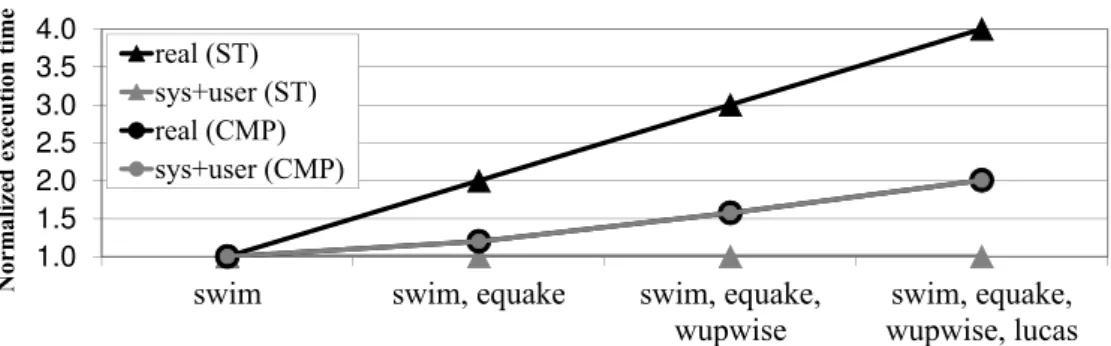
Figure 1.1 shows the total (real) and the accounted execution time (sys+user) of the 171.swim(or simplyswim) SPEC CPU 2000 benchmark [60] when it runs in different workloads. In this figure, the time results are normalized to the real execution time ofswimwhen it runs in isolation3, meaning that, onceswimis scheduled on a CPU it does not share the CPU resources with any other task. For this experiment, we use an Intel Xeon Quad-Core processor at 2.5 GHz (though the general trends drawn from Figure 1 apply to other current MT processor). There are four cores in the chip,
2
In this Thesis, we use the term workload to refer to a set of tasks running onto a processor simultan-eously.
3
In this Thesis, we use the term execution inisolationto refer to when a task runs alone onto a processor.
1.0 1.5 2.0 2.5 3.0 3.5 4.0
swim swim, equake swim, equake,
wupwise swim, equake, wupwise, lucas N o r m a li z e d e x e c u ti o n t im e real (ST) sys+user (ST) real (CMP) sys+user (CMP)
Figure 1.1: Total (real) and accounted (sys+user) time ofswimin different workloads running on an Intel Xeon Quad-Core CPU
on which we run Linux 2.6.18. We move most of the OS activity to the first core, leaving the other cores as isolated as possible fromOS noise. Whenswimruns alone in one of the isolated cores, it completes its execution in 117 seconds. However, when
swimruns together with other tasks in the same core, its real execution time increases up to 4x due to context switches forced by the OS (black triangles in Figure 1.1). Nevertheless,swimis accounted roughly the same time (grey triangles), which is the time the task actually uses the CPU. Tasks may suffer some delay because of cache data eviction and the loss of TLB contents caused by a context switch, but this effect is small in this case. Hence, even if total execution time ofswimincreases depending upon the other tasks it is co-scheduled with, the time accounted toswimis always the same.
In ST uniprocessor systems, each running task uses 100% of the processor’s re-sources and its progress can be generally measured in terms of the time spent running onto the CPU. We call this CPU accounting mechanism theClassical Approach. The classical approach has been proved to work well for ST uniprocessor and SMP sys-tems, as the amount of hardware resources spatially shared is limited.
However, MT processors make more complex to measure CPU utilization because the progress of a task depends upon the activity of the other tasks running at the same time. Current CPU accounting mechanisms may lead to inaccuracy for the time ac-counted to each task. In order to show this inaccuracy, in a second experiment, we use all the cores in the Intel Xeon Quad-Core processor. We execute swim concur-rently with other tasks, as shown by the x-axis in Figure 1.1. In this case,swimsuffers no time sharing and realtime is roughly the same assys+user because the number of tasks that are running is equal or lower than the number of virtual CPUs (see Fig-ure 3.1) in the system. In FigFig-ure 1.1, the grey circles show a variance up of to 2x in the
1.1. Challenges for Accurate CPU Accounting in Multi-Threaded Processors 5
timeswimis accounted for depending upon the workload in which it runs. This means
thata task running onto a MT processor may be accounted different CPU utilization
depending upon the other tasks running on the same chip at the same time. From the
user point of view this is an undesirable situation, as the same task with the same input data set is accounted differently depending upon the tasks it is co-scheduled with.
In short, the principle of accounting is not guaranteed in MT processors due to the fact that the performance of a task depends on both the time the task runs onto the processor and the amount of resources it receives during that time. The latter is in general not under the control of the user or the OS. To make things worse, there is a non-linear relation between the percentage of resources assigned to a task and the slowdown it suffers with respect to running in isolation.
The inaccuracy measuring per-task CPU utilization may affect several key com-ponents of a computing system, such as performance monitoring tools, the CPU scheduler, or billing mechanisms in data centers:
• Performance tools generate statistics of various parameters of a task such as
CPU utilization and I/O activities in order to know the behaviour of the task in a computing system. For example, in Unix-like systems the command vm-statreports statistics regarding virtual memory, disks, and CPU activity. These tools may not properly account the CPU utilization of task in a MT processor and hence, the tools generate wrong profile of tasks. This is undesirable. For instance, in a queue system, a task may exceed the threshold for the particular queue where it runs because its execution time changes depending upon who are its co-runners.
• In modern time-sharing OSes, the CPU scheduling algorithmmultiplexes the CPU time for different tasks in the system and maintains fairness between tasks. In this scenario, the task schedulers assume that the time a task is scheduled onto CPU is a good metric in order to measure the CPU utilization of each task in ST uniprocessor system. However, in MT processors, this metric is flawed because each task may make a different progress in different workloads. For this reason, even if the CPU scheduler can balance time among tasks in the system achieving fairness, the scheduling algorithms cannot guarantee that a task progresses according to its software-assigned priority.
• Selection of appropriate co-runners. Task interaction in hardware shared
requirements. Per-task CPU accounting can help the OS scheduler or a runtime-based scheduler to decide which tasks must be run and when, thus increasing the total system performance.
• Billing in data centers. Data centers charge users for the use of their resources.
The fact that CPU utilization in MT processors is not accurately measured, makes current billing systems unfair when several users are consolidated onto the same processor. Measuring the CPU utilization each task performs, would allow charging each user more fairly. Traditionally, data centers offer services of compute capacity and storage to execution and store of its customers’ tasks and data. In order to charge compute capacity to a customer, the data center may utilize the CPU utilization as measurement of the CPU activity. The payment of these services depends upon the utilized resources such as used amount of memory, disk space, I/O and CPUs activity, etc. For example,Amazon Elastic
Compute Cloud (Amazon EC2) [3] is a virtual computing environment that
leverages Amazon’s own infrastructure to provide computing capacity to ex-ternal users. The user sets up an image with all the required applications, lib-raries and data, and uploads them to Amazon’s facilities. After this preliminary step, the user instructs Amazon EC2 to start executing an instance bound to previously uploaded image. At this point, Amazon starts billing the user for the number of hours the instance executes, for data transfers (network usage) and for disk space usage. In conclusion, having accurate per-task CPU utilization will facilitate server consolidation, allowing an efficient usage of the servers and a fair charging to users.
1.2
Thesis Contributions
This Thesis presents several proposals that effectively track the CPU capacity to ac-count each task running onto MT processors. The contributions are divided into three groups. First, we formally define the CPU capacity and CPU accounting for MT pro-cessors. Second, at the hardware level, we propose two novel CPU accounting mech-anisms that improve the accuracy in measuring the CPU accounting in MT processors. To start with, we study CPU accounting mechanisms for CMP processors. Next, CPU accounting mechanisms are studied for CMP+SMT processors, where each core sup-ports SMT. Finally, at the software level, we study how the CPU scheduler should be adapted to take advantage of the proposed CPU accounting hardware mechanisms to
1.2. Thesis Contributions 7
increase system fairness. The following sections briefly summarize each one of the contributions.
1.2.1 Concept of CPU Capacity and CPU Accounting for Multi-Threaded Processors
The first problem that is addressed in the Thesis is the definition of CPU capacity
andCPU accountingfor MT processors. Although these concepts are clearly defined
in ST processors, they are vague in MT processors. For this reason, we provide two definitions of CPU capacity (resource utilizationandCPU progress) and we also in-troduce thefair share of CPU capacitywhich represents the hardware resources that a task should get access when the task runs alone onto a MT processor. The fair share of CPU capacity can be defined with two different approaches: full-shareand
even-share.
In this Thesis, we focus on CPU capacity as CPU progress. The full-share ap-proach assumes that a task running in isolation accesses all processor hardware re-sources during a given period of time. Consequently, the task execution progress of a task in a MT processor is equivalent to its execution progress when runs in isolation. Meanwhile, the even-share approach assumes that a task accesses even part of the pro-cessor resources. In our cases, even part of the propro-cessor resources is defined as1/N of the processor resources, whereN is the number of tasks supported by processors. In this way, the task execution progress of a task is equivalent to its execution progress when runs in isolation with an even part of the processor resources.
TheCPU accountingis the process of measuring the CPU capacity utilized by task
in a MT processor. In other words, the CPU accounting measures the CPU capacity of a task would have if the task run alone onto a MT processor. For instance, if a task A executes 5 milliseconds in a MT processor and the CPU accounting measures 4.5 milliseconds, it means that the task would run for 4.5 milliseconds if it is alone on the processor. The task progressed 90 percent of the time, and in the remaining time, the task was stalled due to interferences with other tasks. In contrast, in a ST processor, the task A would have progressed 100 percent of the time as it would run alone in the processor. We name full-share accountingwhen using CPU capacity based on CPU progress and full-share approach andeven-share accountingwhen using CPU capacity based on CPU progress and even-share approach.
1.2.2 CPU Accounting for Multi-Core Processors
The second problem that we address in this Thesis is how the CPU accounting is ob-tained in CMP processors. CMP processors consist of simple processor cores and share only some levels of the cache hierarchy and the memory bandwidth (see Fig-ure 2.1). We firstly focus on CMP processors because they have less shared hardware resource among tasks than SMT processors and we can easily identify the sources that generate inaccuracies when measuring CPU capacity in CMP processors with current CPU accounting mechanisms.
We propose a new CPU accounting mechanism for CMP processors, called
In-terTask Conflict-Aware (ITCA) accounting [33, 34]. The main goal of ITCA is to
estimate accurately the CPU accounting to a task by keeping track of the interference in shared hardware resources, mainly in the on-chip shared cache. Moreover, we show that our understanding of the processor architecture in developing ITCA is correct by making a complete design space exploration of the possible combinations of hardware resource status indicator states. This exploration confirms that ITCA provides reason-ably accurate results at moderate hardware cost. It also shows that with small changes we can implement an improved ITCA accounting mechanism, denoted I2TCA, that further improves the accuracy of ITCA.
In addition, we show that ITCA works well with cache partitioning algorithms and that bothfull-shareandeven-shareaccounting approaches can be used with our proposed mechanisms.
1.2.3 CPU Accounting for CMP+SMT Processors
The third problem that is addressed in the Thesis is how the CPU capacity is measured in processors combining different TLP paradigms such as CMP+SMT processors. In these processors, more hardware resources are shared than CMP processors, since both on-core and off-core hardware resources are shared among running tasks. It is important to note that, in general, on-core shared resources in the SMT processor are more heavily shared than off-core resources shared among different cores.
ITCA does not adapt correctly to processors with multiple TLP paradigms be-cause it cannot track interferences of shared on-core resources such as register files, issue queues, execution units, the reorder buffer, etc. In addition, the current CPU ac-counting mechanisms or combination of them either incurs an unaffordable hardware cost to track CPU capacity in processors with multiple TLP paradigms, or leads to inaccuracies in its measurement. Consequently, we introduceMicro-Isolation Based
1.2. Thesis Contributions 9
Time Accounting(MIBTA) [35], a new CPU accounting mechanism to compute CPU
capacity in CMP+SMT processors. Instead of adding hardware support ineachshared hardware resource to track tasks’ slowdown, MIBTA makes use of a time sampling technique in which tasks run in isolation for short periods of time, with negligible ef-fect on the system throughput and with high accuracy in CPU accounting of tasks. In particular, our CPU accounting mechanism combines the following two mechanisms: • At SMT level, where tracking how tasks interact in each core resource would introduce significant hardware overhead, our technique periodically runs each task in isolation to measure its CPU capacity. The execution of each task in a workload is divided into two phases that are executed in alternate fashion. In the first,isolationphase, all tasks but one are stopped so that the Instruction Per Cycle (IPC) in isolation of the task is measured. In a second, multi-threaded
phase, all tasks run together. The ratioIP CM T/IP Cisoltimes the total execu-tion time gives the CPU accounting for each task. Since the number of available threads in each SMT processor is restricted (only 2-8 threads), this solution can be implemented with minimal performance degradation.
• At CMP level, our technique makes use of dedicated hardware monitoring sup-port to track the interferences between tasks running in different cores. This hardware support is based on ITCA accounting mechanism [33, 34], which tracks the conflicts in the last level of cache, shared among all different cores, and estimates with high accuracy the CPU accounting in CMP processors. In addition, we propose a new monitoring hardware that significantly reduces the storage overhead of ITCA without affecting its high accuracy. TheRandomized
Sampled Auxiliary tag directory, denotedRSA, combines sampling techniques
with randomized algorithms to predict inter-task misses to the entire LLC. MIBTA combines both proposals to provide tight CPU accounting in CMP+SMT processors with reduced hardware overhead.
1.2.4 CPU Capacity-Aware Scheduling in Multi-Core Processors
Finally, we address how the software can be adapted to the proposed CPU accounting mechanisms in this Thesis with the aim of improving fairness. We focus on the CPU scheduler, which is a key component of the OS and has a significant impact in the system throughput and fairness.
The CPU scheduler focuses on efficiently sharing CPU resources among tasks. In ST uniprocessors, the CPU resources are shared temporarily, in other words, they are time-shared. The CPU scheduler selects the task that should be run next, and for how long this task should use the CPU resources. Time-based schedulers assume that the progress of a task is measured in terms of the time spent onto a CPU. On the other hand, for MT processors, which dynamically share a large amount of processor resources, this assumption is invalid because the task’s progress depends upon the activity of other tasks in the same processor as illustrated in Figure 1.1.
In this Thesis, we define a new concept ofeffective CPU capacity sharefor MT processors, which is aware of the amount of actual CPU capacity used by a task dur-ing its execution. Moreover, we propose two novel task schedulers, Balanced CPU
Capacity Scheduler andEqual CPU Capacity Scheduler, that are aware of the CPU
capacity received by each running task, and make use of this information to share the CPU more effectively.
1.3
Thesis Structure
This Thesis is structured as follows:
• Chapter 2 focuses on explaining our experimental environment. This includes both the simulation tools and the benchmarks used in this Thesis.
• Chapter 3 defines the concepts ofCPU CapacityandCPU Accountingfor MT processors, identifying the main sources of inaccuracy in current CPU account-ing mechanisms. Also, it introduces the fair share of CPU capacity which represents the hardware resources that a task should get access when the task runs alone onto a MT processor.
• Chapter 4 presents a novel CPU accounting mechanism, ITCA, for CMP pro-cessors that is aware of interference in shared hardware resources.
• Chapter 5 describes a novel CPU accounting mechanism for CMP+SMT pro-cessors, MIBTA, that extends the concepts of ITCA to SMT processors. • Chapter 6 describes our concept of effective CPU capacity share for MT
pro-cessor and proposes two OS CPU scheduling algorithms that are aware of the actual CPU capacity enjoyed by each scheduled task.
1.3. Thesis Structure 11
• Chapter 7 summarizes the main conclusions of this Thesis, presents our future work, and lists the relevant publications related to this Thesis.
Chapter
2
Platform, Tools, and Benchmarks
In this Chapter, we explain the tools and benchmarks we use to evaluate the current CPU accounting mechanisms and the CPU accounting mechanisms proposed in this Thesis.
2.1
Introduction
Researchers in this field propose and test novel techniques that could be included in the actual processor designs. In order to evaluate new techniques, computer architec-ture researchers usually use both simulation tools and benchmark suites. The simula-tion tools are used at different levels of detail, form circuit to system level, depending on the particular target system are studied. The benchmarks suites are representative of current and future applications that will be executed by the designed processor.
In this Thesis, several microarchitecture proposals are evaluated in term of both performance and accuracy for different workloads and processor configurations. For this reason, cycle-level microarchitecture simulators are used to model in detail the ar-chitecture of the processor and estimate the performance of a benchmark with differ-ent configurations. This simulator can be execution driven or trace driven. Execution-driven simulators usually have higher accuracy, but are time-consuming. Trace-Execution-driven simulators are less accurate, but are faster. As a result, we decided to choose a trace-driven simulator in order to get a trade-off between speed and accuracy in our experi-ments.
shared BUS
core 1 core 0
Memory Controller DRAM Memory Device
core N
I$ D$ I$ D$ I$ D$
Shared Cache
chip
...
Figure 2.1: Modeled baseline microarchitecture
2.2
MPsim Simulator
To evaluate the performance of the different mechanisms shown in this Thesis and cal-culate the IPC, we use MPSim [1] (Multiple Purpose Simulator). This simulation tool includes a trace driven SMT simulator derived from SMTsim [64]. MPsim supports CMP processors and SMT processors and simulates the impact of executing along wrong paths on the branch predictor and the Instruction Cache. Also, MPsim models an in-order processor and an out-of-order processor.
In this Thesis, we model both CMP and CMP+SMT processors. Figure 2.1 shows our baseline CMP microarchitecture which consists of two or more cores which are connected to a shared L1-L2 bus, a shared last level cache, a shared memory control-ler, and a shared memory bandwidth. In our baseline CMP+SMT, each core supports SMT in which most on-core hardware resources are shared among all tasks running in the core. In both processor microarchitectures, the modelled pipeline each core is out-of-order as shown in Figure 2.2.
The fetch logic fetches instructions from the instruction cache in program order. Next, instructions are decoded and renamed in order to track data dependences. When an instruction is renamed, it is allocated an entry in the issue queues (Integer queue (IQ), Floating point queue (FPQ), and load/store queue (LSQ)) until all its operands are ready. Each instruction also allocates one entry in the Re-Order Buffer (ROB) and a physical register, if required. ROB entries are assigned in program order. When
2.2. MPsim Simulator 15
Figure 2.2: Block diagram of pipeline of a core
an instruction has all its operands ready, it is issued1: it reads its operands, executes, writes its results, and finally commits.
The data and the instruction caches are accessed with physical addresses. The data cache uses write back as write hit policy and write allocate as write miss policy. Caches are tagged with the identifier of tasks so that tasks do not share data and/or instructions.
The instruction fetch policy has an important role in SMT core because it determ-ines which of the available tasks can fetch instructions each cycles. In our baseline SMT core, the modelled instruction fetch policy is ICOUNT [30] policy. The con-figuration of ICOUNT policy is1.N: up toN instructions can be fetched each cycle from a task.
The main shared resources in our baseline SMT core are the following. (1) The front-end bandwidth, which is assigned to tasks according to the instruction fetch policy. (2) The issue queues are shared between all tasks running on a core. (3) The is-sue bandwidth: we use isfirst in first out(oldest first) as issue policy. (4) The physical register files (Integer register file (IReg), and Floating point register file (FReg)) are
1In this Thesis, the term dispatch indicates the action of moving instructions to the issue queues.
The term issue is applied to the action of submitting instructions from the issue queues to the backend of the processor.
Fetch Decode Rename Queue/
Issue RRead Execute RWrite Commit
Figure 2.3: Pipeline stages in a core
common to all tasks. (5) Instruction and Data caches are shared between tasks. (6) In-struction and data Translation Lookaside Buffer (TLB) are also shared and tagged with task identifier, and (7) the ROB is shared among all tasks in a core.
The pipeline of our baseline core is composed of eight stages as shown in Fig-ure 2.3. In our experiments, the decode stage takes up to four cycles and, in this way, the final number of stages in our pipeline is eleven.
2.3
Benchmarks
In the experiments performed during this research, we used the SPEC CPU 2000 benchmark suite [60] to evaluate our proposals in Chapter 4, and the SPEC CPU 2006 benchmark suite [61] in remaining Chapters. These benchmark suites are released by the Standard Performance Evaluation Corp. (SPEC), and are a worldwide standard for measuring and comparing computer performance across different hardware platforms. SPEC CPU 2000 and SPEC CPU 2006 comprise two suites of benchmarks: SPEC CPU INT 2000 and SPEC CPU INT 2006 for compute-intensive integer performance and SPEC CPU FP 2000 and SPEC CPU FP 2006 for compute-intensive floating point performance. These benchmarks are selected from existing applications, represent-ing high performance computrepresent-ing applications that stress the microarchitecture of the processor. Benchmark source codes run in different platforms so that performance comparisons can be made between different systems.
In our case, we run all benchmarks on an Alpha machine: an AlphaServer DS25 with two processors Alpha 21264C running at 1 GHz with the operating system Tru64 5.1b. Each program is compiled with the -O2 -non_sharedoptions us-ing DEC Alpha AXP-21264 C/C++ compiler and executed usus-ing the reference input set. Fortran programs are compiled with the DIGITAL Fortran 90/Fortran 77 com-pilers. We succeeded in compiling all the SPEC CPU 2000 benchmark suite and the SPEC CPU 2006 benchmark suite. We only had problems with the integer benchmark 483.xalancbmkfrom SPEC CPU 2006 since its execution produced a known stack overflow problem.
2.3. Benchmarks 17
Table 2.1: SPEC CPU INT 2000 benchmark description and simulation starting point (in millions of instructions) using the SimPoint methodology [54]
Benchmark Description Input Language Fast
forward
164.gzip Data compression utility graphic C 68.100
175.vpr FPGA circuit placement and routing place C 2.100
176.gcc C compiler 166.i C 14.000
181.mcf Minimum cost network flow solver inp.in C 43.500
186.crafty Chess program crafty.in C 74.700
191.parser Natural language processing ref.in C 83.100
252.eon Ray tracing cook C++ 57.600
253.perlbmk Perl splitmail.535 C 45.300
254.gap Computational group theory ref.in C 79.800
255.vortex Object Oriented Database lendian1.raw C 58.200
256.bzip2 Data compression utility inp.program C 13.500
300.twolf Place and route simulator ref C 324.300
these suites together with the language in which the source codes were written. In the case of integer benchmarks, all the applications are written in C or C++, while in the case of floating point benchmarks, some of them are written in Fortran, C, C++, or a combination of C and Fortran codes. For example, in435.gromacsthe only Fortran code is the inner loops (innerf.f) which typically account for more than 95% of the runtime.
Some benchmarks in the SPEC CPU 2006 suite are executed multiple times with different inputs for the reference test. We execute all benchmarks with the input sets suggested by Phansalkar et al. [46]. In this paper, the authors analyze all the ref-erence input sets of each benchmark to find redundant input sets, and they choose the representative input set of the benchmarks that have multiple input sets. To ob-tain this representative input set, the authors find the input set that is the closest to the whole benchmark run (with all the input sets). In the SPEC CPU INT 2006 suite, the benchmarks with multiple input sets are400.perlbench,401.bzip2, 403.gcc,445.gobmk,456.hmmer,464.h264.refand473.astar. In the SPEC CPU FP 2006 suite, they are416.gamesand450.soplex. For each bench-mark, we list the most representative input set in Tables 2.5 and 2.6 for the all the integer and floating point benchmarks, respectively.
Table 2.2: SPEC CPU INT 2006 benchmark description
Benchmark Description Language
400.perlbench Devired from Perl V5.8.7 C
401.bzip2 Julian Seward’s bzip2 version 1.0.3, modified to do most work in memory, rather than doing I/O
C
403.gcc Based on gcc Version 3.2, generates code for Opteron C
429.mcf Vehicle scheduling. Uses a network simplex algorithm (which is
also used in commercial products) to schedule public transport
C 445.gobmk Plays the game of Go, a simply described but deeply complex game C
456.hmmer Protein sequence analysis using profile hidden Markov models C
458.sjeng A highly-ranked chess program that also plays several chess vari-ants
C 462.libquantum Simulates a quantum computer, running Shor’s polynomial-time
factorization algorithm
C 464.h264ref A reference implementation of H.264/AVC, encodes a videostream
using 2 parameter sets. The H.264/AVC standard is expected to replace MPEG2
C
471.omnetpp Uses the OMNet++ discrete event simulator to model a large Ether-net campus Ether-network
C++ 473.astar Pathfinding library for 2D maps, including the well known A*
al-gorithm
C++ 483.xalancbmk Transforms XML documents to other docs using a modified
Xalan-C++
C++
2.3.1 Simulation Time Reduction
The simulation of a whole benchmark takes a great amount of time which makes un-affordable to evaluate new techniques. To reduce simulation time, the most common approach is to select a smaller segment of every benchmark that is representative of the whole execution. Selecting these representative samples is an important issue [54,67]. Random samples appear to be inadequate, while just choosing the beginning of a pro-gram could be incorrect due to initialization code. However, we know that a propro-gram execution consists of many different phases, where statistics such as cache or branch misses significantly change among them. Thus, representative segment (throughout this work we will call it trace) should represent major program phases. As a con-sequence, the traces allow reducing simulation time to analyse new techniques in this Thesis.
Another advantage of working with traces is that researches must only perform time consuming functional simulation of the whole application once, whereas they perform many times detailed timing simulations of the reduced trace. Therefore, the time of detailed simulation is significantly reduced.
2.3. Benchmarks 19
Table 2.3: SPEC CPU FP 2000 benchmark description and simulation starting point (in mil-lions of instructions) using the SimPoint methodology [54]
Benchmark Description Input Language Fast
forward
168.wupwise Quantum chromodynamics wupwise.in Fortran77 263.100
171.swim Shallow water modeling swim.in Fortran77 47.100
172.mgrid Multi-grid solver in mgrid.in Fortran77 187.800
3D potential field
173.applu Parabolic/elliptic applu.in Fortran77 10.200
partial differential equations
177.mesa 3D Graphics library frames100 + msea.in C 294.600
178.galgel Fluid dynamics: analysis galgel.in Fortran90 175.800
of oscillatory instability
179.art Neural network simulation; -scanfile c756hel.in C 13.200
adaptive resonance theory -trainfile1 a10.img -trainfile2 hc.img -stride 2 -startx 110 -starty 200 -endx 160 -endy 240 -objects 10
183.equake Finite element simulation; inp.in C 27.000
earthquake modeling
187.facerec Image processing facerec.in Fortran90
188.ammp Computer vision: ammp.in C 13.200
recognizes faces
189.lucas Computational chemistry lucas2.in Fortran90 30.000
191.fma3d Finite element crash simulation fma3d.in Fortran90 10.500
200.sixtrack Particle accelerator model sixtrack.in Fortran77 173.500
301.apsi Solves problems regarding apsi.in Fortran77 192.600
temperature, wind, velocity and distribution of pollutants
This idea drives theSimPointmethodology [54]. Sherwood et al. [54] explain how to detect a program’s phases by using the Basic Block Vector (BBV) which counts how many times each basic block appears. Two phases are considered the same if Mannheim’s distance between their BBVs is small. At the beginning, the execution of the program is split into a set ofintervalsof fixed size (10 million instructions). Us-ing clusterUs-ing algorithms, such asrandom linear projectionork-means, the samples are joined. The first algorithm is used to reduce the dimension of the BBV and, in that way, accelerate the k-means algorithm. This last algorithm is run for values of k between 1 and M (M is the maximum number of phases to use) and the intervals are grouped into phases. Using the Bayesian Information Criterion (BIC), which meas-ures the goodness of fit of a clustering within a dataset, the smallest value of k with
Table 2.4: SPEC CPU FP 2006 benchmark description
Benchmark Description Language
410.bwaves Computes 3D transonic transient laminar viscous flow Fortran
416.gamess Implements a wide range of quantum chemical computations. Test case does self-consistent field calculations using several methods
Fortran
433.milc A gauge filed program: lattice gauge theory with dynamical
quarks
C 434.zeusmp a computational fluid dynamics code developed at NCSA for the
simulation of astrophysical phenomena
Fortran 435.gromacs Molecular dynamics: simulate Newtonian equations of motion for
hundreds to millions of particles. The test case simulates protein Lysozyme in a solution
C, Fortran
436.cactusADM Solves the Einstein evolution equations using a staggered-leapfrog numerical method
C, Fortran
437.leslie3d Computational Fluid Dynamics (CFD) using Large-Eddy
Simu-lations with Linear-Eddy Model in 3D. Uses the MacCormack Predictor-Corrector time integration scheme
Fortran
444.namd Simulates large biomolecular systems. The test case has 92,224 atoms of apolipoprotein A-I
C++ 447.dealII C++ program library targeted at adaptive finite elements and error
estimation. The testcase solves a Helmholtz-type equation with non-constant coefficients
C++
450.soplex Solves a linear program using a simplex algorithm and sparse lin-ear algebra. Test cases include railroad planning and military air-lift models
C++
453.povray Image rendering. The testcase is a 1280x1024 anti-aliased image of a landscape with some abstract objects with textures using a Perlin noise function
C++
454.calculix Finite element code for linear and nonlinear 3D structural applic-ations. Uses the SPOOLES solver library
C, Fortran 459.GemsFDTD Solves the Maxwell equations in 3D using the finite-difference
time-domain (FDTD) method
Fortran
465.tonto An open source quantum chemistry package, using an
object-oriented design in Fortran 95. The test case places a constraint on a molecular Hartree-Fock wavefunction calculation to better match experimental X-ray diffraction data
Fortran
470.lbm Implements the "Lattice-Boltzmann Method" to simulate incom-pressible fluids in 3D
C
481.wrf Weather modeling. The test case is from a 30km area over 2 days C, Fortran
482.sphinx3 A widely-known speech recognition system from Carnegie Mel-lon University
C
a minimum BIC score is chosen. SimPoint chooses the representative of each phase that is closest to its centroid. Finally, these representatives are accurately simulated and the results are weighted by the size of each phase.
In the experiments performed in this Thesis, we made use of sampled simulation techniques in order to reduce simulation time without losing accuracy. In
particu-2.3. Benchmarks 21
Table 2.5: The input sets for each benchmark in SPEC CPU INT 2006 and simulation starting point (in millions of instructions) using the SimPoint methodology [54]
Benchmark Input Fast Forward
400.perlbench -I./lib checkspam.pl 2500 5 25 11 150 1 1 1 1 1439900
401.bzip2 input.program 280 107000
403.gcc 166.i -o 166.s 25500
429.mcf inp.in 90700
445.gobmk –quiet –mode gtp -i trevord.tst 50300
456.hmmer –fixed 0 –mean 500 –num 500000 –sd 350 –seed 0 retro.hmm 14900
458.sjeng ref.txt 822100 462.libquantum 1397 8 237000 464.h264ref -d foreman_ref_encoder_main.cfg 382800 471.omnetpp omnetpp.ini 683400 473.astar rivers.cfg 220700 483.xalancbmk − −
Table 2.6: The input sets for each benchmark in SPEC CPU FP 2006 and simulation starting point (in Millions of instructions) using the SimPoint methodology [54]
Benchmark Input Fast Forward
410.bwaves − 1668800
416.gamess -i triazolium.config 2980700
433.milc − 897600
434.zeusmp − 17939
435.gromacs -silent -deffnm gromacs -nice 0 588700
436.cactusADM − 18497
437.leslie3d -i leslie3d.in 637200
444.namd –input namd.input –iterations 38 –output namd.out 1200
447.dealII 23 41900 450.soplex -m3500 ref.mps 67400 453.povray SPEC-benchmark-ref.ini 168600 454.calculix -i hyperviscoplastic 1099500 459.GemsFDTD − 31713 465.tonto − 11500 470.lbm 3000 reference.dat 0 0 100_100_130_ldc.of 17900 481.wrf 2749700
482.sphinx3 ctlfile . args.an4 1740400
lar, we collected traces of the most representative 300 million instruction segment of each benchmark in SPEC CPU 2000 and 100 million instruction segment of each benchmark in SPEC CPU 2006, following the SimPoint methodology [54], as this methodology is widely accepted in the literature.
The fast forwards to apply to each benchmark in both SPEC CPU 2000 and SPEC CPU 2006 are shown in Table 2.1, 2.3, 2.5, 2.6, respectively. Finally, we are not able to create the traces from three benchmarks:459.GermsFTDT,483.xalancbmk, and481.wrffrom SPEC CPU 2006.
time PTk STk PTk ends its execution Workload execution ends here STk re-executes
Figure 2.4: Execution mode of a workload
2.3.2 Workload Selection
In order to compute the accuracy of CPU accounting mechanisms, we generate work-loads which consists of number of tasks. In each workload the first task in the tuple is the Principal Task (PTk) and the remaining tasks are considered as Secondary Task (STk). In every workload, we execute the PTk until completion. The other tasks are re-executed until the PTk completes as showed in Figure 2.4. This allows us to char-acterize the accuracy of proposals based on the type of the PTk and STks. It also allows to compare the execution time of the PTk when it runs in isolation with the time predicted by a CPU accounting mechanism once the workload simulation ends.
2.4
Comparison Metrics
The CPU accounting mechanisms presented in this Thesis are evaluated with two main metrics: throughput and accuracy. As the throughput metric, we measure weighted speedup [32], which is the sum of related IPC of each task in a workload. The related IPC of a task X is defined as IP C
M T X
IP Cisol X
where theIP CXM T is the IPC of the task X in a given workload in a multi-threaded processor, and theIP CXisolis the IPC of the task X when it runs in isolation in a system. The weighted speedup is calculated as shown in Equation 2.1 W eighted Speedup = N X i=1 IP CiM T IP Ciisol (2.1) where N number of tasks in a given workload.
As the accuracy metric, we use theOff estimationwhich the relative error of the approximation time accounted to a task,T A, from a given CPU accounting mechan-ism, and the execution time of a task is running in isolation in a system,ETisol. The off estimation is defined in Equation 2.2.
2.4. Comparison Metrics 23 Of f estimation= 1− T A ETisol (2.2)
When a task is running in isolation in a system,ETisolcan be defined with two approaches that will be studied in Chapter 3: full-shareandeven-share. The former is the execution of a task that uses all hardware resources,ETisol
f ull, and the latter is the execution time of a task that runs with an even part of the hardware resources, ETevenisol.
Also, we report the average values of the five workloads with the worst off estim-ation, denotedAvg5WOE.
Chapter
3
Concept of CPU Capacity and
CPU Accounting for
Multi-Threaded Processors
In this Chapter, we discuss the definition of CPU capacity and CPU accounting for MT processors because these concepts are vague in these processors, whereas they are clearly defined in ST processors. To our knowledge, this Thesis represents the first effort in that direction.
3.1
Defining CPU Capacity
We define CPU capacity as the amount of ‘CPU computing power’ assigned to a task per time unit when the task is scheduled onto the CPU. In other words, the CPU capacity is the percentage of CPU assigned to a task running onto a processor.
We define CPU capacity accountingor simply CPU accounting to the process of measuring the CPU capacity assigned to a task. As shown in this section, CPU capacity can be easily defined for a ST architecture: in ST processors, a task gets access to 100 percent of the processor resources when it runs, since it has exclusive access to the processor. Under this scenario, CPU capacity can be measured simply using the CPU time of a task. CPU capacity is, however, more complex to define in MT processors, which is, in fact, the focus on this Chapter.
VCPU 3 VCPU 4 VCPU 1 VCPU 2
Processor
O
S
Thread1 Thread2 Core 1 Thread3 Thread4 Core 2H
ar
d
w
ar
e
Figure 3.1: View point of a system for a MT processor
3.1.1 Abstracting CPU Capacity in MT processor
Many current OSes stick to the SMP model for MT processors [7]. In this model, the OSes equally perceive each core in a CMP or each hardware thread in an SMT as a virtual CPU (VCPU), which is assumed to deliver the same performance as a real processor (i.e. it suffers no slowdown when tasks run onto other VPCUs), and do not have any bias toward one VCPU with respect to others as illustrated in Figure 3.1. However, this model assumes that all processor resources are available for a task running onto a VCPU without considering the interference between tasks caused by shared hardware resources. This assumption is not accurate, because VCPUs from a MT processor share processor resources. Therefore, CPU capacity is shared among VCPU from a processor. This breaks the principle of accounting in MT processors as shown in Section 1.1.
Figure 3.2 shows a synthetic example with three tasks running on a system with a two-core processor. Tasks A, C, and D have the same priority. Task A, which is assigned a core (VCPU 0), runs concurrently with task C and D that are assigned to a different core (VCPU 1). The processor resources are shared between tasks running simultaneously onto the processor. We note that a task can receive different CPU capacity depending upon the hardware requirements of other tasks running onto the processor. For example, task A gets more CPU capacity when running with task C than with task D. This may be because task D needs more hardware resources than task C.
The main problem to provide the principle of accounting in MT processors is that the execution time of tasks is highly influenced by the on-chip shared resources, which taskscompete for. As a result, the execution time of a task, and hence, the CPU capacity assigned to the task does not only depend upon the time it runs onto the pro-cessor, as it is the case in ST uniprocessor systems, but also on the other tasks it runs with (the workload). The workload in which a task runs determines the interference
3.1. Defining CPU Capacity 27
Time
A
A
A
A
C
D
C
D
C
P
U
C
ap
ac
ity
C
Figure 3.2: Synthetic example with three tasks that are scheduling onto two VCPUs and receive different CPU capacities
when accessing shared resources it suffers. Moreover, the non-linear relation between the resources a task receives and the progress it does, makes the computation of CPU capacity hard [33,13,16].
3.1.2 CPU Capacity
Finding an appropriate definition ofCPU capacityis challenging, since (1) CPU ca-pacity has not been defined in the literature (it is an abstract concept), and (2) it is hard to estimate the CPU capacity a task receives as it shares the CPU with other tasks. Next, we provide two novel definitions of CPU capacity, and also provide a qualitative evaluation of each CPU capacity definition.
CPU capacity as time. This approach is an extension of ST processor systems. It assumes that all the CPU capacity is available when a task is running onto a VCPU. As a consequence, the approach makes use of time as a proxy to measure CPU capacity. As we have shown, this definition is fundamentally flawed in MT processors.
CPU capacity as resource utilization. Intuitively, CPU capacity can be under-stood as resource utilization, meaning that tasks with the same priority should be given access to the same percentage of shared resources. Note that this approach does not imply physically partitioning the shared resources to ensure that each task receives the assigned amount of resources. This could be done, but it is not mandatory. As an alternative, tasks could be allowed to run with no resource utilization constraints, but with the proper hardware support to track the actual resource utilization (occupancy). This interpretation of CPU capacity requires hardware support to track the re-source utilization per task and requires adequate control policies for these rere-sources. Let’s assume a multi-core processor with N cores, in which each core has its private first level instruction and data cache, with a shared second level cache. The CPU capacity a taskireceives is a function of the utilization of the shared resources (e.g.
cache and memory bandwidth):
CP U_Capacityi = f
RUicache, RUimemBW (3.1)
Deriving a formula that computes overall CPU resource utilization based on the per-resource utilization is complex. This is specially the case in processors with high degree of resource sharing such as SMT processors. Moreover, some tasks are more sensitive to sharing a given resource than others, so two tasks receiving the same percentage of each shared resource may make different forward progress.
It is also the case that current processors do not provide such per-task resource utilization support. So, specific hardware support is required for that purpose. The overhead of that hardware is high when shared resources are accessed on a cycle-basis, for instance the core resources in an SMT.
CPU capacity as the CPU progress. The limitations of the previous definition of CPU capacity motivates us to propose an alternative definition. In this case, CPU capacity is mapped into task execution progress that the task would do with a ‘fair
share’ of resources.
Let’s assume that a task X runs for a period of time in a MT processor,T RM T X,IX, in which it executesIX instructions. The relative fair progress that task X has in this interval of time (PX,IM T
X) is expressed as PX,IM TX = T R f air−share X,IX T RM TX,I X (3.2) The relative progress can also be expressed with the equation
PX,IM TX = IP C
M T X,IX IP CX,If air−share
X
(3.3)
in whichIP CX,IM T
X andIP C
f air−share
X,IX are the IPC of the task X when executing the sameIX instructions in the MT processor (likely shared with other tasks) and with a fair share of CPU capacity, respectively.
3.1.3 Fair Share of CPU Capacity
Several definitions of the actual fair share of CPU capacity are possible. In this Thesis, we have advocated for the following:
3.1. Defining CPU Capacity 29
fair share incarnates as follows
– Taking CPU progress as CPU capacity, a task is considered to progress adequately (in a fair manner) when its execution progress is the same as it would be when the task runs in isolation onto the CPU. This account-ing approach establishes that a task can access all processor hardware re-sources when it runs onto the CPU.
– Taking resource utilization as CPU capacity. Under this definition of fair share of CPU capacity, a task should have access to all processor resources during its execution. That is, a task accesses a fair share of the CPU capacity when it has access to all processor resources.
• Even-Share Approach: Under each CPU capacity definition, this definition of fair share incarnates as follows
– Taking CPU progress as CPU capacity, the even-share approach considers that the progress that a task should do is equivalent to the progress that the task would do with an even share of the processor resources.
– Taking resource utilization as CPU capacity, a fair share is mapped into an even part of shared resources. That is, for each shared resources ri, the CPU capacity a task should receive would be 1/Ni of the resource capacity and bandwidth, whereNi is the number of tasks that can simul-taneously accessri.
3.1.3.1 Putting It All Together
When using CPU capacity based on progress with full-share approach (denoted
full-share accounting) or with even-share approach (denotedeven-share accounting), the
main challenge is determining dynamically, while a task X is simultaneously running with other tasks onto a processor, the speed (or IPC) it would have taken X to execute the same instructions if it had run with a fair share of the resources. This challenge is studied in Chapters 4 and 5. In Chapter 4, we provide novel CPU accounting hardware mechanisms, one for full-share accounting and one for even-share accounting respect-ively. In Chapter 5, we provides a novel CPU accounting mechanism for full-share accounting.
When using CPU capacity based on resource utilization with both definitions of fair share, to the best of our knowledge, no hardware support has been provided to
measure the resource utilization of tasks with the required level of detail (per cycle information), and no methods exist to derive the resource utilization of running tasks for chip resources.
3.2
Defining CPU Accounting
The CPU accounting of a task measures the CPU capacity utilized by the task during its execution in a MT processor. The CPU accounting serves as a bridge between the hardware and software, for instance the OS which works with the notion of time. So under our reference (i.e. full-share and even-share accounting) the CPU accounting mechanism measures the time that a task would need to execute the same instructions that have been executed onto MT processor in a given period when running in isolation with access to either all processor resources or even part of the processor resources.
The CPU accounting of a task X,T AM TX,I
X, is the time it would take this task to execute in isolation IX instructions (either with all processor resources or an even part of the processor resources), denotedT RisolX,IX, that have been run onto MT pro-cessor,T RM TX,I
X, and the relative progress of task X isP
M T
X,IX. The CPU accounting is expressed as
T AM TX,IX =T RM TX,IX ·PX,IM TX (3.4) from which we conclude
T AM TX,IX =T RISOLX,IX (3.5) This makes the CPU accounting of a task independent from the rest of the workload, regaining the principle of accounting for MT processors.
For instance, if a task A executes 5 milliseconds in a MT processor and the CPU accounting measures 4.5 milliseconds, it means that the task would run for 4.5 milli-seconds if it run in isolation on the processor. The task progressed 90 percent of the time, and in the remaining time, the task was stalled due to interferences with other tasks. In contrast, in a ST processor, the task A would have progressed 100 percent of the time as it would run alone in the processor.
Under full-share accounting, a CPU accounting mechanism should take into count the interference due to activities of other tasks in order to obtain the CPU ac-counting of tasks accurately. For instance, assuming that for a task A, its working set fits in the LLC when running in isolation, and for other task B its working set does not fit in the LLC. If both tasks run onto a two-core CMP processor with shared LLC, the CPU capacity of task A will be different from in isolation because the task B
mono-3.3. Summary 31
polizes the LLC. However, the CPU accounting of the task A should be similar to or the same as in isolation.
Under even-share accounting, CPU accounting mechanisms should measure the CPU accounting of a task in its even-share of resources without split hardware re-source physically, but logically. For example, in a CMP processor, a task can progress more than in isolation (even-share of resources) because the task can utilize more hardware resources than its even-share of resources. This scenario should be taken into account by CPU accounting mechanisms.
In conclusion, both accounting approaches can be utilized as reference in order to measure the CPU accounting of tasks in MT processors. Choosing one of the approaches depends upon the objectives of CPU accounting mechanisms and the sys-tems.
3.3
Summary
This Chapter has introduced the concept of CPU capacity in MT processors as well as suitable definitions of CPU capacity and of fair share of CPU capacity for MT processors. Moreover, we have introduced the concept of CPU accounting, which measures the CPU capacity of a task that is scheduled onto a MT processor as if the task is alone running onto the processor.
Chapter
4
CPU Accounting for Multi-Core
Processors
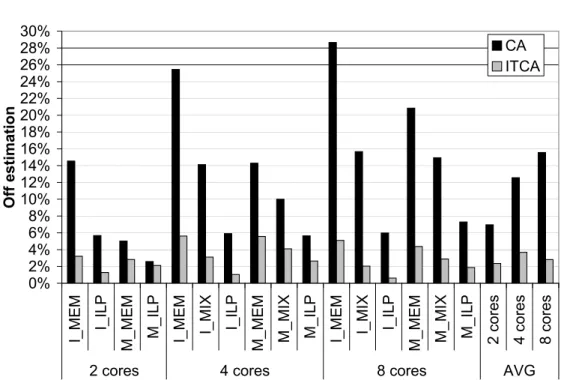
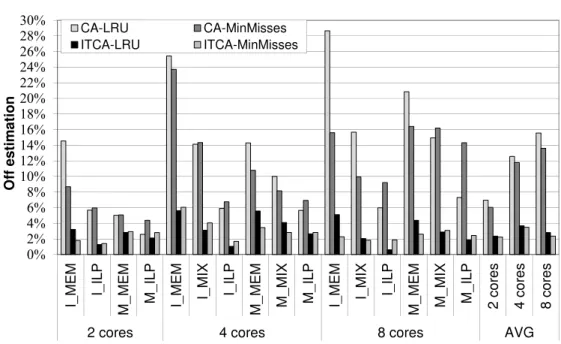
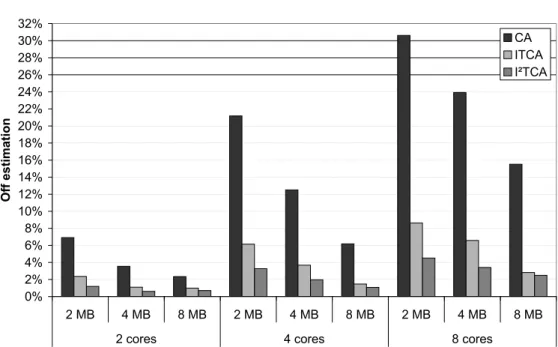
In this Chapter, we firstly analyse the classical approach for CMP processors, and pro-pose a novel CPU accounting hardware mechanism,InterTask Conflict-Aware(ITCA) accounting, which improves the accuracy in measuring CPU capacity of the Classical Approach (CA) for CMPs. On a modelled 2-, 4-, and 8-core CMP, ITCA reduces the inaccuracy of the classical approach from 7.0%, 13%, and 16%, to 2.4%, 3.7%, and 2.8%, respectively. Second, we evaluate the accuracy of ITCA in conjunction with dynamic cache partitioning algorithms [49]. Third, we show that we can imple-ment an improveimple-ment of ITCA with small changes, denoted I2TCA, and that I2TCA reduces the average off estimation of ITCA. Finally, we show that under even-share accounting, I2TCA works well with small changes.4.1
Introduction
Chip MultiProcessors (CMP) or multi-core processors have emerged as the dominant architecture choice for modern computing systems. The benefits of multi-core pro-cessors are high power efficiency and less design costs, due to multiplex simpler cores in a processor (chip). In addition, cores have less power-hungry hardware structures, and as a result, average power consumption is reasonable.
Due to gap between the processor and the memory speed, the performance of a task may be degraded. In order to face this scenario, the cache hierarchy is included in most currently processor. The cache hierarchy store data recently used by a task in order take advantage of the temporal and spatial locality of the task.
In CMP processors, the cache hierarchy is normally organized in a first level of in-33
struction and data cache private to each core. The last level cache is generally shared among different cores in the processor. Shared caches increase resource utilization and system performance. Large caches improve performance and efficiency by in-creasing the probability that each task can access data from closer level of the cache hierarchy. Moreover, they allow a task to make use of the entire cache.
Since tasks share the same address space in LLC, they compete for space in the LLC. As a consequence, the contention in the LLC may degrade tasks’ performance and may affect CPU accounting as shown in Section 1.1. In current CPU account-ing mechanisms, the contention in LLC does not take into account CPU accountaccount-ing and hence, their accuracy is poor. In this Chapter, we present a new CPU accounting mechanism, named ITCA (Intertask Conflict-Aware) and ITCA maintains the prin-ciple of accounting in CMP processors.
ITCA [33] has been developed based on our understanding of the processor archi-tecture. In this Chapter, we show that our intuition in developing ITCA is correct by making a complete design space exploration of the possible combinations of
Hard-ware Resource Status Indicator (HRSI) states. This exploration confirms that ITCA
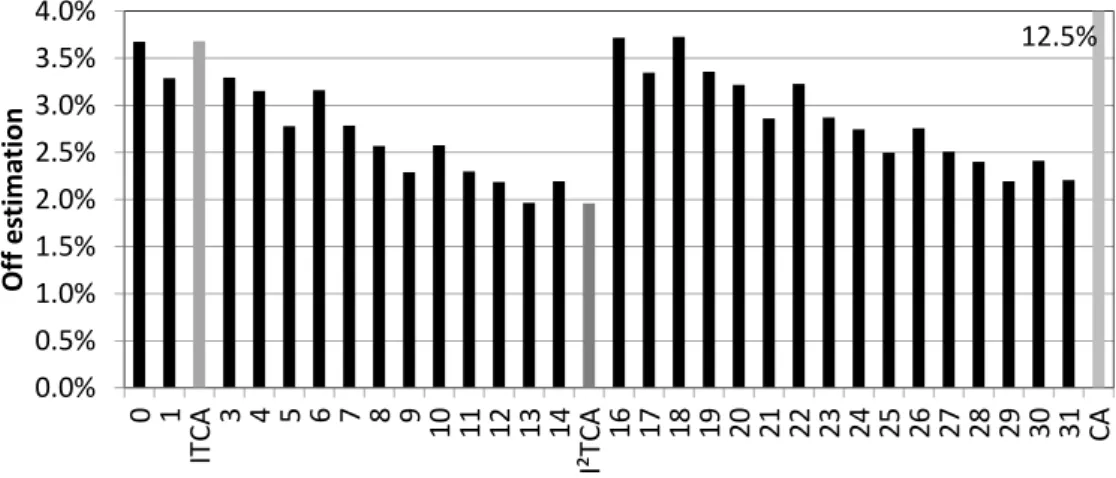
provides reasonable accurate results. It also shows that we can implement an im-provement of ITCA with small changes, denoted I2TCA, and that I2TCA reduces the average off estimation of ITCA mainly in the five worst workloads: from 32% to 13% in the 2-core configuration, from 35% and 17% in the 4-core configuration and from 20% to 14% in the 8-core configuration. Furthermore, I2TCA can work well in even-share accounting in order to maintain the principle of accounting.
The rest of the Chapter is organized as follows.
![Table 2.5: The input sets for each benchmark in SPEC CPU INT 2006 and simulation starting point (in millions of instructions) using the SimPoint methodology [54]](https://thumb-us.123doks.com/thumbv2/123dok_us/534247.2563005/32.892.184.733.262.482/table-benchmark-simulation-starting-millions-instructions-simpoint-methodology.webp)