Open Access Dissertations Theses and Dissertations
January 2015
An Exploratory Investigation Into The Factors
Associated With The Attrition Of Athletic Training
Students
Craig Alan Voll, Jr. Purdue University
Follow this and additional works at:https://docs.lib.purdue.edu/open_access_dissertations
This document has been made available through Purdue e-Pubs, a service of the Purdue University Libraries. Please contact [email protected] for additional information.
Recommended Citation
Voll, Jr., Craig Alan, "An Exploratory Investigation Into The Factors Associated With The Attrition Of Athletic Training Students" (2015).Open Access Dissertations. 1156.
PURDUE UNIVERSITY GRADUATE SCHOOL Thesis/Dissertation Acceptance
This is to certify that the thesis/dissertation prepared By
Entitled
For the degree of
Is approved by the final examining committee:
To the best of my knowledge and as understood by the student in the Thesis/Dissertation Agreement, Publication Delay, and Certification Disclaimer (Graduate School Form 32), this thesis/dissertation adheres to the provisions of Purdue University’s “Policy of Integrity in Research” and the use of copyright material.
Approved by Major Professor(s):
Approved by:
Head of the Departmental Graduate Program Date
Craig Alan Voll, Jr.
AN EXPLORATORY INVESTIGATION INTO THE FACTORS ASSOCIATED WITH THE ATTRITION OF ATHLETIC TRAINING STUDENTS Doctor of Philosophy Thomas J. Templin Chair Larry J. Leverenz Bonnie T. Blankenship Donna L. Enersen Thomas J Templin David B. Klenosky 8/13/2015
i
AN EXPLORATORY INVESTIGATION INTO THE FACTORS ASSOCIATED WITH THE ATTRITION OF ATHLETIC TRAINING STUDENTS
A Dissertation Submitted to the Faculty
of
Purdue University by
Craig Alan Voll, Jr.
In Partial Fulfillment of the Requirements for the Degree
of
Doctor of Philosophy
December 2015 Purdue University West Lafayette, Indiana
ii
This Dissertation is dedicated to my wife, Corry Voll
From the moment we met you have given me unconditional love, friendship, untiring support and reinforcement. For that I am eternally grateful!
No person was ever honored for what was received: Honor has always been the reward for what was given. - William E. “Pinky” Newell
iii
ACKNOWLEDGMENTS
The successful completion of this dissertation would not have been possible without the help of several people.
For my best friend and wife, Corry Voll, to whom this dissertation is dedicated, you are the one person in my life who has sacrificed and given the most of yourself so that I can do what I truly love to do as a profession. I realize that it hasn’t always been easy to be a single mother of three children while I was at work. Whether it was the long hours of football season, week long wrestling road trips, being away for conferences and executive board meetings, or forcing you to be a taxi driver for three kids with events on different sides of the county by yourself I want you to know that it would be impossible for me to have completed this dissertation if it were not for you. I hope you realize how important you have been to my success and while I know I can never completely make up for all the missed time together I hope that over time I can at least close the gap.
To my parents, Craig and Darlene Voll, you taught me at a young age that there were two kinds of people in the world, those who do the work and those who take the credit. You taught me that I should always strive to be in the first group because there was much less competition there. You have given me your love, faith and support through all my endeavors and have helped lay the foundation for all the success I have had to date. Thank You!
iv
To Dr. Tom Templin, I would like to express my sincere appreciation for not giving up on me throughout this process and for your guidance and insight into the world of socialization. You have lit a fire within me that is fueled only by knowledge. You have helped me not only become a better student but a better person. For that I will always be grateful!
A special thank you to Dr. Larry Leverenz is also in order. When I came to that fork in the road of my career you encouraged me to take it. It was your mentoring and guidance which gave me the courage to pursue my PhD and enter the world of academia after 15 years of working as a clinical athletic trainer. It was also you who gave me my first opportunity to teach full time which allowed me to hone my craft and validate my decision to change careers. For that I will be eternally grateful!
I would also like to thank Dr. Bonnie Blankenship and Dr. Donna Enersen for serving on my dissertation committee. Thank you for sticking by me and encouraging me through this process. I will be forever indebted for the time and energy you have put into making my education at Purdue all that it has been.
To my Purdue family, as I look back on my career it has been an amazing blessing to have been placed on your shoulders for the first 16 years of my career. To have had the opportunity to be mentored, guided and learn from Denny Miller, Larry Leverenz, Alice Wilcoxson, Randy Cohen, Terry DeZeeuw, Wes Robinson and Jessica Lipsett on a daily basis has made me the athletic training educator I am today.
To my new University of Indianapolis family, Chrisy Lauber and Scott Lawrance, thank you for taking a chance on me, sticking by me throughout this entire process and
v
giving me the opportunity to do what I am most passionate about doing which is teaching the future generation of athletic trainers.
Lastly, it truly has been a blessing to have been born and raised on the east side of Cleveland. It has taught me innumerable lessons about life and has made me who I am today. Growing up in a city that has been a national punch line since the Cuyahoga river caught on fire and is known for such iconic sporting moments like Willie May’s over the shoulder catch in the 1954 World Series to beat the heavily favored Indians, John Elway and the Drive, Earnest Byner and The Fumble, LeBron James and the decision I have come to realize how important it is to never give up and to work hard because as I have learned by being from Cleveland, life does not owe you any favors.
vi TABLE OF CONTENTS Page LIST OF TABLES ... xi ABSTRACT ... xiii INTRODUCTION ... 1 Occupational Socialization ...2 Acculturation/Anticipatory Socialization ... 3 Professional Socialization ... 4 Organizational Socialization ... 5 Attrition ... 5
Purpose of the Study ...6
Research Questions ...8
Definition of Terms ...9
Limitations and Assumptions ...11
Significance of the Study ...12
Overview of the thesis ...12
REVIEW OF LITERATURE ... 14 Theoretical Frameworks ... 15 Occupational Socialization ... 15 Acculturation/Anticipatory Socialization ... 17 Subjective Warrant: ... 18 Apprenticeship of Observation: ... 19
Attractors and Facilitators: ... 20
Socialization via Sport: ... 22
Dialectics of Socialization: ... 23
vii
Page
Studentship ... 25
Organizational Socialization ... 27
Professional Preparation Programs ... 30
Retention and Attrition ... 30
Tinto’s Student Integration Model ... 30
Clinical Education ... 32
Professional Involvement ... 35
Relevant Studies in Athletic Training ... 36
Attractors/Facilitators ... 36 Student Retention ... 37 Commitment to AT Education ... 43 Chapter Summary ... 45 METHODS ... 46 General Design/Overview ... 46 Phase I ... 47
Development of SATCSI Instrument ... 48
SATCSI Section I: Anticipatory Socialization ... 48
SATCSI Section II: Professional Socialization (Attrition Group) ... 50
SATCSI Section III: Professional Socialization (Persistence Group) ... 52
Pilot Study ... 52
Phase I Quantitative and Qualitative Data Sources ... 53
Student Athletic Trainer Career Shift Inventory ... 54
Phase II Qualitative Data Sources ... 55
Semi-structured interview ... 56
Participants ... 56
Recruitment of subjects and obtaining informed consent ... 57
Quantitative Data Analysis ...59
Qualitative Data Analysis ... 60
vii
i
Page
RESULTS AND DISCUSSION ... 63
Introduction ... 63
Section I: Nature of the Population Studied ... 64
Participants ... 64
Participants Background (Entire Sample Population) ... 65
Participants Background (Attrition Group) ... 66
Participants Background (Persistence Group) ... 70
Chi-Square ... 71
Summary of Findings in Demographic Information ...73
Section II - Reliability Analyses for the SATCSI ...74
Anticipatory Socialization Construct – Attractors and Facilitators Subscale ... 74
Professional Socialization Construct – Pre-College Experiences with AT ... 75
Professional Socialization Construct – Professional Involvement as an ATS ... 78
Professional Socialization Construct – Academic Experiences as an ATS ... 79
Professional Socialization Construct – Clinical Education Experiences as an ATS.. 80
Professional Socialization Construct – Social Experiences as an ATS ... 84
Professional Socialization Construct – Motivation to Persist as an ATS ... 85
Section III – Acculturation Construct ... 87
SATSCI – Acculturation Construct Frequency Distributions ... 88
SATSCI – Acculturation Construct Variable Mean Scores (Attractors) ... 90
Mean Scores (Facilitators) ... 92
Kruskal Wallis Analysis of Variance ... 96
Attractors to the Profession of Athletic Training ... 96
Facilitators to the Profession of Athletic Training ... 97
Post Hoc Testing ... 99
Predictors of AT Attrition ... 106
Summary of Findings in Analyses of the Acculturation Construct ... 108
Section IV Professional Socialization Construct ... 110
ix
Page
Kruskal Wallis Analysis of Variance ... 122
Post Hoc Testing ... 129
Predictors of AT Attrition ... 136
Summary of Findings in Analyses of Professional Socialization Construct ... 140
Initial Insights from Phase Two ... 141
Attrition Construct ... 141
Summary of Qualitative Findings ... 145
CONCLUSIONS AND DISCUSSION ... 146
Discussion ... 147
Respondents’ Backgrounds ... 147
Acculturation Construct ... 150
Attractors to the Athletic Training Profession ... 150
Difference between attrition and persistence groups ... 151
Facilitators to the Athletic Training Profession ... 151
Differences between attrition and persistence groups ... 152
Predictors of AT Attrition ... 153
Professional Socialization Construct ... 153
Pre-College Experiences with AT ... 154
Professional Involvement as an ATS ... 154
Academic Experiences as an ATS ... 155
Clinical Experiences as an ATS ... 155
Social Experiences as an ATS ... 157
Motivation to Persist as an ATS ... 158
Differences between attrition and persistence group ... 159
Predictors of AT Attrition ... 160
Conclusions and Implications ... 160
Directions for Future Studies ...167
Summary of Key Findings ... 169
x Page APPENDICES Appendix A ...189 Appendix B ...198 Appendix C ... 213 Appendix D ... 229 Appendix E ... 232 Appendix F ... 235 Appendix G ...237 Appendix H ... 239 Appendix I ... 240 VITA ... 245
xi
LIST OF TABLES
Table ... Page
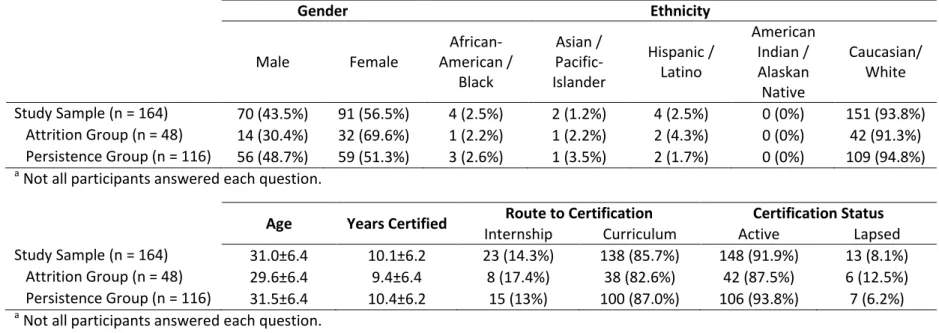
Table 4.1 Participants Demographics ... 67
Table 4.2 Age Interested in Athletic Training ... 67
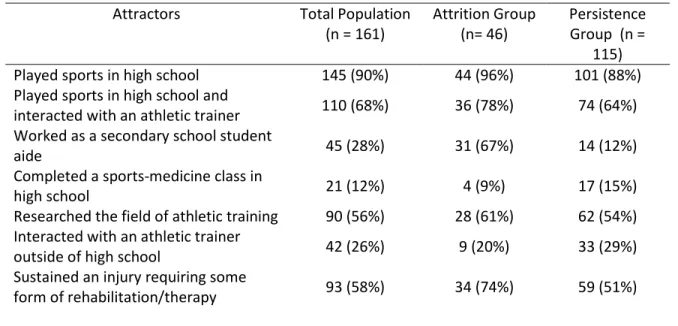
Table 4.3 Pre-College Attractors ... 68
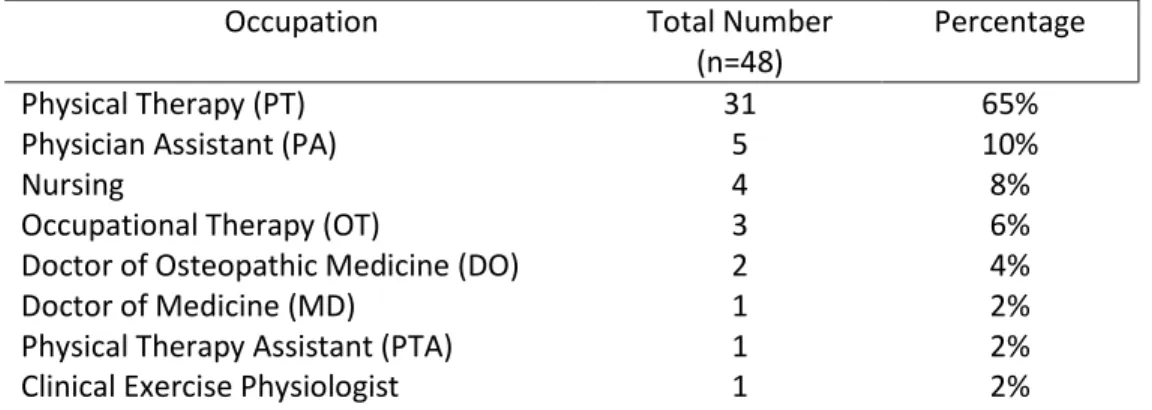
Table 4.4 Occupation after graduation from ATP ... 70
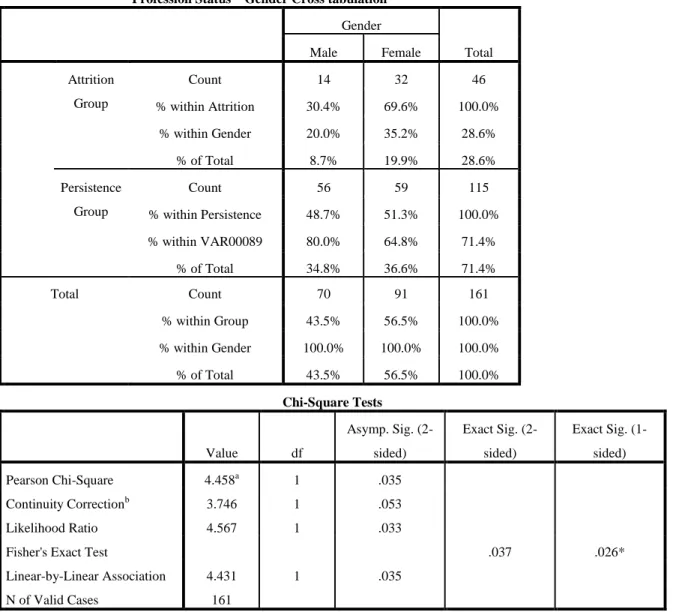
Table 4.5 Chi-Square Data Table... 72
Table 4.6 Reliability Analysis: Attractors to profession of athletic training ... 76
Table 4.7 Reliability Analysis: Facilitators to profession of athletic training ... 77
Table 4.8 Reliability Analysis: Pre-College Experiences ... 78
Table 4.9 Reliability Analysis: Professional Involvement ... 79
Table 4.10 Reliability Analysis: Academic Experience ... 80
Table 4.11 Reliability Analysis: Clinical Integration Site 1 ... 81
Table 4.12 Reliability Analysis: Clinical Integration Site 2 ... 82
Table 4.13 Reliability Analysis: Clinical Integration Site 3 ... 83
Table 4.14 Reliability Analysis: Clinical Integration Site 4 ... 84
Table 4.15 Reliability Analysis: Social Integration ... 85
Table 4.16 Reliability Analysis: Motivation ... 87
Table 4.17 Participants Introduction to Athletic Training ... 88
Table 4.18 Attractor Mean Scores ... 93
Table 4.19 Facilitator Mean Scores ... 95
Table 4.20 Kruskal-Wallis Analysis of Variance: Attractors ... 98
Table 4.21 Kruskal-Wallis Analysis of Variance: Facilitators ... 99
Table 4.22 Post-Hoc Testing: Prepare for Another Profession ... 101
xii
Table Page
Table 4.24 Post-Hoc Testing: To Work in the Clinical Setting ... 104
Table 4.25 Post-Hoc Testing: To Work with Athletes ... 105
Table 4.26 Post-Hoc Testing: College Athletic Trainer ... 106
Table 4.27 Acculturation Regression Analysis Summary ... 107
Table 4.28 Pre-College Experience Mean Scores ... 113
Table 4.29 Professional Involvement Mean Scores ... 114
Table 4.30 Academic Experiences Mean Scores ... 114
Table 4.31 Clinical Experiences Mean Scores ... 115
Table 4.32 Social Experiences Mean Scores ... 116
Table 4.33 Motivation Mean Scores ... 117
Table 4.34 Kruskal-Wallis Analysis of Variance: Pre-College Experiences ... 123
Table 4.35 Kruskal-Wallis Analysis of Variance: Professional Involvement ... 124
Table 4.36 Kruskal-Wallis Analysis of Variance: Academic Experiences ... 125
Table 4.37 Kruskal-Wallis Analysis of Variance: Clinical Experiences ... 126
Table 4.38 Kruskal-Wallis Analysis of Variance: Social Experiences... 128
Table 4.39 Kruskal-Wallis Analysis of Variance: Motivation ... 129
Table 4.40 Post-Hoc Testing: Never Intended to Pursue AT as a career ... 131
Table 4.41 Post-Hoc Testing: Faculty Members were good teachers ... 132
Table 4.42 Post-Hoc Testing: Had time to socialize with friends ... 133
Table 4.43 Post-Hoc Testing: Had time for myself ... 134
Table 4.44 Post-Hoc Testing: AT would prepare me for next career ... 135
Table 4.45 Post-Hoc Testing: Had desire to get certified as an AT ... 136
xii
i
ABSTRACT
Voll, Jr., Craig A. Ph.D., Purdue University, December 2015. An Exploratory
Investigation into the Factors Associated with the Attrition of Athletic Training Students: Major Professor: Thomas J. Templin.
The expansion of athletic training practice beyond its traditional roots has broadened its role within the healthcare community. In order for the profession of athletic training to continue to advance and remain relevant in the new healthcare environment it must be able to attract and retain quality recruits with the ultimate goal of eventual practice as an athletic trainer. The ability to attract and retain quality students within the profession has taken on added significance with the recent decision by the strategic alliance to require professional education of athletic trainers at the graduate level in no less than seven years. Using occupational socialization theory and the student integration model, the purpose of this investigation was to examine the socialization process of students attempting to become certified athletic trainers and determine factors contributing to either the
persistence of a student or the attrition of a student from athletic training. The study was divided into two phases. In phase one, former athletic training students from a variety of athletic training programs within the Great Lakes Athletic Trainers Association
completed an online survey related to their experiences as an athletic training student. Results indicate that, while both the attrition and persistence groups share some
xiv
similarities regarding attraction to the athletic training profession, they vary on the timing of a decision to pursue athletic training as a major as well as the importance of certain attractors and facilitators. In phase two, a subset of participants were invited to participate in interviews regarding their decision to leave the profession of athletic training and pursue a career in another allied healthcare field. At the completion of this dissertation, phase two was still ongoing, but initial insights from the interviews revealed that when participants were asked to explain why they decided to pursue another
profession upon completion of their athletic training program, the themes of quality of life and increased career opportunities emerged. The results of this study speak to the importance of the ability of athletic training educators to attract and retain those students who are truly interested in becoming an athletic trainer to advance the field. Implications for retaining quality students and fostering persistence are discussed at length.
1 INTRODUCTION
Grounded in socialization theory (Lortie, 1975; Merton, 1957; Tinto, 1975), this study examines the attrition of athletic training education program graduates. In essence, it examines why graduates leave the field of athletic training (AT). Choosing a
professional career, such as AT, has been identified as a major life decision in which individuals are confronted with different occupational choices, each of which offer different sets of advantages and disadvantages (Lortie, 1975). Additionally, individuals possess unique attributes such as values, interests, and abilities which ultimately makes the choice of a satisfying profession a complex process involving many variables (Mulling, 1981). Individuals who are interested in becoming an AT must first earn a degree from a university or college with a professional athletic training program (ATP) accredited by the Commission on Accreditation of Athletic Training Education (CAATE) which then enables them to be eligible to sit for the Board of Certification (BOC) exam (Mazerolle, Bowman & Dodge, 2014).
Mulling (1981) explains that sometimes the initial choice of a career is not always completely satisfactory to a student. In fact, when a student discovers that continued pursuit of a specific career is less than desirable, he or she may elect to pursue a career in another area. This is true in all professions including athletic training where once
1
experience requirements. More troubling is the fact that even upon successful
completion of an ATP, students decide they no longer wish to pursue athletic training and embark on another career path. When compared to professions like nursing, occupational therapy and physical therapy, athletic training is a relatively new allied health profession. Athletic training is expanding both in employment opportunities and in available CAATE professional education programs (Benes & Mazerolle, 2014; National Athletic Trainers Association (NATA), 2015). Both the professional and educational opportunities for the athletic trainer have increased over the past few years and all indications are that they will continue to do so into the future (Mazerolle, Gavin, Pitney & Casa, 2012). With this expansion, it has become increasingly important to ensure that students who enter ATPs continue on to work in the field and advance the profession (Benes & Mazerolle, 2014).
Retaining and graduating strong students is obviously a key factor to preserve the status and quality of ATPs. Bowman and Dodge (2013) contend that recruits today not only have a much larger range of health care-related programs from which to choose, but also 365 CAATE accredited ATPEPs (CAATE, 2015) to choose from, thus making the individual ATP’s reputation increasingly important. While graduating and retaining athletic trainers in the profession holds importance for ATPs, it is vitally important from a more global perspective for the athletic training profession. Eberman and Kahanov (2013) point out that retaining health care providers, such as ATs, in their respective profession is imperative to maintain mature practitioners and ensure mentorship of young and future practitioners to continue to facilitate optimal care of patients.
According to Mazerolle, Gavin, Pitney, Casa and Burton (2012), the National Athletic Trainers’ Association (NATA, 2015) estimates it has more than 5,000 student
2
members who are seniors in their ATP, however, in their first year of employment following successful matriculation through their respective ATP, approximately 1,200 were certified members. This, Mazerolle et al. explains, indicates attrition away from the profession. Furthermore, Benes and Mazerolle (2014) state that data from the 2004 NATA database revealed that 51% of the 2003 ATP graduates found employment in fields other than athletic training, and of the graduates who were continuing their education, 72% were pursuing degrees in fields other than athletic training. Therefore, retention of quality athletic trainers within the field is not only important for the continued growth and long term health of the profession, but important to continually supply the workforce with sufficient numbers of clinicians, especially considering that the profession of athletic training expects to see a 37% increase in the number of
positions available by the year 2018 (Bowman & Dodge, 2013; Lacey & Wright, 2009). Occupational Socialization
Occupational socialization is in its essence, a learning process (Quijada, 2007; Saks & Ashforth, 1997). Socialization is a process of learning the values, norms and required behavior which permit an individual to participate as a member of the group (Schein, 1968; VanMaanen & Schein, 1979). According to Lortie (1975) this is a very subjective, individual process that happens to people as they move through a series of structured experiences and internalize the subculture of the group they wish to become a member. Quijada (2007) states that there exists a dual nature to what is learned during the socialization process with one part referring to skill acquisition and the other to learning a cultural pattern. This socialization process therefore provides the basis for
3
what Schein (1968) described as a new social identity in which the new values, norms and rules of conduct are incorporated into a new identity. Occupational socialization, therefore, involves a lifelong process in which individuals learn the norms, customs, and ideologies important to the particular culture they aspire to enter through interactions with one another and social institutions (Billingham, 2007; Clausen, 1968; Templin & Richards, 2014).
Scholars have generally adopted a three-phase approach to understanding occupational socialization that occurs along a temporal continuum. These three phases, however, do not contain distinct transition points or definitive times at which all
individuals move from one state to another (Gardiner-Shires & Mensch, 2009; Lawson, 1983a; Lawson, 1983b; Mazerolle Bowman & Dodge, 2014; Mensch, Crews & Mitchell, 2005; Mensch & Mitchell, 2008; Templin & Schempp, 1989; Templin & Richards, 2014). The first phase, acculturation or anticipatory socialization, relates to pre-training
socialization. The second phase, professional socialization, begins when recruits formalize their commitment to a specific profession by enrolling in a professional education program typically in a university setting. The third phase, organizational socialization, refers to socialization that takes place in the context of the work place where individuals assume and are socialized into the role of a professional within the organization.
Acculturation/Anticipatory Socialization
Acculturation or anticipatory socialization reflects socialization that occurs prior to an individual’s formal decision to pursue professional education training (Lawson,
4
1983a; Mazerolle, Bowman & Dodge, 2014; Richards, Templin & Graber, 2014). During this time, prospective recruits learn what it means to be a professional through
interactions with socializing agents. Within the field of athletic training these socializing agents include an interest in sports medicine, a sports-oriented and team-oriented
atmosphere and mentoring received from a high school athletic trainer (Gardiner-Shires & Mensch, 2009; Mazerolle, Bowman & Dodge, 2014; Mensch & Mitchell, 2008). Generally, research indicates that acculturation reflects an important phase of
socialization in the development of professionals (Templin & Richards, 2014). In fact, within the context of teacher development, Curtner-Smith, Hastie and Kinchin (2008) note that acculturation is a very potent type of socialization experienced by recruits and in some cases can be more powerful than the professional preparation program (Zeichner & Gore, 1990).
Professional Socialization
Professional socialization begins when potential recruits make a formal
commitment to acquire the attitudes, knowledge, skills and behaviors related to his or her intended role (Lawson, 1983a; Richards, Templin & Graber, 2014). Fundamental to this process for the athletic training student (ATS) is enrolling in a CAATE athletic training program which involves both academic and clinical training (Mazerolle, Bowman & Dodge, 2014). The professional education program offered in college is a means to learn the norms, values, and knowledge necessary to become a member of a chosen profession. Formal preparation programs are designed to adjust initial impressions of a field through
5
interaction with the socialization agents in the profession (Mensch, Crews, & Murray, 2005)
Organizational Socialization
Organizational socialization refers to workplace socialization that occurs on the job and is ongoing throughout an individual’s career (Richards, Templin & Graber, 2014). VanMaanen and Schein (1979) referred to organizational socialization as a process by which one is taught and learns the ropes of a particular organization and is grounded in the realization that students are not finished products upon graduating from their
professional education program. During this phase, individuals must adjust the ideals and theories they have learned during professional socialization to the demands and
imperfections of the real world (Mensch, Crews & Mitchell, 2005). Ashforth and Saks (1996) are quick to point out that even if the professional socialization process is ultimately successful, those results do tend to decay slightly over time. Therefore, the objective of organizational socialization is to develop a state of “creative individualism” where the relevant rules and norms are accepted, but room for role innovation is
maintained (Quijada, 2007).
Attrition
Socialization is a process of inclusion and a process of becoming more central to the organization by learning what is needed to be an effective member (Ashforth & Saks, 1996; Schein, 1968; VanMaanen & Schein, 1979); whereas, attrition is the process of exclusion, not necessarily from the organization itself, but from the central elements of the organization (Quijada, 2007). Attrition is not necessarily the direct opposite of
6
socialization, but the two concepts are deeply interconnected with socialization being more a learning process and attrition not necessarily a process of unlearning but a degradation of the results of socialization (Quijada, 2007). If the student perceives the socialization process as irrelevant and/or insignificant to one’s occupational future, the process will become one of attrition versus socialization ultimately manifesting itself in the student choosing to desocialize out of one occupation in favor of another (Mulling, 1981).
Purpose of the Study
The literature suggests that in physical education, disinterest in course content, conflicting expectations of course work, undesirable occupational duties, lack of necessary aptitude, and being unlike other students in the field all contributed to an individual’s decision to discontinue his first choice of an occupation (Holland & Nichols, 1964; Mulling, 1981; Pierson, 1962; Templin, Woodford & Mulling, 1982). Factors that have been identified leading to student attrition from allied health professional education programs include disenchantment about the program and profession, perceived lack of support from faculty, personal stressors, misinformation regarding the program and profession, problems with clinical placements, lack of clinical integration, poor social and academic integration within the program and an overall decreased motivation to continue in the program (Bowman & Dodge, 2013; Dodge, Mitchell & Mensch, 2009; Harvey & McMurray, 1997; Mazerolle, Gavin, Pitney, Casa & Burton 2012; Wells, 1997; Young, Klossner, Docherty, Dodge & Mensch, 2013). These findings combined with
7
are a few of the investigations which have specifically studied the influential factors affecting a student’s decision to change one’s major field of study.
Retrospective analysis has been used successfully by other researchers to examine career decisions in teaching (Lortie, 1975), physical education (Richards & Templin, 2011) and athletic training (Gardiner-Shires & Mensch, 2009; Pitney, 2002; Pitney, Ilsley, & Rintala, 2002). My interests lie specifically in utilizing retrospective analysis to gain a better understanding of factors which contribute to a student’s decision to leave athletic training and choose another profession. Mazerolle, Gavin, Pitney, Casa and Burton (2012) point out that although a plethora of data exists regarding student retention in higher education, a paucity of research exists on those students who complete degree programs but choose not to enter the workforce in which they were professionally trained. While insight has been given into how ATs are introduced to and either choose to
become an AT or decide against a career in athletic training (Bowman & Dodge, 2013; Dodge, Mitchell & Mensch, 2009; Gardiner-Shires & Mensch, 2009; Mazerolle, Gavin, Pitney, Casa & Burton 2012; Mensch, Rogers & Mitchell, 2004; Mensch & Mitchell, 2006), within the field of athletic training no studies have been found that specifically investigated the reasons an athletic training student, upon completion of all requirements of the profession, withdraws from athletic training and enters a new field of study. Thus the purpose of this investigation will be to examine the professional socialization process of students attempting to become certified athletic trainers and determine what factors contribute to either the persistence of a student or the attrition of a student from athletic training. In order to advance as a profession it is imperative that as a community we have a better understanding of the professional socialization process within ATPs and the
8
impact it has on students to persist in athletic training or to no longer pursue athletic training as a career.
Research Questions
The overarching research question guiding this investigation is “What factors influence students who choose athletic training as a career to change their mind and drop out of the profession even though they have fulfilled all the requirements?” To help focus the investigation an attempt will be made to answer the following questions:
1. What were the important influential attractors to and facilitators for entering into an athletic training program (ATP)?
2. Are the attractors to and facilitators for entering into an ATP different between those who persist in athletic training and those who pursue education in another allied health profession upon completion of their ATP?
3. Which attractors to and facilitators for entering an ATP discriminate between
persistence in the athletic training profession or attrition from the athletic training profession and pursing education in another allied health care profession? Which is the strongest predictor of attrition from or persistence in the athletic training profession?
4. Which of the following variables discriminate between persisting in the athletic
training profession or attrition from the athletic training profession and pursuing education in another allied healthcare profession: pre-college experiences;
9
professional involvement experiences; academic experiences; clinical education experiences; social experiences and motivation?
5. What are commonly-stated reasons students choose to pursue another allied
healthcare profession?
Definition of Terms
Throughout this document it is important for the reader to be familiar with the following definitions.
Academic Integration: A product of personal satisfaction with the athletic training program learning experiences and perceptions of faculty abilities (Dodge, Mitchell & Mensch, 2009).
Acculturation or Anticipatory Socialization: The first phase of the socialization process known as the recruitment period where individuals learn and develop
perceptions about the profession they aspire to join (Gardiner-Shires & Mensch, 2009; Lortie, 1975).
Anticipatory factors: Knowledge of academic, clinical and time demands of athletic training prior to enrollment in an athletic training program (Dodge, Mitchell & Mensch, 2009).
Athletic Training Attrition: The term used to describe athletic trainers who leave the profession of athletic training and seek employment in another healthcare profession Athletic Training Persistence: The term used to describe athletic trainers who remain in the profession of athletic training.
10
Attractors: The many characteristics of a profession which compel the interest of recruits (Gardiner-Shires & Mensch, 2009; Lortie, 1975).
Clinical Integration: A complex blend of abilities to get along with supervisors, peers and clients in the clinical setting as well as personal perceptions of learning, task appropriateness, time demands, personal anxiety and satisfaction within the clinical experience (Dodge, Mitchell & Mensch, 2009).
Facilitators: The individuals and events which influence recruits’ career decision (Gardiner-Shires & Mensch, 2009; Lortie, 1975).
Motivation: A concept represented by the drive to complete the athletic training program (Dodge, Mitchell & Mensch, 2009).
Organizational Socialization: Last phase of the socialization process that occurs when an individual exits his or her professional education program and learns how to function as a member of the employment setting (Gardiner-Shires & Mensch, 2009; Lawson, 1983a).
Professional Involvement: A concept represented by the involvement of the individual within local, state, district, and national athletic training associations. Professional Socialization: Second phase of the socialization process that occurs in a professional education program in which an individual will engage in a variety of clinical and didactic experiences to develop further their understanding of their chosen profession and the knowledge and skills necessary to be successful (Gardiner-Shires & Mensch, 2009; Lawson, 1983a).
11
Social Integration: A combination of perceptions of time availability for demands other than the didactic and clinical component of the athletic training program, and quality of interactions with others (Dodge, Mitchell & Mensch, 2009).
Limitations and Assumptions
The following limitations and assumptions were identified prior to beginning the study. They include the following:
1. This study was designed to be retrospective in nature with the primary
investigator relying on the respondents’ abilities to recall events that happened during the time spent in their athletic training program (ATP). Since
individuals tend to process information and change their impression of events over time (Brewer, Van Raalte, Linders & Van Raalte, 1991; Richards, 2010), it is likely that different data would have emerged if the study had been conducted while the respondents were enrolled in their respective ATPs.
2. Respondents attended different ATPs with different requirements to enter and
remain in the program. The differences in programs make the experiences of the respondents diverse and difficult to compare.
3. This study used participants only from ATPs located in the Great Lakes
Athletic Trainers Association (GLATA) comprised of six states (Illinois, Indiana, Michigan, Minnesota, Ohio, Wisconsin) located within the United States Midwest which limits the generalizability of the findings.
12
4. It is assumed that participants will respond to the questionnaire and email interview truthfully and honestly.
Significance of the Study
Athletic trainers have chosen to compete for a place as legitimate healthcare providers (Peer & Rakich, 2000). Additionally, the expansion of athletic training practice beyond its traditional roots has broadened our role in the healthcare community. When compared to peer professions like physical therapy, occupational therapy and nursing, athletic training is a relatively young allied healthcare profession. In order for the profession of athletic training to continue to advance and remain relevant in the new healthcare environment it must be able to attract and retain quality recruits with the ultimate goal of eventual practice as an athletic trainer. Students’ decisions to not pursue employment in athletic training is concerning. In order to gain a better understanding of the factors influencing prospective athletic trainers, it is imperative that athletic training educators have a better understanding of the professional socialization process within the ATPs.
Overview of the thesis
This dissertation project has been written in a traditional format. Chapter Two represents a general literature review. Chapter Three includes the general methods for data collection and analysis for the entire dissertation study (Phase one and two).
Chapter Four, details the results of the dissertation study with initial insights gained from qualitative inquiry shared as well. Finally, chapter Five draws conclusions and discusses
13
the implications of the dissertation study. A comprehensive list of references is provided at the end of the dissertation.
14 REVIEW OF LITERATURE
Since the 1970’s, much attention has been paid to the process of socialization within physical education literature as well as allied health professions, especially nursing. In contrast, socialization research within the athletic training profession began in earnest within the last decade. Examining the concept of socialization is important because this process provides researchers a theoretical framework from which they can gain insights into how athletic trainers, educators and allied health professionals learn to understand and fulfill the professional responsibilities of the career they have chosen (Mensch, Crews & Murray, 2005; Stroot & Williamson, 1993). Lortie in 1975, explained that socialization is a subjective, individual process that happens to people as they move through a series of structured experiences helping them internalize the subculture of the group they wish to become a member of. In essence it is a process of change by which an individual becomes a member of a particular profession (Lacey, 1977).
Stroot and Williamson (1993) eloquently explain that as educators it is important that we conduct and study research on occupational socialization to gain a better
understanding of factors influencing prospective recruits in the hope we can limit problems they may encounter along their journey to become a professional.
15 Theoretical Frameworks
Occupational Socialization
The theoretical perspective most often used to encompass socialization research in physical education and the allied health professions has been occupational socialization, which is based on models of socialization in medicine and law and later applied in the education setting (Lawson & Stroot, 1993). At its essence, occupational socialization is a process of learning the values, norms and required behavior permitting an individual to participate as a member of the group (Quijada, 2007; Saks & Ashforth, 1997; Schein, 1968; VanMaanen & Schein, 1979). Lawson (1986) defined occupational socialization as all the kinds of socialization that initially influence a person to enter a particular field and then later are responsible for their perceptions and actions as a professional. This socialization process, therefore, involves a lifelong process in which individuals learn the norms, customs and ideologies important to the particular culture they aspire to enter, providing the basis for a new social identity (Billingham, 2007; Clausen, 1968; Schein, 1968; Templin & Richards, 2014).
Teschendorf and Nemshick (2001) postulate it is important to remember that each occupational group controls the educational experiences of its students and in so doing creates what Merton (1957) referred to as its own normative subculture. This subculture is a body of shared and transmitted ideas, values, and standards toward which members of the profession are expected to orient their behavior. This subculture therefore, is part of the process used to reproduce the profession (Teschendorf & Nemshick, 2001). The other components include efforts of the faculty to impart knowledge, values, beliefs, as
16
well as ways of thinking about specific problems. Thus, the subculture is created when you combine the efforts of the faculty, students and professional accreditation standards (Teschendorf & Nemshick, 2001).
The “professionalization” of an individual is the process by which recruits into a profession develop values, attitudes, and beliefs that support their role as practitioners (Hayden, 1995). Hall (1968) included the following attributes consistent with an individual who has undergone professionalization: autonomy or independent decision making, a sense of calling or dedication to the field, use of the professional organization as a reference, belief in colleague control, and belief in the indispensability of the
profession. While the primary purpose of the education program is to prepare students to assume a new role, the preparation offered must help students learn skills, assimilate values and acquire a new identity as a member of the professional group (Teschendorf & Nemshick, 2001). Some of this assimilation occurs at the university and some occurs later at the work setting as part of clinical education.
Scholars have generally adopted a three-phase approach to understanding occupational socialization that occurs along a temporal continuum. These three phases, however, do not contain distinct transition points or definitive times at which all
individuals move from one state to another (Gardiner-Shires & Mensch, 2009; Lawson, 1983a; Lawson, 1983b; Lawson & Stroot, 1993; Mazerolle Bowman & Dodge, 2014; Mensch, Crews & Mitchell, 2005; Mensch & Mitchell, 2008; Stroot & Williamson, 1993; Templin & Schempp, 1989; Templin & Richards, 2014). The first phase, acculturation or anticipatory socialization, relates to pre-training socialization. The second phase,
17
profession by enrolling in a professional education program typically in a university setting. The third phase, organizational socialization, refers to socialization that takes place in the context of the work place where individuals assume and are socialized into the role of a professional within the organization.
Because allied health care professions and physical education use both didactic and clinical education as part of training, there is overlap of the professional socialization and organizational socialization stages with clinical education serving as a preview of the realities students will face when they enter the workplace (Mazerolle, Bowman & Dodge, 2014; Teschendorf & Nemshick, 2001; Templin & Richards, 2014; Young, Klossner, Docherty, Dodge & Mensch, 2013).
Acculturation/Anticipatory Socialization
The first phase within the occupational socialization model is the acculturation phase. This phase reflects socialization that occurs prior to an individual’s formal
decision to pursue professional education training and is characterized by career aspirants exploring professional requirements and contrasting these with their personal attributes (Lawson, 1983a; Mazerolle, Bowman & Dodge, 2014; Mensch & Murray, 2008; Richards, Templin & Graber, 2014). Much of the research examining recruits into a profession has stemmed from the seminal work of Western and Anderson in 1968, and revolves around the concept of anticipatory socialization. Western and Anderson (1968) defined anticipatory socialization as the process of developing professional beliefs. In this phase, prospective professionals begin to develop an understanding of the roles and duties associated with the career they have chosen and explore what is required to
18
become a professional and consider how their own attributes match these expectations (Murray & Mensch, 2008).
Subjective Warrant:
Occupational socialization literature points to the precollege years as critical in making decisions to enter a particular profession (Dewar, 1989; Dewar & Lawson, 1984; Dodds et al., 1992; Gardiner-Shires, & Mensch, 2009; Lawson, 1983a; Lortie, 1975; Mazerolle, Bowman & Dodge, 2014; Mensch & Murray, 2008; Sage, 1989; Templin, Woodford, & Mulling, 1982; Templin & Richards, 2014). The time prior to formal professional training, or recruit phase, is important because people begin to develop what Lortie describes as a “subjective warrant” for the type of work (Dodds et al., 1992; Lortie, 1975). The term subjective warrant is used in the context of the potential recruit
developing perceptions and accumulating information about the role of and the requirements for the profession they wish to enter and about the requisite formal preparation training (Dewar & Lawson, 1984; Lawson, 1983a; Lortie, 1975; Murray & Mensch, 2008). Addressing the concept of a subjective warrant, Lawson (1983a) explains that recruits against their perceptions of job requirements, tend to compare personal capabilities, interests, and opportunities to perform in a particular occupation. Lawson (1983a) goes on to say that recruits’ perceptions about themselves with respect to their prospective work form the foundation for professional training, influencing their receptivity to training and future professional and organizational socialization. Each individual has a subjective warrant for each possible career and sorts through them as part
19
of the silent competition among professions before making a choice (Dewar & Lawson, 1984).
Apprenticeship of Observation:
Lawson (1983a), in regards to anticipatory socialization, discusses what he calls acculturation. Lawson suggests that acculturation begins at birth, and is seen as an
ongoing process that impacts recruits well before acceptance into a professional program. In fact, experiences throughout childhood and influences of significant people have helped to develop our understanding of what it means to be a professional in a chosen profession (Stroot & Williamson, 1993). Lawson’s concept of acculturation was based in part on Lortie’s (1975) notion of an “apprenticeship of observation.” In defining his concept of an apprenticeship of observation, Lortie states that there are ways in which being a student is like serving an apprenticeship in teaching. In fact, Lortie proposed that the many hours of observation and interaction with teachers during kindergarten through twelfth grade has an indirect impact on the perceptions of the teaching role (Stroot & Williamson, 1993). During this time, prospective recruits learn what it means to be a professional through interactions with socializing agents. In athletic training these socializing agents have been found to be an interest in a sports-oriented and team-oriented atmosphere, and mentoring received from a high school athletic trainer (Gardiner-Shires & Mensch, 2009; Mazerolle, Bowman & Dodge, 2014; Mensch & Mitchell, 2008). Schempp (1989) states that the apprenticeship of observation does not represent a professional or systematic introductory framework, but does represent
20
that these experiences provide a continuing influence over the pedagogical practices and orientations of physical education teachers during the professional and organizational socialization phases. Generally, research indicates that acculturation reflects an important phase of socialization in the development of professionals (Templin & Richards, 2014). In fact, within the context of teacher development, Curtner-Smith, Hastie and Kinchin (2008) note that acculturation is a very potent type of socialization experienced by physical education teachers and in some cases can be more powerful than the
professional preparation program (Zeichner & Gore, 1990). Mazerolle, Bowman and Dodge (2014) conclude that these interactions actually only provide limited contact or exposure to the profession, as they often capture only a small portrait of the complexities associated with the role of the AT which has implications for their perceptions of what it means to be an athletic trainer. Richards, Templin and Graber (2014) postulate that because these recruits often have limited insight into the sociopolitical and technical culture of their chosen profession, these observations are often incomplete and flawed.
Attractors and Facilitators:
The complexity of the pre-socialization process is illustrated by Lortie’s (1975) model of occupational choice. In his model of occupational choice, Lortie introduces into the socialization literature the terms attractors of a profession and factors that
facilitate one’s entrance into the profession (Lortie, 1975). According to Lortie (1975), attractors are the characteristics of the profession which interest recruits and include such things as monetary benefits, prestige, and the attractions of the professional tasks. Therefore, a person may elect to enter a profession because of the various extrinsic and
21
intrinsic benefits it has to offer (Mulling, 1981). Previous studies on attractors to the profession of athletic training indicate that recruits were attracted to athletic training because they had a desire to be part of a team, wanted to help others and wanted to stay associated with sports (Gardiner-Shires & Mensch, 2009; Mensch, Rodger and Mitchell, 2004; Mensch & Mitchell, 2008). Gardiner-Shires and Mensch (2009) further identified working with athletes, becoming a healthcare provider, teaching young people and working with adults as attractors.
The factors which facilitate one’s entrance are viewed as the social mechanism which helps people move into the occupation and are the individuals and events that influence recruits’ career decisions (Lortie, 1975). One example of a facilitator is related to the degree of congruency between the person’s self-perception of his/her own abilities, interests and values and the required tasks of the profession. In other words, if a person believes he/she is capable of doing the work, then the probability of the individual considering the occupation may be increased (Lortie, 1975; Mulling, 1981). Other facilitators which possibly could help individuals enter a profession include the influence of significant others or ease of entry into a professional training program (Lortie, 1975; Mulling, 1981). Previous studies on facilitators to the profession of athletic training indicate that recruits are influenced by a variety of individuals on their journey to become an athletic trainer including oneself, relationship with a high school athletic trainer, relationship with a college athletic trainer, clinical preceptors, program directors, parents, injury in high school, friends, high school athletic training course, and other ATs.
22
Western and Anderson (1968) hypothesized that in combination, both attractors and facilitators linked to an occupation may influence one’s decision to enter that field. In essence, these variables reflect a balance between the image of the occupation and the image of oneself. Mulling (1981) goes further and explains that Lortie’s model may also serve to illustrate the process of attrition especially if such attractors become no longer attractive, or if facilitators enhance one’s exit from the field.
Socialization via Sport:
When speaking about attractors and facilitators of recruits seeking to become physical education teachers, Lawson (1983) introduced into the socialization literature the concept of socialization via sport. Lawson argues that when considering subjective warrants, the effects of significant others, societal influences and direct experiences with activities such as sports is as important to the understanding of identity formation as it is to a career choice (Lawson, 1983). Undergraduate physical education majors have been found in multiple studies (Curtner-Smith et al., 2008, Dodds et al., 1991; Hutchinson, 1993; Templin et al., 1982) to have extensive backgrounds in sports and express the opportunity to sustain involvement in sports as a major reason for becoming a physical education teacher. Similarly, research on athletic training majors also finds this extensive background in sports and ability to remain involved in sports as a major attractor to the profession of athletic training (Dodge, Mitchell & Mensch, 2009; Gardiner-Shires & Mensch, 2009; Mensch & Mitchell, 2004) and attachment to these activities.
23 Dialectics of Socialization:
One of the first researchers to study the career choice of teachers using an
occupational socialization framework was Merton in 1957. Merton defined socialization as the process by which people selectively acquire the values, attitudes, interests, skills, and knowledge found in groups in which they are seeking to become a member. This definition characterizes socialization as a learning concept and initially, traditional models of teacher socialization adopted a functionalist framework (Parsons, 1951; Wentworth, 1980). In a functionalist framework it is assumed that individuals are passively socialized into the role and that socialization begins during formal teacher training programs (Templin & Richards, 2014). Therefore, the functionalist perspective espoused first by Parsons and later by Wentworth appears to be one of order and compliance and resides in the belief that individuals are products of society. Schempp and Graber (1992) and Zeichner and Gore (1990) described a more contemporary model of teacher socialization where a dialectical perspective was adopted that recognized a teachers’ sense of control in navigating the socialization process. According to Zeichner and Gore (1990), the dialectical perspective acknowledges the role of pre-training
socialization in shaping recruits’ perspectives and beliefs relative to teaching, as opposed to assuming that socialization begins with teacher education programming.
Templin and Schempp in 1989, explained that a dialectical perspective of socialization represents one as an active agent in determining one’s own behavioral destiny. It suggests that one can produce and create versus simply reproducing the expected and familiar. Therefore, it is suggested by Templin and Schempp that becoming socialized involves more than just learning the appropriate script. It is an
24
active process whereby individuals negotiate not only what they learn, but how they interpret what is necessary to become successfully socialized. In essence, the dialectical perspective of socialization focuses on a constant interplay between individuals, societal influences, and the institutions into which they are socialized and defines people as both recipients and creators of values (Templin & Schempp, 1989). Furthermore, according to the dialectical perspective, socialization is a dynamic process involving pressure to change from various directions as individuals assume roles and learn and attempt to influence the role expectations within a given social setting. Van Maanen and Schein (1979) describe it as a process in which individuals are taught and learn what behaviors and perspectives are customary and desirable with a professional role.
Research conducted within the teacher socialization literature illustrates a shift from a functionalist to a dialectical perspective on how teachers can play an active role in the formation of their beliefs, attitudes, and behavior. Dialectical focused research, therefore, focuses on the constant interplay between individuals’, societal influences, and the institutions into which they are socialized.
Professional Socialization
The second phase, professional socialization, marks the time when aspirants make the formal commitment to acquire the attitudes, knowledge, skills and behaviors related to their intended profession and enter professional education programs (Lawson, 1983a; Mensch, Crews, & Murray, 2005; Richards, Templin & Graber 2014). This stage is characterized by recruits exploring what is required to become a professional and
25
Templin (1979) points to the work of Etzioni (1961) and Roberts and Blankenship (1970) when he states that the greater the difference between the beliefs of the organization (formal programs) and those of a new member (recruit), the greater the pressure exerted on the new member to bring his view into agreement with those of the organization. Therefore, formal preparation programs are designed to adjust initial impressions of a field through interaction with the socialization agents in the profession (e.g., university faculty, clinical preceptors, peers, mentors, patients, coaches, or other allied health professionals) (Mensch, Crews, & Murray, 2005). In other words, these professional preparation programs are believed to be a major instrument of this professional socialization (Lawson, 1983).
Professional socialization has been described by Lawson (1983) as the process by which professionals who are recruited into a profession acquire and maintain the values, sensitivities, skills and knowledge that are deemed ideal for that profession. Such knowledge and skills comprise Lortie’s (1975) notion of a shared technical culture. Lortie uses this term to describe the technologies and vocabularies necessary to be successful within the profession one chooses (Lawson, 1983, 1986).
Studentship
In spite of the fact that the first formal process in becoming a professional occurs in university professional preparation programs extending from coursework, through the field experiences and into the profession, less inquiry has been undertaken regarding the influence of these professional preparation programs (Stroot & Williamson, 1993;
26
as the neglected area of inquiry. In her argument, Graber emphasized the limited understanding of physical education students as they progressed through a teacher preparation program. In fact, Graber further argues that the impact of general education courses and methods and foundations courses have been virtually ignored (Stroot & Williamson, 1993). Graber in 1991, however, did examine the interactions of students when moving through a professional preparation program. She introduced the term
studentship as the means in which students react to the training program environment, enabling them to acquire skills they believe are important while ignoring those which they believe to be irrelevant or dysfunctional (Graber, 1991). She goes on to state that studentship, through the use of collusion, negotiation, and cheating, was a strategy
developed within the students’ subculture which allowed students some control over their own teacher preparation (Graber, 1991). Furthermore, the extent to which teacher
educators succumbed to demands of students influenced learning experiences of prospective teachers (Graber, 1991). In addition to her work on studentship, Graber in 1989 addressed how pre-service education is impacted by personal biographies that recruits bring into the training program. Specifically, Graber explains that this includes students’ expectations for pre-service training, students’ reactions to the forces of socialization, and the overall influence of the training program on the recruits’ development (Graber, 1989). Graber concludes that although teacher education is
generally a low impact enterprise, students to a varying degree learn some teaching skills from both the formal or intended curriculum and from the hidden or unintended
27
observation is a significant socializing agency and has a lasting effect that can lessen the impact of professional training (Graber, 1989).
Although many of the processes related to pre-service training are considered by some in the socialization field to be insignificant, one dimension of the professional preparation program is acknowledged to be of great influence, namely field or clinical experiences (Templin & Schempp, 1989). Thus, during the clinical experience, the pre-service professional first has the opportunity to compare his or her value system, as influenced by the professional preparation program, with the views of an experienced professional (Templin, 1979). It is therefore felt that the clinical experience initiates another significant phase of the professional preparation of the prospective professional (Templin, 1979). As the prospective professional interacts with and learns from his or her clinical instructor or cooperating teacher, professional training and personal
biographies may take very different meanings, especially if inconsistencies exist between the student’s value system and expectations and those of the significant other with whom they are paired (Templin, 1979).
Organizational Socialization
The final phase of the occupational socialization process occurs as individuals move into the work force and are organizationally socialized into their roles in a specific work environment and is an ongoing process throughout an individual’s career (Mensch & Murray, 2008; Richards, Templin & Graber, 2014). During this final phase,
individuals must adjust the ideas and theories they have learned in their professional socialization to the demands and imperfections of the real world (Mensch, Crews, &
28
Murray, 2005). Ashforth and Saks (1994) are quick to point out that even if the
professional socialization process is ultimately successful, those results do tend to decay slightly over time. Quijada (2007) states that the objective of organizational socialization, therefore, is to develop a state of “creative individualism” where the relevant rules and norms of the organization are accepted, but room for individual role innovation is maintained.
According to Stroot and Williamson (1993), organizational socialization is a term used by social scientists that refers to the process by which one is taught and learns the ropes of a particular organizational role. Lawson (1983) goes further to explain it as a process by which prospective and experienced professionals acquire and maintain a custodial ideology of the knowledge and skills that are valued and rewarded by the organizational. Organizational socialization, therefore, relates to how individuals adapt to their new roles and learn about what is the accepted norm in dealing with the demands of their new work (Pitney, 2002). Templin and Schempp (1989) refer to occupational socialization as the process whereby the neophyte is molded into a mature practitioner as a result of learning and employing the cultural perspective of a given setting.
The organizational socialization phase of occupational socialization can be divided into two parts: a period of induction, and role continuance (Pitney, 2002). Induction experiences take many forms and can be either very formal or very informal. Additionally, induction processes may be either sequential, requiring specific skills to be learned at specific times during the initial period of a job, or random, having no time frame for the development of various skills within the organization (Pitney, 2002). Role continuance, on the other hand, focuses on adjusting to the organizational demands over
29
time and continually learning the nuances of a given role and developing professionally (Pitney, 2002).
Organizational socialization has been studied in detail with new recruits because as Chao, O’Leary, Wolf, Klein, and Gardner (1994) explain, this is when the influences of the organization are at their strongest and most needed. They affect overall job satisfaction (Chao et al., 1994; Mazerolle, Bruening, Casa, & Burton, 2008; Mazerolle, Bruening, & Casa 2008; Pitney, 2008; Pitney, 2010; Terranova & Henning, 2011), organizational identification (Ashforth & Saks, 1996; Malasarn, Bloom, & Crumpton, 2002), commitment (Pitney, 2010; Schein, 1968; Templin, 1985; Terranova & Henning, 2011; Winterstein, 1998), loyalty (Ashforth & Saks, 1996) and job involvement
(Mazerolle et al., 2008; Mazerolle, Bruening, & Casa, 2008; Pitney, 2010; Pitney, 2008; Terranova & Henning, 2011; Winterstein, 1998) depending on how successful the professional socialization process was. Within organizational-socialization literature job satisfaction has been shown to be the main predictor of intention to leave a profession or organization (Coomber & Barriball, 2007; Mobley, Horner, & Hollingsworth, 1978; Terranova & Henning, 2011). Within athletic training, studies have shown that factors like pay, job stress, work-family conflict, role strain, and organizational constraints can positively or negatively affect an individual’s overall job satisfaction (Bowman & Dodge, 2013; Bowman & Dodge, 2011; Brumels & Beach, 2008; Eberman & Kahanov, 2013; Goodman, Mensch, Jay, French, Mitchell, & Fritz, 2010; Kahanov & Eberman, 2011; Mazerolle, Bowman, & Dodge, 2014; Mazerolle, Gavin, Pitney, & Casa, 2012; Mazerolle, Borland, & Burton, 2012; Mazerolle, Pitney, Casa, & Pagnotta, 2011; Mensch, Crews, &
30
Mitchell, 2005; Pitney, Mazerolle, & Pagnotta, 2011; Pitney, 2006; Pitney, Ilsley, & Rintala, 2002; Pitney, 2002 Terranova & Henning, 2011).
Professional Preparation Programs Retention and Attrition
While retention of undergraduate students has been a topic of interest for decades within higher education, there has been a recent surge in literature pertaining to retention and persistence of athletic training students. In academia, retention is referred to as the ability to maintain student enrollment until degree completion, whereas attrition occurs when a student decides to leave college, a professional program or a chosen profession (Bowman, Pitney, Mazerolle, & Dodge, 2015; Bowman, Hertel, & Wathington, 2015; Bowman & Dodge, 2011; Dodge, Mitchell, & Mensch, 2009; Mazerolle, Bowman, & Dodge, 2014; Young, Klossner Docherty, Dodge, & Mensch, 2013). In light of the fact that the health care, industry has become the largest industry in the United States (Watson, 2010) student retention in a health-care discipline like athletic training is of major
concern. The ability of athletic training programs to produce qualified health
professionals in sufficient numbers is essential if AT is to remain relevant in the new healthcare environment (Bowman, Hertel & Wathington, 2015).
Tinto’s Student Integration Model
Tinto in 1975, created a theoretical model of college-student attrition called the student integration model. According to Tinto (1975), an individual must be committed to his or her institution and have a goal of receiving a college degree if he/she is to be ultimately successful and graduate. Furthermore, Tinto explains that institutional
31
commitment is influenced by an individual’s social and academic integration at the institution. According to the model, social integration is achieved through a student’s interactions with peers and faculty while academic integration arises from the
combination of grade performance and intellectual development (Tinto, 1975). Tinto (1975) eloquently explains that through social interactions students develop a sense of institutional commitment which leaves students more likely to persist, while those students who are academically integrated achieve what Tinto (1975) refers to as goal commitment or the motivation to complete a college degree.
The first study which attempted to investigate retention in undergraduate athletic training programs was conducted by Dodge, Mitchell and Mensch in 2009. In their seminal study, because of the importance of the clinical experiences within athletic training education, Dodge and colleagues modified Tinto’s student integration model to include a clinical integration component. Dodge, Mitchell and Mensch (2009) argued similar to Tinto’s theorized need for students to achieve academic and social integration, persistent students in athletic training may also require some type of clinical integration. Results from this study identified a difference between persistent senior athletic training students and students who changed their major. Specifically, student motivation, clinical and academic integration and a peer support system were identified as key factors in persistence (Dodge, Mitchell & Mensch, 2009). Key findings indicated that persistent athletic training students enjoyed their clinical experiences and described them as positive, while students who dropped out did not like their clinical experiences and reported the clinical experiences as being a factor in their decision to leave the athletic training program (Dodge, Mitchell & Mensch, 2009).