Assisting the First-Year International Students’ Socio-cultural
Adjustment, Through a Peer Mentoring Program, at One
University in China
Oziambo Katiti Betweli
Faculty of Education, Northeast Normal University, 5268 Renmin Street, Changchun City, Post Code: 130024. Jilin Province, China
Abstract
This paper aimed at exploring how a mentoring program assists first-year international students’ adjustment to socio-cultural experiences, at one university in China. The study employed a qualitative approach that was informed by a case study design. The study involved 9 participants who were purposively selected, and data was collected through semi-structured interviews, and thematically analyzed. The study revealed that peer mentors assist first-year international students, to adjust to socio-cultural experiences in areas such as language and cultural adjustment. However, limited time, poor attendance during the group meetings, language barriers, and timetabling emerged as major challenges for the mentoring program at the university. Thus, it was suggested that clear program objectives and evaluation procedures, together with motivation, and recognition of the mentors’ roles called for improvement. The study concludes that the mentoring program at the university plays a key role in assisting first-year international students’ adjustment to socio-cultural experiences; nevertheless, it requires improvement in some areas.
Keywords: First-year International students, Socio-cultural adjustment, Mentoring program, China.
DOI: 10.7176/JEP/11-4-12
Publication date: February 29th 2020
1. Introduction
In recent years, there has been an increase in the number of international students who opt to pursue their education in foreign countries. An increasing number of students who choose to receive higher education abroad is attributable to socio-cultural, educational, geographical, and economic factors (Alebeek & Wilson, 2019; Boyaci & Yakup, 2019; Tan, 2015). China, like many other developed countries, has been experiencing a tremendous increase in the number of international students from different parts of the world. Currently, China is among the leading destination countries for international students in the world. China is ranked fifth only behind the USA, UK, France and Germany in hosting international students, as 6% of all internally mobile students globally opt to pursue their studies in China (IIE, 2013). In China, by mid-April, 2015 there were 397,635 international students from 202 countries and regions around the world (MOE, 2015). The characteristics of international students who pursue their studies abroad vary in terms of ethnicities, study programs, as well as the duration of the programs. China, in particular, enrolls international students among its major universities and colleges in programs such as undergraduate, postgraduate and short-term exchange programs, ranging from six months to five years of study (MOE, 2015).
However, as a result socio-cultural, economic and geographical differences between their countries of origin and the destination countries, international students, particularly during their first year of study, face several different adjustment problems. In the USA, international students tend to experience a variety of adjustment concerns when pursuing their studies at universities. Such concerns emanate from different sources such as cultural differences, language limitations, and potential prejudice and discrimination (de Araujo, 2011), academic problems such as adjusting to second languages or new educational systems; personal issues such as homesickness; and cross-cultural problems such as understanding and adjusting to new social norms (Church, 1982). Based on those facts, in order to address socio-cultural concerns that face first-year international students in host countries, researchers who are interested in international students have conducted various studies in different countries. The literature shows that most of the studies regarding international students’ socio-cultural adjustment concerns have been done in the USA, UK, Australia, and other European countries (de Araujo, 2011; O’Reilley, Hickey, & Ryan, 2015; H. Wu, Garza, & Guzman, 2015). Likewise, in China, most of the studies have focused mainly on adjustment issues and challenges, as well as the coping strategies of international students’ adjustment to the socio-cultural experiences in the country (Ding, 2016; Tian & Lowe, 2014; Tsegay, Zegergish, & Ashra, 2018; Wen, Hu, & Hao, 2018; Wen, Liu, Die, & Chen, 2014; H. Wu et al., 2015).
2. Literature Review
2.1 International Students’ Socio-cultural Adjustment Issues
international students face several adjustment challenges in the host universities especially when there is a great variation in terms of culture (Thomson, Rosenthal, & Russell, 2006). Despite the fact that students become happy when they get the opportunity to join the university education, most of them become anxious in adapting to the new environment when they move away from their homes (Wangeri, Kimani, & Mutweleli, 2012). The psychological stressors such as academic demands, changes in their support system, and lack of familiarity with customs and culture, can lead to social isolation among international students (Murphy & Ozturgut, 2009). Language difficulties, adaptation to a new learning system, psychological problems such as homesickness, discrimination, and feeling isolated, as well as socio-cultural problems with health care and financial systems, are among the issues of concern for most of the international students (Tsenga & Nweton, 2002).
In USA, Anderson and his colleagues in their study of international students’ adjustment challenges identified five major critical areas of concern: psychological concerns (such as homesickness, isolation, loneliness, frustration, and depression); academic concerns (language and communication, difficulty to adjust in academic culture, use of library structures and services; socio-cultural concerns (cultural shock, cultural fatigue, racial discrimination); residential transitional challenges (counseling and health services, documentation issues, dietary restrictions); career development issues (M. Anderson, Isensee, Martin, Godfrey, & O'Brien, 2012). International students’ difficulties in understanding colloquial English and feelings of isolation were among their major issues of concern in Australia (Robertson, Line, Jones, & Thomas, 2000).
Like elsewhere, international students who pursue their studies in China face socio-cultural adjustment concerns. International students’ adjustment concerns in China fall under different categories. The language barrier has been identified as one of the most challenging areas for the majority of international students who study in China (Tsegay et al., 2018; Wen et al., 2014; H. Wu et al., 2015). Equally important, adopting Chinese culture provides a critical challenge for international students. Adapting Chinese ways of life such as Chinese food (Ding, 2016; Tian & Lowe, 2014; Wen et al., 2014), and establishing friendship with the Chinese people (Tsegay et al., 2018; H. Wu et al., 2015; Zhang & Zhou, 2013), make it difficult for the most international students particularly during their first year of study, to be accustomed to such experiences.
As a result of the prevalence of international students’ adjustment concerns, different universities in different countries that host international students, find out different mechanisms so as to assist international students adjust to the socio-cultural challenges, particularly during their first year of study. The processes aiding the transition to university for first-year students have included faculty or discipline-specific programs (McInnis, James, & Hartley, 2000) such as academically oriented peer support programs (Ashwin, 2003), reciprocal peer tutoring (Ritschoff & Griffin, 2001), and mentoring programs (Heirdsfield, Sue Walker, & Wilss, 2008).
As noted earlier, the literature shows that in recent years the number of international students from various countries who come to study in China has drastically increased (MOE, 2016). On the other hand, studying in China international students face numerous difficulties that affect their social, psychological and academic wellbeing. However, the studies on the mechanisms employed by the Chinese host colleges and universities mentoring program in particular, so as to assist international students adjust to the experienced socio-cultural challenges in China, are scarce. Henceforth, the findings of this study would help to add knowledge on the existing body literature, on the experience of the mentoring program and socio-cultural concerns related to international students who pursue their studies, not only in China but also elsewhere in the world.
2.2 The Concept of Mentoring
The concept of mentoring has been defined by different scholars. Mentoring is defined as a nurturing process in which a more skilled or experienced person, serving as a role model, teaches, sponsors, encourages, counsels, and befriends a less skilled or less experienced person for the purpose of promoting the latter’s professional and/or personal development (E. M. Anderson & Shannon, 1988). Traditionally, mentors are defined as individuals with advanced experience and knowledge who are committed to providing upward mobility and support to protégés careers (Ragins, 1997). Some researchers have extended their mentoring definitions to include alternative forms of mentoring such as peer mentoring (Bozionelos, 2004), formal and informal mentoring (Chao, Walz, & Gardner, 1992), and diversified mentoring, relationships where individuals of different racial, ethnic, or gender groups engage in mentoring (Ragins, 1997).
Arguably, peer support and mentoring programs where more experienced students adopt the role of peer mentors are preferable, because they provide more effective support during the first-year transition (McInnis et al., 2000). Using more senior university students other than academic staff may yield more successful outcomes, as first-year students may hesitate to approach or question academic staff, and have difficulty relating to them (Muldoon & Godwin, 2003). By the same token, selecting mentors with a strong academic background and using interview procedures to assess the suitability of mentor candidates, contribute to more successful mentoring programs (Clulow, 2000; Weisz & Kemlo, 2004). Mentor/mentee relationships may be enhanced by matching mentors and mentees on the basis of similar interests or demographics (Drew, Pike, Pooley, Young, & Breen, 2000). The most significant characteristics of a mentor among others include willingness to share
knowledge; honest; competent; willingness to let mentor grow; willingness to give positive and critical feedback and direct in dealing with the mentee (Knox & McGovern, 1988). An effective mentor is respectful, reliable, patient, trustworthy, and a very good listener and communicator (Clulow, 2000). The mentor serves as the one who provides training and inside information on the organization, provides psychological support and increase the mentee’s self-confidence by serving as counselor, friend, role model and coach (Ragins, 1997). Therefore, the mentoring program is of great importance in helping new students at the university, particularly during their first year of study.
2.3 The Role of a Peer Mentoring Program in assisting First-year International Students’ Socio-cultural Adjustment
The literature on mentoring programs of international students has indicated the role of peer mentoring programs in assisting international students, during their transitional period in a foreign country. Peer mentoring helps international students to cope with their socio-cultural experiences (Koskinen & Tossavainen, 2003a; Menziesa, Rachael Baron, & Zutshia, 2015; Poyrazli & Grahame, 2007). A good relationship between mentor and mentee positively influences mentees’ adjustment to socio-cultural difficulties (Koskinen & Tossavainen, 2003a).
The peer mentoring program serves both socio-cultural and academic purposes. Among others, the role of the peer mentoring program is to offer social academic support to mentees (Colvin & Ashman, 2010). When asked about the benefit of a peer mentoring program at the university, both mentors and mentees reported that the program enabled the mentees to have access to information about campus life/courses, and school resources (Gunn, Lee, & Steed, 2017). As a result, international students develop a positive attitude to the host countries (Quintrell & Westwood, 1994) thus positively influence their academic performance (Westwood & Barker, 1990).
2.4 Challenges encountered in Assisting First-year International Students’ Socio-cultural Adjustment, through a Mentoring Program
In assisting international students’ socio-cultural adjustment at a university in a foreign country, several different challenges have been reported that are encountered in the mentoring programs. The language barrier is one of the big challenges for the majority of the mentoring programs, that involve assisting international students to adjust to their socio-cultural experience in the host countries (Koskinen & Tossavainen, 2003a; W. Wu & Hammond, 2011). Other studies have singled out that mentors’ lack of cooperation from university or school administration, leaves the mentors frustrated and isolated (Jeong et al., 2011; Koskinen & Tossavainen, 2003a). The process of mentoring demands much time, thus limited time affects the effective participation among the participants and scheduling of the meetings (Koskinen & Tossavainen, 2003a). Besides their eagerness to assist the international students, the mentors perceive that mentoring is time consuming especially during the group meetings (Heirdsfield et al., 2008). Difficulties discussing in groups, lack of prolonged relationship, and hard to make personal connections, provide a critical challenge for both mentors and mentees (Gunn et al., 2017).
3. Research Methodology
3.1 Context of the Mentoring Program
The mentoring program at the study university, one of the main Chinese public universities had just been in place a year before this study was conducted. The mentoring for first-year international students was offered by only one school (school of education) at the university, other schools had not yet adopted such a program by the time this study was being undertaken. The school had around 70 international students who were pursuing postgraduate degrees in different fields of education, such as Education psychology, Curriculum studies, Comparative education, Teacher education, Higher education, and Educational leadership and management. In the same vein, the school had already enrolled around 24 first-year international students when this study was conducted.
The aim of offering the mentoring program at the study school was to assist first-year international students’ adjustment to the socio-cultural experiences, at the university, and in China at large. The program participants involved the first-year international students (mentees), and the Chinese postgraduate students (mentors), who were pursuing their master’s and Ph.D. degrees in the school of education, as well as the program coordinator (school administrator). The postgraduate program for international students in the school of education was an English-taught program. The majority of international students enrolled at the university, particularly at the school of education, had never visited China prior to their enrollment at the university. Notwithstanding, the majority of international students had socio-cultural backgrounds that were quite different from the Asian and Chinese in particular. Additionally, most of the international students were unable to communicate and/or understand the Chinese language. On the other hand, the Chinese students (mentors) who were assisting first-year international students to adjust to their socio-cultural experiences were enrolled in a Chinese-taught program, and most of them had problems communicating in the English language. Therefore,
given those circumstances, this study was interested in exploring how the mentoring program through the mentors assisted first-year international students to adjust to their socio-cultural experiences at the university, so as to effectively achieve their career goals.
3.2 Purpose of the study
This study aimed at exploring how the mentoring program assists first-year international students’ adjustment to socio-cultural experience at the university. Specifically, the study sought to attempt the following questions:
i. How does the mentoring program assist the first-year international students’ adjustment to socio-cultural experiences?
ii. What challenges are encountered in the motoring program, in assisting first-year international students’ socio-cultural adjustment at the university?
iii. How do the program participants suggest, so as to make the mentoring program more effective?
3.3 Research Design
This study employed a qualitative approach that was informed by a case study design. The selection of this approach was based on the fact that this study sought to explore the experiences of the mentoring program at the university in assisting first-year international students’ adjustment to socio-cultural experience. It is suggested that a qualitative case study approach, is useful when exploring perceptions and experiences (Patton, 2002).
3.4 Study Participants
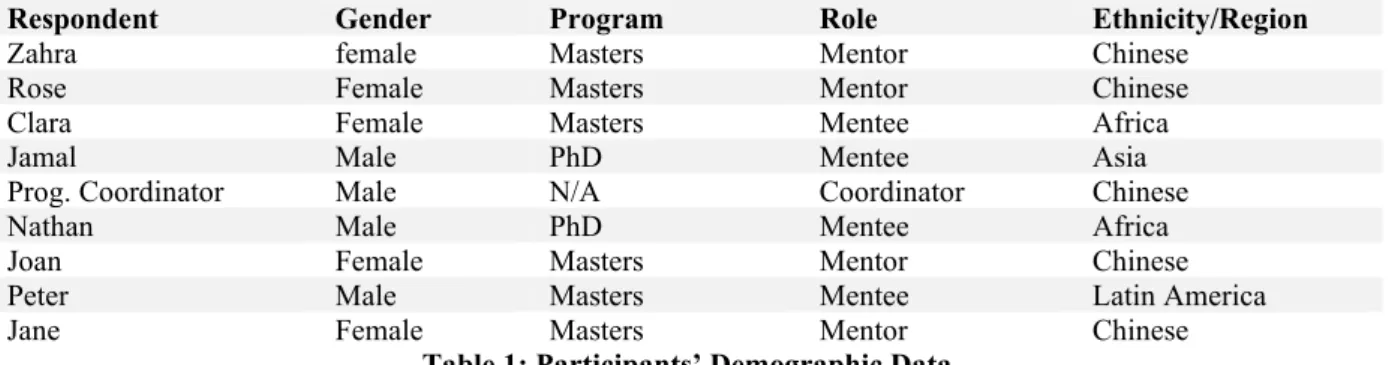
The study participants involved 9 participants from the school of education: 4 first-year international students (mentees); 4 peer mentors; and 1 administrator (the coordinator of the program). Specifically, the participants involved: 1 female master's student from Africa; 1 male Ph.D. student from Africa; 1 male Ph.D. student from Asia; 1 male master’s student from Latin America; 4 female master’s students (native Chinese), who were the mentors from the school of education; the coordinator of the program who was a male. The demographic data sample participants are shown in Table 1 below.
Respondent Gender Program Role Ethnicity/Region
Zahra female Masters Mentor Chinese
Rose Female Masters Mentor Chinese
Clara Female Masters Mentee Africa
Jamal Male PhD Mentee Asia
Prog. Coordinator Male N/A Coordinator Chinese
Nathan Male PhD Mentee Africa
Joan Female Masters Mentor Chinese
Peter Male Masters Mentee Latin America
Jane Female Masters Mentor Chinese
Table 1: Participants’ Demographic Data
3.5 Sampling Techniques
The study employed purposive sampling to select participants. First, the study area (school of education) was purposively selected for this study because it was the only school with a mentoring program for first-year international students at the university. Secondly, the coordinator of the mentoring program at the school of education was purposively selected as he was the overall in charge of the program at the school, thus exploring his experience in the program was important. The mentees were purposively selected as the researcher was interested in getting experiences from the postgraduate students who were involved in the mentoring program in the school. Thus, both master’s and Ph.D. students were purposively selected to take part in the study. The selection of the mentors depended on the selected mentees because the researcher was interested in the pairs (mentees and mentors). Therefore, the selected mentors were the peer mentors of the selected mentees. This helped the researcher to make triangulation of the information from the mentees and mentors, that is, whether or not there were consistencies between them.
3.6 Data Collection Methods
The study used in-depth semi-structured interviews to gather information on the experiences of the mentoring program in assisting first-year international students to adjust to socio-cultural experiences at the university. This method allowed the researcher to identify the themes among the participants in exploring their experiences in the mentoring program. Before conducting the interviews, a pilot study was conducted with 2 first-year international students (the mentees) and 2 mentors, the assistant coordinator of the program who was not the parts sample participants. After the pilot study, the interview guides were adjusted in terms of time and clarity and relevance of the content. The interview sessions with the participants ranged from 40 to 60 minutes. More importantly, a
research assistant with both English and Chinese language proficiencies was employed to facilitate the interviews with the mentor participants in particular, due to the fact that a large number of the mentors had difficulties communicating in the English language effectively.
3.7 Data Analysis
The analysis of the gathered information was done whereby the transcripts were coded by using open, axial and selective techniques. The research created the initial list of the code related to the participants’ experience of the mentoring program at the school in assisting first-year international students’ socio-cultural adjustment. Then the interviews were coded to connect similar ideas together. In the meantime, the emerging themes were explored and adjusted accordingly.
3.8 Ethical Issues
The anonymity of both the specific area of study (the university) and participants’ names were clearly observed.
4. The Findings
4.1 First-year International Students’ Adjustment to the Socio-cultural Experiences at the University
The participants were asked to identify the ways in which mentoring programs assist first-year international students to adjust to socio-cultural experiences at the university. During interviews, adjusting to Chinese culture and language emerged as the major areas in which first-year international students were assisted, through the mentoring program at the university.
4.1.1 Coping with the Chinese Culture
The cultural adjustment was one of the key areas that provided a critical challenge among first-year international students at the university. The responses of the participants indicated that most of the international students’ cultural backgrounds were quite different from the Chinese culture. All the interviewed participants admitted that the program had a crucial role to play in assisting international students to adapt to Chinese cultural practices. Indeed, this was evident during the interview with the program coordinator, who revealed that one of the motives behind the establishment of the program at the school was to familiarize international students with the Chinese culture through their peer mentors. “…they need to learn about the Chinese culture, this helps them to cope with
some of the challenges which they may face”. Similarly, the mentors and mentees also singled out that cultural
aspect was one of the important aspects in which international students needed more assistance:
“When we meet, we usually share with them about the Chinese culture for example, how to interact with Chinese people…things which Chinese people like and do not like, how to eat Chinese foods by using chopsticks…we also learn from them about their countries’ culture” [Rose]
“The majority of international students find it difficult to cope with the ways of life especially during their early months after arriving in China. Their cultural backgrounds are quite different from the Chinese…Among others, our main role as mentors is to help our mentee cope with the Chinese culture however we also learn a lot from their cultures” [Joan]
Based on the above excerpts from Rose and Joan, who were Jamal and Nathan’s mentors respectively, it was clear that culture was one of the major foci of the mentoring program, in assisting first-year international students. However, apart from helping their mentees to adjust to Chinese culture, the mentors also used that opportunity to learn foreign countries’ cultures through their peer mentees. Correspondingly, during the interviews held with the mentees, the participants admitted that their mentors helped them to familiarize themselves with the Chinese culture in different ways. For instance, Jamal revealed that her mentor among other things took him to different areas such as museums in the city, so as to experience the Chinese culture. Equally important, other participant mentees highlighted the role of their mentors in assisting them to adapt to the Chinese culture:
“…Interacting with the Chinese people during my first days at this university was very challenging, and I was frustrated in whatever I attempted to do. Chinese culture is complex enough to be easily accustomed to, personally, I am grateful to the school of education for designing this program, or else the situation would be terrible” [Peter]
“This program has been helpful for us, as we come from countries which are different from China almost in every sphere of life…both geographically and culturally my country is quite different from this country. Therefore, when we meet with our peer mentors they usually assist us to cope with such new experiences” [Nathan]
Additionally, during the interview with the program coordinator, it was disclosed that helping the first-year students to adapt to the new culture, so as to assist them to perform well in other aspects such as academically, was one of the main program objectives. He highlighted, “In our school, we acknowledge the influence of socio-cultural experiences in international students’ academic wellbeing, as a result, we come up with this strategy”.
4.1.2 Adjusting to the Chinese Language
The Chinese language was one of the major concerns for the majority of first-year international students thus it emerged as one of the key areas in which mentors through the mentoring program, assisted their mentees to adjust to it. During the interview with the program coordinator, it was revealed that one of the motives behind the establishment of the mentoring program at the school was to assist international students in the area of language, “Most international students in the English-taught program lack Chinese language ability. It is more difficult for them to adjust to both their studies and lives in China. We hope this program can give them help”.
Similarly, the responses of the participant mentors disclosed that helping first-year international students to communicate through the Chinese language, was one of their main agendas during their meetings with their mentees. Zahra and her peer mentee Clara, in particular, pointed out that when they met during their group meetings with other pairs, the mentors used that opportunity to teach their mentee the Chinese language. Zahra maintained that usually when they planed the meetings asked their mentees to identify the topics or aspects of the language such as ordering food in the hotel, buying fruits and other related aspects, that were to be discussed during the meetings. Other participant mentors and mentees highlighted on the language dimension:
“…Language is of the most frustrating experiences for the majority of foreign students who come to study in China. It is even more complicated as quite the largest number of native Chinese cannot speak other languages apart from their own language, our peer mentors help us a lot to overcome this problem” [Jamal]
Additionally, Peter expressed this view, “During the group meetings with our mentors learning the Chinese language is one of the main topics that dominate our discussions. This is helpful to us because language
learning requires practice…”. Interestingly, the responses of mentors unearthed that teaching their mentees the
Chinese language, did not only help their mentees to learn the Chinese language but also provided them an opportunity to improve their English language proficiencies, as a result of their interaction with their mentees, whose English language proficiencies were high. “…It is helpful for both sides, we teach them Chinese they also teach us English in the process…I add some new vocabularies and phrases when I interact with my mentee”. 4.2 Challenges that Face the Mentoring Program at the University
During the interviews, each participant was asked to identify the challenges which were experienced in the mentoring program at the school. All of the interviewed participants at least highlighted some challenges which they experienced in this program as explained hereunder:
4.2.1 The Timetabling of the Group Meetings
Timetabling the group meetings was one of the major issues of concern for both peer mentors and mentees. Based on the nature of the mentoring program at that school, which was conducted on a group basis where three or more pairs of mentors and mentees had to meet, it made it difficult for group members to come up with the common timetable which would fit all of them. Under those circumstances, there was the frequent rescheduling of the timetable henceforth leading to the frequent postponements of the group meetings:
“The issue of timetable to conduct our group meetings is really frustrating …It is very difficult to have a timetable which fits all of us at the same time…You know our groups have different types of people thus we differ in several aspects. Look at our peer mentors! They attend a quite different academic program from ours, their courses, timetable, and almost everything are different…” [Clara]
In the same vein, Zahra who was Clara’s peer mentor also was concerned with the issue of timetable. She admitted that both differences in study programs and personal timetables (private timetables) between the mentors and mentees, were among the major issues that were responsible for the encountered challenges in organizing group meetings. For this reason, based on both Zahra and Clara’s experiences, it was indicative that difficulties which were encountered in scheduling the timetables for group meetings were attributable to the differences in study programs and personal arrangements among the program participants.
4.2.2 Language Barriers
The research findings indicated that language problem among the peer mentors and mentees was one of the big challenges for the effectiveness of the mentoring program at the school. Both participant mentors and mentees admitted encountering some difficulties in communing effectively with their peers. For mentors commutating in the English language was a major challenge. Conversely, for the mentees communicating in the Chinese language which was their mentors’ mother tongue provided them with a critical challenge during conversations. During the interview, Rose who was Jamal’s peer mentor admitted that communicating effectively in English was the issue of concern for her major concern:
“My English is not good, I usually tell my mentee to speak slowly so that I can understand him properly, or sometimes I ask him to speak or clarify in the Chinese language because he can also speak good Chinese language. It helps us to switch to either of the two languages”
Nevertheless, for Jamal language barrier was not a big problem compared to most of his fellow mentees such as Clara, Nathan, and Peter. This condition was due to the fact that Jamal who had lived in China for quite a
longer time than his counterparts, his Chinese language ability was relatively better than the other mentees. Consequently, this facilitated the communication between Jamal and his mentor, as they were able to mix or switch from one language to another to make their communication more effective, a strategy that could not work for other pairs:
“…For me, the Chinese language is not a big problem. You know, I have been living in China for more than three years now…I did my master’s degree in another province in central China…I’m not like other first-year students, my needs are a bit different from theirs, they need more assistance in language than I do” [Jamal]
For the other pairs, the language problem was more serious compared to Rose and Jamal’s pair. This was due to the fact that, apart from other mentees’ inability to speak the Chinese language, their peer mentors were also struggling to communicate in the English language effectively thus giving them hard times to understand each other. In line with that, the program coordinator indicated that the language barrier was the major challenge experienced in the program, “Language barrier is one of the major challenges for both mentors and mentees, the mentors struggle when communicating in English while for mentees the Chinese language is a serious problem”.
Henceforth, the participants developed some strategies to address or cope with the challenge of the language barriers among the pairs. It was noted that the different pairs had some similar and different coping strategies. Generally, most of them relied on the assistance of Chinese-English dictionaries and other software applications such as ‘pleco translator’, in order to overcome the language barriers. Notwithstanding, for some pairs Rose and Jamal’s in particular, code-switching was the mostly employed strategy, as Jamal had the ability to communicate in both Chinese and English languages.
4.2.3 Poor Group Meeting Attendance among Group Members
During the interviews held with both mentors and mentees, it was learned that some group members in particular mentees failed to show up during the group meetings. However, the responses of the participant mentees suggested that a tight timetable and relatively heavy load among the first-year international students was one of the possible reasons for some mentee’s failure to attend some of the group meetings. In that regard, Nathan had this to share his experience, “…This semester we are having many courses…I have 8 courses, some students
have even more than these, and we have a lot of assignments almost everyday people are busy…”. In support of
Nathan’s view, Clara expressed this view:
“Sometimes I fail to attend the group meetings because I am overwhelmed by other school and personal engagements. You know I am still in a transitional period adapting to the new environment, such condition affects my commitment to the mentoring program…”.
Peer mentors also admitted that some mentees failed to attend the group meeting regularly, as indicated by Joan, “…Sometimes not all members attend the group meetings, especially some of the mentees. If you ask them why they did not come, sometimes they say they had other urgent commitments”. However, in order to deal with the problem of poor attendance during the group meetings, the peer mentors had to find some special time to meet with their specific peer mentees who missed the previous meeting, so as to share with them what was discussed during the group meeting:
“…We help them, we find a convenient time for them and share with them their concerns. Normally each individual mentor finds the convenient time to meet with his or her mentee who missed the previous group meeting, to share what was discussed during the meeting” [Zahra]
4.2.4 Limited time
The time spared for conducting the group meetings, in particular, raised concerns among the participants. The responses of mentors and mentees revealed that both mentors and mentees were not satisfied with the time that was reserved for conducting their group meetings. It was disclosed that they usually met only once a month, regardless of the fact that both mentees and mentors acknowledged the importance of group meetings, over the individual pair's meetings. Both mentors and mentees were of the view that there was a need to meet more than once a month because the group meetings were very helpful for mentees; though, they admitted that tight school timetable was the major hindrance for them to get more time:
“This program is very crucial for the wellbeing of the first-year international students at the university, it helps to address some of the issues that they face which if not well addressed can the students socially, psychologically and academically. However, the time is very limited to make it more effective…” [Jane] “I think conducting the group meetings once a month is not enough, because during the group meeting we discuss several different issues that face first-year international students. We share different personal experiences that are very helpful in improving our adjustment to different issues” [Peter].
In the meantime, in order to cope with the time challenge, the peer mentors used frequent communications with their individual peers to share different experiences, instead of waiting until the next group meeting, as Rose highlighted:
“We know that it is difficult to have more time in conducting our group meetings due to the tight schedule of the school. We maintain close communication with our peers or daily or weekly basis; to
address some of the issues that emerge…We use mobile phones, social networks such as WeChat and QQ to do that”.
4.3 Participants’ Suggestions for the Improvement of the Mentoring Program
Based on their experiences in the mentoring program at school, participants were asked to give their suggestions for future improvement of the program. Besides the fact that all the participants acknowledged the role of the mentoring program in assisting first-year international students, they suggested some key areas of improvement so as to make the program more effective:
4.3.1 Program Objectives
The findings unearthed that the participant mentees, in particular, indicated that the program objectives were not clear to them thus, called upon for the need to make the objectives of the program clear to the participants, prior to the start of the program. Nathan for instance, apart from appreciating the importance of the program at the school, he was critical of lack of information on the specific objectives of the program:
“…The objectives of the program should be clear for both mentor and mentees. For example, we just sign the forms after meeting with our mentors but we do not know why do we have to sign them…The school should organize common education activities with both the mentors and mentees at the beginning of the program so to know the program objectives and our roles”
Clara’s suggestion on the clarity of program objectives was not far from her counterpart Nathan, as she suggested that lack of clear information among the mentees at beginning of the program needed to be addressed in the future. She revealed when the program started the mentees were just informed about their respective mentors and groups through mobile phones, nonetheless they were not told about their roles as mentees in the program, “We were just notified via mobile phone SMS about our pair mentors…nothing else was made known
to us about this program before we started it”. Correspondingly, Jamal went further by stressing that even their
peer mentors were not able to clearly tell their mentees the objectives of the program, “…This needs to be improved in the future, nobody informed us as mentee about objectives of this program, event our peer mentors were unable to clearly explain to us the objectives…”.
4.3.2 Program evaluation
The participants apart from being critical of the objectives were also concerned about the evaluation procedures of the program. They indicated that lack of clear program objectives signified uncertainties in evaluating the effectiveness of the program. Peter for example, apart from being concerned with program objectives he was also critical of evaluation procedures of the program, to know whether or not it was effective. “The evaluation of the program is not clear too as we do not know its objectives…in the future these should be addressed, the
program evaluation criteria should be clear”. Similarly, other participants highlighted the need to have clear
evaluation procedures by indicating the importance of evaluation for the effectiveness of the mentoring program: “Evaluation is one of the key components for the success of any program. It is through the evaluation process where one can be able to determine whether the program is performing well or not. Likewise, the only way to know if this program is effective or not is through evaluating its performance” [Jamal] Additionally, Nathan highlighted, “…There is a need to evaluate the effectiveness of the program at various stages, that is, in the beginning, the middle, and the end. This will help to identify the strengths and weaknesses of the program…”. Moreover, the program coordinator also admitted that the program had no evaluation mechanisms to determine the attainment of its objectives. However, he indicated that the program had got its objectives, and based on his experience in the program he maintained that so far the program had been effective:
“...I think it is effective. International students at our faculty have only two main information sources, one is ISO, and the other one is the Faculty Office. Both of the offices are very busy, only can provide important information. But the Chinese mentors can provide more detailed information about study and living, which definitely will benefit the international group…” [Program Coordinator]
4.3.3 Workshop/Induction Programs for Participants
The participant mentors and mentees, in particular, suggested that at the beginning of the program the school should organize a kind of training for the program participants so as to make them aware of the expectations of the program from both the mentors and mentees. Zahra suggested that training before being assigned with the mentoring roles would have been helpful to them in the sense that it could offer them some experiences regarding their role before getting into the program:
“…We could get some experiences about the kind of students or mentees we are going to interact with, how to interact with people of different cultural background as well as tips on our roles and responsibilities as mentors in order to be effective in fulfilling our roles”
Similarly, Rose suggested that the joint workshop would give them as mentors the room to get preliminary experiences with their mentees before starting the program, so as to establish a close relationship right from the beginning of the program, “…It is important for the participants of the program to familiarize with one another
concern about the need for an induction program for the program participants before commencing the program. In particular, Peter, made this suggestion, “In future, the school should organize an induction program so as to
make the participants be prepared for their roles in the program”. Nevertheless, the program coordinator had a
different view on the absence of the induction program for the program participants. He indicated that they usually conduct meeting with the mentors before assigning them the task of mentoring international students, yet there was no such kind of meeting for the mentees, “…We hold a meeting to introduce the program to the mentors and assign the task to them. We also have a QQ group; all the mentors are in this group”.
4.3.4 The motivation for the mentors
The responses of participants especially the peer mentors suggested that the school administration should recognize and honor mentors for their roles in assisting international students to cope with university life during their first year at the university. For instance, Jane pointed out that since the mentors who we involved in the program were volunteers, thus there was a need to motivate them, and other Chinese students to participate in the program: “Certificate of recognition for both the mentors and mentees to show that we have been involved in
this program...just as appreciation for our involvement in this program and motivation to others…”. Jane’s
suggestion was supported by other participant mentors who indicated the importance of providing motivation for the mentors who were volunteering in the program, as Joan highlighted, “…the motivation for the mentors who volunteer to assist the first-year international students, should be indicated from the beginning of the program.
This will help to encourage the volunteers and other people to be attracted to participate”. In the same vein, the
program coordinator also emphasized the issue of motivation, particularly among Chinese male students. He indicated that the ratio between male and female peer mentors was not equal whereby the number of male mentors was very low:
“We need to increase the motivation to the participant mentors, so as to encourage and attract more Chinese students to volunteer in this program…The participation of male students in this program is very low, they need to be motivated” [Program Coordinator]
It was clear that the program coordinator admitted experiencing a lack of motivation to volunteer in the program, among the participant mentors. As a result, he appealed for the need to motivate and encourage more Chinese students, especially male students to participate in this program.
5. Discussion
This study sought to explore how the mentoring program assists first-year international students adjust to socio-cultural experiences, at one university in China. The results of this study revealed that the mentoring program through the use of peer mentors assisted the first-year international students to adjust to their socio-cultural experiences, in two major areas. First, adjusting to the Chinese culture was the main concern of the majority of international students, during their first year at the university. More specifically, interacting with the Chinese people, adapting to the Chinese acceptable behavior, and food (Ding, 2016; Tsegay et al., 2018; Wen et al., 2018), were the key areas where the mentors assisted their mentees to adjust to them. In the USA studies revealed that socio-cultural issues such as cultural shock, and cultural fatigue were among key areas where first-year international students faced difficulties (M. Anderson et al., 2012). Mediated cultural differences, was identified by mentors as one of the major areas of concern in assisting international students to adjust to the Australian culture (Jeong et al., 2011).
Second, first-year international students experienced difficulties in interacting with the native Chinese, particularly communicating with the native Chinese in the Chinese language, henceforth, they needed assistance from their peer mentors. As a matter of fact, the difficulties in interacting with the native people were catalyzed by the native people’s inability to speak the major international languages such as English, French, Spanish, and German. Similarly, other studies indicated that English language proficiency and other related issues were the major areas of unsolved problems facing international students in Australia (Robertson et al., 2000). The mentors used both group and individual peer meetings to teach first-year international students some of the common Chinese language words and phrases, so as to enable them to overcome some of the communication problems.
Several different challenges were encountered in the mentoring program. The language barrier became one of the major challenges encountered by both mentors and mentees. It affected the effectiveness of communication between the individual pairs, as well as during the group meetings however, the effect varied among the pairs. The first-year international students who had the experience of living in China prior to their enrollment at the study university encountered fewer difficulties communicating in the Chinese language than their counterparts who had never lived in China, before joining that university. The former had already developed some Chinese language proficiencies that enabled them to overcome some of the language barriers with their mentors and other native speakers. Notwithstanding, the program participants used devices such as mobile phones, software applications such as language translators, dictionaries, so as to overcome the language barriers during their daily communication. In line with that, scheduling the group meetings that could cater to the need of every participant, provided a critical challenge for mentors and mentees. Differences in subject majors
and/or programs of studies between the mentors and mentees made the scheduling of both the group and individual pairs meetings more challenging. Thus, as noted in the previous research (Heirdsfield et al., 2008; Ragins, 1997) in particular, finding a convenient time for all participants to attend the meeting, is one of the major challenges of mentoring programs. Additionally, the mentoring program at the university was also affected by limited time and poor participation in the group meetings. The results of this study revealed that, despite the fact that the participants acknowledged the importance of the mentoring program, in assisting the first-year international students at the university, lack of time and poor participation among the participants, affected the effectiveness of the program. Among others, tight school timetable was attributable to the limited time that was reserved for the group meetings, and poor attendance during such meetings.
On the other hand, to overcome and/or cope with the encountered challenges, the mentors employed different strategies. The mentors used individual pairs’ meetings when the group meetings seemed to be ineffective, due to poor attendance and timetabling problems. This strategy helped the individual pairs as it was easier for them to arrange individual pairs’ meetings, than the group meetings that were complicated due to tight school and personal schedules. By the same token, mentor-mentees’ frequent communication through mobile phones, social networks (Heirdsfield et al., 2008), were also used to cope with the challenges associated with the group meetings. Additionally, electronic applications such as language translators and dictionaries helped mentors and mentees to overcome language barrier-related changes.
Based on the challenges that were encountered in the mentoring program, it was evident that more was required to be done by the university, in order to make the program more effective in assisting first-year international students to adjust to the socio-cultural experiences. Several different areas that appealed for improvement were identified. First, the lack of clear and specific program objectives and evaluation procedures affected the attainment of the goal of the mentoring program at the university. Lack of clarity of the program objectives and evaluation procedures among the mentors and mentees, in particular, affected the implementation of the program. As a result, the participants had to find their own directions or ways in their attempt to attain the goal of the program, that is, to assist the first-year international students to adjust to their socio-cultural experiences at the university. Thus, arguably, had the participants been well informed about the specific objectives and evaluation procedures of the mentoring program, the implementation of the program would have been less challenging to them.
Equally important, the responses of the participants suggested that there was a need for the school/university administration to provide the program participants with an induction program prior to the start of the program. Providing the induction program to the participants would help the participants in different ways. First, it would help mentors and mentees to get to know each other’s backgrounds, interests, beliefs, and expectations of the mentoring program. Correspondingly, the previous research affirmed that mentors’ intercultural sensitivity increased empathy towards their mentees (Koskinen & Tossavainen, 2003a). Second, the provision of an induction program would help the program participants to be informed about their roles in the program, the objectives of the program, as well as the evaluation procedures of the program. Third, the induction program could be the best avenue for the program participants, to seek clarification or raise their concerns that would require more clarification from the school administration, regarding the implementation of the program. Likewise, other researches emphasize that in order to effectively prepare mentors for their roles in a mentoring program, the mentors should be well informed about their roles (Heirdsfield et al., 2008; Jeong et al., 2011). Furthermore, motivation among the mentors who were volunteering in the program was revealed as one of the main areas that required to be improved in order to effectively achieve the goal of the program. Despite the fact that the mentors’ involvement in the program was on a voluntary basis, it was suggested that motivating the mentors in different ways would not only motivate the participant mentors to be committed to the program but also to motivate other Chinese students to volunteer in the program in future. The low rate of participation in the mentoring program, among the male Chinese students was attributable to the lack of motivation. The provision of the certificates of participation to the program participants among, in particular, was identified as one of the forms of motivation that could attract a large number of mentors to take part in the program. Indeed, providing mentors with motivation increases their levels of satisfaction in the program thus ensuring the achievement of program objectives (Drew et al., 2000).
6. Recommendations
Based on the findings of this study, it is recommended as follows. First, as it has been noted earlier the mentoring program is crucial for the wellbeing of international students, thus, the university administration should adopt the mentoring program in its policy, so as to assist the first-year international students’ socio-cultural adjustment at the university. This recommendation is laid on the ground that at the study university the mentoring program was offered by one school only (the school of education), other schools did not offer the mentoring program, and neither the university stipulated the provision of such program in its policies and guiding documents.
Second, there is a need for the school of education to organize and/or provide formal training/induction program for both mentors and mentees prior to the beginning of the program, so as to familiarize them, as well as to explain to them their roles in the program and the objectives of the program. Third, the school should put in place the evaluation procedures for the mentoring program, so as to be to determine the attainment of the program objectives at the beginning, the middle and the end of the program. Fourth, the school should encourage and motivate Chinese male students to participate in the mentoring program since their involvement in the program is also a great deal.
7. Conclusion
The peer mentoring program at the university, school of education in particular, plays a key role in assisting first-year international students’ socio-cultural adjustment at the university, in various ways. Coping with Chinese culture and language in particular, emerged as the key areas where the peer mentors through the mentoring program, assisted the first-year international students. However, the program encountered several different challenges that affected the effective attainment of its goal, which among other included language barriers, limited time, timetabling of group meeting, and poor attendance among members during group meetings. Under those circumstances, it was suggested that the need to work on some of the issues of concerns, so as to make the program more effective was of a great deal. Therefore, the program participants’ suggestions on the best practices of the peer mentoring program at the university should not be underestimated, since these are the key players involved in the program.
References
Alebeek, W. V., & Wilson, K. B. (2019). Exploring the college choice decisions at a regional university in the United States. Journal of Research in International Education, 18(3), 291-309.
Anderson, E. M., & Shannon, A. L. (1988). Toward a conceptualization of mentoring. Journal of Teacher
Education, 39, 38-42.
Anderson, M., Isensee, B., Martin, K., Godfrey, L., & O'Brien, M. K. (2012). Student Voices: A Survey of
International Undergraduate Students’ First-Year Challenges at the University of Minnesota-Twin Cities.
Retrieved from Minnesota: https://global.umn.edu/icc/student-voices/student_voices_report2012.pdf Ashwin, P. (2003). Peer support: Relations between the context, process and outcomes for the students who are
supported. Instructional Science, 31, 159-173.
Boyaci, A., & Yakup, O. (2019). Opinions of international students on choosing a state university in a developing country. Journal of International Students, 9(1), 338-361.
Bozionelos, N. (2004). Mentoring provided: Relation to mentor's career success, potentiality, and mentoring received. Journal of Vocational Behavior, 64(1), 24-46.
Chao, G. T., Walz, P. M., & Gardner, P. D. (1992). Formal and informal mentorships: A comparison on mentoring functions and contrast with non-mentored counterparts. Personnel Psychology, 45(3), 619-637. Church, A. T. (1982). Sojourner adjustment. Psychological Bulletin, 91, 540-572.
Clulow, V. (2000). Student involvement and transition: A role for peer tutoring? Paper presented at The 4th Pacific Rim – First Year in Higher Education Conference: Creating Futures for a New Millennium., Queensland University of Technology, Brisbane, Australia.
Colvin, J. W., & Ashman, M. (2010). Roles, risks, and benefits of peer mentoring relationships in higher education, mentoring & tutoring. Partnership in Learning, 18(2), 121-134.
de Araujo, A. A. (2011). Adjustment Issues of international students enrolled in American colleges and universities: A review of the literature. Higher Education Studies, 1(1), 1-7.
Ding, X. (2016). Exploring the Experiences of International Students in China. Journal of Studies in
International Education, 20(4), 319–338.
Drew, N. M., Pike, L. T., Pooley, J. A., Young, A. H. C., & Breen, L. (2000). School of psychology peer
mentoring pilot program. Paper presented at The 4thPacific Rim –First Year in Higher Education
Conference: Creating Futures for a New Millennium., Queensland University of Technology, Brisbane, Australia.
Gunn, F., Lee, S. H., & Steed, M. (2017). Student perceptions of benefits and challenges of peer mentoring programs: Divergent perspectives from mentors and mentees. Marketing Education Review, 27(1), 15-26. Heirdsfield, A. M., Sue Walker, S., Walsh, K., & Wilss, L. (2008). Peer mentoring for first year teacher
education students: the mentors’ experience, Mentoring & Tutoring. Partnership in Learning, 16(2), 109-124.
IIE. (2013). Open doors 2013: Data highlights. Retrieved from http://www.iie.org/Who-We-Are/News-and-Events/Press-Center
Jeong, S. Y., Hickey, N., Levett-Jones, T., Pitt, V., Hoffman, K., Norton, C. A., & Ohr, S. O. (2011). Understanding and enhancing the learning experiences of culturally and linguistically diverse nursing
students in an Australian bachelor of nursing program. Nurse Education Today, 3(3), 238-244.
Knox, P. L., & McGovern, T. V. (1988). Mentoring women in academia. Teaching of Psychology, 15(1), 39-41. Koskinen, L., & Tossavainen, K. (2003a). Relationships with undergraduate nursing exchange students-a tutor
perspective. Journal of Advanced Nursing 41, 499-508.
McInnis, C., James, R., & Hartley, R. (2000). Trends in the first year experience in Australian universities.
Canberra: Department of Education, Training and Youth Affairs.
Menziesa, J. L., Rachael Baron, R., & Zutshia, A. (2015). Transitional experiences of international postgraduate students utilizing a peer mentor programme. Educational Research, 57(4), 403-419.
MOE. (2015). Some figures on international students in China in 2014. Retrieved from http://www.moe.edu.cn/publicfiles/business/htmlfiles/moe/s5987/201503/184959
MOE. (2016). China releases report on Foreign Students 2015. Retrieved from www.en.moe.gov.cn/News/Top-News/201604/t201604-239196.html
Muldoon, R., & Godwin, J. (2003). The faculty mentor program in the sciences: An innovative approach to
supporting student learning. Paper presented at The 7th Pacific Rim-First YearExperience in Higher
Education Conference, Queensland University of Technology, Brisbane, Australia.
Murphy, C., & Ozturgut, O. (2009). Literature vs Practice: Challenges for International Students in U.S.
International Journal of Teaching and Learning in Higher, 22 (3), 374-385.
O’Reilley, A., Hickey, T., & Ryan, D. (2015). The Experiences of American International Students in a Large Irish University. Journal of International Students, 5(1), 86-98.
Patton, M. Q. (2002). Qualitative research and evaluation methods (3 ed.). Thousand Oaks, CA: Sage.
Poyrazli, S., & Grahame, K. M. (2007). Barriers to adjustment: Needs of international students within a semi-urban campus community. Journal of Instructional Psychology, 34(1), 28-36.
Quintrell, N., & Westwood, M. (1994). The Influence of a Peer‐Pairing Program on InternationalStudents’ First-Year Experience and Use of Student Services. Higher Education Research and Development, 13(1), 49-58. Ragins, B. R. (1997). Diversified mentoring relationships in organizations: A power perspective. Academy of
Management Review, 22, 482-521.
Ritschoff, K. A., & Griffin, B. W. (2001). Reciprocal peer tutoring: Re-examining the value of a co-operative learning technique to college students and instructors. Educational Psychology, 21(3), 313-331.
Robertson, M., Line, M., Jones, S., & Thomas, S. (2000). International students, learning environments and perceptions: A case study using the Delphi technique. Higher Education Research & Development, 19(1), 89-102.
Tan, A. (2015). College choice behaviors of international students. SAGE Open, 5(4), 1-14.
Thomson, G., Rosenthal, D., & Russell, J. (2006). Cultural stress among international students at an Australian
university. Paper presented at the Australian International Education Conference 2006.
Tian, M., & Lowe, J. A. (2014). Intercultural identity and intercultural experiences of American students in China. Journal of Studies in International Education, 18(3), 281-296.
Tsegay, S. M., Zegergish, M. Z., & Ashra, M. A. (2018). ArticleSocio-cultural Adjustment Experiences of International Students in Chinese Higher Education Institutions. Millennial Asia, 9(2), 183-202.
Tsenga, W., & Nweton, F. B. (2002). International students' strategies for well-being. College Student Journal, 36(4), 591-597.
Wangeri, T., Kimani, E., & Mutweleli, S. M. (2012). Transitional challenges facing university first year students in Kenyan public universities: A case of Kenyatta University. Interdisciplinary Review of Economics and
Management, 2(1), 41-50.
Weisz, M., & Kemlo, L. (2004). Improving student learning through peer support. Paper presented at The 8th Pacific Rim – First Year Experience in Higher Education Conference, Queensland University of Technology & Monash University, Brisbane, Australia.
Wen, W., Hu, D., & Hao, J. (2018). International students’ experiences in China: Does the planned reverse mobility work? International Journal of Educational Development, 61, 204-212.
Wen, W., Liu, J. Q., Die, H. U., & Chen, Q. (2014). An Empirical Study of Cross-cultural Adaptation of International Students in China and Its Determinants. Fudan Education Forum.
Westwood, M. J., & Barker, M. (1990). Academic achievement and social adaptation among international students: A comparison group study of the peer-pairing program. International Journal of Intercultural
Relations, 14, 251-263.
Wu, H., Garza, E., & Guzman, N. (2015). International Students’ Challenge and Adjustment to College.
Education Research International, 1-10.
Wu, W., & Hammond, M. (2011). Challenges of university adjustment in the UK: a study of East Asian Master’s degree students. Journal of Further and Higher Education, 35(3), 423-438.
Zhang, Z., & Zhou, G. (2013). International Students’ Adjustment Problems at a University: A Critical Literature Review. Academic Research International, 4(2), 400-406.