2019
An efficient framework for privacy-preserving
computations on encrypted IoT data
Shruthi Ramesh Iowa State University
Follow this and additional works at:https://lib.dr.iastate.edu/etd Part of theComputer Engineering Commons
This Thesis is brought to you for free and open access by the Iowa State University Capstones, Theses and Dissertations at Iowa State University Digital Repository. It has been accepted for inclusion in Graduate Theses and Dissertations by an authorized administrator of Iowa State University Digital Repository. For more information, please [email protected].
Recommended Citation
Ramesh, Shruthi, "An efficient framework for privacy-preserving computations on encrypted IoT data" (2019).Graduate Theses and Dissertations. 17082.
by
Shruthi Ramesh
A thesis submitted to the graduate faculty
in partial fulfillment of the requirements for the degree of MASTER OF SCIENCE
Major: Computer Engineering (Secure and Reliable Computing)
Program of Study Committee: Manimaran Govindarasu, Major Professor
Wensheng Zhang Neil Gong
The student author, whose presentation of the scholarship herein was approved by the program of study committee, is solely responsible for the content of this thesis. The Graduate
College will ensure this thesis is globally accessible and will not permit alterations after a degree is conferred.
.
Iowa State University Ames, Iowa
2019
DEDICATION
I would like to dedicate this thesis to my family – my parents, Ramesh Rengaswamy and Vijay Ramesh who have always been the constant source of unconditional love, support and encouragement, my brother Dr. Sridharan Ramesh, for always being there whenever I needed moral support, motivation and guidance and to my partner Sudarsanan Krishnan, for the cheers, support and sacrifices throughout this journey.
TABLE OF CONTENTS
Page
LIST OF FIGURES ...v
LIST OF TABLES ... vii
LIST OF ALGORITHMS ... viii
NOMENCLATURE ... ix
ACKNOWLEDGMENTS ...x
ABSTRACT ... xi
CHAPTER 1. INTRODUCTION TO CLOUD BASED IoT ...1
1.1 Overview ... 1
1.1.1 Internet of Things ... 1
1.1.2 Cloud Computing ... 4
1.1.2.1 Cloud Storage ... 5
1.1.2.2 Cloud Compute ... 6
1.1.3 Internet of Things and Cloud ... 6
1.2 Research Motivation and Objective ... 7
1.3 Thesis Organization ... 8
CHAPTER 2. BACKGROUND AND LITERATURE REVIEW ...10
2.1 Conventional Encryption Schemes ... 10
2.2 Homomorphic Encryption Schemes ... 14
2.2.1 Partially Homomorphic Encryption Schemes ... 14
2.2.2 Fully Homomorphic Encryption Schemes ... 17
CHAPTER 3. PROPOSED SOLUTION-PROXY RE-CIPHERING AS A SERVICE ...21
3.1 Design Goals ... 22
3.2 Major Cyber Threats ... 23
3.3 System Architecture ... 25
3.4 Model Assumptions ... 27
3.5 Data Distribution Schemes ... 28
3.6 Proposed Workflow ... 32
CHAPTER 4. CASE STUDY: SMART HEALTHCARE ...46
4.1 Internet of Things in Healthcare ... 46
4.2 Smart Healthcare and Cloud ... 48
4.3 Security for Healthcare ... 49
4.4 Proxy re-ciphering as a service for Healthcare IoT ... 50
CHAPTER 5. PERFORMANCE EVALUATION ...57
5.1 Experimental Evaluation ... 57
5.1.1 Experimental Setup ... 57
5.1.2 Performance Evaluation ... 60
5.2 Theoretical Evaluation ... 76
CHAPTER 6. CONCLUSION AND FUTURE WORK ...86
6.1 Summary ... 86
6.2 Limitations and Future work ... 88
LIST OF FIGURES
Page
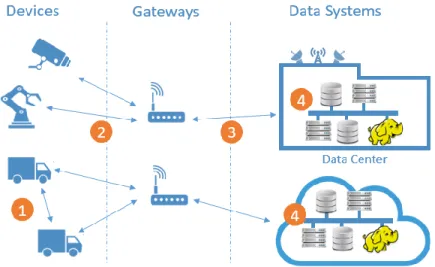
Figure 1. An example of IoT ecosystem ... 3
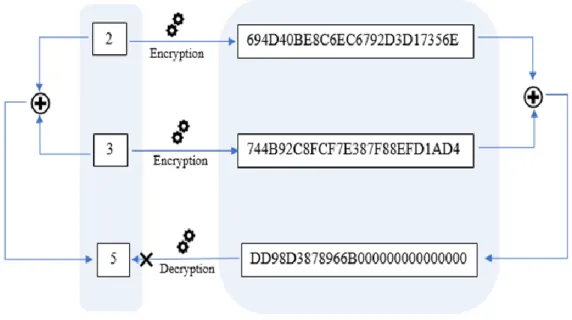
Figure 2. An example of computation on AES-encrypted data ... 14
Figure 3. The proposed architecture for Proxy re-ciphering as a service ... 27
Figure 4. High level workflow of Proxy re-ciphering as a service-Phase I-III ... 32
Figure 5. High level workflow of Proxy re-ciphering as a service-Phase IV ... 33
Figure 6. Overview of complaints regarding medical identity thefts from 2013-2017 [110] ... 50
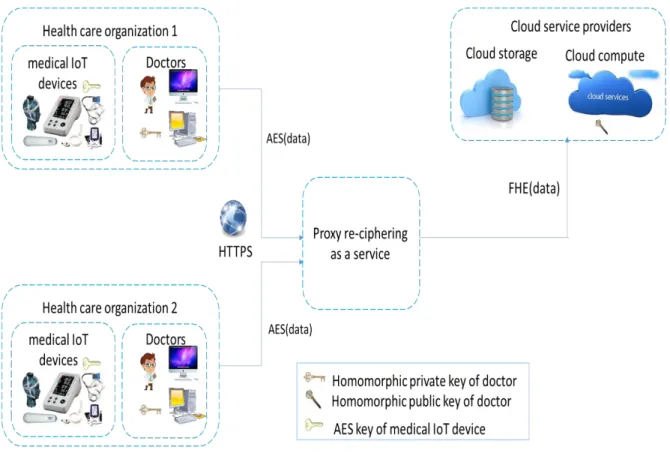
Figure 7. An example of proxy re-ciphering as a service framework for smart healthcare ... 53
Figure 8. Experiment setup with high-level workflow ... 59
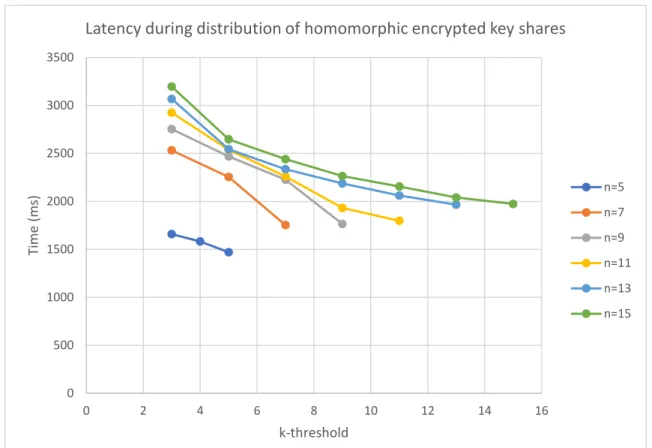
Figure 9. Evaluation of latency to distribute Krawczyk’s shares of homomorphic encrypted device key ... 63
Figure 10. Evaluation of latency at each proxy server for homomorphic key reconstruction ... 64
Figure 11. Evaluation of latency to distribute Shamir’s shares of homomorphic encrypted device key ... 66
Figure 12. Evaluation of privacy vs latency trade-off for encryption schemes ... 67
Figure 13. Evaluation of privacy vs latency trade-off for encryption schemes – with offline pre-processing ... 69
Figure 14. Evaluation of latency for different ECG sampling frequencies ... 70
Figure 15. An example of stress-ng command line to emulate a CPU load of 40% ... 71
Figure 16. Evaluation of latency at a proxy server under various CPU loads ... 72
Figure 18. Evaluation of total latency to dynamically refresh an encryption key ... 76
LIST OF TABLES
Page
Table 1. Constrained node classification [2] ... 2
Table 2. Recommended key size in bits by NIST [29] ... 12
LIST OF ALGORITHMS
Page
Algorithm 1. Secure sharing of encrypted IoT device key ... 34
Algorithm 2. Secure reconstruction of encrypted IoT device key ... 35
Algorithm 3. Re-ciphering during data flow ... 39
Algorithm 4. Finding chameleon collision at gateway ... 43
Algorithm 5. Dynamic key generation at IoT device ... 44
NOMENCLATURE
IoT Internet of Things
FHE Fully Homomorphic Encryption
KMS Key Manager Server
HCO Health Care Organization
CIA Confidentiality, Integrity and Availability
AES Advanced Encryption Standard
ECC Elliptic Curve Cryptography
MPC Multi Party Computation
UDP User Datagram Protocol
NIST National Institute of Standards and Technology
HDFS Hadoop Distributed File System
CloudIoT Cloud based IoT
IETF Internet Engineering Task Force
ACKNOWLEDGMENTS
This thesis would have not been possible without the help and support of many people. First, I would like to thank my research advisor, Dr. Manimaran Govindarasu for his patience, guidance and encouragement throughout this journey. Thank you for challenging my ideas and allowing me to explore different domains before finding the topic of my interest. Thank you for teaching me the basic tools of conducting a thorough research.
I would also like to thank Dr. Wensheng Zhang and Dr. Neil Gong for taking out time to respond to my emails and for agreeing to be a part of my POS committee. Thank you, Dr. Wensheng Zhang, for always accepting to meet me and for the valuable feedback after every discussion.
I would also like to thank my research group for providing valuable feedback during all the research meetings. I would like to thank my friend Ranjitha for the support and cheers throughout this journey.
ABSTRACT
There are two fundamental expectations from Cloud-IoT applications using sensitive and personal data: data utility and user privacy. With the complex nature of cloud-IoT ecosystem, there is a growing concern about data utility at the cost of privacy. While the current state-of-the-art encryption schemes protect users’ privacy, they preclude meaningful computations on encrypted data. Thus, the question remains “how to help IoT device users benefit from cloud computing without compromising data confidentiality and user privacy”? Cloud service providers (CSP) can leverage Fully homomorphic encryption (FHE) schemes to deliver privacy-preserving services. However, there are limitations in directly adopting FHE-based solutions for real-world Cloud-IoT applications. Thus, to foster real-world adoption of FHE-based solutions, we propose a framework called Proxy re-ciphering as a service. It leverages existing schemes such as distributed proxy servers, threshold secret sharing, chameleon hash function and FHE to tailor a practical solution that enables long-term privacy-preserving cloud computations for IoT ecosystem. We also encourage CSPs to store minimal yet adequate information from processing the raw IoT device data. Furthermore, we explore a way for IoT devices to refresh their device keys after a key-compromise. To evaluate the framework, we first develop a testbed and measure the latencies with real-world ECG records from TELE ECG Database. We observe that i) although the distributed framework introduces computation and communication latencies, the security gains outweighs the latencies, ii) the throughput of the servers providing re-ciphering service can be greatly increased with pre-processing iii) with a key refresh scheme we can limit the upper bound on the attack window post a key-compromise. Finally, we analyze the security properties against major threats faced
scalable and an easy-to-adopt framework for long-term privacy-preserving cloud computations for encrypted IoT data.
CHAPTER 1. INTRODUCTION TO CLOUD BASED IoT
1.1 Overview
1.1.1 Internet of Things
Internet of Things (IoT) refers to a system where devices with embedded sensors and actuators in the physical world are connected to the Internet through wired or wireless communication channels and can be uniquely identified and addressed. IoT, a vision that was conceived in the early 2000s, has become a reality today, allowing users to connect everything from industrial components like gas turbines, freight goods, industrial heating and ventilation equipment to everyday consumer devices like light bulbs, door lock, washing machines etc., to the Internet. The pervasive presence of the IoT devices around humans has given the devices the ability to measure, infer and even alter the human environment. This has become possible primarily due to several advancements in technologies like wireless networks, embedded sensors, and cloud computing, to name a few, over the years. In a nutshell, an IoT ecosystem offers the following benefits to users, when compared to a traditional IT infrastructure: i) communication: the ability to collect and transfer information from various sensors
like temperature sensor, air purity monitoring sensors, heart rate monitoring sensors etc.
ii) remote control: the ability to control the environment remotely, like turning on air conditioners at home from the office, remotely administering insulin delivery for a patient, unlocking home door from a car etc.
iii) correctness: the ability to avoid human errors arising from manual entries during high precision recordings like in heart rate monitoring, supply chain logistics management etc.
iv) cost: the ability to effectively minimize the cost associated with managing an application infrastructure by means of data, like analyzing sensor data to minimize equipment failures with a planned maintenance, reducing fuel consumption by monitoring drive behavior etc.
Hence, it comes as no surprise that the US National Intelligence Council named IoT as one of the six disruptive technologies that will potentially impact US interests by 2025 [1]. Since a multitude of applications take advantage of IoT, diverse classes of IoT devices have been developed over the years, ranging from wireless sensor networks to fitness bands to smart meters to connected vehicles. These diverse types of devices typically vary in their processing power, cost, buffer space, size, and user interfaces, to name a few aspects. Small devices that are limited in their power, CPU and memory are termed as constrained devices by the IETF
[2]. IETF has also roughly classified the constrained devices into three classes (𝑐𝑙𝑎𝑠𝑠 − 𝑁 for
𝑁 = 0,1,2 ) depending on the device capabilities [2] as shown in Table 1.
Table 1. Constrained node classification [2]
Name Data size
(KB) Code size (KB) Class 0 <10 <100 Class 1 ~10 ~100 Class 2 ~50 ~250
Class 0 devices typically include sensor-like motes that are very limited in their memory and processing power. They connect to the Internet using other computationally
powerful devices like gateways. Class 1 devices are relatively constrained in processing power
and memory and connect to the Internet using lightweight protocol stacks like Constrained
support protocol stacks like HTTP, although they are usually designed to use lightweight protocols to improve efficiency and cost.
Figure 1 shows a typical IoT ecosystem where IoT devices capture information and share it to the cloud-based servers via gateways.
Figure 1. An example of IoT ecosystem
There are two fundamental expectations from IoT applications: data security and data utility. Data security circles around the Confidentiality-Integrity-Availability triad [4] which in the context of IoT device data can be informally and appropriately defined as the follows:
• Confidentiality: the data generated by an IoT device is protected by allowing only users (device owner, legitimate recipients, etc.) who can prove their identity and have appropriate privileges to access the data
• Integrity: the data generated by an IoT device should not be altered throughout its lifecycle by anyone, including the device owners
• Availability: the data generated by an IoT device should be readily available to the appropriate users (device owners, legitimate recipients, etc.) upon request
Data utility refers to using raw data generated by the devices to make intelligent decisions that can help the end-users. With the embedded sensors in IoT devices continuously collecting data about the human environment, device owners are interested in more than just a mere collection and storage of the raw device data in the cloud servers. Rather, they expect useful services like intelligent insights with daily statistics, periodic reports, and alerts from anomaly detection, to name a few. For example, people using fitness bands expect to see their resting heart rate values, number of steps walked in a day, number of hours of deep sleep in a day, the stress levels throughout the day, etc. Thus, it becomes imperative for IoT device vendors to design a back-end infrastructure that can handle and process the device data while meeting the above-mentioned requirements of their consumers.
1.1.2 Cloud Computing
The National Institute of Standards and Technology (NIST) has provided the following definition for “cloud computing” capturing its essential and multi-faceted aspects: "cloud computing is a model for enabling ubiquitous, convenient, on-demand network access to a shared pool of configurable computing resources (e.g., networks, servers, storage, applications and services) that can be rapidly provisioned and released with minimal
management effort or service provider interaction." [5]. Over the years, cloud computing has
enabled the realization of new computing paradigms owing to its ability to provide nearly unlimited storage and processing capabilities, in turn hugely impacting the IT industry.
Cloud service providers are companies that leverage cloud computing and offer cloud-based solutions such as Infrastructure as a Service (e.g. Amazon Web Service [6], Microsoft Azure [7]), Platform as a service (e.g. Red hat OpenShift [8]) and Software as a service (Salesforce [9]). Cloud service providers facilitate off-premise storage and processing,
enabling companies to offload the overhead associated with maintaining on-premise infrastructures, managing IT personnel and expanding them as required. Furthermore, the system of virtually distributed, powerful and always up-to-date servers hosted by the cloud service providers can guarantee better resiliency, scalability and security compared to a traditional computing system, while at the same time being cost-effective. These salient features are essentially responsible for the recent transformation in the business models of various industries ranging from transportation to manufacturing to IT companies [10]- [11].
In the following section, the current study provides a high-level functional overview of the state-of-the-art cloud storage and processing services provided by the cloud service providers.
1.1.2.1 Cloud Storage
A typical cloud storage model involves clients storing data (e.g. images, text files) in the cloud server and querying it later when they want to view the data. For example, service likes Amazon S3 [6], Azure storage [7], Google Drive [12] and Dropbox [13]. Clients typically use a secure channel to transfer the data to the cloud to prevent an adversary from eavesdropping on the channel. In case the information shared with the cloud servers is sensitive (e.g. business critical data), clients can encrypt the sensitive and critical data before uploading the data to the cloud servers. An encrypted data, by the virtue of encryption, is protected against eavesdropping over an unsecure wireless channel (security for data in-transit) and against data leakage after storing in the cloud servers (security for data at-rest). Clients can also use encrypted query processing to conceal access patterns from the cloud servers [7, 8] and decrypt the data after receiving.
1.1.2.2 Cloud Compute
By cloud compute, the current study refers to allowing the cloud servers to process data in their servers. Personal assistants like Siri [14] and Alexa [15], to productivity tools like Office Online [16] and Google Docs [12], to big data analytics tools like Hadoop [17], are all examples of compute services provided by cloud service providers. Cloud compute services are generally data driven in that they rely on providing services by processing huge amounts of data shared by the clients. To protect the data during transit and storage, clients typically encrypt the data in their local machine and then upload the data to the cloud servers. When the data is required for computation, the authorized cloud application first decrypts the data and then performs the necessary computation on the data [18]. To protect the result of the computation from an adversary, the cloud application re-encrypts the result before sharing with the clients.
The next section provides a brief overview of IoT ecosystem integration with cloud computing.
1.1.3 Internet of Things and Cloud
In 2011, the number of interconnected IoT devices exceeded the total number of people [19] and by 2025 it is expected to reach a value of over 75 billion [20]. This in turn would substantially increase the volume of data generated. It is thus evident that IoT will soon become one of the main sources of Bigdata [21]. Industrial analysts typically describe the nature of Bigdata using the 4V’s: volume (amount of data generated), velocity (rate of data generation), veracity (accuracy of data) and variety (diverse nature of data originating from varied sources) [21]. It can be inferred that a traditional infrastructure is not efficient for long-term storage or processing of such enormous amounts of varied data generated by the IoT
devices. Interestingly, there exists a perfect symbiotic relation between cloud computing and IoT. While IoT generates massive amounts of data, cloud computing can efficiently handle the data throughout its lifecycle.
Several cloud-based IoT applications have been developed over the years that leverage the merits of both the ecosystems. Wearables like Fitbit [22] to smart home appliances like Nest Thermostat [23] and Ring video doorbells [24] to self-driving cars like Tesla [25], are all examples of real-world implementations of Cloud-based IoT applications.
While outsourcing the task of storing and processing the data to the cloud servers can improve efficiency for businesses, it can naturally introduce concerns over the loss of privacy and data security for businesses. Encryption schemes, such as AES [26] can satisfactorily address this concern by allowing businesses/end-users to encrypt the data before outsourcing them to cloud. Thus, this guarantees the privacy of end-users during the storage phase. However, the state-of-the-art encryption schemes do not provide meaningful results when cloud servers perform any computation on the encrypted data. An alternate approach is to allow cloud servers to decrypt the data before performing any computations and re-encrypt the data after the computation. However, it is evident that such a scheme is not privacy-preserving.
1.2 Research Motivation and Objective
The state-of-the-art encryption schemes allow IoT device users to make use of cloud servers to store their encrypted device data. However, it is currently not possible for cloud servers to deliver intelligent insights to the device users while preserving their privacy completely. Fully homomorphic encryption schemes have been proposed in the literature as a solution to tackle this issue. When a data is encrypted under FHE schemes, it is possible for cloud servers to perform computations on it, thereby enabling privacy preserving cloud
computations for encrypted IoT data. However, the FHE schemes proposed so far are computationally intensive and are unsuitable to be employed on an IoT device.
Recent research studies have proposed alternate solutions to assuage this limitation. However, there are still challenges in the practical implementation of these solutions for a resource constrained IoT ecosystem. Fostering real-world adoption of the FHE based privacy-preserving computation schemes for IoT ecosystem requires a practical solution with a modest overhead for all the entities, ranging from the device vendors, the device users to the cloud
service providers. Thus, this thesis attempts to answer the question: “how to help IoT device
users benefit from cloud computing without compromising data confidentiality and user privacy?” by proposing a practical framework called Proxy re-ciphering as a service. It leverages existing schemes such as distributed semi-trusted proxy servers and threshold secret sharing to tailor FHE schemes for IoT applications, thereby enabling long-term privacy-preserving cloud computations for encrypted IoT data.
1.3 Thesis Organization
The rest of the thesis work is organized as follows:
➢ Chapter 2: Background and literature review of the existing secure and privacy
pre-serving computation schemes
➢ Chapter 3: Proposal of Proxy re-ciphering as a service to enable privacy-preserving
computations for IoT devices
➢ Chapter 4: Case study of Proxy re-ciphering as a service with application to smart healthcare ecosystem
➢ Chapter 5: Evaluation of the proposed framework using experimental testbeds and theoretical analysis
CHAPTER 2. BACKGROUND AND LITERATURE REVIEW
This chapter focuses on various encryption schemes that are proposed in the literature along with a special emphasis on schemes that allow privacy-preserving computations on the encrypted data. Specific attention is given to the merits and limitations of each of these encryption schemes in the context of IoT. After analyzing each of these schemes, a suitable encryption scheme is chosen for the current study. During this process, various works proposed in the literature are covered that help enable cloud-based privacy-preserving computations on the encrypted data.
The field of End-to-End security encompasses a variety of areas that address various concerns related to computer/network security. Specifically, a data is called End-to-End secure if its CIA triad is protected from the time of its generation to the time of its consumption. In the context of an IoT ecosystem, end-to-end data security essentially means that data is encrypted before it leaves the embedded device and it is not decrypted until it reaches the end-user (typically an application running on the end-user’s smartphone/laptop). The goal of such an implementation is to secure data against the common attacks, such as eavesdropping (confidentiality), man-in-the-middle (integrity, availability) and denial of service (availability) to preserve its CIA triad. Employing End-to-End encryption schemes can satisfactorily guarantee security of a system against eavesdropping attacks.
2.1 Conventional Encryption Schemes
Most real-world applications that aim to protect the confidentiality of their data use conventional encryption schemes. They can be implemented either in the form of a public-key encryption system or as a symmetric key encryption system.
Public key cryptography involves two different keys for encryption and decryption purposes, named public key and private key, respectively. As the name suggests, every participating node/user in a system is given a public key that is not a secret and a private key, which is a secret and is known only the node/user. A sender node encrypts the data using the public key of the recipient node before sending the data to the recipient. Upon receiving the encrypted data, the recipient node decrypts the data using its private key. One of the main advantages of this system is the key management and the scalability of the scheme.
RSA [27] is one of the most widely used public key cryptographic solutions. The security and the hard problem in this primitive are based on finding prime factors of a composite number. The length of the key used for encryption is a measure of the security of the system. It has been identified that to provide an equivalent level of security compared to AES encryption [26] with 128 bits key, RSA requires 3072 bits of key [28] . This is also shown in Table 2. In addition, it is close to 1000 times slower than the symmetric key counterparts, due to its computational processing power requirements [29]-[30] . This makes asymmetric encryption schemes challenging and computationally intensive for constrained IoT devices.
Elliptic curve cryptography (ECC) [32]-[33] is another public key scheme that is based on elliptic curves over finite fields. It requires smaller key size when compared to RSA and is a better candidate when using public key cryptography for resource constrained IoT devices. The security of ECC is based on the hardness of Elliptic curve discrete logarithm problem [31].
Table 2. Recommended key size in bits by NIST [29]
Symmetric key algorithms, on the other hand, perform encryption and decryption using a single key that is pre-shared between a sender and a recipient. Symmetric key encryption schemes are usually less computationally intensive compared to the asymmetric key encryption schemes and require relatively smaller-length key to provide the same level of security guarantees compared to asymmetric key encryption schemes [28].
Currently Advanced Encryption Standard [26] (AES) is one of the most widely deployed symmetric-key encryption algorithm and is accepted as a standard by NIST for government applications and industrial applications [33][34]. Authors in [35] tested and compared the encryption performance of various symmetric key encryption schemes like AES, CLEFIA [36], PRINCE [37], SPECK [38], Camellia [39], Midori [40] under a restricted memory size of 1024 bytes or less of ROM and 128 bytes or less RAM. Their results show that AES was the fastest followed by SPECK. The current work focuses on devices that typically belong to Class 1 or Class 2 category of constrained nodes [discussed in Chapter 1 and shown in Table 1]. These devices have around 10-50 KB RAM and 100-500 KB ROM. In most IoT devices, the cryptographic schemes are implemented as a software component rather than a dedicated chip[35]. Therefore, it is practical to choose an algorithm that requires less CPU cycles and a modest amount of ROM. Since the current study requires medical IoT devices to
Symmetric key RSA key Elliptic curve key
80 1024 160
112 2048 224
128 3072 256
192 7680 384
only perform encryption, following the results of [35], the current study uses AES encryption scheme to encrypt IoT device data before sending to the cloud servers .
AES is by design optimized for low memory, speed and thus has been deployed across platform ranging from 8-bit processors to super power CPU / GPUs [35]. Even x86 architectures have witnessed instruction-set extensions by Intel [33] for improving the performance of encryption and decryption functions. AES is a block cipher that operates on
128-bit blocks of data. The number of rounds (𝑛𝑟) of processing depends on the size of the key
(128/192/256 bits) used in the schemes. As the key length increases, the security of the system
increases, along with the number of rounds of processing (𝑛𝑟=10 for 128, 12 for
AES-192 and 14 for AES-256). The current study uses AES-128 with 𝑛𝑟 = 10. AES provides the
following modes of operation: Electronic Code Book (ECB), Ciphertext Chain Blocking (CBC), and Counter (CTR).
While AES is energy efficient and provides strong security guarantees, one of the main disadvantages is that it does not provide meaningful results, when performing arithmetic or logical operations on the ciphertext. Figure 2 shows an example of this limitation. It can be seen that when encrypting an integer value of 2 and an integer value of 3, the sum of the encrypted ciphertexts does not yield a value equal to encrypting an integer value of five:
Figure 2. An example of computation on AES-encrypted data
2.2 Homomorphic Encryption Schemes
Homomorphic encryption schemes have been proposed to tackle the problem to provide secure and privacy-preserving computations on encrypted data, while minimizing the communication complexity that secure multi party computation schemes [41]–[43] usually witness. Rivest, Adleman and Dertouzos [44] stated the following around 1978 :
“It remains to be seen whether it is possible to have a privacy homomorphism with a large set of operations which is highly secure”
In other words, the possibility of building an encryption scheme, that is practical and worthwhile to perform arbitrary computations on an encrypted data, without having to decrypt during computation, remained an open question for a long time.
2.2.1 Partially Homomorphic Encryption Schemes
Partially homomorphic encryption schemes are a class of encryption schemes that allow arbitrary number of homomorphic additions or homomorphic multiplications on the
encrypted data. A scheme is additively-homomorphic if the result of an addition operation on two ciphertexts followed by a decryption, results in the same value as the addition operation
on the two-plaintexts. Similarly, multiplicatively-homomorphic scheme is one where the result
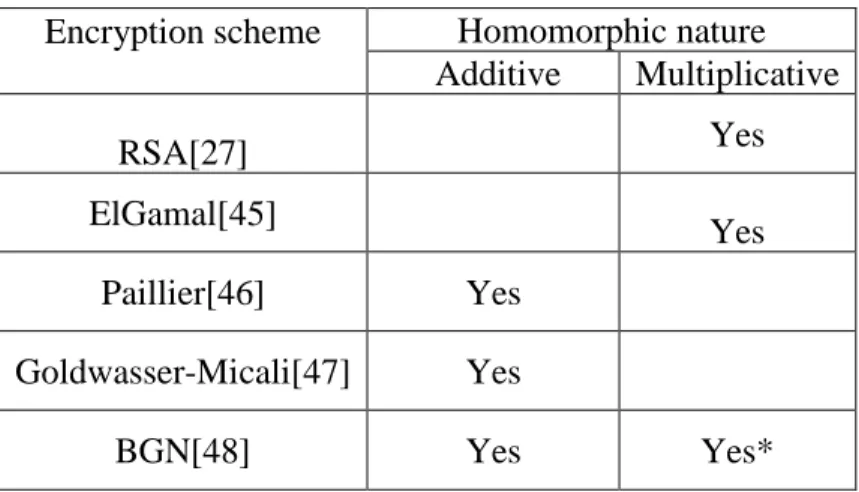
of a multiplication operation on two ciphertexts followed by a decryption operation gives the same value as the multiplication operation on the two-plaintexts. Table 3 presents the most-widely used partial homomorphic encryption schemes along with their homomorphic
properties.
Table 3. Widely known partially homomorphic encryption schemes
Encryption scheme Homomorphic nature
Additive Multiplicative RSA[27] Yes ElGamal[45] Yes Paillier[46] Yes Goldwasser-Micali[47] Yes BGN[48] Yes Yes*
*: allows only one multiplication operation
Table 3 shows that RSA and ElGamal schemes allow multiplication operations over the encrypted data while schemes like Galwasser-Micali (GM) and Paillier allow addition operations over the encrypted data. Furthermore, BGN encryption scheme allows an arbitrary number of addition operations on the encrypted data along with one multiplication operation. GM scheme was one of the first schemes to achieve additive homomorphism with probabilistic public key crypto system, giving the highest security guarantees. However, one of the limitations of this scheme was that it allowed only a single bit data as its plaintext input. In
addition, the ciphertexts in this scheme were large, rendering the scheme impractical. Benaloh
[49] generalized the GM scheme to extend support for plaintext data of up to a bit-length 𝑘 .
However, it suffered from high cost of decryption [50]. Paillier improved the earlier schemes by allowing encryption of plaintext data up to a bit-length 𝑘, while reducing the ciphertext expansion during encryption and at the same time maintaining a reasonable encryption and decryption costs.
CryptDB [51] is seminal research work that focused on access control for SQL queries on encrypted data. The authors implemented a Paillier cryptosystem to compute arithmetic
operations like SUM over encrypted data. Authors in [52] proposed DBMask, to address the
limitations of decrypting data to weaker encryption schemes within the cloud server in CryptDB, thus guaranteeing that the security of the data is not weakened with time. However, both DBMask and CryptDB were designed for web applications, with a fully trusted proxy server intercepting the communication between a client and a server to apply encryption and decryption schemes transparent to the clients. In an IoT application, such an approach can potentially conflict with the security and privacy requirements. In addition, it has been identified that the solutions are computationally intensive with an overhead of 25% [50].
Authors in [50] introduced Talos, keeping IoT ecosystems in mind. Their solution does
not require a fully trusted proxy server and allowed query processing locally in the end-user device. They improved the efficiency of Paillier encryption scheme to operate on 32-bit integer data, by packing multiple plaintext data in a single ciphertext, thereby allowing parallel
operations on multiple plaintexts. Along these lines, Pilatus [53] was introduced to overcome
some of the limitations of Talos. Pilatus further optimized Talos to work on larger plaintext
proxy re-encryption. The authors of Pilatus demonstrated their work on data from Fitbit [22] servers and on an anonymized data from Awawomen startup [54].
Despite its merits, partial homomorphic encryption schemes like Paillier, have a limitation where they can only be used for algorithms that require either addition or multiplication operation (with an exception to BGN) and not a combination of both. However, many practical IoT-based applications may require a combination of both, for example, linear regression, logistic regression, standard deviation, to name a few.
2.2.2 Fully Homomorphic Encryption Schemes
Gentry’s Fully homomorphic encryption (FHE) [55] is a seminal work that showed that it is plausible and achievable to design a FHE scheme, answering the open question raised by Rivest, Adleman and Dertouzos . However, the scheme is computationally expensive to apply in real-life due to the bootstrapping operations. When a noise-level of a ciphertext reaches the threshold level, any homomorphic operation performed thereafter can potentially result in incorrect results. Gentry addressed this by bootstrapping the ciphertext to transform it into a new ciphertext with lesser noise-levels, thereby enabling further operations on the ciphertext. BGV [56] scheme, based on Learning With Errors, is currently one of the most widely used FHE scheme. It is a leveled FHE scheme that allows evaluation of arithmetic circuits of level 𝐿. It does not require bootstrapping and has been optimized to allow practical implementations of FHE based solutions. Libraries like HElib [58]-[59] have been developed using BGV schemes and are available for public use, making FHE accessible to researchers and application developers.
Early works on practical applications of FHE attempted to solve real world problems [59]-[60] , where the clients ( laptop like devices) encrypted their data using FHE schemes to allow a computationally powerful third-party server (like a cloud server) to perform
computations on the encrypted data. This was clearly an improvement over to traditional encryption schemes where the cloud servers needed to decrypt data to perform computations. However, these solutions were proposed for traditional file-based applications running on laptop-like devices and are not suitable IoT devices. Furthermore, the computational complexity of this scheme is high, even for traditional devices, as it requires homomorphic encryption before every single data transfer. In addition, the communicational complexity of the scheme is also high due to the size of the ciphertext (for example in [61], the ciphertext-size is 𝑛 𝑙𝑜𝑔 (𝑞) , where 𝑛 = 2048 and q=2258to allow single multiplication and a large number of additions and the values are larger for applications that require more multiplication operations [61]) resulting in high latencies and bandwidth requirement.
Authors in [35] proposed a possible solution to address this problem. In their scheme, the clients can homomorphically encrypt the AES encryption key once and share it with the server, as a part of setup phase. During the data flow phase, the client can encrypt the data using AES encryption scheme allowing the server to homomorphically evaluate the AES decryption function to transform AES encrypted ciphertext to a homomorphic encrypted ciphertext. Thus, this scheme allows cloud servers to compute on data encrypted under homomorphic scheme, while optimizing the communication complexity. This is discussed in great detail in [62] and is available for application developers along with the HElib library. This solution clearly relieves the client devices from performing computationally intensive task for every single data transfer. Authors in [62] tested their solution on a 4GB RAM Intel Core i5-3320M laptop to evaluate its feasibility and performance. However, this approach is still not suitable for IoT devices and are computationally intensive, even if the device is required to encrypt the AES key under homomorphic encryption scheme just once.
An alternate approach could be to encrypt the key under homomorphic encryption scheme using computationally more powerful devices like a device owner’s smartphone. However, there are a couple of limitations in the practical implement of this approach. Although algorithms in HElib are constantly optimized and updated, the authors of [62] have not tested the algorithms in HElib library for their feasibility and efficiency on lower computational devices like IPhones or Android smartphones. In addition, the library is not trivially compatible with Android like environments since they are natively written in C++ and depend on other libraries like NTL [63] and GMP [64]. In addition, device encryption is transparent to end users in some real-world implementations [65]-[66] where device vendors often do not store the encryption keys in the end-user apps running on a smartphone / laptop [67]. Rather, they rely on secure channel communication using HTTPS between a smartphone and the cloud server to download results from cloud servers to the smartphone [65], [68].
Authors in [69]-[70][71] have proposed a novel privacy-preserving remote patient ECG monitoring system. Their work is the first of its kind to show practical feasibility of FHE in terms of computational complexity and the storage costs for a real-world medical application on the cloud. However, they make a few assumptions that might always not be acceptable. They take advantage of a cloudlet (a PC primarily provided by the hospital, in their work) to decrypt the AES encrypted data from the IoT device and re-encrypt it using FHE scheme. This has a few limitations since it requires hospitals to distribute additional hardware to all patients. The other alternative solution requires patients to own a laptop. Although the latter is not a very unreasonable assumption, this can however prevent the mobility of the patients as called out by the authors themselves [69]. Apart from these, such a solution can quickly become a
single point of attack and might not be applicable to real-world implementations like the ones discussed in [22], [65], [68].
CHAPTER 3. PROPOSED SOLUTION-PROXY RE-CIPHERING AS A SERVICE
CloudIoT is a recently introduced paradigm that leverages two complementary
technologies: Cloud computing and IoT [72]. Over the years, multitudes of CloudIoT
applications have been developed, aiming to improve the efficiency of the tasks and the quality of living for the device users. From wearables like Fitbit [22] to secure smart homes appliances like Ring [24] to self-driving cars like Tesla [25], CloudIoT now has a pervasive presence
among humans. The demand and expectations from the CloudIoT applications have also
drastically increased, resulting in a highly competitive IoT market. Yet, there are two fundamental expectations from these applications that capture sensitive and personal information: data utility and user privacy. In the contemporary world of IoT, with the complex nature of data usage between multiple service providers that are typically masked away from the end-users, there is a growing concern among device users about receiving utility at the cost of their privacy. For example, an early work on understanding the ecosystem of Fitbit found that the mega dumps consisting of user activity data were sent to an analytics company called Mixpanel [68]. Although the Fitbit ecosystem has changed since then, this example illustrates
the complicated world of CloudIoT with multiple backend service providers that end-users are
necessarily not aware of. In a report released by Economist Intelligence Unit in 2018, 74% of the surveyed consumers were concerned that small privacy invasions may eventually result in loss of civil rights [73].
Fully homomorphic encryption schemes (FHE) can be leveraged by cloud service providers to guarantee privacy-preserving data services to device users. Understandably, adopting a new encryption scheme, especially a computationally-intensive and a nascent one, can be challenging for existing CloudIoT applications and businesses. A migration from a
functioning workflow to a new FHE based workflow can be practically fostered, only when the cost associated with the transition is modest for all the entities in the IoT ecosystem ranging from the device vendors to the device users to the cloud service providers.
Solutions proposed in the literature have the following limitations when integrating them into a real-world IoT ecosystem : 1) a fully homomorphic encryption scheme is computationally intensive to be deployed on an IoT device 2) a fully trusted cloudlet/proxy server to decrypt AES device data and encrypt it using a FHE data can become a single point of attack and is not truly privacy-preserving , 3) homomorphic encryption of IoT device keys (that are required to transform AES device data to FHE data) demands significant resources for computational purposes from the IoT devices and 4) outsourcing heavy computations to end-user devices like smartphones / laptops is not possible in some real-world implementations where device vendors often do not store the device encryption keys in the end-user apps [67], as discussed in chapter 2 .
Thus, to bridge the gap between the proposed solutions in the literature and their real-world adoption in the IoT ecosystem, the current work proposes Proxy re-ciphering as a service. It leverages existing schemes such as distributed semi-trusted proxy servers, threshold secret sharing and FHE to tailor a framework that enables long-term privacy-preserving cloud computations for encrypted IoT data.
3.1 Design Goals
This section will provide a brief overview of the high-level considerations that were given before arriving at the proposed solution. Design goals such as the ones considered form the salient features of the proposed solution.
Security: The data encrypted by an IoT device should not be decrypted by anyone other than the end users (device owners / legitimate recipients)
Availability: The solution should be resilient to any failures (internal or external) to ensure that the service is always available to the IoT device users
Accessibility and deployment readiness: The solution should use existing technologies that are publicly available and easily accessible to application developers
Scalability: The solution should ensure that the storage complexity is acceptable given the large ciphertext size of FHE schemes.
Energy efficiency and Performance: The solution should be lightweight on the IoT devices in terms of computational, communicational and storage complexity
Back-portability: Existing devices that are already operational should be readily able to take advantage of the solution
Transparency: The solution should be adoptable without requiring any additional hardware, for the end-users. Any additional manual/configurational overhead to the device users should be modest.
Practicality: The solution should closely resemble real-world implementations of CloudIoT applications, with minimal assumptions.
3.2 Major Cyber Threats
In this section, we will briefly focus on the major threats faced by cloud-based solutions where IoT devices generate data and end-users review the data using their device-companion apps. In the following discussion, the proxy servers are intermediary nodes that intercept IoT device-cloud communication and pre-process the device data before uploading it to the cloud servers.
Threat 1: Cloud database/server compromise: The current study assumes a semi-trusted cloud. This means that the server is honest and performs the algorithms correctly, but it is not trusted with the private data. Compromising cloud servers can give an adversary access to the encrypted data. A rogue administrator can misuse data for monetary incentives.
Threat 2: Proxy database / server compromise: The current study assumes a semi-trusted proxy server. An adversary can be interested in attacking the proxy servers to learn about the device encryption keys.
Threat 3: Byzantine proxy storage servers: A special attack on the proxy servers where an adversary can maliciously control the behavior of nodes/servers in the system resulting in the failure or corruption of data or a combination a both.
Threat 4: IoT device key compromise: An adversary can remotely launch attacks on the resource constrained IoT device to compromise the device key. This is a critical and relevant threat in today’s IoT ecosystem[68]-[69]. Most device manufacturers hardcode the encryption keys [75] [65], [66], [74], [76] in the devices during the manufacturing phase. When
such a long-term device key is compromised, the post-compromise security [77] for the IoT
devices can be jeopardized.
Threat 5: Network-based attack: An adversary can attack the communication channel between different participating nodes in the system like the medical device, gateway, proxy servers and the cloud servers. This threat can be launched by a passive or an active attacker. Passive attackers are generally interested in learning about data patterns by launching eavesdropping attack and active attackers are typically interested in intercepting data to launch a man-in-the-middle attack.
3.3 System Architecture
In this section, the key components of the proposed system are discussed:
IoT device
These are embedded devices that fall under Class 1 and class 2 category of constrained devices as defined in Chapter 1 with around 10-50 KB RAM and 100-300 KB ROM. For example, Fitbit devices have around 250 KB flash and 32KB SRAM [74]. They support AES encryption to securely transmit the device generated data wirelessly [65]. They typically do not store information locally for processing and outsource the computations to cloud servers. They communicate only through gateways devices, typically via Bluetooth while other protocols like Zigbee are also supported.
Gateway devices
These are computationally powerful devices compared to the medical devices. They typically function via the device-companion apps running on smartphones (most widely used), laptops (supported configuration), enabling portability for the users. They have enough resources to support full stack HTTP protocols. They pack (typically as a JSON) the data from received from the IoT device before relaying it to cloud servers. They do not perform any other computations on the device data.
Cloud servers
These servers provide storage and compute services for other businesses. They receive device data from the gateway devices. They are computationally powerful and can scale their service when required. When a data is encrypted under FHE scheme, cloud servers can perform computation on the data and share privacy preserving insights with end-users.
Key Manager Server (KMS)
They are maintained by device vendors or OEMs depending on the implementation. They are solely responsible for generating and maintaining the cryptographic keying materials and embedding device specific keys during the manufacturing. These servers are computationally powerful and are assumed to be very secure.
Distributed semi-trusted proxy servers
These are computationally powerful servers that act as an intermediary between businesses and their cloud server providers. The current study employs a total of 𝑛 proxy servers in a geographical region (across US, for example).
GUI devices
These are devices that display the results of cloud computations to the data consumers. The proposed system currently supports laptops since the authors in [58] have tested the performance on laptop like devices. When an optimized version of the library that is compatible with smartphones is available, the current system can be extended to work on relatively lower computational systems like smartphone devices.
Figure 3 shows proposed system model comprising of the above-mentioned key components along with a brief high-level description of the proposed workflow.
Figure 3. The proposed architecture for Proxy re-ciphering as a service
3.4 Model Assumptions
Given the number and nature of design goals, it was necessary to make few assumptions (listed below) which forms the basis of our system mode. Efforts were taken to ensure that these assumptions are as modest as possible.
1. Cloud servers and proxy servers are semi-trusted. They are honest in performing the
algorithms but are not trusted with sensitive data
2. Every entity in the system has a unique and random identifier that is not publicly known.
3. The system chooses 𝑚 proxy servers that are closest to the cloud servers for every organization, to provide the service. The value of 𝑚 can differ for each business depending on the load like:
• proxy server’s total capacity
• maximum server utilization per tenant
• throughput guaranteed as per the service level agreement
• incoming traffic load
A load balancer is assumed to take care of traffic routing between the 𝑚 proxy servers.
Since the proxy servers are essentially cloud based servers, it is assumed that the system always has enough proxy servers to provide service.
4. The knowledge about an IoT device compromise is available to the system.
3.5 Data Distribution Schemes
The current study utilizes distributed proxy framework primarily to build a fault resilient system against corruption and availability of data and services in the system. The following techniques were inspected to select a scheme for distribution of data (which in the current case is device encryption keys encrypted under homomorphic scheme).
Data Replication
The traditional technique to guarantee a robust system is to replicate a server data across multiple servers (let’s say, 𝑛). This provides a fault resilience [78] up to 𝑛 − 1 servers. However, the secret in the current study is the expanded AES-128 homomorphic device key. The size of homomorphic ciphertexts generated using widely used homomorphic libraries like HElib [57] and SEAL [79] are typically not less than 1MB for one input [80]. Thus, when
considering a practical and a scalable solution, replication (across 𝑛 servers) is not be the most efficient solution, in terms of storage complexity.
Threshold secret sharing
An informal definition of a threshold secret sharing can be described as follows:
Definition 1: Let 𝑘 and 𝑛 be positive integers such that 𝑘 ≤ 𝑛. A (𝑘, 𝑛) Threshold secret sharing scheme is a way to share a secret 𝑆 with 𝑛 participants such that any group of at least 𝑘 participants can pool their shares to compute the value of 𝑆, but no group of 𝑘 −1 or fewer should be able to do so.
Thus in a (𝑘, 𝑛) threshold secret sharing, a secret is split into 𝑛 shares by a mutual trusted node (called dealer) and is shared among 𝑛 participating nodes ( called recipients) such that any 𝑘 or more shares are enough to reconstruct the original secret but a fewer than 𝑘 shares cannot reproduce the secret. In this scheme, 𝑘 is called the threshold of secret sharing. In other
words, a threshold secret sharing schemes provide a fault resilience up to 𝑛 − 𝑘 shares.
Shamir’s secret sharing scheme
Of the many techniques that are available in the literature, the most widely used
threshold secret sharing technique was proposed by Shamir [81]. In this (𝑘, 𝑛 ) scheme a secret
message ′𝑠 ′ is being shared among 𝑛 participating nodes in the following way:
The dealer constructs a secret polynomial 𝑦 = 𝑎(𝑥) of degree 𝑘 − 1 by randomly choosing coefficients 𝑎1, 𝑎2, . . , 𝑎𝑘−1 from a finite field 𝐹 and assigns 𝑎0 = 𝑠.
𝑎(𝑥) = 𝑠 + 𝑎1𝑥 + 𝑎2𝑥2 + ⋯ + 𝑎
𝑘−1𝑥𝑘−1
Then the dealer picks out 𝑛 random points on the polynomial, 𝑥𝑖, 1 ≤ 𝑖 ≤ 𝑛 and creates shares(𝑠1, 𝑠2 , . . , 𝑠𝑛) to distribute share 𝑠𝑖 to recipient 𝑟𝑖, such that
𝑠1 = (𝑥1, 𝑦1 = 𝑎(𝑥1)) , 𝑠2 = (𝑥2, 𝑦2 = 𝑎(𝑥2)) , . . , 𝑠𝑛 = (𝑥𝑛, 𝑦𝑛 = 𝑎(𝑥𝑛))
To reconstruct the secret, a group of 𝑘 recipients should pool their shares (𝑠1, 𝑠2, … 𝑠𝑘 )
and construct Lagrange basis polynomials [82] 𝑙𝑗 (𝑥), 𝑤ℎ𝑒𝑟𝑒 1 ≤ 𝑗 ≤ 𝑘 ,such that
𝑠 =∑𝑘𝑗=1𝑙𝑗(𝑥)𝑦𝑗
It can be inferred that a subset of authorized participants has a k-out-of-n access structure. Shamir’s secret sharing scheme is a perfect secret sharing scheme (PSSS) where a
subset of non-authorized participants gets no information about the secret and thus advantage
of a non-authorized subset is same as the advantage of an outsider in computing the correct secret. Here, no information is defined in an information-theoretic sense.
Secret sharing schemes in general have one limitation in that the size of the shares are typically at least the size of secret itself. For example, Blakely’s [83] have a share size that are
𝑘 times larger than the size of the original secret. However, Shamir’s shares have a minimal
property in that the shares are only as large as the original secret. This is not a serious limitation in general where the secrets are typically small, like an AES-128 encryption key. However, in the current study, shares of homomorphic encrypted AES keys are distributed to the proxy servers. Thus Shamir’s shares with a share-size of |𝑆| for a secret 𝑆 [84], can incur a high storage complexity.
Krawczyk’s secret sharing scheme
Krawczyk’s scheme [85] is a space efficient hybrid scheme that utilizes PSSS and Information dispersal algorithm [86] to generate shares close to a size of |𝑆|
𝑘 where 𝑆 represents the original secret. Krawczyk’s scheme relaxes the secrecy from an information-theoretic sense to a computational sense, where an adversary has a bounded resource, making it more practical.
Information dispersal algorithm (IDA) proposed by Rabin introduces redundancy into a given data 𝐷𝑎𝑡𝑎 before partitioning it into 𝑘 fragments of size|𝐷𝑎𝑡𝑎|
𝑘 , such that, the interpolation of any 𝑘 fragments will result in the reconstruction of 𝐷𝑎𝑡𝑎. Unlike secret sharing schemes, secrecy of the data is inherently not a priority in IDA. In addition, this scheme assumes that the participants behave honestly, returning unaltered fragments for reconstruction. Krawczyk’s scheme can be explained as follows:
Distribution scheme
1. Choose a secure private encryption scheme 𝐸𝑁𝐶 and an encryption key 𝐾𝑒𝑦.
2. Encrypt the secret 𝑆 with 𝐸𝑁𝐶 using 𝐾𝑒𝑦, let 𝐸 = 𝐸𝑁𝐶(𝑆, 𝐾𝑒𝑦)
3. Use IDA to split the encrypted data 𝐸 into 𝑛 fragments: 𝐸1, 𝐸2, . . , 𝐸𝑛
4. Use PSS to generate 𝑛 shares of 𝐾𝑒𝑦 : 𝐾𝑒𝑦1, 𝐾𝑒𝑦2, . . , 𝐾𝑒𝑦𝑛
5. Distribute shares 𝑆𝑖 , 1 ≤ 𝑖 ≤ 𝑛 to each participant 𝑃𝑖 where 𝑆𝑖 = (𝐸𝑖, 𝐾𝑒𝑦𝑖)
Reconstruction scheme
1. Collect 𝑘 shares 𝑆𝑗 = ( 𝐸𝑗 , 𝐾𝑒𝑦𝑗) from participants 𝑃𝑗 , 1 ≤ 𝑗 ≤ 𝑘
2. Reconstruct 𝐸 from collected 𝐸𝑗 using IDA
3. Compute 𝐾𝑒𝑦 from 𝐾𝑒𝑦𝑗 using PSSS
4. Decrypt 𝐸 with function 𝐷𝑒𝑐 using 𝐾𝑒𝑦 to recover 𝑆, 𝑆 = 𝐷𝑒𝑐 (𝐸 , 𝐾𝑒𝑦)
The size of each share received by each participating node is|𝐷𝑎𝑡𝑎|
𝑘 + |𝐾𝑒𝑦| . Total size of the
𝑛 shares is therefore 𝑛. (|𝐷𝑎𝑡𝑎|
𝑘 + |𝐾𝑒𝑦|) . Krawczyk’s technique is thus a more efficient (since
1 𝑘
⁄ .The current study takes advantage of the following cryptographic schemes for data
distribution:
IDA: Rabin’s IDA scheme
PSSS: Shamir’s secret sharing scheme Private encryption scheme : ChaCha20 [87]
3.6 Proposed Workflow
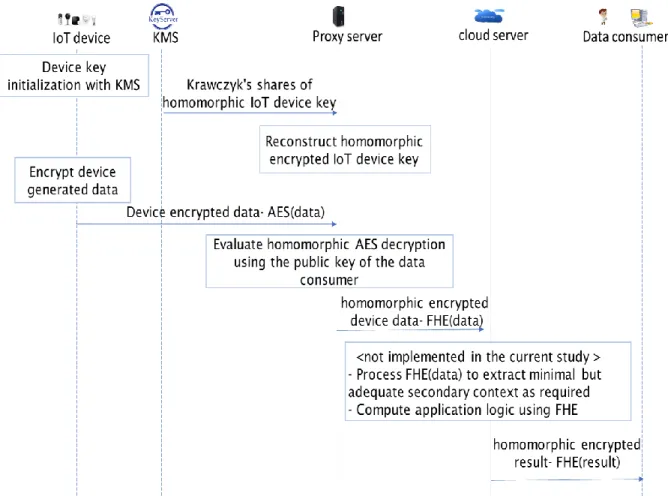
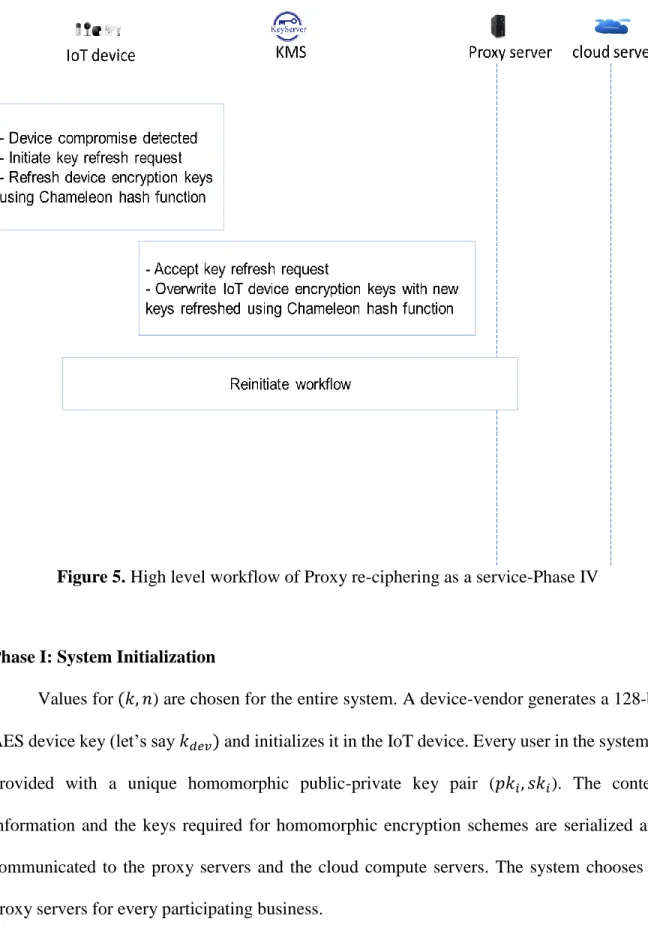
A high-level rundown of Proxy re-ciphering as a service is shown in Figure 4 and Figure 5.The workflow can be segmented into four phases and the interactions between the entities in each phase is now explained in greater detail.
Figure 5. High level workflow of Proxy re-ciphering as a service-Phase IV
Phase I: System Initialization
Values for (𝑘, 𝑛) are chosen for the entire system. A device-vendor generates a 128-bit
AES device key (let’s say 𝑘𝑑𝑒𝑣) and initializes it in the IoT device. Every user in the system is
provided with a unique homomorphic public-private key pair (𝑝𝑘𝑖, 𝑠𝑘𝑖). The context
information and the keys required for homomorphic encryption schemes are serialized and
communicated to the proxy servers and the cloud compute servers. The system chooses 𝑚
Phase II: Device setup
IoT device user (let's say, 𝑢𝑠𝑒𝑟𝑖 ) begins authenticating the account and registering the
IoT device (let’s say 𝑑𝑒𝑣𝑖𝑐𝑒𝑖𝑑) with the cloud service provider through the gateway device.
After authenticating, the proxy servers are assigned as the new endpoint to the gateway device,
by the cloud server. The gateway device now starts to share the data from 𝑑𝑒𝑣𝑖𝑐𝑒𝑖𝑑with the
cloud server through the proxy servers. During its connection with the gateway device, proxy server requests the key manager server for the device encryption key for 𝑢𝑠𝑒𝑟𝑖 , encrypted
under homomorphic scheme, by sharing public key 𝑝𝑘𝑖 as shown in Algorithm 1.
Algorithm 1. Secure sharing of encrypted IoT device key
Algorithm 1
Secure sharing of IoT device key
Where: KMS Input:𝑢𝑠𝑒𝑟𝑖and 𝑝𝑘𝑖
Output: shares of device key 𝑘𝑑𝑒𝑣 encrypted under homomorphic scheme
1. Fetch AES device key 𝑘𝑑𝑒𝑣 corresponding to 𝑢𝑠𝑒𝑟𝑖
2. Encrypt AES device key𝑘𝑑𝑒𝑣 using homomorphic encryption scheme:
hom_𝑘𝑑𝑒𝑣 < −encryptAESkey(𝑘𝑑𝑒𝑣, 𝑝𝑘𝑖 )
3. Generate (𝑘, 𝑛) shares for hom_𝑘𝑑𝑒𝑣 using Krawczyk’s scheme:
Encrypt hom_𝑘𝑑𝑒𝑣 using ChaCha20 with a random key 𝑠𝑠𝑘𝑒𝑦
𝐸𝑖 = 𝐸𝑛𝑐(hom_𝑘𝑑𝑒𝑣, 𝑠𝑠𝑘𝑒𝑦)
Generate Shamir’s shares for 𝑠𝑠𝑘𝑒𝑦
Generate fragments for 𝐸𝑖 using Rabin’s IDA
𝑠ℎ𝑎𝑟𝑒𝑠𝑖 = (𝐸𝑖, 𝑠𝑠𝑘𝑒𝑦𝑖)
4. Distribute 𝑠ℎ𝑎𝑟𝑒𝑠𝑖 to 𝑛 cloud proxy servers 5. Delete hom_𝑘𝑑𝑒𝑣
KMS runs Algorithm 1 as shown above, upon receiving a request from the proxy
server. Homomorphic encryption of 𝑘𝑑𝑒𝑣and generation of Krawczyk’s shares were done
using libraries provided in the literature ([57] ,[88] respectively). At the end of Algorithm 1,
the KMS deletes ℎ𝑜𝑚_𝑘𝑑𝑒𝑣. This ensures that there is no additional storage-overhead for the
KMS after executing Algorithm 1. This is an important step to ensure that it is practically possible for existing KMS infrastructures to run this algorithm with a modest computational and storage overhead. At the end of Algorithm 1, shares of ℎ𝑜𝑚_𝑘𝑑𝑒𝑣 are distributed to 𝑛 proxy servers.
Algorithm 2. Secure reconstruction of encrypted IoT device key
Upon receiving the encrypted key shares, the 𝑚 proxy servers providing service to
𝑢𝑠𝑒𝑟𝑖 run Algorithm 2 as shown above. To provide re-ciphering service to 𝑢𝑠𝑒𝑟𝑖, the 𝑚 servers require ℎ𝑜𝑚_𝑘𝑑𝑒𝑣. . Hence, the 𝑚 servers wait until at least other 𝑘 − 𝑚 proxy servers provide
Algorithm 2
Secure retrieval of IoT device key
Where: ‘m’ proxy servers providing service to 𝑢𝑠𝑒𝑟𝑖 Input: key shares 𝑠ℎ𝑎𝑟𝑒𝑠𝑖=(𝐸𝑖, 𝑠𝑠𝑘𝑒𝑦𝑖)
Output: reconstructed encrypted key hom_𝑘𝑑𝑒𝑣
1. Pool m shares :𝑠ℎ𝑎𝑟𝑒𝑠1, 𝑠ℎ𝑎𝑟𝑒𝑠2, … 𝑠ℎ𝑎𝑟𝑒𝑠𝑚 2. Request 𝑛 − 𝑚servers to contribute shares
3. Wait until at least 𝑘 − 𝑚 shares (𝑠ℎ𝑎𝑟𝑒𝑠𝑚+1, 𝑠ℎ𝑎𝑟𝑒𝑠𝑚+2, … 𝑠ℎ𝑎𝑟𝑒𝑠𝑘) are received 4. Reconstruct hom_𝑘𝑑𝑒𝑣 using Krawczyk’s scheme:
Reconstruct 𝐸 using interpolation
Reconstruct 𝑠𝑠𝑘𝑒𝑦 using Lagrange’s interpolation Decrypt 𝐸 using ChaCha20 encryption with𝑠𝑠𝑘𝑒𝑦
hom_𝑘𝑑𝑒𝑣 = 𝐷𝑒𝑐(𝐸, 𝑠𝑠𝑘𝑒𝑦) 5. Store hom_𝑘𝑑𝑒𝑣 with 𝑢𝑠𝑒𝑟𝑖
their shares 𝑠ℎ𝑎𝑟𝑒𝑠𝑗, 1 ≤ 𝑗 ≤ 𝑘 − 𝑚 . When at least 𝑘 shares are pooled, each proxy server
independently reconstructs ℎ𝑜𝑚_𝑘𝑑𝑒𝑣 with Krawczyk’s reconstruction scheme. The current
study utilize the libraries from literature ([88]) to reconstruct ℎ𝑜𝑚_𝑘𝑑𝑒𝑣. After executing Algorithm 2, the 𝑚 proxy servers have hom_𝑘𝑑𝑒𝑣 for 𝑢𝑠𝑒𝑟𝑖.
Phase III: Data flow
At this stage 𝑑𝑒𝑣𝑖𝑐𝑒𝑖𝑑becomes functional and is ready to use. The device begins to
record data (let’s call it 𝑑𝑎𝑡𝑎 ) and encrypts it using an encryption scheme (let’s say 𝐸𝑛𝑐)
and 𝑘𝑑𝑒𝑣. Upon encryption, 𝑑𝑒𝑣𝑖𝑐𝑒𝑖𝑑 transmits the encrypted data securely to the gateway device. When a proxy server receives the encrypted IoT device data from the gateway device,
it is required to transform the ciphertext from 𝐸𝑛𝑐 scheme to FHE scheme. This is possible by
exploiting the homomorphic property of the FHE scheme. Additional details are discussed in [62] . The following paragraphs aim to explain the implementation of this homomorphic property for the current study.
For the sake of explanation, let us call the encrypted data transmitted by the IoT device as 𝑑𝑎𝑡𝑎′ . Then 𝑑𝑎𝑡𝑎′ = 𝐸𝑛𝑐 (𝑑𝑎𝑡𝑎, 𝑘
𝑑𝑒𝑣). According to homomorphic property of FHE, for
any function 𝑓:
𝑓 (𝐻𝐸𝑝𝑘 (𝑥), 𝐻𝐸𝑝𝑘 (𝑦)) = 𝐻𝐸𝑝𝑘((𝑓(𝑥, 𝑦))
Where, 𝐻𝐸𝑝𝑘 () represents the fully homomorphic encryption under the public
key 𝑝𝑘.
Substituting 𝑓 = 𝐷𝑒𝑐,𝑥 = 𝑑𝑎𝑡𝑎’ and 𝑦 = 𝑘𝑑𝑒𝑣 to evaluate a decryption function 𝐷𝑒𝑐
𝐿𝐻𝑆 = 𝐷𝑒𝑐 (𝐻𝐸𝑝𝑘 (𝑑𝑎𝑡𝑎′), 𝐻𝐸𝑝𝑘 (𝑘𝑑𝑒𝑣)) => 𝐷𝑒𝑐(𝐻𝐸𝑝𝑘 (𝐸𝑛𝑐(𝑑𝑎𝑡𝑎, 𝑘𝑑𝑒𝑣)), hom_𝑘𝑑𝑒𝑣)
𝑅𝐻𝑆 = 𝐻𝐸𝑝𝑘(𝐷𝑒𝑐(𝑑𝑎𝑡𝑎′, 𝑘
𝑑𝑒𝑣)) => 𝐻𝐸𝑝𝑘(𝐷𝑒𝑐(𝐸𝑛𝑐 (𝑑𝑎𝑡𝑎, 𝑘𝑑𝑒𝑣), 𝑘𝑑𝑒𝑣))
The RHS equation is 𝐻𝐸𝑝𝑘(𝐷𝑒𝑐(𝐸𝑛𝑐 (𝑑𝑎𝑡𝑎, 𝑘𝑑𝑒𝑣), 𝑘𝑑𝑒𝑣)) , where the value within the parenthesis of 𝐻𝐸𝑝𝑘 (… ) 𝑖𝑠 𝐷𝑒𝑐(𝐸𝑛𝑐 (𝑑𝑎𝑡𝑎, 𝑘𝑑𝑒𝑣), 𝑘𝑑𝑒𝑣) . This is a standard decryption
function, yielding 𝑑𝑎𝑡𝑎 as the output. Thus, it can be inferred that 𝑅𝐻𝑆 = 𝐻𝐸𝑝𝑘(𝑑𝑎𝑡𝑎). Now,
equating LHS and RHS gives:
𝐷𝑒𝑐(𝐻𝐸𝑝𝑘 (𝐸𝑛𝑐(𝑑𝑎𝑡𝑎, 𝑘𝑑𝑒𝑣)), hom_𝑘𝑑𝑒𝑣) = 𝐻𝐸𝑝𝑘(𝑑𝑎𝑡𝑎)
The above equations play a vital role in the current application as it explains that in
order to transform 𝑑𝑎𝑡𝑎 encrypted by 𝑑𝑒𝑣𝑖𝑐𝑒𝑖𝑑using 𝐸𝑛𝑐 with 𝑘𝑑𝑒𝑣to a FHE scheme at the
proxy server, the proxy server is required to perform i) homomorphic encryption of 𝑑𝑒𝑣𝑖𝑐𝑒𝑖𝑑
generated ciphertext 𝑑𝑎𝑡𝑎’ = 𝐸𝑁𝐶(𝑑𝑎𝑡𝑎, 𝑘𝑑𝑒𝑣) with 𝑝𝑘 and a ii) homomorphic evaluation of
decryption function 𝐷𝑒𝑐 corresponding to 𝐸𝑛𝑐 with hom_𝑘𝑑𝑒𝑣.Thus the computational
overhead of proxy servers that affects the system parameters like utilization, throughput etc.,
depends on the cost of homomorphic encryption of 𝑑𝑎𝑡𝑎’ and homomorphic evaluation of
𝐷𝑒𝑐 .
AES encryption in CTR mode is used as 𝐸𝑛𝑐 scheme for the IoT device. This is chosen
after comparing the performance of homomorphic evaluation of AES encryption in block
cipher mode and stream cipher mode as explained in detail in Chapter 5.1. Although usage of
stream ciphers instead of AES encryption in the stream cipher mode might give better performance, AES encryption is still chosen so that existing real-world implementations[65], especially the operational devices can adopt the proposed solution without requiring major changes.
![Table 2. Recommended key size in bits by NIST [29]](https://thumb-us.123doks.com/thumbv2/123dok_us/420480.2548235/25.918.226.773.149.318/table-recommended-key-size-in-bits-by-nist.webp)
![Figure 6. Overview of complaints regarding medical identity thefts from 2013-2017 [110]](https://thumb-us.123doks.com/thumbv2/123dok_us/420480.2548235/63.918.231.725.108.444/figure-overview-complaints-regarding-medical-identity-thefts.webp)