A Video Denoising Method with 3D Surfacelet
Transform Based on Block matching and
Grouping
Peng GengThe center of educational technology, Shijiazhuang Tiedao University Shijiazhuang, China
He Jiang
Zhangjiakou Educational College Zhangjiakou, China
Zhigang Zhang, Xiang Zheng
The center of educational technology, Shijiazhuang Tiedao University Shijiazhuang, China
Abstract—This paper proposes a novel video denoising method combining block matching based on the E3SS and grouping these blok strategy, 3D Surfacelet transform. Firstly, we utilize the SAD standard and E3SS search algorithm which we proposed by searching all frames for blocks which are similar to the currently processed one. Secondly, the matched blocks are stacked together to form some new 3D Sub-video sequence and because of the similarity between them, the data in the video array exists high level of correlation. We apply the 3D surfacelet transform to them and effectively attenuate the noise by solid threshold shrinkage of the 3D transform coefficients. Finally, inversely transforming the coefficients and obtaining the denoising video. This algorithm is obviously better than other 3D method in the denoising effect and the PSNR is increased about 0.9 dB. In terms of visual quality, the proposed method can effectively preserve the video detail, and the trajectory of motion object is very smooth, which is especially adequate to process the video flames with acute movement and plenty of large area movement object and background movement.
Index Terms—video denoising;Surfacelet transform;Block matching;Grouping
I. INTRODUCTION
The traditional wavelet denoising is usually each frame denoising, without considering the correlation between each frame movement, moving objects trailing phenomenon. [1] .A new video denoising algorithm is the video signal as a special 3d signal, three-dimensional transform to regard it as a whole, the algorithm is effective
to solve the moving object trailing, flashing and algorithm robustness problems. The method of [2-4] using 3D double tree complex wavelet (3DTCWT) to decompose signal to six directions, has good selectivity, but when the movement in video are very intense, the video texture is very much, its directions are obviously insufficient.The proposed 3D Curvelet[5-8] like the 3D TCWT method. Yue
Lu of Surfacelet Transform [9-13] (ST) is a new kind of 3D
transformation, has many direction decomposition, anisotropy, the efficiency of the tree structure filter, completely rebuilding and low redundancy properties, which is very suitable for video processing. Xiao in [11] proposed the 3DCMST method that the ST coefficient matrix is divided into several parts using 3D context model in the threshold value selection according to the energy, but without considering the original video frame correlation, no motion detection and motion estimation, and so has great redundancy, especially for the high correlation between frames.
This paper presents a BMG-3DST (Block-matching Grouping 3D surfacelet transform) Video denoising algorithm. Firstly, using SAD standards and E3SS search algorithm, the motion estimation, motion detection and interframe block matching are made between the video frames. Secondly, group the matched bocks from the video into some groups which are new 3D subsequence. Adopting Surfacelet transform on the new 3D subsequence and filtering the surfacelet transform coefficients using the hard threshold. Finally, inverse surfacelet transform the filtered coefficients to the 3D subsequence. And restore the 3D subsequence to original video. Experiments show that this method can achieve better visual effect and PSNR. Especially, the method is suitable for high correlation between neighboring frames of the video, such as the object image containing acuteness movement video.
Corresponding author: Peng Geng (1979- ), Male, lecturer, center of educationa technology, Shijiazhuang Tiedao University,China.
II. BLOCK MATCHING AND GROUPING
Video sequence exists the space redundancy and temporal redundancies. The motion estimation can effectively eliminate motion video frame exists between the temporal redundancies. The video compression standard such as MPEG1/24, h.261, h.263 h.264[14-18] are
base on block matching motion estimation algorithm. Block matching criterion
Block matching algorithm of matching effect depends on the search mode, matching criterion, etc. Matching criterion refers to the cost function, motion estimation for that cost function is the smallest reference image block relative to the current image block of displacement, the displacement is sports vector. For the same image block, different matching criterion may have different motion vector, decoding the image quality will also have a difference. Commonly block matching criterion including MSE, MAD, and MSE etc. My method uses the least mean-square error (SAD) as the Block matching criterion.
(
)
1 1 c( )
(
)
0 0
,
N N,
r,
i j
SAD m n
f i j
f
i
m j
n
− −
= =
=
∑∑
−
+
+
(1)fr (i,j) is pixel value in the reference block. fc(i,j) is
the pixels of the current block. The size of the block matching is N * N. m and n represents the search step of the block. The best motion vector is the m and n which make the smallest SAD.
Block matching algorithm
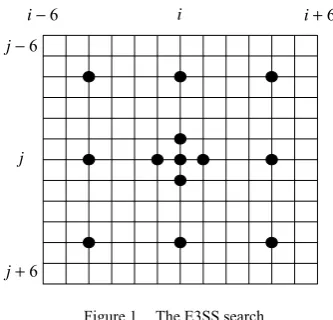
This paper uses a kind of effective three-step search algorithm (effective three step search, E3SS). Figure 1 is the E3SS search templates, Search window size is 5 pixels. That is that the search range is
( 5,
i
±
j
±
5)
.In the real video sequences, the distribution of the motion vectors has the characteristics of migration center. The search algorithm (FS) match results show that the matching point in the center of has the highest probability. The posterior highest probability exits the center around the top, bottom, left and right of the four neighbors[14-16],Therefore in search of the window of a
small we used a small diamond search template to replace the little square search template of the N3SS.
Firstly, searching the 13 detection points on the template. If they are the minimum block distortion (the smallest SAD), the algorithm stops the searching.
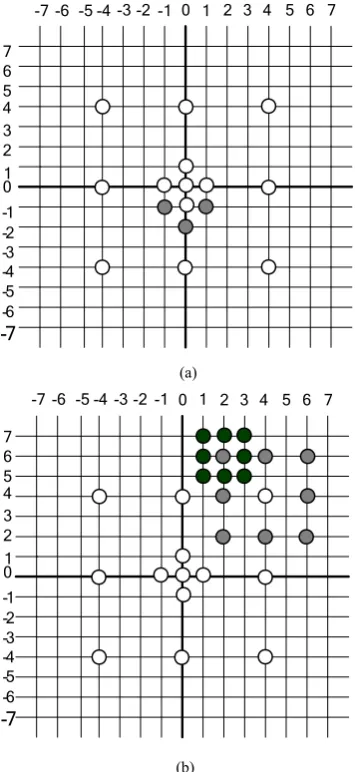
Secondly, if the MBD exists the four neighboring points in the center, Moving the diamond template to the MBD point in the fist step and Continuing to search for the other points in the little diamond template until the MBD is the center of the diamond or the diamond template reaches the edge of search window. Such as showing in the figure 2, the point of (0,-1)is the MBD point in the step 1 and in the Sep 2 and locates at the center of search window. The number of the each point show that the check points in the different search stages.
Figure 1. The E3SS search
Finally, if the MBD point is one of the eight points in the 9×9 template, the searching method uses the 3SS.The 3SS method is as following:
Halving the step length and moving the center point to the above step MBD point, block-matching the eight points at around steps distance until the searching step distance is one step. The position of the last point is the best motion vector. As shown in figure 2, the point of (4,4) is the MBD point in the Step 1, then the step 2 is round the center of (4,4) which the search radius is halved to 2 pixels. Finally, Step 3 is executed based on the current MBD point (2,6) and the best matching point is found.
Grouping
According to block matching algorithm and the matching principle in the section II.B, the grouping is method finding the image blocks satisfying matching criterion from the reference frames and the rest frame in the video sequences V(x,y,t) and stacking these matching blocks into a new group stored into a new 3D matrix GL
(i, j, k). L is the number of group. In a sense, the GL (i, j,
k) is a video sequence and suitable for 3D Surfacelet transform (ST). Figure 3 is the Schematic diagram for block matching in a frame. Block matching grouping between frames are similar and the description method is omitted because of the limited length.
III. SURFACELET
3D-DFB
In 1992, Bamberger and Smith proposed firstly the DFB (Directional Filter Bank). DFB is a non redundant transformations, can achieve the complete reconstruction the signal. In 2002, M.N.Do and M.Vetterli proposed the Contourlet transform to obtain a multi-directional and multiresolution method of sparse image in combination on the basis of the pyramidal decomposition and the DFB. The 2D-DFB frequency decomposition is as following in figure 4 (a). Yue Lu and M.N.Do in 2007 expanded the 2D-DFB to 3D and puts forward a new 3d direction filter 3D-DFB (three Dimension Directional Filter Bank s). The 3D-DFB frequency division is as in Figure 4 (b).
i
j
6 −
i i+6
6 +
j
6 −
Multiscale Decomposition
The multidimensional surface singular of signal can be captured by the 3D-DFB frequency decomposition. Because the 3D-DFB only processes the high frequency part of signal, therefore in the use of 3D-DFB signal, signal must be decomposed by multi-scale. A new Surfacelet transformation is constituted by Combining multi-scale decomposition and the 3D-DFB. In ST transform, multi-scale decomposition adopted a pyramid structure as shown in figure 5 and figure 6.
(a)
(b)
Figure 2. The E3SS search process (The hollow points are searching points in the first step, Gray points are searching points the second
step.The Black points are searching points the third step.)
Figure 3. Gouping only in a frame diagram
(a)
(b)
Figure 4. 2D-DFB and 3D-DFB frequency decomposition ((a) 2D-DFB Frequency decomposition (b) 3D-DFB Frequency decomposition)
Figure 5. The block diagram of the proposed surfacelet transform.(The forward transform 3DFB) .
Figure 6. The block diagram of the proposed inverse surfacelet transform ( its inverse I-3DFB are attached to the highpass) .
ST has the characteristics of directional decomposition, the more efficient tree filter banks, completely reconstruction and low redundancy. It can use different scale and different frequency direction sub-block accurately to capture the surface singularity of a 3D signal. The ST coefficient energy is very concentrated. Detailed description can be seeing in [9] and [11].
IV. ALGORITHM
Algorithm is listed below:
• Using SAD standards, E3SS search algorithm, and block-matching in the frame and in the adjoining frames;
-1 1
-2 -3 -4 -5 -6
-7 0 2 3 4 5 6 7
-1 1
-2 -3 -4 -5 -6
-7
0 2 3 4 5 6 7
-1 1
-2 -3 -4 -5 -6
-7 0 2 3 4 5 6 7
-1 1
-2 -3 -4 -5 -6
-7
• Stacking the macthig blocks into a new group (the sub-video) untill all blocks in the refence frame are matched;
• Executing the ST on the every noisy groups(the sub-video);
• ST coefficient using hard threshold denoising;
• Reconstruction the groups from the denoised ST coefficients;
• According to the steps 1 restoring the every block matched in the every group to its intial position in the video.
V. ANALYSIS OF EXPERIMENTAL RESULTS
Our experiment is based on Matlab 2008a and the 2GB memory, and uses the MAT formats video sequences of the size of 240×320×60 such as the Bus and Flower sequence with large background changes and the Football sequence with acute movement.
Firstly, adding the variance (30 and 50) Gaussian white noise with zero mean to the video sequences. Secondly, denoising the noisy sequences by the method such as the dual-tree complex wavelet transform (DTCWT), the Surfacelet Transform [10] with hard threshold, the 3DCMST proposed in paper [11] and our proposed method based on block-matching grouping denoising with Surfacelet Transform (BMG-3DST).In the experiment, all method is executed by decomposing the video sequence into three levels.
To investigate the effect by the decomposition layers in our algorithm, applying three layers decomposition of ST. corresponding to the number of 3D-DFB direction respectively are 64, 16, 4, shrinkage only used on the two finest levels coefficients.
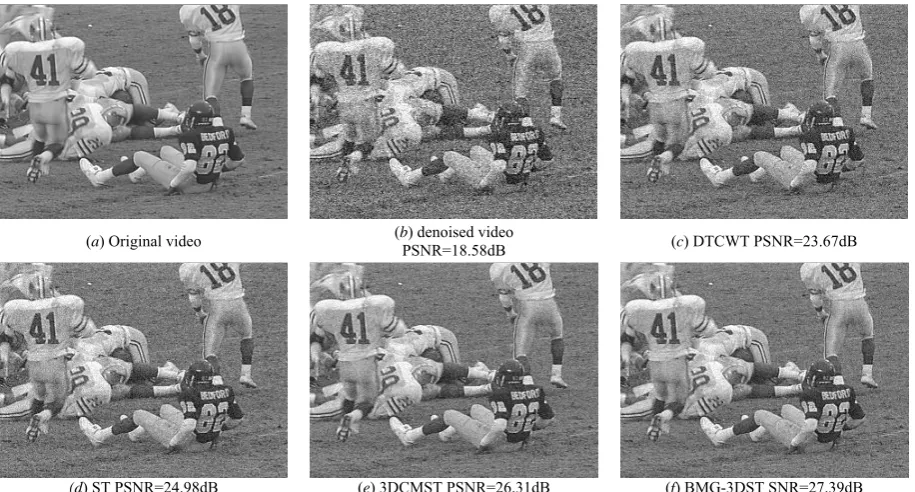
Table 1 gives PSNR after denoising by the four algorithms. Figure 7 are the comparison of the football video denoising result by the four algorithms.
From the experiment results can be obtained in the following conclusions:
• The PSNR of algorithm is obviously superior to the other three algorithms. This algorithm can improve the PSNR than other algorithms about 0.9dB.
• The visual effect of subjective evaluation is better than other algorithms. The denoising effect is apparently better when this algorithm used to deal with video containing acuteness movement.
We innovatively propose the video denoising algorithm based on block matching grouping and Surfacelet transform.
This algorithm can significantly improve the denoising video PSNR.
Not only can keep well the video details, and attain very good effect for movement video especially for the strenuous movement objects and the large area changes in the background. The movement objects are vey fluent and does not exist the phenomenon such as flash and ghosting in the traditional algorithm.
We will focus on the next research work such as researching the more suitable block matching algorithm, adopting the different characteristics of filter for the grouping of block matching using the block-matching ST denoising to the image.
Figure 7. Efeect of the denoised football video
(a) Original video (bPSNR=18.58dB ) denoised video (c) DTCWT PSNR=23.67dB
(d) ST PSNR=24.98dB (e) 3DCMST PSNR=26.31dB (f) BMG-3DST SNR=27.39dB
TABLE I.
THE PSNR(DB) OF DIFFERENT METHOD
Flower Football Bus
Variance 30 50 30 50 30 50 DTCWT 24.60 22.59 23.67 20.90 23.60 21.59
ACKNOWLEDGEMENT
This work was supported in part by National Science Foundation of China under grant 61072148 and Hebei Province University Science Research Project under grant Z2010306.
REFERENCES
[1] E Chang, A Zakhor, Subband video coding based on velocity flters, IEEE International Symposium on Circuits and Systems. San Diego, USA: Academic Press, 1992:2288-2291.
[2] I W Selesnick, K Y Li, Video denoising using 2D and 3D dual tree complex wavelet transforms, Proc.of SPIE conference on Wavelet Applications in Signaland Image Processing X. San Diego, USA: Academic Press, vol. 5207, pp. 607-618,2003.
[3] Yang, Jingyu ,Wang Yao, Xu Wenli, Dai Qionghai, Image and video denoising using adaptive dual-tree discrete wavelet packets, IEEE Transactions on Circuits and Systems for Video Technology, vol. 19, pp. 642-655, May 2009
[4] Alarcon-Aquino, V. Starostenko, O. Ramirez-Cortes, J.M., Detection of microcalcifications in digital mammograms using the dual-tree complex wavelet transform, Engineering Intelligent Systems, vol. 17, pp. 49-63, March 2009
[5] Lexing Ying, Laurent Demanet, Emmanuel Candes, 3D discrete Curvelet transform.Applied and Computational Mathematics, USA:California Institute of Technology, 2005:38.
[6] Minhas, Rashid, Adeel Mohammed, Abdul, Jonathan Wu, Q.M., Shape from focus using fast discrete curvelet transform, Pattern Recognition, vol. 44, pp. 839-853, April 2011
[7] Brannock, Evelyn Weeks, Michael Harrison, Robert, The effect of wavelet families on watermarking, Journal of Computers, vol. 4, pp 554-566, June 2009
[8] Huaqing, Zhou, Shenghui Dai, Wavelet descriptor for closed curves detection in complex background, Journal of Computers, vol. 5, pp. 1723-1730, 2010
[9] Y Lu, M.N Do, Multidimensional Directional FiIter Banks and Surfacelets, IEEE Transactions on Image Processing, vol. 16, pp 919-931, 2007.
[10] Wang Yan, Rosen, David W. Multiscale heterogeneous modeling with surfacelets, Computer-Aided Design and Applications, vol. 7, pp. 759-776, 2010
[11] Xiao hongzhi, Yan jingwen, Qu xiaobo, A novel video denoising method with 3D context model Based on Surfacelet transform, chinese journal of electronics, vol. 36, pp 1460-1464,2008.
[12] Cao Jianian, Tang Chunrui, Liu, Dandan, An image denoising method combining surfacelet transform and multidirectional cycle spinning, Harbin Gongcheng Daxue Xuebao/Journal of Harbin Engineering University, vol.30, pp. 952-956, August 2009
[13] Tang Chunrui, Liu Dandan, Cao Jianian, Denoising method for underwater acoustic transient signals based on surfacelet transform, Dalian Haishi Daxue Xuebao/Journal of Dalian Maritime University, vol. 34, pp 51-54, August 2008
[14] Liu changjin, Guo li. A Super-SAD matching criterion and its fast algorithm.Journal of circuits and systems, vol. 12, pp 137-141, 2007.
[15] Essannouni F, Thami, R. Oulad Haj, Aboutajdine D. , Salam A, Adjustable SAD matching algorithm using frequency domain, Source: Journal of Real-Time Image Processing, vol. 1, pp. 257-265, July 2007
[16] Bruenig, Michael, Niehsen, Wolfgang, Fast full search block matching based on combined SAD and MSE measures, Proceedings of SPIE - The International Society for Optical Engineering, vol. 3653, pp. 439-449, 1999
[17] Xiang Youjun, Leina, YU Weiyu, Xie Sheng, Research of Block Matching Criterion for Motion Estimation, Computer science, vol. 36, pp. 278-280, 2009.
[18] Tao Yang, Liu Zhiming, Peng Yuxing, Ke Shuizhou, A New Matching Criterion and Block Matching Algorithm, Computer engineering & science, vol. 29, pp. 69-72, 2007.
Peng Geng was born in Hebei, China. He received the B.S. degree in education technolgoy from the Hebei nornal University for Nationalities of China, Hebei in 2001, and the M.S. degrees in Computer application technology, Information engineering department, Shijiazhuang Tiedao university for Nationalities of China, Hebei in 2007.
His current research interests include image processing, video processing, pattern classification and machine learning. He is a vice professor of the center of education technology, Shijiazhuang Tiedao University. His papers have been cited by EI and ISTP more than 6 articles and have been published in Journal of Computational Information Systems.
E-mail: [email protected]
He Jiang was born in Inner Mongolia, China. He received the M.S. degree in education technolgoy from the Inner Mongolia normal University .
His current research interests include Teacher education, study science and technology. He is an associate professor of Zhangjiakou Educational College. He is a expert of Hebei Educational Technology Society, the Chinese teacher training network, the National Science and Technology College Alliance Learning.
E-mail:[email protected]
Zhigang Zhang was born in Hebei , China. He received B.S.E. degree in education technolgoy from Hebei Normal University, Hebei in 2002, and is now studying for M.S degree in Computer technology, Hebei University of Technology,will graduate in 2012.