ISSN (e): 2250-3021, ISSN (p): 2278-8719
Vol. 09, Issue 5 (May. 2019), ||S (III) || PP 52-58
Survey on channel estimation techniques for mm wave massive
MIMO with hybrid precoding
Kalyani .J , Luxy Mathews
(Department of Electronics and Communication Engineering, Mar Baselios College of Engineering and Technology, Trivandrum, India)
Abstract:
Estimating a channel has become a difficulty for a mm wave system massive MIMO system with hybrid as the number of Radio Frequency (RF) chains are less than the number of antennas. For having a super resolution for the channel estimation the true parameters have been resolved with good precision. Some of the methods used for estimating channels are Auxiliary Beam pair(ABP), Adaptive algorithm based Code book design,2 D Unitary ESPRIT and Iterative Reweight (IR). In ABP amplitude comparison is done against each auxiliary beam pair thus by obtaining the best ratio which gives way to the estimation of angles. Code book design is done by rotating and scaling a code book.2 D Unitary ESPRIT method is the 2D version of the 1 D Estimation of Signal Parameters by Rotational InvarianceTechnique (ESPRIT) is used in a Mm wave Massive MIMO channel. The precoding technique used is hybrid precoding. Hybrid precoding is used in order to reduce power consumption and the power loss. A 2D ESPRIT method is used to estimate the direction or angles of the signals. An iterative reweight (IR) based super resolution channel estimation is used to improve channel estimation accuracy. In this method a gradient descent method is used to find an objective function which can iteratively change direction of the estimated angles of arrivals and departures in order to have a super resolution channel estimation. While optimizing, weighing parameter is used to control balance between sparsity and data fitting error. A singular value decomposition(SVD) is used in order to reduce the computational complexity.Keywords:Hybrid precoding, Millimetre- wave (mm Wave), Channel estimation, Angle of departure(AoDs),
Angle of Arrivals (AoAs), beam forming, codebook design, hybrid precoding, Auxiliary Beam Pair (ABP) --- --- Date of Submission: 21-05-2019 Date of acceptance: 07-06-2019 --- ---I.
INTRODUCTION
A Milli–meter(mm) wave massive MIMO is a new research field. As the mm wave is having a disadvantage of path loss. In order to overcome that number of antennas placed at both the Base Stations(BS) and Mobile Stations(MS) are increased but the number of Radio Frequency (RF)chains are less compared to that of the number of antennas [1]. A mm wave is used because it is having large number of underutilized bandwidth. Precoding is the technique of using a group of antennas which are placed in an array which are used for transmitting one or more spatially directive signals. Precoding is related to beam forming in which the same spatially directive signals are fed to each antenna and then analog phase shifters are used to control the signals which are emitted by the array of antennas. The advantage of using precoding is that it increases the spectral efficiency. Spectral efficiency or bandwidth efficiency is the rate of information that can be transmitted over a particular band width in a given communication system. Hybrid precoding is used because it reduces cost and power consumption. It is having both the analog and digital section. Both of the section requires Channel State Information (CSI). The number of RF chains are less it becomes difficult for the antennas to access. Therefore, a multiple input multiple output high dimensional channel is difficult to accurate. The massive MIMO is having more advantages than point to point MIMO. As it is using mm wave the data rate is expected to be greater than today‟s LAN technologies. Mm waves are having large bandwidth.
About the 2D ESPRIT method. First of all, the training signals are designed at both the MS and BS for uplink transmission then a low dimensional channel is obtained with less pilot overhead [3]. The AoAs and AoDs are found out with help of algorithm. The path gains are obtained using Least Square (LS) estimator. At last, a high dimensional channel is reconstructed with angles and path gain. Least square estimator does not require correlation function or matrix inversion. So it is termed as a simple estimation technique. By using the Least square estimator, the channel can be estimated according to the pilot subcarriers.
An Iterative Reweight (IR) method is used to improve the efficiency of channel estimation [4]. In IR method the estimates of the angles, angles of arrivals (AoAs) /departures(AoDs) are iteratively optimized in order to cause a decrease in the weighted summation of sparsity and data fitting error. This is done by optimizing an objective function by using a gradient descent method. In order to avoid the over or the under fitting a weight controlling parameter which is the balance between sparsity and data fitting error can be valued. As the estimated angles are moved from initial angle domain grids to the off grids which are continuously distributed grids then the super resolution channel is estimated. A Singular value decomposition is also done to reduce the complexity. It is done by decreasing number of first receiving values of the angles.
II.
SYSTEM MODEL
Amm wave massive MIMO with uplink transmission using hybrid precoding is considered,
Figure1: Transceiver for the system.
Figure 1 illustrates a transmitter receiver whereNBS andNMS represents number of antennas at the base stations
and mobile stations .𝑁𝑅𝐹 𝐵𝑆, 𝑁𝑅𝐹 𝑀𝑆 represents the number of radio frequency chains at base stations and mobile
stations.𝑁𝑆is the independent data stream at base stations and the mobile stations.
2.1Adaptive algorithm based codebook design
The conditions for the selection of independent stream are NS ≤ NRF MS ≤ NMS and NS ≤ NRF BS ≤
NBS. Considering the downlink transmission. Let transmitted signal be x= FTs where FT is base station
precoding matrix and s is transmitted signal vector. A channel which is a block fading is considered. At the mobile station received signal is observed as :
r= HFTs + n…(1)
„H‟ is channel matrix ,‟n‟ is the Gaussian noise. When baseband and radio frequency combiners are used in r then it becomes:
y= 𝑊𝑇𝐻H𝐹𝑇s+𝑊𝑇𝐻n…(2)
Channel matrix „H‟is expressed as :
H= 𝑁𝐵𝑆 𝑁𝑀𝑆
𝜌 𝛼𝑙
𝐿
𝑙=1 𝑎𝑀𝑆(θ𝑙) 𝑎𝐵𝑆𝐻(Φ𝑙)…(3)
where ∝𝑙 is the complex gain of the 𝑙𝑡ℎ path ,θ𝑙 and Φ𝑙are azimuthal angles of AoA and AoD of the 𝑙𝑡ℎpath.
2.2Auxiliary Beam Pair Enabled estimation
A narrow band MIMO system is taken into account. The architecture used at transmitter and receiver is a shared one. After baseband and analog combining received signal is :
𝑊𝐵𝐵∗𝑊𝑅𝐹∗ and 𝐹𝑅𝐹𝐹𝐵𝐵 are hybrid combiners and precoders.Uniform Parallel Array and Uniform Linear Array
are the stations. ULA share same propagation path so that MIMO channel become co -related at both the ends.Then:
H= 𝑁𝑅𝑁𝑇 𝑁𝑟=1𝑅 𝑔𝑟𝑎𝑟(𝜓𝑟) 𝑎𝑡∗(𝜃𝑟, 𝛷𝑟)…(5)
where 𝑔𝑟, 𝜃𝑟and 𝛷𝑟 are the complex path gain and azimuthal angles.𝑎𝑟 and 𝑎𝑡are the array response array.
2.3 2D Unitary ESPRIT method
The conditions for the selection of independent stream are 𝑁𝑆 ≤ 𝑁𝑅𝐹 𝑀𝑆 ≤ 𝑁𝑀𝑆 and 𝑁𝑆 ≤ 𝑁𝑅𝐹 𝐵𝑆 ≤
𝑁𝐵𝑆. Considering the uplink transmission. Let „y‟ be the received signal then:
y =𝑊𝐻HFs + 𝑊𝐻n…(6)
where W = 𝑊𝑅𝐹𝑊𝐵𝐵 ,W is the hybrid combiner .𝑊𝑅𝐹 and 𝑊𝐵𝐵denotes the analog and digital combiners‟ =
𝐹𝑅𝐹𝐹𝐵𝐵F is hybrid precoder. 𝐹𝑅𝐹 and 𝐹𝐵𝐵are the analog and digital precoders. Here Time Division
Multiplexing (TDM) is used. In TDM independent signals are transmitted or received over a common path by means of switches which are synchronized at each end of the line. Each signal passes through the path in fraction of seconds in different patterns. A TDM is used when the bitrate exceeds to that of the transmitted signal. Both the 𝐹𝑅𝐹 and 𝑊𝑅𝐹 are realized using analog RF phase shifters. Consider a severe path loss for Non –
Line –Of –Sight (NLOS) path.It is having controlled scattering dueto L dominated paths having L scatterer‟s which are different in nature. Then channel matrix is:
H= 𝑁𝐵𝑆𝑁𝑀𝑆
𝐿 ∝𝑙 𝑎𝐵𝑆 (𝜃𝑙) 𝑎𝑀𝑆 𝐻
(ψ𝑙)
𝐿
𝑙=1 (7)
When a Uniform Linear Array (ULA) is considered at both the BS and MS. Then 𝑎𝐵𝑆 (𝜃𝑙) ,𝑎𝑀𝑆(ψ𝑙) be steering
vectors at 𝑙𝑡ℎ path.
2.4Iterative Reweight (IR) method
A mm wave massive MIMO system is being considered. (typical)having uniform linear array (ULA). ULA share same propagation path so that MIMO channel become co -related at both the ends. Let N𝑇 and NR be
number of antennas at the transmitters and receivers . 𝑁𝑅𝐹 𝑇 represents the number of radio frequency chains at
transmitter and 𝑁𝑅𝐹 𝑅represents the number of RF chains at the receiver. For practical cases the number of RF chains are less than the number of antennas for a MIMO channel. Therefore, the model of system can be designed as:
r = 𝑄𝐻HPs + n… (8)
where „r‟ is the received signal, ‟Q‟ is the hybrid combining matrix, „s‟ is the transmitted signal, „H‟ is the channel matrix,‟ P‟ is the hybrid precoding matrix & „n‟ is the received noise. Then model for channel is:
H= 𝑧𝑙𝑎𝑅 (d sinͅ𝛷𝑅,𝑙/𝜆) 𝑎𝑇 𝐻
(d sinͅ𝛷𝑇,𝑙/𝜆) 𝐿
𝑙=1 (9 )
where „L „is the number of propagation path, ′𝑧𝑙′ is the complex path gain ,′𝛷𝑅,𝑙 „&ͅ'𝛷𝑇,𝑙′ are the physical angles
of 𝑙𝑡ℎpath , „d‟ is antenna spacing.′𝜆′ is wavelength and‟ 𝑎
𝑅 (d sinͅ𝛷𝑅,𝑙/𝜆) ,𝑎𝑇 (d sinͅ𝛷𝑇,𝑙/𝜆) „are the steering
vectors at transmitter. As number of radio frequency chains are less than the required dimension of received pilot sequence 𝑥𝑝 ( 1≤ p ≤ 𝑁𝑥) .Consider „M‟ time slots in order to get𝑁𝑌 dimensional received pilot sequence𝑦𝑝
.The channel matrix „H‟ can be estimated as the angles and the path gain of the signal. Then the sparsity channel estimation problem is:
min ҄𝑧 𝑜 , ≤ ƹ … (10)
where, ҄𝑧 𝑜 „is the number of non -zero elements of ҄ z , ƹ is error tolerance parameter and the estimated
channel matrix.
III.
ADAPTIVE ESTIMATION ALGORITHM
First of all, it is formulated for a single path channel model that is a channel with rank one. This channel is having a single non –zero element. A single channel path is said to be estimated by finding the location of this non –zero element which also helps in determining the angles of arrivals / departures and also the path gain. It is done by multi –resolution beam forming vectors. Initially the base station uses „K ‟precoding vectors which will be the training vectors. This will be from the first stages of the codebook. Then the power of the values will be compared at the mobile station. This process is repeated till 𝑙𝑜𝑔𝐾N in order to achieve
maximum resolution ie 2𝜋
𝑁 for the estimated angles .Each beam forming vectors should have ‟K‟ vectors for
measurement and beam forming. So the required number of steps can be decreased to K[ 𝐾
compressed sensing is used. Here the path gain is estimated for 𝐿𝑑 paths. Therefore there will be 𝐿𝑑 number of
non –zero elements which is having maximum power .A modified code book design is used here. Now number of measurement and beam forming vectors will be K𝐿𝑑.First level of iteration will be s and the next level will
be s+1.It is done up to maximum resolution 2𝜋
𝑁.The required number of steps can be decreased up to K𝐿𝑑 2[𝐿𝐿𝑑
𝑁𝑅𝐹]
𝑙𝑜𝑔𝐾( 𝑁 𝐿𝑑).
IV.
AUXILIARY BEAM PAIR ENABLED METHOD
Single path channel is assumed. The minimum value of path index is taken into account. A single RF chain having analog beam forming and combining is used. To cover up angular ranges a pair of beams are used. For this a Time Division Multiplexing(TDM) is used. Each analog transmit beams are examined by transmitter at every instance. It will continue till beams are probed. Each pair contains two probed analog beams which are probed. In order to estimate the angles auxiliary beam pair having the highest signal to noise ratio is selected. If a multipath channel is selected then dominant path can be identified by power comparison. In order to estimate multi paths many number of RF chains are used.
V.
2D UNITARY ESPRIT BASED SUPER-RESOLUTION CHANNEL ESTIMATION
SCHEME
A 2 Dimensional unitary Estimation of Signal Parameters by Rotational Invariance Technique algorithm is a high resolution algorithm which automatically pairs source azimuthal angle and elevation angle in an efficient way to reconstruct the signal which is affected. They are having many advantages. Some of them are, Except for the final Eigen Value Decomposition (EVD) it is formulated in terms of real valued decomposition, it can be said as an efficient Discrete Fourier Transform (DFT) beam space implementation. It is applicable to array configuration with three identical subarrays which are of centro –symmetric in nature and possess invariance in two distinct directions. It takes sources with only one member of the spatial frequency co – ordinate pair. The scheme is such that a training signal for the uplink transmission is designed to estimate a low dimensional effective channel having same shift –invariance array as the high dimensional with low pilot overhead. The angles of arrival and departures are estimated by means of the 2D ESPRIT algorithm which is based on the channel estimation algorithm and path gains are estimated by means of Least Square (LS) estimation. A high dimensional channel can be reconstructed from the estimated angles and path gain. Signals should be designed for uplink transmission. In order to find out a high dimensional mm wave MIMO channel angles have to be estimated with high accuracy. The uplink transmission consists of analog and digital RF base band part at both the stations. For reconstructing the high dimensional channel, a low dimensional channel having shift invariance of array response same in values are required. Consider an uplink channel i.e, the transmission from mobile station to base station in multiple time slots. In order to improve channel estimation performance two time blocks are considered at the transmitter and receiver jointly as 𝑁𝑏𝑇&𝑁𝑏𝑅.As the time
blocks are taken jointly then the received signal „Y‟can be taken as the aggregate. From the aggregated values of the hybrid combiner and precoder total number of pilot overheads required for the channel estimation can be calculated as:
T = 𝑇𝑀𝑆𝑁𝑏𝑇𝑁𝑏𝑅 … (11)
Due to RF phase shift network each observation has different signals as it contains more than one antennas. Conventional ESPRIT algorithm cannot be used because shift -invariance of array response may get destroyed in those valuations. In order to solve this problem aggregated precoder and combiners can be preserved. After forming the matrix, the angles can be estimated for a low dimension channel by means of the ESPRIT algorithm instead of the high dimensional channel. In order to obtain AoAs and AoDs at the receiver a 2D ESPRIT algorithm is used. For the algorithm first of all a Hankel matrix should be constructed after that a process called real processing is done Then a rank reduction process is done to it. At last joint diagonalization and spatial smoothening pre - processing of the matrix are done.
VI.
ITERATIVE REWEIGHT (IR) BASED METHOD
channel estimation problem a majorization –minimization process is needed .It is because finding the optimal solution by using 𝑙0norm is not computationally efficient. Therefore the 𝑙0 should be replaced with log sum
function. The log -sum function can be written as:
(12)
where δ > 0 is the log sum function which is defined. A regularization parameter λ is being added to in order to make it an unconstrained optimization problem which can be represented as :
(13)
A function which is an iterative surrogate function can be used other than log sum function as :
(14) where 𝑆 𝑖 (𝑧,⊖
𝑅,⊖𝑇) is the surrogate function. The objective function 𝑆 𝑖 (𝑧,⊖𝑅,⊖𝑇) is the weighted sum
of 𝑧𝐻Dz is the part which is used to control the sparsity of the estimation and which denotes the
residue. The regularization parameter λ which controls balance between sparsity and data fitting error. Choice of λ is important for the channel estimation and speed of the channel. Larger λ implies well-fitting solution whereas smaller λ implies worse fitting solution. In this method the value of the regularization parameter λ is updated as:
λ=min (d/ 𝑟𝑖,𝜆
𝑚𝑎𝑥) (15)
where d is the constant scaling factor ,the reason how 𝜆𝑚𝑎𝑥 is selected depends upon whether the
problem is well-conditioned and𝑟𝑖is the square of the residue from the last step. Singular Value Decomposition
is used to reduce computational complexity of the method used. By using the IR method angle domain grids which are nearer to the real angles can be found out.
VII.
SIMULATION RESULTS
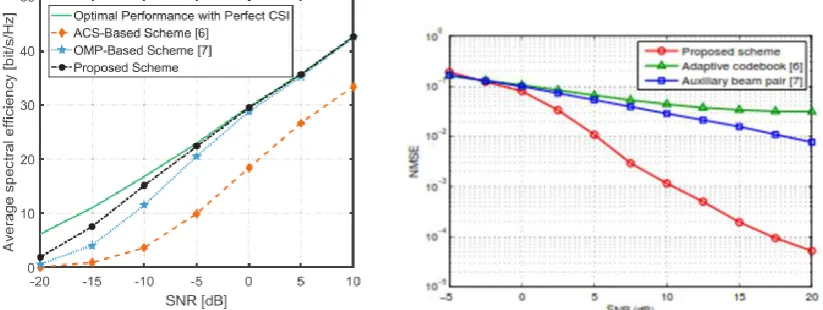
Simulation results helps to find out performance of methods used. The values for NBS= NMS = 64 𝑁𝑅𝐹 𝐵𝑆 =
𝑁𝑅𝐹 𝑀𝑆= 4 , 𝑁𝑆= 3.
Figure1Spectral efficiency versus SNRFigure 2NMSE versus SNR of different schemes
Figure 3Average spectral efficiencyFigure 4NMSE versus SNR
Figure 5ASE against SNR
VIII.
CONCLUSION
International organization of Scientific Research
58 | Page
reconstructed.A SVD based preconditioning is used to reduce the computational complexity. By using this method, the surrogate function is iteratively decreased by majorizing an objective function. This overcomes mismatch of grid problems and achieves a super resolution accuracy. It is also used to estimate the off-grid angles with affordable complexity. It shows that the IR based super resolution channel estimation estimates the angles more accurately with high channel accuracy.REFERENCES
[1]. R. W. Heath, Jr., N. González-Prelcic, S. Rangan, W. Roh, and A M. Sayeed, ``An overview of signal processing techniques for millimetre wave MIMO systems,'' IEEE J. Sel. Topics Signal Process., vol. 10, no. 3, pp. 436_453, Apr. 2016S.
[2]. H. Miao, M. Juntti, and K. Yu, ``2-D unitary ESPRIT based joint AOA and AOD estimation for MIMO system,'' in Proc. IEEE 17th Int. Symp. PIMRC, Sep. 2006
[3]. AnwenLio, Zhen Gao,”2D Unitary ESPRIT Based Super-Resolution Channel Estimation for Millimeter-Wave Massive MIMO With Hybrid Precoding”IEEE November 2017
[4]. Chen Hu, Linglong Dai, Zhen Gao, and Jun Fang,”Super resolution channel estimation for mm wave massive MIMO with hybrid precoding”IEEE Vehicular communication January 2018
[5]. H. Ghauch, T. Kim, M. Bengtsson, and M. Skoglund, “Subspace estimation and decomposition for large millimeter-wave MIMO systems,”IEEE J. Sel. Top. Signal Process., vol. 10, no. 3, pp. 528-542, Apr. 2016.
[6]. Lee, G. T. Gil, and Y. H. Lee, “Channel estimation via orthogonal matching pursuit for hybrid MIMO systems in millimeter wave communications,”IEEE Trans. Commun., vol. 64, no. 6, pp. 2370-2386, Jun. 2016..
[7]. A. Alkhateeb, O. E. Ayach, G. Leus, and R. W. Heath, “Channel estimation and hybrid precoding for millimeter wave cellular systems,”IEEE J. Sel. Topics Signal Process., vol. 8, no. 5, pp. 831-846, Oct. 2014.
[8]. D. Zhu, J. Choi, and R. W. Heath, “Auxiliary beam pair enabled AoD and AoA estimation in mm Wave FD-MIMO systems,” Submitted to IEEE Trans. Wireless Commun., , Oct. 2016.