Back Propagation Algorithm for Computerized Pape
Evaluation using Neural Network
Lakshya Aggarwal1, Biswa Mohan Sahoo2
Amity School of Engineering and Technology, Amity University, Uttar Pradesh Greater Noida, India
ABSTRACT
This research is focused on introducing a hypothetical approach to the field of computerized paper evaluation. This would help in developing a better and efficient way of developing an automatic evaluation of examinations. The usage of the traditional evaluation system makes use of pen and paper based technique. This way of evaluation is not as efficient as there are a number of factors that might affect the unbiased evaluation of the examination by the examiner. Hence using an automatic emotion less machine would help in building an evaluation system that is free of any biasness and is much quicker in response. Hence the focus is the present a better approach to the evaluation of the exams using the machine learning techniques with the help of neural networks and back propagation algorithms.
Keywords: Back Propagation Algorithm, Neural Network, Image Processing, Machine Learning.
I.
INTRODUCTION
Machine learning is a technique of introducing artificial intelligence to the system where the system starts to learn as it works and hence becomes more efficient over the time[1]. This technique helps with forming a system that is adaptable to any changes that it might face while working.
Neural network is a form of machine learning that is inspired by the human brain neuron system [2]. In the neural network we build various neurons that contain the logics and information that is needed by the system. They need to be trained in the starting and then they learn as they work. Neurons are connected to each other as they are working and hence pass the information from one neuron to the other [3].
Back propagation algorithm is focused on increasing the efficiency of the neurons[4] in this paper. Back proliferation neural systems utilize a standout amongst the most famous neural system learning
calculations, the Back spread (BP) calculation. It has been utilized effectively for wide assortment of utilizations, for example, discourse or voice acknowledgment, picture design acknowledgment, restorative finding, and programmed controls [6]. A standout amongst the most striking early applications was NET TALK by T. J. Sejnowski and C. R. Rosenberg in 1986. The NET TALK could take in the standards of phonetics, at that point the framework delivered a sound by perusing from the succession of given letters, with a conduct of a kid figuring out how to peruse out loud [7].
II.
LITERATURE REVIEW
There are various forms of machine learning techniques that can be applied to this research using neural networks defines that entering the logic for the evaluation of a particular question [8]. Back propagation would help the system to contact and refer to the answers of the same questions by other students so that we get an efficient evaluation system [9].
2.1. Neural Network
An Artificial Neural Network (ANN) is Associate in data science worldview which is electrifies through the sensory system, for example, the cerebrum and the technique information. The way to this example is that the novel structure of the learning procedure framework. It's made out of an outsized assortment of to a great degree interconnected process parts (neurons) operating along to unravel specific issues.
The fake neural framework contains 3 gatherings/layers wherein an info layer is connected to a shrouded layer which is then associated with a yield layer. The activity of the data units addresses the unrefined data that is supported into the framework. The activity of each covered unit is picked by the activities of the data units and moreover the weights on the relationship between the data and besides the hid units. The lead of the yield units depends upon the development of the disguised units and moreover the weights between the concealed and yield units[11].
Neural networks square measure usually organized in layers. Layers square measure created of variety of interconnected 'nodes' that contain Associate in nursing 'activation function'. In procedure networks, the activation perform of a node defines the output of that node given Associate in Nursing input or set of inputs. Artificial Neurons square measure the essential unit of Artificial Neural Network that simulates the four basic perform of biological nerve
cell. Its function formed as a model of natural nerve cell. The subsequent figure shows the essential artificial nerve cell[12].
2.2. Back Propagation Algorithm
Back propagation, short for "backward propagation of errors," is a algorithm for directed learning of manufactured neural systems utilizing slope plunge. Given a manufactured neural system and a blunder work, the technique ascertains the slope of the mistake work concerning the neural system's weights. It is a speculation of the delta govern for recognitions to multilayer nourish forward neural systems [13].
The "backwards" portion of the name originates from the way that computation of the slope continues in reverse through the system, with the angle of the last layer of weights being figured first and the inclination of the principal layer of weights being ascertained last. Halfway calculations of the slope from one layer are reused in the calculation of the angle for the past layer. This regressive stream of the mistake data takes into account effective calculation of the inclination at each layer versus the gullible approach of computing the angle of each layer independently [14].
Back propagation's prevalence has encountered a current resurgence given the across the board appropriation of profound neural systems for picture acknowledgment and discourse acknowledgment. It is viewed as an effective calculation, and present day executions exploit specific GPUs to additionally enhance execution [15].
III.
METHODOLOGY
3.2 Back Propagation: The use of the back propagation for this system would be to track the answers given by the other students for the same answer and hence omit any errors that can be incurred by the system while the evaluation process. This will help in learning of the neurons for any further answers to be evaluated for the same question using the back learning technique.
Proposed System: The proposed system is dependent on the processing and training of the exam sheet of an individual so in order to achieve the evaluation of the answer scripts following steps are performed.
Image Processing: The initial step in the working of the system would be scanning of the examination sheet and then processing it into a grayscale image. The usage of this would be to have a digital copy of the sheet for evaluation by the neurons. Conversion to grayscale would eliminate any possibility of the errors due to usage of different colored inks in the paper by the student as the colors would only be changed to greyscale.
Figure 1. Proposed System
Training:
The training of the neurons would include teaching the neurons various handwriting styles of the students so that when detecting the image of the paper there is no errors due to the same. Next would be the input of a logic of the answer. This means that the system would read and analyse the answer of the student and
then check the logic with the already input logic of the answer.
The back propagation would be applied to form a databases to save the similar logics and handwritings that are incurred by the system in the previous papers so that it is able to build and learn easily.
Detection:
The paper when scanned by the system, would be evaluated after checking the logic of the answer. And then mark the student accordingly. The back propagation would be referred to if the system finds that the answer logic from the paper is not similar to the logic of the database, then the logic saved from the previous answers would be hence referred to find any similar logics.
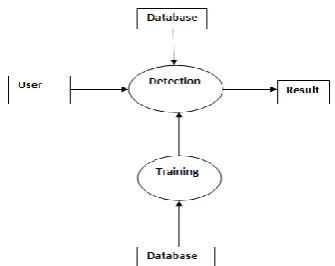
Figure 2 represents the whole working of the proposed system where the user inputs the exam answer sheet. The result is later stored in the system database.
Figure 2. Data flow Diagram of Proposed System
IV.
RESULT
student has to get particular marks in a particular question.
If there are Q1, Q2 … Qn number of questions in the set, S be the number of students and s1, s2, s3 …. sn be the score of the student in all the subjects. Each student has to score above average score of all the questions in the set. Passing criteria should be:
Average = (s1, s2, s3 …. sn)/Qn
For example, Student S1 with ID 890723 has to score above or equal to the average score of all the questions in the set to meet the passing criteria.
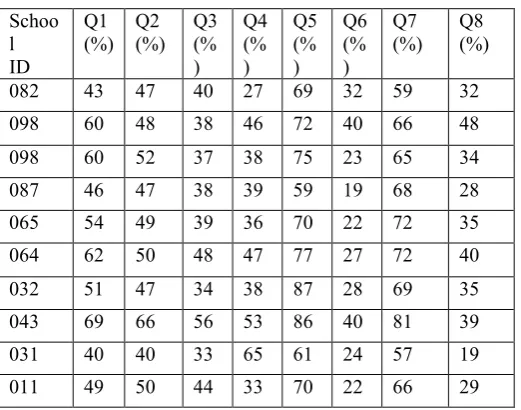
Average = (43+47+40+27+69+32+59+32)/8 = 43 (approx)
Similarly the evaluation of other students of different schools can be done easily and efficiently and the progress of the student can be recorded and stored in the system. Thus the above proposed system can be used for result evaluation and is better than the traditional evaluation system as there are minimum chances of faults.
Table 1. Data Set of Students of Different Schools Schoo
l ID
Q1
(%) Q2 (%) Q3 (% )
Q4 (% )
Q5 (% )
Q6 (% )
Q7 (%) Q8 (%)
082 43 47 40 27 69 32 59 32
098 60 48 38 46 72 40 66 48
098 60 52 37 38 75 23 65 34
087 46 47 38 39 59 19 68 28
065 54 49 39 36 70 22 72 35
064 62 50 48 47 77 27 72 40
032 51 47 34 38 87 28 69 35
043 69 66 56 53 86 40 81 39
031 40 40 33 65 61 24 57 19
011 49 50 44 33 70 22 66 29
Through this result we can evaluate the score of individuals in any organization and the data is stored in the computer and there will be minimum chances of error as it is evaluated by the system and there
would be complete transparency of the result to the students.
V.
CONCLUSION AND FUTURE SCOPE
Counterfeit neural system is one of the developing fields that contains for the future figuring. This paper proposes an arrangement of mechanized paper assessment that would be exceptionally valuable for the assessment of the aftereffects of the understudies. They work more also to human mind than regular PC rationale. A framework is proposed in this paper which can be executed to assess the examination aftereffect of the understudies. This framework is a reasonable method for assessment as it one-sided to the understudies. Programmed assessment of single sentence distinct answer would be valuable for the colleges, schools and universities for scholarly reason by giving simplicity to resources and the examination assessment cell. Expectations this paper draws out the essential comprehension of ANN and rouses the exploration assemble taking a shot at Computerized Paper Evaluation. The fate of this innovation is extremely encouraging and the entire key lies in equipment improvement as ANN require speedier equipment
VI.
REFERENCES
[1]. Hermawan, Arief. "The Dimensional Reduction to Improve the Speed and Accuracy of Neural Network in Identyfying the Senior High Scool Students' Major." International Journal of Applied Engineering Research 11.7 (2016): 4758-4762.
[2]. Oladokun, V. O., A. T. Adebanjo, and O. E. Charles-Owaba. "Predicting students' academic performance using artificial neural network: A case study of an engineering course." The Pacific Journal of Science and Technology 9.1 (2008): 72-79.
quality in technical education: an empirical study." International Journal of Productivity and Quality Management 2.3 (2007): 287-306. [4]. Budhi, Gregorius Satia, Liliana Liliana, and
Steven Harryanto. "Cluster Analysis untuk Memprediksi Talenta Pemain Basket Menggunakan Jaringan Saraf Tiruan Self Organizing Maps (SOM)." Jurnal Informatika 9.1 (2009): 23-32.
[5]. S. Muknahallipatna, and B. Chowdhury, "Input Dimension Reduction in Neural Network Training – case Study in Transient Stability Assessment of Large System", Proceedings ISAP, pp 50-54, 1996.
[6]. Blum, Michael GB, et al. "A comparative review of dimension reduction methods in approximate Bayesian computation." Statistical Science 28.2 (2013): 189-208.
[7]. Hinton, Geoffrey E., and Ruslan R. Salakhutdinov. "Reducing the dimensionality of data with neural networks." science 313.5786 (2006): 504-507.
[8]. Perantonis, S. J., and V. Virvilis. "Dimensionality reduction using a novel neural network based feature extraction method." Neural Networks, 1999. IJCNN'99. International Joint Conference on. Vol. 2. IEEE, 1999.
[9]. Hermawan, Arief. "The Dimensional Reduction to Improve the Speed and Accuracy of Neural Network in Identyfying the Senior High Scool Students' Major." International Journal of Applied Engineering Research 11.7 (2016): 4758-4762.
[10]. Yuyun and Munawir,, "Neural Network