http://www.ijcmph.com pISSN 2394-6032 | eISSN 2394-6040
Original Research Article
Trends and factors determining the place of delivery in
a rural setting of Maharashtra
Arvind Singh Kushwaha
1*, Anshika Singh Kushwaha
2INTRODUCTION
“No country sends its soldiers to war, without seeing to it that they will return safely, and yet mankind for centuries has been sending women to battle to renew the human resource without protecting them.” Fred Sai, former president of the International Planned Parenthood Federation.1
Every year, more than 500,000 maternal deaths occur worldwide, 4 million newborns die and another 3 million babies are stillborn.2-4 Nearly all these deaths take place
in low and middle income countries and most could be prevented with current medical care.2-5 India alone accounts for nearly 20% of the global burden of both maternal and child deaths.6 The MMR in India was estimated to be around 212 maternal deaths per one lakh live births which translate to about 55,000 women dying annually due to pregnancy.7 The figures are though contrasting for the various states and even within the states.
Most obstetric complications occur around the time of delivery and cannot be predicted. Therefore it is important that all pregnant women have access to a
ABSTRACT
Background: The MMR in India was 212 according to SRS 2009, which translates to about 55,000 women dying annually due to pregnancy and related causes. Very few studies have been done to understand thebirthing practices in the rural setup. This study was conducted to estimate the trends of delivery and elucidate the various socio-cultural factors determining the birthing practices in rural India.
Methods: A cross sectional study was conducted among married women, aged 18 to 49 years residing in a Gram Panchayat Kasurdi of Daund Taluka in Pune district from March to October 2016. A structured, interview based, pre-tested questionnaire was used for collection of the data.
Results: Most of the study subjects were literate (69.5%), housewife (46.2%) and residing in joint family (39.7%). Four fifth (83%) of the women had at least two children. Despite this, it was both the partners (47.8%) who were the most common decision maker for the place of delivery. Though most (81.6%) of women wanted to deliver in an institution but home delivery was found in one fourth cases (26.5%). The most common reason for home delivery was ease, comfort and privacy while the most common reason for institutional delivery was that it was safe.
Conclusions: There is a wide gap between where the rural women want to deliver and where they actually do.As the parity rises complacency is seen in utilization of the ANC services and institutional delivery.
Keywords: Birthing practices, Rural, India
1Department ofCommunity Medicine, Armed Forces Medical College, Pune, Maharashtra, India 2
Manipal College of Medical Sciences, Pokhara, Nepal
Received: 11 April 2018
Revised: 25 May 2018
Accepted: 26 May 2018
*Correspondence:
Dr. Arvind Singh Kushwaha, E-mail: [email protected]
Copyright: © the author(s), publisher and licensee Medip Academy. This is an open-access article distributed under the terms of the Creative Commons Attribution Non-Commercial License, which permits unrestricted non-commercial use, distribution, and reproduction in any medium, provided the original work is properly cited.
skilled birth attendant. It has been advocated as the single most important factor in preventing both maternal and neonatal deaths, and therefore one of the indicators for Millennium Development Goals.8
Despite the uniformity in program design throughout the country, there is considerable regional variation in the proportion of institutional deliveries ranging from 30.4% to 99.9% in different states.9 Explanations and answers to these variations are complex. Studies have identified various factors associated with the institutional delivery i.e. availability, distance, cost and quality of services in addition to personal health beliefs and other socio-cultural and economic factors.10,11 But there have been very few studies done to understand thebirthing practices in the rural setup in a comprehensive pattern taking in account the various medico-socio-economic factors.
This study was conducted to estimate the trends of delivery and elucidate various socio-cultural factors determining the birthing practices in rural India.
METHODS
A cross sectional study was conducted from March to October 2016 among married women in the reproductive age group, residing in Kasurdi village Panchayat of Taluka Daund in Pune district. The sample size was calculated based on the national average of home deliveries (27.1%) by proportion method. The sample size was taken as 305 assuming a non response rate of 10% and non eligible as 10%. Simple random sampling without replacement was done after obtaining the details of all women aged 18 to 49 years from the office of Gram Panchayat.
All married women between the age of 18 to 49 years, who had been pregnant at least once and residing in Gram Panchayat were included. If any household had more than one eligible woman, then only the woman with the latest delivery was considered. A structured, interview based, close ended and pre-tested questionnaire was used for collection of the data. Five Interviewers were centrally trained for data collection and feedback from each interviewer was discussed after each session. In addition, random checking of interview sessions was also done. Data was thereafter entered, randomly cross checked by another person and then analyzed using SPSS ver 17.0.
RESULTS
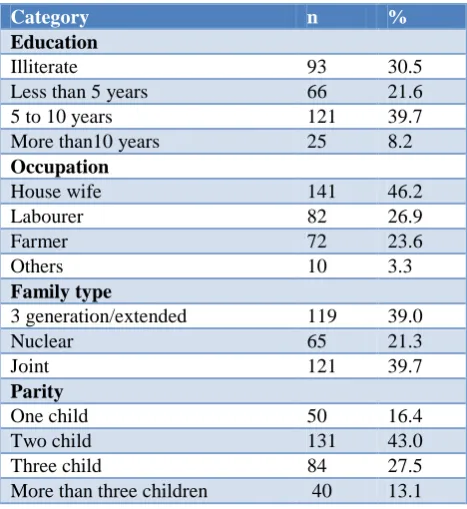
The socio demographic profile of the study population showed that more than one third of them were educated till middle (standard 8) school (39.6%), while a significant portion (30.5%) was illiterate. Nearly half of the women were working (53.8%), mostly related to agriculture. Most of the women were residing in either joint families or extended families (78.7%). More than one third women (40.6%) had borne more than two children (Table 1).
Table 1: Socio-demographic parameters (N=305).
Category n %
Education
Illiterate 93 30.5
Less than 5 years 66 21.6 5 to 10 years 121 39.7 More than10 years 25 8.2
Occupation
House wife 141 46.2
Labourer 82 26.9
Farmer 72 23.6
Others 10 3.3
Family type
3 generation/extended 119 39.0
Nuclear 65 21.3
Joint 121 39.7
Parity
One child 50 16.4
Two child 131 43.0
Three child 84 27.5
More than three children 40 13.1
Table 2: Factors which decided the place of delivery.
Factors n %
Source of motivation for institutional delivery
Peripheral health care worker 105 34.42 MO/specialist 203 66.55 Parents/in laws 155 50.81
Others * 78 25.57
Decision makers for place of delivery
Self 14 4.59
Husband 21 6.88
Both 146 47.86
In laws or parents 82 26.87 Family as a whole 53 17.37
*Others: Village elders, Teacher, Mass media, Information brochure.
Peripheral health care workers were instrumental in motivation of nearly one third cases (34.4%) and doctors in two third cases (66.5%) for institutional delivery. This is an interesting finding keeping in view that ASHA, under Janani Suraksha Yojana scheme is entitled for monitory benefits for encouraging institutional delivery. Other sources of information like mass media campaigns had a poor impact (25.5%) in motivating women about the place of delivery. In nearly half of the times, (47.8%) both partners were the decision maker for the place of delivery. But other family members also played a dominant role (44.2%) in the decision making process (Table 2).
65.7%) instances. Home delivery was found in one third of the occasions (n=103, 34.3%).
The most common reason (24.6%) for home delivery was ease, comfort and privacy at home, while inability to pay for the hospital and lack of transport were reflected in 18.2% of answers. The perceived one of the most common reason for home delivery that delivery is conducted by a male doctor was present in only 3.4% of instances. Common reason for delivery at hospital was that it is safe (26.2%), adequate facilities available at hospital (17%) and it was accessible (15.3%). Labour can
be dangerous and hence preference for hospital delivery was cited by 14.1% of respondents (Table 3).
It was observed that with an increase in parity, there was significant (p<0.0001) increase in non-utilization of ANC service and also an increase in the home delivery. (Table 4) Perhaps complacency developed in the study population after a safe and complication free delivery. It is also the reflection of the inherent belief that child birth is regarded as a normal phenomenon without any complications in our country.
Table 3: Reasons for choice of place of last delivery (n=305).
(n=103) (%)
Reason for delivery at home
Ease & comfort, privacy 65 63.1
Cannot afford hospital 48 46.6
Hospital is far away 42 40.7
Lack of transport 48 46.6
Decision of family/in laws 9 8.7
Poor facility at hospital 25 24.2
Delivery by a male doctor 5 4.8
Labour had already started 22 21.3
Reason for delivery at hospital (n=202)
It is safe 180 89.1
Labour can be dangerous 97 48.1
Cleanliness 97 48.1
It was affordable 14 6.9
Incentive 37 18.3
Accessible 105 51.9
Facilities available 117 57.9
Complications started/difficult labour 38 18.8
Table 4: Association of parity with antenatal care and place of delivery.
Para status Parameters OR X2 for linear trend
Antenatal care Present (%) Absent (%)
19.24 (p< 0.0000) First child 215 (72.9) 80 (27.1) 1.00
Second child 174 (71.9) 68 (28.1) 0.95 Third child 66 (58.4) 47 (41.6) 0.52 Fourth child 11 (34.4) 21 (65.6) 0.19
466 216
Place of delivery Institution (%) Home (%)
24.87 (p <0.0000) First child 214 (72.5) 81 (27.5) 1.00
Second child 163 (67.4) 79 (32.6) 0.81 Third child 60 (53.1) 53 (46.9) 0.52 Fourth child 11 (34.4) 21 (65.6) 0.19
448 234
234 deliveries at home /682 total deliveries= 34.3% (prevalence of deliveries at home per 100 deliveries) 466 ANC/682 Preg= 68.3% (prevalence of ANC care provided per 100 pregnancies) not including abortions.
DISCUSSION
Although the debate on the safety and women's right of choice to a home delivery vs. hospital delivery continues in the developed countries, an undesirable outcome of
Our study shows 30.5% illiterates and 69.5% literates which is close to the literacy rate of rural Pune (72.01%). while all India female literacy rate is 65.46% and Maharashtra has got the female literacy rate of 75.48%.14 Bolam et al. have reported that multiparity and lower maternal education are associated with home delivery.15 With the mother's education lower than primary, multiparity and no ANC were also associated with a high proportion of home delivery. Multiparity was associated with a double risk of home delivery. Maternal education was strongly and independently associated with the choice of location of delivery. For the choice sets of public facility versus home delivery and private facility versus home delivery, a clear dose–response relationship was apparent-higher maternal education was associated with a higher probability of delivery at a public or private health facility compared to home.16
In the above study, 141 (46.2%) were house wives, 82 (53.8%) were working women mostly related to agriculture. In a study by Munjial et al it was reported that men, who were in some kind of service, were more likely to send their wives for institutional deliveries (83%) than non-institutional deliveries (54%). Among the daily wagers, findings were just the reverse. Thirty-nine (39%) and seven(7%) of the non-institutional and institutional deliveries respectively were carried out on the wives of daily wagers.17 In another study it was found that the women who were farmers, agricultural workers and labourers were less likely to use maternal health services in comparison with professional women which is similar to our finding.18
In the present study most of the women were residing in either joint families or extended families 240 (78.7%) while 65 (21.3%) in nuclear family. In the study by Fotso, Ezeh and Essendi, it was found that, In communities were cultural norms result in the suppression of women’s autonomy, extended families and big numbers of small children, limits access of women to skilled birth attendance.19
In the above 16.4% had one child and 83.6% had one or more children, out of which 43% had 2 children. In the study by Kesterton et al the probability of an institutional delivery rises from 9% in high order births to 39% in first births. Huge regional differences are apparent. In the South 59% of births were institutional compared with only 16% in the North.20 Multiparity was associated with a double risk of home delivery. Unfortunate experiences in hospital, quicker childbirth in the multiparous or having had an uncomplicated first delivery might explain why some of the multiparous deliver at home.21
High birth order was found to be a predisposing factor of home delivery by Thind in India as well as by Navaneetham in four states of southern India; after an uneventful birth of the first child at home, subsequent deliveries are perceived to be low risk thus increasing the
likelihood of delivering the subsequent babies at home. 22, 23
In our study the place of delivery was decided by the pregnant mother independently in 14 (4.59%) cases, while the couple collectively took decision in 146 (47.86%) cases. In a study by Furuta and Salway, it was found that educated mothers will have broader knowledge and different information related to the types and availability of services and will have more access to financial resources; and will be in a position to influence husbands and other family members in terms of demand and decision making.24
Common reason for delivery at hospital was it is safe, next to it was adequate facilities at hospital, equal number of participants felt that labour can be dangerous and cleanliness of Hospital as the reason for hospital delivery. But in the study conducted by Monica Munjial et al the main reasons cited by the respondents for delivering at an institution was delivery being easy and convenient (73.7%) followed by faith in the doctor (21.2%).17 The most common reason for home delivery in our study was ease and comfort, privacy, while equal number of participants gave the reason of can’t afford hospital and lack of transport, and the least common cause was delivery by male doctor at Institutes. These findings are in contrast to the earlier study where the most common reason for delivering the child at home was that it was a cultural practice (68.3%) in the society. Even their older generations had given birth to their children only at home and they believe in the continuation of this practice. In their view, childbirth is a natural phenomenon and there is no need to go to a health facility.17
Limitations
Some of the limitations of our study are that; some factors like medical insurance and distance from healthcare facility were not taken into account, but as the gram panchayat has a fairly even socio-economic status and had a good coverage of both public and private health care institutes, the effect of these factors would be uniform. Second, the factor of previous experience with these facilities and the perception of their quality was not analyzed which could explain why there was a decreases in the institutional care with rise in parity.
CONCLUSION
Also it is found that as a mother’s education, empowering her to decide after analyzing the various options present was one of the major factors associated with the use of ANC and skilled attendance at delivery.
ACKNOWLEDGEMENTS
We would like to thank Dean, Smt. Kashibai Navale Medical College and General Hospital, Narhe, Pune.
Funding: No funding sources Conflict of interest: None declared
Ethical approval: The study was approved by the Institutional Ethics Committee
REFERENCES
1. Fred Sai spoke about maternal mortality at opening of the conference, “Saving Lives: Skilled Attendance at Childbirth,” held in Tunisia, 2000. 2. Lawn JE, Cousens S, Zupan J; Lancet Neonatal
Survival Steering Team. 4 million neonatal deaths: When? Where? Why? Lancet. 2005;365:891–900. 3. Ronsmans C, Graham WJ. Maternal mortality: who,
when, where, and why. Lancet. 2006;368(9542):1189-1200.
4. Stanton C, Lawn JE, Rahman H, Wilczynska-Ketende K, Hill K: Stillbirth rates: delivering estimates in 190 countries. Lancet. 2006;367(9521):1487-94
5. WHO, UNICEF, UNFPA: Maternal Mortality in 2000: Estimates developed by WHO, UNICEF and UNFPA. Available at: http:/ / www.who.int/ making_pregnancy_safer/documents/maternal_mort ality/ en/ index.html] WHO website Geneva 2004 6. World Health Organization. The World Health Day
2005 – Make every mother and child count. Geneva: WHO; 2005.
7. Sample Registration System 2009. Registrar General India. Available at: http://censusindia.gov.in/vital_statistics/SRS_Bullet ins/SRS-Bulletin-October-2009.pdf
8. WHO: Reduction of maternal mortality. A joint WHO/UNFPA/UNICEF/World Bank statement. Available at: [http:/ / www.who.int/ reproductivehealth/ publications/ monitoring/ 9789241561952/ en/ ] website Geneva 1999. 9. National Factsheet. Coverage Evaluation Survey
Report 2009. UNICEF India Country Office, Delhi; 2009
10. Khan ME, Gupta RB, Bella C Patel. The quality of coverage of family planning services in Uttar Pradesh: Client perspective. In: Michael A Koenig, Khan ME, editors. Improving quality of care in India’s Family Welfare Programme: The challenge ahead. New York: The Population Council; 1999: 49-69.
11. Sugathan KS, Mishra V, Retherford. Promoting institutional deliveries in rural India: The role of antenatal care services. National Family Health Survey Report No. 20. Mumbai: International Institute of Population Sciences; Population and Health Studies, East-West Centre Hawaii; 2001. 12. Ackermann-Liebrich U, Vogeli T, Gunter-Witt K,
Kunz I, Zullig M, Schindler C, Maurer M, Zurich Study Team: Home versus-hospital deliveries: follow up study of matched pairs for procedures and outcomes. BMJ. 1996;313:1313-8.
13. Sorensen HT, Steffensen FH, Rothman KJ, Gillman MW, Fischer P, Sabroe S, et al. Effect of home and hospital delivery on long term cognitive function. Epidemiology 2000;11:706-8.
14. Family Welfare Statistics In India 2011, Statistics Division, Ministry of Health and Family Welfare, Government of India.
15. Bolam A, Manandhar DS, Shrestha P, Ellis M, Malla K, Costello AM: Factors affecting home delivery in the Kathmandu valley. Health Policy Plann. 1998;13:152-8.
16. Aggarwal R, Thind A. Effect of maternal education on choice of location for delivery among Indian women. Natl Med J India. 2011;24:328–34.
17. Monica M, Poonam K, Agnihotri S. A comparative analysis of institutional and noninstitutional Deliveries in a village of Punjab. Health and Population Perspectives Issues. 2009;32(3):131-40. 18. Tej R J, Nawi Ng, Sebastian MS. Factors affecting
the use of maternal health services in Madhya Pradesh state of India: a multilevel analysis. International J Equity Health. 2011
19. Fotso JC, Ezeh AC, Essendi H. Maternal health in resource-poor urban settings: how does women’s autonomy influence the utilization of obstetric care services? Reproductive Health. 2009:6(9):9.
20. Amy JK, John C, Andy S, Carine R. Institutional delivery in rural India: the relative importance of accessibility and economic status: BMC Pregnancy Childbirth. 2010
21. Wagle RR, Svend S, Birgitte BN. Socioeconomic and physical distance to the maternity hospital as predictors for place of delivery: an observation study from Nepal. BMC Pregnancy Childbirth. 2004.
22. Thind A, Mohani A, Banerjee K, Hagigi F. Where to deliver? Analysis of choice of delivery location from a national survey in India. BMC Public Health. 2008.
23. Navaneetham K, Dharmalingamb A. Utilization of maternal health care services in Southern India. Soc Sci Med. 2002.
24. Furuta BM, Salway S. Women’s Position within the Household as a Determinant Of Maternal Health Care Use in Nepal. International Family Planning Perspectives. 2001.