Original Research Article
Study on sleep quality and associated psychosocial factors among
elderly in a rural population of Kerala, India
Sobha George
1, George Paul
2*, Nimitha Paul
1INTRODUCTION
Sleep is an important physiological process with many restorative functions. It is essential in maintaining the body’s circadian rhythm. Insomnia defined as difficulty in falling or staying asleep which is frequent in older people. In the absence of a causative factor, it is referred to as primary insomnia. If it is caused by an underlying medical condition or as a side effect of medication it is referred to as secondary insomnia.
Along with the physical changes that happen as we age, changes to sleep pattern are a part of the normal aging process.1 Poor sleep quality, often referred to as “sleep disturbance” is found in up to 55% of the elderly population and consistently increases with age.2 The elderly experience more fragmented sleep-wake cycles and less total night time sleep due to more night time arousals. There are multiple etiologies that influence sleep quality in the elderly. The chronic medical illnesses and psychological influences are important factors that
ABSTRACT
Background: Sleep is an important physiological process with many restorative functions. Insomnia defined as difficulty in falling or staying asleep which is frequent in older people. Reduced sleep quality can result in impaired daytime function which can lead to severe consequences. This study was conducted to examine sleep quality of elderly and to determine its relationship with psychosocial factors, in a rural population of Kerala.
Methods: A community based cross sectional study was done by interviewing 170 people who were 60 years or above, selected by simple random sampling, after getting consent. The study tools used were Pittsburgh sleep quality index (PSQI), General anxiety disorder 7 item (GAD-7) scale, geriatric depression score (GDS 5 items) and a self designed general sociodemographic questionnaire. Data was tabulated using MS Excel and analyzed using SPSS V-20.
Results: The sleep quality according to global PSQI was good for 27.6%, while it was poor for 72.4% of respondents. The mean GPSQI of the study was 8.04±4.59. Absence of toilet inside home (p=0.036), current health problems (p=0.003), multiple (>3) health problems (p=0.006), regular use of current medications (p=0.033) had a significant association with poor sleep quality. Association between general anxiety disorder and GPSQI was significant with poor sleep quality among those with severe anxiety (p=0.017). Association between GDS-5 score and GPSQI showed a significant association between symptoms suggestive of depression and poor sleep quality (p=0.014).
Conclusions: Questions on sleep quality should be routinely asked by clinicians as part of general health assessment of an elderly.
Keywords: Elderly, Sleep quality, Pittsburgh sleep quality index, General anxiety disorder, Geriatric depression score
1Department of Community Medicine, 2Department of Geriatrics, Amrita Institute of Medical Sciences, Amrita
Vishwa Vidyapeetham, Kochi, Kerala, India
Received: 01 January 2018 Revised: 16 January 2018 Accepted: 17 January 2018
*Correspondence: Dr. George Paul,
E-mail: [email protected]
Copyright: © the author(s), publisher and licensee Medip Academy. This is an open-access article distributed under the terms of the Creative Commons Attribution Non-Commercial License, which permits unrestricted non-commercial use, distribution, and reproduction in any medium, provided the original work is properly cited.
affect sleep quality. Reduced sleep quality can result in excessive daytime sleepiness leading to impaired daytime function. This can lead to consequences which include depression, misuse of hypnotics, cognitive impairment, reduced work performance, increased health care utilization and impaired quality of life. In view of its consequences, poor sleep quality is a primary concern for health professionals. Any complaint of significantly disrupted night time sleep must be investigated and treated early. Hence, this study was conducted to examine sleep quality of elderly individuals and to determine its relationship with the psychosocial factors, in a rural population of Kerala.
Objectives
To determine sleep quality among elderly in a rural area and to find out the psychosocial factors associated with sleep quality.
METHODS
A community based cross sectional study was done in Njarakkal Panchayat, a rural coastal area of Kerala, India. The study population included residents of Njarakkal Panchayat who were 60 years and above. The minimum sample size was calculated based on a previous study where the prevalence of poor sleep quality was 47%.3 Data was collected from 170 individuals, selected by simple random sampling, from among the 2345 elderly residing in Njarackal. Data collection was done by face to face interview in local language at home of respondent after obtaining consent. Those who were unable to respond to the questions and those who did not give consent were excluded. The study period was from Feb 2017 to July 2017.
The study tools used were Pittsburgh Sleep Quality Index (PSQI), General Anxiety Disorder 7 item (GAD-7) scale, geriatric depression score (GDS 5 items) and a self designed general sociodemographic questionnaire.4-6 The Pittsburgh sleep quality index (PSQI) is an effective instrument used to measure the quality and patterns of sleep in adults. It differentiates poor from good sleep quality by measuring seven components: subjective sleep quality (C1), sleep latency (C2), sleep duration (C3), habitual sleep efficiency (C4), sleep disturbances (C5), use of sleeping medications (C6) and daytime dysfunction (C7) over the last month. Each component has a range of 0-3 points. A score of 0 indicates no difficulty, while a score of 3 indicates severe difficulty. The seven components are added to yield one global score, with a range of 0-21 points, 0 indicating no difficulty and 21 indicating severe difficulty. A total score of 5 or greater is indicative of poor sleep quality.
The generalized anxiety disorder 7-item scale has seven questions which deals with problems by which the respondents might have been bothered over the last 2 weeks, with scoring of 0-3 for each question. The total score is noted and the cut off values are <5 denotes no
anxiety, 5-9 mild anxiety, 10-14 moderate anxiety and >15 denotes severe anxiety.
The 5- Item geriatric depression scale (GDS-5) is a short screening tool used to identify the possible presence of a depression. It consists of 5 items from the traditional form and two or more answers in bold are suggestive of depression
Data was tabulated using MS Excel and analyzed using SPSS V-20. Ethical clearance of the institution was obtained before the start of the study.
RESULTS
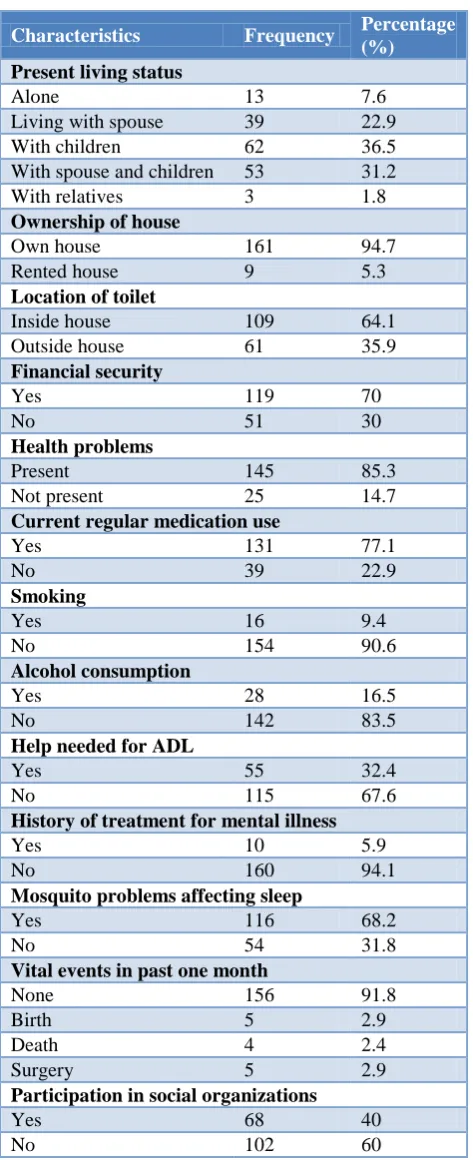
Analysis of socio-demographic characteristics of the study population showed that 55.9% were in the age group of 60-69 years. Majority (60%) were females. 15.9% did not have any formal education. 10% were still working. 98.8% of the respondents were married, of which 65.3% had partners alive. 36.5%were living with children. Majority (94.7%) lived in own houses. 64.1% had a toilet inside the house. 70% reported to be financially secure and were not dependant on anyone for financial needs. 85.3% reported current health problems and 77.1% were on medications regularly. Most common morbidity reported was hypertension (48.2%). Only 9.4% were smokers and 16.5% were alcohol consumers.67.6% did not need any help for activities of daily living.5.9% gave history of treatment for mental illness. Majority (68.2%) reported sleep to be affected by mosquito problems. 40% were involved in activities of social organizations like Kudumbashree and church organizations (Table 1).
Table 1: Socio-demographic characteristics of the study population.
Characteristics Frequency Percentage (%)
Age (years)
60-69 95 55.9
70-79 52 30.6
≥80 23 13.5
Gender
Males 68 40
Females 102 60
Formal education
Yes 143 84.1
No 27 15.9
Occupation
Unemployed 113 66.5
Retired 40 23.5
Still working 17 10 Marital status
Married 168 98.8
Married-partner alive 111 65.3 Married-partner dead 57 33.5
Characteristics Frequency Percentage (%)
Present living status
Alone 13 7.6
Living with spouse 39 22.9 With children 62 36.5 With spouse and children 53 31.2 With relatives 3 1.8 Ownership of house
Own house 161 94.7 Rented house 9 5.3 Location of toilet
Inside house 109 64.1 Outside house 61 35.9 Financial security
Yes 119 70
No 51 30
Health problems
Present 145 85.3
Not present 25 14.7 Current regular medication use
Yes 131 77.1
No 39 22.9
Smoking
Yes 16 9.4
No 154 90.6
Alcohol consumption
Yes 28 16.5
No 142 83.5
Help needed for ADL
Yes 55 32.4
No 115 67.6
History of treatment for mental illness
Yes 10 5.9
No 160 94.1
Mosquito problems affecting sleep
Yes 116 68.2
No 54 31.8
Vital events in past one month
None 156 91.8
Birth 5 2.9
Death 4 2.4
Surgery 5 2.9
Participation in social organizations
Yes 68 40
No 102 60
On administering the PSQI questionnaire, it was noted that in majority (68.2%) the usual time of going to bed was 8-10 pm. Majority (79.4%) got up at 5-7 am. The subjective sleep quality (C1) was reported to be fairly good for 48.2% while 15.3% rated as very good. Sleep latency (C2) was >60 minutes for 35.3%. Sleep duration (C3) was <5 hours for 27.6%. Habitual sleep efficiency score (C4) was >85% for 47.1%. 65.3% reported sleep disturbances (C5) once in a week. 92.9% did not report
use of sleeping medications (C6) in the previous month. 50.6% of respondents had some form of daytime dysfunction (C7). The global PSQI was less than 5 (good sleep quality) for 27.6% while it was 5 or more (poor sleep quality) for the remaining 72.4% of the respondents. The mean GPSQI of the study was 8.04±4.59 (Table 2).
Table 2: Distribution of respondents according to PSQI.
Components Frequency Percentage
(%)
Subjective sleep quality (C1)
Very good 26 15.3
Fairly good 82 48.2 Fairly bad 47 27.6
Very bad 15 8.8
Sleep latency (C2)
<15 min 50 29.4
16-30 min 32 18.8
31-60 min 28 16.5
> 60 min 60 35.3 Sleep duration (C 3)
>7 hours 44 25.9
6-7 hours 36 21.2
5-6 hours 43 25.3
<5 hours 47 27.6 Habitual sleep efficiency (C 4)
>85% 80 47.1
75-84% 24 14.1
65-74% 23 13.5
<65% 43 25.3
Sleep disturbances (C 5)
Not in last month 4 2.4 Once in a week 111 65.3 1-2 times a week 54 31.8 More than thrice a week 1 0.6 Use of sleeping medications (C 6)
Not in last month 158 92.9 One tablet in a week 3 1.8 1-2 tablet in a week 4 2.4 More than 3 tablets in a
week 5 2.9
Daytime dysfunction (C 7)
Not difficult 84 49.4 Little difficult 52 30.6
Difficult 31 18.2
Very difficult 3 1.8 Global PSQI (GPSQI) score
Less than 5 47 27.6 5 or more 123 72.4
Table 3: Distribution of respondents according to GAD-7 and GDS-5.
Frequency Percentage (%)
GAD-7
No anxiety 100 58.8
Mild 36 21.2
Moderate 16 9.4
Severe 18 10.6
GDS-5
No depression 109 64.1 Symptoms suggestive of
depression 61 35.9
On looking at the association between GPSQI and socio-demographic variables, it was noted that age, gender, education, occupation, marital status, living status, ownership of home, financial security, help needed for daily activities and participation in social activities did not significantly affect sleep quality. Absence of toilet inside home (0.036), current health problems (0.003), multiple (>3) health problems (p=0.006), regular use of current medications (0.033) had a significant association with poor sleep quality with p<0.05. Association between general anxiety disorder and GPSQI showed a significant association with poor sleep quality among those with severe anxiety (p=0.017). Association between GDS-5 score and GPSQI showed a significant association between symptoms suggestive of depression and poor sleep quality (p=0.014) (Table 4).
Table 4: Association between sleep quality (GPSQI) and socio-demographic variables, GAD-7 and GDS-5.
Variable Sleep quality (GPSQI) P value
Good (%) Poor (%) Toilet
Inside house 36 (33) 73 (67)
0.036
Outside house 11 (18) 50 (82)
Health problems
Present 13 (52.0) 111 (76.6)
0.003
Not present 34 (23.4) 12 (48.0)
No of current health problems
None 13 (52.0) 12 (48.0)
0.006
Less than 3 29 (26.1) 82 (73.9)
3or more than 3 5 (14.7) 29 (85.3)
Current regular medications
Yes 31 (23.7) 100 (76.3)
0.033
No 16 (41.0) 23 (59.0)
GAD-7 score
No anxiety 36 (36.0) 64 (64.0)
0.017
Mild anxiety 8 (22.2) 28 (77.8)
Moderate anxiety 2 (12.5) 14 (87.5)
Severe anxiety 1 (5.6) 17 (94.4)
GDS-5 score
Symptoms suggestive of depression 10 (16.4) 51 (83.6)
0.014
No depression 37 (33.9) 72 (66.1)
On looking at the components of sleep quality according to PSQI, poor subjective sleep quality (C1) was significantly associated with female gender (p=0.019), no formal education (p=0.016), currently working (p=0.010), no financial security (p=0.025), presence of mosquito problem (p=0.009). Sleep latency (C2) was significantly associated with presence of health problems (p=0.036) and on current medications (p=0.026). Sleep duration (C3) was significantly associated with age (p=0.048) and married but partner dead (p=0.002). Day time dysfunction (C7) was significantly associated with no financial security (p=0.003), living in rented house (p=0.031).
DISCUSSION
The prevalence of poor sleep quality was found to be high among the population (72.4%). In this study the mean GPSQI is 8.04±4.59. A study done by Gulseren Daglar, in Turkey reported a PSQI of 7.28±3.97, while a study done by Abdul Rashid, in Malaysia reported a PSQI of 7.1±3.40.7 A study done by Chia-Yi-Wu, in Taipei reported a PSQI of 6.3±4.40.8 The difference in the GPSQI may be due to the different cultures and lifestyles of people in different countries.
noted that age, gender, education, occupation, marital status, living status, ownership of home, financial security, help needed for daily activities and participation in social activities did not significantly affect sleep quality. A study done in Turkeyalso showed that sleep quality was not significantly influenced by personal variables such as age, gender, education, income and having children.7 A study done in Malaysiashowed that sleep quality was associated with age but not with gender and living arrangement.3
Absence of toilet inside home, current health problems, regular use of current medications had a significant association with poor sleep quality according to this study. The availability of toilet facilities was not taken into account in any of the studies reviewed. This study area being in a rural coastal area consisting of fishermen, nearly 40% had no toilet inside the houses. Getting up at night to use toilet facility outside the house by the elderly can affect sleep quality.
In our study the sleep quality was found to be significantly associated with current morbidity. This is similar to a study conducted by Abdul Rashid in Malaysiawhere mean PSQI of those with chronic illness was higher than those without chronic illness indicating that chronic illness affected sleep.3 Presence of >3 comorbidities was associated with poor sleep quality similar to this study. However in a study conducted in Turkey sleep quality of the individual was not significantly influenced by physical illness.7
In our study, there was found to be a positive association between regular current medication intake and higher scores of PSQI, indicating a poor sleep quality.
There was a positive correlation between high scores of GAD-7 and lower sleep quality in our study indicating that anxiety is associated with sleep quality. According to this study, poor sleep quality was found to be significantly associated with symptoms suggestive of depression in accordance with GDS-5 score. There was a significant association between depression and sleep quality in the study in Taipei, in accordance to our study results.8
CONCLUSION
The sleep quality according to global PSQI in this study was good for 27.6%, while it was poor for 72.4% of respondents. The mean GPSQI of the study was 8.04±4.59. Absence of toilet inside home (p=0.036), current health problems (p=0.003), multiple (>3) health problems (p=0.006), regular use of current medications (p=0.033) had a significant association with poor sleep quality. Association between general anxiety disorder and GPSQI was significant with poor sleep quality among those with severe anxiety (p=0.017). Association between GDS-5 score and GPSQI showed a significant association between symptoms suggestive of depression and poor
sleep quality (p=0.014). Hence questions on sleep quality should be routinely asked by clinicians as part of general health assessment of an elderly.
Recommendations
Since significant association between sleep quality and psychological problems (anxiety and depression) has been noted by the study, questions on sleep quality should be routinely asked by clinicians or health workers as part of general health assessment of an elderly. Immediate professional help could help them recover from depression associated with ageing.
Current health problems and medications for the same are of importance in determining sleep quality. Many factors that contribute to decrements of ageing and burden of illness are potentially responsive to preventive interventions. Timely check-ups, proper diet and exercise, taking the right medicines at the right time all helps to improve the physical health of geriatric population.
People with toilet outside were also found to have poor sleep quality. It is recommended to have toilets attached to the house in case there is a person in the geriatric category in the house.
Financial security has been found to affect subjective sleep quality, so making sure that they have some savings during working years could help improve subjective sleep quality.
Limitations
Data related to presence of current morbidity was based on self-reporting by respondents which was not cross-checked. Recall bias among elderly might have led to exaggerations or understatements. Those who screened positive for psychological problems like anxiety and depression were advised to go to the local centre but not followed up by us.
ACKNOWLEDGEMENTS
We acknowledge the help of 2014 MBBS students who helped in data collection.
Funding: No funding sources Conflict of interest: None declared
Ethical approval: The study was approved by the Institutional Ethics Committee
REFERENCES
1. Neubauer DN. Sleep problems in the elderly. Am Fam Physician. 1999;59:2551-60.
in elderly. Canadian Med Asso J. 2007;176(9):1299–304.
3. Razali R, Ariffin J, Aziz A. Sleep quality and psychosocial correlates among elderly attendees of an urban primary care centre in Malaysia. Neurology Asia. 2016;21(3):265-73.
4. Buysse DJ, Reynolds CF, Monk TH, Berman SR, Kupfer DJ. The Pittsburgh Sleep Quality Index (PSQI): A new instrument for psychiatric research and practice. Psychiatry Res. 1989;28(2):193-213. 5. Spitzer RL, Kroenke K, Williams JBW, Lowe B. A
brief measure for assessing generalized anxiety disorder. Arch Inern Med. 2006;166:1092-7. 6. Hoyl MT, Alessi CA, Harker JO, Josephson KR.
Pietruszka F, Koelfgen M, et al. Development and testing of a five-item version of the Geriatric Depression Scale. JAGS. 1999;47:873-8.
7. Dağlar G, Pınar SE, Sabancıoğulları S, Kav S. Sleep quality in the elderly either living at home or in a nursing home. Australian J Adv Nurs. 2014:31(4):6-13.
8. Wu CY, Su TP, Fang CL, Chang MY. Sleep quality among community-dwelling elderly people and its demographic, mental, and physical correlates. J Chinese Med Assoc. 2012;75(2):75-80.