Volume-6 Issue-2
International Journal of Intellectual Advancements
and Research in Engineering Computations
A study on consumer preference and satisfaction
towards Ayurvedic products with reference to erode
Mrs. Dr.V. Manimegalai MBA., PH.D Professor / MBA
E.P.Aasamsha & P. Sathish – II MBA, Nandha Engineering college
Email- [email protected], [email protected]
ABSTRACT
India is one of the most important countries in the
world in term of floristic diversity. The Ministry of
Environments and Forests, Government of India
has established 8 biosphere reserves, 85 national
parks and 448 sanctuaries for conservation of flora
and fauna. India has a network of about 140
botanical gardens for ex-situ (outside natural
habitat) conservation and demonstration of plants.
Land based developmental activities provide means
of livelihood, health and opportunity for
employment. India has global position in the field
of traditional medicines. There are about 45,000
plants species in India which are in abundant in the
regions of eastern Himalaya, western Ghats and
Andman and Nicobar Islands. The official
documented plants with medicinal potential are
3,000 but traditional practitioner use about 8,000
vegetable drugs. India is the largest producer of
medicinal herbs and approximately called the
botanical garden of the world
.
I.INTRODUCTION
The word 'Ayurveda' comes from the word 'ayur'
meaning 'life' and the word 'Veda' meaning 'to
know'. Ayurveda means 'the science of life', and
is a medical system practiced in India, Sri Lanka
and Nepal. Ayurveda’s mythological origins,
though, are attributed to the Indo- European
Nasatya or Aswins, twin physicians of the gods
of the ancient Indo-European pantheon. Four
thousand year old references to the Nasatya are
found in the now extinct, Hurrian and Hittite
languages in Turkey, and in the Sanskrit language
in India. Ayurveda is considered the upaveda or
accessory Veda to the Atharva Veda. The four
Vedas are the world's oldest literary documents
in an Indo-European language. The ayurvedic
expertise with modern medical research
methodology, to extend the science of ayurveda to
produce scientifically verified herbal solutions.
Ayurveda means ‘’ knowledge of life ‘’ and is
about 5000 years old traditional Indian system of
medicine. Ayurveda is a system, which avail the
essential fundamentals of nature, to maintain
Copyrights © International Journal of Intellectual Advancements and Research in Engineering Computations, www.ijiarec.com
health in a person by preserving their mind,
body and spirit in adept equanimity with
nature. Natural remedies have immense
applications globally. Ayurveda sees health and
disease in holistic terms. It links the microcosm
of individuals with the cosmos. It takes
account the relationship between energy and
matter. This system of healing believes in
treatment of not just a part affected by disease
but the individual as a whole. Consumer
perception is defined as the way that
consumers usually view or feel about certain
products and services. It can also be related to
customer satisfaction which is the expectation
of consumers towards the product ayurveda
has been recognized by WHO as complete
system of natural medicine. The crude drugs
have therapeutic benefits significant for both
humans and animals.
II.OBJECTIVIES OF THE STUDY
To identify the problems faced by the
respondents due to ayurvedic products.
III.SCOPE OF THE STUDY
1. The present study will be helpful in
understanding the consumer attitude
of the different strata people in the
society especially in towards Ayurvedic
health Products.
2. The study will also be helpful in
analyzing the customer attitude
towards the different factors identified
after the focus group discussions for
the future studies by the researchers
and academicians.
3. It will also help in studying the effect
of cosmetics purchase of the study
specifically among the segment under
consideration.
IV. LIMITATION OF THE STUDY
1. Ayurvedic tend to be more effective for
long standing health complaints that
don‟t respond well to traditional
medicine.
2. The effect of use of soaps, shampoos
and oils cannot be ruled out.
V.LITERATURE REVIEW
Since the beginning of human civilization,
medicinal plants have been used by mankind for
its therapeutic value. Nature has been a source
of medicinal agents for thousands of years and an
impressive number of modern drugs have been
isolated from natural sources. Many of these
isolations were based on the uses of the these
systems contains a rich heritage of indigenous
herbal practices that have helped to sustain the
health of most rural people of India. The ancient
texts like Rig Veda (4500-1600 BC) and Atharva
Veda mention the use of several plants as
medicine. The books on ayurvedic medicine such
as Charaka Samhita and Susruta Samhita refer to the use of more than 700 herbs (Jain, 1968). India
has several traditional medical systems, such as
Ayurveda and Unani, which has survived
through more than 3000 years, mainly using
plant-based drugs. The materia medica According to the World Health Organization (WHO, 1977) “a
medicinal plant” is any plant, which in one or more
of its organ contains substances that can be used
for the therapeutic purposes or which, are
precursors for the synthesis of useful drugs. This
Copyrights © International Journal of Intellectual Advancements and Research in Engineering Computations, www.ijiarec.com
therapeutic properties and constituents have
been established scientifically and plants that
are regarded as medicinal but which have not
yet been subjected to thorough investigation.
RESEARCH METHODOLOGY
RESEARCH DESIGN
1. A Master plan that specifies the
method and procedures for collecting
and analyzing needed information.
2. A research design is a framework or
blueprint for conducting the marketing
research project.
SAMPLE DESIGN
Sampling is the process of selecting
a sufficient number of element from the
population. A Sample Design is a definite
plan for obtaining a sample from the
sampling frame. It refers to the technique
or the procedure the researcher would adopt
in selecting some sampling units from which
inferences about the population is drawn.
NON-PROBABILITY SAMPLING
Non-Probability sampling is a
sampling technique where the samples are
gathered in a
CONVENIENCE SAMPLING
Convenience sampling (also known as
Availability Sampling) is a specific type of
non-probability sampling method that relies on data
collection from population members who are
conveniently available to participate in study
SIZE OF THE SAMPLE
The Sample size is 100.
DATA COLLECTIONMETHOD
PRIMARY DATA
These are data which are collected
for the first time directly by the Researcher
for the Specific study undertaken by him. In
this research primary data are collected
directly from the Respondent by using
Questionnaire.
SECONDARY DATA
These are data which are already
collected and used by someone preciously. In
this research review of Literature, Details of
the industry are collected from the Internet.
STATISTICAL TOOLS USED
To analyze and interpret collected
data the following simple percentage and
ranking were used.
FORMULA
Number of respondent Percentage analysis = ---X100
Total no of respondents
HENRY GARRETT RANKING
Garrett’s ranking technique to find out the most significant factor which influences
the respondent, Garrett’s ranking technique
was used. As per this method, respondents
have been asked to assign the rank for all
factors and the outcomes of such ranking
have been converted into score value with
the help of the following formula:
Percent position = 100(Rij – 0.5) Nj
Copyrights © International Journal of Intellectual Advancements and Research in Engineering Computations, www.ijiarec.com
variable by jth respondents
Nj= number of ranked by jth
respondents
DATA ANALYSIS
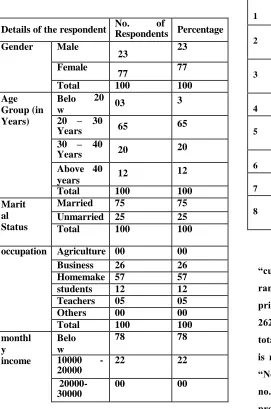
PROFILE OF THE RESPONDENTS
The Respondent who participated in the
research are from diversified background with
gender, age group, marital status and
educational qualification.
Table 1: PROFILE OF RESPONDENTS
Details of the respondent No. Respondents Percentage of
Gender Male
23 23
Female
77 77
Total 100 100
Age Group (in Years) Belo w Years 20
03 3
20 – 30
Years 65 65
30 – 40
Years 20 20
Above 40
years 12
12
Total 100 100
Marit al Status
Married 75 75
Unmarried 25 25
Total 100 100
occupation Agriculture 00 00
Business 26 26
Homemake r
57 57
students 12 12
Teachers 05 05
Others 00 00
Total 100 100
monthl y income Belo w 10000
78 78
10000 20000
- 22 22
20000- 30000
00 00
30000- 40000
00 00
Abov e 40000
00 00
TOTAL 100 100
Table : 2
RANK THE PROBLEM FACED BY
AYURVEDIC PRODUCTS
S.NO PROBLEMS MEA
N SCO RE TOT AL SCOR E RAN K
1 High price 328 2624 2
2 Cure slowly by
using ayurvedic products
400 2800 1
3 Easily not
available in
shop
428 2140 4
4 Less quantity 420 2520 3
5 Not to find
duplicate products
474 1896 5
6 confusion of
brand
538 1076 7
7 side effects 551 551 8
8 Not to flow
procedure 501 1503 6
From the above table it is evident that
“cure slowly by using ayurvedic products” ranked as no.1 with a total score of 2800,”high price” is ranked as no.2 with a total score of 2624, “less quality” is ranked as no.3 with a total score of 2520, “Easily available in shop”
is ranked as no.4 with a total score of 2140,
Copyrights © International Journal of Intellectual Advancements and Research in Engineering Computations, www.ijiarec.com
of 1503, “Confusion of brand” is ranked as
no.7 with a total score of 1076,”Side effects” is
ranked as no.8 with a total score of 551.
FINDINGS
1. From this evident that “cure slowly by
using ayurvedic products” ranked as no.1 with a
total score of 2800.
2. ”High price” is ranked as no.2 with a
total score of 2624,.
3. “Less quality” is ranked as no.3 with a
total score of 2520.
4. 65 % of the respondent had falls under
“20 to 30 Years”
5. 77% of the respondent had falls under
“Female”
6. 75% of the respondent had falls
under “Married”
7. 57% of the respondent had falls under
“Home Maker”
8. 78% of the respondent had falls under “Below 10000”
SUGGESTIONS
1. The organization can adopt
advertisement techniques such as television
advertisements, newspaper advertisements etc. to
create awareness about the products among
consumers.
2. The pharmacy may implement online
shopping site to attract various prospective
consumers to make them a real consumers of the
products.
3. The pharmacy can provide a service of
experienced consultants at its own premises.
4. The organization can adopt web based
promotional techniques to increase its area of
operation and also to increase its commercial sales
CONCLUSION
The ayurvedic industry which already exhibits a
very high level of inter-dependence of rivals and
multi- market multi-contact situations will stand
to benefit immensely when the resource
allocations and utilization are also performed
after Mutual forbearance consideration of the
rival units. The network perspective affixed along
with the resource perspective would add
practicality to the firms' competitive strategies,
fine tuning them towards more pragmatic market
maneuvering. The modern market is highly
competitive in nature. The consumer is the king in
the market. The importance gained by the
individual consumer in the present market compel
the marketers to look the buying habits,
preferences, taste, like and dislikes of consumers
and accordingly they need to revise its policies and
marketing mix. While purchase of health product,
the consumers are found more quality conscious
preferred to purchase ayurvedic products, they 3000
2500
2000
1500
1000
500
Copyrights © International Journal of Intellectual Advancements and Research in Engineering Computations, www.ijiarec.com
wait for the brand during no availability, become
emerging as important source of information and
inspite of impact of other factors, the actual brand
decision is taken by themselves.
REFERENCE
1. Akhtar S, Halim, MA, Sohel, MSI,
Sarker, SK,Chowdhury, MSH & Sonet, SS, ‘A
review on the use of non-timber forest products in
beautycare in Bangladesh’, Journal of Forestry
Research, vol. 19 no. 1, , 2008 ,pp. 72-78.
2. Arya.V, Kumar.S & Kumar.S Consumer
Buying Behaviour towards ayurvedic
Medicines/Products in Joginder IRACST –
International Journal of Commerce, Business and
Management (IJCBM), ISSN: 2319–2828 Vol. 5,
No.6, Nov-Dec 2016 Nagar (Himachal Pradesh)-A
Survey. Ayurpharm Int J Ayur Alli Sci., 1(3),
2012,60-64.
3. Awad.A, & Al-Shaye.D, Public
awareness, patterns of use and attitudes toward
natural health products in Kuwait: A
cross-sectional survey. BMC Complementary and
Alternative Medicine, 2014,p.105.
4. Basha, SK, Anjaneyulu.E & Sudarsanam
,‘Herbal plants for wound healing among Sugali
tribes of Yerramaalai forest of Kurnool district,
Andhra Prdesh, India’, Indian Journal of Applied
and Pure Biology, vol. 28, no. 1,2013, pp. 19-25.
5. Hawkins, D. I, Best, J. R, Coney, A. K, &
Mookerjee.A Consumer Behaviour-Building
Marketing Strategy (9th ed.). 2007,New Delhi:
Tata McGraw- Hill.
6. Zimmerman. C & Kandish. J ,A pilot study to
assess students' perceptions, familiarity, and
knowledge in the use of complementary and
alternative herbal supplements in health
Promotion. Alternative The Health
Med(18),2012.
7.
http://www.nistads.res.in/indiasnt2008/t4industry