R E S E A R C H
Open Access
Efficient reversible data hiding in
encrypted image with public key cryptosystem
Shijun Xiang
*and Xinrong Luo
Abstract
This paper proposes a new reversible data hiding scheme for encrypted images by using homomorphic and probabilistic properties of Paillier cryptosystem. The proposed method can embed additional data directly into encrypted image without any preprocessing operations on original image. By selecting two pixels as a group for encryption, data hider can retrieve the absolute differences of groups of two pixels by employing a modular multiplicative inverse method. Additional data can be embedded into encrypted image by shifting histogram of the absolute differences by using the homomorphic property in encrypted domain. On the receiver side, legal user can extract the marked histogram in encrypted domain in the same way as data hiding procedure. Then, the hidden data can be extracted from the marked histogram and the encrypted version of original image can be restored by using inverse histogram shifting operations. Besides, the marked absolute differences can be computed after decryption for extraction of additional data and restoration of original image. Compared with previous state-of-the-art works, the proposed scheme can effectively avoid preprocessing operations before encryption and can efficiently embed and extract data in encrypted domain. The experiments on the standard image files also certify the effectiveness of the proposed scheme.
Keywords: Reversible data hiding, Image encryption, Public key cryptosystem, Homomorphic property, Probabilistic property, Paillier cryptosystem
1 Introduction
Reversible data hiding (RDH) is an efficient technology for cover authentication or content integrity verification [1–3] in which the hidden data can be extracted com-pletely and the original carrier can be recovered losslessly after data extraction. With this property, reversible data hiding is widely applied in such areas as medical imagery, military imagery, and law forensics. Reversible data hid-ing algorithms are generally classified into three categories by using lossless compression [4, 5], difference expansion [6, 7], and histogram shifting [8, 9]. RDH technique is further developed by making good use of new prediction error algorithms and embedding strategies [10–12], which have higher payload and better image quality.
For the sake of information security and privacy pro-tection, data are usually encrypted before upload and
*Correspondence: [email protected]
School of Information Science and Technology, Jinan University, Guangzhou 510632, China
transmission. Encryption, which is one of the most pow-erful method for content protection, can convert original data into unintelligible ciphertexts. It is especially useful in scenarios that content owner is unwilling to expose their sensitive data or private information to untrusted channel and database. On the administrator side, additional data such as content-related keywords, information features, or authentication data are desired to be embedded directly into the encrypted data for the convenience of man-agement and security protection. What is more, content owner still expects that the original cover can be restored perfectly since any distortion is tolerated in many appli-cations. To this end, reversible data hiding in encrypted images (RDHEI) emerges. RDHEI is a technology which implements data hiding procedure in encrypted domain and can recover the original plaintext without error after decryption and data extraction. Owning to this merit, RDHEI has been a research hotspot in information secu-rity community recently. In [13], Zhang encrypted image with a standard stream cipher and further divided the encrypted image into blocks, each of which contains two
groups. One bit can be embedded by flipping three LSBs of each pixel in the corresponding group. Zhang’s method was improved by using a different estimation equation so as to better exploit the spatial correlation [14] and differ-ent flipping rates [15]. In order to extract the hidden data directly in encrypted domain, Zhang proposed a separable RDHEI which compresses the LSBs of encrypted image with a source coding method to accommodate additional data [16]. Besides, RDHEI for JPEG image has been pre-sented in [17]. To improve the embedding performance, spare room for data hiding was created by implement-ing self-embeddimplement-ing or compression before encryption [18, 19]. In [20], Qian et al. vacated room after encryp-tion with a distributed source encoding operaencryp-tion, which can avoid to pre-process original image before encryp-tion and has a high capacity. The RDHEI methods men-tioned above focus on symmetric cryptosystem. The data encrypted with stream cipher symmetric cryptosystem is hardly for the cloud computing.
Different from symmetric cryptosystem, public key cryptosystem with probabilistic and homomorphic prop-erties, which allows us to conduct operations directly on ciphertexts to generate the expected result, is more pow-erful in secure signal processing. For example, mass data of an enterprise can be uploaded to the cloud after encryp-tion for statistical analysis services from the third party, e.g., the enterprise can get corresponding annual turnover (sum of plain data) and growth (difference of plain data) from the cloud without any information leakage by uti-lizing Paillier cryptosystem [21]. Secure signal processing with public key cryptosystem can bring us great benefits.
In the literature, there are a few works on signal process-ing in encrypted domain with public key cryptosystem [22–26], and two of them have applied Paillier public key cryptosystem for reversible data hiding [25, 26]. In [25], Chen et al. first raised a novel RDHEI method with pub-lic key cryptography by dividing a pixel into two parts: LSB and the rest. Image owner encrypted these two parts with Paillier mechanism and transmitted them to data hider. In this way, the transmitted data in size will be twice of the directly encrypted image. One bit can be embedded in encrypted domain by modifying magnitude relationships between the encrypted LSB values of two adjacent pixels with homomorphic multiplication. Since the magnitude relationships can not be kept for the corre-sponding ciphertexts, the hidden data cannot be extracted before decryption. Aiming at retrieving the hidden data in encrypted domain, Zhang et al. proposed a new reversible data hiding algorithm with public key cryptosystem [26] by using a pre-procession operation to shrink histogram of original image to vacate room for data hiding. After encryption, data hider first embedded additional data into the reserved room so that additional data can be extracted in the plaintext domain. In order to extract data in the
encrypted domain in [26], the authors ingeniously applied probabilistic property of Paillier cryptosystem with multi-layer wet paper code (WPC) [27] strategy so that the additional data can be hidden into and extracted from the bit-planes of ciphertexts.
This paper proposes a new reversible data hiding scheme in the homomorphic encrypted domain with pub-lic key cryptosystem. The main idea is that groups of two selected pixels are encrypted in a way that two pixels in a group are encrypted with two selected parameters by exploiting the probabilistic property. In such a way, the absolute differences of groups of two pixels are reserved and can be retrieved from encrypted domain by imple-menting a modular multiplicative inverse method and looking for a mapping table. After that, additional data can be embedded into encrypted image by using the homomorphic property to shift histogram of the abso-lute differences. On the receiver side, legal receiver can extract the marked histogram in encrypted domain in the same way as data hiding procedure. The hidden data can be extracted from the marked histogram and the encrypted image without hiding data can be restored by using an inverse operations of histogram shifting. Besides, the marked absolute difference can be computed after decryption, and then data extraction and image restora-tion operarestora-tions can be accomplished perfectly. By using standard example images as data set, extensive testing has been implemented for performance evaluation. The proposed scheme has the following highlights:
1. Preprocessing operations on original image for data hiding can be effectively avoided before encryption. This is beneficial to protect image content privacy in preprocessing procedure. More importantly, the proposed scheme is more scalable due to the avoidance of preprocessing operations.
2. The data can be directly inserted into and extracted from encrypted images with private key. This is useful for cloud computing services while protecting image privacy in the cloud. In the literature, it is a dilemma to extract the hidden data in encrypted domain with public key cryptosystem. In this paper, we have presented a solution.
3. Compared with the previous work [26], the hidden data in the proposed one has stronger security performance in encrypted domain because the data are embedded into plaintexts by using the
homomorphic property instead of embedded into the information into bit-planes of ciphertexts [26].
The remainder of this paper is organized as follows. A brief introduction of Paillier cryptosystem is given in Section 2. Then, the details of the proposed reversible data hiding scheme is elaborated in Section 3. Experi-ment results and performance comparison are given in Section 4. Finally, we draw a conclusion in Section 5.
2 Paillier cryptosystem and modular
multiplicative inverse method
2.1 Paillier cryptosystem
Paillier cryptosystem [21], which has homomorphic and probabilistic properties, has been widely used in secure computation fields. In Paillier cryptosystem, a plaintext is encrypted with the same public key and different cipher-texts can be obtained since the parameter is selected randomly. The same plaintext, of course, can be retrieved after decrypting corresponding ciphertexts with private key. Hence, Paillier cryptosystem can achieve semantic security. Besides, homomorphic multiplication is per-mitted in Paillier cryptosystem, meaning that decrypted product of two ciphertexts is equal to the sum of two cor-responding plaintexts. It provides an efficient approach to process the original data in encrypted domain. The following is the details of Paillier cryptography.
Key generation: Select two large primes p and q ran-domly. ComputeN=pqandλ=lcm(p−1,q−1), where lcm(·)is a function for calculating the least common mul-tiple of two inputs. And then, randomly selectg ∈ Z∗N2,
wheregcd(·)is to derive the greatest common divisor of two inputs,Z∗N2 is denoted as the subset ofZN2 in which
elements are all relatively prime with N2 and Z
N2 =
0, 1, 2,. . .,N2−1. Finally, we get the public key(N,g) and corresponding private keyλrespectively.
Encryption For each original data m ∈ ZN, select an integerr∈ Z∗N randomly. Denote encryption function as E[·]. The corresponding ciphertextccan be obtained by
c=E[m,r]=gmrNmodN2 (3)
According to the property of Paillier cryptosystem, the ciphertextcis still inZ∗N2.
Decryption Denote the decryption function as D[·]. With corresponding private keyλ, the original plaintextm can be derived by
m=D[c]= L
cλmodN2
L(gλmodN2)modN (4)
Furthermore, the two important properties of Paillier cryptosystem (which have been applied in the proposed method) are introduced as follows:
Lemma one: The function E[m,r] is bijective when g obeys Eq. (1). For two plaintextsm1,m2 ∈ ZN, compute corresponding ciphertextsc1,c2 with r1,r2 according to Eq. (1). The Eq.c1=c2holds if and only ifm1 =m2and r1=r2.
Homomorphic multiplication: For ∀r1,r2 ∈ Z∗N, two plaintexts m1,m2 ∈ ZN and corresponding ciphertexts E[m1,r1] ,E[m2,r2]∈Z∗N2satisfy:
2.2 Modular multiplicative inverse method
For better description, we introduce the principle of modular multiplicative inverse (MMI) method first. For two coprime integersyand z, there exists an integer satisfying
·y=1 modz, (7)
where is called as the modular multiplicative inverse of y. With a given y, the corresponding can be com-puted efficiently via an Extended Euclidean algorithm [28]. According to the properties of MMI, the division operation can be implemented after modular operation. Assume another integerxand denotevas the product ofx andyto the moduloz.xcan be derived from the product vby multiplyingy’s corresponding modular multiplicative inverse,
v·=x·y·=xmodz. (8)
3 Reversible data hiding scheme with public key
cryptosystem
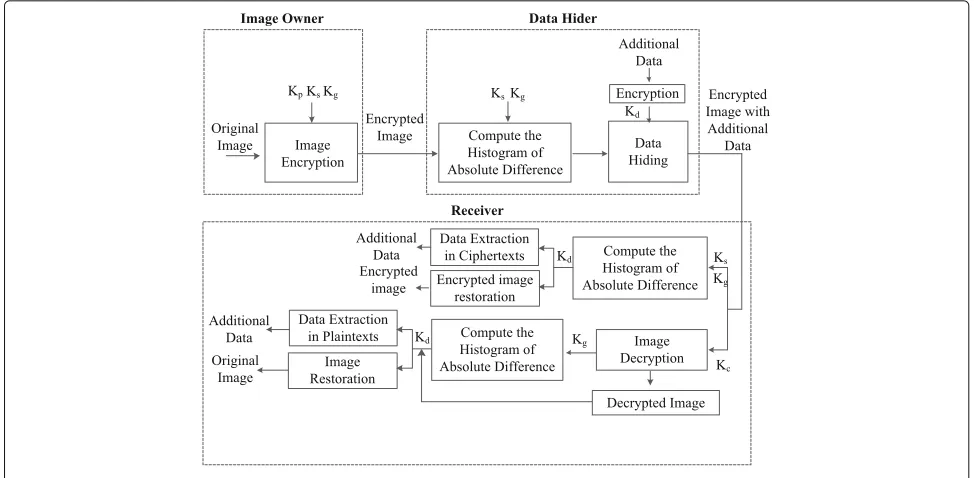
Fig. 1Sketch of the proposed reversible data hiding scheme with public key cryptography
in Section 2) first. Then, one of the two pixels is fur-ther encrypted with r2 (controlled by a secret key Ks). With Kg and Ks, data hider can calculate absolute dif-ferences of groups of two pixels by exploiting modular multiplicative inverse method and looking for a map-ping table in encrypted domain. Then, additional data, after encryption, are embedded into the encrypted image by shifting histogram of the calculated absolute differ-ences with a data hiding key Kd. With Kg, Ks, and Kd, receiver can extract the additional data from the his-togram of absolute differences (which are computed in the same manner as data hiding procedure). With the pri-vate keyKconly, receiver can obtain an image similar to the original image after decryption. With bothKdandKc, receiver can retrieve the hidden data from the histogram of absolute differences of pixel groups after decryp-tion and recover the original image by implementing an inverse operation of histogram shifting. The remainder of this section elaborates the details of the proposed scheme.
3.1 Image encryption
According to the probabilistic property of Paillier cryp-tosystem, the parameterr ∈Z∗N is selected randomly for each plaintext to achieve semantic security. Since magni-tude relationships among plaintexts can not be kept to the corresponding ciphertexts, it is still a dilemma to embed additional data directly into an encrypted image with such a cryptosystem. In this work, with the probabilistic property, we design a strategy to encrypt two pixels in a group by using a random parameter so as to reserve the
difference of two plaintexts for data hiding in encrypted domain.
Firstly, groups of two selected pixels are chosen from original imageIby using a keyKg. Denote the two pixels inkthgroup asP1(k)andP2(k), respectively. Data hider first randomly selects an integerr1(k)∈Z∗N and encrypts P1(k) and P2(k) with the public key (N,g) and Paillier cryptosystem.
c1(k)=E[P1(k),r1(k)]=gP1(k)r1(k)NmodN2 (9)
c2(k)=E[P2(k),r1(k)]=gP2(k)r1(k)NmodN2 (10)
wherec1(k)andc2(k)are the corresponding ciphertexts ofP1(k)andP2(k), respectively. To void the effect of using the same parameter for encrypting a group of two pixels, image owner selects another integerr2(k) ∈ Z∗N with a secret keyKsand implement a homomorphic multiplica-tion operamultiplica-tion onc2(k),
c2(k)=c2(k)·E[0,r2(k)]=gP2(k)(r1(k)·r2(k))N modN2 (11)
Let Dc2(k)
be the decrypted version of c2(k). According to Eqs. (5) and (6),Dc2(k)
satisfies
Dc2(k)=P2(k)modN (12)
3.2 Data hiding
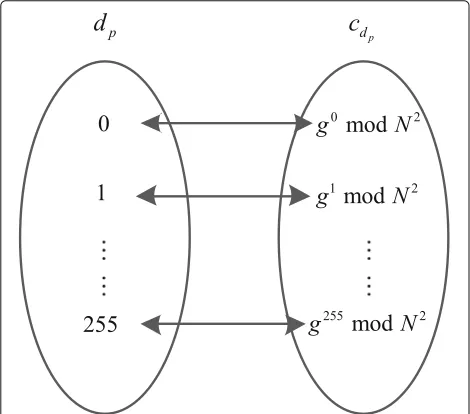
With the encrypted imageE[I] and the group selection key Kg and the secret key Ks, data hider can retrieve ciphertext of the absolute difference of two plaintexts with a modular multiplicative inverse method, and then extract the absolute difference from the corresponding ciphertexts by looking for a mapping table (see Fig. 2) without private keyKc. Additional data can be embedded into E[I] by shifting histogram of the absolute differ-ences with a data hiding keyKd. Firstly, data hider divides E[I] into groups in the same manner as image encryp-tion procedure, and then retrieves the ciphertext group {c1(k),c2(k)}.
3.2.1 Data embedding
With the property of MMI, ciphertext of the absolute dif-ference between the two plaintexts P1(k) and P2(k) in the kth group can be calculated in encrypted domain. As described in Section 2, ciphertext c = E[m,r] can be obtained for each m ∈ ZN according to Eq. (3) andc ∈ Z∗N2. It means that E[0,r2(k)], c1(k) andc2(k) are coprime to N2. Denote the modular multiplicative inverse of E[0,r2(k)] as Er. Data hider first calculates
Er(k)with the Extended Euclidean algorithm andEr(k) satisfies
Er(k)·E[0,r2(k)]=1 modN2. (13) Since c2(k) is the product of c2(k) and E[0,r2(k)] according to Eq. (11), data hider derivesc2(k)by multiply-ingc2(k)withEr(k),
c2(k)·Er =c2(k)·E[0,r2(k)]·Er(k)=c2(k)modN2. (14)
Fig. 2Mapping table between an absolute difference and its ciphertext
Furthermore, data hider computes the corresponding modular multiplicative inverse ofc1(k)andc2(k), denoted
According to Carmichael’s theorem, Eq. (17) holds for anyα∈Z∗N2[21]
αNλ=1 modN2, (17)
whereN is the product of two large primespandqand
λ=lcm(p−1,q−1). Hence, in the Paillier cryptosystem
Combining Eq. (15) with Eq. (19), we can derive specific expressions of1(k)and2(k)
1(k)=gNλ−P1(k)·rN1(λ−1)modN2
2(k)=gNλ−P2(k)·rN1(λ−1)modN2
(20)
With Eq. (18) and the expressions of 1(k), 2(k), Eq. (16) can be further simplified as (21) and (22) by con-sidering the magnitude relation ofP1(k)andP2(k), the encrypted version of the absolute difference between P1(k)andP2(k). Denote probable value of the absolute
the matched result as d(k), which is the corresponding absolute difference between the two plaintextsP1(k)and P2(k). Besides, data hider can get the magnitude relation-ships betweenP1(k)andP2(k). Ifcd1(k)is matched with
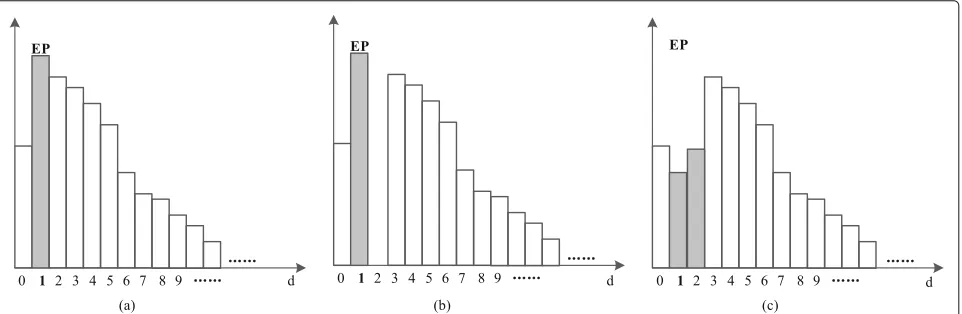
the mapping table, we have P1(k) ≥ P2(k); Otherwise, we haveP2(k) >P1(k). Consequently, a histogram of the absolute differences between groups of two plaintexts is obtained as shown in Fig. 3a.
Additional data can be embedded into the encrypted imageE[I] by shifting histogram of the absolute differ-ences in several rounds. Assume ne rounds are imple-mented and EP is the embedding bin in each round in referring to data hiding keyKd. To achieve a better per-formance, we suggest to select the peak point of the histogram asEPin each round. Data hiding procedure is accomplished as follows:
IfP1(k)≥P2(k),
cw1(k)= ⎧ ⎨ ⎩
c1(k)·gw=gP1(k)+w·r1N, if d(k)=EP c1(k)·g1=gP1(k)+1·r1N, if d(k)≥EP+1
c1(k), else
(24)
cw2(k)=c2(k) (25)
else
cw1(k)=c1(k) (26)
cw2(k)= ⎧ ⎨ ⎩
c2(k)·gw=gP2(k)+w·r1N, if d(k)=EP c2(k)·g1=gP2(k)+1·r1N, if d(k)≥EP+1
c2(k), else
(27)
wherecw1(k)andcw2(k)are the ciphertexts after data hiding inkthgroup andwis one bit of the additional data. Denote decrypted versions ofcw1(k)andcw2(k)asPw1(k)andPw2(k)
respectively. The effect of data hiding on plaintexts is to changeP1(k),P2(k)toP1w(k),P2w(k):
IfP1(k)≥P2(k), Pw1(k)=
⎧ ⎨ ⎩
P1(k)+w, if d(k)=EP P1(k)+1, if d(k)≥EP+1 P1(k), else
(28)
Pw2(k)=P2(k) (29)
else
Pw1(k)=P1(k) (30)
Pw2(k)= ⎧ ⎨ ⎩
P2(k)+w, if d(k)=EP P2(k)+1, if d(k)≥EP+1 P2(k), else
(31)
Here, we denotePw1(k)andP2w(k)as the marked versions ofP1(k)andP2(k). Obviously, we keep the relative mag-nitude of two pixels in each group unchanged after data hiding:Pw1(k)≥Pw2(k)ifP1(k)≥P2(k)orP1w(k) <Pw2(k) ifP1(k) <P2(k). Denote the absolute difference after data hiding asdw(k). According to Eqs. (28), (29), (30) and (31), whend(k) ≥ EP+1, letdw(k) = d(k)+1 create room for data hiding, as shown in Fig. 3b. Letdw(k)=d(k)+w hide the additional data ifd(k)=EP, as shown in Fig. 3c. If the receiver has the EP in each round, he/she can extract the hidden data and recover the original pixels with the inverse operation of embedding procedure.
Finally, data hider multipliescw2(k)with corresponding E[0,r2(k)] to encrypt the absolute difference properties according toKs,
cw2(k)=cw2(k)·E[0,r2(k)] modN2 (32) Denote the encrypted image with hidden data asE[Iw]. By employing Paillier cryptosystem to encrypt a group of two pixels with two selected parameters, we have suc-cessfully reserved the absolute differences of plaintexts
in encrypted domain. Data hider can retrieve the abso-lute differences and embed additional data directly into the encrypted image by shifting histogram of the absolute differences.
3.2.2 Security of image content in encrypted domain
Security of image content in encrypted domain is an important aspect that users are most concerned about. Here, we discussed the security problem by considering whether an attacker is with the secret keyKs:
Case one: If the user does not haveKs, there is no extra information can be extracted from the encrypted image sinceP1(k)andP2(k)were encrypted with two random integersr1(k)andr1(k)·r2(k). In this case, the proposed image encryption strategy has the same security perfor-mance as the standard encryption method in Eq. (3).
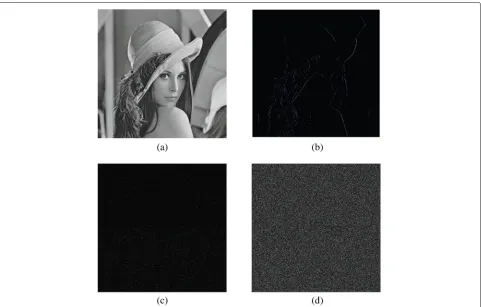
Case two: If someone (like the data hider) has the secret keyKs, he or she can extract the absolute differences of groups of two plaintext pixels. In this case, the differ-ences of groups of two adjacent pixels may expose the high-frequency information of original image, as shown in Fig. 4b. To solve this problem, we apply the following two group selection strategies:
Strategy 1: Select two adjacent pixels as a group for encryption. This is followed by a permutation operation on groups of two encrypted pixels. With the permutation operation, the high-frequency information can be effec-tively covered, as shown in Fig. 4c. Correspondingly, an inverse operation of permutation need to be implemented during the image restoration procedure.
Strategy 2: Randomly select two pixels as a group for encryption. The permutation operation in thestrategy 1 is not needed. By randomly select two pixels as a group, there is no any information leaked from the absolute differences, as shown in Fig. 4d.
3.3 Data extraction and image restoration
In the proposed scheme, data extraction and image restoration can be completed together by inverse oper-ations of histogram shifting. For a receiver, there are two ways to extract the hidden data and restore original ciphertext image or plaintext image.
3.3.1 Extract hidden data and restore original ciphertext image in encrypted domain
With the data hiding keyKd and secret keyKs, receiver can retrieve the hidden data wand recover the directly
encrypted imageE[I] from the received imageE[Iw]. The extraction and restoration procedures are described as follows:
1. For a legal receiver, the same group selection operation is first implemented on the received ciphertext imageE[Iw]. Denote thekthciphtext
group bycw1(k),cw2(k), which contains the hidden dataw.
2. With the secret keyKs, receiver can get the corresponding parameterr2(k), and then compute
E[0,r2(k)]referring to Eq. (3). Furthermore,Er(k),
which is modular multiplicative inverse of
E[0,r2(k)], is calculated with Extended Euclidean
algorithm. Referring to Eqs. (13) and (32),cw2(k)
(which is the ciphertext ofPw2(k)) is derived by
cw2(k)=cw2(k)·Er(k)modN2 (33)
Using the same method, receiver further computes
w
1(k)andw2(k), which are the corresponding
modular multiplicative inverse ofcw1(k)andcw2(k). Similar to extract the absolute difference in the data hiding procedure, receiver calculatescwd
1(k)and
and computes the mapping table beforehand by referring to Eq. (23). After searchingcwd
1(k)andc of the absolute differences of all the groups. Besides, the magnitude relationships betweenP1w(k)and
Pw2(k)) are obtained by: Ifcwd
1(k)is matched with the
table,P1w(k)≥Pw2(k); Otherwise,Pw2(k) >Pw1(k). 3). With the data hiding keyKd, receiver can obtain the
rounds of embeddingneand the embedding point in each roundEP. According to the corresponding EP and the magnitude relationships betweenP1w(k)and
Pw2(k), additional dataw can be extracted from the
Accompanied with data extraction, the directly encrypted imageE[I]can be recovered without any error. Receiver calculates the modular multiplicative inverse ofg via Extended Euclidean algorithm, denoted asg.gsatisfies
g·g=1modN2 (36)
According to the property of MMI, ciphertextsc1(k)
andc2(k)before hiding data can be restored as
histogram shifting can be implemented. 4). Afternerounds of data extraction and inverse
operations of histogram shifting, the hidden data can be extracted perfectly and the original ciphertext imageE[I]can be restored.
3.3.2 Extract the hidden data and restore the original image after decryption
With the private keyKcand data hiding keyKd, receiver can extract the hidden data and recover the original image after decryption.
As described in Section 2, the ciphertext group
cw1(k),cw2(k)in the received encrypted imageE[Iw] can be decrypted by private keyKc=λ, formulated as
Scenario 1: The receiver extracts the hidden data and recover the original image immediately. Firstly, the receiver divideIwinto groups in the same manner as in the image encryption procedure and getPw1(k)andP2w(k). Then, dwk (the absolute difference between P1w(k) and P2w(k)) is calculated
dw(k)=Pw1(k)−P2w(k) (43)
In this way, the receiver can obtain histogram of the absolute differences. With the data hiding key Kd, the receiver can getne(embedding rounds) andPZ (embed-ding point in each round). Referring toPZ, the hidden data wcan be retrieved by
w=
0, if dw(k)=EP
1, if dw(k)=EP+1. (44)
Meanwhile, original image pixels can be recovered by the following formulations.
Afterne rounds of data extraction and image restora-tion, the hidden data can be retrieved perfectly and the original image can be restored without any error.
Scenario 2: Receiver wants to store or deliver a marked version of plaintext image. If needed, the hidden data can be extracted and the original image can be recovered. This case is possible in cloud computing application. For exam-ple, a company may upload the encrypted image to the cloud for watermarking service from the third party. After decryption, the company can deliver the watermarked image to legal users for business. The user can get the orig-inal image according to the data hiding key Kd and the hidden data can be extracted for copyright authentication. Due to the effect of data hiding, pixel oversaturation in plaintext domain could be caused. Denote Pw(i,j) by a plaintext in Iw, where (i,j) indicates the position. Receiver can scansIwin order to find overflowed pixels (ifPw(i,j)≥255). Then, the overflowed part of thePw(i,j) can be calculated as
o(l)=Pw(i,j)−255 (49)
wherePw(i,j)is thelthplaintext which is greater than or equal to 255, ando(l)is the overflowed part ofPw(i,j).
Since the effect of data hiding in each round is to add 1 or a binary bit to the corresponding plaintexts, receiver usesLL=log2(ne) When there areQoverflowed pixels, we can get aLSa
(LSa =L×Q) bits of sequence, denoted bySa.
For the overflow problem, we can modify pixels greater than 255 as 255 and restore their position information. All the appendix information includingL,Saand the posi-tions of the overflowed pixels, can be reversibly embedded intoIwto generateIw. In this way, receiver could deliver Iwto his clients for business. For copyright problem, the receiver can extract the inserted appendix information and reconstructIw. With the data hiding key, the hidden datawcan be extracted fromIwand the original imageI can be restored, as described inScenario 1above.
4 Experimental results
In Section 3.2.2, we have presented two group selection strategies. The two group selection strategies is applied to form the proposed two reversible data hiding methods:
Method 1: We choose two adjacent pixels as a group for encryption. This is followed by a permutation operation on the encrypted image so as to avoid the difference of the adjacent pixels to leak image content.
Method 2: We randomly select two pixels as a group for encryption. The permutation operation in theMethod 1is not needed.
In this section, we will discuss the performance of the proposed reversible data hiding methods with several standard images (see Fig. 5). Then, the embedding dis-tortion of the proposed methods is evaluated by using Lenaas example image. Last part is a comprehensive com-parison of the proposed two methods against previous schemes with Paillier cryptosystem.
4.1 Embedding distortion
Embedding distortion in the proposed scheme is from histogram shifting operation in encrypted domain. As embedding capacity increases, the more groups are needed and more rounds of histogram shifting will be implemented for data embedding. As a result, the distor-tion increases.
Fig. 5Six standard test images sized by 512×512.aLena.bMan.cPlane.dLake.eBaboon.fRoom
of two adjacent pixels range from 0 to 4 due to strong cor-relation among neighboring pixels. In the Method 2, since two randomly selected pixels in magnitude are often dif-ferent, only a small number of the absolute differences are smaller than 4 in magnitude. For 4960 bits of additional data, the PSNR value with the Method 2 is 41.754 dB, as shown in Fig. 6c.
4.2 Performance comparison
In the literature, there are two existing works to reversibly hide data into Homomorphic encrypted image [25, 26] by using Paillier cryptosystem (which is a public key cryp-tosystem with both homomorphic and probabilistic prop-erties). With Paillier cryptosystem, one of the advantages is that the encrypted image can be processed by the third party in encrypted domain.
Table 1 lists a comprehensive comparison results of the proposed methods against the two previous schemes by considering (1) if a preprocessing operation is needed before encryption, (2) if the image after encryption is bigger than the directly encrypted image, (3) if data extrac-tion and image restoraextrac-tion is separable, and (4) security of hidden data in encrypted domain, which are described as follows:
1. To reserve room before encryption for data hiding in encrypted domain is good idea proposed by Ma et al. in [18]. In [25, 26], preprocessing image before encryption is important step so that additional can be hidden into encrypted image. In the proposed scheme, the use of two selected pixels as a group is directly encrypted with a genuine encryption strategy
Fig. 6Embedding distortion (in PSNR) with two group selection methods.aLena.bEmbedding 40,960 bits with Method 1 (44.914 dB).c
Table 1Comprehensive comparison between the proposed schemes and two previous methods
Features
Methods Preprocessing Extra data expansion Separable ? Protection mechanism of the hidden data
Method [25] Yes Yes No Homomorphic and probabilistic mechanism
Method [26] Yes No Yes WPC mechanism
The proposed schemes No No Yes Homomorphic and probabilistic mechanism
to transmit the absolute differences of groups of the two plaintext pixels to encrypted domain for data hiding. In other words, without any preprocessing operations are needed in the proposed scheme. This is beneficial to reduce risk of image content exposed.
Besides, the scheme without preprocessing has better scalability.
2. The method [25] introduced an extra data expansion due to the fact that original pixel has been divided into two parts (LSB and the rest) for encryption.
Fig. 7Comparison of Embedding capacity versus embedding distortion in six different images against two existing works.aLena.bMan.cPlane.
Such a way will make delivered ciphertext data double. The method [26] and the proposed scheme has no extra data expansion introduced.
3. The proposed method embedded additional data by shifting histogram of the absolute differences of groups of two pixels in encrypted domain. Since the histogram can be derived in encrypted domain, data extraction is separable from the content decryption. The method in [25] is on the opposite side, where the data can not be extracted before encryption. In [26], additional data were inserted twice in a reversible way and a lossless way, so that the data can be extracted in both encrypted and plaintext domains. 4. The security of hidden data in encrypted domain is one of the features that people are most concerned about. Method in [26] utilized WPC and probabilistic properties of Paillier cryptosystem to embed bits into bit-planes of the ciphertexts, where WPC
mechanism was applied to protect the hidden data. Since the bit-planes of ciphertext are exposed in encrypted domain, there exists a risk that an illegal client may embed fake information into the bit-planes. Besides, when the same data are embedded into different images, the hidden data could be found in statistical way. In the proposed scheme, additional data are embedded into histogram of the absolute differences of groups of two selected pixels by using homomorphic properties in encrypted domain. Since the hidden data are capsuled with homomorphic and probabilistic properties of Paillier cryptosystem, an illegal receiver without the data hiding key can hardly crack those encrypted pixels, meaning that the hidden data in the proposed scheme is secure in encrypted domain.
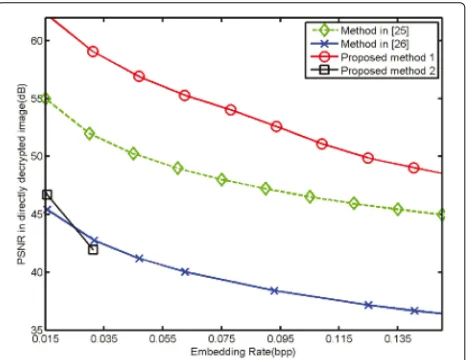
Finally, we report the PSNR values of the proposed scheme with two group selection methods and the pre-vious two schemes at different embedding rates. With six standard images (as shown in Fig. 5), we plot the corresponding comparison results of embedding capacity versus embedding distortion. We can see from Fig.7 that the proposed method 1 with the group selection strategy 1 (by selecting two adjacent pixels as a group for encryp-tion followed by a permutaencryp-tion operaencryp-tion) can provide the best performance since the use of two adjacent pix-els as a group is beneficial to generate a great number of the differences with smaller magnitude. Also, we can see from this figure that the proposed method 2 with the group selection strategy 2 (by randomly selecting two pix-els as a group for encryption) has lower PSNR value at the same embedding rate due to the fact that only a small number of the differences with smaller magnitude can be achieved. Furthermore, we compute the average PSNR values of 50 standard test images at different embedding
rates, as shown in Fig. 8. We can see from this figure that the simulation results are similar.
5 Conclusions
In this paper, we proposed a new reversible data hiding scheme in encrypted domain with public key cryptosys-tem. In the proposed method, groups of two pixels are selected for encryption in a way that two pixels in the same group are encrypted with a random integer r1to obtain two ciphertexts first. Then, one of the two ciphertexts is further encrypted with another parameterr2(controlled by a key) so that their difference can be transmitted to encrypted domain. Owing to the encryption strategy, data hider can retrieve absolute differences of groups of two plaintext pixels by combining a modular multiplica-tive inverse method and a mapping table. And, additional data can be embedded into encrypted image by shifting histogram of the retrieved absolute differences by using the homomorphic property. With the proposed embed-ding strategy, there is no preprocessing on original image before encryption. On the receiver side, legal receiver can extract the modified histogram in encrypted domain with the same method as data hiding procedure. The hidden data can be further extracted from the marked histogram by performing inverse operations of histogram shifting. After decryption, the marked absolute differences can be computed in plaintext domain. Then, data extraction and image restoration can be accomplished perfectly. Exper-imental results have shown superiority of the proposed scheme by comparing with two previous schemes.
Also, we have discussed the security of original image and the hidden data in encrypted domain, and the conclu-sion is satisfied. Since the proposed scheme with Paillier public key cryptosystem is separable and without any pre-processing operations on original image, we suggest that
the proposed scheme is useful for privacy protection and cloud computing.
Funding
This work was partially supported by the NSFC project (No. 61772234 and 61272414) , co-funded by the State Key Laboratory of Information Security (No. 2016-MS-07).
Authors’ contributions
All the authors have participated in writing the manuscript. Both authors read and approved the final manuscript.
Competing interests
The authors declare that they have no competing interests.
Publisher’s Note
Springer Nature remains neutral with regard to jurisdictional claims in published maps and institutional affiliations.
Received: 13 February 2017 Accepted: 10 August 2017
References
1. CW Honsinger, P Jones, M Rabbani, JC Stoffel, Lossless recovery of an original image containing embedded data. (US Patent 6278791, 2001) 2. B Macq, inProc. the European Signal Processing Conf,. Lossless
multiresolution transform for image authenticating watermarking, (Tampere, 2000), pp. 533–536
3. Y Hu, H Lee, K Chen, J Li, Difference expasion based reversible data hiding using two embedding directions. IEEE Trans. Multimedia.10(8), 1500–1512 (2010)
4. J Fridrich, M Goljan, R Du, Lossless data embedding—new paradigm in digital watermarking. Eur.Assoc. Signal Process. J. Appl. Signal Process.
2002(2), 185–196 (2002)
5. M Celik, G Sharma, A Tekalp, E Saber, Lossless generalized-LSB data embedding. IEEE Trans. Image Process.14(2), 253–266 (2005) 6. J Tian, Reversible data embedding using a difference expansion. IEEE
Trans. Circ. Syst. Video Technol.13(8), 890–896 (2003)
7. DM Thodi, JJ Rodriguez, Expansion embedding techniques for reversible watermarking. IEEE Trans. Image Process.16(3), 721–730 (2007) 8. Z Ni, YQ Shi, N Ansari, W Su, Reversible data hiding. IEEE Trans. Circ. Syst.
Video Technol.16(3), 354–362 (2006)
9. SK Lee, YH Suh, YS Ho, inProc. IEEE Int. Conf. Multimedia Expo. Reversible image authentication based on watermarking, (Toronto, 2006), pp. 1321–1324
10. W Hong, TS Chen, CW Shiu, Reversible data hiding for high quality images using modification of prediction errors. J. Syst. Softw.82(11), 1833–1842 (2009)
11. L Luo, et al., Reversible image watermarking using interpolation technique. IEEE Trans. Inf. Forensic Secur.5(1), 187–193 (2010) 12. XL Li, B Yang, TY Zeng, Efficient reversible watermarking based on
adaptive prediction-error expansion and pixel selection. IEEE Trans. Image Process.20(12), 3524–3533 (2011)
13. X Zhang, Reversible data hiding in encrypted image. IEEE Signal Process. Lett.18(4), 255–258 (2011)
14. W Hong, TS Chen, HY Wu, An improved reversible data hiding in encrypted images using side match. IEEE Signal Process. Lett.19(4), 199–202 (2012)
15. W Hong, TS Chen, J Chen, YH Kao, Reversible data embedment for encrypted cartoon images using unbalanced bit flipping. Advances on Swarm Intell. Lect. Notes Comput. Sci.7929, 208–14 (2013)
16. X Zhang, Separable reversible data hiding in encrypted image. IEEE Trans. Inf. Forensic Secur.7(2), 526–532 (2012)
17. Z Qian, X Zhang, S Wang, Reversible data hiding in encrypted JPEG bitstream. IEEE Trans. Multimedia.16(5), 1486–1491 (2014) 18. K Ma, W Zhang, et al., Reversible data hiding in encrypted images by
reserving room before encryption. IEEE Trans. Inf. Forensic Secur.8(3), 553–562 (2013)
19. W Zhang, Ma K, N Yu, Reversibility improved data hiding in encrypted images by reserving images. Signal Process.94, 174–182 (2014)
20. Z Qian, X Zhang, Reversible data hiding in encrypted image with distributed source encoding. IEEE Trans. Circ. Syst. for Video Technol.
26(4), 636–646 (2016)
21. P Paillier, Public-key cryptosystems based on composite degree residuosity classes. Proceeding of the, Advances Cryptology. EUROCRYPT99, LNCS.1592, 223–238 (1999)
22. T Bianchi, A Piva, M Barni, On the implementation of the discrete fourier transform in the encrypted domain. IEEE Trans. Inf. Forensic Secur.4(1), 86–97 (2009)
23. T Bianchi, A Piva, M Barni, Composite signal representation for fast and storage-efficient processing of encrypted signals. IEEE Trans. Inf. Forensic Secur.5(1), 180–187 (2010)
24. P Zheng, J Huang, Discrete wavelet transform and data expansion reduction in homomorphic encrypted domain. IEEE Trans. Image Process.
22(6), 2455–2468 (2013)
25. YC Chen, CW Shiu, G Horng, Encrypted signal-based reversible data hiding with public key cryptosystem. J. Vis. Commun. Image Represent.
25, 1164–1170 (2014)
26. X Zhang, J Long, Z Wang, H Cheng, Lossless and reversible data hiding in encrypted images with public key cryptography. IEEE Trans. Circ. Syst. for Video Technol.26(9), 1622–1631 (2016)
27. J Fridrich, M Goljan, P Lisonek, D Soukal, Writing on wet paper. IEEE Trans. Signal Proc.53(10), 3923–3935 (2005)