University of South Carolina
Scholar Commons
Theses and Dissertations
12-14-2015
Industrial Robot Acceptance: Effects of Workforce
Demographics and Establishing a Culture of
Acceptance within Manufacturing Industry
Melissa M. HendersonUniversity of South Carolina - Columbia
Follow this and additional works at:https://scholarcommons.sc.edu/etd Part of theEngineering Commons
This Open Access Thesis is brought to you by Scholar Commons. It has been accepted for inclusion in Theses and Dissertations by an authorized administrator of Scholar Commons. For more information, please [email protected].
Recommended Citation
Industrial Robot Acceptance: Effects of Workforce Demographics and Establishing a Culture of Acceptance within Manufacturing Industry
By
Melissa M. Henderson
Bachelor of Science
University of South Carolina, 2012
___________________________________________________
Submitted in Partial Fulfillment of the Requirements
For the Degree of Master of Science in
Engineering Management
College of Engineering and Computing
University of South Carolina
2015
Accepted by:
Jenay Beer, Director of Thesis
Elizabeth Ravlin, Reader
Matthew Thatcher, Reader
ii
© Copyright by Melissa M. Henderson, 2015
iii
ABSTRACT
Industrial applications have not been extensively researched regarding
human-robot interaction. This project investigated industrial robot acceptance in the
context of one manufacturing site. Acceptance was examined in relation to the workforce
and conditions of acceptance were identified using mixed methodology. Quantitative
(surveys) and qualitative (interviews) data was used to measure and analyze the existing
state of technology acceptance and site culture. Based on this exploratory study, it was
found the manufacturing facility has a weak culture but would be generally accepting of
industrial robots if the technology were easy to use and useful. The identified boundary
conditions to acceptance included training, job satisfaction and the opportunity to work in
teams. It is hypothesized there was hesitation towards acceptance for age groups > 42
iv
TABLE OF CONTENTS
ABSTRACT ... iii
LIST OF TABLES ... vi
LIST OF FIGURES ... vii
CHAPTER 1: INTRODUCTION ... 1
Industrial Robots ... 1
Perceived Usefulness and Perceived Ease of Use ... 4
Demographics of the Workplace ... 4
Measuring Culture ... 7
Changing Culture ... 8
Purpose of Proposed Study ... 9
CHAPTER 2: METHODOLOGY ... 11
Part A: Survey (N=37) Study ... 12
Part B: Interview (N=8) Study ... 14
Data Analysis ... 16
CHAPTER 3: PART A SURVEY RESULTS ... 19
Technology and Robot Experience Findings ... 19
Robot Acceptance: Robot Opinions Survey and Assistance Preference Checklist Findings ... 20
Workplace Culture Survey Findings ... 31
CHAPTER 4: PART B INTERVIEW RESULTS ... 37
CHAPTER 5: DISCUSSION ... 40
Summary of Findings ... 40
Discussion ... 43
Caveats and Future Directions ... 45
CHAPTER 6: CLOSING ... 48
v
APPENDIX A: DEMOGRAPHICS QUESTIONNAIRE ... 52
APPENDIX B: TECHNOLOGY EXPERIENCE SURVEY ... 54
APPENDIX C: ROBOT OPINIONS AND ATTITUDES QUESTIONNAIRE ... 58
APPENDIX D: ASSISTANCE PREFERENCE CHECKLIST ... 60
APPENDIX E: ROBOT FAMILIARITY AND USE QUESTIONNAIRE ... 63
APPENDIX F: WORKPLACE CULTURE SURVEY ... 65
APPENDIX G: INTERVIEW SCRIPT ... 66
vi
LIST OF TABLES
Table 2.1: Proposed Study ... 12
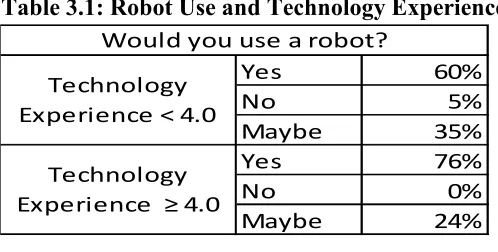
Table 3.1: Robot Use and Technology Experience ... 27
Table 3.2: Assistance Preference Checklist ... 29
Table H.1: Demographics- Gender and Age... 72
vii
LIST OF FIGURES
Figure 2.1: Demographics of Workforce ………..13
Figure 2.2: Demographics of Management ………..15
Figure 3.1: General Technology Experience ………19
Figure 3.2: Robot Use ………20
Figure 3.3: Perceived Usefulness ……….21
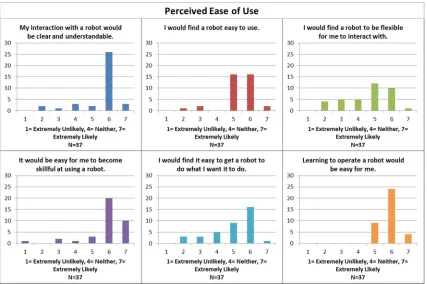
Figure 3.4: Perceived Ease of Use ………22
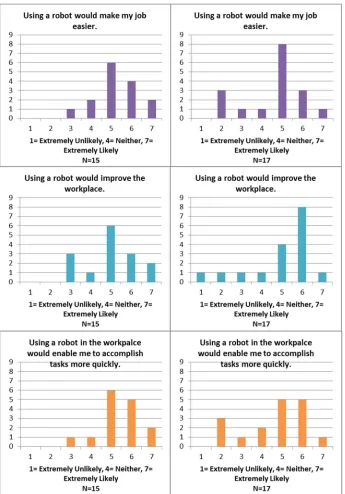
Figure 3.5: Perceived Usefulness Comparison ……….24
Figure 3.6: Perceived Ease of Use Comparison ………26
Figure 3.7: Robot Opinions Based on Technology Experience ………28
Figure 3.8: Assistance Preference Checklist Boxplot ………..30
Figure 3.9: Training Statements……… 32
Figure 3.10: Statements Ranked Most True ……….33
1
CHAPTER 1: INTRODUCTION
The purpose of my thesis was to investigate industrial robot acceptance in a
manufacturing facility. As industries adopt advanced technologies, the workforce and
workplace must adapt to change which has not yet been measured or explored in detail.
Many existing studies have not analyzed the relationship between industrial robot
acceptance and workplace culture. This thesis was exploratory in nature and focused on
industrial robot acceptance as it pertains to conditions of acceptance, culture and
demographics. Due to its exploratory aims, this project focused on a single workplace site
to draw a preliminary understanding of the factors that influence industrial robot
acceptance. I investigated the boundary and facilitating conditions of industrial robot
acceptance and was guided by two main topics of focus. First, this thesis evaluated those
factors of acceptance in comparison to the site’s workforce demographics and descriptors
(e.g., age, experience). Second, my research explored avenues in which the
manufacturing site could establish a culture that fosters technology adoption of industrial
robots. This research did not include the actual adoption via robot introduction but used
the employees’ perception to make conjectures.
Industrial Robots
Industrial robots are considered to be a radical technology. By ISO8373,
industrial robots are defined as automatically controllable, reprogrammable, multipurpose
2
(IFR.org). The industrial robot market accounted for greater than four billion dollars with
a growth rate of four percent per year in 2005, and is now valued at over twenty-nine
billion dollars in the US alone. (Kumar, Bekey, & Zheng, 2005, IFR.org). Most industrial
applications are in material handling or welding, however industrial robots can also be
assemblers, palletizers, or painters.
Typically industrial robots are contained to the workplace environment and have
repeatable programmable tasks, which compared to personal robots, require less social
interaction between a human operator and the robot. Although much of the work in the
field of human-robot interaction (HRI) has been conducted within the scope of personal
robots, HRI still plays an important role in industrial robotics because as such robots
become more advanced, they are more likely to work collaboratively with people (Guizzo
& Ackerman, 2012). Thus, it is crucial to understand HRI within an industrial
application.
HRI has five main components, which include the robot, the human, the
interaction between the robot and human, the environment in which the interaction takes
place, and the specific tasks to be completed. Environment, or physical space, is of
particular interest. This is because the environment is both a part of an organization’s
culture and it includes the physical space in which a robot would interact with a human.
Culture has been found to be a boundary condition to robot acceptance specifically if the
culture is stagnant or resistant to change (Straub, Keil, & Brenner, 1997). I define a
boundary condition in this context as an obstacle or challenge to overcome. Similarly, a
facilitating condition is one that promotes or furthers the acceptance or object itself.
3
there is high social interaction between the two. However, industrial robots typically have
little social interaction; yet, the existence of the human and robot is in a physical space
that can affect the acceptance of robots due to varying elements of workplace culture.
There is no one prevailing, correct definition of culture. Culture, for the purposes of this
research, encompassed the physical space, people, behaviors, and team environment of an
organization (Robbins, 2013).
Industrial environments have not been observed or assessed in regards to robot
acceptance. Early research has been focused on managerial influence on workplace
culture and attitudes in a standard corporate setting to provide an advantage over
competitors (Bellot, 2011). Many HRI frameworks also ignore task or environment while
focusing on aspects of the robot, like design and usability (Hancock et.all, 2011). The
Technology Acceptance Model, Unified Theory of Acceptance and Use of Technology
and Task-Technology Fit Model generally center on incremental technology acceptance.
Incremental technology acceptance refers to a series of small developments for
continuous improvement. Industrial robots on the other hand, are regarded as radical
technologies; industrial robots are not an adaptation or a series of small developments
(Smarr, Fisk, & Rogers, 2013). Industrial robots are implemented as a new technology
and entirely new product. Thus, the existing technology acceptance models are
applicable, but are likely not the best representations of industrial robot acceptance.
Despite this, these models and frameworks provided a starting point for understanding
this problem space by suggesting some variables that might be important for industrial
robot acceptance. The following sections consider some variables that likely influence
4
Perceived Usefulness and Perceived Ease of Use
There are varying levels of robot acceptance to include perceived usefulness and
perceived ease of use (Chen & Chan, 2011; Davis, 1989; Ezer, Fisk, & Rogers, 2009).
These studies have found that there is an increased desire to accept and value technology
that will enhance daily life. If the technology makes a task easier, enhances convenience
or supports current everyday activities, it is deemed useful. Additionally, if the
technology is easy to facilitate, users are more inclined to use the technology and have
positive attitudes towards the technology. However, studies also found older adults
generally have a lesser interest in adopting new technology and are less likely to use new
technology than younger adults (Chen & Chan, 2011). One limitation of this research,
within the context of this proposal, is that the technology that was investigated mainly
operated within the home and related to domestic actions. Therefore, there is an absolute
need for observation and research relating to robot acceptance within an industry. This
thesis project explored the perception of industrial robots and acceptance from the
workforce. The study was not to be limited to a specific age in order to confirm or refute
existing frameworks about age and technology adoption. Technology might also affect
culture, in addition to the fact that culture affects technology acceptance. Industries must
remain competitive in today’s technological environment which may infer that newer and
radical technologies are unavoidable. A workforce may not have the option to adopt
certain technologies.
Demographics of the Workplace
This project collected demographics and descriptors about various constructs,
5
are stereotypes about age-related performance and mental abilities regarding an aging
population (i.e., called “ageism”). Stereotypes include being incompetent when compared
to younger generations and more dependent on assistance like additional training or
traditional work methods that do not include the use of technology. Older adults tend to
suffer the effects of these stereotypes as studies found that older workers receive less
support for learning and development (Lee, Czaja & Sharit, 2009). Additionally, with
technology-based employment, it is the aging population that must engage in training to
remain competitive. In relation to technology adoption and perceived usefulness, training
and development is influenced by factors such as perceived benefits of participation and
self-efficacy. The older adults whom believed that they were indeed capable of
improving or learning new skills tend to be more likely to participate in training classes
(Lee, Czaja & Sharit, 2009). Due to changes in work demands and shifting
demographics, an active learning process is emphasized as optimal for older learners
(Lee, Czaja & Sharit, 2009). Gathering information about workforce will allow this
research to discover any demographic related themes that may exist within the
manufacturing site.
One way to battle against ageism is to establish a supportive workplace culture. A
responsive and welcoming culture can also impact robot acceptance because it has been
said “a company’s cultural characteristics can inhibit or defeat a reengineering effort
before it begins” (Detert, Schroeder, & Mauriel, 2000, pp. 850). Technology adoption
and radical innovations can, in theory, not succeed without a supportive culture. Culture
includes the physical space, people and behaviors and the team environment. The
6
supports employees” (Brower, 2014). An organization with a dedicated space to celebrate
and build camaraderie supports positive organizational behavior amongst employees.
This dedicated space can be communal, such as a location where meals are shared to
include tables or cafes. Identified spaces can be indoor, outdoor or even multi-functional
to take on a variety of events. Each physical space should be a focal point with an
intention of use.
Physical spaces are occupied by people with behaviors. The main components of
individual attitudes include cognitive, affective and behavioral. First, cognitive attitudes
are defined as the description or belief in the way things are (Robbins, 2013). These
attitudes are a person’s evaluation about an object, being or situation. Second, affective
attitudes include a person’s emotions or feelings. Lastly, behavioral attitudes are one’s
actions of behaving in a certain way. There are also major job attitudes within culture.
Job attitudes include job satisfaction, job involvement, perceived organizational
support and employee engagement. Job satisfaction is defined as the contentment an
individual about their work or occupation. Job involvement is the employee’s belief in
the extent to which they influence their work environment. Involvement also includes
how meaningful one feels their job is. Perceived organizational support refers to the
support of the organization for the employees. Employee engagement is the involvement
of the employees in the organization itself, whether this is new developments or state of
the business. According to Detert and Schroeder, “Shared vision and shared goals among
employees and management are critical for organizational success. Because of this, all
employees should be involved in meaningful ways in the decision-making about the
7
The third component of culture is team environment. Team environment is
directly related to people and behaviors, specifically major job attitudes. Team
environment includes how employees perceive the characteristics of an organization’s
culture. Environments of an organization can include having attention to detail. It also
includes being innovative and risk taking, outcome orientated, people orientated, team
orientated, aggressive and stable.
Demographics of the workplace of interest include age, the physical work
environment, physical spaces and the team environment. All components and variables
played a role in robot acceptance. It was hypothesized, that if the culture and individuals
within the culture are not supportive of change and radical technology, the reception
would be limited. Therefore, it was important that the workplace demographics be taken
into account when evaluating robot acceptance within this particular manufacturing
facility.
Measuring Culture
There are multiple ways in which culture can be measured. Most studies measure
culture quantitatively (e.g., surveys), qualitatively (e.g., interviews), or using mixed
methods which is a combination of the two previously mentioned. Quantitative
measurement contains the “numbers” collected through surveys. Qualitative analysis is
oppositely, the “words” gathered through the use of interviews, focus groups, participant
observation and document review, to name a few examples. Because there is no one true
definition of culture, focus areas for culture quantification and research differ greatly.
Mannion, Davies and Marshall (2003) posit that instead of choosing one best instrument
for cultural assessment, “the choice of instrument should be determined by how
8
investigation, intended use of the results and availability of resources” (Bellot, 2011).
Hofstede used open-ended questions, standardized surveys, questionnaires and personal
interviews. His use of mixed model assessments is considered to be a precedent set for
thorough culture evaluations (Hofstede, et.all, 1990).
Surveys are the most popular method to gather information with custom-designed
measures (CR Magazine, n.d.). A high consensus amongst respondents is indicative of a
strong and integrated culture while a lower consensus correlates to differentiation and a
weaker culture. Differentiation could mean that there are many sub-cultures within the
organization’s culture. No agreement amongst participants points to no established
culture and much fragmentation within the establishment. The optimal time for
qualitative measurement is within the first two to six months of evaluation. Subsequently,
quantitative research is executed post the qualitative portion and it should not exceed
eleven to fourteen months.
Changing Culture
Resistance to change and creating a culture to support change are subjects of
interest for many industries. Innovative companies must undergo more change in terms of
technology than mature product market-producing companies to remain competitive in
their industry. However, there has been little effort to discern what dimensions of
organizational culture relate to the implementation of such innovative or change
programs (Detert, Schroeder, & Mauriel, 2000). It is known that incorporating change
can be positive if it leads to open discussion and debate. To overcome employees’
resistance to change, a business must educate and communicate with the people.
Participation is important as a company must build the support and commitment of its
9
significant obstacle for industries (Brower, 2014). These costs include implementing
training programs or hiring people open to change, but losing the knowledge of the aged
workforce.
Innovative organizations tend to have similar cultures. These cultures promote
experimentation, reward successes, encourage failures and celebrate mistakes. Innovative
organizations align with technology by actively promoting training and development in
order to keep the employees “most current”. Companies that have greater technology
availability tend to have more employee work-life supports. Greater job satisfaction and
organizational citizenship behavior in turn leads to positive relationships (Robbins,
2013).
To promote a positive and cohesive culture, organizations can improve the
physical space by making it more attractive to employees (Brower, 2014). Businesses can
offer places for employees to meet and connect with one another. Some examples include
meeting rooms or inviting spaces with food and drinks, like common areas or lunch
rooms. Keeping the space fresh and changing will allow for creativity. The creativity
should be fueled by people’s ideas about how to use the space. There is also an optimal
level of density. Positive behaviors and social conditions can result from physical
surroundings that are “inspiring, stimulating and not too dense” (Brower, 2014).
Purpose of Proposed Study
Robot acceptance within an industry has not been investigated within the context
of a manufacturing site and culture as it was presented in this research. Industries are
becoming more technologically innovative with new products and the methods required
in creating those new products. As industries evolve, the workforce must also be
10
example, but with the use of such advanced technologies in daily tasks. This project is
important because it researched how a manufacturing site can promote a culture of robot
acceptance and identify probable facilitating and boundary conditions of acceptance.
Main components of a company include the workforce and the workplace, or
organizational culture within it. Certain aspects within culture are found to be hurdles
when it comes to industrial robot acceptance; however they have not been measured
(Straub, Keil, & Brenner, 1997). The means in which a manufacturing facility can
influence the culture to promote innovation, change and acceptance also required
exploration. For older learners, providing feedback is extremely important throughout the
educating process but to what lengths does an organization go to incorporate active
training in the culture? Thus, the proposition of my thesis was to:
• Investigate acceptance of industrial robots in a manufacturing facility in
regards to its workforce
• Identify the boundary and facilitating conditions of industrial robot
acceptance
• Understand how a manufacturing site might establish a culture that fosters
11
CHAPTER 2: METHODOLOGY
A mixed methodology was used to investigate the effects of an aging workforce
on industrial robotic acceptance. Quantitative surveys and qualitative interviews were
employed to determine the extent to which manufacturing sites can be limited, or
facilitated, by its workplace culture. The site for which data collection took place for this
project fabricates one category of manufactured goods and is continuously supporting the
introduction of new products. The site is currently the only kind for the company in the
world that manufactures this product. The facility has been in its current industry location
since the 1980s. It is a non-union facility with approximately 220 manufacturing
personnel that assemble and test the product, 10 members of manufacturing management
and 10 support staff. Manufacturing employee demographics include the following: 1)
more than 50% have tenure over 15 years 2) approximately 40% are over 50 years of age
and 3) 75% to 25% male to female ratio. For this project, there were multiple focuses for
12
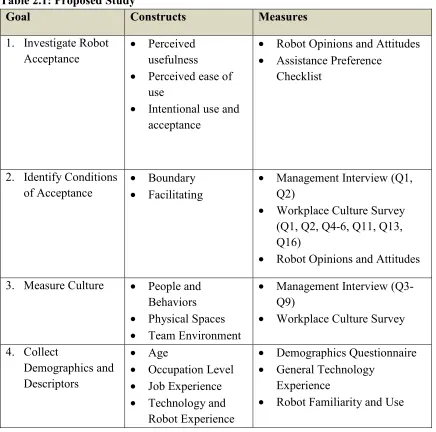
Table 2.1: Proposed Study
Goal Constructs Measures
1. Investigate Robot Acceptance
• Perceived usefulness
• Perceived ease of use
• Intentional use and acceptance
• Robot Opinions and Attitudes • Assistance Preference
Checklist
2. Identify Conditions of Acceptance
• Boundary • Facilitating
• Management Interview (Q1, Q2)
• Workplace Culture Survey (Q1, Q2, Q4-6, Q11, Q13, Q16)
• Robot Opinions and Attitudes
3. Measure Culture • People and Behaviors • Physical Spaces • Team Environment
• Management Interview (Q3-Q9)
• Workplace Culture Survey
4. Collect
Demographics and Descriptors
• Age
• Occupation Level • Job Experience • Technology and
Robot Experience
• Demographics Questionnaire • General Technology
Experience
• Robot Familiarity and Use
Part A: Survey (N=37) Study
Participants: Distribution of surveys to manufacturing personnel resulted in a
response from 37 out of a population of approximately 220 manufacturing personnel.
Although not all respondents reported gender or age, 91.43% were males. On average,
13
respondent did not report their gender and five did not report their age. The average age
for the sample size was 41.37, SD = 11.42, Median = 42 years.
Figure 2.1: Demographics of Workforce
Surveys were administered in a conference room or private office during the
employee’s normal shift working hours. There were no supervisors present, and all data
was kept confidential with no descriptions as to reveal the identity of the employee. Each
survey completion lasted approximately 30 minutes.
Survey Procedure: We determined how the current workforce perceives
technology and advanced technology adoption. To do this we distributed multiple
surveys. The surveys focused on the following topics (Appendices A-E):
• Demographics Questionnaire
• General Technology Experience
• Robot Familiarity and Use
• Robot Opinions and Attitudes (Perceived Usefulness & Perceived Ease of
14 • Assistance Preference Checklist
We also examined the role of culture; surveys administered to all employees
determined whether there is one strong and integrated culture, a weaker culture, or no
established culture based on employee viewpoints or beliefs as referred to byRousseau
and Cooke (1988). The Workplace Culture Survey, framed from the Development and
Use of the Organizational Culture Profile by O’Reilly and colleagues (O’Reilly,
Chatman, & Caldwell, 1991), focused on the employee’s perception in the following
areas:
• People and behaviors (i.e. job satisfaction, training)
• Team environment (i.e. organizational support)
• Physical space (i.e. common areas, lunch rooms)
The surveys collected robot usage and acceptance, culture information and
demographic details (Reference: Demographics Questionnaire) about the workforce.
They also assessed technology adoption in general.
Part B: Interview (N=8) Study
Participants: Interviews were only given to site management to examine if there
were any misalignments in opinion between management and the workforce. Because
management does not assemble or test the product, the surveys were not applicable for
this sample. Therefore, qualitative questions were used to gain a better understanding of
their perceptions on the site’s culture. Eight interviews were conducted with
manufacturing management. Of those eight, one member was female and two omitted
their age. The average age of the six respondents was 43.67 years, SD = 7.76 years. The
15
twenty nine with M= 17.19 years. Four managers had an education level of a Master’s
Degree and four managers had a Bachelor’s Degree.
Female Male 7 6 5 4 3 2 1 0 52 48 44 40 36 32 2.0 1.5 1.0 0.5 0.0 Gender_1 Fr e q u e n c y Age_1 Demographics
Figure 2.2: Demographics of Management
Interview Procedure: Qualitative interviews were conducted to assess the
perception of culture and technology adoption from site management. The Demographics
Questionnaire was also administered for site management for descriptive purposes, as
well as correlations between responses. This expanded upon the quantification of culture
and the extent to which the environment can promote the acceptance of change from a
management perspective. Next, interviews were administered in a conference room or
private office with only the interviewer and the interviewee. The interviews were audio
recorded and as expected, the sessions lasted approximately 30 minutes. Examples of
interview questions from the Management Culture Interview include:
• How would you describe manufacturing employees’ acceptance of
change?
16
• How do you think the manufacturing personnel perceive management?
• How do you perceive the workforce regarding job satisfaction in the
industry’s current state?
• What opportunities does the site provide for the employees to work cross
functionally or in teams?
• In your opinion, is there a shared vision across the site with specific goals?
• Describe how the site may or may not empower its employees to go above
and beyond their daily roles and responsibilities.
• Do you see employees take initiative to work in teams or side projects, if so how?
Data Analysis
Part A Survey Study: Surveys in Part A were assessed using descriptive and
correlational statistics. The surveys were analyzed with a variety of goals. First,
demographics, technology experience, and robot experience were assessed for descriptive
purposes. Reports of means, ranges, and standard deviations of these data provided
information regarding the participants’ overall descriptors, but also for determining
descriptive differences between the older and younger employees.
Assistance Preference Checklist was assessed to gain an understanding of the type
of help robots may provide to employees. The ordinal data was averaged, so that the
means could be used in analysis. Means, medians and quartiles from this questionnaire
were used to compare groups of actions to determine if the participant responses were
different from the mid-point response.
Workplace culture was determined by a questionnaire based on O’Reilly and
17
regression, thus our findings on culture is descriptive in nature. Participants were asked
to rank 18 statements about culture (see Appendix F), from least true to most true. Each
statement was given a rank-order number, so that the frequencies of statements
considered most true or least true could be compared amongst the respondent group.
Ranks from 1-9 were considered least true while ranks 10-18 were considered most true.
A smaller subset of statements was chosen due to the scope of this project and focus on
the relationship between the site’s culture and industrial robot acceptance.
Robot opinions provided data on employee’s perceptions of robot ease of use and
usefulness (i.e., robot acceptance). Similarly ordinal data was assessed using frequency
counts. Furthermore, acceptance was assessed to determine if it is correlated with age,
technology or robot experience, or participant’s perceptions of workplace culture.
Part B Interview Study: Interviews were analyzed according to a qualitative
coding scheme to identify patterns and themes from the discussions. To do this,
interviews were transcribed, then segmented into units of analysis (i.e., a segment may be
determined as any utterance in which a though or opinion related to robot acceptance and
culture is mentioned). Next, a coding scheme was developed to categorize each segment.
A coding scheme is an organized categorization of the information in the interviews. The
coding scheme was based on both the literature and the nature of the participant
comments. In other words, an initial coding scheme was developed top-down, so that it
depicts themes already known to be related to culture (i.e., physical space, employee
behaviors, etc.) or robot acceptance (i.e., usefulness, ease of use, etc.). Then an iterative
category generation strategy was used to complete the coding scheme. In this approach,
18
category already included in the coding scheme, or assigned a new category label that
described the general idea of that segment (i.e., a bottom-up approach). Therefore, each
19
CHAPTER 3: PART A SURVEY RESULTS
Technology and Robot Experience Findings
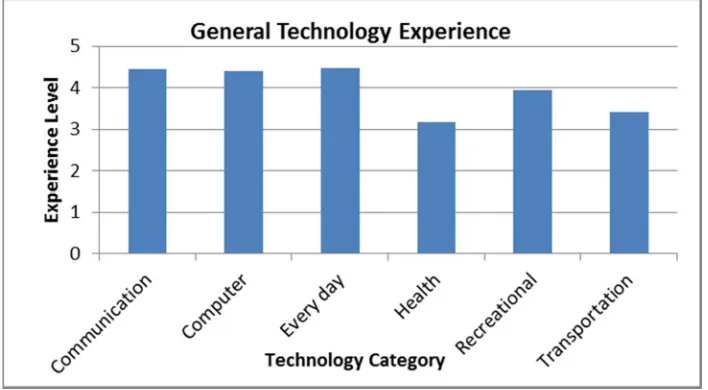
Based on the General Technology Experience questionnaire, participants did not
report a frequent exposure to communication, computer, every day, health recreational, or
transportation technologies (Ref: Figure 3.1: General Technology Experience). On
average, the personnel reported occasional to frequent use of communication, computer
and every day technology, occasional use of recreational technology and one time use of
health or transportation technologies.
Figure 3.1: General Technology Experience
In addition to unfamiliarity with general technology, industrial robot familiarity
was measured with the Robot Familiarity and Use Questionnaire. (Response scale: 1=
Never heard about, seen, or used this robot, 2= Have only heard about or seen this robot,
20
frequently). The average response was a 1.96 (SD= 0.66). Based on this sample mean
with 95% confidence, it is estimated the larger population at the site would result in a
response range of 1.75 to 2.17. This approximation means that the workforce at this site
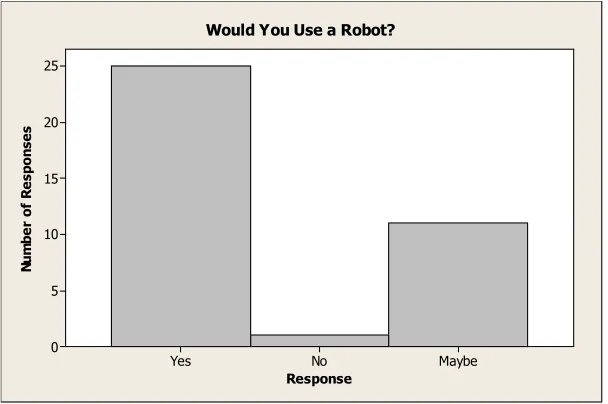
may be unfamiliar with robotic technology as well. Although the majority of individuals
were unfamiliar with various robot types, 67.57% respondents indicated that they would
be open to using a robot.
Maybe No Yes 25 20 15 10 5 0 Response N u m b e r o f R e s p o n s e s
Would You Use a Robot?
Figure 3.2: Robot Use
Robot Acceptance: Robot Opinions Survey and Assistance Preference Checklist Findings
Robot Opinions:
Robot acceptance was investigated with two primary measures: Robot Opinions
Survey and the Assistance Preference Checklist. These surveys measured perceived
usefulness, ease of use, intentional use, and preferences for use (Davis, 1989; Ezer, Fisk,
& Rogers, 2009).
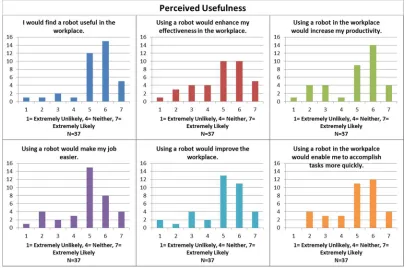
General opinions of robots (Ref. Robot Opinions and Attitudes Survey) response
21
3.3 and 3.4: Perceived Usefulness and Perceived Ease of Use, the collective response to
the twelve questions is skewed towards ‘likely’ responses. A majority of those surveyed
stated that a robot would be useful, enhance effectiveness, increase productivity, make a
job easier, improve the workplace and allow tasks to be completed quickly. In addition, a
majority of the workforce also thought robots would be easy to use. This is shown with
the same pattern that a majority of responses are in the ‘likely’ responses. Specifically, it
is supposed that the interactions would be clear, it would be easy to become skillful and
learning to operate the robot would not be a challenge. The employees in general believe
they would likely have positive interactions with robots. This leads to the assumption that
the respondent group would be open to robots in the workplace, as they are perceived to
be useful and easy to use.
22
Figure 3.4: Perceived Ease of Use
Data was also sorted according to the employees’ median age of 42 years. The
median age was chosen because for this workforce, it reflects two age groups- a younger
and an older (although not aged), approximate in sample size for ease of comparison.
Both age groups would still be accepting if the robots were perceived easy to use and
useful, however there are slight differences amongst 42 years of age and older. Those ≥
42 years (N=17) had responses of “unlikely” at least once for every question relating to
usefulness. Those < 42 years (N=15), had no responses in the extremely unlikely (i.e.
response of 1) or quite unlikely (i.e. response of 2) as shown in Figure 3.5. Similarly,
those ≥ 42 years, were less sure (i.e., responses “slightly likely”; “no preference”; and
“unlikely”) if it would be easy to become skillful at using a robot, if robot would be
23
that although less sure, those above the median age believed a robot would be flexible to
interact with, more so than those < 42 years. The average weighted response was 4.8 for
≥ 42 years and 4.4 for < 42 years. There is also no or little difference amongst the age
24
operate a robot would be easy.(M improve workplace, < 42= M improve workplace ≥ 42= 5; M learning to
operate, < 42= 6, M learning to operate ≥ 42= 5.82).
26
Figure 3.6: Perceived Ease of Use Comparison
Robot Opinions and Attitudes were also evaluated in relation to participants’
technology experience. The data was divided into two groups, 20 employees with a
technology experience average of < 4.0 indicating technology is used once or less and 17
27
found those with a greater experience level of ≥ 4.0 were more likely to have favorable
opinions of robots amongst all 12 questions relating to perceived ease of use and
perceived usefulness, as shown in Figure 3.6. Following the same pattern, question 13,
“Would you use a robot?” returned a greater response for “Yes” of with those that have
more technology experience. Table 3.1 shows there may be a relationship between less
technology experience and hesitance towards robot use. A two sample t-test was
calculated for the response of robot opinions based on technology experience. This
resulted in a rejection of the null hypothesis (p=0.002, α=0.05) concluding there is in fact
a significant difference in response values between those with less technology experience
(< 4.0) and those with more experience( ≥ 4.0).
Table 3.1: Robot Use and Technology Experience
Yes 60%
No 5%
Maybe 35%
Yes 76%
No 0%
Maybe 24%
Technology Experience < 4.0
Technology Experience ≥ 4.0
28
Figure 3.7: Robot Opinions Based on Technology Experience
Assistance Preference Checklist:
The Assistance Preference Checklist measured participants’ preferences for
human and robot assistance for 21 workplace tasks (Response scale: 1= Only a human,
2= Prefer a human, 3=No preference, 4= Prefer a robot, 5= Only a robot). In this
checklist, participants indicated who (robot vs. human) they would prefer to assist them,
if they needed help performing certain tasks. Interestingly, the participants’ preferences
were very task-dependent. Manual tasks that use technology such as calling for
assistance (i.e. stockroom, support) or using the computer data-entry system (i.e. eDHR,
password entry) resulted in a preference toward human assistance, with means lower than
3.0 (3.0 = no preference). However, the remainder of manual tasks such as using hand
29
items, listed in Table 3.2, pertaining to specialized, tedious or non-ergonomic tasks like
soldering, lifting heavy parts, installing or picking hardware, moving kit carts, sweeping,
bending down to the floor or over reaching above head or climbing to reach parts resulted
in a slight preference for robotic assistance, with means greater than 3.0.
Table 3.2: Assistance Preference Checklist
A visual representation of the assistance preference results (Ref: Assistance
Preference Checklist Survey) is depicted in Figure 3.8. The actions are listed next to the
respective box-plot indicating the range, lower and upper quartiles and median of
responses. The response for 3.0= No preference is highlighted in bold to emphasize the
preference to the left or right of the centerline. Left of the line contains responses of a 1
or 2 identifying human preference and right of the line shows responses of a 4 or 5
Preference Type Range Actions Mean (M)
Calling a support specialist or PE 1.73
Typing username and password 1.97
Completing tasks in eDHR 2.03
Calling the stockroom 2.11
Using hand tools 2.86
Unwrapping parts 2.92
Walking on flat ground 2.97
Putting away tools 2.97
Taping floor/re-labeling 3.00
Aligning parts or components 3.16
Installing nuts and bolts 3.27
Disinfecting 3.30
Holding parts during install 3.30
Moving a kit cart 3.32
Picking hardware or piece parts from bins 3.32
Sweeping area 3.32
Climbing five steps to get part 3.46
Soldering (if applicable) 3.49
Bending down to floor 3.51
Reaching above head 3.65
Lifting heavy parts 4.22
M < 3.0
M ~ 3.0
M > 3.0 Robot Assistance
30
identifying robot preference. The actions from the survey are grouped into manufacturing
related categories, color-coded for ease of comparison. For example, the two tasks in the
Reach category, presented in purple, resulted in robot preference.
31
Workplace Culture Survey Findings
Additional boundary and facilitating conditions were identified from the
Workplace Culture Survey. Employees were asked to rank eighteen statements from an
order of least true to most true. The statements and their rank order were analyzed for
agreement amongst responses and order of rank highlighting potential themes or topics
within the culture. For this survey, one employee omitted questions thirteen and fourteen,
one employee omitted question two and one employee chose not to partake. Items ranked
one through nine were least true, while ten through eighteen were most true. From the
survey, training, job security, and qualities of innovative companies were topics that
could be boundary conditions to acceptance due to lack of manufacturing consensus or
importance. One facilitating condition is the existing workplace demands. The following
sections address each of these boundary/facilitating conditions.
Training:
Statements four, five and six from the Workplace Culture Survey pertain to the
employee benefitting from more training to meet current work demands, desire for more
training and importance of providing training, respectively. Benefitting from and the
desire for more training were not the highest in any ranking however, approximately 64%
and 60% rated the statements as most true (in positions ten to eighteen). Seen in Figure
3.9 and 3.10, training ranks as desired amongst respondents as the number of occurrences
increases as the rank order increases towards most true. This indicates the employees
32
Figure 3.9: Training Statements
Actually, 13.89% wanted more training to meet current work demands ranking
this need as second to most true. 86.11% also rated the importance of training courses for
employees as most true (in positions ten to eighteen). All training related statements
indicate the industrial workforce could benefit from training, wants more training for
current work demands and thinks it is most important for an organization to provide
33
Figure 3.10: Statements Ranked Most True
Job Security:
Job security was identified as a second boundary condition. There was no
consensus amongst the manufacturing employees regarding job security. The lack of
agreement is seen when asked to rank the statement “I have good job security”. 47.22%
ranked the statement in a lesser true position while 52.78% ranked the statement in a
more true position. Also, 52.78% state their current position is not the perfect job for
them. With almost a fifty-fifty split amongst those surveyed, I did not find evidence of
34
Figure 3.11: Job Security
Innovativeness:
A third boundary condition to acceptance related to characteristics and attractive
physical spaces of innovative companies. Innovative organizations encourage failures,
celebrate mistakes and promote training (Robbins, 2013). When asked if the site was
innovative, 16.67% rated the statement was the second most true and 61.11% ranked the
statement as generally most true (in positions ten to eighteen). However, 77.78% do not
agree with the statement, “My workplace encourages failure and learning from mistakes”.
A main trait of an innovative organization was not found from the site culture survey.
The lack of agreement between the two statements regarding innovation and culture
insinuates that a boundary condition may exist. This boundary condition would be the
alignment of the company with truly being innovative, adopting all characteristics as
research suggests. To be truly advanced, the site must develop the culture and adopt
qualities that are shared amongst innovative organizations, such as promoting
35
also found to be unattractive. Rated as the some of the least true statements, the physical
spaces such as the cafeteria and break areas are not ideal and unappealing for the
workforce. An organization with a dedicated space to build fellowship supports positive
organizational behavior amongst employees; this dedicated and updated space was not
found to exist at the site.
Work Demands:
One facilitating condition identified was the current work demands.
Approximately 55% and 72% of those surveyed believe they are able to meet their
current work demands and did not think the workplace expects too much from its
employees. Furthermore, 66.67% are satisfied with their career path. Thirty one of the
thirty six respondents consider their job meaningful to themselves and those around them.
Thus, if a new robot technology were to be introduced, it is theorized that the workforce
would have adequate means to spend time with the new technology without adding extra
stressors to their daily workplace.
Constructs of Culture:
In addition to identifying existing boundary and facilitating conditions, three
constructs of culture were measured developing to a hypothesis about the existing culture
at the site. Based on the employees sampled, the manufacturing site has a weak culture.
Only two statements from the Workplace Culture Survey had greater than 50%
agreement by the employees in the top four rank orders for least true. There was little
agreement for the statements rated most true; the highest number of employees that
agreed on statement rank ranges from four to nine. However, if broadening the field of
36
60-70 percentiles. Thus, there appears to be a culture but it is not integrated nor aligned
37
CHAPTER 4: PART B INTERVIEW RESULTS
Interviews of eight managers revealed potential boundary and facilitating
conditions to acceptance of change and site culture. Site management was misaligned
with the shared vision and goals of the facility, communication and opportunities for a
strong team environment. There was relative agreement regarding overall job satisfaction.
The following sections address these conditions and constructs from the management
point of view.
Acceptance of Change:
To battle against resistance to change, an organization has to educate and
communicate with the people; it must build the support of its workforce (Brower, 2014).
Communication and support are key factors for a workforce to accept change, especially
of such radical technologies like industrial robots. When discussing how the site
specifically introduces or promotes change, only four managers emphasized
communication as being critical for reaching out to employees and establishing an open
atmosphere. Of those four, two managers do not believe the site communicates well. “I
don’t… think we do a good job of providing a ton of communication and a ton of
information of why a decision is made or why a change is happening” said one manager.
Another stated, “I think because we choose to only communicate to the broader employee
population once a quarter, a lot of people are left in the dark about the nature of change
and what’s going on.” Five managers also mentioned “resistance” or “hurdles” when
38
newer, less experienced… tend to be more open to… trying new things.” Three of the
managers did consider the workforce “generally accepting” with a 7/10 towards good
acceptance of “low to no hurdles”.
Although communication may hinder the acceptance of change, there does appear
to be agreement regarding support for employees. When asked if the interaction between
management and manufacturing personnel is supportive, seven managers openly said,
“Yes” while one stated “I think it’s we over here”. The manager referred to “we” as a
cohesive management-employee relationship as opposed to two separate identities. Thus,
managers believed they provide employees with the needed support throughout the
workplace. The support would theoretically help to battle against employee resistance to
change.
For employees to be fully supportive, including introduction of change, the site
management and employees must also have a common vision. The theme of a shared
vision and goals across a site are essential for success. Every employee “should be
involved in meaningful ways… about the vision and goals they are asked to support”
(Detert, Schroeder, & Mauriel, 2000). There was a slight consensus, at best, regarding a
vision and goals between the site management. Two managers indicated there was no
shared vision or that there could be indicators but no explicit goals. “I don’t think if you
asked 100 people, could be management, could be production associate, would be able to
give you some tangible goals…” Of the six remaining replies pertaining to the site’s
goals, five managers mentioned quality, four mentioned safety, and six highlighted cost
or financial metrics.
39
People and their behaviors, including job satisfaction, largely shape the
workforce. Seven out of eight managers believed the workforce was pleased with their
jobs using key words such as happy, fairly or overall satisfied. Five managers actually
attributed the satisfaction to the pay, wage, benefits and hours at the facility. Comments
such as “well treated from the standpoint of pay” and “highest paid in the area and in the
state for what they do” resonate as themes throughout the interviews.
Team environment is also a main component of culture. This portion of the study
suggest that from site management’s point of view, there were multiple opportunities to
work in teams; however, employees at the site may not have been motivated as there was
a lack of initiative to do so. A common trend throughout the interviews included team
opportunities for lean activity, special projects and EHS (Environment, Health and
Safety) to benefit the business or company. Five managers did recognize a potential for
improvement, which alludes to self-awareness from management. “I would say we have
some [opportunities to work in teams], but… we probably should have more,” said one
manager. Others stated, “I don’t think there’s as much initiative as it used to be”, “No… I
don’t see initiative to work in teams” or “I see it [initiative to work on teams or go above
40
CHAPTER 5: DISCUSSION
Summary of Findings
This study is important because it investigated industrial robot acceptance in
relation to workplace culture. Although the project was largely exploratory, it identified
several preliminary factors that may influence robot acceptance. Certain trends emerged
from the questionnaire and interview data as descriptors such as age and experience were
used to gauge robot opinions and constructs of the site’s culture were explored. Age may
not play a significant factor in industrial robot acceptance and a lack of technology
experience may cause hesitation regarding robot acceptance. Top themes as boundary
conditions within the identified weak site culture pertain to the importance of training,
chance to work in teams and attractiveness of space.
The manufacturing personnel will be accepting of industrial robots and advanced
technology if it is perceived to be useful and it is easy to use. Survey responses that gaged
these factors resulted in ‘likely’ responses when asked various questions pertaining to
robot opinions about use and interactions. Grouping the robot opinions by the median age
did not result in strong differences in viewpoint. However, if grouping the data by
technology experience, those with more exposure seemed to more open to the use or
introduction of a robot in the workplace. Despite the general acceptance among the
workforce, the preferences for human vs robot assistance did vary by task. Specialized
and physical tasks, such as soldering, lifting heavy parts or reaching over head resulted in
41
usefulness of the robot. If the employee is unable or limited by their physical capabilities,
the robot would allow them to fulfill the demands of their job more easily. In addition,
tasks that require dexterity or fine motor skills such as installing nuts and bolts or
communicating to another individual did not result in robot preference.
Training as the first culture related theme has the potential to be a boundary
condition to robot and technology acceptance. This is evident from the employees
ranking statements about training as some of the truest statements. In conjunction with
the thought that training is very important, there was evidence that the existing workforce
did not believe training was currently adequate. Therefore, if a new technology were to
be introduced, there would need to be an emphasis on training to achieve the acceptance.
The Robot Opinions survey showed the employees would be open and accepting if the
technology is easy to use and useful. Yet, if there are no sufficient teachings for the
employees to see the benefit, it is hypothesized that the workforce will object to the
advanced technology. Also, because the workforce desires more training for current
demands, the site may have a longer roadmap to successful implementation from a
culture standpoint. If introducing a complex technology like a robot, existing training
should be mitigated before extra training is required. Minimizing this conflict would
ensure a smoother transition and more agreement amongst employees for a theme
(training) ranked as high importance.
The site’s weaker culture also expanded into the manufacturing employee and
management interaction. Management was in relative agreement on the topic of job
satisfaction due to the competitive wages and benefits; however there was no consensus
42
agreement, the implementation of a radical technology may actually skew the opinions
regarding job security causing increased dissatisfaction. A lack of understanding of the
technological benefit could add negative feelings due to the thoughts of “human
replacement” instead of teamwork, like human-robot interaction. Additionally, there were
differences in regards to shared vision and goals and the opportunity or availability to
work on teams. There is even discrepancy between management in regards to the site’s
shared vision and goals which has translated down to the workforce. When asked to rank
the statement, “I share the same values as my organization”, 16 manufacturing employees
listed it in a rank order of 1 to 9 (less true) while 20 placed the statement in a rank order
of 10 to 18 (more true). There is little indication regarding the agreement of the vision
throughout the facility.
The team environment at the manufacturing site was not very strong as indicated
by the Workplace Culture Survey. The contrast in responses from the workforce and
management also highlight a misalignment between the manufacturing personnel and
senior managers. From the perspective of the manufacturing personnel, it is only slightly
true that the site allow opportunities for employees to work on teams. Furthermore, the
encouragement of teamwork was never a top ranked statement by employees. Yet, all
eight managers stated that there are multiple opportunities to work in teams.
Physical spaces can also be upgraded or enhanced to establish that dedicated
space for camaraderie. The spaces can also be developed to be more inviting and fresh
allowing for creativity. According to this project, this improvement may allow for a more
unified and supportive site culture to increase employee feelings of organizational
43
Based on this exploratory project, the following statements about the
manufacturing site are speculated to be true:
• The site has a weak culture that can be accepting of industrial robots and
advanced technology if it is perceived useful and easy to use
• Manufacturing employees prefer robotic assistance with specialized, tedious and
non-ergonomic tasks
• More frequent use or exposure to technology may correlate to greater chance for
robot acceptance
• Important sub-culture topics such as training, job satisfaction and opportunities to
work in team can hinder the acceptance of change
• The facility can adopt characteristics of innovative companies such as open
communication and attractive physical spaces to improve feelings of employee
support
Discussion
The type of assistance preferred by industrial employees is human assistance
when using general technology. For actions that are quite simple, such as re-labeling or
putting away tools, the lack of preference does not indicate whether the employees would
be accepting of or object to robotics performing in this category. Yet for tasks that may
require additional training or are un-appealing, robotic assistance is preferred. Because
industrial robot applications do address highly specific tasks (i.e. soldering, placement,
painting, cleaning or lifting), it is theorized the subset of the population would be
accepting of the introduction of robots or advanced technologies to complete these tasks.
44
perceived to be useful. In this instance, the industrial robot would be useful because it
would replace the need for the human to partake in tedious, specialized or non-ergonomic
activities. The actions are also primarily physical in nature. This observation about the
industrial workforce supports the notion of increased acceptance if the technology
enhances tasks or convenience (Chen & Chan, 2011; Davis, 1989; Ezer, Fisk, & Rogers,
2009). This theory of perceived usefulness as a facilitating condition based on the
workforce sample is supported by the responses to multiple surveys (Ref: Robot
Familiarity and Use, Robot Opinions and Attitudes, Assistance Preference Checklist).
If the technology was to be useful for the industrial workforce and assumed to be
accepted, this exploratory study has found that employees > 42 years may not indicate a
lesser interest of adoption as found by Chen and Chan (2011). The average sampled age
of 41.37 years represents the industrial workforce at this site and as previously mentioned
survey results of those > 42 years still point to overall acceptance. Because Chen and
Chan’s (2011) research was limited to domestic environments, this project confirms there
is a need for research in this field. Despite the small sample size for this project, it is
theorized some descriptors, like age, may not be boundary conditions in regards to
advanced technology acceptance in the home versus workplace.
The emphasis placed on training by the workforce at this site indicates the need
for an “active learning process” in regards to the introduction of industrial robots.
Industrial robots will change work demands for both younger and older workers. Studies
by Lee, Czaja & Charit, 2009 remain applicable to industrial robot acceptance. Those >
42 years that were more hesitant regarding acceptance may believe they will be capable
45
The difference in opinion about the team environment at the site can be a distinct
factor towards robot acceptance. If management believes there are plenty of team options,
the introduction of an industrial robot may not be presented with this consideration in
mind. There is potential for the workforce to not consider the robot a “team member”, but
the opposite and an advanced technology that is replacing human work. However, the
workforce may support the additional interaction with a robot because it is comparable to
teamwork and working together. Due to the smaller sample size and exploratory aims of
this project, more research should be done to observe the interactions between human and
robot within industry. Further research should draw conclusions relating back to the
theory of acceptance and team environment as a suspect boundary condition.
Caveats and Future Directions
This exploratory project contributed to the confirmation or necessity to research
conditions of acceptance. However, this study’s small sample size does not confirm nor
deny existing theories regarding acceptance. This project establishes potential conditions
important in industrial robot acceptance that should be explored in the future within the
context of multiple site-studies with larger respondent groups. These boundary and
facilitating conditions act as a baseline for generalities regarding industrial robot
acceptance. For topics such as preference for human or robot assistance with simple
tasks, research with larger samples can form added conjectures.
Due to the method limitations and scope of the research, little statistical analysis
could be performed, especially to form conclusions from the Workplace Culture Survey.
Generalities and agreement was largely based upon rank-order and bulk groupings as a
result of lack of consensus from the respondents. There may also be misinterpretations
46
Biases were not identified with this exploratory study; potential biases may exist due to
only subjective data being collected coupled with the fact that actual interaction with
robots did not occur. There were also limitations regarding the time frame for research
and data collection. Due to the time frame, there was an inability to request participation
from all employees resulting in the smaller sample size. Therefore as this research
provides a starting point for industrial robot acceptance in the spectrum of HRI, there is a
need for future studies and developments.
Additional research can focus on age as a demographic factor for industrial robot
acceptance and expand upon the boundary and facilitating conditions of acceptance in
relation to culture. Technology experience was used to make preliminary conjectures,
however age as a second factor for technology experience may propose additional themes
or trends to acceptance. Hypotheses regarding manufacturing facilities can center on
training, vision and goals or teamwork with efforts to confirm or refute assumptions from
this exploratory project. The general hypotheses for industrial robot acceptance will also
not be limited to a specific facility as many sites can be studied. Specifics regarding
culture may vary across manufacturing sites; therefore the emphasis on boundary and
facilitating conditions with demographics as an influence is a future direction for this
type of research. Further research may also consider clarifying the surveys or adjusting
questions. For example, innovation was a topic that resulted in conflicting responses;
however the topic of innovation in can be open to interpretation. Innovation can be in
regards to the tools or equipment or how innovative the company is as an entity; this
clarification was not made in this study. Therefore, the following themes and topics
47
• The correlation of descriptors such as age and technology experience with
robot opinions and acceptance
• Existence of culture, training, job satisfaction and teamwork as conditions
48
CHAPTER 6: CLOSING
In conclusion, this study helped to connect existing frameworks regarding robot
acceptance in the home with potential themes about robot acceptance in industry. Future
research is required to expand upon the baseline theories presented about advanced
technology acceptance’s relation to demographics and conditions of culture. Themes
include conditions such as adequate training, teamwork and shared vision amongst
49
REFERENCES
Bellot PhD, RN, MHSA, Jennifer, “Defining and Assessing Organizational Culture”
(2011) School of Nursing Faculty Papers & Presentations. Paper 34.
Brower, T. (2014). Bring work to life by bringing life to work: A guide for leaders and
organizations. Bibliomotion.
Chen, K. & Chan, A. H.S. (2011). A review of technology acceptance by older adults.
Gerontechnology, 10(1), 1-12.
Complementary use of Qualitative and Quantitative Cultural Assessment Methods.
Charlene A Yauch, Harold J. Steudel
Davis, F. D. (1989). Perceived usefulness, perceived ease of use, and user acceptance of
information technology. MIS quarterly, 319-340.
Detert, J., Schroeder, R., & Mauriel, J. (2000). A Framework for Linking Culture and
Improvement Initiatives in Organizations. The Academy of Management Review,
25(4), 850-863.
Ezer, N., Fisk, A. D., & Rogers, W. A. (2009). Attitudinal and intentional acceptance of
domestic robots by younger and older adults. Lecture Notes in Computer Science:
Universal Access in Human-Computer Interaction, Intelligent and Ubiquitous
Interaction, 39-48.
Gershon, R, R.M. DrPH, MHS, MT, Stone, P. W. PhD, RN, MPH, Bakken, S, DNSc,
RN, Larson, E, PhD, RN, CIC. (2004). Measurement of Organizational Culture
50
Guizzo, E., & Ackerman, E. (2012). How rethink robotics built its new baxter robot
worker. IEEE Spectrum. Received from
http://spectrum.ieee.org/robotics/industrial-robots/rethink-robotics-baxter-robot-factory-worker.
Hancock, P., Billings, D., Schaefer, K., Chen, J., Visser, E., Parasuraman, R. (2011).
Meta-Analysis of Factors Affecting Trust in Human-Robot Interaction. Human
Factors: The Journal of the Human Factors and Ergonomics Society 2011 53:517.
Hofstede, G., Neuijen, B., Ohayv, D., Sanders, G. (1990). Measuring Organizational
Cultures: A Qualitative and Quantitative Study across Twenty Cases.
Administrative Science Quarterly, 35: 286-316.
ISO Standard 8373:1994, Manipulating Industrial Robots – Vocabulary. (2007).
American National Standards Institute.
Koten, A. Organizational Culture DNA. The Alder Koten Institute.
http://www.alderkoten.com/institute/2013/10/breaking-dna-organizational-culture/
Kumar, V., Bekey, G., & Zheng, Y. (2005). Industrial, Personal, And Service Robots.
Robotics: State of the Art and Future Challenges, 55-62. Retrieved April 22,
2015, from http://wtec.org/robotics/report/05-Industrial.pdf
Lee, C. C., Czaja, S. J., & Sharit, J. (2009). TRAINING OLDER WORKERS FOR
TECHNOLOGY-BASED EMPLOYMENT. Educational Gerontology, 35(1), 15–
31.
O’Reilly, C., Chatman, J., Caldwell, D. (1991). PEOPLE AND ORGANIZAITONAL