Constant-Round Black-Box Construction of Composable
Multi-Party Computation Protocol
?Susumu Kiyoshima1, Yoshifumi Manabe2, and Tatsuaki Okamoto1 1
NTT Secure Platform Laboratories, Japan.
{kiyoshima.susumu, okamoto.tatsuaki}@lab.ntt.co.jp
2
Kogakuin University, Japan. [email protected]
Abstract. We present the first general MPC protocol that satisfies the following: (1) the con-struction is black-box, (2) the protocol is universally composable in the plain model, and (3) the number of rounds is constant. The security of our protocol is proven in angel-based UC security under the assumption of the existence of one-way functions that are secure against sub-exponential-time adversaries and constant-round semi-honest oblivious transfer protocols that are secure against quasi-polynomial-time adversaries. We obtain the MPC protocol by constructing a constant-round CCA-secure commitment scheme in a black-box way under the assumption of the existence of one-way functions that are secure against sub-exponential-time adversaries. To justify the use of such a sub-exponential hardness assumption in obtaining our constant-round CCA-secure commitment scheme, we show that if black-box reductions are used, there does not exist any constant-round CCA-secure commitment scheme under any falsifiable polynomial-time hardness assumptions.
1 Introduction
Protocols for secure multi-party computation (MPC) enable mutually distrustful parties to compute a functionality without compromising the correctness of the outputs and the privacy of the inputs. In the seminal work of Goldreich et al. [GMW87], a general MPC protocol was constructed in a model with malicious adversaries and a dishonest majority.3 (By “a general MPC protocol,” we mean a protocol that can be used to securely compute any functionality.)
Black-box constructions. A construction of a protocol isblack-box if it uses the underlying cryptographic primitives only in a black-box way (that is, only through their input/output interfaces). In contrast, if a construction uses the codes of the underlying primitives, it is
non-black-box.
Obtaining black-box constructions is an important step toward obtaining practical MPC protocols. This is because black-box constructions are typically more efficient than non-black-box ones. (Typical non-black-non-black-box constructions, such as that of [GMW87], use the codes of the primitives to compute NP reductions in general zero-knowledge proofs. Thus, they should be viewed as feasibility results.) Black-box constructions are also theoretically interesting, since
?
This is the full version of a paper that appears in TCC 2014 [KMO14].
understanding whether non-black-box use of primitives is necessary for a cryptographic task is of great theoretical interest.
Recently, a series of works showed black-box constructions of general MPC protocols. Ishai et al. [IKLP06] showed the first construction of a general MPC protocol that uses the underlying low-level primitives in a black-box way. Combined with the subsequent work of Haitner [Hai08], their work showed a black-box construction of a general MPC protocol based on a semi-honest oblivious transfer protocol [HIK+11]. Subsequently, Wee [Wee10] showed an O(log∗n)-round protocol under polynomial-time hardness assumptions and a constant-round protocol under sub-exponential-time hardness assumptions, and Goyal [Goy11] showed a constant-round protocol under polynomial-time hardness assumptions.
The security of these black-box protocols is considered in thestand-alone setting. That is, the protocols of [IKLP06,Wee10,Goy11] are secure in the setting where only a single instance of the protocol is executed at a time.
Composable security. The concurrent setting, in which many instances of protocols are executed concurrently in an arbitrary schedule, is a more general and realistic setting than the stand-alone one. In the concurrent setting, an adversary can perform a coordinated attack in which he chooses his messages in an instance based on the executions of the other instances. As a strong and realistic security notion in the concurrent setting, Canetti [Can01] pro-poseduniversally composable (UC) security. The main advantage of UC security is compos-ability, which guarantees that when we compose many UC-secure protocols, we can prove the security of the resultant protocol using the security of its components. Thus, UC secu-rity enables us to construct protocols in a modular way. Composability also guarantees that a protocol remains secure even when it is concurrently executed with any other protocols in any schedule. Canetti et al. [CLOS02] constructed a UC-secure general MPC protocol in thecommon reference string (CRS) model (i.e., in a model in which all parties are given a common public string that is chosen by a trusted third party).
assumptions. Subsequently, Malkin et al. [MMY06] constructed another general MPC pro-tocol that satisfies this security notion in the plain model based on new number-theoretic assumption. In [BS05], Barak and Sahai remarked that their protocol (which is SPS secure under subexponential-time hardness assumptions) can be shown to be secure in angel-based UC security.
Recently, Canetti et al. constructed a polynomial-round general MPC protocol in angel-based UC security angel-based on a standard assumption (the existence of enhanced trapdoor permutations). Subsequently, Lin [Lin11] and Goyal et al. [GLP+12] reduced the round com-plexity toOe(logn) under the same assumption. They also proposed constant-round protocols,
where the security is based on a super-polynomial-time hardness assumption (the existence of enhanced trapdoor permutations that are secure against quasi-polynomial-time adversaries). These constructions, however, use the underlying primitives in a non-black-box way.
Black-box constructions of composable protocols. Lin and Pass [LP12] showed the first black-box construction of a general MPC protocol that guarantees composable security in the plain model. The security of their protocol is proven under angel-based UC security, and based on the minimum assumption of the existence of semi-honest oblivious transfer (OT) protocols.
The round complexity of their protocol isO(n), where >0 is an arbitrary constant. In contrast, for non-black-box constructions of composable protocols, we have constant-round protocols in the plain model (under non-standard assumptions or super-polynomial-time hardness assumptions) [PS04, MMY06, Lin11, GLP+12]. Thus, a natural question is the fol-lowing.
Does there exist a constant-round black-box construction of a general MPC protocol that guarantees composability in the plain model (possibly under super-polynomial-time hardness assumptions)?
1.1 Our Result
In this paper, we answer the above question affirmatively.
Theorem (Informal). Assume the existence of one-way functions that are secure against sub-exponential-time adversaries and constant-round semi-honest oblivious transfer protocols that are secure against quasi-polynomial-time adversaries. Then, there exists a constant-round black-box construction of a general MPC protocol that satisfies angel-based UC security in the plain model.
The formal statement of this theorem is given in Section 7.
we obtain a CCA-secure commitment scheme, we can construct a general MPC protocol in essentially the same way as Lin and Pass do in [LP12].
Roughly speaking, a CCA-secure commitment scheme is a tag-based commitment scheme (i.e., a commitment scheme that takes an n-bit string, or tag, as an additional input) such that the committed value of a commitment with tag id remains hidden even if the receiver has access to a super-polynomial-time oracle—thecommitted-value oracle—that returns the committed value of any commitment with tagid0 6=id. Lin and Pass [LP12] showed anO(n )-round black-box construction of a CCA-secure commitment scheme for arbitrary > 0 by assuming the minimum assumption of the existence of one-way functions.
Our main technical result is the following.
Theorem (Informal). Assume the existence of one-way functions that are secure against sub-exponential-time adversaries. Then, there exists a constant-round black-box construction of a CCA-secure commitment scheme.
The formal statement of this theorem is given in Section 7.
To obtain our CCA-secure commitment scheme, we use the idea ofnon-malleability am-plification that was used in previous works on concurrent non-malleable (NM) commitment schemes [LP09, PW10]. That is, we construct a CCA commitment scheme in the following steps.
Step 1. We say that a commitment scheme isone-one CCA secure if it is CCA secure with respect to restricted classes of adversaries that receive only a single answer from the oracle. Then, we construct a constant-round one-one CCA-secure commitment for tags of length
O(log log logn).
Step 2. We construct a transformation from the commitment scheme constructed in Step 1 to a CCA-secure commitment for tags of length O(n) with a constant additive increase in round complexity. Toward this end, we construct the following two transformations:
– A transformation from any one-one CCA-secure commitment scheme for tags of length
t(n) to a CCA-secure commitment scheme for tags of length t(n) with a constant additive increase in round complexity
– A transformation from any CCA-secure commitment scheme for tags of lengtht(n) to a one-one CCA-secure commitment scheme for tags of length 2t(n)−1 with no increase in round complexity
(The latter transformation is essentially the same as the “DDN logn trick” [DDN00, LPV08].) By repeatedly composing these two transformations, we obtain the desired transformation.
On the use of super-polynomial-time hardness assumption. Although the round com-plexity of our CCA-secure commitment scheme is constant, it relies on a super-polynomial-time hardness assumption. (Recall that the O(n)-round CCA-secure commitment scheme of [LP12] relies on a polynomial-time hardness assumption.)
[Nao03, GW11] by using ablack-box reduction. Roughly speaking, a falsifiable assumption is an assumption that is modeled as an interactive game between a challenger and an adversary such that the challenger can decide whether the adversary won the game in polynomial time. Then, we say that the CCA security of a commitment scheme hC, Ri is proven under a falsifiable assumption by using a black-box reduction if the CCA security of hC, Ri is proven by constructing apptTuring machineRsuch that for any adversaryAthat breaks the CCA
security of hC, Ri, R can break the assumption by using A only in a black-box way. Then, we show the following theorem.
Theorem (Informal). Let hC, Ri be any constant-round commitment scheme. Then, the CCA security of hC, Ri cannot be proven by using black-box reductions under any falsifiable polynomial-time hardness assumption.
Roughly speaking, we obtain this theorem by using techniques of the negative result on concurrent zero-knowledge protocols [CKPR02].
Since all standard cryptographic assumptions are falsifiable, this theorem says that if we want to construct a constant-round CCA-secure commitment scheme based on standard assumptions, we must use either super-polynomial-time hardness assumptions (as this paper does) or non-black-box reductions.4
We note that this negative result holds even for non-black-box constructions. That is, we cannot construct constant-round CCA-secure commitment schemes even when we use primitives in a non-black-box way, as long as we use black-box reductions and polynomial-time hardness assumptions.
2 Overview of the Protocols
In this section, we give overviews of our main technical results: a one-one CCA-secure com-mitment scheme for short tags and a transformation from one-one CCA security to CCA security.
2.1 One-One CCA-Security for Short Tags
We obtain our one-one CCA-secure commitment scheme by observing that the non-black-box construction of a NM commitment scheme of [PW10] is one-one CCA secure and converting it into a black-box one.
First, we recall the scheme of [PW10].5 The starting point of the scheme is “two-slot message length” technique [Pas04]. The basic idea of the technique is to let the receiver sequentially send two challenges—one “long” and one “short”—where the length of the chal-lenges are determined by the tag of the commitment. The protocol is designed so that the response to a shorter challenge does not help a man-in-the-middle adversary to provide a 4 We note that, although very recently Goyal [Goy13] showed how to use non-black-box techniques in the
fully concurrent setting, Goyal’s technique requires polynomially many rounds.
response to a longer challenge. A key conceptual insight of [PW10] is to rely on the com-plexity leveraging technique [CGGM00] to construct these challenges: For one-way functions with sub-exponential hardness, an oracle for inverting challenges of lengthno(1) (the “short” challenge) does not help invert random challenges of length n (the “long” challenge), since we can simulate such an oracle by brute force in time 2no(1).
More precisely, the scheme of [PW10] is as follows. Letd=O(log logn) be the number of tags, and letnω(1) =T0(n)T1(n) · · · Td+2(n) be a hierarchy of running times. Then, to commit tov∈ {0,1}n with tag id∈ {0,1, . . . , d−1}, the committerC does the following with the receiverR.
1. C commits to v by using a statistically binding commitment Com that is hiding against
Td+1(n)-time adversaries but is completely broken in time Td+2(n).
2. (Slot 1)Cproves knowledge ofvby using a zero-knowledge argument of knowledge that is computationally sound againstTid+1(n)-time adversaries and can be simulated in straight line in time o(Tid+2(n)), where the simulated view is indistinguishable from the real one
in timeTd+2(n).
3. (Slot 2)Cproves knowledge ofvby using a zero-knowledge argument of knowledge that is computationally sound againstTd−id(n)-time adversaries and can be simulated in straight
line in timeo(Td−id+1(n)), where the simulated view is indistinguishable from the real one
in timeTd+2(n).
We can show that the scheme of [PW10] is one-one CCA secure as follows (by using essentially the same proof as the proof of its non-malleability). Recall that a commitment scheme is one-one CCA secure if it is hiding against adversaries that give a single query to the committed-value oracleO. Letidbe the tag used in the left session (a commitment from the committer to the adversaryA) andide be the tag used in theright session (a commitment fromAtoO).
Then, let us consider a hybrid experiment in which the proofs in the second and third steps are replaced with the straight-line simulations in the left session. Since the running time ofO
is at mostTd+2(n), the zero-knowledge property guarantees that the view of Ain the hybrid experiment is indistinguishable from that ofAin the real experiment even when Ainteracts withO. Furthermore, in the right session of the hybrid experiment, the soundness of the zero-knowledge argument still holds either in the second step or in the third step. This follows from the following reasons. For simplicity, let us consider a synchronized adversary.6 Then, since the simulation of the second step takes at most time o(Tid+2(n)) and the soundness of the second step holds againstT
e
id+1(n)-time adversaries, the soundness of the second step holds ifid<ide; similarly, the soundness of the third step holds ifid>ide. In the hybrid experiment,
therefore, the committed valuevcan be extracted by using the knowledge extractor either in the second step or in the third step, and thus the committed value oracleOcan be simulated in timeo(max(Tid+2(n), Td−id+1(n)))·poly(n)Td+1(n). Then, from the hiding property of
Comin the first step, the view ofAin the hybrid experiment is computationally independent of the valuev. Thus, one-one CCA security follows.
6
To convert the scheme of [PW10] into a black-box protocol, we use a black-box trapdoor commitment scheme TrapCom of [PW09]. We observe that TrapCom has similar properties to the zero-knowledge argument used in the scheme of [PW10]:TrapCom is extractable and a TrapCom commitment can be simulated in straight line in super-polynomial time. Then, we modify the scheme of [PW10] and let the committer commit tov instead of proving the knowledge of v. To ensure the “soundness,” that is, to ensure that the committed value of
TrapCom is v, we use the cut-and-choose technique and Shamir’s secret sharing scheme in a similar manner to previous works on black-box protocols [CDSMW08, CDSMW09, Wee10, LP12]. That is, we let the committer commit to Shamir’s secret sharing s = (s1, . . . , s10n) of value v in all steps, let the receiver choose a random subset Γ ⊂[10n] of sizen, and let the committer revealsj and decommit the corresponding commitments for everyj∈Γ. The resultant scheme uses the underlying primitives only in a black-box way, and can be proven to be one-one CCA secure from a similar argument to the scheme of [PW10]. (We note that the actual scheme is a little more complicated. For details, see Section 4.) We note that Lin and Pass [LP12] also useTrapCom to convert a non-black-box protocol into a black-box one. Unlike them, who mainly use the fact thatTrapComis extractable and is secure against selective opening attacks, we also use the fact thatTrapCom commitments are straight-line simulatable.
2.2 CCA Security from One-one CCA Security
We give an overview of the transformation from any one-one CCA-secure commitment scheme to a CCA-secure commitment scheme. Let nω(1) = T0(n) T1(n) T2(n) T3(n) be a hierarchy of running times. Then, we construct a CCA-secure commitment schemeCCACom0 that is secure againstT0(n)-time adversaries from a one-one CCA-secure commitment scheme
CCACom1:13 that is secure against T3(n)-time adversaries. Let Com1 be a 2-round statistically binding commitment scheme that is secure against T1(n)-time adversaries but is completely broken in timeo(T2(n)), andCECom2be a constant-round commitment scheme that is hiding against T2(n)-time adversaries and is concurrently extractable by rewinding the committer
poly(nlogn) times [MOSV06, PV08]. Then, to commit to value v, the committer C does the following with the receiverR.
1. R commits to a random subsetΓ ⊂[10n] of size nby using CCACom1:13 .
2. C computes an (n+ 1)-out-of-10n Shamir’s secret sharing s = (s1, . . . , s10n) of value v
and commits tosj for each j∈[10n] in parallel by using Com1. 3. C commits to sj for eachj ∈[10n] in parallel by using CECom2. 4. R decommits the commitment of the first step and revealΓ.
5. For each j ∈ Γ, C decommits the Com1 and CECom2 commitments whose committed values aresj.
The committed value of CCACom0 is determined by the committed values of Com1. Thus, the running time ofO is at mosto(T2(n))·poly(n)T2(n).
In the first hybrid, in the left interaction the committed valueΓ ofCCACom1:13 is extracted by brute force and the committed value ofCECom2 is switched from sj to 0 for everyj6∈Γ. Note that, during theCECom2 commitments of the left, the combined running time ofAand
O is at most T2(n). Thus, from the hiding property of CECom2, the view of A in the first hybrid is indistinguishable from that ofA in the honest experiment.
The second hybrid is the same as the first one except for the following: in every right session of which the second step ends after the start of the second step of the left session, the committed values of the CEComcommitments are extracted; then, the answer of O are computed from the extracted values (instead of the committed values of Com1). We note that, since the second hybrid differs from the first one only in how the answers of O are computed, to show the indistinguishability it suffices to show that in the first hybrid the committed values of CECom2 agree with those of Com1 in “most” indexes in every right session. We first note that if we ignore the messages that A receives in the left session, we can prove that the committed values ofCECom2 agree with those of Com1 in most indexes by using the property of the cut-and-choose technique. In the hybrid, however, A receives messages in the left session, in whichΓ is extracted by brute force and the committed values of CECom2 disagree with those of Com1 in 90% of indexes. Thus, Amay be able to use the messages in the left to break the hiding property of CCACom1:1 in the right. (Note that, if
Acan break the hiding property of CCACom1:1, we cannot use the property of the cut-and-choose technique.) We show thatAcannot break the hiding property ofCCACom1:1even with the messages of the left session. A key is that given Γ, the left session can be simulated in polynomial time. Hence, one-one CCA security of CCACom1:1 guarantees that the messages of the left session are useless for breaking the hiding property of CCACom1:1. Thus, even with messages of the left session, the cut-and-choose guarantees that the committed values ofCECom2 agree with those ofCom1 in most indexes. The view of Ain the second hybrid is therefore indistinguishable from that ofAin the first one.
The third hybrid is the same as the first one except that in the left session, the committed value ofCom1 is switched fromsj to 0 for everyj 6∈Γ. Note that during theCom1 commit-ments of the left, the combined running time ofAandOis at mostT0(n)·poly(nlogn)T1(n). This is because
– for every right session in whichAcompletes the second step before the start of the second step of the left session, the answer of O (i.e., the committed value of CCACom0) can be computed before the start of Com1 commitments of the left session, and
– for every right session in whichAcompletes the second step after the start of the second step of the left session, the answer ofO is computed by extracting the committed values of CECom2, which requires rewindingA at mostpoly(nlogn) times.
Thus, from the hiding property ofCom1, the view ofAin the third hybrid is indistinguishable from that ofA in the second one.
3 Preliminaries
In this section, we explain the assumptions and the definitions that we use in this paper.
3.1 Assumptions
For our CCA-secure commitment scheme, we use a one-way functionf that is secure against 2n-time adversaries, where <1 is a positive constant. Without loss of generality, we assume that f can be inverted in time 2n. Let Ti(n) def= 2(logn)(2/)10
i+1
for i∈ N. Then, by setting
the security parameter off to`i(n) = (logn)(2/)10i+2, we obtain a one-way function fi that is secure againstTi(n)-time adversaries but can be inverted in time less than Ti+0.5(n). We note that wheni≤O(log logn), we have `i(n)≤poly(n).
For our composable MPC protocol, we additionally use semi-honest oblivious transfer protocols that are secure against 2poly(logn)-time adversaries.
3.2 Shamir’s Secret Sharing Scheme
In this paper, we use Shamir’s (n+ 1)-out-of-10nsecret sharing scheme. For any positive real number x ≤ 1 and any s= (s1, . . . , s10n) and s0 = (s01, . . . , s010n), we say that s and s0 are
x-close if |{i | si = s0i}| ≥ x·10n. We note that Shamir’s secret sharing is a codeword of Reed-Solomon code with minimum relative distance 0.9. Thus, for any x > 0.55 and any s
that isx-close to a valid codewordw, we can compute wfrom s.
3.3 Commitment Schemes
Recall that commitment schemes are two-party protocols between the committerC and the receiverR. A transcript of the commit phase is accepted if R does not abort in the commit phase. A transcript of the commit phase isvalid if there exists a valid decommitment of this transcript. We use a 2-round statistically binding commitment schemeCombased on one-way functions [Nao91].
Strong computational binding property. We say that a commitment scheme hC, Ri satisfies a strong computational binding property if for any ppt committer C∗ interacting with the
honest receiverR, the probability that C∗ generates a commitment that has more than one committed value is negligible.7
7 The standard computational binding property guarantees only that for any
pptcommitter C∗, the com-mitment thatC∗
3.4 Extractable Commitments
We recall the definition ofextractable commitments from [PW09]. Roughly speaking, a com-mitment scheme is extractable if there exists an expected polynomial-time oracle machine (orextractor) E such that for any committer C∗,EC∗ extracts the value thatC∗ commits to whenever the commitment is valid. We note that when the commitment is invalid, E may output a garbage value. (This is calledover-extraction.)
Formally, let hC, Ri be a commitment scheme that satisfies the strong computational binding property. Then, hC, Ri is extractable if there exists an expected polynomial-time probabilistic oracle machineE such that for anypptcommitterC∗, extractorEC∗ outputs a
pair (τ, σ) such that
– τ is identically distributed with the view ofC∗ of the commit phase in whichC∗ interacts with honest receiverR.
– Ifτ is accepted, thenσ 6=⊥except with negligible probability.
– Ifσ 6=⊥, then it is statistically impossible to decommitτ to any value other than σ. Note that whenτ is accepted but invalid,σ may be an arbitrary value.
There exists a 4-round extractable commitment scheme ExtCombased on one-way func-tions [PW09] (see Figure 1). The commit phase ofExtComconsists of three stages—commit,
challenge, andreply—and given two accepted transcripts that have the samecommit mes-sage but have differentchallenge messages, we can extract the committed value. Thus, we can extract the committed value by rewinding the committer and obtaining two such tran-scripts. In the following, we useslot to denote a pair of thechallenge and reply messages inExtCom.
As shown in [PW09],ExtComis in fact parallel extractable. Thus, even when a committer commits to many values in parallel, we can extract all committed values.
3.5 Concurrently Extractable Commitments
Roughly speaking, a commitment scheme is concurrently extractable if there exists an ex-pected polynomial-time extractor E such that for any committerC∗ that concurrently com-mits to many values, EC∗ extracts the committed value of each commitment immediately afterC∗ generates each commitment.
Formally, an extractable commitmenthC, Ri is concurrently extractable if for every poly-nomialm, there exists an expected polynomial-time extractor E such that for anyppt
com-mitterC∗ that concurrently commits to at most m(n) values by using hC, Ri, the following hold:
– The outputτ ofEC∗ is identically distributed with the view ofC∗ of the commit phase in which C∗ interacts with honest receivers.
Commit Phase
The committerCand the receiverRreceive common inputs 1n. To commit tov∈ {0,1}n, the committerC does the following with the receiverR.
commit stage. For eachi∈[n], the committer C chooses a pair of randomn-bit strings (a0
i, a1i) such thata0i ⊕a1i =v. Then, for eachi∈[n] in parallel,Ccommits toa0i and
a1i by usingCom. For eachi∈[n] and b∈ {0,1}, letcbi be the commitment to abi.
challenge stage. R sends random n-bit stringe= (e1, . . . , en) to C.
reply stage. For eachi∈[n],C decommits ceii toaeii .
Decommit Phase
C sends v toR and decommits cbi for all i∈[n] and b∈ {0,1}. Then,R checks whether
a01⊕a11 =· · ·=a0n⊕a1n=v.
Fig. 1.Extractable commitmentExtCom[PW09].
Commit phase. The committer C and the receiver R receive common inputs 1n and parameterr. To commit tov∈ {0,1}n, the committer C does the following.
Step 1. C and R execute commitstage ofExtCom r times in parallel.
Step 2i (i∈[r]). R sends thechallenge message ofExtCom for thei-th session.
Step 2i+ 1(i∈[r]). C sends thereply message ofExtCom for thei-th session.
Decommit phase. Csends vtoRand decommits all theExtComcommitments in the commit phase.
Fig. 2.Concurrently extractable commitmentCECom[MOSV06].
Micciancio et al. [MOSV06] showed a concurrently extractable commitment CECom(see Figure 2). In CECom with parameterr, the committer sends commit messages of ExtCom r
times in parallel and then the committer and the receiver exchange challenge and reply
Concurrently T(n)-Extractable Commitments
For any function T(n), we consider a relaxed notion of concurrent extractability called con-current T(n)-extractability, which is the same as concurrent extractability except that the expected running time of the extractor isT(n).
By using the rewinding strategy of [PV08], we can show that CECom is concurrently
poly(nlogn)-extractable when r≥3. (Note that whenr is a constant, the round complexity of
CEComis constant.) In the rewinding strategy of [PV08], the extractor computes a sequence of “threads of execution”—themain thread andlook-ahead threads—where each thread consists of the views of all the parties. For these threads, the following hold.
– Each thread is a perfect simulation of a prefix of an actual execution.
– Any two threads share a (possibly empty) prefix, but they are independent after the shared prefix (i.e., after the prefix, the extractor emulates the interaction independently in each thread).
– The main thread is a perfect simulation of a complete execution, and the extractor outputs the view of C∗ in the main thread.
A little more precisely, the extractor does the following. First, the extractor begins to gener-ate the main thread by simulating the interaction between C∗ and a honest receiver. Then, whenever a slot ends in a session on the main thread and the slot contains only “small” number of other slots, the extractor repeatedly generates look-ahead threads—by rewinding the slot and starting new simulations with fresh randomness—until the committed value of the session is extracted. In the look-ahead thread, the extractor also rewinds the slot in the same manner as in the main thread (thus, the rewinding is performed recursively). It was guaranteed that, whenr≥3, the extractor rewinds at least one slot in every accepted session and therefore the extraction succeeds with probability 1.
3.6 Trapdoor Commitments
We recall the definition of trapdoor commitments from [PW09]. Roughly speaking, trapdoor commitments are ones such that there exists a simulator that can generate a simulated commitment and can later decommit it to any value.
Formally, a commitment scheme hC, Ri is a trapdoor commitment if there exists an ex-pected polynomial-time probabilistic oracle machine (orsimulator)S= (S1,S2) such that for anypptadversaryR∗ and allv∈ {0,1}n, the output (τ, ω) of the following two experiments
are computationally indistinguishable:
Experiment 1. On inputv, the honest committerC interacts withR∗ to commit tov, and then decommits the commitment to v. Letτ be the view of R∗ in the commit phase and
ω be the message that C sends to R∗ in the decommit phase.
Commit phase. To commit toσ∈ {0,1} on common input 1n, the committerC does the following with the receiver R:
Step 1. R chooses a random n-bit string e = (e1, . . . , en) and commits to e by using
Com.
Step 2. For eachi∈[n], the committer C chooses a randomηi∈ {0,1} and sets
vi :=
vi00v01i vi10v11i
=
ηi ηi
σ⊕ηiσ⊕ηi
.
Then, for each i∈[n], α ∈ {0,1}, and β ∈ {0,1} in parallel, C commits to vαβi by using ExtCom; let (viαβ, dαβi ) be the corresponding decommitment.
Step 3. R decommits the Step 1 commitment toe.
Step 4. For each i ∈ [n], C sends (viei0, dei0i ) and (vei1i , dei1i ) to R. Then, R checks whether these are valid decommitments and whetherviei0=viei1.
Decommit phase. Csendsσ and randomγ ∈ {0,1}toR. In addition, for everyi∈[n],
C sends (vi0γ, d0γi ) and (vi1γ, d1γi ) toR. Then,R checks whether (v0γi , d0γi ) and (v1γi , d1γi ) are valid decommitments for everyi∈[n] and whether v0γ0 ⊕v01γ=· · ·=v0γn ⊕v1γn =σ.
Fig. 3.Black-box trapdoor bit commitmentTrapCom.
Pass and Wee [PW09] showed that the black-box protocol TrapCom in Figure 3 is a trapdoor bit commitment scheme. In fact, given the receiver’s challengeein advance, we can generate a simulated commitment and decommit it to both 0 and 1 in a straight-line manner (i.e., without rewinding the receiver) as follows. To generate a simulated commitment, the simulator internally simulates an interaction betweenCand R∗ honestly except that in Step 2, the simulator chooses randomγ ∈ {0,1} and lets eachvi be a matrix such that the ei-th row ofvi is (ηi, ηi) and the (1−ei)-th row of vi is (γ ⊕ηi,(1−γ)⊕ηi). To decommit the simulated commitment to σ ∈ {0,1}, the simulator decommits all the commitments in the (σ⊕γ)-th column of each vi.
From the extractability of ExtCom, we can show that TrapCom is extractable. In addi-tion, by using the hiding property of Com, we can show that TrapCom satisfies the strong computational binding property. (Roughly speaking, ifC∗ generates a commitment that has more than one committed value, we can compute the committed valueeofComby extracting
v1, . . . , vn.)
3.7 CCA-Secure Commitments
We recall the definition of CCA security andκ-robustness [CLP10, LP12].Tag-based commit-ment schemes are ones such that both the committer and the receiver receive a string, or
tag, as an additional input.
CCA security (w.r.t. the committed-value oracle). Roughly speaking, a tag-based commitment schemehC, RiisCCA-secure if the hiding property ofhC, Riholds even against adversaryA that interacts with the committed-value oracle during the interaction with the committer. The committed-value oracle O interacts with A as an honest receiver in many concurrent sessions of the commit phase ofhC, Riusing tags chosen adaptively by A. At the end of each session, if the commitment of this session is invalid or has multiple committed values,O returns⊥toA. Otherwise, Oreturns the unique committed value toA.
More precisely, let us consider the following probabilistic experimentindb(hC, Ri,A, n, z) for each b ∈ {0,1}. On input 1n and auxiliary input z, adversary AO adaptively chooses a pair of challenge valuesv0, v1 ∈ {0,1}n and an n-bit tag id ∈ {0,1}n. Then, AO receives a commitment tovb with tagid, andAoutputsy. The output of the experiment is⊥if during the experiment, A sends O any commitment using tag id. Otherwise, the output of the ex-periment isy. LetINDb(hC, Ri,A, n, z) denote the output of experimentindb(hC, Ri,A, n, z).
Then, the CCA security ofhC, Riis defined as follows.
Definition 1. Let hC, Ri be a tag-based commitment scheme and O be the committed-value oracle of hC, Ri. Then, hC, Ri is CCA-secure (w.r.t the committed-value oracle) if for any
pptadversary A, the following are computationally indistinguishable:
– {IND0(hC, Ri,A, n, z)}n∈N,z∈{0,1}∗ – {IND1(hC, Ri,A, n, z)}n∈N,z∈{0,1}∗
If the length of the tags chosen by A is t(n) instead of n, hC, Ri is CCA-secure for tags of
lengtht(n). ♦
We also consider a relaxed notion of CCA security called one-one CCA security. In the definition of one-one CCA security, we consider adversaries that interact with O only in a single session of the commit phase.
In the following, we use left session to denote the session of the commit phase between the committer andA, and useright sessions to denote the sessions betweenA andO.
κ-robustness (w.r.t. the committed-value oracle). Roughly speaking, a tag-based com-mitment scheme is κ-robust if for any adversary A and any ITM B, the joint output of a
κ-round interaction between AO and B can be simulated without O by a ppt simulator.
Thus, the κ-robustness guarantees that the committed-value oracle is useless in attacking anyκ-round protocol.
value oracle) if there exists apptoracle machine (or simulator)S such that for any ppt
ad-versaryAand anyκ-roundpptITMB, the following are computationally indistinguishable:
– {outputB,AO[hB(y),AO(z)i(1n, x)]}n∈
N,x,y,z∈{0,1}n – {outputB,SA[hB(y),SA(z)i(1n, x)]}n∈
N,x,y,z∈{0,1}n
Here, for any ITMA andB, we use outputA,B[hA(y), B(z)i(x)] to denote the joint output of
Aand B in an interaction between them on inputs x, ytoA and x, z toB respectively. We also consider a relaxed notion ofκ-robustness calledκ-pqt-robustness. In the
defini-tion ofκ-pqt-robustness, we allow the simulator to run in quasi-polynomial time.
Remark 1. In this paper, we assume that any adversary A (against CCA security or κ -robustness) interacts withO in at mostpoly(n) sessions even when the running time ofA is super-polynomial. For our purpose, we can make this assumption without loss of generality. This is because when we use our CCA secure commitment scheme to obtain a general MPC protocol, the scheme need to be secure only forpptadversaries.
4 One-One CCA Security for Short Tags
In this section, we construct a one-one CCA-secure commitment for tags of lengthO(log log logn). Since the length of the tags isO(log log logn), we can view each tag as a value in{0,1. . . , d−
1 =O(log logn)}.
4.1 Building Blocks
LetTi(n)def= 2(logn)(2/)10 i+1
fori∈N. Then, for constantsa, b∈N,PTrapComba is a commit-ment scheme such that
– the hiding property holds against any Ta(n)-time adversary but is completely broken in timeTa+0.5(n),
– the strong computational binding property holds against any Tb(n)-time adversary, and
– there exists a Tb+0.5(n)-time straight-line simulator (of the trapdoor property) such that the simulated commitment is indistinguishable from the actual commitment in timeTa(n). (This holds even when Tb+0.5(n)Ta(n).)
We can construct PTrapComba by appropriately setting the security parameters of Com and
ExtCom in PTrapCom. (Recall that in PTrapCom, many TrapCom are executed in parallel.) More precisely, we scale down the security parameter ofExtComso that the parallel execution ofExtComis hiding againstTa(n)-time adversaries but is completely broken in time less than
Ta+0.5(n), and scale down the security parameter ofComso that the parallel execution ofCom
is hiding againstTb(n)-time adversaries but is completely broken in time less than Tb+0.5(n).
PCETrapComba is the same asPTrapComba except that we useCEComin Step 2 instead of
Commit phase. The committer C and the receiver R receive common inputs 1n and
id ∈ {0,1, . . . , d−1 = O(log logn)}. To commit to v ∈ {0,1}n, the committer C does the following with the receiver R.
Stage 1. Ccomputes an (n+ 1)-out-of-10nShamir’s secret sharings= (s1, . . . , s10n) of valuev. Then, for eachj∈[10n] in parallel,Ccommits tosjby usingPTrapComi+d+1i+d+1. Let (sj, dj) be the decommitment of thej-th commitment.
Stage 2. For each j ∈ [10n] in parallel, C commits to (sj, dj) by using
PCETrapComi+i+d+2id+1. Here, the number of slots inPCETrapComi+i+d+2id+1 is max(3, r+ 1), where r is the round complexity of PTrapComi+d+1i+d+1 in Stage 1.
Stage 3. For each j ∈ [10n] in parallel, C commits to (sj, dj) by using
PCETrapComi+d−i+d+2id. Here, the number of slots inPCETrapComi+d−i+d+2idis max(3, r+ 1).
Stage 4. R sends a random subset Γ ⊆[10n] of sizen toC.
Stage 5. For eachj∈Γ,C decommits thej-th Stage 2 commitment and thej-th Stage 3 commitment to (sj, dj). Then,R checks whether (sj, dj) is a valid decommitment of the j-th Stage 1 commitment.
Decommit phase. C sends v, s = (s1, . . . , s10n), and d = (d1, . . . , d10n) to R. Then,
R checks whether (sj, dj) is a valid decommitment of the j-th Stage 1 commitment for every j ∈ [10n]. Furthermore, R checks whether (1) s is 0.9-close to a valid codeword
w= (w1, . . . , w10n) and (2) for eachj∈Γ,wj is equal to the share that was revealed in Stage 5. Finally, R checks whetherw is a codeword corresponding tov.
Fig. 4.One-one CCA-secure commitmentCCACom1:1 i .
4.2 One-One CCA Security for Tags of Length O(log log logn)
Lemma 1. Let <1 be a positive constant, and for any i∈N, let Ti(n)def= 2(logn)
(2/)10i+1
. Assume the existence of one-way functions that are secure against2n-time adversaries. Then, for any i ∈ N, there exists a constant-round commitment scheme CCACom1:1i that satisfies
the following for any Ti(n)-time adversary. – Strong computational binding property, and
– One-one CCA security for tags of length O(log log logn).
Furthermore,CCACom1:1i uses the underlying one-way function only in a black-box way.
Proof. CCACom1:1i is shown in Figure 4. The binding property follows from that ofPTrapComi+d+1i+d+1. Thus, it remains to show thatCCACom1:1i is one-one CCA secure for tags of lengthO(log log logn).
– {IND0(CCACom1:1i ,A, n, z)}n∈N,z∈{0,1}∗ – {IND1(CCACom1:1i ,A, n, z)}n∈N,z∈{0,1}∗
At the end of the right session, the committed-value oracle O does the following. First, O
computes the committed valuess= (s1, . . . , s10n) of the Stage 1 commitments by brute force. (If the committed value of thej-th commitment is not uniquely determined,sj is defined to be ⊥.) Then, O checks whether the following conditions hold: (1) s is 0.9-close to a valid codewordw= (w1, . . . , w10n) and (2) for everyj∈Γ (whereΓ is the subset thatO sends to
Ain Stage 4), wj is equal to the share that was revealed in Stage 5. If both conditions hold,
O recovers v from w and returns v to A. Otherwise, O returns v:= ⊥ toA. We note that the running time ofO is at mostpoly(n)·Ti+d+1.5(n).
To show the indistinguishability, we consider hybrid experimentsGba(n, z) fora∈ {0,1,2,3}
andb∈ {0,1}.
HybridGb0(n, z) is the same as experimentindb(CCACom1:1i ,A, n, z).
HybridGb1(n, z) is the same asGb0(n, z) except for the following:
– In Stage 2 (resp., Stage 3) on the left, the left committer simulates the 10n com-mitments ofPCETrapComi+i+d+2id+1 (resp.,PCETrapComi+d−i+d+2id) by using the straight-line simulator.
– In Stage 5 on the left, for each j ∈ Γ, the left committer decommits the simulated commitment ofPCETrapComi+i+d+2id+1(resp.,PCETrapComi+d−i+d+2id) to (sj, dj) by using the simulator.
We note that the running time ofGb1(n, z) is at mostpoly(n)·Ti+d+1.5(n).
HybridGb
2(n, z) is the same asGb1(n, z) except for the following:
– Letide be the tag of the right session. In Stage 2 (resp., Stage 3) of the right session, the
committed values of thePCETrapComi+ide+1
i+d+2 (resp.,PCETrapCom i+d−ide
i+d+2) commitments are extracted without rewinding Stage 1 on the left by using the technique of [LP09, CLP10]. (That is, in Step 2 of each PCETrapComi+ide+1
i+d+2 (resp. PCETrapCom i+d−ide
i+d+2) commitment, the committed values of CECom are extracted by rewinding a single slot that does not contain any Stage 1 messages of the left session. Such a slot must exist, since the number of slots in CECom is max(3, r+ 1).) Then,sb= (bs1, . . . ,sb10n)
is defined as follows: if there exists a∈ {2,3} such that the extracted value (bs(a)j ,db
(a) j ) of the j-th commitment in Stage a is a valid decommitment of thej-th commitment in Stage 1, let bsj
def
= bs(a)j (if both (bs(2)j ,db
(2)
j ) and (sb
(3) j ,db
(3)
j ) are valid decommitments butsb(2)j 6=bs(3)j , let bsj
def
= ⊥); otherwise, letbsj def
= ⊥.
– At the end of the right session, O checks whether the following conditions hold: (1)
b
s is 0.8-close to a valid codeword wb = (wb1, . . . ,wb10n) and (2) for every j ∈Γ,wbj is equal to the share that was revealed in Stage 5. If both conditions hold, O recoversbv
from wb and returns bv toA. Otherwise, O returnsbv:=⊥toA. We note thatO does not extract the committed values of the Stage 1 commitments.
HybridGb3(n, z) is the same as Gb2(n, z) except that on the left, the Stage 1 commitments are simulated by the straight-line simulator ofPTrapComi+d+1i+d+1.
SinceAreceives no information about{sj}j6∈Γ inG03(n, z) andG13(n, z), the output ofG03(n, z) and that of G1
3(n, z) are identically distributed. Then, we consider the following claims. In what follows, we useGbi(n, z) to denote the output of experimentGbi(n, z).
Claim 1. For each b ∈ {0,1}, {Gb0(n, z)}n∈N,z∈{0,1}∗ and {Gb1(n, z)}n∈
N,z∈{0,1}∗ are compu-tationally indistinguishable.
Claim 2. For each b ∈ {0,1}, {Gb1(n, z)}n∈N,z∈{0,1}∗ and {Gb2(n, z)}n∈
N,z∈{0,1}∗ are statisti-cally indistinguishable.
Claim 3. For each b ∈ {0,1}, {Gb2(n, z)}n∈N,z∈{0,1}∗ and {Gb3(n, z)}n∈
N,z∈{0,1}∗ are compu-tationally indistinguishable.
The lemma follows from these claims. ut
Proof (of Claim 1).Gb1(n, z) differs fromGb0(n, z) only in that the Stage 2 commitments and the Stage 3 commitments on the left are simulated by the simulator of PCETrapComi+i+d+2id+1
and that ofPCETrapComi+d−i+d+2id. Then, since the running time ofGb0(n, z) and that ofGb1(n, z) are at mostpoly(n)·Ti+d+1.5(n)Ti+d+2(n), the claim follows from the trapdoor property ofPCETrapComi+i+d+2id+1 and that of PCETrapComi+d−i+d+2id. ut
Next, we consider Claim 2. Note that Gb2(n, z) differs from Gb1(n, z) in thatO computes the committed value of the right session from the extracted values of the Stage 2 commitments and those of the Stage 3 commitments instead of from those of Stage 1 commitments. We prove Claim 2 by showing that the value bv that O computes in Gb2(n, z) is the same as the valuev thatO computes inGb
1(n, z). Toward this end, we first show that in the right session ofGb1(n, z), the strong computational binding property holds in Stage 1 and either in Stage 2 or in Stage 3. Note that from the property of the cut-and-choose technique, this implies that the committed values of either the Stage 2 commitments or the Sage 3 commitments are 0.9-close to those of the Stage 1 commitments except with negligible probability. Let us say that A cheats in Stage 1 if at least one of 10n PTrapCom commitments in Stage 1 on the right has more than one committed value. We define cheating in Stage 2 and cheating in Stage 3 similarly. Then, we prove two subclaims.
Subclaim 1. In Gb1(n, z), the probability that A cheats in Stage 1 is negligible.
Proof. This subclaim follows directly from the strong computational binding property of
PTrapComi+d+1i+d+1, since the running time ofGb1(n, z) is at mostpoly(n)·Ti+d+0.5(n)Ti+d+1(n) whenA completes Stage 1 on the right.
Let us consider the following adversaryBagainst the strong computational binding prop-erty ofPTrapComi+d+1i+d+1.B internally invokesA and simulates Gb1(n, z) forAas follows until
Acompletes Stage 1 on the right. On the left, Bperfectly simulatesGb1(n, z). On the right,B
perfectly simulatesGb1(n, z) except that in Stage 1,Bchooses randomj∗ ∈[10n] and forwards thej∗-thPTrapComi+d+1i+d+1 commitment from Ato the external receiver.
Since B does not simulate Gb1(n, z) afterA completes Stage 1 on the right (and thus, B
does not need to simulate the value thatO returns toA at the end of the right session), the running time ofBis at mostpoly(n)·Ti+d+0.5(n)Ti+d+1(n). In addition, sinceBperfectly simulates Gb1(n, z), the j∗-th PTrapComi+d+1i+d+1 commitment has more than one committed value with non-negligible probability. Thus, we reach a contradiction. ut
Subclaim 2. InGb1(n, z), the probability thatAcheats in Stage 2 and Stage 3 simultaneously is negligible.
Proof. To prove this subclaim, we need to show that even though the left committer “cheats,”
Acannot use the messages received on the left to cheat on the right. This can be proven by following the proof of the scheme of [PW10]. Roughly speaking, we show that there always existsa∗ ∈ {2,3} such that during Stagea∗ on the right, the left session can be simulated in “short” time (i.e., the left session can be simulated without breaking the strong computational binding property ofPCETrapComin Stagea∗). A little more precisely, we show the following. Recall that the commitment ofPCETrapComcan be simulated in polynomial time if we know the committed value of the Step 1 commitment of PCETrapCom. Then, we show that in the left session, either this committed value can be extracted in “short” time (during Stagea∗ of the right session) or it can be extracted before Astarts Stage a∗ on the right (and thus can be considered as an auxiliary input). Once we show thatAcannot use the messages received on the left to cheat on the right, the subclaim follows from the strong computational binding property ofPCETrapCom on the right.
Formally, assume for contradiction that with non-negligible probability,Acheats in Stage 2 and Stage 3 simultaneously. LetCheat2,3 be the event that A cheats in Stage 2 and Stage 3 simultaneously, and let Tagid,
e
id be the event that A uses id on the left and uses ide on
the right for any tags id and ide. Then, since the number of tags is d = O(log logn), there
exists two distinct tags id and ide such that Cheat2,3 and Tag
id,ide occur at the same time
with non-negligible probability. In the following, we fix any suchid and ide. Then, to reach a
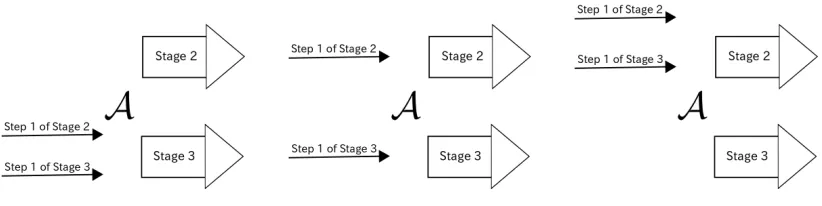
contradiction, we consider the following three message schedules ofGb1(n, z) (see Figure 5).
Schedule 1. A completes Step 1 ofPCETrapComi+i+d+2id+1 in Stage 2 on the left after A com-pletes Stage 2 on the right.
Schedule 2. A completes Step 1 of PCETrapComi+i+d+2id+1 in Stage 2 on the left before A
completes Stage 2 on the right, andA completes Step 1 ofPCETrapComi+d−i+d+2idin Stage 3 on the left afterA completes Stage 2 on the right.
Schedule 3. A completes Step 1 of PCETrapComi+d−i+d+2id in Stage 3 on the left before A
For any k ∈ {1,2,3}, let Schedulek be the event that A chooses Schedule k. Since A must choose one of these schedules, there existsk∗∈ {1,2,3} such that the probability that all of
Schedulek∗, Cheat2,3, and Tag
id,ide occur simultaneously is non-negligible. Below, we reach a
contradiction for eachk∗ ∈ {1,2,3}.
Fig. 5.Schedule 1 (left), Schedule 2 (center), and Schedule 3 (right).
When k∗= 1, let us consider the following adversary B1 against the strong computational binding property of PCETrapComi+ide+1
i+d+2. B1 internally invokes A and simulates Gb1(n, z) forAas follows untilAcompletes Stage 2 on the right. On the left,B1 honestly simulates
Gb1(n, z). On the right,B1 honestly simulatesGb1(n, z) except that in Stage 2, B1 chooses a uniformly random j∗ ∈ [10n] and forwards the j∗-th PCETrapComi+i+d+2id+1 commitment fromAto the external receiver. IfSchedule1orTagid,ide does not occur,B1 terminates and outputsfail.
Since B1 does not simulate the left session after A completes Step 1 of Stage 2, and sinceB1 does not simulate the right session after A completes Stage 2, the running time of B1 is poly(n) +Ti(n) Ti+ide+1(n). In addition, from our assumption, B1 breaks the
strong computational binding property with non-negligible probability. Thus, we reach a contradiction.
When k∗= 2 and id<ide, let us consider the following adversary B2 against the strong
computational binding property of PCETrapComi+ide+1
i+d+2. B2 is the same as B1 except that
B2 terminates and outputs failifSchedule2 orTagid,ide does not occur.
SinceB2 does not simulate the left session afterA completes Step 1 of Stage 3, and since
B1 does not simulate the right interaction afterAcompletes Stage 2, the running time of
B2 ispoly(n)·Ti+id+1.5(n)Ti+ide+1(n). In addition, from our assumption,B2 breaks the
strong computational binding property with non-negligible probability. Thus, we reach a contradiction.
When k∗= 2 and id>ide, from an average argument, there exists a partial joint viewV of
all the parties (the left committer,A, andO) such that afterV, (1)Aimmediately starts Stage 3 on the right and (2) the probability that all of Schedule2, Cheat2,3, and Tagid,ide
PCETrapComi+i+d+2id+1 in Stage 2 on the left. Let ebe the sequence of the committed values of Comcommitments in Step 1 of thesePCETrapComi+i+d+2id+1 commitments.
Then, let us consider the following adversaryB20 against the strong computational binding property ofPCETrapComi+d−ide
i+d+2. Upon receiving non-uniform adviceV ande,B 0
2internally invokesA and simulatesGb1(n, z) forAas follows untilAcompletes Stage 3 on the right. First, B20 feeds V to A. Then, on the left, B02 honestly simulates Gb1(n, z) by using e
to simulate Stage 2. On the right, B0
2 honestly simulates Gb1(n, z) except that in Stage 3, B20 chooses uniformly random j∗ ∈ [10n] and forwards the j∗-th PCETrapComi+d−ide
i+d+2 commitment from Ato the external receiver.
Since B02 can simulate Stage 2 in the left session in polynomial time by using e, the running time ofB20 is at mostpoly(n)·Ti+d−id+0.5(n)Ti+d−ide(n). In addition, from our
assumption,B02 breaks the strong computational binding property of PCETrapComi+d−ide
i+d+2 with non-negligible probability. Thus, we reach a contradiction.
When k∗= 3, from an average argument, there exists a partial joint view V0 of all the parties (the left committer,A, andO) such that afterV0, (1)A immediately starts Stage 3 on the right and (2) the probability that all of Schedule3, Cheat2,3, and Tagid,ide occur is non-negligible. Then, since Schedule3 and Tagid,ide can occur, V
0 contains Step 1 of
PCETrapComi+d−i+d+2idin Stage 3 on the left. Let ebe the sequence of the committed values of Comcommitments in Step 1 of thesePCETrapComi+d−i+d+2id.
Then, let us consider the following adversaryB3 against the strong computational binding property ofPCETrapComi+d−ide
i+d+2.B3 is the same as B 0
2 except that B3 receivesV0 and eas non-uniform advice, feeds V0 toA, and simulates Stage 3 on the left by using e. (Since
V0 contains Stage 2 on the left,B
3 does not need to simulate Stage 2 on the left.)
The running time ofB3 is at mostpoly(n) +Ti(n)Ti+d−ide(n), andB3 breaks the strong
computational binding property of PCETrapComi+d−ide
i+d+2 with non-negligible probability. Thus, we reach a contradiction.
Thus, for any case, we reach a contradiction. ut
Now, we are ready to prove Claim 2.
Formally, to show the indistinguishability, let us consider the following hybrid experiment:
HybridGb1.5(n, z) is the same as Gb2(n, z) except that (1) on the right, O computes both v
(as in Gb1(n, z)) and bv (as in Gb2(n, z)) and (2) if v 6=bv, then Gb1.5(n, z) terminates and outputsfail.
In the following, we show thatGb1.5(n, z) outputs failwith at most negligible probability. Since the view of A in Gb1(n, z) and that of A in Gb2(n, z) differ only in the value that O
returns toA, Claim 2 follows.
If the right session is not accepted, we have v = bv = ⊥, and thus Gb1.5(n, z) does not output fail. Thus, in the following, we assume that the right session is accepted. Since the view ofAinGb1.5(n, z) is identical with that ofAinGb1(n, z) untilAcompletes the right ses-sion, Subclaims 1 and 2 imply that except with negligible probability, there existsa∈ {2,3}
such that each commitment in Stage 1 and Stageaon the right has at most one committed value. Let s(1) = (s(1)1 , . . . , s(1)10n) be the committed values of the Stage 1 commitment. Let ((s(a)1 , d(a)1 ), . . . ,(s(a)10n, d(a)10n)) be the committed values of the Stage a commitments, and let
s(a) = (s(a)1 , . . . , s(a)10n) and d(a) = (d(a)1 , . . . , d(a)10n). Forj ∈[10n], we say thatthe j-th column is bad if (s(a)j , d(a)j ) is not a valid decommitment of the j-th Stage 1 commitment. Then, from the property of the cut-and-choose technique, the number of bad columns is less thann
except with exponentially small probability. Thus, when the committed values of the Stage
acommitments are extracted as in Gb2(n, z), the valid decommitments of the Stage 1 com-mitments are extracted in at least 9ncolumns. Then, since each Stage 1 commitment has at most one committed value, the shares sb, which is computed as in G
b
2(n, z), is also 0.9-close tos(1) except with negligible probability. Then, let us consider the following two cases:
– In Case 1, s(1) is 0.9-close to a valid codeword w = (w1, . . . , w10n). In this case, except with negligible probability,sbis 0.8-close tow. Thus, the codewordwb, whichOcomputed from sb as in Gb
2(n, z), is identical with w. Thus, we have vb= v except with negligible
probability.
– In Case 2,s(1) is not 0.9-close to any valid codeword. In this case, we have v=⊥. Ifsbis not 0.8-close to any valid codeword, we have bv=⊥; thus we havevb=v. If sbis 0.8-close
to a valid codeword wb = (wb1, . . . ,wb10n), since s
(1) and
b
w are not 0.9-close, except with exponentially small probability there existsj∈Γ such thatwbj 6=s(1)j . Thus, except with negligible probability, we havevb=v=⊥.
Thus,Gb1.5(n, z) outputs failwith at most negligible probability. ut
Finally, we prove Claim 3.
Proof (of Claim 3). Gb3(n, z) differs from Gb2(n, z) only in that on the left, the Stage 1 com-mitments and their decomcom-mitments are generated by the simulator ofPTrapComi+d+1i+d+1. Then, since the running time of Gb2(n, z) and that of Gb3(n, z) are at most poly(n)·Ti+d+0.5(n)
Ti+d+1(n) except for Stage 1 on the left, and since Stage 1 on the left is not rewound in
Gb2(n, z) and in Gb3(n, z), the claim follows from the trapdoor property ofPTrapComi+d+1i+d+1.
5 CCA Security from One-One CCA Security
In this section, we show a transformation from any one-one CCA-secure commitment scheme to a CCA-secure commitment scheme. To use this transformation to obtain a general MPC protocol, we also show that the resultant CCA-secure commitment satisfiesκ-pqt-robustness
for any κ∈N.
Lemma 2. Let < 1 be a positive constant, and assume the existence of one-way func-tions that are secure against 2n-time adversaries. Let r(·) and t(·) be arbitrary functions,
let Ti(n) def= 2(logn)(2/)10 i+1
for anyi∈N, and let CCACom1:1i+3 be an r(n)-round commitment scheme that satisfies the following for anyTi+3(n)-time adversary.
– Strong computational binding property, and – One-one CCA security for tags of length t(n).
Then, for anyκ∈N, there exists an (r(n) +O(1))-round commitment scheme CCAComi that
satisfies the following for anyTi(n)-time adversary. – Statistical binding property,
– CCA security for tags of length t(n), and – κ-pqt-robustness.
If CCACom1:1i+3 uses the underlying one-way function only in a black-box way, then CCAComi
uses the underlying one-way function only in a black-box way.
In the proof of Lemma 2, we use the following building blocks, which we can obtain by appropriately setting the security parameters of known protocols [Nao91, MOSV06, PV08].
– A 2-round statistically binding commitment Comi+1 that is secure against Ti+1(n)-time adversaries but is completely broken in time Ti+1.5(n).
– A constant-round concurrently poly(nlogn)-extractable commitment CEComi+2 that is secure against Ti+2(n)-time adversaries but is completely broken in time Ti+2.5(n). The number of slots in CEComi+2 is κ + 3, and the extractor uses the rewinding strategy of [PV08].
We note that bothComi+1andCEComi+2 use the underlying one-way function in a black-box way.
Proof (of Lemma 2). CCAComi is shown in Figure 6. The statistical binding property of
CCAComi follows from that of Comi+1. Then, we consider the following propositions.
Proposition 1. For any Ti(n)-time adversary, CCAComi is CCA secure for tags of length
t(n).
Proposition 2. For any Ti(n)-time adversary, CCAComi isκ-pqt-robust.
Commit phase. The committer C and the receiver R receive common inputs 1n and
id ∈ {0,1}t(n). To commit to v ∈ {0,1}n, the committer C does the following with the receiverR.
Stage 1. R chooses a random subset Γ ⊆ [10n] of size n. Then, R commits to Γ by using CCACom1:1i+3 with tagid.
Stage 2. C computes an (n+ 1)-out-of-10n Shamir’s secret sharing s = (s1, . . . , s10n) of value v. Then, for eachj∈[10n] in parallel, C commits tosj by usingComi+1.
Stage 3. For eachj∈[10n] in parallel, C commits tosj by using CEComi+2.
Stage 4. R decommits the Stage 1 commitment toΓ.
Stage 5. For everyj∈[10n], let the j-th column denote thej-th commitment in Stage 2 and the j-th one in Stage 3 (that is, the commitments whose committed value is
sj). Then, for eachj∈Γ,C decommits the commitments of thej-th column tosj.
Decommit phase. C sends v to R and decommits the Stage 2 commitments to s. Then, R checks whether all of these decommitments are valid. Furthermore, R checks whether (1) s is 0.9-close to a valid codeword w = (w1, . . . , w10n) and (2) for every
j ∈Γ,wj is equal to the share that was revealed in Stage 5. Finally, R checks whether
w is a codeword corresponding tov.
Fig. 6.CCA-secure commitmentCCAComi.
5.1 Proof of Proposition 1
Proof (of Proposition 1). We show that for any Ti(n)-time adversary A, the following are computationally indistinguishable:
– {IND0(CCAComi,A, n, z)}n∈N,z∈{0,1}∗ – {IND1(CCAComi,A, n, z)}n∈N,z∈{0,1}∗
Note thatO does the following in each right session. First, Oextracts the committed values
s= (s1, . . . , s10n) of the Stage 2 commitments by brute force. (If the committed value of the
j-th commitment is not uniquely determined,sj is defined to be⊥.) Then, at the end of the session,Ochecks whether the following conditions hold: (1)sis 0.9-close to a valid codeword
w= (w1, . . . , w10n), and (2) for everyj ∈Γ (whereΓ is the value thatOsends toAin Stage 4),wj is equal to the share that was revealed in Stage 5. If both conditions hold,O recovers
v from w and returns v toA. Otherwise, O returns v:=⊥ toA. We note that the running time ofO is at most poly(n)·Ti+1.5(n).
To show the indistinguishability, we consider hybrid experimentsHab(n, z) fora∈ {0,1,2,3}
andb∈ {0,1}.
HybridH0b(n, z) is the same as experiment indb(CCAComi,A, n, z).
– In Stage 1 of the left session, the committed valueΓ is extracted by brute force. If the commitment is invalid or has multiple committed values, Γ is defined to be a random subset.8
– In Stage 3 of the left session, the left committer commits to 0 instead of sj for each
j 6∈Γ.
The running time of H1b(n, z) is at most poly(n) ·Ti+1.5(n) except for the brute-force extraction of the Stage 1 commitment on the left.
HybridH2b(n, z) is the same as H1b(n, z) except for the following:
– In every right session of which Stage 2 ends after A starts Stage 2 on the left, the committed values of the Stage 3 commitments are extracted by using the concurrent
poly(nlogn)-extractability ofCEComi+2. Letsb= (bs1, . . . ,sb10n) be the extracted values.
– At the end of each right session in which sb= (bs1, . . . ,sb10n) is extracted, O does the following. First, O checks whether the following conditions hold: (1)sbis0.8-close to
a valid codeword wb = (wb1, . . . ,wb10n) and (2) for every j ∈ Γe (where Γe is the value
thatO sends toAin this session),wbj is equal to the share that was revealed in Stage 5. If both conditions hold, O recovers bv from wb and returns bv to A. Otherwise, O
returns bv := ⊥ to A. We note that O does not extract the committed values of the Stage 2 commitments in such right sessions.
The expected running time of Hb
2(n, z) is at most poly(nlogn)·Ti(n) after the start of Stage 2 on the left.
HybridH3b(n, z) is the same asH2b(n, z) except that in Stage 2 on the left, the left committer commits to 0 instead ofsj for each j6∈Γ.
Since A receives no information about {sj}j6∈Γ on the left in H30(n, z) and H31(n, z), and since s is (n+ 1)-out-of-10n secret sharing, the output of H30(n, z) and that of H31(n, z) are identically distributed. Then, we consider the following claims. In what follows, we use
Hbi(n, z) to denote the output of experimentHib(n, z).
Claim 4. For each b ∈ {0,1}, {Hb0(n, z)}n∈N,z∈{0,1}∗ and {Hb1(n, z)}n∈
N,z∈{0,1}∗ are compu-tationally indistinguishable.
Claim 5. For each b∈ {0,1}, {Hb1(n, z)}n∈N,z∈{0,1}∗ and {Hb2(n, z)}n∈
N,z∈{0,1}∗ are statisti-cally indistinguishable.
Claim 6. For each b ∈ {0,1}, {Hb2(n, z)}n∈N,z∈{0,1}∗ and {Hb3(n, z)}n∈
N,z∈{0,1}∗ are compu-tationally indistinguishable.
The proposition follows from these claims. ut
Proof (of Claim 4). The view of A in H0b(n, z) and that of A in H1b(n, z) differ only in the committed values of CEComi+2 on the left. In addition, the running time of H0b(n, z) and 8 Since the running time of A and O is at most poly(n)·Ti+1.5(n) Ti+2(n), the strong computational
binding property ofCCACom1:1i+3guarantees that the Stage 1 commitment has at most one committed value
that ofH1b(n, z) arepoly(n)·Ti+1.5(n)Ti+2(n) (except for the brute force extraction of the Stage 1 commitment on the left inH1b(n, z)). Thus, by consideringΓ as non-uniform advice, we can prove indistinguishability from the hiding property ofCEComi+2.
Formally, assume for contradiction that there exists a polynomial p(·) such that for in-finitely manyn, there existsz∈ {0,1}∗ and appt distinguisherD such that
Pr
h
D(Hb0(n, z)) = 1
i −Pr
h
D(Hb1(n, z)) = 1
i
≥
1
p(n) .
In the following, we fix any suchn and z. Letρ be a prefix of the transcript of Hb0(n, z) and
Hb1(n, z) such that immediately after ρ, Stage 3 starts on the left. (Recall that Hb0(n, z) and
Hb1(n, z) proceed identically until the start of Stage 3 on the left.) Let prefixρ be the event that a prefix of the transcript isρ. From an average argument, with probability 1/2p(n) over the choice ofρ, we have
Pr
h
D(Hb0(n, z)) = 1|prefixρ
i −Pr
h
D(Hb1(n, z)) = 1|prefixρ
i
≥
1
2p(n) . (1) Then, from the strong computational binding property of CCACom1:1i+3, with probability 1/2p(n)−negl(n) over the choice of ρ, we have Equation (1) and ρ uniquely determines the committed valueΓ of the Stage 1 commitment of the left session. We fix any suchρ.
Let us consider the followingTi+2(n)-time adversaryBagainst the (parallel) hiding prop-erty of CEComi+2. On non-uniform advice ρ and Γ, adversary B internally invokes A and honestly simulatesH1b(n, z) after ρ except for the following:
– In Stage 3 on the left, B sends (sj)j6∈Γ and (0, . . . ,0) to the external committer of
CEComi+2. Then, since the external committer commits to either (sj)j6∈Γ or (0, . . . ,0) in parallel,Bforwards these commitments toA. (At the same time,Bcomputes commit-ments to (sj)j∈Γ and sends them toA.)
The output ofB is that of the simulated H1b(n, z).
We reach a contradiction by showing thatBbreaks the hiding property ofCEComi+2. The view of the internal A is identical with either that of A inH0b(n, z) (when B receives com-mitments to (sj)j6∈Γ) or that of Ain H1b(n, z) (whenB receives commitments to (0, . . . ,0)). Thus, from Equation (1),Bdistinguishes the commitments of (sj)j6∈Γ from those of (0, . . . ,0)
with non-negligible probability. ut
Next, we consider Claim 5. Note that H2b(n, z) differs fromH1b(n, z) in that O computes the committed value of each right session from the extracted values of Stage 3 commitments instead of from those of Stage 2 commitments. We prove Claim 5 by showing that at the end of each right session, the value bv that O computes in H2b(n, z) is the same as the value