Multi-document Summarization via
Budgeted Maximization of Submodular Functions
Hui Lin
Dept. of Electrical Engineering University of Washington
Seattle, WA 98195, USA [email protected]
Jeff Bilmes
Dept. of Electrical Engineering University of Washington
Seattle, WA 98195, USA [email protected]
Abstract
We treat the text summarization problem as maximizing a submodular function under a budget constraint. We show, both theoretically and empirically, a modified greedy algorithm can efficiently solve the budgeted submodu-lar maximization problem near-optimally, and we derive new approximation bounds in do-ing so. Experiments on DUC’04 task show that our approach is superior to the best-performing method from the DUC’04 evalu-ation on ROUGE-1 scores.
1 Introduction
Automatically generating summaries from large text corpora has long been studied in both information retrieval and natural language processing. There are several types of text summarization tasks. For example, if an input query is given, the generated summary can be query-specific, and otherwise it is generic. Also, the number of documents to be sum-marized can vary from one to many. The constituent sentences of a summary, moreover, might be formed in a variety of different ways — summarization can be conducted using eitherextractionorabstraction, the former selects only sentences from the origi-nal document set, whereas the latter involves natu-ral language generation. In this paper, we address the problem of generic extractive summaries from clusters of related documents, commonly known as multi-document summarization.
In extractive text summarization, textual units (e.g., sentences) from a document set are extracted to form a summary, where grammaticality is as-sured at the local level. Finding the optimal
sum-mary can be viewed as a combinatorial optimiza-tion problem which is NP-hard to solve (McDon-ald, 2007). One of the standard methods for this problem is called Maximum Marginal Rele-vance (MMR) (Dang, 2005)(Carbonell and Gold-stein, 1998), where a greedy algorithm selects the most relevant sentences, and at the same time avoids redundancy by removing sentences that are too sim-ilar to already selected ones. One major problem of MMR is that it is non-optimal because the deci-sion is made based on the scores at the current it-eration. McDonald (2007) proposed to replace the greedy search of MMR with a globally optimal for-mulation, where the basic MMR framework can be expressed as a knapsack packing problem, and an integer linear program (ILP) solver can be used to maximize the resulting objective function. ILP Al-gorithms, however, can sometimes either be expen-sive for large scale problems or themselves might only be heuristic without associated theoretical ap-proximation guarantees.
In this paper, we study graph-based approaches for multi-document summarization. Indeed, several graph-based methods have been proposed for extrac-tive summarization in the past. Erkan and Radev (2004) introduced a stochastic graph-based method, LexRank, for computing the relative importance of textual units for multi-document summarization. In LexRank the importance of sentences is computed based on the concept of eigenvector centrality in the graph representation of sentences. Mihalcea and Tarau also proposed an eigenvector centrality algo-rithm on weighted graphs for document summariza-tion (Mihalcea and Tarau, 2004). Mihalcea et al. later applied Google’s PageRank (Brin and Page, 1998) to natural language processing tasks ranging
from automatic keyphrase extraction and word sense disambiguation, to extractive summarization (Mi-halcea et al., 2004; Mi(Mi-halcea, 2004). Recent work in (Lin et al., 2009) presents a graph-based approach where an undirected weighted graph is built for the document to be summarized, and vertices represent the candidate sentences and edge weights represent the similarity between sentences. The summary ex-traction procedure is done by maximizing a submod-ular set function under a cardinality constraint.
Inspired by (Lin et al., 2009), we perform summa-rization by maximizing submodular functions under a budget constraint. A budget constraint is natural in summarization task as the length of the summary is often restricted. The length (byte budget) limita-tion represents the real world scenario where sum-maries are displayed using only limited computer screen real estate. In practice, the candidate tex-tual/linguistic units might not have identical costs (e.g., sentence lengths vary). Since a cardinality constraint is a special case (a budget constraint with unity costs), our approach is more general than (Lin et al., 2009). Moreover, we propose a modified greedy algorithm (Section 4) and both theoretically (Section 4.1) and empirically (Section 5.1) show that the algorithm solves the problem near-optimally, thanks to submodularity. Regarding summarization performance, experiments on DUC’04 task show that our approach is superior to the best-performing method in DUC’04 evaluation on ROUGE-1 scores (Section 5).
2 Background on Submodularity
Consider a set function f : 2V → R, which maps subsetsS⊆V of a finite ground setV to real num-bers. f(·) is called normalized if f(∅) = 0, and is monotone if f(S) ≤ f(T) whenever S ⊆ T.
f(·)is calledsubmodular(Lovasz, 1983) if for any
S, T ⊆V, we have
f(S∪T) +f(S∩T)≤f(S) +f(T). (1)
An equivalent definition of submodularity is the property of diminishing returns, well-known in the field of economics. That is,f(·)is submodular if for anyR ⊆S⊆V ands∈V \S,
f(S∪ {s})−f(S)≤f(R∪ {s})−f(R). (2)
Eqn. 2 states that the “value” of snever increases in the contexts of ever larger sets, exactly the prop-erty of diminishing returns. This phenomenon arises naturally in many other contexts as well. For ex-ample, the Shannon entropy function is submodu-lar in the set of random variables. Submodular-ity, moreover, is a discrete analog of convexity (Lo-vasz, 1983). As convexity makes continuous func-tions more amenable to optimization, submodular-ity plays an essential role in combinatorial optimiza-tion.
Many combinatorial optimization problems can be solved optimally or near-optimally in polynomial time only when the underlying function is submod-ular. It has been shown that any submodular func-tion can be minimized in polynomial time (Schri-jver, 2000)(Iwata et al., 2001). Maximization of sub-modular functions, however, is an NP-complete op-timization problem but fortunately, some submod-ular maximization problems can be solved near-optimally. A famous result is that the maximization of a monotone submodular function under a cardi-nality constraint can be solved using a greedy al-gorithm (Nemhauser et al., 1978) within a constant factor (0.63) of being optimal. A constant-factor ap-proximation algorithm has also been obtained for maximizing monotone submodular function with a knapsack constraint (see Section 4.2). Feige et.al. (2007) studied unconstrained maximization of a ar-bitrary submodular functions (not necessarily mono-tone). Kawahara et.al. (2009) proposed a cutting-plane method for optimally maximizing a submod-ular set function under a cardinality constraint, and Lee et.al. (2009) studied non-monotone submodu-lar maximization under matroid and knapsack con-straints.
3 Problem Setup
In this paper, we study the problem of maximizing a submodular function under budget constraint, stated formally below:
max
S⊆V
{
f(S) :∑
i∈S
ci≤ B
}
(3)
selecting unitiandBis our budget, and submodular functionf(·)scores the summary quality.
The budgeted constraint arises naturally since of-ten the summary must be length limited as men-tioned above. In particular, the budget B could be the maximum number of words allowed in any sum-mary, or alternatively the maximum number of bytes of any summary, whereciwould then be either num-ber of words or the numnum-ber of bytes in sentencei.
To benefit from submodular optimization, the objective function measuring the summary quality must be submodular. In general, there are two ways to apply submodular optimization to any application domain. One way is to force submodularity on an application, leading to an artificial and poorly per-forming objective function even if it can be opti-mized well. The alternative is to address applica-tions where submodularity naturally applies. We are fortunate in that, like convexity in the continuous do-main, submodularity seems to arise naturally in a va-riety of discrete domains, and as we will see below, extractive summarization is one of them. As men-tioned in Section 1, our approach is graph-based, not only because a graph is a natural representation of the relationships and interactions between textual units, but also because many submodular functions are well defined on a graph and can naturally be used in measuring the summary quality.
Suppose certain pairs(i, j)withi, j∈V are sim-ilar and the simsim-ilarity of iand j is measured by a non-negative value wi,j. We can represent the en-tire document with a weighted graph (V, E), with non-negative weightswi,jassociated with each edge
ei,j, e ∈E. One well-known graph-based submod-ular function that measures the similarity ofSto the remainderV \Sis the graph-cut function:
fcut(S) =
∑
i∈V\S
∑
j∈S
wi,j. (4)
In multi-document summarization, redundancy is a particularly important issue since textual units from different documents might convey the same infor-mation. A high quality (small and meaningful) sum-mary should not only be informative about the re-mainder but also be compact (non-redundant). Typ-ically, this goal is expressed as a combination of maximizing the information coverage and minimiz-ing the redundancy (as used in MMR (Carbonell and
Goldstein, 1998)). Inspired by this, we use the fol-lowing objective by combining aλ-weighted penalty term with the graph cut function:
fMMR(S) =
∑
i∈V\S
∑
j∈S
wi,j−λ
∑
i,j∈S:i̸=j
wi,j, λ≥0.
Luckily, this function is still submodular as both the graph cut function and the redundancy term are sub-modular. Neither objective, however, is monotone, something we address in Theorem 3. Although sim-ilar to the MMR objective function, our approach is different since 1) ours is graph-based and 2) we for-malize the problem as submodular function maxi-mization under the budget constraint where a simple greedy algorithm can solve the problem guaranteed near-optimally.
4 Algorithms
Algorithm 1Modified greedy algorithm
1: G← ∅
2: U ←V
3: whileU ̸=∅do
4: k←arg maxℓ∈U f(G∪{(cℓℓ}))r−f(G)
5: G ← G∪ {k} if ∑i∈Gci +ck ≤ B and
f(G∪ {k})−f(G)≥0
6: U ←U \ {k}
7: end while
8: v∗ ←arg maxv∈V,cv≤Bf({v}) 9: returnGf = arg maxS∈{{v∗},G}f(S)
Inspired by (Khuller et al., 1999), we propose Algorithm 1 to solve Eqn. (3). The algorithm se-quentially finds unitk with the largest ratio of ob-jective function gain to scaled cost, i.e., (f(G ∪
{ℓ})−f(G))/crℓ, wherer >0is the scaling factor. If adding k increases the objective function value while not violating the budget constraint, it is then selected and otherwise bypassed. After the sequen-tial selection, setGis compared to the within-budget singleton with the largest objective value, and the larger of the two becomes the final output.
ca = 1, cb = p+ 1, andB = p+ 1. The solution obtained by the greedy heuristic is{a}with objec-tive function value1, while the true optimal objec-tive function value isp. The approximation factor for this example is thenpand therefore unbounded.
We address this issue by the following two mod-ifications to the naive greedy algorithms. The first one is the final step (line 8 and 9) in Algorithm 1 where setGand singletons are compared. This step ensures that we could obtain a constant approxima-tion factor forr= 1(see the proof in the Appendix). The second modification is that we introduce a scaling factorrto adjust the scale of the cost. Sup-pose, in the above example, we scale the cost as
ca= 1r, cb= (p+ 1)r, then selectingaorbdepends also on the scaler, and we might get the optimal so-lution using a appropriater. Indeed, the objective function values and the costs might be uncalibrated since they might measure different units. E.g., it is hard to say if selecting a sentence of 15 words with an objective function gain of 2 is better than select-ing sentence of 10 words with gain of 1. Scalselect-ing can potentially alleviate this mismatch (i.e., we can adjustr on development set). Interestingly, our the-oretical analysis of the performance guarantee of the algorithm also gives us guidance about how to scale the cost for a particular problem (see Section 4.1).
4.1 Analysis of performance guarantee
Although Algorithm 1 is essentially a simple greedy strategy, we show that it solves Eqn. (3) globally and near-optimally, by exploiting the structure of sub-modularity. As far as we know, this is a new result for submodular optimization, not previously stated or published before.
Theorem 1. For normalized monotone submodular functionf(·), Algorithm 1 withr = 1has a constant approximation factor as follows:
f(Gf)≥
(
1−e−12 )
f(S∗), (5)
whereS∗ is an optimal solution.
Proof. See Appendix.
Note that an α-approximation algorithm for an optimization problem is a polynomial-time algo-rithm that forallinstances of the problem produces a solution whose value is within a factor ofαof the
value of the an optimal solution. So Theorem 1 ba-sically states that the solution found by Algorithm 1 can be at least as good as (1 − 1/√e)f(S∗) ≈ 0.39f(S∗) even in the worst case. A constant ap-proximation bound is good since it is true for all in-stances of the problem, and we always know how good the algorithm is guaranteed to be without any extra computation. Forr̸= 1, we resort to instance-dependent bound where the approximation can be easily computed per problem instance.
Theorem 2. With normalized monotone submodu-lar f(·), for i = 1, . . . ,|G|, let vi be the ith unit added intoGandGiis the set after addingvi. When
0≤r≤1,
f(Gi)≥
( 1−
i
∏
k=1
(
1− c
r vk Br|S∗|1−r
)) f(S∗)
(6)
≥
( 1−
i
∏
k=1
(
1− c
r vk Br|V|1−r
))
f(S∗) (7)
and whenr≥1,
f(Gi)≥
( 1−
i
∏
k=1
( 1−
(c
vk B
)r))
f(S∗). (8)
Proof. See Appendix.
Theorem 2 gives bounds for a specific instance of the problem. Eqn. (6) requires the size|S∗|, which is unknown, requiring us to estimate an upper bound of the cardinality of the optimal setS∗. Obviously, |S∗| ≤ |V|, giving us Eqn. (7). A tighter upper bound is obtained, however, by sorting the costs. That is, letc[1], c[2], . . . , c[|V|]be the sorted sequence of costs in nondecreasing order, giving|S∗| < m
where∑mk=1−1c[i] ≤ B and
∑m
k=1c[i] > B. In this
case, the computation cost for the bound estimation isO(|V|log|V|), which is quite feasible.
monotone and our theoretical results still hold. Pre-cisely, assume that all edge weights are bounded:
wi,j ∈ [0,1] (which is the case for cosine simi-larity between non-negative vectors). Also assume that edges weights are independently identically dis-tributed with mean µ, i.e. E(wi,j) = µ. Given a budget B, assume the maximum possible size of a solution isK. Letα = 2λ+ 1, andβ = 2K−1. Notice thatβ≪ |V|for our summarization task. We have the following theorem:
Theorem 3. Algorithm 1 solves the summarization problem near-optimally (i.e. Theorem 1 and Theo-rem 2 hold) with high probability of at least
1−exp {
−2(|V| | −(α+ 1)β)2µ2
V|+ (α2−1)β + lnK
}
Proof. Omitted due to space limitation.
4.2 Related work
Algorithms for maximizing submodular function under budget constraint (Eqn. (3)) have been stud-ied before. Krause (2005) generalized the work by Khuller et al.(1999) on budgeted maximum cover problem to the submodular framework, and showed a 12(1−1/e)-approximation algorithm. The algo-rithm in (Krause and Guestrin, 2005) and (Khuller et al., 1999) is actually a special case of Algorithm 1 when r = 1, and Theorem 1 gives a better bound (i.e.,(1−1/√e)> 12(1−1/e)) in this case. There is also a greedy algorithm with partial enumerations (Sviridenko, 2004; Krause and Guestrin, 2005) fac-tor(1−1/e). This algorithm, however, is too com-putationally expensive and thus not practical for real world applications (the computation cost isO(|V|5)
in general). When each unit has identical cost, the budget constraint reduces to cardinality constraint where a greedy algorithm is known to be a(1−1/e) -approximation algorithm (Nemhauser et al., 1978) which is the best that can be achieved in polyno-mial time (Feige, 1998) if P ̸= NP. Recent work (Takamura and Okumura, 2009) applied the maxi-mum coverage problem to text summarization (with-out apparently being aware that their objective is submodular) and studied a similar algorithm to ours when r = 1 and for the non-penalized graph-cut function. This problem, however, is a special case of constrained submodular function maximization.
5 Experiments
We evaluated our approach on the data set of DUC’04 (2004) with the setting of task 2, which is a multi-document summarization task on English news articles. In this task, 50 document clusters are given, each of which consists of 10 documents. For each document cluster, a short multi-document summary is to be generated. The summary should not be longer than 665 bytes including spaces and punctuation, as required in the DUC’04 evaluation. We used DUC’03 as our development set. All docu-ments were segmented into sentences using a script distributed by DUC. ROUGE version 1.5.5 (Lin, 2004), which is widely used in the study of summa-rization, was used to evaluate summarization perfor-mance in our experiments1. We focus on ROUGE-1 (unigram) F-measure scores since it has demon-strated strong correlation with human annotation (Lin, 2004).
The basic textual/linguistic units we consider in our experiments are sentences. For each document cluster, sentences in all the documents of this cluster forms the ground setV. We built semantic graphs for each document cluster based on cosine similar-ity, where cosine similarity is computed based on the TF-IDF (term frequency, inverse document fre-quency) vectors for the words in the sentences. The cosine similarity measures the similarity between sentences, i.e.,wi,j.
Here the IDF values were calculated using all the document clusters. The weighted graph was built by connecting vertices (corresponding to sentences) with weightwi,j >0. Any unconnected vertex was removed from the graph, which is equivalent to pre-excluding certain sentences from the summary.
5.1 Comparison with exact solution
In this section, we empirically show that Algo-rithm 1 works near-optimally in practice. To deter-mine how much accuracy is lost due to approxima-tions, we compared our approximation algorithms with an exact solution. The exact solutions were ob-tained by Integer Linear Programming (ILP). Solv-ing arbitrary ILP is an NP-hard problem. If the size of the problem is not too large, we can sometimes find the exact solution within a manageable time
1
using a branch-and-bound method. In our experi-ments, MOSEK was used as our ILP solver.
We formalize Eqn. (3) as an ILP by introducing indicator (binary) variables xi,j, yi,j, i ̸= j and zi for i, j ∈ V. In particular, zi = 1 indicates that unitiis selected, i.e.,i∈S,xi,j = 1indicates that
i ∈S butj /∈ S, andyi,j = 1indicates bothiand
jare selected. Adding constraints to ensure a valid solution, we have the following ILP formulation for Eqn. (3) with objective functionfMMR(S):
max ∑
i̸=j,i,j∈V
wi,jxi,j−λ
∑
i̸=j,i,j∈V
wi,jyi,j
subject to:∑ i∈V
cizi≤ B,
xi,j−zi ≤0, xi,j+zj ≤1, zi−zj−xi,j ≤0,
yi,j−zi ≤0, yi,j −zj ≤0, zi+zj−yi,j ≤1,
xi,j, yi,j, zi ∈ {0,1},∀i̸=j, i, j∈V
Note that the number of variables in the ILP for-mulation is O(|V|2). For a document cluster with
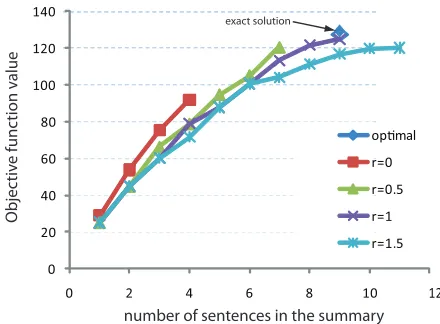
hundreds of candidate textual units, the scale of the problem easily grows involving tens of thousands of variables, making the problem very expensive to solve. For instance, solving the ILP exactly on a document cluster with 182 sentences (as used in Fig-ure 1) took about 17 hours while our Algorithm 1 finished in less than0.01seconds.
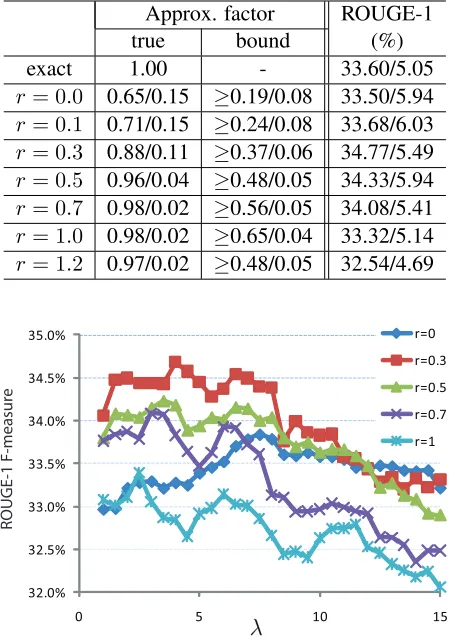
We tested both approximate and exact algorithms on DUC’03 data where 60 document clusters were used (30 TDT document clusters and 30 TREC doc-ument clusters), each of which contains 10 docu-ments on average. The true approximation factor was computed by dividing the objective function value found by Algorithm 1 over the optimal ob-jective function value (found by ILP). The average approximation factors over the 58 document clus-ters (ILP on 2 of the 60 document clusclus-ters failed to finish) are shown in Table 1, along with other statis-tics. On average Algorithm 1 finds a solution that is over 90% as good as the optimal solution for many different r values, which backs up our claim that the modified greedy algorithm solves the problem near-optimally, even occasionally optimally (Figure 1 shows one such example).
The higher objective function value does not al-ways indicate higher ROUGE-1 score. Indeed,
0 20 40 60 80 100 120 140
0 2 4 6 8 10 12
op mal r=0 r=0.5 r=1 r=1.5
number of sentences in the summary
Objec
tiv
e func
ti
on
v
a
lue
[image:6.612.318.538.64.226.2]exact solution
Figure 1: Application of Algorithm 1 when summariz-ing document cluster d30001t in the DUC’04 dataset with summary size limited to 665 bytes. The objective func-tion wasfMMRwithλ= 2. The plots show the achieved
objective function as the number of selected sentences grows. The plots stop when in each case adding more sentences violates the budget. Algorithm 1 withr = 1
found the optimal solution exactly.
rather than directly optimizing ROUGE, we opti-mize a surrogate submodular function that indicates the quality of a summary. Optimality in the submod-ular function does not necessary indicate optimality in ROUGE score. Nevertheless, we will show that our approach outperforms several other approaches in terms of ROUGE. We note that ROUGE is itself a surrogate for true human-judged summary quality, it might possibly be thatfMMRis a still better surro-gate — we do not consider this possibility further in this work, however.
5.2 Summarization Results
We used DUC’03 (as above) for our development set to investigate howrandλrelate to the ROUGE-1 score. From Figure 2, the best performance is achieved withr = 0.3, λ= 4. Using these settings, we applied our approach to the DUC’04 task. The results, along with the results of other approaches, are shown in Table 2. All the results in Table 2 are presented as ROUGE-1 F-measure scores.2
We compared our approach to two other
well-2When the evaluation was done in 2004, ROUGE was still in
Table 1: Comparison of Algorithm 1 to exact algorithms on DUC’03 dataset. All the numbers shown in the ta-ble are the average statistics (mean/std). The “true” ap-proximation factor is the ratio of objective function value found by Algorithm 1 over the ILP-derived true-optimal objective value, and the approximation bounds were esti-mated using Theorem 2.
Approx. factor ROUGE-1
true bound (%)
exact 1.00 - 33.60/5.05
r = 0.0 0.65/0.15 ≥0.19/0.08 33.50/5.94
r = 0.1 0.71/0.15 ≥0.24/0.08 33.68/6.03
r = 0.3 0.88/0.11 ≥0.37/0.06 34.77/5.49
r = 0.5 0.96/0.04 ≥0.48/0.05 34.33/5.94
r = 0.7 0.98/0.02 ≥0.56/0.05 34.08/5.41
r = 1.0 0.98/0.02 ≥0.65/0.04 33.32/5.14
r = 1.2 0.97/0.02 ≥0.48/0.05 32.54/4.69
32.0% 32.5% 33.0% 33.5% 34.0% 34.5% 35.0%
0 5 10 15
r=0
r=0.3
r=0.5
r=0.7
r=1
R
OUGE-1 F-me
a
sur
e
Figure 2: Different combinations of r andλfor fMMR
related to ROUGE-1 score on DUC’03 task 1.
known graph-based approaches, LexRank and PageRank. LexRank was one of the participat-ing system in DUC’04, with peer code 104. For PageRank, we implemented the recursive graph-based ranking algorithm ourselves. The importance of sentences was estimated in an iterative way as in (Brin and Page, 1998)(Mihalcea et al., 2004). Sentences were then selected based on their impor-tance rankings until the budget constraint was vi-olated. The graphs used for PageRank were ex-actlythe graphs in our submodular approaches (i.e., an undirected graph). In both cases, submodu-lar summarization achieves better ROUGE-1 scores. The improvement is statistically significant by the
Wilcoxon signed rank test at levelp < 0.05. Our approach also outperforms the best system (Conroy et al., 2004), peer code 65 in the DUC’04 evalua-tion although not as significant (p <0.08). The rea-son might be that DUC’03 is a poor representation of DUC’04 — indeed, by varyingr andλover the ranges0≤r ≤0.2and5≤λ≤9respectively, the DUC’04 ROUGE-1 scores were all > 38.8% with the best DUC’04 score being39.3%.
Table 2: ROUGE-1 F-measure results (%)
Method ROUGE-1 score
peer65 (best system in DUC04) 37.94
peer104 (LexRank) 37.12
PageRank 35.37
Submodular (r= 0.3, λ= 4) 38.39
6 Appendix
We analyze the performance guarantee of Algorithm 1. We use the following notation: S∗ is the optimal solu-tion; Gf is the final solution obtained by Algorithm 1;
Gis the solution obtained by the greedy heuristic (line 1 to 7 in Algorithm 1); vi is the ith unit added to G,
i= 1, . . . ,|G|;Giis the set obtained by greedy algorithm
after addingvi(i.e.,Gi=∪ik=1{vk}, fori= 1, . . . ,|G|,
withG0 = ∅ andG|G| = G); f(·) : 2V → Ris a
monotone submodular function; andρk(S)is the gain of
addingktoS, i.e.,f(S∪ {k})−f(S).
Lemma 1. ∀X, Y ⊆V,
f(X)≤f(Y) + ∑
k∈X\Y
ρk(Y). (9)
Proof. See (Nemhauser et al., 1978)
Lemma 2. Fori= 1, . . . ,|G|, when0≤r≤1,
f(S∗)−f(Gi−1)≤B
r|S∗|1−r
cr vi
(f(Gi)−f(Gi−1)),
(10)
and whenr≥1,
f(S∗)−f(Gi−1)≤ (
B cvi
)r
(f(Gi)−f(Gi−1))
(11)
Proof. Based on line 4 of Algorithm 1, we have
∀u∈S∗\Gi−1,
ρu(Gi−1)
cr u
≤ρvi(Gi−1)
cr vi
Thus when0≤r≤1,
∑
u∈S∗\Gi−1
ρu(Gi−1)≤
ρvi(Gi−1)
cr vi
∑
u∈S∗\Gi−1
cru
≤ρvi(Gi−1)
cr vi
|S∗\Gi−1| (∑
u∈S∗\Gi−1cu |S∗\Gi−1|
)r
≤ρvi(Gi−1)
cr vi
|S∗|1−r
∑
u∈S∗\Gi−1
cu r
≤ρvi(Gi−1)
cr vi
|S∗|1−rBr,
where the second inequality is due to the concavity of
g(x) = xr, x > 0,0 ≤ r≤ 1. The last inequality uses
the fact that∑u∈S∗cu≤ B. Similarly, whenr≥1,
∑
u∈S∗\Gi−1
ρu(Gi−1)≤
ρvi(Gi−1)
cr vi
∑
u∈S∗\Gi−1
cru
≤ρvi(Gi−1)
cr vi
∑
u∈S∗\Gi−1
cu r
≤ρvi(Gi−1)
cr vi
Br.
Applying Lemma 1, i.e., letX =S∗andY =Gi−1, the
lemma immediately follows.
The following is a proof of Theorem 2.
Proof. Obviously, the theorem is true when i = 1 by applying Lemma 2.
Assume that the theorem is true fori−1,2≤i≤ |G|, we show that it also holds fori. When0≤r≤1,
f(Gi) =f(Gi−1) + (f(Gi)−f(Gi−1))
≥f(Gi−1) +
cr vi
Br|S∗|1−r(f(S
∗)−f(G i−1))
=
(
1− c
r vi
Br|S∗|1−r )
f(Gi−1) +
cr vi
Br|S∗|1−rf(S ∗)
≥ (
1− c
r vi
Br|S∗|1−r ) (
1−
i−1 ∏
k=1 (
1− c
r vk
Br|S∗|1−r ))
f(S∗) + c
r vi
Br|S∗|1−rf(S ∗) = ( 1− i ∏ k=1 (
1− c
r vk
Br|S∗|1−r ))
f(S∗).
The case whenr≥1can be proven similarly.
Now we are ready to prove Theorem 1.
Proof. Consider the following two cases:
Case 1: ∃v∈V such thatf({v})> 12f(S∗). Then it is guaranteed thatf(Gf)≥f({v}))> 12f(S∗)due line
9 of Algorithm 1.
Case 2: ∀v ∈ V, we havef({v}) ≤ 12f(S∗). We consider the following two sub-cases, namely Case 2.1 and Case 2.2:
Case 2.1: If ∑v∈Gcv ≤ 12B, then we know that ∀v /∈G, cv > 12Bsince otherwise we can add av /∈G
into Gto increase the objective function value without violating the budget constraint. This implies that there is at most one unit inS∗\Gsince otherwise we will have
∑
v∈S∗cv >B. By assumption, we havef(S∗\G)≤ 1
2f(S∗). Submodularity off(·)gives us:
f(S∗\G) +f(S∗∩G)≥f(S∗),
which impliesf(S∗∩G)≥12f(S∗). Thus we have
f(Gf)≥f(G)≥f(S∗∩G)≥
1
2f(S
∗),
where the second inequality follows from monotonicity. Case 2.2: If∑v∈Gcv > 12B, for0 ≤ r ≤ 1, using
Theorem 2, we have
f(G)≥
1−
|G| ∏
k=1 (
1− c
r vk
Br|S∗|1−r )
f(S∗)
≥ 1−
|G| ∏
k=1
1− c
r vk|S
∗|r−1
2r(∑|G|
k=1cvk
)r
f(S∗)
≥ (
1−
(
1−|S
∗|r−1
2r|G|r
)|G|)
f(S∗)
≥ (
1−e−12
“|S∗|
2|G|
”r−1)
f(S∗)
where the third inequality uses the fact (provable using Lagrange multipliers) that fora1, . . . , an∈R+such that ∑n
i=1ai=α, function
1−
n ∏
i=1 (
1−βa
r i
αr )
achieves its minimum of1−(1−β/nr)n when a 1 = · · ·=an=α/nforα, β >0. The last inequality follows
frome−x≥1−x.
In all cases, we have
f(Gf)≥min {
1
2,1−e
−1 2
“|S∗|
2|G|
”r−1}
f(S∗)
In particular, whenr= 1, we obtain the constant approx-imation factor, i.e.
f(Gf)≥ (
1−e−12
)
Acknowledgments
This work is supported by an ONR MURI grant (No. N000140510388), the Companions project (IST programme under EC grant IST-FP6-034434), and the National Science Foundation under grant IIS-0535100. We also wish to thank the anonymous reviewers for their comments.
References
S. Brin and L. Page. 1998. The anatomy of a large-scale hypertextual Web search engine. Computer networks and ISDN systems, 30(1-7):107–117.
Jaime Carbonell and Jade Goldstein. 1998. The use of MMR, diversity-based reranking for reordering docu-ments and producing summaries. InProc. of SIGIR. J.M. Conroy, J.D. Schlesinger, J. Goldstein, and D.P.
O’leary. 2004. Left-brain/right-brain multi-document summarization. InProceedings of the Document Un-derstanding Conference (DUC 2004).
H.T. Dang. 2005. Overview of DUC 2005. In Proceed-ings of the Document Understanding Conference. 2004. Document understanding conferences (DUC).
http://www-nlpir.nist.gov/projects/duc/index.html. G. Erkan and D.R. Radev. 2004. LexRank:
Graph-based Lexical Centrality as Salience in Text Summa-rization. Journal of Artificial Intelligence Research, 22:457–479.
U. Feige, V. Mirrokni, and J. Vondrak. 2007. Maximiz-ing non-monotone submodular functions. In Proceed-ings of 48th Annual IEEE Symposium on Foundations of Computer Science (FOCS).
U. Feige. 1998. A threshold of ln n for approximating set cover. Journal of the ACM (JACM), 45(4):634–652. G. Goel, , C. Karande, P. Tripathi, and L. Wang.
2009. Approximability of Combinatorial Problems with Multi-agent Submodular Cost Functions. FOCS. S. Iwata, L. Fleischer, and S. Fujishige. 2001. A combinatorial strongly polynomial algorithm for min-imizing submodular functions. Journal of the ACM, 48(4):761–777.
Yoshinobu Kawahara, Kiyohito Nagano, Koji Tsuda, and Jeff Bilmes. 2009. Submodularity cuts and appli-cations. In Neural Information Processing Society (NIPS), Vancouver, Canada, December.
S. Khuller, A. Moss, and J. Naor. 1999. The budgeted maximum coverage problem. Information Processing Letters, 70(1):39–45.
A. Krause and C. Guestrin. 2005. A note on the bud-geted maximization of submodular functions. Techni-cal Rep. No. CMU-CALD-05, 103.
J. Lee, V.S. Mirrokni, V. Nagarajan, and M. Sviridenko. 2009. Non-monotone submodular maximization un-der matroid and knapsack constraints. InProceedings of the 41st annual ACM symposium on Symposium on theory of computing, pages 323–332. ACM New York, NY, USA.
Hui Lin, Jeff Bilmes, and Shasha Xie. 2009. Graph-based submodular selection for extractive summariza-tion. In Proc. IEEE Automatic Speech Recognition and Understanding (ASRU), Merano, Italy, December. Chin-Yew Lin. 2004. ROUGE: A package for auto-matic evaluation of summaries. InText Summarization Branches Out: Proceedings of the ACL-04 Workshop. L. Lovasz. 1983. Submodular functions and convexity.
Mathematical programming-The state of the art,(eds. A. Bachem, M. Grotschel and B. Korte) Springer, pages 235–257.
R. McDonald. 2007. A study of global inference al-gorithms in multi-document summarization. Lecture Notes in Computer Science, 4425:557.
R. Mihalcea and P. Tarau. 2004. TextRank: bringing or-der into texts. InProceedings of EMNLP, Barcelona, Spain.
R. Mihalcea, P. Tarau, and E. Figa. 2004. PageRank on semantic networks, with application to word sense dis-ambiguation. InProceedings of the 20th International Conference on Computational Linguistics (COLING-04).
R. Mihalcea. 2004. Graph-based ranking algorithms for sentence extraction, applied to text summarization. In
Proceedings of the ACL 2004 (companion volume). 2006. Mosek.
G.L. Nemhauser, L.A. Wolsey, and M.L. Fisher. 1978. An analysis of approximations for maximizing sub-modular set functions I. Mathematical Programming, 14(1):265–294.
A. Schrijver. 2000. A combinatorial algorithm mini-mizing submodular functions in strongly polynomial time. Journal of Combinatorial Theory, Series B, 80(2):346–355.
M. Sviridenko. 2004. A note on maximizing a submod-ular set function subject to a knapsack constraint. Op-erations Research Letters, 32(1):41–43.