An Efficient Image Retrieval Based on
Fusion of Low-Level Visual Features
Atif Nazir1(Non-member), Kashif Nazir2 (Non-Member) 1 Department of Computer Science, National Textile University, Faisalabad, Pakistan.
2 Department of Computer Science, Riphah International University , Faisalabad, Pakistan. [[email protected]]
*Corresponding author: Atif Nazir
Abstract
Due to an increase in the number of image achieves, Content-Based Image Retrieval (CBIR) has gained attention for research community of computer vision. The image visual contents are represented in a feature space in the form of numerical values that is considered as a feature vector of image. Images belonging to different classes may contain the common visuals and shapes that can result in the closeness of computed feature space of two different images belonging to separate classes. Due to this reason, feature extraction and image representation is selected with appropriate features as it directly affects the performance of image retrieval system. The commonly used visual features are image spatial layout, color, texture and shape. Image feature space is combined to achieve the discriminating ability that is not possible to achieve when the features are used separately. Due to this reason, in this paper, we aim to explore the low-level feature combination that are based on color and shape features. We selected color moments and color histogram to represent color while shape is represented by using invariant moments. We selected this combination, as these features are reported intuitive, compact and robust for image representation. We evaluated the performance of our proposed research by using the Corel, Coil and Ground Truth (GT) image datasets. We evaluated the proposed low-level feature fusion by calculating the precision, recall and time required for feature extraction. The precision, recall and feature extraction values obtained from the proposed low-level feature fusion outperforms the existing research of CBIR.
Keywords: Image retrieval, color features, shape features, low-level features combination,
1.
Introduction
Due to recent growth in the volume of image contents, the search of relevant image from a database is an open research problem for computer vision community [1-3]. The use of internet and social media is growing day-by-day and on daily basis, there is sufficient addition of images to the existing archives [3, 4]. Due to these reasons, there is a need to improve the existing CBIR systems so that they can handle the transformations that are part of image archives [5, 6]. In past, the images were labeled manually and retrieved by using keyword-based search . The manual efforts and difference in human perception to interpret the images make this approach less effective and reliable for the existing image datasets [1, 2, 5]. The most of the existing search engines retrieve the images by using manual tagging that involves human efforts and traditional text-based approaches [1, 2, 5, 7].
The second approach to retrieve the images is based on the use of visual image features that are color, shape, texture and spatial image layout [2, 5, 6]. Query By Image Contents (QBIC), SIMPLicity and Blobworld are the examples of image search systems that are using low-level image features [2, 3]. The main aim of any CBIR research is to sort the images in order of closeness that are visually similar [7-10]. The feature extraction approaches are applied to generate the discriminative representation of images and this is considered as one of the key challenges in CBIR [2, 3]. The fusion of low-level features is used to boost the performance of image retrieval as single feature-based image representation cannot handle the variety of changes/transformations that are in the multimedia archives [7-10]. The similarity measure is applied in CBIR to sort the similar images and selection of appropriate similarity measure affects the performance of CBIR [5].
In last few years, assortment of low level visual features is proposed in the literature that are associated with different applications of CBIR [11] . The low-level visual features are divided into two main types: 1) global and 2) local. The global features are applied to extract the visual information that is in the form of color, shape, texture and spatial contents by representing the whole image [5, 6]. The local features describe the image parts such as corner, image edges or the regions obtained through image segmentation [5, 6]. The type of selected image representation (either global or local) is dependent on the user requirements [8]. The appropriate selection of two low-level features can increase the effectiveness of CBIR because this process integrates different feature spaces[8]. Here it is necessary to mention that the proper selection of features to be use in fusion is important as fusion of inappropriate feature spaces degrades the performance of CBIR [5, 6, 8]. Due to these facts, in this paper, we aim to investigate the low-level feature fusion of color and shape features ( color histogram [12] , color moments [13, 14] and invariant moments [15]) as these features are reported intuitive, compact and robust for image representation, rotations and translation [3, 16]. In this paper, we present a simple idea with very less computational cost that combines the low-level features for CBIR. Therefore, our main contributions are 1) design an efficient image retrieval framework by using a combination of pre-existed low-level visual features based on color and shape, 2) reduction of semantic gap. By using a combination of these three features, our proposed framework performs better than many of image retrieval frameworks requiring lot of computational power. It is worth emphasizing that we selected the features that are pre-existed and we just performed feature fusion, as we want to deliver an efficient way for image retrieval.
The remaining paper is organized as follows: Section 2 presents literature review, Section 3
2.
Related Work
In last two decades, the research of CBIR is focused on different techniques that are based on computation of image spatial layout, features integration/fusion for hybrid image representation [8, 9, 11, 16]. Among low-level image features, color is used in image analysis and retrieval to represent objects and it contains the information that can differentiate between the foreground and background. Color features are unique as they are considered to be invariant to the transformation such as rotations [2, 3, 16]. According to Jiao et al. [17], the fusion of Color Scale Invariant Feature Transform and Edge Orientation Difference Histogram (EODH) can enhance the effectiveness of CBIR. Edge Orientation Difference Histogram (EODH) is selected for the image feature vector representation to achieve rotation and scale invariance. In another research, Walia et al. [18], investigated the fusion of low-level features that are based on texture and color representation. The two low-level features are selected to be used on a combination to obtained a better CBIR performance. Dubey et al. [19], investigated the another fusion of low-level features. The RGB color space is used in a quantized form and texture is computed by using different patterns. The final feature vector representation contains both of low-level features and the selected fusion enhances the CBIR performance. Ali et al. [8], investigated the visual word fusion of two local features. Two different codebooks are computed from SIFT and Speeded-Up Robust Features (SURF)and later on an image is represented in the form of clusters of two local features. The proposed techniques for feature vector representation is reported beneficial as it increases the size of image histogram by representing it with two distant features. In an other research [11], local features are integrated with binary feature space to represent an image as the histogram of SIFT and FREAK. The research studies [8, 11] show that the integration of two feature space is beneficial for image retrieval problem. Yuan et al. [20], selected a combination of local features and Local Binary Pattern (LBP) to address the problem that occur due to noise in the background when SIFT is used alone. The research of Yuan et al. [20] is based on early feature fusion balance is maintained by applying a weighted scheme at the time of computation of cluster. According to [21]. the high computational pre-trained Convolutional Neural Networks (CNN) models can be used for image retrieval tasks. The use of CNN along with with proper feature refining schemes outperforms hand-crafted features on all image datasets
The approaches of CBIR that are discussed earlier [7-11, 20, 22] are solving the problem of image retrieval by using image classification model that is based on training and testing approach and require lot of training time when training data is large. The research that is proposed in this paper is using a combination of low-level visual features that are based on color and shape. The computed feature space is used as image representation and without the use of any classification model, we performed the image retrieval through distance measures that is beneficial as it save the time that is associated with classifier training.
3.
Proposed Methodology
a. Color Histogram
Color histogram [12] is used to represent the color information about the image. A color image consists of red, green and blue planes and is referred as RGB image. The color histogram can be constructed in other color spaces such as HSV. The color bins are represented in the form of histograms and the total number of bins in RGB histograms can be determined on the basis of RGB planes.
3.2 Color Moments
Color moments [13, 14] are used to overcome the quantization impact of color histogram. For the color distribution, the color moments are divided into three central moments that are mean, skewness and standard deviation. The mathematical equations of mean, skewness and standard deviation are presented as [14]:
I. First-moment (Mean)
𝐸𝑖 = ∑ | 1 𝑁𝑃𝑖𝑗| 𝑗=1
𝑁 (1)
It calculates the average color distribution of an image. Here N is the number of pixels in the image and Pijis the j pixel at i channel
II. Second-moment (standard deviation)
𝜎𝑖 = √| 1
2∑ (𝑃𝑖𝑗− 𝐸𝑖) 2 𝑗=1
𝑁 | (2)
The standard deviation is calculated by the square ro ot of the variance for color distribution and Ei is the mean is calculated in equation 1.
III. Third-moment (skewness)
𝑆𝑖= √| 1 𝑁∑ (𝑃𝑖𝑗− 𝐸𝑖) 3 𝑗=1 𝑁 | 3 (3)
Skewness Si is used to find the asymmetric in the color distribution is.
The sum of weighted difference and the image distribution between the two images is 25 give as:
𝑑𝑚𝑜𝑚(𝑋, 𝑌) = ∑𝑟𝑛=1𝑤𝑛1|𝑀𝑛1− 𝑀𝑛2| + 𝑤𝑛2|𝜎1− 𝜎2| + 𝑤𝑛3|𝑆𝑖1− 𝑆𝑖2| (4)
Here X and Y are two images, n is current channel for HSV H=1, S=2 and V=3, M 1 , M 2 is the first moment of mean between the two images, σ 1 σ 2 is the second moments of standard deviation between the two images, S 1, S 2 is the third moments skewness between the two images and w that represents the assigned weight.
3.3 Invariant Moment
There are seven invariant moments for shape features [15] that are reported efficient incase of transformations such as change in view point or illuminations [23]. These moments are robust to translation, in-plane rotations and scale invariant and are derived from the second and third order moment. Suppose I(p, q) is denoted by an image, so the moment for the order x + y and calculation of mx,y is
𝜇𝑥,𝑦= ∑ ∑ |𝑝𝑝 𝑞 𝑥𝑞𝑦𝐼(𝑝, 𝑞)| (5)
𝑚𝑥,𝑦= ∑ ∑ (𝑝 − 𝑝𝑐)𝑝 𝑞 𝑥(𝑞 − 𝑞𝑐)𝑦𝐼(𝑝, 𝑞) (6)
where 𝑝𝑐 =𝑚1,0
𝑚0,0 and 𝑞𝑐 = 𝑚0,1
𝑚0,0 is the central region of the image I(p, q) and the central
moment for third order is derived as
𝜇0,0= 𝑚0,0 𝜇1,0= 𝜇1,0= 0 𝜇2,0= 𝑚2,0− 𝑝𝑐 ∗ 𝑚1,0 𝜇0,2= 𝑚0,2− 𝑞𝑐 ∗ 𝑚0,1 𝜇1,1= 𝑚1,1− 𝑝𝑐 ∗ 𝑚1,0
𝜇2,1= 𝑚2,1− 2𝑝𝑐 ∗ 𝑚1,1− 𝑞𝑐 ∗ 𝑚0,2+ 𝑚1,0 𝑝𝑐2 𝜇1,2= 𝑚1,2− 2𝑞𝑐 ∗ 𝑚1,1− 𝑝𝑐 ∗ 𝑚0,2+ 𝑚1,0 𝑞𝑐2
𝜇3,0= 𝑚3,0− 3𝑝𝑐 ∗ 𝑚2,0+ 2𝑚1,0 𝑝𝑐2 𝜇0,3= 𝑚0,3− 3𝑞𝑐 ∗ 𝑚0,2+ 2𝑚1,0 𝑞𝑐2
The central moment of normalized form is denoted as Nx,y
𝑁𝑥,𝑦= 𝜇𝑥,𝑦
𝜇𝑎 (7)
Where 𝑎 =𝑥+𝑦+2
2 For the second and third moments, in this way we can calculate the
50
seven invariant moments that are:
𝑤1= 𝑁2,0+ 𝑁0,2 𝑤2= (𝑁2,0− 𝑁0,2)
2
+ 4𝑁1,12 𝑤3= (𝑁3,0− 𝑁1,2)
2
+ (3𝑁2,1− 𝑁0,3) 2
𝑤4= (𝑁3,0− 𝑁1,2) 2
+ (𝑁2,1− 𝑁0,3) 2
𝑤5= (𝑁3,0− 3𝑁1,2) + (𝑁3,0+ 𝑁1,2)[𝑁3,0+ 𝑁1,2] 2
− 3[𝑁2,1+ 𝑁0,3] 2
+ 3𝑁2,1 − 𝑁0,3(𝑁2,1− 𝑁0,3) 3 [(𝑁3,0− 𝑁1,2)
2
− (𝑁2,1− 𝑁0,3) 2
]
𝑤6= (𝑁2,0− 𝑁0,2) + (𝑁3,0− 𝑁1,2) 2
− (𝑁2,1− 𝑁0,3) 2
+ 4𝑁1,1(𝑁0,3+ 𝑁1,2)(𝑁2,1+ 𝑁0,3) 𝑤7= 3(𝑁3,1− 𝑁0,3)(𝑁3,0− 𝑁1,2) [(𝑁3,0− 𝑁1,2)
2
] − 3(𝑁2,1− 𝑁0,3) 2
+ 3𝑁2,1
− 𝑁0,3(𝑁2,1− 𝑁0,3) [3(𝑁3,0+ 𝑁1,2) 2
− (𝑁2,1+ 𝑁0,3) 2
]
3.4 Proposed Method Based on Fusion of Color and Shape Features
The block diagram of proposed research based on feature fusion of color and shape features is represented in Fig. 1. The main steps of the proposed method are described as:
1. In the pre-processing step, the images are resized and we used a resolution of 384*256 for every image that is available in the dataset.
2. The RGB images are converted into HSV color space and quantization is applied to construct a normalized HSV color histogram consisting of 32*2*2 bins.
3. For color moments, the RGB color space is converted into YCbCr (Y is luma and Cb,Cr are the blue,red difference luma). The YCbCr color space is used to extract first two moments that are mean and standard deviation and two channels are represented with a dimension of 1*6.
and as a result the length of obtained feature vector is 1*7.
5. The computed color histogram, color moments and invariant moments are combined to represent an image with combination of these three features. The resultant size of the feature vector for the image representation consists of 141 dimensions.
Fig 1. The block diagram of the proposed research.
4.
Results and Discussion
We selected the Corel-1k [24] , Corel-1.5K [24], Coil [10] and Ground-Truth (GT) [8] image dataset to evaluate our proposed low-level feature fusion. These datasets are selected for performance evaluation as they are used in research published in recent years [1, 8, 17, 22, 25-27]. . We used MATLAB for the implementation of the proposed research and we selected precision [8] and recall [8] to compare the performance of our proposed model with the existing research of CBIR. To compare the efficiency, image retrieval time for feature extraction is compared with the recent research of CBIR [17, 19].
4.1 Image Retrieval Performance Using Corel-1k Image Dataset
Fig 2. Images taken from each class of Corel-1K dataset [24].
Table 1. Comparison of precision using invariant moments, color histogram, color moments and proposed method.
Class name and method Invariant Moment Color Moments Color histogram Proposed Research
Africa 25 75 65 75
Beach 15 60 35 65
Buildings 25 75 45 85
Busses 45 100 75 100
Dinosaurs 95 100 95 100
Elephants 25 75 35 85
Flowers 65 80 70 95
Horses 45 100 75 100
Mountains 20 35 75 55
Food 45 25 35 55
Mean 40.5 62.6 60.5 81.5
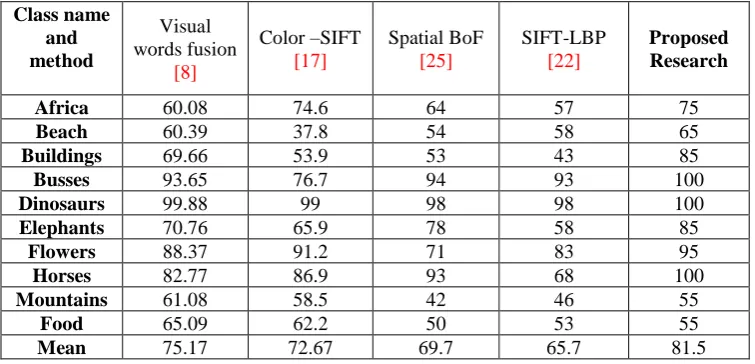
Table 2. Comparison of precision of the proposed low-level feature fusion with existing research. Class name and method Visual words fusion [8] Color –SIFT [17] Spatial BoF [25] SIFT-LBP [22] Proposed Research
Africa 60.08 74.6 64 57 75
Beach 60.39 37.8 54 58 65
Buildings 69.66 53.9 53 43 85
Busses 93.65 76.7 94 93 100
Dinosaurs 99.88 99 98 98 100
Elephants 70.76 65.9 78 58 85
Flowers 88.37 91.2 71 83 95
Horses 82.77 86.9 93 68 100
Mountains 61.08 58.5 42 46 55
Food 65.09 62.2 50 53 55
Mean 75.17 72.67 69.7 65.7 81.5
Table 2. Comparison of recall of the proposed low-level feature fusion with existing research. Class name and method Visual words fusion [8]
Color – SIFT [17]
Spatial BoF [25] SIFT-LBP [22] Proposed Research
Africa 12.02 14.92 12.8 11.4 15.0
Beach 12.08 7.56 10.8 11.6 13.0
Buildings 13.93 10.78 10.6 8.6 17.0
Busses 18.73 19.34 18.8 18.6 20.0
Dinosaurs 19.98 19.8 19.6 19.6 20.0
Elephants 14.15 13.18 15.6 11.6 17.0
Flowers 17.67 18.24 14.2 16.6 19.0
Horses 16.55 17.38 18.6 13.6 20.0
Food 13.02 12.44 10.0 10.6 11.0
Mean 15.03 14.53 13.94 13.14 16.3
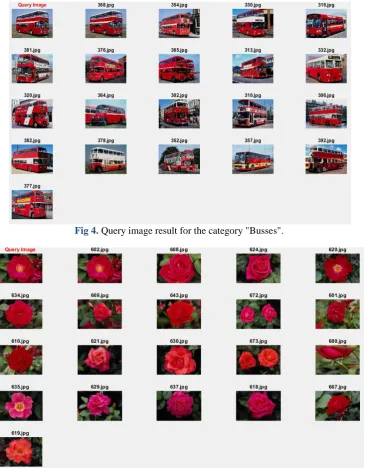
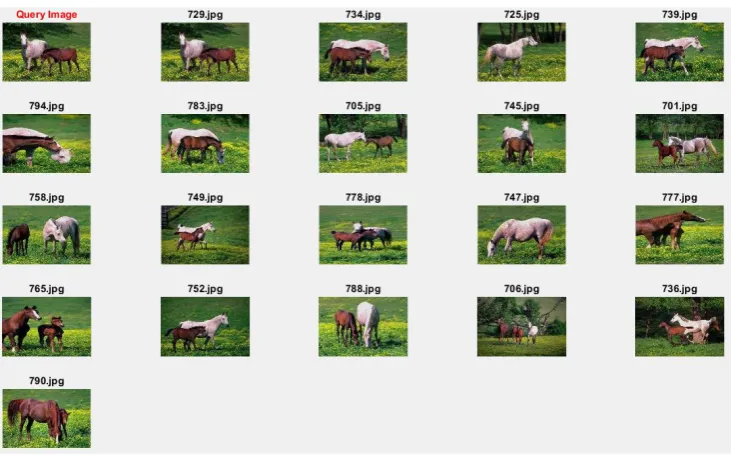
The numerical values of precision presented in Table 1 for top-20 retrievals present the effectiveness of proposed research. The comparison of precision and recall presented in Table 2-3 show a remarkable performance of the proposed research in most of the categories/classes as compared to the existing research [8, 17, 22, 25]. The mean image retrieval performance of proposed research is higher than that of color histogram, color moments and invariant moments. Table 4 represents the time required for feature extraction and numbers of images retrieved in seconds. The numerical values presented in Table 4 validate the robust performance of the proposed approach in term of feature extraction. Image retrieval results using different classes are represented in Fig. 3-6.
Table 4. Time required for feature extraction.
Proposed Approach
RSHD [19] Color-SIFT [17] CDH [19]
0.32 0.375 5.6 1.7
Fig 4. Query image result for the category "Busses".
Fig 6. Query image result for the category "Horses".
4.2 Image Retrieval Performance Using Corel-1.5k Image Dataset
Fig 7. Images taken from each class of Corel-1.5 K dataset [24].
Corel-1.5K dataset consists of 15 classes and is previously used to evaluate CBIR research.
Fig. 7 represents the photo gallery of each class from Corel-1.5K image dataset. The details about the total number of classes and images in the Corel 1.5K dataset is available in [8, 28]. The average precision and recall values comparison of the proposed research are presented in
table. 5.
Table 5. Average precision and recall values comparison obtained using the Corel 1.5K dataset.
Performance / Method
Visual word fusion [[8]
SQ+ Spatiogram [28]
SQ+ mSpatiogram
[28]
Proposed research
Precision 74.95 63.95 74.1 80.5
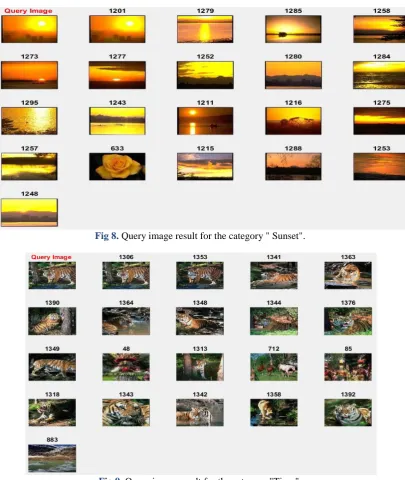
According to the numerical values presented in table 5, the mean precision value obtained from the proposed research using Corel 1.5K dataset is higher than the recent research [8, 28]. Image retrieval results when using different classes of query images are shown in Fig. 8-9.
Fig 8. Query image result for the category " Sunset".
Fig 9. Query image result for the category "Tiger".
4.3 Image Retrieval Performance Using Coil Image Dataset
The Coil image dataset is publicly available and is used to evaluate research based on CBIR
of experimental results, we can say that the proposed system is more reliable and outperforms the existing research [29]. Image retrieval results obtained using Coil image dataset are represented in Fig. 11 .
Fig10. Comparison of precision and recall using Coil dataset.
4.4 Image Retrieval Performance Using GT Dataset
GT dataset is publicly available and is used to evaluate the research based on CBIR [8, 27, 30]. The details about the total number of classes and images in the GT dataset is available in
[8, 27, 30]. Table. 6 presents the comparison of mean precision values obtained using GT dataset.
Table. 6 Mean precision when using GT dataset.
Performance / Method name
Visual words integration [8]
SVM-ensambles [30]
Wavelet- based IR [27]
Proposed research
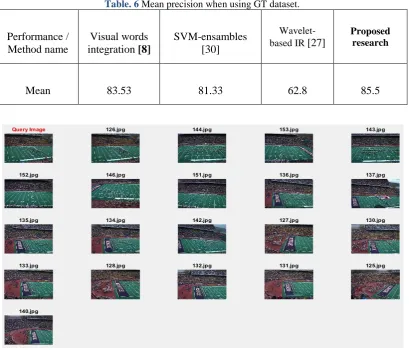
Mean 83.53 81.33 62.8 85.5
Fig 12. Image retrieval result for the class " Football".
The comparisons presented in Table 5, show that the proposed research outperforms the
existing[8, 27, 30]in term of precision when using GT image dataset. Image retrieval results
5.
Conclusion and Future Directions
The research proposed in this paper is based on the feature fusion of low-level visual features that are based on color histogram, color moments and invariant moments. The proposed research in this paper reduces the semantic gap between image visuals concepts and feature vector representation. We have selected the combination of these low-level visual features as they are robust and computation of these features requires less time. The distance of the query image to the images placed in the dataset is computed by applying Manhattan distance. The Corel-1K, Corel-1.5K, Coil and GT image datasets are selected to compute the image retrieval performance of low-level feature fusion of color and shape features. The values of precision, recall and feature extraction obtained from the proposed low-level visual feature fusion are compared with existing research of CBIR. All of these comparisons reflect the higher performance of proposed research model. The proposed research is efficient in term of feature extraction. Keeping in view this efficiency, the proposed research can be applied in any real-time domain for computer vision such as image retrieval or video surveillance. In future, we aim to extend the proposed low-level feature fusion with a classification model such as deep auto encoders for large-scale image retrieval.
References
[1] A. Nazir, R. Ashraf, T. Hamdani, and N. Ali, "Content based image retrieval system by using HSV color histogram, discrete wavelet transform and edge histogram descriptor," in
Computing, Mathematics and Engineering Technologies (iCoMET), 2018 International Conference on, 2018, pp. 1-6.
[2] B. Zafar, R. Ashraf, N. Ali, M. Ahmed, S. Jabbar, K. Naseer, et al., "Intelligent Image Classification-Based on Spatial Weighted Histograms of Concentric Circles," Computer Science & Information Systems, vol. 15, 2018.
[3] B. Zafar, R. Ashraf, N. Ali, M. Iqbal, M. Sajid, S. Dar, et al., "A Novel Discriminating and Relative Global Spatial Image Representation with Applications in CBIR," Applied Sciences,
vol. 8, p. 2242, 2018.
[4] N. Ali, B. Zafar, F. Riaz, S. H. Dar, N. I. Ratyal, K. B. Bajwa, et al., "A Hybrid Geometric Spatial Image Representation for scene classification," PloS one, vol. 13, p. e0203339, 2018. [5] B. Zafar, R. Ashraf, N. Ali, M. Ahmed, S. Jabbar, and S. A. Chatzichristofis, "Image
classification by addition of spatial information based on histograms of orthogonal vectors,"
PloS one, vol. 13, p. e0198175, 2018.
[6] M. Naeem, R. Ashraf, N. Ali, M. Ahmad, and M. A. Habib, "Bottom up Approach for Better Requirements Elicitation," in Proceedings of the International Conference on Future Networks and Distributed Systems, 2017, p. 47.
[7] F. Riaz, S. Jabbar, M. Sajid, M. Ahmad, K. Naseer, and N. Ali, "A collision avoidance scheme for autonomous vehicles inspired by human social norms," Computers & Electrical Engineering, 2018.
[8] N. Ali, K. B. Bajwa, R. Sablatnig, S. A. Chatzichristofis, Z. Iqbal, M. Rashid, et al., "A novel image retrieval based on visual words integration of SIFT and SURF," PloS one, vol. 11, p. e0157428, 2016.
information based on histograms of triangular regions," Computers & Electrical Engineering,
vol. 54, pp. 539-550, 2016.
[10] R. Ashraf, K. B. Bajwa, and T. Mahmood, "Content-based Image Retrieval by Exploring Bandletized Regions through Support Vector Machines," J. Inf. Sci. Eng., vol. 32, pp. 245-269, 2016.
[11] N. Ali, D. A. Mazhary, Z. Iqbaly, R. Ashraf, J. Ahmedz, and F. Zeeshan, "Content-Based Image Retrieval Based on Late Fusion of Binary and Local Descriptors," International Journal of Computer Science and Information Security, vol. 14, p. 821, 2016.
[12] X.-Y. Wang, J.-F. Wu, and H.-Y. Yang, "Robust image retrieval based on color histogram of local feature regions," Multimedia Tools and Applications, vol. 49, pp. 323-345, 2010. [13] J. Huang and R. Zabih, Color-spatial image indexing and applications: Cornell University
Ithaca,, USA, 1998.
[14] M. S. Navabi and Z. A. Brooghani, "Content-Based Image Retrieval through Combined Data of Color Moment and Texture," International Journal of Computer Science and Network Security (IJCSNS), vol. 17, p. 94, 2017.
[15] M.-K. Hu, "Visual pattern recognition by moment invariants," IRE transactions on information theory, vol. 8, pp. 179-187, 1962.
[16] Z. Mehmood, S. M. Anwar, N. Ali, H. A. Habib, and M. Rashid, "A novel image retrieval based on a combination of local and global histograms of visual words," Mathematical Problems in Engineering, vol. 2016, 2016.
[17] X. Tian, L. Jiao, X. Liu, and X. Zhang, "Feature integration of EODH and Color-SIFT: Application to image retrieval based on codebook," Signal Processing: Image Communication,
vol. 29, pp. 530-545, 2014.
[18] E. Walia and A. Pal, "Fusion framework for effective color image retrieval," Journal of Visual Communication and Image Representation, vol. 25, pp. 1335-1348, 2014.
[19] S. R. Dubey, S. K. Singh, and R. K. Singh, "Rotation and scale invariant hybrid image descriptor and retrieval," Computers & Electrical Engineering, vol. 46, pp. 288-302, 2015. [20] X. Yuan, J. Yu, Z. Qin, and T. Wan, "A SIFT-LBP image retrieval model based on bag of
features," in IEEE international conference on image processing, 2011.
[21] J. Wan, D. Wang, S. C. H. Hoi, P. Wu, J. Zhu, Y. Zhang, et al., "Deep learning for content-based image retrieval: A comprehensive study," in Proceedings of the 22nd ACM international conference on Multimedia, 2014, pp. 157-166.
[22] J. Yu, Z. Qin, T. Wan, and X. Zhang, "Feature integration analysis of bag-of-features model for image retrieval," Neurocomputing, vol. 120, pp. 355-364, 2013.
[23] F. Mindru, T. Tuytelaars, L. Van Gool, and T. Moons, "Moment invariants for recognition under changing viewpoint and illumination," Computer Vision and Image Understanding, vol. 94, pp. 3-27, 2004.
[24] J. Li and J. Z. Wang, "Real-time computerized annotation of pictures," IEEE transactions on pattern analysis and machine intelligence, vol. 30, pp. 985-1002, 2008.
[25] C. Wang, B. Zhang, Z. Qin, and J. Xiong, "Spatial weighting for bag-of-features based image retrieval," in International Symposium on Integrated Uncertainty in Knowledge Modelling and Decision Making, 2013, pp. 91-100.
[26] R. Ashraf, M. Ahmed, S. Jabbar, S. Khalid, A. Ahmad, S. Din, et al., "Content Based Image Retrieval by Using Color Descriptor and Discrete Wavelet Transform," Journal of medical systems, vol. 42, p. 44, 2018.
[27] E. Yildizer, A. M. Balci, T. N. Jarada, and R. Alhajj, "Integrating wavelets with clustering and indexing for effective content-based image retrieval," Knowledge-Based Systems, vol. 31, pp. 55-66, 2012.
[28] S. Zeng, R. Huang, H. Wang, and Z. Kang, "Image retrieval using spatiograms of colors quantized by gaussian mixture models," Neurocomputing, vol. 171, pp. 673-684, 2016. [29] S. M. Youssef, "ICTEDCT-CBIR: Integrating curvelet transform with enhanced dominant
![Fig 2. Images taken from each class of Corel-1K dataset [24].](https://thumb-us.123doks.com/thumbv2/123dok_us/8014885.1332633/7.595.151.497.293.432/fig-images-taken-class-corel-k-dataset.webp)
![Table 4. Time required for feature extraction. RSHD [19] Color-SIFT [17]](https://thumb-us.123doks.com/thumbv2/123dok_us/8014885.1332633/9.595.138.475.293.570/table-time-required-feature-extraction-rshd-color-sift.webp)