Automatic Search of Truncated Impossible Differentials for
Word-Oriented Block Ciphers (Full Version)
?Shengbao Wu1,2, Mingsheng Wang3
1. Institute of Software, Chinese Academy of Sciences, Beijing 100190, PO Box 8718, China 2. Graduate School of Chinese Academy of Sciences, Beijing 100190, China 3. State Key Laboratory of Information Security, Institute of Information Engineering,
Chinese Academy of Sciences, Beijing, China [email protected] [email protected]
Abstract. Impossible differential cryptanalysis is a powerful technique to recover the secret key of block ciphers by exploiting the fact that in block ciphers specific input and output differences are not compatible. This paper introduces a novel tool to search truncated impossible differentials for word-oriented block ciphers with bijective Sboxes. Our tool generalizes the earlier U-method and the UID-method. It allows to reduce the gap between the best impossible differentials found by these methods and the best known differentials found by ad hoc methods that rely on cryptanalytic insights. The time and space complexities of our tool in judging an r-round truncated impossible differential are aboutO(c·l4·r4) andO(c0·
l2·r2) respectively, wherelis the number of words in the plaintext andc,c0 are constants depending on the machine and the block cipher. In order to demonstrate the strength of our tool, we show that it does not only allow to automatically rediscover the longest truncated impossible differentials of many word-oriented block ciphers, but also finds new results. It independently rediscovers all 72 known truncated impossible differentials on 9-round CLEFIA. In addition, finds new truncated impossible differentials for AES, ARIA, Camellia without FL and FL−1layers, E2, LBlock, MIBS and Piccolo. Although our tool does not improve the lengths of impossible differentials for existing block ciphers, it helps to close the gap between the best known results of previous tools and those of manual cryptanalysis.
Key words: word-oriented block ciphers, truncated impossible differentials, difference propagation system,U-method, UID-method
1
Introduction
Impossible differential cryptanalysis is one of the most popular cryptanalytic tools for block ciphers. It
was firstly proposed by Knudsen to analyze DEAL [14] in 1998 and then extended by Biham et al. to
attack IDEA [5] and Skipjack [4]. Unlike traditional differential cryptanalysis [7], which uses differential characteristics with high probabilities to recover the right key, impossible differential cryptanalysis is a sieving method which exploits differentials with probability zero to retrieve the right key by filtering out all wrong keys. Until now, impossible differential cryptanalysis has shown its superiority over differential cryptanalysis in many block ciphers such as IDEA, Skipjack, CLEFIA [23] and AES [9].
Impossible differential cryptanalysis mainly consists of two steps. Firstly, an attacker tries to find impossible differentials, that is, differentials that never occur. Then, after gaining a list of plaintext-ciphertext pairs, the attacker guesses some subkey material involved in the outer rounds of the impossible differentials, and then partially encrypts/decrypts each plaintext-ciphertext pair to check whether the corresponding internal differences are identical to the input and output differences of the impossible differentials. Once that happens, the guessed subkey will be discarded. The right key will be recovered if we discard all wrong keys.
Several factors influence the success of impossible differential cryptanalysis, including the length of impossible differentials, specific input/output difference patterns and the strength of one-round encryp-tion/decryption. Among them, the most important factor is the length of an impossible differential. The
?
longer the impossible differential is, the better the attack will be. Another important factor is the in-put/output difference pattern when two impossible differentials have the same length, because the new impossible differentials may well result in improved attacks [27, 17, 10]. If we find more impossible differ-entials, we can perform a successful attack or improve the time/data complexities of known attacks with higher possibilities.
In Indocrypt 2003, Kim et al.[13] proposed theU-method to find impossible differentials for various
block cipher structures with bijective round functions. TheU-method is based on the miss-in-the-middle
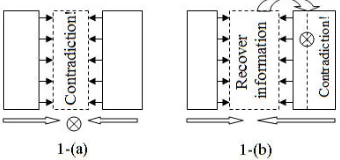
approach (see 1-(a) of Fig. 1): it first constructs two differentials with probability one from the encryption and decryption direction and subsequently demonstrates some contradictions by combining them. In the
U-method, the propagation of differences in a block cipher (structure) is translated into simple matrix
operations, and some inconsistent conditions are used to detect impossible differentials. Luo et al. [18]
developed the idea of the U-method and proposed a more general method —the UID-method. The
UID-method removed some limitations in theU-method and harnesses more inconsistent conditions to
evaluate impossible differentials. So far, theU-method and the UID-method have been employed as tool
by some block cipher designers to evaluate the security of their designs against impossible differential cryptanalysis, for instance, LBlock [26] and Piccolo [22].
However, theU-method and the UID-method only focus on finding impossible differentials with the
miss-in-the-middle approach, which limits their power. An example is illustrated in 1-(b) of Fig. 1. In this case, we cannot detect a contradiction in the match point of the two probability-one differentials, but instead recover some useful information, which will feed back to the internal rounds to produce
a contradiction. The U-method and the UID-method fail to detect this kind of impossible differentials
because they do not fully use the information in the match point.
Fig. 1.Basic idea of the miss-in-the-middle approach (1-(a)) and impossible differentials with information feedback (1-(b))
Indeed, the longest impossible differentials of many block ciphers known so far are not found by theU -method and the UID--method, but constructed by ad hoc approaches and the experience of cryptanalysts,
such as 8-round MIBS [3], 6-round E2 [25], 8-round Camellia without theF LandF L−1layers [27] [25]
and all 72 9-round impossible differentials of CLEFIA listed in [24]. Almost all impossible differentials of these block ciphers fall under the model of 1-(b) of Fig. 1, which implies that they are beyond the abilities
of theU-method and the UID-method. Of course, ad hoc approaches also have some disadvantages. For
example, it is very computationally intensive to find even one impossible differential, and the success of finding an impossible differential is highly dependent to the experience of a cryptanalyst. Thus, they are not efficient and systematic in practice. Especially in designing a block cipher, one has to modify his/her design and frequently re-evaluate its security against impossible differential cryptanalysis.
Our Contributions. In this work, we propose a new tool for automatically finding impossible differen-tials of word-oriented block ciphers with bijective S-boxes. The goals of our tool are to reduce the gap
between previous automatic tools (i.e., theU-method and the UID-method) and ad hoc approaches, and
Unlike the miss-in-the-middle approach, which splits a block cipher into two parts factitiously, we treat it as an entirety. The inputs of our tool are some constraints of the plaintext difference and the ciphertext difference, and a system of equations that describes the propagation behavior when differences pass through the inner primitives of a block cipher. Then, our tool predicts information about unknown variables from the known ones iteratively, with probability one in each step. Finally, it outputs a flag indicating whether a truncated differential is impossible under several filtering conditions. The time and space complexities of our tool in judging anr-round truncated impossible differential are aboutO(c·l4·r4) and O(c0·l2·r2) respectively, where l is the number of words in the plaintext and c, c0 are constants
depending on the machine and the block cipher.
Although our tool does not improve the lengths of impossible differentials for existing block ciphers, it helps in reducing the gap between previous automatic tools and ad hoc approaches. Experimental results also indicate that our tool is efficient and systematic. It not only rediscovers the longest truncated impossible differentials of many word-oriented block ciphers known so far, but also finds new results. It independently rediscovers all 72 known truncated impossible differentials on 9-round CLEFIA [24]. In addition, besides the best results known so far, our tool finds new truncated impossible differentials for
many other word-oriented block ciphers, such as the AES, Camellia [1] without F L and F L−1 layers,
MIBS [11], LBlock [26], ARIA [15], E2 [12] and Piccolo [22]. The number of new truncated impossible differentials obtained by our tool is summarized in Table 1.
Table 1.Summary of new truncated impossible differentials (ID) obtained by our tool. Camellia* is a variant of Camellia withoutF LandF L−1 layers.
Block Cipher Word unit Previous results In this paper Round No. of IDs Method Round No. of IDs New IDs AES byte 4 ([6, 20, 21, 2, 19]) 269,554 ad hoc 4 3,608,100 3,338,546 ARIA byte 4 ([27, 17, 10, 16]) 156 ad hoc 4 94,416 94,260 Camellia* byte 8 ([27],[25]) 3 ad hoc 8 4 1
E2 byte 6 ([25]) 1 ad hoc 6 56 55
MIBS nibble 8 ([3]) 2 ad hoc 8 8 6
LBlock nibble 14 ([26]) 64 U-method 14 80 16 Piccolo nibble 7 ([22]) 1 U-method 7 450 449
An interesting observation is that the U-method and the UID-method are specific cases of our tool,
and our tool is more powerful than them. An example is given to indicate that our tool can find longer
impossible differentials than theU-method and the UID-method. Thus, we expect that our tool is useful
in evaluating the security of block ciphers against impossible differential cryptanalysis, especially when one tries to design a word-oriented block cipher with bijective Sboxes.
For the convenience of verifying our results, the source code for finding truncated impossible differ-entials of SPN ciphers and Feistel ciphers with SPN round functions are listed in Appendix B.
Outline of This Paper.In Sect. 2, we discuss how to build difference propagation systems, which describe the propagation behavior when differences pass through the inner primitives of block ciphers. In Sect. 3, we discuss our idea to find new impossible differentials. Then, a tool for automatically searching truncated impossible differentials is proposed in Sect. 4. Experimental results are also provided in this
section. Finally, we compare our tool with theU-method and the UID-method in Sect. 5 and conclude
this paper in Sect. 6.
2
Difference Propagation System
Throughout this paper, we consider the exclusive-or difference, and we assume that: (1)E is anr-round
word-oriented block cipher with block length l·s bits (where s is the bit length of a word), that is,
it does not influence the propagation of differences. Although some block ciphers do not satisfy all the above conditions, e.g., IDEA, we believe that similar ideas can also be applied, with some modifications. In this section, we discuss how to build a system of equations that describes the propagation behavior when differences pass through the inner primitives of a word-oriented block cipher. This system will be calleddifference propagation systemin the subsequent discussions.
2.1 Difference Propagation of Basic Primitives
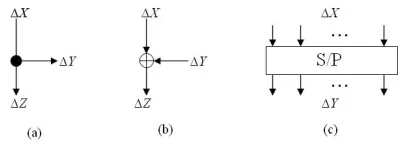
Before studying block ciphers, we first investigate the difference propagation of four basic primitives which are often employed as parts of a word-oriented block cipher, namely the branching operation, the XOR-operation, the bijective Sbox layer and the linear permutation layer. These primitives are illustrated in (a), (b) and (c) of Fig. 2.
Fig. 2.Basic primitives of a block cipher: (a) the branching operation, (b) the XOR-operation and (c) the bijective Sbox/linear permutation layer
Suppose ∆X = (∆xi)1≤i≤n, ∆Y = (∆yi)1≤i≤n and ∆Z = (∆zi)1≤i≤n are row vectors in Fn2s, the difference propagation of basic primitives can be described as follows.
Lemma 1. (The branching operation.) For a branching operation (see (a) of Fig. 3), we have ∆X = ∆Y =∆Z. This equation can be written as2nlinear equations∆xi⊕∆yi= 0and∆xi⊕∆zi= 0.
Lemma 2. (The XOR-operation.) For an XOR-operation (see (b) of Fig. 3), we have∆X⊕∆Y =∆Z. This equation can be written asnlinear equations∆xi⊕∆yi⊕∆zi= 0.
Lemma 3. (The linear permutation layer.) A linear permutation (see (c) of Fig. 3) has matrix repre-sentationP = (pi,j)1≤i,j≤n over F2s, that is, ∆YT =P ·∆XT, where ∆XT is the transposed vector of ∆X. This equation can be written asnlinear equations∆yi⊕
Ln
j=1pi,j·∆xj = 0.
Lemma 4. (The Sbox layer.) For an Sbox layer consisting ofn bijective SboxesSi :F2s →F2s (see (c) of Fig. 3), we build nformal equationsSi(∆xi, ∆yi) = 0.
Remark 1. Notice that Si(·,·) is inherently a nonlinear map if we try to write its concrete expression,
sinceSi is a nonlinear bijective Sbox. Each pair (∆xi, ∆yi) withP r(∆xi →∆yi)6= 0 in the Difference
Distributed Table [7] ofSi is a solution of Si(∆xi, ∆yi) = 0, which means that an input difference∆xi
may propagate to the output difference ∆yi. However, in Lemma 4, we build a formal equation for an
Sbox without considering its concrete expression because the only property used in our tool is that it is bijective.
2.2 Build Difference Propagation Systems
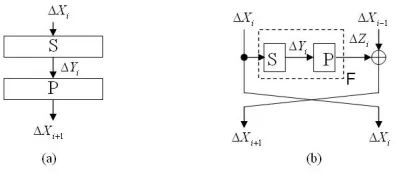
Fig. 3.The three most important classes of block ciphers: (a) SPN ciphers and (b) Feistel ciphers with SPN round function
SPN Cipher. One round of an SPN cipher typically has three layers (see (a) of Fig. 3): the Sub-keyAddition layer, the Sbox layer and the linear permutation layer. As mentioned above, we omit the SubkeyAddition layer since it does not influence the propagation of differences. Additionally, we can omit the last linear permutation layer since it does not influence the length of an impossible differential.
We denote by∆Xi= (∆Xi,j)1≤j≤l and∆Yi = (∆Yi,j)1≤j≤l the differences before and after the Sbox
layer of roundi, respectively. Then, for anr-round SPN cipher, we build a difference propagation system as follows:
Sj(∆Xi,j, ∆Yi,j) = 0 for 1≤i≤rand 1≤j≤l ,
∆XT
i+1⊕P·∆YiT = 0 for 1≤i≤r−1 ,
(1)
whereP is the matrix of linear permutation layer. This system contains 2·l·runknown variables, l·r
formal (and nonlinear) equations from Sbox layers andl·(r−1) linear equations (using Lemma 3).∆X1
is the plaintext difference and∆Yris the ciphertext difference.
Feistel Cipher with SPN Round Functions. For an r-round Feistel cipher (see (b) of Fig. 3), we denote by∆Xi−1 = (∆Xi−1,j)1≤j≤l
2 and ∆Xi = (∆Xi,j)1≤j≤
l
2 the differences of the right branch and
the left branch of round i, respectively. Note that we assume that l is even. Thus, (∆X1, ∆X0) is the
plaintext difference and (∆Xr+1, ∆Xr) is the ciphertext difference.
The SPN round function typically has three layers: the SubkeyAddition layer, the Sbox layer and the linear permutation layer. We introduce∆Yi= (∆Yi,j)1≤j≤l
2 to denote the difference after the Sbox layer
of roundi and∆Zi = (∆Zi,j)1≤j≤l
2 to represent the output difference of F function in round i. Then,
we build a difference propagation system as follows:
8 < :
Sj(∆Xi,j, ∆Yi,j) = 0 for 1≤i≤r and 1≤j≤ 2l ,
∆ZiT⊕P·∆YiT = 0 for 1≤i≤r , ∆Xi−1⊕∆Xi+1⊕∆Zi= 0 for 1≤i≤r ,
(2)
whereP is the matrix of the linear permutation layer inF. This system contains l
2·(3r+ 2) unknown
variables, 2l·rformal (and nonlinear) equations andl·rlinear equations (using Lemma 2 and Lemma 3). IfF is an SPS-type round function (e.g., the block cipher E2), that is,F consists of two consecutive SPN round functions, a similar system can be built by introducing new variables to represent the input difference and the output difference of the second Sbox layer.
Other Block Ciphers. Similar systems can be built for other block ciphers by introducing proper internal variables and combining Lemma 1 to Lemma 4 appropriately. For the convenience of building formal equations from Sbox layers and running our tool, different variables should be introduced before and after an Sbox layer to represent its input difference and output difference, respectively.
Remark 2. From Lemma 1 to Lemma 4, we know that a basic primitive costs 3l variables and provides
difference propagation system with 3l·mvariables and 2l·mequations in the worst case. In general,mis a small constant. For example,mis 2 in SPN ciphers (see (a) of Fig. 3) andmis 4 in Feistel ciphers with
SPN round functions (see (b) of Fig. 3). Hence, for anr-round block cipher, we can build a difference
propagation system with O(c1·r·l) variables andO(c2·r·l) equations, wherec1 andc2 are constants depending on specific block ciphers.
3
Finding Impossible Differentials
In this section, we first introduce the basic idea of finding impossible differentials. Then, we discuss how to predict information from a given difference propagation system and how to detect contradictions. Finally,
we briefly review theU-method and the UID-method.
3.1 Basic Idea
For a given difference propagation system, each solution satisfying it is anr-round differential character-istic, without considering its probability. On the contrary, anr-round impossible differential is obtained if one demonstrates that there is no solution satisfying the system under given plaintext difference and ciphertext difference.
The idea of finding impossible differentials in this paper is simple: given some information of the plain-text difference and the cipherplain-text difference, we may predict the information of new variables according to the difference propagation system, yielding a new set of “known” variables. Then, new information may again be predicted from these “known” variables. This process will continue until we find a contradiction or we can no longer obtain any new information. Notice that every prediction we made is deterministic (i.e., with probability one), which implies that the system does not have any solution if a contradiction is found. In other words, we obtain an impossible differential if a contradiction is detected in the process of predicting information, under given plaintext difference and ciphertext difference.
3.2 Predict Information and Detect Contradictions
We can divide a difference propagation system into two subsystems — L and N L. L includes all
lin-ear equations whileN L contains all formal (and nonlinear) equations from bijective Sboxes. Then, the
information can be obtained with probability one in the following two ways:
(i) Predict information from the linear systemL. If systemLhas solutions, then they can be solved by theGauss-Jordan Eliminationalgorithm, which gets solutions by firstly reducing the augmented matrix
of L to row echelon form using elementary row operations and then back-substituting until the entire
solution is found. The reduced augmented matrix after the back-substituting step represents a linear system that is equivalent to the original. Then, we have the following lemma.
Lemma 5. SupposeL has solutions and the reduced augmented matrix ofL is obtained, then
1) If an affine equation with only one variable, that is, ∆X⊕c = 0 (c is a constant), is found in the reduced system ofL, we have ∆X= 0 ifc= 0and∆X 6= 0if c6= 0.
2) If a linear equation with two variables, that is,∆X⊕∆Y = 0, is found in the reduced system ofL, we have ∆X6= 0if and only if ∆Y 6= 0.
Remark 3. After solving a system of linear equationsL with the Gauss-Jordan Eliminationalgorithm, each variable that has a unique solution will be recovered, that is, all equations of the form∆X⊕c= 0 (c
is a constant) exist in the reduced augmented matrix ofL. Hence, Lemma 5 does not miss any information
that falls under case 1).
(ii) Predict information from the nonlinear systemN L. We have
According to the basic idea of finding impossible differentials, the strategy of predicting information is
clear now: predict information from systemLandN Lalternately until a contradiction is found or we can
no longer obtain any new information. An impossible differential is detected by the following proposition:
Proposition 1. We denote by∆P and∆C the plaintext difference and the ciphertext difference, respec-tively. Then, ∆P →∆C is impossible if one of the following two situations happens:
– I. The linear system L does not have any solution. That is, the rank of its coefficient matrix is not equal to the rank of its augmented matrix.
– II. There exists a variable with both zero and nonzero values.
Two tiny examples of the second case are given below.
Example 1. Suppose the equations ∆Y ⊕∆Z = 0 and S(∆X, ∆Y) = 0 are included in a difference
propagation system, and we know that ∆X = 0 and ∆Z 6= 0 from the previous information. Then, in
the next prediction, we know that ∆Y 6= 0 from Lemma 5 while ∆Y = 0 from Lemma 6, which is a
contradiction.
Example 2. Suppose we have known that [∆a1, ∆a2, . . . , ∆an] is a nonzero vector. Then, a contradiction
is found if we deduce that∆ai= 0 (for 1≤i≤n) in the subsequent information predictions.
3.3 Related Work — theU-method and the UID-method
In this section, we briefly review theU-method and the UID-method. The specification of these tools can
be found in [13] and [18].
Both theU-method and the UID-method mainly have three steps in finding an impossible differential.
First, both tools construct a characteristic matrix which describes the propagation of differences in one round encryption/decryption. For example, for one round of Feistel structure (see (b) of Fig. 3), we have ∆Xi+1 = F(∆Xi)⊕∆Xi−1 and ∆Xi = ∆Xi, that is, (∆Xi+1, ∆Xi)T = E ·(∆Xi, ∆Xi−1)T, where E=F 1
1 0
is the characteristic matrix of one round encryption. The characteristic matrixDof one round
decryption can be defined similarly. Secondly, theU-method and the UID-method defined some operations
to calculate the multiplications between a characteristic matrix and a vector, because the output difference
after r1-round encryptions (resp., r2-round decryptions) can be described as ∆U = Er1 ·∆PT (resp.,
∆V = Dr2 ·∆CT). Finally, suppose ∆U = (∆u
j)1≤j≤l and ∆V = (∆vj)1≤j≤l are two vectors which
should be combined in the miss-in-the-middle approach, the following filtering conditions are used to detect contradictions.
Definition 1. (Definition 1 of [18]) Vectors ∆U and∆V are inconsistent if there exists a subset I ⊆ {1,2, . . . , l} such that ⊕i∈I(∆ui⊕∆vi) 6= 0, where ∆ui (respectively, ∆vi and f =⊕i∈I(∆ui⊕∆vi))
is a linear XOR combination of the four types of differences: zero difference, nonzero fixed difference, nonzero unspecified difference and unknown difference. Especially, theU-method always considers subsets that have exactly one index.
There are two main differences between the U-method and the UID-method. First, the UID-method
relaxes the 1-Property (i.e., the number of 1 entries in each column of the characteristic matrix is zero
or one) required in theU-method. Secondly, the UID-method exploits a more general filtering condition
to detect contradictions than theU-method, which has shown in Definition 1. Thus, the UID-method is
more general than theU-method.
4
Algorithm to Find Truncated Impossible Differentials
4.1 Sketch of Our Algorithm
After building a difference propagation system as (1) or (2), we first implement it in a computer. Then, we choose a set of promising (∆P, ∆C) pairs. Finally, for each of these pairs, our algorithm judges whether it is an impossible differential automatically, that is, our algorithm predicts information from the linear
systemL and the nonlinear system N Lalternately until a contradiction is found or we can no longer
obtain any new information. The outline of our algorithm is shown in Algorithm 1.f lagindicates whether
∆P →∆C is impossible, andindex controls the termination of predicting information.
Implement the difference propagation system, i.e.,LandN L, on a computer;
1
forevery pair of(∆P, ∆C)we choose do
2
f lag:=false;index:=true;
3
whileindex do
4
if SystemLdoes not have any solution then
5
f lag:=true;index:=false;
6
else
Predict information from the reduced augmented matrix ofL;
7
Predict information from the nonlinear systemN L;
8
if do not find new information then
9
index:=false;
10
else
if find a variable with both zero and nonzero values then
11
f lag:=true;index:=false;
12
returnf lag;
13
Algorithm 1: The outline of our algorithm
In the subsequent sections, we will discuss some details of Algorithm 1, including how we implement a difference propagation system on a computer, the choices of the plaintext difference and the ciphertext difference, and a specific algorithm for automatically judging a truncated impossible differential.Λ0and Λ1 are sets for storing variables with zero difference and nonzero differences in a difference propagation system.
4.2 Implementation of a Difference Propagation System
Since a difference propagation system is divided into two parts — systems L and N Lin our tool, we
discuss how to implement them on a computer, respectively.
Implement system L with a matrix. SystemL can be written formally as A·x=b, where A, b andB = [A|b] are called thecoefficient matrix, constant matrixand augmented matrixof this system respectively,xis the set ofallvariables (in order) involved in the whole difference propagation system.
For a further step, the systemLcan be represented as a column vector form:
A1·x1⊕A2·x2⊕ · · · ⊕An·xn =b . (3)
If we change the order of variables in (3), the coefficient matrixAwill be changed accordingly. For example,
the column positions ofA1 and A2 in A will be exchanged if we exchange the order ofx1 and x2 in x.
Thus, matrixA(andB) is determined once the order of variables inxis fixed. In computer manipulations,
we do not deal with the system in terms of equations but instead make use of the augmented matrixB.
In the following example, we show that matrixAcan be easily constructed if we choose a proper order
of variables.
Example 3. We consider Feistel ciphers with SPN round functions, that is, we need to generate the coefficient matrix of linear equations in (2). Firstly, we may simplify the second and third equations of (2) as
whereI1=I2=IandIis the identity matrix. Notice that variables∆Zis are eliminated in the simplified
system. For a further step, the coefficient matrices of∆XiT−1 and ∆XiT+1 may be substituted by other matrices according to the specification of the block ciphers.
Next, we fix the order of all variables in the simplified system as
x= [∆X0, ∆X1, ∆X2, ∆X3, . . . , ∆Xr−1, ∆Xr, ∆Xr+1, ∆Y1, ∆Y2, . . . , ∆Yr] . (5)
Finally, (4) can be represented as
A·xT = 0 , where
A=
I1 0 I2 0 · · · 0 0 0 P 0 · · · 0 0 I1 0 I2· · · 0 0 0 0 P · · · 0
..
. ... ... ... . .. ... ... ... ... ... . .. ... 0 0 0 0 · · ·I10I2 0 0 · · ·P
is a block matrix withrrows and 2r+ 2 columns. Now,Ais a highly structured matrix. We can easily
generate it in a computer if we obtain the coefficient matrices of∆Xi−1,∆Xi+1 and∆Yi in (4).
For iterative block ciphers with other structures, similar techniques can be used to construct highly structured coefficient matrices.
A technical detail in solving a linear system is to dispose a zero variable. Without loss of generality,
suppose x1 = 0 in (3). Then, to avoid reduplicate judges of case 1) in Lemma 5, we can eliminate the
termA1·x1 from (3) to obtain a system with one less variable, or keep the variable x1 in the system
while settingA1to a zero vector. Both methods keep the solutions of the other variables unchanged and
need additional space to store the value ofx1. In our tool, we choose the latter manner for implementing systemN Lconveniently, and variables with zero value will be stored in setΛ0. Notice that for the last
method,B is a matrix with a fixed number of columns.
Implement systemN Lwith a table.Once the order of variables inxis given, thei-th variable in
xcorresponds to thei-th column ofA(andB). Then, we can store equations of systemN Lwith a simple
table using the column indexes ofB. First, we initialize an empty tableT, then for each equation inN L, we add an element{v1, v2}toT, wherev1, v2 are two integers (i.e., the column indexes ofB) indicating the two variables involved in the formal equation of an Sbox. For example, if the order of variables in a Feistel cipher is fixed as that in (5), then tableT for formal equations in (2) is
T = [{l
2+
l
2 ·(i−1) +j, l
2·(r+ 2) + l
2 ·(i−1) +j}: 1≤i≤r,1≤j≤ l 2] .
4.3 The Choices of the Plaintext Difference and the Ciphertext Difference
To judge an impossible differential, we have to first initialize some information, i.e., impose some
con-straints on the plaintext difference ∆P and the ciphertext difference ∆C. To avoid trivial results, an
obvious constraint is that ∆P 6= 0 and ∆C 6= 0 . However, besides this constraint, there are still
(2ls−1)·(2ls−1) choices for all combinations of∆P and∆C. It is impossible to enumerate all of them
on a personal computer, even for a 32-bit block cipher.
According to the property of word-oriented block ciphers, a natural way is to consider truncated differences. That is, for each word of∆P = (∆Pi)1≤i≤land∆C= (∆Ci)1≤i≤l, we assign an indicator to
indicate the choice of its difference, representing by 0 a word without difference and by 1 a word with
a difference. In such representation, the indicator vectors of∆P and ∆C are row vectors inFl
2, and the number of all possible combinations of∆P and∆C is reduced to (2l−1)·(2l−1), which makes it feasible
to enumerate all or a big part of them.
Notice that the value of∆Pi (or ∆Ci) is zero if its indicator is 0, which implies that, in a difference
propagation system, the variable ∆Pi (or ∆Ci) can be evaluated as zero. However, if the indicator of
∆Pi (or ∆Ci) is 1, we cannot evaluate any specific value for∆Pi (or ∆Ci). In this case, we just leave
∆Pi (or∆Ci) as an undetermined variable in a difference propagation system while storing its indicator
4.4 Algorithm for Judging a Truncated Impossible Differential
Letp= [p1, p2, . . . , pl] (respectively, c = [c1, c2, . . . , cl]) be a vector, indicating the variable positions of
∆P (respectively,∆C) inx. Fox example,p= [2l+ 1,2l+ 2, . . . , l,1,2, . . . ,2l] if the order of variables in an r-round Feistel cipher is fixed as given in (5), since [∆X1, ∆X0] is the plaintext difference.M ulCol(B,i,j)
is a function that multiplies thej-th column of matrixB with elementi, andColSubM atrix(B, i, j) is
the submatrix ofB with columns fromito j.
Our algorithm takes the matrix B, table T, vector p, vector c, indicator vectors of ∆P and ∆C
as inputs, and then predicts information as described in Algorithm 1 (i.e., from step 3 to step 12)
automatically. Finally, it outputs a f lag indicating whether ∆P → ∆C is impossible, under the filter
conditions listed in Proposition 1. The specific description of our algorithm is shown in Algorithm 2, and some sketches are listed as follows.
– In step 1, our tool initializes the sets Λ0 and Λ1, which are used for storing variables with zero
difference and nonzero differences. We also introduce a new matrix B0 to protect the matrix B
against revision, because B can be re-used for different indicator vectors of ∆P and ∆C (we also
discuss it below in the remarks of Algorithm 2).
– From step 2 to step 6, our tool scans the indicator vectors of∆P and∆C, and stores their information inΛ0orΛ1. As mentioned in Sect. 4.2, if the value of a variable is zero, then the corresponding column ofB0 will be set to a zero vector.
– From step 7 to step 17, our tool predicts information from systemLandN Lalternately. This process
is terminated if indexis false, which implies that a contradiction is found by using Proposition 1 or we can no longer obtain any new information. Especially,
• in step 10 and step 11, our tool detects whether there is a typeIcontradiction of Proposition 1;
• in step 12, it preforms Gauss-Jordan Elimination algorithm to obtain the reduced augmented
matrix of the systemL;
• in step 13, it predicts information from the reduced augmented matrix of the systemL and the
systemN Lby calling the subprogramPredict Info;
• in step 15 and step 16, it detects whether there is a typeIIcontradiction of Proposition 1.
– From step 18 to step 36, our tool predicts information from the reduced augmented matrix of the
systemLand the systemN L. Especially,
• in step 19, our tool defines atemp to represent whether it finally obtain some new information
in the information prediction;
• from step 20 to step 27, our tool predicts information from the reduced augmented matrix of
the systemL, by scanning all linear equations in the system Land recovering information using
Lemma 5;
• from step 28 to step 33, our tool predicts information from the systemN Lusing Lemma 6;
• in step 34 and step 35, some new information is obtained if the number of variables in the setΛ0
orΛ1 is increased. If that happens, the returnedtempwill be true.
For anr-round word-oriented block cipher, we may obtain allr-round truncated impossible
differen-tials by enumerating all possible nonzero indicator vectors of∆Pand∆C. To obtain truncated impossible
differentials with different lengths, it only needs to try different round numbers. Some remarks on our algorithm are given below.
1. Since the encryption process of a block cipher is deterministic, for a fixed round numberr, we only
need to build the difference propagation system once. So, matrix B, table T, vectorpand vector c
can be reused for different indicator vectors of ∆P and∆C. Thus, we introduce a new matrixB0 in
Algorithm 2 to protect the matrix B against revision.
2. Besides indicator vectors of∆P and ∆C, some linear constraints between nonzero variables in∆P
and∆C can also be added while selecting the initial constraints. Our tool still works in this case by translating all linear constraints to row matrices firstly and then adding these rows to matrixB0. 3. Our tool only uses the bijective property of an Sbox to predict information, without solving nonlinear
systems. The most time-consuming steps are calculating the rank of a matrix and solving a linear system.
Input: MatrixB, tableT, vectorp, vectorcand indicator vectors of∆P and∆C. Output: Af lag indicates whether∆P →∆C is impossible.
B0:=B;Λ0:=∅;Λ1:=∅;n:=NumberOfColumns(B0);
1
// Initialize the truncated information of ∆P and ∆C . . . // . . . using their indicator vectors SdeltaP and SdeltaC.
fori:= 1 toldo
2
Λ1:=Λ1∪ {pi}if SdeltaP=1;
3
Λ0:=Λ0∪ {pi}andB0:=MulCol(B0,0, pi) if SdeltaP=0; 4
Λ1:=Λ1∪ {ci}if SdeltaC=1;
5
Λ0:=Λ0∪ {ci}andB0:=MulCol(B0,0, ci) if SdeltaC=0; 6
// Predict information and find contradictions. f lag:= false;index:=true;
7
whileindexdo
8
A0:=ColSubMatrix(B0,1, n−1);
9
if rank(A0)6=rank(B0)then
10
f lag:= true;index:=false;
11
else
// Gauss-Jordan Elimination. B0:=Reduced-row-echelon-form-of(B0);
12
< B0, Λ0, Λ1, temp >:=Predict Info(B0,T, Λ0, Λ1);
13
index:=temp;
14
if Λ0∩Λ1 6=∅then
15
f lag:= true;index:=false;
16
returnf lag.
17
Predict Info(B0,T, Λ0, Λ1);
18
n0:=|Λ0|;n1:=|Λ1|;temp:=false;n:=NumberOfColumns(B0);
19
// Predict information from the reduced row echelon form of B0 using Lemma 5. fori:= 1 to NumberOfRows(B0)do
20
S:=∅;
21
forj:= 1ton−1do
22
S:=S∪ {j}ifB0[i, j]6= 0;
23
// A linear equation with form ∆X= 0. if |S|= 1 andB0[i, n] = 0then
24
Λ0:=Λ0∪S;B0:=MulCol(B0,0, j) forj∈S ;
25
// An equation with form ∆X⊕c= 0 (c6= 0) or ∆X⊕∆Y = 0. if (|S|= 1andB0[i, n]6= 0)or(|S|= 2,B0[i, n] = 0andS∩Λ16=∅)then
26
Λ1:=Λ1∪S;
27
// Scan table T and use Lemma 6 to predict information. forj:= 1to NumberOfElements(T)do
28
if T[j]∩Λ06=∅andT[j]\Λ06=∅then
29
B0:=MulCol(B0,0, e) fore∈ T[j]\Λ0;
30
Λ0:=Λ0∪ T[j];
31
if T[j]∩Λ16=∅then
32
Λ1:=Λ1∪ T[j];
33
if |Λ0|> n0 or|Λ1|> n1 then
34
temp:=true;
35
return< B0, Λ0, Λ1, temp >.
36
Algorithm Complexity. SupposeB0 is a matrix withM rows andN columns. The time consumption
for computing rank(A0), rank(B0) and Gauss-Jordan Elimination is about O(M2·N), and the time
consumption for the subprogram Predict Info is about O(M ·N). Algorithm 2 terminates ifindex is
false. Otherwise, at least one of setsΛ0andΛ1is updated after each while loop. According to the pigeon-hole principle, there must be a typeIIcontradiction mentioned in Proposition 1 when|Λ0|+|Λ1|> N.
Therefore, while loop runsN+ 1 times at most. In summary, the time complexity of judging a truncated
impossible differential does not exceed O(M2·N2). From Remark 2, we knowM is about O(c
1·l·r) and N is about O(c2·l·r). Thus, the time complexity of Algorithm 2 is aboutO(c·l4·r4), where c is a constant depending on the machine and the block cipher. The space complexity of Algorithm 2 is dominated by storing the matricesB,B0 andA0. Thus, the space complexity is aboutO(M·N), that is, O(c0·l2·r2), wherec0 is also a constant depending on the machine and the block cipher.
4.5 Experimental Results
We apply our tool to find truncated impossible differentials for various byte-(or nibble-)oriented block
ciphers, such as the AES, CLEFIA, E2, Camellia withoutF L and F L−1 layers, ARIA, LBlock, MIBS
and Piccolo. All of these block ciphers havel = 16. We may classify them into three groups according
to their underlying structures: SPN ciphers (AES and ARIA), Feistel ciphers (Camellia withoutF Land
F L−1layers, LBlock, MIBS and E2), and generalized Feistel ciphers (CLEFIA and Piccolo). The results
of this section are obtained on a 2.66 GHz processor with MAGMA package [8]. For the convenience of verifying our results, the source code for searching the truncated impossible differentials of some block ciphers are listed in Appendix B.
SPN Ciphers. For the AES, our tool finds 3,608,100 4-round truncated impossible differentials in hours using the filter conditions of Example 2. All impossible differentials of AES follow an inherent rule. We can describe them explicitly (see Appendix A). The classes of impossible differentials discussed in [6, 20, 21, 2, 19] are included in our result set. For the ARIA, besides the results shown in [27, 17, 10], our tool finds 94,260 new 4-round truncated impossible differentials in about two weeks.
Feistel Ciphers. Since there is always a five round impossible differential (0, ∆X0)6→5(∆X6,0) for the
Feistel structure with bijective round function when ∆X0 = ∆X6 [13], we focus on finding impossible
differentials (0, ∆X0) 6→r (∆Xr+1,0) with r ≥ 6. The search space is reduced to (2 l
2 −1)·(2
l
2 −1).
Results for Camellia withoutF LandF L−1layers, MIBS, LBlock and E2 can be obtained in a few hours.
Notice that E2 is a Feistel cipher with SPS-type round function.
SupposeIis a set,eI denotes a vector whosei-th (for alli∈I) component is a nonzero difference while
other components are zero difference. Then, the results obtained by our tool are illustrated in Table 2, where (eI, eJ) is the shortened form of (0, ∆X1)6→r (∆Xr+1,0). For example, (e3, e5) in the results of MIBS means that
(00000000,00α00000)6→8(0000β000,00000000) , (6)
whereαandβ are nonzero 4-bit differences.
Generalized Feistel Ciphers. CLEFIA is a 4-branch generalized Feistel cipher with SPN round func-tions, and Piccolo has a variant of 4-branch generalized Feistel structure with an SPS-type round function. The specification of these block ciphers can be found in [23] and [22].
The plaintext differences and the ciphertext differences of CLEFIA and Piccolo can be divided into four branches with four words in each branch. In this paper, we focus on finding truncated impossible differentials of the form∆P =∆C = (0000,????,0000,????)∈F162 \ {0}, where “?” can be zero difference
or a nonzero difference. The number of choices is reduced to (28 −1)·(28−1) now. Our computer
enumerates them in a few hours. For the CLEFIA, our tool independently rediscovers all 72 known truncated impossible differentials listed in [24] but does not find new results. In [22], the designers of
Table 2.Truncated impossible differentials (0, ∆X1) 6→r (∆Xr+1,0) for some Feistel ciphers. Previous results are marked with bold type. Camellia* is a variant of Camellia withoutF LandF L−1layers.
Ciphers r No. Truncated Impossible Differentials Camellia* 8 4 (e1,e1), (e2,e2), (e3,e3)[27], (e4, e4).
MIBS 8 6 (e3,e8), (e7,e5) [3], (e3, e5), (e5, e3), (e5, e7) , (e8, e3). (ei,ej) [26], for 1≤i, j≤8.
LBlock 14 80 (e1, e{4,6}), (e2, e{2,8}), (e3, e{5,7}), (e4, e{5,7}), (e5, e{2,8}), (e6, e{4,6}),
(e7, e{1,3}), (e8, e{1,3}), (e{1,2}, e1), (e{3,8}, e2), (e{5,6}, e3), (e{3,8}, e4), (e{5,6}, e5), (e{4,7}, e6), (e{1,2}, e7), (e{4,7}, e8).
(e1, e1), (e1,e3)[25], (e1, e5), (e1, e6), (e1, e8), (e2, e5), (e2, e6), (e2, e7), (e2, e8), (e3, e1), (e3, e3), (e3, e6), (e3, e8), (e4, e5), (e4, e6), (e4, e8), (e5, e1), (e5, e2), (e5, e3), (e5, e4), (e5, e5), (e5, e6), (e5, e8), (e6, e1), E2 6 56 (e6, e2), (e6, e3), (e6, e4), (e6, e5), (e6, e6), (e6, e7), (e7, e2), (e7, e6), (e7, e7), (e7, e8), (e8, e1), (e8, e2), (e8, e3), (e8, e4), (e8, e5), (e8, e7), (e5, e{2,7}), (e5, e{4,7}), (e6, e{1,8}), (e6, e{3,8}), (e7, e{2,5}), (e7, e{5,8}),
(e8, e{1,6}), (e8, e{3,6}), (e{2,7}, e5), (e{4,7}, e5), (e{1,8}, e6), (e{3,8}, e6), (e{2,5}, e7), (e{5,8}, e7), (e{1,6}, e8), (e{3,6}, e8).
specification is not shown. With the application of our tool, we find 450 truncated impossible differentials for 7-round Piccolo. They are distributed in two classes
(0000,00α1α2,0000, α3α400)6→7(0000, β1β200,0000,00β3β4) , (7)
(0000, α1α200,0000,00α3α4)6→7(0000,00β1β2,0000, β3β400) , (8)
where eachαi (respectively, βi) can be a zero difference or a nonzero difference, and at least one of αi
(respectively,βi) is nonzero.
4.6 Discussions
Despite the fact that impossible differential cryptanalysis has been proposed more than one decade, many
problems are still unsolved. Until now, we even do not know how to prove whether anr-round impossible
differential is one of the longest impossible differentials of a block cipher, since this implies that one can prove that there is not any (r+ 1)-round impossible differential. In other words, to prove this, one needs
to show that there is an (r+ 1)-round differential characteristic satisfying given∆P and ∆C, whatever
the choices of∆P and∆C (∆P 6= 0 and∆C 6= 0). So far providing such a proof is beyond the state of
the art.
For our tool, the only thing we can confirm is that impossible differentials obtained by our tool must be correct if one implements a difference propagation system and our algorithm on a computer correctly, because the conditions of judging an impossible differential are sufficient conditions. The ability and efficiency of our tool have been experimentally verified for many block ciphers.
However, our tool still has some limitations, which are also unsolved by theU-method and the
UID-method. First, the choice of truncated difference may result in missing some impossible differentials. For
example,∆P →∆C should be an impossible differential if ∆P and ∆C are evaluated to some specific
values, but our tool may miss it if we only know the indicator information of∆P and∆C. Secondly, our
tool is not able to exploit any properties of the Sboxes beyond the fact that they are bijective. Thus, we may also miss some impossible differentials if we need some specific properties of an Sbox to detect these impossible differentials. Finally, our tool may fail if a block cipher is not word-oriented or uses an Sbox that is not bijective.
5
Comparison of Our Tool with the
U
-method and the UID-method
In this section, we investigate the relationship of our tool with theU-method and the UID-method.
Proposition 2. TheU-method and the UID-method are specific cases of our tool.
Proof. First, the characteristic matrices defined by theU-method and the UID-method are specific forms of our difference propagation systems.
Secondly, the operations used in these tools (see Table 2 and 3 in [13], Table 1 and Definition 3 in [18]) are included in Lemma 5, Lemma 6 and the difference propagation system. For example, in Table 3 of [13], the operation 1·1F = 1 , i.e., the result of a nonzero difference propagating through a nonlinear
bijective function (Sbox) is also a nonzero difference, is described in Lemma 6.
Finally, we show that a contradiction that is detected by the U-method or the UID-method can also
be found by our tool. From Definition 1, to detect an impossible differential, we have to show that the final value of f =⊕i∈I(∆ui⊕∆vi) is a nonzero difference. However, the value off is unpredictable if
its final expression contains a term with an unknown difference or two terms with nonzero unspecified differences. Andf is useless for us if it is a zero difference, or it contains a term with a nonzero fixed
difference and a term with a nonzero unspecified difference. Thus, a useful f only consists of a single
term with a nonzero fixed difference or a nonzero unspecified difference. In our tool, we can buildl linear
equations, i.e., ∆ui⊕∆vi = 0 for 1 ≤i≤l, in a difference propagation system by introducing proper
internal variables. These linear equations are included in the subsystemL, then we have
(1) f =∆c, where ∆c is a nonzero fixed difference. That is, a nonzero fixed difference is in the linear space spanned by {∆ui⊕∆vi: 1≤i≤l}. In this case, we conclude that the rank of the coefficient
matrix ofL is not equal to the rank of the augmented matrix ofL. Thus, an impossible differential
is detected by caseIof Proposition 1.
(2) f =∆a, where ∆a is a nonzero unspecified difference. In this case, we have known that there is a variable with nonzero unspecified difference, i.e.,∆a6= 0, from previous information. Meanwhile, we
obtain ∆a = 0 if linear system L is solved by the Gauss-Jordan Elimination algorithm. Thus, an
impossible differential is detected by caseIIof Proposition 1.
In summary, theU-method and the UID-method are specific cases of our tool. ut
On the other hand, our tool is more powerful than theU-method and the UID-method. An example,
i.e., the 8-round impossible differential (e3, e5) of MIBS, is given to illustrate that our tool finds longer
impossible differentials. The U-method and the UID-method fail to detect this impossible differential
because they do not fully use the information hiding in the match point of the two probability-one differentials (see Fig. 1).
Example 4. MIBS is a nibble-oriented block cipher following the Feistel structure. It operates on 64-bit blocks, uses keys of 64 or 80 bits, and iterates 32 rounds for both key sizes. Therefore, the plaintext/ci-phertext can be represented with a vector with 16 nibbles, i.e.,l= 16.
The difference propagation system ofr-round MIBS is
S(∆Xi,j, ∆Yi,j) = 0 for 1≤i≤rand 1≤j ≤8 ,
I1·∆XiT−1⊕I2·∆XiT+1⊕P·∆YiT = 0 for 1≤i≤r , (9)
whereI1andI2are the identity matrix, andP is the linear permutation layer in round functions. Here,
P = 0 B B B B B B B B B B @
1 1 0 1 1 0 1 1 0 1 1 1 1 1 1 0 1 1 1 0 1 1 0 1 0 1 1 1 0 0 1 1 1 0 1 1 1 0 0 1 1 1 0 1 1 1 0 0 1 1 1 0 0 1 1 0 1 0 1 1 0 1 1 1
1 C C C C C C C C C C A
and its inverseP−1= 0 B B B B B B B B B B @
0 1 0 1 0 1 1 1 1 0 0 1 1 0 1 1 1 0 1 1 1 1 0 0 0 1 1 0 1 1 1 0 0 1 1 1 1 0 1 1 1 1 0 1 1 1 0 1 1 0 1 0 1 1 1 1 1 1 1 1 0 1 1 0
1 C C C C C C C C C C A .
(see Fig. 4). After 4-round deductions in the forward direction, we obtain that the output difference of round 4 is
(∆X5k∆X4) = (e1, e2⊕b, e3⊕b, e4⊕b, e5⊕b, e6, e7⊕b, e8⊕bkc1, c2, c3⊕a, c4, c5, c6, c7, c8) , (10)
wherea, bandbt(t∈ {2,3,4,5,7,8}) are nonzero differences whilect, dtandet(1≤t≤8) are unspecific
differences. While in the backward direction, after 4-round deductions, we obtain that the input difference of round 5 is
(∆X5k∆X4) = (i1, i2, i3, i4, i5⊕g, i6, i7, i8kk1⊕h, k2⊕h, k3⊕h, k4, k5⊕h, k6⊕h, k7, k8) , (11)
whereg, h andht(t∈ {1,2,3,5,6}) are nonzero differences whileii, jtand kt(1≤t≤8) are unknown
differences.
Now, if we combine (10) and (11) together and try to find a contradiction by the filtering conditions
of the U-method and the UID-method, we get nothing because et and kt (1 ≤ t ≤ 8) are unknown
differences. Thus, theU-method and the UID-method can not detect this impossible differential.
Fig. 4.A truncated impossible differential of 8-round MIBS
However, our tool retrieves some important information by solving a system of linear equations
de-duced from (10) and (11). Notice that from (10), we know that∆XT
4 =∆Z3T⊕∆X2T =P·∆Y3T⊕∆X2T,
and we also have∆XT
4 =∆Z5T ⊕∆X6T =P·∆Y5T ⊕P·∆Y7T from (11). Thus, we get
It is equivalent to solve the following linear system
∆Y3T ⊕P−1·∆X2T ⊕∆Y5T ⊕∆Y7T = 0 . (13)
Since∆YT
3 = (0, b2, b3, b4, b5,0, b7, b8)T,P−1·∆X2T = (0,0, a, a, a,0, a, a)T and∆Y7T = (0,0,0,0, h,0,0,0)T, we deduce that the first nibble and the six nibble of∆Y5 are zero, that is,j1=j6= 0. From Lemma 6, we knowi1=i6= 0. For a further step, since∆Z6T =P·∆Y6T, we have
i1=h1⊕h2⊕h5 ,
i6=h1⊕h2⊕h5⊕h6 .
Now,i1=i6= 0 implies thath6= 0, which contradicts withh66= 0.
We observe that the U-method and UID-method fail to find any of the 6 impossible differentials of
8-round MIBS listed in Table 2. Similarly, all 4 impossible differentials of 8-round Camellia without FL
andF L−1 layers are also beyond the abilities of theU-method and UID-method.
6
Conclusions
This paper presents an automated tool for finding truncated impossible differentials of word-oriented
block ciphers with bijective S-boxes. The U-method and the UID-method are specific cases of our tool.
Although our tool does not improve the lengths of impossible differentials for existing block ciphers, it
reduces the gap between previous automated tools (i.e., theU-method and the UID-method) and ad hoc
approaches. With the application of our tool, we not only rediscover the longest truncated impossible differentials of many byte-(and nibble-)oriented block ciphers known so far, but also find new results. Although it is not clear whether new results found by our tool are useful to improve known attacks or not, they bring more choices in designing attack algorithms. Hence it may be possible to improve the known attacks.
To obtain a better tool in the future, one may find some more general filtering conditions than those given in Proposition 1 or manage to exploit any properties of the Sboxes beyond the fact that they are bijective.
We except that the tool proposed in this article, especially the idea of building and solving a difference propagation system, is not only helpful for evaluating the security of block ciphers against impossible differential cryptanalysis, but also useful in other attacks.
Acknowledgements. We are grateful to the anonymous reviewers for their valuable comments on this paper. This work was partially supported by the 973 Program (Grant No. 2013CB834203) and the National Natural Science Foundation of China (Grant No. 60970134 and Grant No. 11171323).
References
1. Aoki, K., Ichikawa, T., Kanda, M., Matsui, M., Moriai, S., Nakajima, J., Tokita,T.: Camellia: a 128-bit block cipher suitable for multiple platforms — design and analysis. In: Stinson, D.R., Tavares, S.E. (eds.) SAC 2000. LNCS, vol. 2012, pp. 39–56. Springer, Heidelberg (2001)
2. Bahrak, B., Aref, M.R.: Impossible differential attack on seven-round AES-128. IET Information Security, vol. 2, pp. 28–32 (2008)
3. Bay, A., Nakahara Jr, J., Vaudenay, S.: Cryptanalysis of Reduced-Round MIBS Block Cipher. In: Heng, S.-H., Wright, R.N., Goi, B.-M. (eds.) CANS 2010. LNCS, vol. 6467, pp. 1–19. Springer, Heidelberg (2010) 4. Biham, E., Biryukov, A., Shamir, A.: Cryptanalysis of Skipjack reduced to 31 rounds using impossible
differ-entials. In: Stern, J. (ed.) EUROCRYPT’99. LNCS, vol. 1592, pp. 12–23. Springer, Heidelberg (1999) 5. Biham, E., Biryukov, A., Shamir, A.: Miss in the middle attacks on IDEA, Khufu and Khafre. In: Knudsen,
L. (ed.) FSE’99. LNCS, vol. 1636, pp. 124–138. Springer, Heidelberg (1999)
6. Biham, E., Keller, N.: Cryptanalysis of Reduced Variants of Rijndael. In: The Third AES Candidate Confer-ence (2000)
8. Bosma, W., Cannon, J., Playoust, C.: The MAGMA Algebra System I: The User Language. In Journal of Symbolic Computation, vol. 24 (3-4), pp. 235–265 (1997)
9. Daemen, J., Rijmen, V.: The Design of Rijndael: AES – The Advanced Encryption Standard. Springer-Verlag (2002)
10. Du, C., Chen, J.: Impossible Differential Cryptanalysis of ARIA Reduced to 7 rounds. In: Heng, S.-H., Wright, R.N., Goi, B.-M. (eds.) CANS 2010. LNCS, vol. 6467, pp. 20–30. Springer, Heidelberg (2010)
11. Izadi, M.I., Sadeghiyan, B., Sadeghian, S.S., Khanooki, H.A.: MIBS: a newlightweight Block Cipher. In: Garay, J.A., Miyaji, A., Otsuka, A. (eds.) CANS 2009. LNCS, vol. 5888, pp. 334–348. Springer, Heidelberg (2009)
12. Kanda, M., Moriai, S., Aoki, K., Ueda, H., Takashima, Y., Ohta, K., Matsumoto, T.: E2 — A new 128-bit block cipher. In: IEICE Transactions Fundamentals – SpecialSection on Cryptography and Information Security, vol. E83 – A (1), pp. 48–59 (2000)
13. Kim, J., Hong, S., Sung, J., Lee, C., Lee, S.: Impossible differential cryptanalysis for block cipher structures. In: Johansson, T., Maitra, S. (eds.) INDOCRYPT 2003. LNCS, vol. 2904, pp. 82–96. Springer, Heidelberg (2003)
14. Knudsen, L.R.: DEAL — A 128-bit block cipher. Technical Report 151, Department of Informatrics, University of Bergen, Bergen, Norway (1998)
15. Kwon, D., Kim, J., Park, S., et al.: New Block Cipher: ARIA. In: Lim, J.-I., Lee, D.-H. (eds.) ICISC 2003. LNCS, vol. 2971, pp. 432–445. Springer, Heidelberg (2004)
16. Li, R., Sun, B., Li, C.: Impossible differential cryptanalysis of SPN ciphers. In: IET Information Security, vol. 5 (2), pp. 111–120 (2011)
17. Li, S., Song, C.: Improved Impossible Differential Cryptanalysis of ARIA. In: ISA 2008, pp. 129–132. IEEE Computer Society, Los Alamitos (April 2008)
18. Luo, Y., Wu, Z., Lai, X., and Gong, G.: A Unified Method for Finding Impossible Differentials of Block Cipher Structures. Cryptology ePrint Archive: Report 2009/627. Available at: http://eprint.iacr.org/2009/627. 19. Mala, H., Dakhilalian, M., Rijmen, V., Modarres, M.-H.,: Improved Impossible Differential Cryptanalysis of
7-Round AES-128. In: Gong, G., Gupta, K.C. (eds.): INDOCRYPT 2010. LNCS 6498, pp. 282–291, Springer, Heidelberg (2010)
20. Phan, R.C.-W., Siddiqi, M.U.: Generalised Impossible Differentials of Advanced Encryption Standard. Elec-tronics Letters, vol. 37(14), pp. 896 – 898 (2001)
21. Phan, R.C.-W.: Classes of Impossible Differentials of Advanced Encryption Standard. Electronics Letters, vol. 38(11), pp. 508–510 (2002)
22. Shibutani, K., Isobe, T., Hiwatari, H., Mitsuda, A., Akishita, T., Shirai, T.: Piccolo: An Ultra-Lightweight Blockcipher. In: Preneel, B., Takagi, T. (eds.) CHES 2011. LNCS, vol. 6917, pp. 342–357. Springer, Heidelberg (2011)
23. Shirai, T., Shibutani, K., Akishita, T., Moriai, S., Iwata, T.: The 128-bit blockcipher CLEFIA (Extended abstract). In: Biryukov, A. (ed.) FSE 2007. LNCS, vol. 4593, pp. 181–195. Springer, Heidelberg (2007) 24. Tsunoo, Y., Tsujihara, E., Shigeri, M., Suzaki, T., Kawabata, T.: Cryptanalysis of CLEFIA Using Multiple
Impossible Differentials. In: International Symposium on Information Theory and its Applications, ISITA 2008, pp. 1–6 (2008)
25. Wei, Y., Li, P., Sun, B., Li, C.: Impossible Differential Cryptanalysis on Feistel Ciphers with SP and SPS Round Functions. In: Zhou, J., Yung, M. (eds.) ACNS 2010. LNCS, vol. 6123, pp. 105–122. Springer, Heidel-berg (2010)
26. Wu, W., Zhang, L.: LBlock: A Lightweight Block Cipher. In: Lopez, J., Tsudik, G. (eds.) ACNS 2011. LNCS, vol. 6715, pp. 327–344. Springer, Heidelberg (2011)
27. Wu, W., Zhang, W., Deng, D.: Impossible Diffrential Cryptanalysis of ARIA and Camellia. In: Journal of Computer Science and Technology, vol. 22(3), pp. 449–456 (2007)
A
All Impossible Differentials of 4-Round AES
In this section, we describe all 4-round truncated impossible differentials of AES obtained by our tool. ∆Xi= (∆Xi,j)1≤j≤16(respectively,∆Yi) can be represented by a 4×4 matrix overF28. In such a matrix,
every byte in rowmand columnnis numbered as bytem+ 4·(n−1), that is, byte one is in the top-left corner, the first column is made of bytes 1-4, while the last column is made of bytes 13-16, with byte 16 in the bottom-right corner.
For given nonzero plaintext difference ∆X1 and ciphertext difference ∆Y4, we denote by I = {j :
∆X1,j 6= 0 for 1 ≤ j ≤ 16} and J = {j : ∆Y4,j 6= 0 for 1 ≤ j ≤ 16}. Suppose a1 = {1,6,11,16},
1 ≤i≤ 4. We denote byH(I) the number of true events that I∩ai 6=∅ for 1 ≤i≤4. For example,
H(I) = 2 ifI={1,2}, because I∩a1 6=∅ andI∩a2 6=∅ but I∩a3=∅ and I∩a4 =∅. Similarly, we denote byH(J) the number of true events thatI∩bi6=∅for 1≤i≤4. Then, we can search all 4-round
truncated impossible differentials as follows.
1. We set truncated values for only a part of elements in ∆X1 and ∆Y4 while letting other elements
undetermined. Notice that∆X1 and∆Y4 are nonzero vectors.
2. Use Algorithm 2 to predict the information of undetermined elements in∆X1 and∆Y4.
3. ∆X1→∆Y4 is impossible if we detect that∆X1 or∆Y4is a zero vector (see Example 2).
For example, in step 1, we initialize∆X1= (?0000?0000?0000?)∈F162 \ {0}and∆Y4= (????0000000 00000)∈F162 \ {0}, that is, only 24 elements of∆X1 and∆Y4 are fixed to zero while other elements are
undetermined. Then, using Algorithm 2, we find∆X1 and∆Y4are zero vectors. Thus, we conclude that
∆X1→∆Y4is impossible, which implies that we obtain 15×15 = 225 truncated impossible differentials
simultaneously. Other sets of impossible differentials can be obtained by changing the choice in step 1. Finally, we have
Proposition 3. All 3,608,100 4-round truncated impossible differentials of AES we found are summa-rized asH(I) +H(J)≤4.
SinceH(I) = 1 provides 41×(24−1) = 60 choices,H(I) = 2 provides 42×(24−1)2= 1350 choices, andH(I) = 3 provides 43×(24−1)3= 13500 choices, the number ofH(I) +H(J)≤4 is
60×(60 + 1350 + 13500) + 1350×(60 + 1350) + 13500×60 = 3,608,100 .
The impossible differentials discussed in [6, 20, 21, 2, 19] are subsets of our generalized results shown in Proposition 3. They include 269,554 impossible differentials in total.
What should be stressed here is that the method used in this section is highly relevant to the structure of AES. Thus, it is difficult to extend it to other block ciphers mentioned in Sect. 4.5.
B
Source Code for Searching Truncated Impossible Differentials of LBlock
In this section, we list our source code for searching truncated impossible differentials of some typical block ciphers. First, the source code of Algorithm 2 is given. It costs about 100 lines in MAGMA package. Then, we list the code for searching truncated impossible differentials of ARIA and LBlock, which are specific examples of SPN ciphers and Feistel ciphers with SPN round functions, respectively.
B.1 Source Code of Algorithm 2
The specification of our source code for Algorithm 2 is given as follows.
1 //===========Sub−a l g o r i t h m s========= 2 // A l g o r i t h m 2 i n t h i s p a p e r .
3 //A i s t h e c o e f f i c i e n t m a t r i x o f t h e l i n e a r s y s t e m L . 4 //B: = [A|b ] i s t h e augmented m a t r i x o f t h e l i n e a r s y s t e m L ; 5
6 P r e d i c t i n f o := f u n c t i o n (B , T , Phi0 , Phi 1 ) ;
7 m:=NumberOfRows (B ) ;
8 n:= NumberOfColumns (B ) ;
9 n0:=#P hi0 ;
10 n1:=#P hi1 ;
11 temp := f a l s e ;
12
13 // P r e d i c t i n f o r m a t i o n from t h e r e d u c e d row e c h e l o n form o f B u s i n g Lemma 5 . 14 f o r i :=1 t o m do;
15 U: ={ };
16 f o r j :=1 t o n−1 do;
17 i f B [ i , j ] ne 0 t h e n ;
18 U:=U j o i n {j};
19 end i f;
20 end f o r;
21
23 i f #U eq 1 and B [ i , n ] eq 0 t h e n ;
24 Ph i0 := Phi 0 j o i n U ;
25 f o r d i n U do;
26 M u l t i p l y C o l u m n ( ˜B , 0 , d ) ;
27 end f o r;
28 //A l i n e a r e q u a t i o n w i t h form X+c=0 o r X+Y=0 29 e l i f #U eq 1 and B [ i , n ] ne 0 t h e n ;
30 Ph i1 := Phi 1 j o i n U ;
31 e l i f #U eq 2 and B [ i , n ] eq 0 and U meet P hi1 ne {} t h e n ;
32 Ph i1 := Phi 1 j o i n U ;
33 end i f;
34 end f o r;
35
36 // Scan T a b l e T and u s e Lemma 6 t o p r e d i c t i n f o r m a t i o n .
37 numc:= NumberOfColumns (T ) ;
38 f o r k :=1 t o numc do;
39 i f T [ 1 , k ] i n Phi 0 t h e n ;
40 Ph i0 := Phi 0 j o i n {T [ 2 , k ]};
41 M u l t i p l y C o l u m n ( ˜B , 0 , T [ 2 , k ] ) ;
42 e l i f T [ 1 , k ] i n Ph i1 t h e n ;
43 Ph i1 := Phi 1 j o i n {T [ 2 , k ]};
44 end i f;
45 end f o r;
46
47 i f #Ph i0 g t n0 o r #Phi 1 g t n1 t h e n ;
48 temp := t r u e ;
49 end i f;
50
51 r e t u r n <B , Phi0 , Phi1 , temp>; 52 end f u n c t i o n ;
53 54
55 J u d g e I D s := f u n c t i o n (B , T , p , c , S d e l t a P , S d e l t a C ) ;
56
57 Ph i0 :={I n t e g e r R i n g ( )| };
58 Ph i1 :={I n t e g e r R i n g ( )| };
59 n:= NumberOfColumns (B ) ;
60
61 // I n i t i a l i z e t h e t r u n c a t e d i n f o r m a t i o n o f d e l t a P and d e l t a C u s i n g S d e l t a P and S d e l t a C . 62 f o r i :=1 t o NumberOfColumns ( S d e l t a P ) do;
63 i f S d e l t a P [ 1 , i ] eq 0 t h e n ;
64 Ph i0 := Phi 0 j o i n {p [ i ]};
65 M u l t i p l y C o l u m n ( ˜B , 0 , p [ i ] ) ;
66 e l s e
67 Ph i1 := Phi 1 j o i n {p [ i ]};
68 end i f;
69
70 i f S d e l t a C [ 1 , i ] eq 0 t h e n ;
71 Ph i0 := Phi 0 j o i n {c [ i ]};
72 M u l t i p l y C o l u m n ( ˜B , 0 , c [ i ] ) ; 73 e l s e
74 Ph i1 := Phi 1 j o i n {c [ i ]};
75 end i f;
76 end f o r;
77
78 // P r e d i c t i n f o r m a t i o n and d e t e c t c o n t r a d i c t i o n s . 79 f l a g := f a l s e ;
80 i n d e x := t r u e ;
81 w h i l e i n d e x do;
82 A:= ColumnSubmatrixRange (B , 1 , n−1 ) ;
83 b:= ColumnSubmatrixRange (B , n , n ) ;
84 i f Rank (A) l t Rank (B) t h e n ;
85 f l a g := t r u e ; i n d e x := f a l s e ;
86 e l s e
87 // Gauss−J o r d a n e l i m i n a t i o n ;
88 B:= EchelonForm (B ) ;
89
90 // R e s u l t :=<B , Phi0 , Phi1 , T2 , temp>; 91 R e s u l t := P r e d i c t i n f o (B , T , Phi0 , Ph i1 ) ;
92 B:= R e s u l t [ 1 ] ;
93 Ph i0 := R e s u l t [ 2 ] ;
94 Ph i1 := R e s u l t [ 3 ] ;
95
96 i f Ph i0 meet Ph i1 ne {} t h e n ;
97 f l a g := t r u e ;
98 i n d e x := f a l s e ;
99 e l s e
100 i n d e x := R e s u l t [ 4 ] ;
101 end i f;
102 end i f;
104
105 r e t u r n f l a g ;
106 end f u n c t i o n ;
B.2 Source Code for ARIA
For SPN ciphers, we fix the order of all variables in (1) as
[∆X1, ∆Y1, ∆X2, ∆Y2, ∆X3, . . . , ∆Yr−1, ∆Xr, ∆Yr], (14)
then, the coefficient matrixAof systemLis
A=
0P I 0 0· · · 0 0 0 0 0 0P I · · · 0 0 0 ..
. ... ... ... ... . .. ... ... ... 0 0 0 0 0· · ·P I 0
and tableT for formal equations in (1) is
T = [{2l(i−1) +j,2l(i−1) +l+j}: 1≤i≤r,1≤j≤l] .
Now, we list our source code for finding truncated impossible differentials of SPN ciphers. ARIA is chosen as an example. For other SPN ciphers, what we need to specify in this code is the number of words lin the plaintext, the number of roundsrwe consider, the finite field involved in the linear permutation
layer and the coefficient matricesP of (1). Of course, the set of SdeltaP and SdeltaC may be changed
according to other purposes. For example, if we are interested in SdeltaP and SdeltaC with exactly one nonzero word, then p1 and p2 in the following code will be chosen from set{2i|0≤i≤l−1}.
1
2 //======Next i s t h e Main A l g o r i t h m o f ARIA====== 3
4 l : = 1 6 ;
5 // D e f i n e t h e c o e f f i c i e n t m a t r i c e s I and P .
6 // Note : d i f f e r e n t c i p h e r s may have d i f f e r e n t m a t r i c e s . 7 F:=GF ( 2 ) ;
8
9 // B u i l d an i d e n t i t y m a t r i x w i t h l r o w s . 10 I := S c a l a r M a t r i x ( F , l , 1 ) ;
11
12 // M a t r i x P o f ARIA . 13 P ARIA:= M a t r i x ( F , l , l ,
14 [ [ 0 , 0 , 0 , 1 , 1 , 0 , 1 , 0 , 1 , 1 , 0 , 0 , 0 , 1 , 1 , 0 ] ,
15 [ 0 , 0 , 1 , 0 , 0 , 1 , 0 , 1 , 1 , 1 , 0 , 0 , 1 , 0 , 0 , 1 ] ,
16 [ 0 , 1 , 0 , 0 , 1 , 0 , 1 , 0 , 0 , 0 , 1 , 1 , 1 , 0 , 0 , 1 ] ,
17 [ 1 , 0 , 0 , 0 , 0 , 1 , 0 , 1 , 0 , 0 , 1 , 1 , 0 , 1 , 1 , 0 ] ,
18 [ 1 , 0 , 1 , 0 , 0 , 1 , 0 , 0 , 1 , 0 , 0 , 1 , 0 , 0 , 1 , 1 ] ,
19 [ 0 , 1 , 0 , 1 , 1 , 0 , 0 , 0 , 0 , 1 , 1 , 0 , 0 , 0 , 1 , 1 ] ,
20 [ 1 , 0 , 1 , 0 , 0 , 0 , 0 , 1 , 0 , 1 , 1 , 0 , 1 , 1 , 0 , 0 ] ,
21 [ 0 , 1 , 0 , 1 , 0 , 0 , 1 , 0 , 1 , 0 , 0 , 1 , 1 , 1 , 0 , 0 ] ,
22 [ 1 , 1 , 0 , 0 , 1 , 0 , 0 , 1 , 0 , 0 , 1 , 0 , 0 , 1 , 0 , 1 ] ,
23 [ 1 , 1 , 0 , 0 , 0 , 1 , 1 , 0 , 0 , 0 , 0 , 1 , 1 , 0 , 1 , 0 ] ,
24 [ 0 , 0 , 1 , 1 , 0 , 1 , 1 , 0 , 1 , 0 , 0 , 0 , 0 , 1 , 0 , 1 ] ,
25 [ 0 , 0 , 1 , 1 , 1 , 0 , 0 , 1 , 0 , 1 , 0 , 0 , 1 , 0 , 1 , 0 ] , 26 [ 0 , 1 , 1 , 0 , 0 , 0 , 1 , 1 , 0 , 1 , 0 , 1 , 1 , 0 , 0 , 0 ] ,
27 [ 1 , 0 , 0 , 1 , 0 , 0 , 1 , 1 , 1 , 0 , 1 , 0 , 0 , 1 , 0 , 0 ] ,
28 [ 1 , 0 , 0 , 1 , 1 , 1 , 0 , 0 , 0 , 1 , 0 , 1 , 0 , 0 , 1 , 0 ] ,
29 [ 0 , 1 , 1 , 0 , 1 , 1 , 0 , 0 , 1 , 0 , 1 , 0 , 0 , 0 , 0 , 1 ]
30 ] ) ;
31 32
33 //To f i n d IDs w i t h d i f f e r e n t l e n g t h s , we can s e t t h e round number r t o o t h e r i n t e g e r s . 34 r : = 4 ;
35 // Note : V a r i a b l e o r d e r we c h o o s e i s [ X {1}, Y {1}, X {2}, Y {2}, X {3},\d o t s , Y{r−1}, X {r}, Y {r}, 1 ] , 36
37 // G e n e r a t e t h e augmented m a t r i x B , i t c o n t a i n s l∗( r−1) l i n e a r e q u a t i o n s . . . 38 // . . . I \D e l t a X {i +1}\o p l u s P \D e l t a Y{i}=0;
39
40 B:= Z e r o M a t r i x ( F , l∗( r−1) , l∗( 2∗r ) + 1 ) ;
42 I n s e r t B l o c k ( ˜B , I , l∗( i−1)+1 , l∗( 2∗i ) + 1 ) ;
43 I n s e r t B l o c k ( ˜B , P ARIA , l∗( i−1)+1 , l∗( 2∗i−1)+1);
44 end f o r;
45 46
47 // C o n s t r u c t t a b l e T ;
48 // An e l e m e n t {v 1 , v 2} i n T i s r e p r e s e n t e d by two c o l u m n s : [ v 1 , v 2 ] and [ v 2 , v 1 ] ; 49
50 T:= Z e r o M a t r i x ( I n t e g e r R i n g ( ) , 2 , 2∗l∗r ) ;
51 f o r i :=1 t o r do;
52 f o r j :=1 t o l do;
53 T [ 1 , 2∗( l∗( i−1)+ j )−1]:=2∗l∗( i−1)+ j ;
54 T [ 2 , 2∗( l∗( i−1)+ j )−1]:=2∗l∗( i−1)+ l+j ;
55
56 T [ 1 , 2∗( l∗( i−1)+ j ) ] : = 2∗l∗( i−1)+ l+j ;
57 T [ 2 , 2∗( l∗( i−1)+ j ) ] : = 2∗l∗( i−1)+ j ;
58 end f o r;
59 end f o r;
60 61
62 // v e c t o r p and v e c t o r c ; 63 p : = [ I n t e g e r R i n g ( )|1 . . l ] ;
64 c : = [ I n t e g e r R i n g ( )|l∗( 2∗r−1 ) + 1 . . l∗2∗r ] ;
65 66
67 f o r p1 :=1 t o 2ˆ l−1 do;
68 // S d e l t a P i s t h e s i g n v e c t o r o f t h e p l a i n t e x t d i f f e r e n c e : X 1 ; 69 S d e l t a P := Z e r o M a t r i x ( F , 1 , l ) ;
70 L1:= I n t e g e r T o S e q u e n c e ( p1 , 2 ) ; 71 f o r i :=1 t o #L1 do;
72 S d e l t a P [ 1 , i ] : = L1 [ i ] ;
73 end f o r;
74
75 f o r p2 :=1 t o 2ˆ l−1 do;
76 // S d e l t a C i s t h e s i g n v e c t o r o f t h e c i p h e r t e x t d i f f e r e n c e : Y{r}; 77 S d e l t a C := Z e r o M a t r i x ( F , 1 , l ) ;
78 L2:= I n t e g e r T o S e q u e n c e ( p2 , 2 ) ;
79 f o r i :=1 t o #L2 do;
80 S d e l t a C [ 1 , i ] : = L2 [ i ] ;
81 end f o r;
82
83 //Now , a l l i n p u t s o f t h e A l g o r i t h m 2 i n t h i s p a p e r a r e r e a d y .
84 // Use a l g o r i t h m 2 t o j u d g e w h e t h e r g i v e n S d e l t a P and S d e l t a C i s i m p o s s i b l e ; 85 // Output t h e f i n a l r e s u l t s . They w i l l be s t o r e d i n t h e f i l e ”ARIA r e s u l t s . t x t ” .
86 TempB:=B ;
87 i f J u d g e I D s (TempB , T , p , c , S d e l t a P , S d e l t a C ) t h e n ;
88 W r i t e ( ”ARIA r e s u l t s . t x t ” ,<r , S d e l t a P , S d e l t a C>) ;
89 end i f;
90
91 end f o r; 92 end f o r;
B.3 Source Code for LBlock
In this section, we list our source code for finding truncated impossible differentials of Feistel ciphers
with SPN round functions. Truncated impossible differentials we consider have the form (0, ∆X0) 6→
(∆Xr+1,0). What we need to specify in this code is the number of wordslin the plaintext, the number of roundsrwe consider, the finite field involved in the linear permutation layer and the coefficient matrices I1,I2and P of (4).
We choose LBlock as an example to illustrate our source code. For MIBS, matricesI1, I2 andP are
mentioned in Example 4.
1
2 //======Next i s t h e Main A l g o r i t h m o f LBlock====== 3
4 l : = 1 6 ;
5 // D e f i n e t h e c o e f f i c i e n t m a t r i c e s I 1 , I 2 and P . 6 // Note : d i f f e r e n t c i p h e r s may have d i f f e r e n t m a t r i c e s . 7
8 F:=GF ( 2 ) ;
9 t := C e i l i n g ( l / 2 ) ;
10
11 I 1 := M a t r i x ( F , t , t ,
12 [ [ 0 , 0 , 1 , 0 , 0 , 0 , 0 , 0 ] ,