Multi-Component Tree Adjoining Grammars,
Dependency Graph Models, and Linguistic Analyses
Joan Chen-Main* and Aravind K. Joshi*
+*Institute for Research in Cognitive Science, and
+
Dept of Computer and Information Science
University of Pennsylvania
Philadelphia, PA 19104-6228
{chenmain,joshi}@seas.upenn.edu
Abstract
Recent work identifies two properties that appear particularly relevant to the charac-terization of graph-based dependency mod-els of syntactic structure1: the absence of
interleaving substructures (well-nestedness)
and a bound on a type of discontinuity (gap-degree ≤ 1) successfully describe
more than 99% of the structures in two de-pendency treebanks (Kuhlmann and Nivre 2006).2 Bodirsky et al. (2005) establish that
every dependency structure with these two properties can be recast as a lexicalized Tree Adjoining Grammar (LTAG) deriva-tion and vice versa. However, multi-component extensions of TAG (MC-TAG), argued to be necessary on linguistic grounds, induce dependency structures that do not conform to these two properties (Kuhlmann and Möhl 2006). In this paper, we observe that several types of MC-TAG as used for linguistic analysis are more re-strictive than the formal system is in prin-ciple. In particular, tree-local MC-TAG, tree-local MC-TAG with flexible
1Whereas weak equivalence of grammar classes is only
con-cerned with string sets and fails to shed light on equivalence at the structural level, our work involves the equivalence of deri-vations and graph based models of dependencies. Thus, our work is relevant to certain aspects of grammar engineering that weak equivalence does not speak to.
2These properties hold for many of the so-called
projective dependency structures and the corresponding non-context free structures associated with TAG, further allowing CKY type dynamic programming approaches to parsing to these dependency graphs.
tion (Kallmeyer and Joshi 2003), and
spe-cial cases of set-local TAG as used to de-scribe certain linguistic phenomena satisfy the well-nested and gap degree ≤ 1 criteria. We also observe that gap degree can dis-tinguish between prohibited and allowed
wh-extractions in English, and report some
preliminary work comparing the predic-tions of the graph approach and the MC-TAG approach to scrambling.
1
Introduction
Bodirsky et al. (2005) introduce a class of graphi-cal dependency models, graphi-called graph drawings
(which differ from standard dependency struc-tures), that are equivalent to lexicalized Tree Ad-joining Grammar (LTAG) derivations (Joshi and Schabes 1997). Whereas TAG is a generative framework in which each well-formed expression corresponds with a legitimate derivation in that system, the graph drawing approach provides a set of structures and a set of constraints on well-formedness. Bodirsky et al. offer the class of graph drawings that satisfy these constraints as a model-based perspective on TAG. Section 2 summarizes this relationship between TAG deriva-tions and these graph drawings.
In related work, Kuhlmann and Nivre (2006) evaluate a number of constraints that have been proposed to restrict the class of dependency struc-tures characterizing natural language with respect to two dependency treebanks: the Prague Depend-ency Treebank (PDT) (Hajič et al., 2001) and the Danish Dependency Treebank (DDT) (Kromann, 2003). The results indicate that two properties provide good coverage of the structures in both
treebanks.3 The first is a binary well-nestedness
constraint.4 The other is a bound on gap degree, a
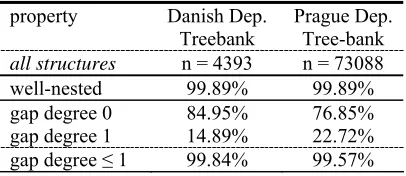
graded measure of discontinuity. These results are given in Table 1. What is noteworthy is that the graph drawings which correspond to LTAG deriva-tions share these two properties: LTAG induced graph drawings are both well-nested and have gap degree ≤ 1, and for every graph drawing that is both well-nested and gap degree ≤ 1, there exists a corresponding LTAG derivation (Möhl 2006). In section 3, these two properties are defined.
property Danish Dep.
Treebank
Prague Dep. Tree-bank
all structures n = 4393 n = 73088
well-nested 99.89% 99.89%
gap degree 0 84.95% 76.85%
gap degree 1 14.89% 22.72%
gap degree ≤ 1 99.84% 99.57%
Table 1. Relevant results from Kuhlmann and Nivre (2006).
In section 4, we show that gap degree can be used to distinguish between strong island viola-tions and weak island violaviola-tions in English. This supports the notion that gap-degree is a linguisti-cally relevant measure.
Although TAG is a linguistically expressive formalism, a closer look at the linguistic data has motivated extensions of TAG.5 One of the most widely used extensions for handling cases that are difficult for classic TAG is Multi-Component TAG (Weir 1988). Like basic TAG, MC-TAG is a for-malism for rewriting nodes of a tree as other trees. The set of underived trees are called elementary trees. The rewriting is accomplished via two
opera-tions: substitution, which rewrites a leaf node
la-beled X with a tree rooted in a node lala-beled X, and
adjoining, which rewrites a node X with a tree that
labels both its root and a distinguished leaf node, the foot, with X. The observation that linguistic
dependencies typically occur within some sort of local domain is expressed in the TAG hypothesis that all such dependencies occur within the basic
3A third property based on
edge degree also characterizes the
structures, but has no clear relationship to TAG-derivations. Thus, reference to it is omitted in the remaining text. See Kuhlmann and Nivre (2006) for the definition of edge degree.
4 Well-nestedness differs from
projectivity. (See section 3.) 5 For a readable introduction, see Chapter 1 of Frank (2002).
building blocks of the grammar. Recursive struc-ture is “factored out,” which allows apparent non-local dependencies to be recast as non-local ones. Whereas basic TAG takes the basic unit to be a single elementary tree, MC-TAG extends the do-main of locality to encompass a set of elementary trees. That is, these sets are the objects over which the combinatory operations apply. The MC-extension allows for linguistically satisfying ac-counts for a number of attested phenomena, such as: English extraposition (Kroch and Joshi 1986), subj-aux inversion in combination with raising verbs (Frank 1992), anaphoric binding (Ryant and Scheffler 2006), quantifier scope ambiguity (Joshi et al. 2003), clitic climbing in Romance (Bleam 1994), and Japanese causatives (Heycock 1986).
The primary concern of this paper is the recon-ciliation of the observation noted above, that MC-TAG appears to be on the right track for a good generative characterization of natural language, with a second observation: The graph drawings that correspond to MC-TAG derivations, are not guaranteed to retain the properties of basic-TAG induced graph drawings. Kuhlmann and Möhl (2006) report that if an entire MC set is anchored by a single lexical element (the natural extension of “lexicalization” of TAGs to MC-TAGs), then the class of dependency structures is expanded with respect to both conditions that characterized the TAG-induced graph drawings: MC-TAG in-duced graph drawings include structures that are not well-nested, have gap degree > 1, or both. As Kuhlmann and Möhl point out, the gap degree in-creases with the number of components, which we will elaborate in section 6. This is true even if we require that all components of a set combine with a single elementary tree (i.e. tree-local MC-TAG, which is known to allow more derivation structures (i.e. derivation trees) than TAG, although they gen-erate the same set of derived trees). If we suppose that the characterization of dependency structures as reported by Kuhlmann and Nivre (2006) for Czech and Danish extends cross-linguistically, i.e. the dependency structures for natural language falls within the class of well-nested and gap degree
≤ 1 dependency structures, then MC-TAG appears to correspond to the wrong class of model-theoretic dependency structures. It is desirable to account for the apparent mismatch.
ex-tremely infrequent, and that this is reflected in the small proportion (< 1%) of data in the PDT and DDT that are not both well-nested and gap degree
≤ 1. A second possibility is that the structures in the PDT and DDT are actually not good represen-tatives of the structures needed to characterize natural languages in general. However, a look at the cases in which MC-TAG is employed reveals that these particular analyses yield derivations that correspond to graph drawings that do satisfy well-nestedness and have gap degree ≤ 1. In practice, MC-TAG seems to be used more restrictively than what the formal system allows in principle. This keeps the corresponding graph drawings within the class of structures identified by Bodirsky et al. (2005) as a model of TAG derivations, and by Kuhlmann and Nivre (2006) as empirically rele-vant. Lastly, we compare the scrambling patterns that are possible in an MC-TAG extension with those that conform to the well-nestedness and gap degree ≤ 1 properties of the graph approach.
2
TAG-induced Graph Dependencies
The next two sections are intended to provide an intuition for the terms defined more formally in Bodirsky et al. (2005) and Kuhlmann and Nivre (2006). In the former, the authors define their de-pendency structures of interest, called graph draw-ings, as a three-tuple: a set of nodes, a dominance
relation, and a (total) precedence relation. These dependency structures are based on information from both a TAG-derivation and that derivation’s final phrase structure. The anchor of each elemen-tary tree of a strictly lexicalized TAG (LTAG) is used as a node label in the induced dependency structure. E.g. suppose tree A is anchored by lexi-cal item a in the LTAG grammar. Then a will be a
node label in any dependency structure induced by an LTAG derivation involving tree A.
To see how the dominance relation and prece-dence relation mirror the derivation and the final derived phrase structure, let us further suppose that LTAG tree B is anchored by lexical item b. Node a dominates node b in the dependency structure iff
Tree A dominates tree B in the derivation struc-ture. (I.e. tree B must substitute or adjoin into tree A during the TAG-derivation.6) Node a precedes
6Whereas in standard dependency graphs, adjunction of t2 to
t1 generally corresponds to a dependency directed from t2 to
node b in the dependency structure iff a linearly
precedes b in the derived phrase structure tree.
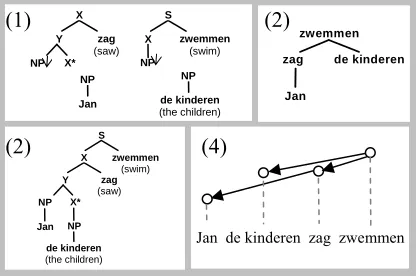
An example based on the cross-serial dependen-cies seen in Dutch subordinate clauses is given in Figure 1. In the graph drawing in (4), the four nodes names, {Jan, de kinderen, zag, zwemmen},
are the same set as the anchors of the elementary trees in (1), which is the same as the set of termi-nals in (3), the derived phrase structure. The or-dering of these nodes is exactly the oror-dering of the terminals in (3). The directed edges between the nodes mirrors the immediate dominance relation represented in (2), the derivation structure showing how the trees in (1) combine. E.g. Just as the
zwemmen node has the zag and de kinderen nodes
as its two children in (2), so does the zwemmen
node dominate zag and de kinderen in (4).
Möhl (2006) provides the formal details show-ing that such LTAG-induced dependency struc-tures have the properties of being 1) well-nested and 2) gap degree ≤ 1, and, conversely, that any structures with these properties have a correspond-ing LTAG derivation.7 These properties are
de-fined in the next section.
(1) (2)
(2) (4)
Figure 1. Derivation for Jan de kinderen zag zwemmen and corresponding graph drawing
3
Properties of Dependency Graphs
3.1 Gap-Degree
It will be useful to first define the term projection.
Definition: The projection of a node x is the set of
nodes dominated by x (including x). (E.g. in (4), the projection of zag = {Jan, zag}.)
t1, in a TAG-induced dependency graph, adjoining t2 to t1 corresponds to the reverse dependency.
7This result refers to single graph drawings and particular
LTAG derivation. See Kuhlmann and Möhl (2007) on the relationship between sets of graph drawings and LTAGs.
Y
NP X* zag
(saw)
X
NP
zwemmen
(swim)
S
Jan
de kinderen
(the children)
zag
Jan
de kinderen zwemmen
Jan de kinderen zag zwemmen Jan
NP
de kinderen
(the children)
NP Y
NP X* zag
(saw)
X
X
NP
zwemmen
(swim)
Recall that the nodes of a graph drawing are in a precedence relation, and that this precedence rela-tion is total.
Definition: A gap is a discontinuity with respect to
precedence in the projection of a node in the draw-ing. (E.g. in (4), de kinderen is the gap preventing Jan and zag from forming a contiguous interval.)
Definition: The gap degree of a node is the
num-ber of gaps in its projection. (E.g. the gap degree of node zag = 1.)
Definition: The gap degree of a drawing is the
maximum among the gap degrees of its nodes. (E.g. in (4), only the projection of zag is
inter-rupted by a gap. Thus, the gap degree of the graph drawing in (4) = 1.)
In TAG drawings, a gap arises from an interrup-tion of the dependencies in an auxiliary tree. If B is adjoined into A, the gap is the material in A that is below the foot node of B. E.g. in figure 1, De kinderen is substituted into the zwemmen tree
be-low the node into which the zag tree adjoins into
the zwemmen tree. Thus, de kinderen interrupts the
pronounced material on the left of the zag tree’s
foot node, Jan, from the pronounced material on
the right of the foot node, zag.
3.2 Well-Nestedness
Definition: If the roots of two subtrees in the
drawing are not in a dominance relation, then the trees are disjoint. (E.g. in (5), the subtrees rooted in b and c are disjoint, while the subtrees rooted in a
and b are not.)
Definition: If nodes x1, x2 belong to tree X, nodes
y1, y2 belong to tree Y, precedence orders these
nodes: x1 > y1 > x2 > y2, and X and Y are disjoint,
then trees X and Y interleave. (E.g. in (5), b and d
belong to the subtree rooted in b, while c and e
be-long to the subtree rooted in c. These two subtrees
are disjoint. Since the nodes are ordered b > c > d
> e, the two trees interleave.)
Definition: If there is no interleaving between
dis-joint subtrees, then a graph drawing is well-nested.
(e.g. (4) is well-nested, but (5) is not)
(5)
Non-well nested graph drawing
4
Island Effects and Gap-Degree
When standard TAG analyses of island effects are adopted (see Frank 2002), we observe that differ-ences in gap degree align with the division be-tween wh-extractions that are attested in natural
language (grammatical wh-movement and weak
island effects) and those claimed to be prohibited (strong island effects). Specifically, four strong island violations, extraction from an adverbial modifier, relative clause, complex NP, or subject, correspond to structures of gap degree 1, while cyclic wh-movement and a weak island violation
(extraction from a wh-island) are gap degree 0 in
English. Interestingly, while it is clear that weak islands vary in their island status from language to language, strong islands have been claimed to block extraction cross-linguistically. We tenta-tively postulate that gap degree is useful for char-acterizing strong islands cross-linguistically.
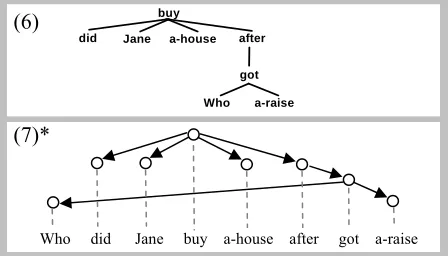
An example is given in (6), a standard TAG derivation for adverbial modification: the after-tree
adjoins into the buy-tree (the matrix clause), the got-tree substitutes into the after-tree, and the two
arguments who and a-raise substitute into the got
-tree. In (7), the corresponding dependency struc-ture, the projection of got includes who, which is
separated from got by the string comprising the
matrix clause and adverbial. Clearly, we do not want to claim that any gap degree of 1 is a sure source of ungrammaticality. However, it is possi-ble that a gap degree of 1 in conjunction with a wh
-element yields ungrammaticality. For the particu-lar set of islands we examined, we postulate that the projection of the node immediately dominating the wh-element is prohibited from containing gaps.
(6)
(7)*
Figure 2. LTAG derivation and graph drawing for *Who did Jane buy a house after got a raise?
a b c d e
Who did Jane buy a-house after got a-raise Jane
got a-house buy
did after
(8a) (8w) α β (11a) (11d) (11e)
(8b) (8c) (8d) (8e) (8x) (8y) (8z) (11b) α β (11c) α β
(9) (10)
(12)
5
MC-TAG-induced Dependency Graphs
5.1 Gap-Degree Beyond 1
As reviewed in section 3, the source of every gap in a TAG drawing comes from an interruption of the dependencies in an auxiliary tree. Since the auxiliary tree only has one foot, it only has a slot for a single gap. A MC-set, however, could be comprised of two auxiliary trees. This means there are slots for two gaps, one associated with each foot. Furthermore, a gap may arise as a result of any pronounced material between the two compo-nents. Thus, when we already have at least one foot, adding an additional foot increases the maxi-mum gap degree by 2. The maximaxi-mum gap degree = 1 + 2(n – 1) = 2n – 1, where n is the max # of foot nodes in any elementary tree set.
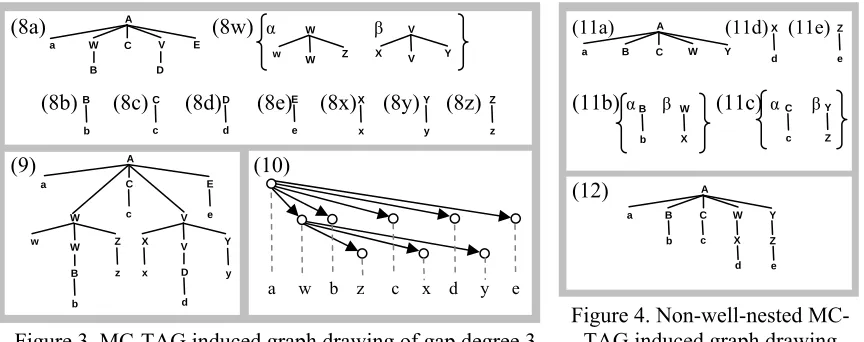
As an example, consider the composition of the trees in (8), Figure 3 (Kuhlmann, p.c.) The tree set in (8w) is comprised of two auxiliary trees. One tree, (8wα), adjoins into (8a), and a gap is created by the material in (8a) that falls below the foot node of (8wα), namely b. When (8wβ) is adjoined
into (8α) at node V, a second gap is created below (8wβ) by d. A third gap is created by the material
between the two components. (9) shows the de-rived phrase structure, and (10), the corresponding graph drawing. The projection of node w, {w, x, y, z} has three discontinuities, nodes b, c, and d.
5.2 Non-Well-Nestedness
Kuhlmann and Möhl (2006) show that even a tree-local MC-TAG that allows only substitution can induce a non-well-nested graph drawing. Figure 4 replicates their example. This derivation involves two MC-sets, (11b) and (11c). The tree anchored
by d, (11d), substitutes into the second component of the set anchored by b, (11b). Similarly, the tree anchored by e, (11e), substitutes into the second component of the set anchored by c, (11c). Both MC-sets compose into the tree anchored by a, yielding the derived phrase structure in (12). The corresponding graph drawing is exactly our earlier example of non-well-nestedness in (5).
6
MC-TAG in Practice
We now turn to cases in which linguists have used MC-TAGs to account for cases argued to have no satisfying solution in basic TAG. Unlike the ex-amples in 5.1 and 5.2, these particular MC-deriva-tions correspond to dependency structures that are well-nested and have gap degree ≤ 1. Table 2 summarizes these cases. The last column indicates the type of MC-extension assumed by the analysis: tree-local MC-TAGs, tree-local MC-TAGs with
flexible composition, the mirror operation to
ad-joining; if tree α adjoins into tree β, the combina-tion can be alternatively viewed as tree β “flexibly” composing with tree α (Joshi et al. 2003, Kall-meyer and Joshi 2003)8, and set-local MC-TAGs.
Set-local MC-TAGs are generally more powerful than TAGs, but since these particular cases induce well-nested graph drawings of gap degree ≤ 1, we can conclude that set-local MC-TAG as used in
8 I.e. When composing A and B, we can take A as the function
and B as the argument or vice versa. For CFGs, such flexibil-ity has no added benefit. For categorical type grammars, this kind of flexibility is accomplished via type raising, which allows for some new types of constituents but does not give rise to any new word orders. For tree local MC-TAGs, such flexibility does allow more word orders (permutations) to be generated than are possible without flexible composition. W
Table 2. Canonical tree sets used in MC-TAG analyses of several phenomena
these cases is weakly equivalent to TAG.
From Table 2, we can draw two generalizations. First, in an MC-TAG analysis, a two-component set is typically used. One of the trees is often a very small piece of structure that corresponds to the “base position,” surface position, or scope posi-tion of a single element. Second, the auxiliary tree components typically have elements with phono-logical content only on one side of the foot.
At this point, we make explicit an assumption that we believe aligns with Bodirsky et al. (2005). Since silent elements, such as traces, do not anchor an elementary tree, they do not correspond to a node in the dependency structure.
6.1 Why the Gap-Degree Remains ≤ 1
Recall that in example (8), each of the two compo-nents in the example MC-TAG has a foot with phonological material on both sides, giving rise to
two gaps, and a third gap is created via the material between the two components. In contrast, in the MC-TAG sets shown in Table 2, the auxiliary trees have pronounced material only on one side of the foot node. This eliminates the gap that would have arisen due to the interruption of material on the left side of the foot from the right side of the foot as a result of the pronounced material beneath the foot. The only way to obtain pronounced material on both sides of the foot node is to adjoin a compo-nent into one of these auxiliary trees. Interestingly, the set-local analyses (in which all components of a set must combine with components of a single set vs. tree-local MC-TAG) for clitic climbing and Japanese causatives do posit recursive components adjoining into other recursive components, but only while maintaining all pronounced material on one side of the foot. In the absence of a deriva-tional step resulting in pronounced material on
analysis
A man arrived who knew Mary.
Auxiliary Auxiliary
Tree-local
Frank
1992 subj-aux inversion with raising verb constructions Does Gabriel seem to like gnocchi?
Non-auxiliary Auxiliary
Tree-Auxiliary Non-auxiliary
Tree-local +
quantifier scope ambiguity
An FBI agent is spying on every professor.
(∀y [prof(y) →∃x [agent(x) ∧ spy (x, y)] ]) OR
(∃x [agent(x) ∧∀y [prof(y)→ spy (x, y)] ])
Auxiliary Non-auxiliary
Tree-local + flexible compo-sition Bleam
1994 clitic climbing in Romance Mari telo quiere permitir ver.
Mari you-it wants to permit to see “Mari wants to permit you to see it.”
Auxiliary Non-auxiliary
Set-local
Heycock
1986 Japanese causatives Watasi-wa Mitiko-ni Taroo-o ik –ase (–sase) –ta.
I TOP DAT ACCgo –CS –CS –PST
“I made Mitiko make Taroo go.”
Auxiliary Auxiliary
both sides of a foot, the only remaining possible gap is that which arises from pronounced material that appears between the two components.
Note that the observation about the position of pronounced material applies only to auxiliary trees in sets with multiple components. That is, auxil-iary trees that comprise a singleton set may still have pronounced material on both sides of the foot.
6.2 Why the Structures Remain Well-Nested
Since Kuhlmann and Möhl (2006) show that even a MC-TAG that allows only non-auxiliary trees in MC-sets will expand the drawings to include non-well-nested drawings, there is no way to pare back the MC-TAG via restrictions on the types of trees allowed in MC-sets so as to avoid interleaving.
Recall that to satisfy the definition of interleav-ing, it is necessary that the two MC-sets are not in any dominance relation in the derivation structure. In Kuhlmann and Möhl’s example, this is satisfied because the two MC-sets are sisters in the deriva-tion; they combine into the same tree. In the lin-guistic analyses considered here, no more than one MC-set combines into the same tree. For tree-local MC-TAG, it appears to be sufficient to bar more than one MC-set from combining into a single tree.
7 MC-TAG and Scrambling
In subordinate clauses in Standard German, the canonical order of verbs and their subject argu-ments is a nested dependency order. However, other orderings are also possible. For example, in the case of a clause-final cluster of three verbs, the canonical order is as given in (13), NP1NP2NP3
V3V2V1, but all the other permutations of the NP
arguments are also possible orderings. All six per-mutations of the NPs can be derived via tree-local MC-TAG. From the graph-model perspective adopted here, this is unsurprising: All the se-quences are well-nested and have gap degree ≤ 1.
(13) NP1 NP2 NP3 V3 V2 V1
. . . Hans Peter Marie schwimmen lassen sah . . . Hans Peter Marie swim make saw “ . . . Hans saw Peter make Marie swim.”
However, with an additional level of embed-ding, i.e. four NPs and four verbs, the situation is different, both linguistically and formally. Our focus is on making the formal predictions of a
lin-guistically informed system precise. We start with a tree-local MC-TAG that is restricted to linguisti-cally motivated tree-sets and to semantilinguisti-cally co-herent derivations. The former linguistic restric-tion is illustrated in (14), the possible tree-sets an-chored by a verb that takes a VP argument. The latter linguistic restriction is that there is no seman-tic feature clash at any stages of the derivation: the VP argument of Vi must be associated with Vi+1.
(14) α
β
Single and two-component sets for Vi
As MC-TAG is enriched in various ways (by al-lowing flexible composition, multiple adjoining at the same node, and/or components from the same MC-set to target the same node), all 24 orderings where the nouns permute while the verbs remain fixed can be derived. (We are aware that German also allows verbs to scramble.) Taking the depend-ency structures of these sequences to consist of an edge from each verb Vi to its subject NP and to the
head of its argument VP, Vi+1, we can compare the
predictions of the graph drawing approach and the MC-TAG approach. It turns out that the permuta-tions of gap degree ≤ 1 and those of gap-degree 2 do not align in an obvious way with particular en-richments. For example, NP4NP2NP3NP1V4V3V2V1
(gap degree 2) is derivable via basic tree-local MC-TAG, but NP3NP1NP4NP2V4V3V2V1 and
NP3NP2NP4NP1V4V3V2V1 (also gap degree 2)
ap-pear to require both flexible composition and al-lowing components from the same MC-set to tar-get the same node.
8
Conclusion and Future Work
This paper reviews the connection established in previous work between TAG derivations and model-theoretic graph drawings, i.e. well-nested dependency structures of gap degree ≤ 1, and re-ports several observations that build on this work. First, additional evidence of the linguistic rele-vance of the gap degree measure is given. The gap degree measure can distinguish wh-movement that
is assumed to be generally disallowed from wh
-movement that is permitted in natural language. Second, we observe that the graph drawings
in-NPi
NP VP(i+1)* VP VP
VP
(e)i Vi
NPi
NP VP(i+1)* VP* VP
VP VP
duced by MC-TAGs used in linguistic analyses continue to fall within the class of well-nested, gap degree ≤ 1 dependency structures. While Kuhlmann and Möhl (2006) show that MC-TAGs in which each set has a single lexical anchor in-duce graph drawings that are outside this class, this extra complexity in the dependency structures does not appear to be utilized. Even for the crucial cases used to argue for MC-extensions, MC-TAG is used in a manner requiring less complexity than the formal system allows. Examining these particular grammars lays the groundwork for identifying a natural class of MC-TAG grammars whose deriva-tions correspond to well-nested graph drawings of gap degree ≤ 1. Specifically, the observations sug-gest the class to be MC-TAGs in which 1) compo-nent sets have up to two members, 2) auxiliary trees that are members of non-singleton MC-sets have pronounced material on only one side of the foot, whether the auxiliary member is derived or not, and 3) up to one MC-set may combine into each tree. Though these constraints appears stipu-lative from a formal perspective, a preliminary look suggests that natural language will not require their violation. That is, we may find linguistic jus-tification for these constraints. Lastly, in ongoing work, we explore how allowing flexible composi-tion and multiple adjoining enables MC-TAGs to derive a range of scrambling patterns.
References
Tonia Bleam. 2000. Clitic climbing and the power of Tree Adjoining Grammar. In A. Abeillé and O.
Ram-bow (eds.), Tree Adjoining Grammars: formalisms,
linguistic analysis and processing. Stanford: CSLI
Publications, 193-220. (written in 1994).
Manuel Bodirsky, Marco Kuhlmann, and Mathias Möhl. 2005. Well-nested drawings as models of syntactic
structure. In 10th Conference of Formal Grammar
and 9th Meeting on Mathematics of Language
(FG-MoL), Edinburgh, UK.
Robert Frank. 1992. Syntactic Locality and Tree
Adjoin-ing Grammar: grammatical, acquisition, and proc-essing perspectives. PhD dissertation, University of
Pennsylvania, Philadelphia, USA.
Robert Frank. 2002. Phrase Structure Composition and
Syntactic Dependencies. MIT Press.
Jan Hajič, Barbora Vidova Hladka, Jarmila Panevová,
Eva Hajičová, Petr Sgall, and Petr Pajas. 2001.
Pra-gue Dependency Treebank 1.0. LDC, 2001T10.
Caroline Heycock. 1986. The structure of the Japanese causative. Technical Report MS-CIS-87-55, Univer-sity of Pennsylvania.
Aravind K. Joshi, Laura Kallmeyer, and Maribel Ro-mero. 2003. Flexible composition in LTAG: quanti-fier scope and inverse linking. In H. Bunt and R.
Muskens (eds.), Computing Meaning 3. Dordrecht:
Kluwer.
Aravind K. Joshi and Y. Schabes. 1997. Tree-Adjoining Grammars. In G. Rozenberg and A. Salomaa (eds.):
Handbook of Formal Languages. Berlin: Springer,
69–123.
Laura Kallmeyer and Aravind K. Joshi. 2003. Factoring predicate argument and scope semantics:
underspeci-fied semantics with LTAG. Research on Language
and Computation 1(1-2), 3-58.
Anthony Kroch and Aravind K. Joshi. 1990. Extraposi-tion in a Tree Adjoining Grammar. In G. Huck and
A. Ojeda, eds., Syntax and Semantics: Discontinuous
Constituents, 107-149.
Matthias Trautner Kromann. 2003. The Danish
Depend-ency Treebank and the DTAG treebank tool. In 2nd
Workshop on Treebanks and Linguistic Theories (TLT), 217-220.
Marco Kuhlmann and Mathias Möhl. 2006. Extended cross-serial dependencies in Tree Adjoining
Gram-mars. In Proceedings of the 8th International
Work-shop on Tree Adjoining Grammar and Related For-malisms, Sydney, Australia, 121-126.
Marco Kuhlmann and Mathias Möhl. 2007. Mildly
con-text-sensitive dependency languages. In 45th Annual
Meeting of the Association for Computational Lin-guistics (ACL), Prague, Czech Republic.
Marco Kuhlmann and Joakim Nivre. 2006. Mildly
non-projective dependency structures. In 21st
Interna-tional Conference on ComputaInterna-tional Linguistics and 44th Annual Meeting of the Association for Computa-tional Linguistics (COLING-ACL), Companion
Vol-ume, Sydney, Australia.
Mathias Möhl. 2006. Drawings as Models of Syntactic
Structure: Theory and Algorithms, Masters thesis,
Saarland University, Saarbrücken, Germany.
Neville Ryant and Tatjana Scheffler. 2006. Binding of
anaphors in LTAG. In Proceedings of the 8th
Interna-tional Workshop on Tree Adjoining Grammar and Related Formalisms, Sydney, Australia, 65-72.
David Weir. 1988. Characterizing mildly
context-sensitive grammar formalisms. PhD dissertation,