A Task-based Comparison of Information Extraction Pattern Models
Mark A. Greenwood and Mark Stevenson
Department of Computer Science University of Sheffield Sheffield, S1 4DP, UK
{m.greenwood, marks}@dcs.shef.ac.uk
Abstract
Several recent approaches to Information Extraction (IE) have used dependency trees as the basis for an extraction pattern repre-sentation. These approaches have used a va-riety of pattern models (schemes which de-fine the parts of the dependency tree which can be used to form extraction patterns). Previous comparisons of these pattern mod-els are limited by the fact that they have used indirect tasks to evaluate each model. This limitation is addressed here in an experiment which compares four pattern models using an unsupervised learning algorithm and a standard IE scenario. It is found that there is a wide variation between the models’ per-formance and suggests that one model is the most useful for IE.
1 Introduction
A common approach to Information Extraction (IE) is to (manually or automatically) create a set of pat-terns which match against text to identify informa-tion of interest. Muslea (1999) reviewed the ap-proaches which were used at the time and found that the most common techniques relied on lexico-syntactic patterns being applied to text which has undergone relatively shallow linguistic processing. For example, the extraction rules used by Soderland (1999) and Riloff (1996) match text in which syn-tactic chunks have been identified. More recently researchers have begun to employ deeper syntactic analysis, such as dependency parsing (Yangarber et
al., 2000; Stevenson and Greenwood, 2005; Sudo et al., 2001; Sudo et al., 2003; Yangarber, 2003). In these approaches extraction patterns are essentially parts of the dependency tree. To perform extraction they are compared against the dependency analysis of a sentence to determine whether it contains the pattern.
Each of these approaches relies on a pattern
model to define which parts of the dependency tree
can be used to form the extraction patterns. A vari-ety of pattern models have been proposed. For ex-ample the patterns used by Yangarber et al. (2000) are the subject-verb-object tuples from the depen-dency tree (the remainder of the dependepen-dency parse is discarded) while Sudo et al. (2003) allow any sub-tree within the dependency parse to act as an ex-traction pattern. Stevenson and Greenwood (2006) showed that the choice of pattern model has impor-tant implications for IE algorithms including signifi-cant differences between the various models in terms of their ability to identify information of interest in text.
However, there has been little comparison be-tween the various pattern models. Those which have been carried out have been limited by the fact that they used indirect tasks to evaluate the various mod-els and did not compare them in an IE scenario. We address this limitation here by presenting a di-rect comparison of four previously described pattern models using an unsupervised learning method ap-plied to a commonly used IE scenario.
The remainder of the paper is organised as fol-lows. The next section presents four pattern models which have been previously introduced in the
ture. Section 3 describes two previous studies which compared these models and their limitations. Sec-tion 4 describes an experiment which compares the four models on an IE task, the results of which are described in Section 5. Finally, Section 6 discusses the conclusions which may be drawn from this work.
2 IE Pattern Models
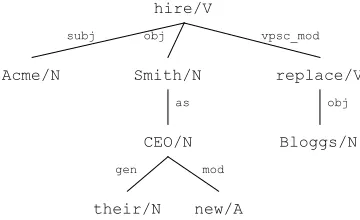
In dependency analysis (Mel’ˇcuk, 1987) the syntax of a sentence is represented by a set of directed bi-nary links between a word (the head) and one of its modifiers. These links may be labelled to indicate the relation between the head and modifier (e.g. sub-ject, object). An example dependency analysis for the sentence “Acme hired Smith as their new CEO,
replacing Bloggs.” is shown Figure 1.
Figure 1: An example dependency tree.
The remainder of this section outlines four mod-els for representing extraction patterns which can be derived from dependency trees.
Predicate-Argument Model (SVO): A simple
approach, used by Yangarber et al. (2000), Yangar-ber (2003) and Stevenson and Greenwood (2005), is to use subject-verb-object tuples from the depen-dency parse as extraction patterns. These consist of a verb and its subject and/or direct object. Figure 2 shows the two SVO patterns1which are produced
for the dependency tree shown in Figure 1.
This model can identify information which is ex-pressed using simple predicate-argument construc-tions such as the relation between Acme and Smith
1
The formalism used for representing dependency patterns is similar to the one introduced by Sudo et al. (2003). Each node in the tree is represented in the format a[b/c](e.g.
subj[N/Acme]) where cis the lexical item (Acme),bits grammatical tag (N) andathe dependency relation between this node and its parent (subj). The relationship between nodes is represented asX(A+B+C)which indicates that nodesA,Band
Care direct descendents of nodeX.
in the dependency tree shown in Figure 1. How-ever, the SVO model cannot represent information described using other linguistic constructions such as nominalisations or prepositional phrases. For ex-ample the SVO model would not be able to recog-nise that Smith’s new job title is CEO since these patterns ignore the part of the dependency tree con-taining that information.
Chains: A pattern is defined as a path between a
verb node and any other node in the dependency tree passing through zero or more intermediate nodes (Sudo et al., 2001). Figure 2 shows examples of the chains which can be extracted from the tree in Figure 1.
Chains provide a mechanism for encoding infor-mation beyond the direct arguments of predicates and includes areas of the dependency tree ignored by the SVO model. For example, they can represent in-formation expressed as a nominalisation or within a prepositional phrase, e.g. “The resignation of Smith
from the board of Acme ...” However, a potential
shortcoming of this model is that it cannot represent the link between arguments of a verb. Patterns in the chain model format are unable to represent even the simplest of sentences containing a transitive verb, e.g. “Smith left Acme”.
Linked Chains: The linked chains model (Greenwood et al., 2005) represents extraction pat-terns as a pair of chains which share the same verb but no direct descendants. Example linked chains are shown in Figure 2. This pattern representa-tion encodes most of the informarepresenta-tion in the sen-tence with the advantage of being able to link to-gether event participants which neither of the SVO or chain model can, for example the relation be-tween “Smith” and “Bloggs” in Figure 1.
Subtrees: The final model to be considered is the
SVO
[V/hire](subj[N/Acme]+obj[N/Smith]) [V/replace](obj[N/Bloggs])
Chains
[V/hire](subj[N/Acme]) [V/hire](obj[N/Smith])
[V/hire](obj[N/Smith](as[N/CEO]))
[V/hire](obj[N/Smith](as[N/CEO](gen[N/their])))
Linked Chains
[V/hire](subj[N/Acme]+obj[N/Smith])
[V/hire](subj[N/Acme]+obj[N/Smith](as[N/CEO]))
[V/hire](obj[N/Smith]+vpsc mod[V/replace](obj[N/Bloggs]))
Subtrees
[V/hire](subj[N/Acme]+obj[N/Smith]+vpsc mod[V/replace]) [V/hire](subj[N/Acme]+vpsc mod[V/replace](obj[N/Bloggs])) [N/Smith](as[N/CEO](gen[N/their]+mod[A/new]))
Figure 2: Example patterns for four models
represent the relation between any set of items in the sentence.
3 Previous Comparisons
There have been few direct comparisons of the var-ious pattern models. Sudo et al. (2003) compared three models (SVO, chains and subtrees) on two IE scenarios using a entity extraction task. Mod-els were evaluated in terms of their ability to iden-tify entities taking part in events and distinguish them from those which did not. They found the SVO model performed poorly in comparison with the other two models and that the performance of the subtree model was generally the same as, or better than, the chain model. However, they did not attempt to determine whether the models could identify the relations between these entities, simply whether they could identify the entities participating in relevant events.
Stevenson and Greenwood (2006) compared the four pattern models described in Section 2 in terms of their complexity and ability to represent rela-tions found in text. The complexity of each model was analysed in terms of the number of patterns which would be generated from a given depen-dency parse. This is important since several of the algorithms which have been proposed to make use of dependency-based IE patterns use iterative learning (e.g. (Yangarber et al., 2000; Yangarber, 2003; Stevenson and Greenwood, 2005)) and are
un-likely to cope with very large sets of candidate pat-terns. The number of patterns generated therefore has an effect on how practical computations using that model may be. It was found that the number of patterns generated for the SVO model is a lin-ear function of the size of the dependency tree. The number of chains and linked chains is a polynomial function while the number of subtrees is exponen-tial.
Stevenson and Greenwood (2006) also analysed the representational power of each model by measur-ing how many of the relations found in a standard IE corpus they are expressive enough to represent. (The documents used were taken from newswire texts and biomedical journal articles.) They found that the SVO and chain model could only represent a small proportion of the relations in the corpora. The sub-tree model could represent more of the relations than any other model but that there was no statistical dif-ference between those relations and the ones cov-ered by the linked chain model. They concluded that the linked chain model was optional since it is expressive enough to represent the information of interest without introducing a potentially unwieldy number of patterns.
(2003) found that in some cases their performance could not be distinguished. In addition to these dis-agreements, these studies are also limited by the fact that they are indirect; they do not evaluate the vari-ous pattern models on an IE task.
4 Experiments
We compared each of the patterns models described in Section 2 using an unsupervised IE experiment similar to one described by Sudo et al. (2003).
Let Dbe a corpus of documents and R a set of documents which are relevant to a particular extrac-tion task. In this context “relevant” means that the document contains the information we are interested in identifying. DandR are such thatD = R∪R¯
andR∩R¯ =∅. As assumption behind this approach is that useful patterns will be far more likely to occur inRthanDoverall.
4.1 Ranking Patterns
Patterns for each model are ranked using a technique inspired by the tf-idf scoring commonly used in In-formation Retrieval (Manning and Sch¨utze, 1999). The score for each pattern,p, is given by:
score(p) =tfp× N dfp
!β
(1)
where tfp is the number of times pattern p
ap-pears in relevant documents, N is the total number of documents in the corpus and dfp the number of documents in the collection containing the pattern
p.
Equation 1 combines two factors: the term
fre-quency (in relevant documents) and inverse docu-ment frequency (across the corpus). Patterns which
occur frequently in relevant documents without be-ing too prevalent in the corpus are preferred. Sudo et al. (2003) found that it was important to find the appropriate balance between these two factors. They introduced theβ parameter as a way of controlling the relative contribution of the inverse document
fre-quency. βis tuned for each extraction task and pat-tern model combination.
Although simple, this approach has the advantage that it can be applied to each of the four pattern mod-els to provide a direct comparison.
4.2 Extraction Scenario
The ranking process was applied to the IE scenario used for the sixth Message Understanding confer-ence (MUC-6). The aim of this task was to iden-tify management succession events from a corpus of newswire texts. Relevant information describes an executive entering or leaving a position within a company, for example “Last month Smith resigned
as CEO of Rooter Ltd.”. This sentence described as
event involving three items: a person (Smith), po-sition (CEO) and company (Rooter Ltd). We made use of a version of the MUC-6 corpus described by Soderland (1999) which consists of 598 documents. For these experiments relevant documents were identified using annotations in the corpus. However, this is not necessary since Sudo et al. (2003) showed that adequate knowledge about document relevance could be obtained automatically using an IR system.
4.3 Pattern Generation
The texts used for these experiments were parsed using the Stanford dependency parser (Klein and Manning, 2002). The dependency trees were pro-cessed to replace the names of entities belonging to specific semantic classes with a general token. Three of these classes were used for the manage-ment succession domain (PERSON, ORGANISA-TIONand POST). For example, in the dependency analysis of “Smith will became CEO next year”,
“Smith” is replaced by PERSON and “CEO” by POST. This process allows more general patterns to be extracted from the dependency trees. For exam-ple,[V/become](subj[N/PERSON]+obj[N/POST]). In the MUC-6 corpus items belonging to the relevant semantic classes are already identified.
set of trees, each of which consists of a single node. At each stage the known trees are extended by the addition of a single node. In order to avoid dupli-cation the extension is restricted to allowing nodes only to be added to the nodes on the rightmost path of the tree. Applying the process recursively creates a search space in which all subtrees are enumerated with minimal duplication.
The rightmost extension algorithm is most suited to finding subtrees which occur multiple times and, even using this efficient approach, we were unable to generate subtrees which occurred fewer than four times in the MUC-6 texts in a reasonable time. Sim-ilar restrictions have been encountered within other approaches which have relied on the generation of a comprehensive set of subtrees from a parse for-est. For example, Kudo et al. (2005) used subtrees for parse ranking but could only generate subtrees which appear at least ten times in a 40,000 sentence corpus. They comment that the size of their data set meant that it would have been difficult to complete the experiments with less restrictive parameters. In addition, Sudo et al. (2003) only generated subtrees which appeared in at least three documents. Kudo et al. (2005) and Sudo et al. (2003) both used the rightmost extension algorithm to generate subtrees.
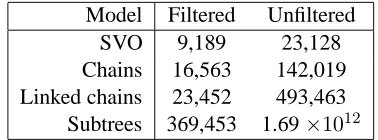
To provide a direct comparison of the pattern models we also produced versions of the sets of pat-terns extracted for the SVO, chain and linked chain models in which patterns which occurred fewer than four times were removed. Table 1 shows the num-ber of patterns generated for each of the four mod-els when the patterns are both filtered and unfil-tered. (Although the set of unfiltered subtree pat-terns were not generated it is possible to determine the number of patterns which would be generated using a process described by Stevenson and Green-wood (2006).)
Model Filtered Unfiltered
SVO 9,189 23,128
Chains 16,563 142,019
Linked chains 23,452 493,463 Subtrees 369,453 1.69×10¹²
Table 1: Number of patterns generated by each model
It can be seen that the various pattern models gen-erate vastly different numbers of patterns and that the number of subtrees is significantly greater than the other three models. Previous analysis (see Sec-tion 3) suggested that the number of subtrees which would be generated from a corpus could be difficult to process computationally and this is supported by our findings here.
4.4 Parameter Tuning
The value of β in equation 1 was set using a sep-arate corpus from which the patterns were gener-ated, a methodology suggested by Sudo et al. (2003). To generate this additional text we used the Reuters Corpus (Rose et al., 2002) which consists of a year’s worth of newswire output. Each document in the Reuters corpus has been manually annotated with topic codes indicating its general subject area(s). One of these topic codes (C411) refers to man-agement succession events and was used to identify documents which are relevant to the MUC6 IE sce-nario. A corpus consisting of 348 documents anno-tated with code C411and 250 documents without that code, representing irrelevant documents, were taken from the Reuters corpus to create a corpus with the same distribution of relevant and irrelevant documents as found in the MUC-6 corpus. Unlike the MUC-6 corpus, items belonging to the required semantic classes are not annotated in the Reuters Corpus. They were identified automatically using a named entity identifier.
The patterns generated from the MUC-6 texts were ranked using formula 1 with a variety of val-ues of β. These sets of ranked patterns were then used to carry out a document filtering task on the Reuters corpus - the aim of which is to differentiate documents based on whether or not they contain a relation of interest. The various values forβ were compared by computing the area under the curve. It was found that the optimal value forβ was 2 for all pattern models and this setting was used for the ex-periments.
4.5 Evaluation
seman-tic classes in the pattern are extracted. These items are considered to be related and compared against the gold standard data in the corpus to determine whether they are in fact related.
The precision of a set of patterns is computed as the proportion of the relations which were identified that are listed in the gold standard data. The recall is the proportion of relations in the gold standard data which are identified by the set of patterns.
The ranked set of patterns are evaluated incremen-tally with the precision and recall of the first (highest ranked) pattern computed. The next pattern is then added to the relations extracted by both are evalu-ated. This process continues until all patterns are exhausted.
5 Results
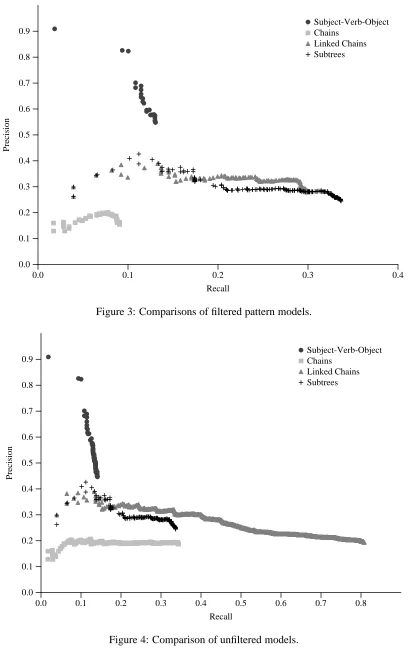
Figure 3 shows the results when the four filtered pat-tern models, ranked using equation 1, are compared. A first observation is that the chain model performs poorly in comparison to the other three models. The highest precision achieved by this model is 19.9% and recall never increases beyond 9%. In comparison the SVO model in-cludes patterns with extremely high precision but the maximum recall achieved by this model is low. Analysis showed that the first three SVO patterns had very high precision. These were [V/succeed](subj[N/PERSON]+obj[N/PERSON]), [V/be](subj[N/PERSON]+obj[N/POST]) and
[V/become](subj[N/PERSON]+obj[N/POST]), which have precision of 90.1%, 80.8% and 78.9% respectively. If these high precision patterns are removed the maximum precision of the SVO model is around 32%, which is comparable with the linked chain and subtree models. This suggests that, while the SVO model includes very useful extraction patterns, the format is restrictive and is unable to represent much of the information in this corpus.
The remaining two pattern models, linked chains and subtrees, have very similar performance and each achieves higher recall than the SVO model, al-beit with lower precision. The maximum recall ob-tained by the linked chain model is slightly lower than the subtree model but it does maintain higher precision at higher recall levels.
The maximum recall achieved by all four models
is very low in this evaluation and part of the reason for this is the fact that the patterns have been filtered to allow direct comparison with the subtree model. Figure 4 shows the results when the unfiltered SVO, chain and linked chain patterns are used. (Perfor-mance of the filtered subtrees are also included in this graph for comparison.)
This result shows that the addition of extra pat-terns for each model improves recall without effect-ing the maximum precision achieved. The chain model also performs badly in this experiment. Pre-cision of the SVO model is still high (again this is due to the same three highly accurate patterns) how-ever the maximum recall achieved by this model is not particularly increased by the addition of the un-filtered patterns. The linked chain model benefits most from the unfiltered patterns. The extra patterns lead to a maximum recall which is more than dou-ble any of the other models without overly degrad-ing precision. The fact that the linked chain model is able to achieve such a high recall shows that it is able to represent the relations found in the MUC-6 text, unlike the SVO and chain models. It is likely that the subtrees model would also produce a set of patterns with high recall but the number of poten-tial patterns which are allowable within this model makes this impractical.
6 Discussion and Conclusions
Some of the results reported for each model in these experiments are low. Precision levels are generally below 40% (with the exception of the SVO model which achieves high precision using a small number of patterns). One reason for this that the the patterns were ranked using a simple unsupervised learning algorithm which allowed direct comparison of four different pattern models. This approach only made use of information about the distribution of patterns in the corpus and it is likely that results could be im-proved for a particular pattern model by employing more sophisticated approaches which make use of additional information, for example the structure of the patterns.
0.0 0.1 0.2 0.3 0.4 Recall
0.0 0.1 0.2 0.3 0.4 0.5 0.6 0.7 0.8 0.9
Precision
Subject-Verb-Object Chains
Linked Chains Subtrees
Figure 3: Comparisons of filtered pattern models.
0.0 0.1 0.2 0.3 0.4 0.5 0.6 0.7 0.8 Recall
0.0 0.1 0.2 0.3 0.4 0.5 0.6 0.7 0.8 0.9
Precision
Subject-Verb-Object Chains
Linked Chains Subtrees
restricted set of possible patterns leads to low re-call. The chain model was found to perform badly with low recall and precision regardless of whether the patterns were filtered. Performance of the linked chain and subtree models were similar when the pat-terns were filtered but unfiltered linked chains were capable of achieving far higher recall than the fil-tered subtrees.
These experiments suggest that the linked chain model is a useful one for IE since it is simple enough for an unfiltered set of patterns to be extracted and able to represent a wider range of information than the SVO and chain models.
References
Kenji Abe, Shinji Kawasoe, Tatsuya Asai, Hiroki Arimura, and Setsuo Arikawa. 2002. Optimised Sub-structure Discovery for Semi-Structured Data. In
Pro-ceedings of the 6th European Conference on Princi-ples and Practice of Knowledge in Databases (PKDD-2002), pages 1–14.
Leslie Ann Goldberg and Mark Jerrum. 2000. Counting
Unlabelled Subtrees of a Tree is#P-Complete.
Lon-don Mathmatical Society Journal of Computation and Mathematics, 3:117–124.
Mark A. Greenwood, Mark Stevenson, Yikun Guo, Henk
Harkema, and Angus Roberts. 2005.
Automati-cally Acquiring a LinguistiAutomati-cally Motivated Genic
In-teraction Extraction System. In Proceedings of the
4th Learning Language in Logic Workshop (LLL05),
Bonn, Germany.
Dan Klein and Christopher D. Manning. 2002. Fast
Exact Inference with a Factored Model for Natural Language Parsing. In Advances in Neural
Informa-tion Processing Systems 15 (NIPS 2002), Vancouver,
Canada.
Taku Kudo, Jun Suzuki, and Hideki Isozaki. 2005.
Boosting-based Parse Reranking with Subtree Fea-tures. In Proceedings of the 43rd Annual Meeting of
the Association for Computational Linguistics, pages
189–196, Ann Arbour, MI.
Chritopher Manning and Hinrich Sch ¨utze. 1999.
Foun-dations of Statistical Natural Language Processing.
MIT Press, Cambridge, MA.
Igor Mel’ˇcuk. 1987. Dependency Syntax: Theory and
Practice. SUNY Press, New York.
Ion Muslea. 1999. Extraction Patterns for Information Extraction: A Survey. In Proceedings of the AAAI-99
workshop on Machine Learning for Information Ex-traction, Orlando, FL.
Ellen Riloff. 1996. Automatically Generating Extraction Patterns from Untagged Text. In Thirteenth National
Conference on Artificial Intelligence (AAAI-96), pages
1044–1049, Portland, OR.
Tony Rose, Mark Stevenson, and Miles Whitehead.
2002. The Reuters Corpus Volume 1 - from
Yes-terday’s News to Tomorrow’s Language Resources. In Proceedings of the Third International Conference
on Language Resources and Evaluation (LREC-02),
pages 827–832, La Palmas de Gran Canaria.
Stephen Soderland. 1999. Learning Information Extrac-tion Rules for Semi-structured and Free Text. Machine
Learning, 31(1-3):233–272.
Mark Stevenson and Mark A. Greenwood. 2005. A Se-mantic Approach to IE Pattern Induction. In
Proceed-ings of the 43rd Annual Meeting of the Association for Computational Linguistics, pages 379–386, Ann
Ar-bor, MI.
Mark Stevenson and Mark A. Greenwood. 2006. Com-paring Information Extraction Pattern Models. In
Pro-ceedings of the Information Extraction Beyond The Document Workshop (COLING/ACL 2006), pages 12–
19, Sydney, Australia.
Kiyoshi Sudo, Satoshi Sekine, and Ralph Grishman.
2001. Automatic Pattern Acquisition for Japanese
Information Extraction. In Proceedings of the
Hu-man Language Technology Conference (HLT2001),
San Diego, CA.
Kiyoshi Sudo, Satoshi Sekine, and Ralph Grishman. 2003. An Improved Extraction Pattern Representa-tion Model for Automatic IE Pattern AcquisiRepresenta-tion. In
Proceedings of the 41st Annual Meeting of the Associ-ation for ComputAssoci-ational Linguistics (ACL-03), pages
224–231, Sapporo, Japan.
Roman Yangarber, Ralph Grishman, Pasi Tapanainen,
and Silja Huttunen. 2000. Unsupervised
Discov-ery of Scenario-level Patterns for Information Extrac-tion. In Proceedings of the Applied Natural Language
Processing Conference (ANLP 2000), pages 282–289,
Seattle, WA.
Roman Yangarber. 2003. Counter-training in the Dis-covery of Semantic Patterns. In Proceedings of the
41st Annual Meeting of the Association for Computa-tional Linguistics (ACL-03), pages 343–350, Sapporo,
Japan.
Mohammed Zaki. 2002. Effectively Mining Frequent Trees in a Forest. In 8th ACM SIGKDD International