Deep-Syntactic Parsing
Miguel Ballesteros1, Bernd Bohnet2, Simon Mille1, Leo Wanner1,3 1Natural Language Processing Group, Pompeu Fabra University, Barcelona, Spain
2School of Computer Science, University of Birmingham, United Kingdom 3Catalan Institute for Research and Advanced Studies (ICREA) 1,3{name.lastname}@upf.edu 2[email protected]
Abstract
“Deep-syntactic” dependency structures that capture the argumentative, attributive and coordi-native relations between full words of a sentence have a great potential for a number of NLP-applications. The abstraction degree of these structures is in-between the output of a syntactic dependency parser (connected trees defined over all words of a sentence and language-specific grammatical functions) and the output of a semantic parser (forests of trees defined over indi-vidual lexemes or phrasal chunks and abstract semantic role labels which capture the argument structure of predicative elements, dropping all attributive and coordinative dependencies). We propose a parser that delivers deep syntactic structures as output.
1 Introduction
Surface-syntactic structures (SSyntSs) as produced by data-driven syntactic dependency parsers areper forceidiosyncratic in that they contain governed prepositions, determiners, support verb constructions and language-specificgrammatical functionssuch as, e.g., SBJ, OBJ, PRD, PMOD, etc. (Johansson and Nugues, 2007). For many NLP-applications, including machine translation, paraphrasing, text simpli-fication, etc., such a high idiosyncrasy is obstructive because of the recurrent divergence between the source and the target structures. Therefore, the use of more abstract “syntactico-semantic” structures seems more appropriate. Following Mel’ˇcuk (1988), we call these structuresdeep-syntactic structures
(DSyntSs). DSyntSs are situated between SSyntSs and PropBank- (Palmer et al., 2005) or Semantic Frame-like structures (Fillmore et al., 2002). Compared to SSyntSs, they have the advantage to ab-stract from language-specific grammatical idiosyncrasies. Compared to PropBank and Semantic Frame stuctures, they have the advantage to be connected and complete, i.e., capture all argumentative, attribu-tive and coordinaattribu-tive dependencies between the meaningful lexical items of a sentence, while PropBank and Semantic Frame structures are not always connected, may contain either individual lexical items or phrasal chunks as nodes, and discard attributive and coordinative relations (be they within the chunks or sentential). In other words, they constitute incomplete structures that drop not only idiosyncratic, func-tional but also meaningful elements of a given sentence and often contain dependencies between chunks rather than individual tokens. Therefore, we propose to put on the research agenda the task of deep-syntactic parsing and show how a DSyntS is obtained from a SSynt dependency parse using data-driven tree transduction in a pipeline with a syntactic parser.1In Section 2, we introduce SSyntSs and DSyntSs and discuss the fundamentals of SSyntS–DSyntS transduction. Section 3 describes the experiments that we carried out on Spanish material, and Section 4 discusses their outcome. Section 5 summarizes the related work, before in Section 6 some conclusions and plans for future work are presented.
2 Fundamentals of SSyntS–DSyntS transduction
Before we set out to discuss the principles of the SSyntS–DSynt transduction, we must specify the DSyntSs and SSyntSs as used in our experiments.
This work is licenced under a Creative Commons Attribution 4.0 International License. Page numbers and proceedings footer are added by the organizers. License details:http://creativecommons.org/licenses/by/4.0/
1The term ‘tree transduction’ is used in this paper in the sense of Rounds (1970) and Thatcher (1970) to denote an extension offinite state transduction(Aho, 1972) to trees.
2.1 Defining SSyntS and DSyntS
SSyntSs and DSyntSs are directed, node- and edge-labeled dependency trees with standard feature-value structures (Kasper and Rounds, 1986) as node labels and dependency relations as edge labels.
The features of the node labels inSSyntSs arelexssynt, and “syntactic grammemes” of the value of lexssynt, i.e.,number,gender,case,definiteness,personfor nouns andtense,aspect,moodandvoicefor
verbs. The value oflexssyntcan be any (either full or functional) lexical item; in graphical representations
of SSyntSs, usually only the value oflexssynt is shown. The edge labels of a SSyntS are grammatical
functions ‘subj’, ‘dobj’, ‘det’, ‘modif’, etc. In other words, SSyntSs are syntactic structures of the kind as encountered in the standard dependency treebanks; cf., e.g., dependency version of the Penn TreeBank (Johansson and Nugues, 2007) for English, Prague Dependency Treebank for Czech (Hajiˇc et al., 2006), Ancora for Spanish (Taul´e et al., 2008), Copenhagen Dependency Treebank for Danish (Buch-Kromann, 2003), etc. In formal terms that we need for the outline of the transduction below, a SSyntS is defined as follows:
Definition 1 (SSyntS) An SSyntS of a languageL is a quintuple TSS = hN, A, λls→n, ρrs→a, γn→gi
defined over all lexical itemsLofL, the set of syntactic grammemesGsynt, and the set of grammatical functionsRgr, where
• the setN of nodes and the setAof directed arcs form a connected tree, • λls→nassigns to eachn∈N anls∈L,
• ρrs→aassigns to eacha∈Aanr∈Rgr, and
• γn→gassigns to eachλls→n(n)a set of grammemesGt∈Gsynt.
The features of the node labels in DSyntSs as worked with in this paper are lexdsynt and
“seman-tic grammemes” of the value oflexdsynt, i.e., number anddeterminationfor nouns and tense, aspect, mood and voicefor verbs.2 In contrast to lex
ssynt in SSyntS, DSyntS’s lexdsynt can be any full, but
not afunctional lexeme. In accordance with this restriction, in the case oflook after a person, AFTER
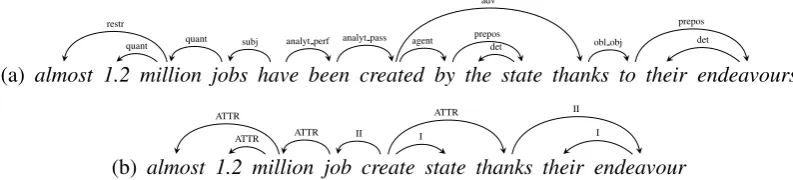
will not appear in the corresponding DSyntS; it is a functional (or governed) preposition (so areTO or BY, in Figure 1).3 In contrast,AFTERinleave after the meetingis a full lexeme; it will remain in the
DSyntS because there it has its own meaning of “succession in time”. The edge labels of a DSyntS are language-independent “deep-syntactic” relations I,. . . ,VI, ATTR, COORD, APPEND. ‘I’,. . . ,‘VI’ are argument relations, analogous to A0,A1, etc. in the PropBank annotation. ‘ATTR’ subsumes all (cir-cumstantial) ARGM-xPropBank relations as well as the modifier relations not captured by the PropBank and FrameNet annotations. ‘COORD’ is the coordinative relation as in:John-COORD→and-II→Mary,
publish-COORD→or-II→perish, and so on. APPEND subsumes all parentheticals, interjections, direct addresses, etc., as, e.g., inListen, John!:listen-APPEND→John. DSyntSs thus show a strong similarity with PropBank structures, with four important differences: (i) their lexical labels are not disambiguated; (ii) instead of circumstantial thematic roles of the kind ARGM-LOC, ARGM-DIR, etc. they use a unique ATTR relation; (iii) they capture all existing dependencies between meaningful lexical nodes; and (iv) they are connected.4 A number of other annotations have resemblance with DSyntSs; cf. (Ivanova et al., 2012) for an overview of deep dependency structures. Formally, a DSyntS is defined as follows:
Definition 2 (DSyntS) An DSyntS of a languageLis a quintuple TDS =hN, A, λls→n, ρrs→a, γn→gi
defined over the full lexical itemsLdofL, the set of semantic grammemesGsem, and the set of deep-syntactic relationsRdsynt, where
• the setN of nodes and the setAof directed arcs form a connected tree, • λls→nassigns to eachn∈N anls∈Ld,
• ρrs→aassigns to eacha∈Aanr∈Rdsynt, and
• γn→gassigns to eachλls→n(n)a set of grammemesGt∈Gsem.
Consider in Figure 1 an example for an SSyntS and its corresponding DSyntS.
2Most of the grammemes have a semantic and a surface interpretation; see (Mel’ˇcuk, 2013).
3Functional lexemes also include auxiliaries (e.g. HAVE, orBEwhen it is not a copula), and definite and indefinite deter-miners (THE,A); see Figure 1).
(a) almost 1.2 million jobs have been created by the state thanks to their endeavours restr
quant quant subj analyt perf analyt pass agent adv
prepos
det obl obj
prepos det
(b) almost 1.2 million job create state thanks their endeavour ATTR
ATTR ATTR II I
ATTR II
I
Figure 1: An SSyntS (a) and its corresponding DSyntS (b)
2.2 Fleshing out the SSyntS–DSyntS transduction
It is clear that the SSyntS and DSyntS of the same sentence are not isomorphic. The following corre-spondences between the SSyntSSssand DSyntSSdsof a sentence need to be taken into account during
SSyntS–DSyntS transduction: (i) a node inSssis a node inSds;
(ii) a relation inSsscorresponds to a relation inSds;
(iii) a fragment of theSsstree corresponds to a single node inSds;
(iv) a relation with a dependent node inSssis a grammeme inSds;
(v) a grammeme inSssis a grammeme inSds;
(vi) a node inSssis conflated with another node inSds; and
(vii) a node inSdshas no correspondence inSss.
The grammeme correspondences (iv) and (v) and the “pseudo” correspondences in (vi) and (vii)5are few or idiosyncratic and are best handled in a rule-based post-processing stage. The main task of the SSyntS–DSyntS transducer is thus to cope with the correspondences (i)–(iii). For this purpose, we can view both SSyntS and DSyntS as vectors indexed in terms of two-dimensional matricesI =N ×N (N being the set of nodes of a given tree1, . . . , m), withI(i, j)=ρ(ni, nj), ifni, nj ∈N and(ni, nj)∈A
andI(i, j)= 0 otherwise (where ‘ρ(ni, nj)’ is the function that assigns to an edge a relation label and
i, j = 1, . . . , m;i 6=jare nodes of the tree). That is, for a given SSyntS, the matrixI(i, j)contains in the cells (i, j),i, j = 1, . . . , m, the names of the SSynt-relations between the nodesniandnj , and ‘0’
otherwise, while for a given DSyntS, the cells of its matrixID contain DSyntS-relations.
Starting from the matrix IS of a given SSyntS, the task is therefore to obtain the matrix ID of the
corresponding DSyntS, that is, to identify correspondences between i/j, (i, j) and groups of (i, j) of IS withi0/j0 and(i0, j0) ofID; see (i)–(iii) above. In other words, the task consists in identifying and
removing all functional lexemes, and attach correctly the remaining nodes between them.6
As a “token chain→surface-syntactic tree” projection, this task can be viewed as a classification task. However, while the former is isomorphic, we know that the SSyntS–DSyntS projection is not. In order to approach the task to an isomorphic projection (and thus simplify its modelling), it is convenient to interpret SSyntS and the targeted DSyntS as collections ofhypernodes:
Definition 3 (Hypernode) Given a SSyntSSswith its index matrixIS(a DSyntSSdwith its index matrix
ID), a node partitionp(with|p|≥1) ofIS(ID) is a hypernodehsi (hdi) iffpcorresponds to a partition
p0 (with|p0 |≥1) ofS
d(Ss).
In this way, the SSyntS–DSyntS correspondence boils down to a correspondence between individual hypernodes and between individual arcs, and the transduction embraces the following three (classifica-tion) subtasks: 1. Hypernode identification, 2. DSynt tree construction, and 3. DSynt arc labeling, which are completed by a post-processing stage.
5(vi) covers, e.g., reflexive verb particles such as se in Spanish, which are conflated in the DSyntS with the verb:
se←aux refl dir-conocervs. CONOCERSE‘know each other’; (vii) covers, e.g., the zero subject in pro-drop languages (which is absent in the SSyntS and present in the DSyntS).
1. Hypernode identification. The hypernode identification consists of a binary classification of the nodes of a given SSyntS as nodes that form a hypernode of cardinality 1 (i.e., nodes that have a one-to-one correspondence to a node in the DSyntS) vs. nodes that form part of a hypernode of cardinality >1. In practice, hypernodes of type one will be formed by: 1) noun nodes that do not govern determiner or functional preposition nodes, 2) full verb nodes that are not governed by any auxiliary verb nodes and that do not govern any functional preposition node, adjective nodes, adverbial nodes, and semantic preposition nodes. Hypernodes of type two will be formed by: 1) noun nodes + determiner / func-tional preposition nodes they govern, 2) verb nodes + auxiliary nodes they are governed by + funcfunc-tional preposition nodes they govern.
2. DSynt tree reconstruction. The outcome of the hypernode identification stage is thus the setHs=
Hs|p|=1∪Hs|p|>1of hypernodes of two types. With this set at hand, we can define an isomorphy function
τ :Hs→Hd|p|=1(withhd∈Hd|p|=1consisting ofnd∈Nds, i.e., the set of nodes of the target DSyntS).
τ is the identity function forhs ∈ Hs|p|=1. Forhs ∈ Hs|p|>1,τ maps the functional nodes inhs onto
grammemes (attribute-value pairs) of the lexically meaningful node in hd and identifies the lexically
meaningful node as head. Some of the dependencies of the obtained nodesnd ∈Nds can be recovered
from the dependencies of their sources. Due to the projection of functional nodes to grammemes (which can be also seen as node removal), some dependencies will be also missing and must be introduced. Algorithm 1 recalculates the dependencies for the target DSyntSSd, starting from the index matrixISof
SSyntSSsto obtain a connected tree.
Algorithm 1: DSyntS tree reconstruction
for∀ni∈Nddo
if∃nj: (nj, ni)∈Ss∧τ(nj)∈Ndthen
(nj, ni)→Sd// the equivalent of the head node ofniis included in DSyntS else if∃nj, na: (nj, ni)∈Ss∧τ(nj)6∈Nd∧
τ(na)∈Ndthen
//nais the first ancestor ofnjthat has an equivalent in DSyntS
//the equivalent of the head node ofniis not included in DSyntS, but the ancestornais (na, ni)→Sd
else
//the equivalent of the head node ofniis not included in DSyntS, but several ancestors of it are
nb:=BestHead(ni, Ss, Sd) (nb, ni)→Sd
endfor
BestHeadrecursively ascendsSsfrom a given nodeniuntil it encounters one or several head nodes
nd ∈ Nds. In case of several encountered head nodes, the one which governs the highest frequency
dependency is returned.
3. Label Classification. The tree reconstruction stage produces a “hybrid” connected dependency tree
Ss→d with DSynt nodesNds, and arcs As labelled by SSynt relation labels, i.e., an index matrix we
can denote as I−, whose cells (i, j) contain SSynt labels for all n
i, nj ∈ Nds : (ni, nj) ∈ As and
‘0’ otherwise. The next and last stage of SSynt-to-DSyntS transduction is thus the projection of SSynt relation labels ofSs→dto their corresponding DSynt labels, or, in other words, the mapping ofI−toID
of the target DSyntS.
4. Postprocessing. As mentioned in Section 2, there is a limited number of idiosyncratic
correspon-dences between elements of SSyntS and DSyntS (the corresponcorrespon-dences (iv–vii) which can be straight-forwardly handled by a rule-based postprocessor because (a) they are non-ambiguous, i.e.,a↔ b, c ↔
d⇒a=b∧c=d, and (b) they are few. Thus, only determiners and auxiliaries in SSyntS map onto a grammeme in DSyntS, both SSyntS and DSyntS count with less than a dozen grammemes, etc.
3 Experiments
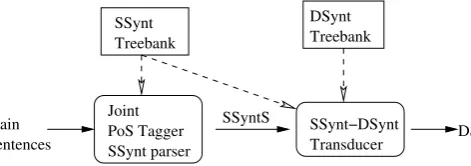
experiments in which we implemented the transducer and integrated it into a pipeline shown in Figure 2.
Joint PoS Tagger SSynt parser
SSynt−DSynt Transducer Plain
Sentences
DSynt Treebank SSynt
Treebank
SSyntS
DSynS
Figure 2: Setup of a deep-syntactic parser
For our experiments, we use the AnCora-UPF SSyntS and DSyntS treebanks of Spanish (Mille et al., 2013) in CoNLL format, adjusted for our needs. In particular, we removed from the 79-tag SSyntS treebank the semantically and information structure influenced relation tags to obtain an annotation gran-ularity closer to the ones used for previous parsing experiments (55 relation tags, see (Mille et al., 2012)). Our development set consisted of 219 sentences (3271 tokens in the DSyntS treebank and 4953 tokens in the SSyntS treebank), the training set of 3036 sentences (57665 tokens in the DSyntS treebank and 86984 tokens in the SSyntS treebank), and the test setheld-out for evaluation of 258 sentences (5641 tokens in the DSyntS treebank and 8955 tokens in the SSyntS treebank).
To obtain the SSyntS, we use Bohnet and Nivre (2012)’s transition-based parser, which combines lemmatization, PoS tagging, and syntactic dependency parsing—tuned and trained on the respective sets of the SSyntS treebank. Cf. Table 1 for the performance of the parser on the development set.
POS LEMMA LAS UAS 96.14 91.10 78.64 86.49
Table 1: Results of Bohnet and Nivre’s surface-syntactic parser on the development set
In what follows, we first present the realization of the SSyntS–DSyntS transducer and then the real-ization of the baseline.
3.1 SSyntS–DSyntS transducer
As outlined in Section 2.2, the SSyntS–DSyntS transducer is composed of three submodules and a post-processing stage:
1. Hypernode identification. For the hypernode identification, we trained a binary polynomial (degree
2) SVM from LIBSVM (Chang and Lin, 2001). The SVM allows both features related to the processed node and higher-order features, which can be related to the head node of the processed node or to its sibling nodes. After several feature selection trials, we chose the following features for each noden:
• lemma or stem of the label ofn,
• label of the relation betweennand its head,
• surface PoS of n’s label (the SSynt and DSyntS treebanks distinguish between surface and deep PoS),
• label of the relation betweenn’s head to its own head,
• surface PoS of the label ofn’s head node.
After an optimization round of the parameters available in the SVM implementation, the hypernode identification achieved over the gold development set 99.78% precision and 99.02% recall (and thus 99.4% F1). That is, only very few hypernodes are not identified correctly. The main error source are
2. Tree reconstruction. The implementation of the tree reconstruction module shows an unlabelled dependency attachment precision of 98.18% and an unlabelled dependency attachment recall of 97.43% over the gold development set. Most of the errors produced by this module have their origin in the previous module, i.e., hypernode identification. When a node has been incorrectly removed, the module errs in the attachment because it cannot use the node in question as the destination or the origin of a dependency, as it is the case in the gold-standard annotation:
Gold-standard: ser como e˜ne be like letter-n
II II
Predicted: ser e˜ne II
When a node has erroneously not been removed, no dependencies between its governor and its depen-dent can be established since DSyntS must remain a tree (which gives the same LAS and UAS errors as when a node has been erroneously removed):
Gold-standard: y Michael Jackson
3. Relation label classification. For relation label classification, we use a multiclass linear SVM. The
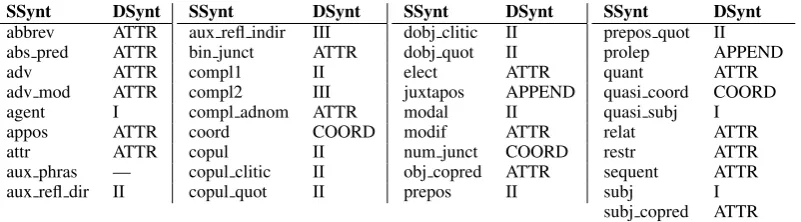
label classification depends on the concrete annotation schemata of the SSyntS and DSyntS treebanks on which the parser is trained. Depending on the schemata, some DSynt relation labels may be easier to derive from the original SSyntS relation labels than others. Table 2 lists all SSynt relation labels that have a straightforward mapping to DSyntS relation labels in the used treebanks, i.e., neither their dependent nor their governor are removed, and the SSyntS label always maps to the same DSynt label.
SSynt DSynt
Table 2: Straightforward SSynt to DSyntS mappings
Table 3 shows SSyntS relation–DSyntS relation label correspondences that are not straightforward.
SSynt DepRelA Mapping to DSynt
analyt fut remove Gov and Dep; add tense=FUT
analyt pass remove Gov; invert I and II; add voice=PASS
analyt perf remove Gov; add tense=PAST
analyt progr remove Gov; add tem constituency=PROGR
aux refl lex remove Dep; addseat the end of Gov’s lemma
aux refl pass remove Dep; invert I and II; add voice=PASS
compar remove Dep if conjunction
compar /coord /sub conj remove Dep if governed preposition
det IFIFDep=el—unDep=possessiveTHENTHENremove Dep; add definiteness=DEF/INDEFDepRel ATTRkIkIIkIII
IFDep=otherTHENDepRel ATTR
dobj remove Dep if governed preposition
iobj remove Dep if governed preposition; DepRel IIkIIIkIVkVkVI
iobj clitic DepRel IIkIIIkIVkVkVI
obl compl remove Dep if governed preposition; DepRel IkIIkIIIkIVkVkVI
obl obj remove Dep if governed preposition; DepRel IIkIIIkIVkVkVI
punc —
punc init —
The final set of features selected for label classification includes: (i) lemma of the dependent node, (ii) dependency relation to the head of the dependent node, (iii) dependency relation label of the head node to its own head, (iv) dependency relation to the head of the sibling nodes of the dependent node, if any.
After an optimization round of the parameter set of the SVM-model, relation labelling achieved 94.00% label precision and 93.28% label recall on the development set. The recall is calculated con-sidering all the nodes that are included in the gold standard. The error sources for relation labelling were mostly the dependencies that involved possessives and the various types of objects (see Table 3) due to their differing valency. For instance, the relation det in su←det−coche ‘his/her car’ and
su←det−llamada‘his/her phone call’ have different correspondences in DSyntS:su←AT T R−coche
vs.su←I−llamada. That is, the DSyntS relation depends on the lexical properties of the governor.7 Once again, more training data is needed in order to classify better those cases.
4. Postprocessing In the postprocessing stage for Spanish, the following rules capture non-ambiguous
correspondences between elements of the SSynt-index matrixIS =Ns×Nsand DSyntS index matrix
ID =Nd×Nd, withns ∈Nsandnd ∈Nd, andnsandndcorresponding to each other (we do not list
here identity correspondences such as between the number grammemes ofnsandnd):
• ifns is dependent of analyt pass oranalyt refl pass relation, then the voice grammeme in nd is PASS;
• ifnsis dependent ofanalyt progr, then the voice grammeme inndisPROGR;
• ifnsis dependent ofanalyt refl lex, then add the particle -SEas suffix of node label (word) ofdd; • if any of the children of ns is labelled by one of the tokens UN ‘amasc’, UNA ‘afem’, UNOS
‘somemasc’ or UNAS ‘somefem’, then the definiteness grammeme in nd INDEF, otherwise it is DEF;
• if thenslabel is a finite verb andnsdoes not govern asubjectrelation, then add toI0 the relation
nd−I→n0d, withn0dbeing a newly introduced node.
3.2 Baseline
As point of reference for the evaluation of the performance of our SSyntS–DSyntS transducer, we use a rule-based baseline that carries out the most direct transformations extracted from Tables 2 and 3. The baseline detects hypernodes by directly removing all the nodes that we are sure need to be removed, i.e. punctuation and auxiliaries. The nodes that are onlypotentiallyto be removed, i.e., all dependents of DepRels that have a possibly governed preposition or conjunction in Table 3, are left in the DSyntS. The new relation labels in the DSyntS are obtained by selecting the label that is most likely to substitute the SSyntS relation label according to classical grammar studies. The rules of the rule-based baseline look as follows:
1 if (deprel==abbrev) then deep deprel=ATTR 2 if (deprel==obl obj) then deep deprel=II . . .
n if (deprel==punc) then remove(current node)
4 Results and Discussion
Let us look in this section at the performance figures of the SSyntS parser, the SSyntS–DSyntS trans-ducer, and the sentence–DSyntS pipeline obtained in the experiments.
4.1 SSyntS–DSyntS transducer results
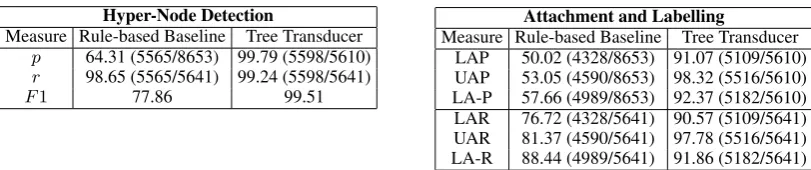
In Table 4, the performance of the subtasks of the SSyntS–DSyntS transducer is contrasted to the per-formance of the baselines; the evaluation of the postprocessing subtask is not included because the one-to-one projection of SSyntS elements to DSyntS guarantees an accuracy of 100% of the operations performed. The transducer has been applied to the gold standard test set, which is the held-out test set, with gold standard PoS tags, lemmas and dependency trees. It outputs in total 5610 nodes; the rule-based baseline outputs 8653 nodes. As mentioned in Section 3, our gold standard includes 5641 nodes.
Hyper-Node Detection
Table 4: Performance of the SSyntS–DSyntS transducer and of the rule-based baseline over the gold-standard held-out test set(LAP: labelled attachment precision, UAP: unlabelled attachment precision, LA-P: label assign-ment precision, LAR: labelled attachassign-ment recall, UAR: Unlabelled attachassign-ment recall and LA-R: Label assignassign-ment recall)
Our data-driven SSyntS–DSyntS transducer is much better than the baseline with respect to all eval-uation measures.8 The transducer relies on distributional patterns identified in the training data set, and makes thus use of information that is not available for the rule-based baseline, which studies one node at a time. However, the rule-based baseline results also show that transduction that would remove a few nodes would provide results close to a 100% recall for the hypernode detection because a DSynt tree is a subtree of the SSynt tree (if we ignore the nodes introduced by post-processing). This is also evidenced by the labeled and attachment recall scores. The results of the transducer on the test and development sets are quite comparable. The hypernode detection is even better on the test set. The label accuracy suffers most from using unseen data during the development of the system. The attachment figures are approximately equivalent on both sets.
4.2 Results of deep-syntactic parsing
Let us consider now the performance of the complete DSynt parsing pipeline (PoS-tagger+surface-dependency parser→SSyntS–DSyntS transducer) on the held-out test set. Table 5 displays the figures of the Bohnet and Nivre parser. The figures are in line with the performance of state-of-the-art parsers for Spanish (Mille et al., 2012).
POS LEMMA LAS UAS 96.05 92.10 81.45 88.09
Table 5: Performance of Bohnet and Nivre’s joint PoS-tagger+dependency parser trained on Ancora-UPF Table 6 shows the performance of the pipeline when we feed the output of the syntactic parser to the rule-based baseline SSyntS–DSyntS module and the tree transducer. We observe a clear error propaga-tion from the dependency parser (which provides 81.45% LAS) to the SSyntS–DSyntS transducer, which loses in tree quality more than 18%.
Hyper-Node Detection
Table 6: Performance of the deep-syntactic parsing pipeline
5 Related Work
To the best of our knowledge, data-driven deep-syntactic parsing as proposed in this paper is novel. As
semantic role labelingandframe-semantic analysis, it has the goal to obtain more semantically oriented structures than those delivered by state-of-the-art syntactic parsing. Semantic role labeling received considerable attention in the CoNLL shared tasks for syntactic dependency parsing in 2006 and 2007
(Buchholz and Marsi, 2006; Nivre et al., 2007), the CoNLL shared task for joint parsing of syntactic and semantic dependencies in 2008 (Surdeanu et al., 2008) and the shared task in 2009 (Hajiˇc et al., 2009). The top ranked systems were pipelines that started with a syntactic analysis (as we do) and continued with predicate identification, argument identification, argument labeling, and word sense disambigua-tion; cf. (Johansson and Nugues, 2008; Che et al., 2009). At the end, a re-ranker that considers jointly all arguments to select the best combination was applied. Some of the systems were based on integrated syntactic and semantic dependency analysis; cf., e.g., (Gesmundo et al., 2009); see also (Llu´ıs et al., 2013) for a more recent proposal along similar lines. However, all of them lack the ability to perform structural changes—as, e.g., introduction of nodes or removal of nodes necessary to obtain a DSyntS. Klimeˇs (2006)’s parser removes nodes (producing tectogrammatical structures as in the Prague Depen-dency Treebank), but is based on rules instead of classifiers, as in our case. The same applies to earlier works in the TAG-framework, as, e.g., in (Rambow and Joshi, 1997).
However, this is not to say that the idea of the surface→surface syntax→deep syntax pipeline is new. It goes back at least to Curry (1961) and is implemented in a number of more recent works; see, e.g., (de Groote, 2001; Klimeˇs, 2006; Bojar et al., 2008).
6 Conclusions and Future Work
We have presented a deep-syntactic parsing pipeline which consists of a state-of-the-art dependency parser and a novel SSyntS–DSyntS transducer. The obtained DSyntSs can be used in different applica-tions since they abstract from language-specific grammatical idiosyncrasies of the SSynt structures as produced by state-of-the art dependency parsers, but still avoid the complexities of genuine semantic analysis.9 DSyntS-treebanks needed for data-driven applications can be bootstrapped by the pipeline. If required, a SSyntS–DSyntS structure pair can be also mapped to a pure predicate-argument graph such as the DELPH-IN structure (Oepen, 2002) or to an approximation thereof (as the Enju conversion (Miyao, 2006), which keeps functional nodes), to an DRS (Kamp and Reyle, 1993), or to a PropBank structure. On the other hand, DSyntS-treebanks can be used for automatic extraction of deep grammars. As shown by Cahill et al. (2008), automatically obtained resources can be of an even better quality than manually-crafted resources. In this context, especially research in the context of CCGs (Hockenmeier, 2003; Clark and Curran, 2007) and TAGs (Xia, 1999) should be also mentioned.
To validate our approach with languages other than Spanish, we carried out an experiment on a Chi-nese SSyntS-DSyntS Treebank (training the DSynt-transducer on the outcome of the SSynt-parser). The results over predicted input showed an accuracy of about 75%, i.e., an accuracy comparable to the accu-racy achieved for Spanish. We are also investigating multilingual approaches, such as the one proposed by McDonald et al. (2013).
In the future, we will carry out further in-depth feature engineering for the task of DSynt-parsing. It proved to be crucial in semantic role labelling and dependency parsing (Che et al., 2009; Ballesteros and Nivre, 2012); we expect it be essential for our task as well. Furthermore, we will join surface syntactic and deep-syntactic parsing we kept so far separate; see, e.g., (Zhang and Clark, 2008; Llu´ıs et al., 2013; Bohnet and Nivre, 2012) for analogous proposals. Further research is required here since although joint models avoid error propagation from the first stage to the second, overall, pipelined models still proved to be competitive; cf. the outcome of CoNLL shared tasks.
The deep-syntactic parser described in this paper is available for downloading athttps://code.
google.com/p/deepsyntacticparsing/.
Acknowledgements
This work has been supported by the European Commission under the contract number FP7-ICT-610411. Many thanks to the three anonymous COLING reviewers for their very helpful comments and sugges-tions.
9The motivation to work with DSyntS instead of SSyntS is thus similiar to the motivation of the authors of theAbstract
References
Alfred V. Aho. 1972.The theory of parsing, translation and, compiling. Prentice Hall, Upper Saddle River, NJ. Miguel Ballesteros and Joakim Nivre. 2012. MaltOptimizer: A System for MaltParser Optimization. In
Proceed-ings of the Eighth International Conference on Language Resources and Evaluation (LREC 12).
L. Banarescu, C. Bonial, S. Cai, M. Georgescu, K. Griffitt, U. Hermjakob, K. Knight, P. Koehn, M. Palmer, and N. Schneider. 2013. Abstract Meaning Representation for Sembanking. InProceedings of the 7th Linguistic Annotation Workshop & Interoperability with Discourse, pages 178–186, Sofia, Bulgaria.
Bernd Bohnet and Joakim Nivre. 2012. A transition-based system for joint part-of-speech tagging and labeled non-projective dependency parsing. InEMNLP-CoNLL.
O. Bojar, S. Cinkov´a, and J. Pt´aˇcek. 2008. Towards English-to-Czech MT via Tectogrammatical Layer. The Prague Bulletin of Mathematical Linguistics, 90:57–68.
Mathias Buch-Kromann. 2003. The Danish dependency treebank and the dtag treebank tool. In2nd Workshop on Treebanks and Linguistic Theories (TLT), Sweden, pages 217–220.
Sabine Buchholz and Erwin Marsi. 2006. CoNLL-X shared task on multilingual dependency parsing. In Proceed-ings of the 10th Conference on Computational Natural Language Learning (CoNLL), pages 149–164.
Aoife Cahill, Michael Burke, Ruth O’Donovan, Stefan Riezler, Josef van Genabith, and Andy Way. 2008. Wide-coverage deep statistical parsing using automatic dependency structure annotation. Computational Linguistics, 34(1):81–124.
Chih-Chung Chang and Chih-Jen Lin, 2001. LIBSVM: A Library for Support Vector Machines. Software available at http://www.csie.ntu.edu.tw/∼cjlin/libsvm.
Wanxiang Che, Zhenghua Li, Yongqiang Li, Yuhang Guo, Bing Qin, and Ting Liu. 2009. Multilingual dependency-based syntactic and semantic parsing. In Proceedings of the Thirteenth Conference on Compu-tational Natural Language Learning (CoNLL 2009): Shared Task, pages 49–54, Boulder, Colorado, June. As-sociation for Computational Linguistics.
Stephen Clark and James R. Curran. 2007. Wide-coverage efficient statistical parsing with CCG and log-linear models. Computational Linguistics, 33:493–552.
R. Curry. 1961. Some logical aspects of grammatical structure. In R. Jakobson, editor,Structure of Language and Its Mathematical Aspects, pages 56–68. American Mathematical Society, Providence, RI.
Ph. de Groote. 2001. Towards abstract categorial grammar. InProceedings of the 39th Annual Meeting of the Association for Computational Linguistics (ACL).
Charles J. Fillmore, Collin F. Baker, and Hiroaki Sato. 2002. The FrameNet database and software tools. In
Proceedings of the Third International Conference on Language Resources and Evaluation, volume IV, Las Palmas. LREC, LREC.
A. Gesmundo, J. Henderson, P. Merlo, and I.Titov. 2009. Latent variable model of synchronous syntactic-semantic parsing for multiple languages. In CoNLL 2009 Shared Task., Conf. on Computational Natural Language Learning, pages 37–42, Boulder, Colorado, USA.
Jan Hajiˇc, Jarmila Panevov´a, Eva Hajiˇcov´a, Petr Sgall, Petr Pajas, Jan ˇStˇep´anek, Jiˇr´ı Havelka, Marie Mikulov´a, and Zdenˇk ˇZabokrtsk´y. 2006. Prague Dependency Treebank 2.0. Linguistic Data Consortium, Philadelphia. Jan Hajiˇc, Massimiliano Ciaramita, Richard Johansson, Daisuke Kawahara, Maria Ant`onia Mart´ı, Llu´ıs M`arquez,
Adam Meyers, Joakim Nivre, Sebastian Pad´o, Jan ˇStˇep´anek, Pavel Straˇn´ak, Mihai Surdeanu, Nianwen Xue, and Yi Zhang. 2009. The conll-2009 shared task: Syntactic and semantic dependencies in multiple languages. InProceedings of the Thirteenth Conference on Computational Natural Language Learning (CoNLL): Shared Task, pages 1–18.
J. Hockenmeier. 2003. Parsing with generative models of predicate-argument structure. InProceedings of the 41st Annual Meeting of the Association for Computational Linguistics (ACL), pages 359–366, Sapporo, Japan. Angelina Ivanova, Stephan Oepen, Lilja Øvrelid, and Dan Flickinger. 2012. Who did what to whom? a contrastive
R. Johansson and P. Nugues. 2007. Extended constituent-to-dependency conversion for english. In J. Nivre, H.-J. Kaalep, K. Muischnek, and M. Koit, editors,Proceedings of NODALIDA 2007, pages 105–112, Tartu, Estonia. Richard Johansson and Pierre Nugues. 2008. Dependency-based syntactic–semantic analysis with PropBank and NomBank. In CoNLL 2008: Proceedings of the Twelfth Conference on Natural Language Learning, pages 183–187, Manchester, United Kingdom.
H. Kamp and U. Reyle. 1993. From Discourse to Logic. Kluwer Academic Publishers, Dordrecht, NL.
R.T. Kasper and W.C. Rounds. 1986. A logical semantics for feature structures. InProceedings of the 24th annual meeting on Association for Computational Linguistics, pages 257–266.
V´aclav Klimeˇs. 2006. Analytical and Tectogrammatical Analysis of a Natural Language. Ph.D. thesis, UFAL, MFF UK, Prague, Czech Republic.
Xavier Llu´ıs, Xavier Carreras, and Llu´ıs M`arquez. 2013. Joint arc-factored parsing of syntactic and semantic dependencies. Transactions of the Association for Computational Linguistics, pages 219–230.
Ryan McDonald, Joakim Nivre, Yvonne Quirmbach-Brundage, Yoav Goldberg, Dipanjan Das, Kuzman Ganchev, Keith Hall, Slav Petrov, Hao Zhang, Oscar T¨ackstr¨om, Claudia Bedini, N´uria Bertomeu Castell´o, and Jungmee Lee. 2013. Universal dependency annotation for multilingual parsing. In Proceedings of the 51st Annual Meeting of the Association for Computational Linguistics (Volume 2: Short Papers), pages 92–97.
Igor Mel’ˇcuk. 1988.Dependency Syntax: Theory and Practice. State University of New York Press.
Igor Mel’ˇcuk. 1996. Lexical functions: A tool for the description of lexical relations in the lexicon. In L. Wanner, editor,Lexical functions in lexicography and natural language processing, pages 37–102. Benjamins Academic Publishers, Amsterdam.
Igor Mel’ˇcuk. 2013.Semantics: From meaning to text, Volume 2. Benjamins Academic Publishers, Amsterdam. Simon Mille, Alicia Burga, Gabriela Ferraro, and Leo Wanner. 2012. How does the granularity of an annotation
scheme influence dependency parsing performance? InConference on Computational Linguistics, COLING 2012.
Simon Mille, Alicia Burga, and Leo Wanner. 2013. AnCora-UPF: A Multi-Level Annotation of Spanish . In
Proceedings of the Second International Conference on Dependency Linguistics (DEPLING 2013).
Yusuke Miyao. 2006. From Linguistic Theory to Syntactic Analysis: Corpus-Oriented Grammar Development and Feature Forest Model. Ph.D. thesis, University of Tokyo.
J. Nivre, J. Hall, S. K¨ubler, R. McDonald, J. Nilsson, S. Riedel, and D. Yuret. 2007. The CoNLL 2007 Shared Task on Dependency Parsing. InProceedings of the CoNLL Shared Task of EMNLP-CoNLL 2007, pages 915–932. Stephan Oepen. 2002. Collaborative Language Engineering: A Case Study in Efficient Grammar-based
Process-ing. Stanford Univ Center for the Study.
Martha Palmer, Daniel Gildea, and Paul Kingsbury. 2005. The proposition bank. Computational Linguistics, 31:71–106.
Owen Rambow and Aravind Joshi. 1997. A formal look at dependency grammar and phrase structure grammars, with special consideration of word-order phenomena. In L. Wanner, editor, Recent Trends in Meaning-Text Theory, pages 167–190. Benjamins Academic Publishers, Amsterdam.
W.C. Rounds. 1970. Mappings and grammars on trees.Mathematical Systems Theory, 4(3):257–287.
Mihai Surdeanu, Richard Johansson, Adam Meyers, Llu´ıs M`arquez, and Joakim Nivre. 2008. The conll 2008 shared task on joint parsing of syntactic and semantic dependencies. In CoNLL 2008: Proceedings of the Twelfth Conference on Computational Natural Language Learning, pages 159–177.
M. Taul´e, M. Ant`onia Mart´ı, and Marta Recasens. 2008. Ancora: Multilevel annotated corpora for Catalan and Spanish. InProceedings of the Sixth International Language Resources and Evaluation (LREC’08), Marrakech, Morocco, may. European Language Resources Association (ELRA).
F. Xia. 1999. Extracting tree adjoining grammars from bracketed corpora. InProceedings of the 5th Natural Language Processing Pacific Rim Symposium, pages 398–403, Beijing, China.