Constraint-based Computational Semantics:
A Comparison between LTAG and LRS
Laura Kallmeyer
University of Tübingen Collaborative Research Center 441
Frank Richter
University of Tübingen Collaborative Research Center 441
Abstract
This paper compares two approaches to computational semantics, namely seman-tic unification in Lexicalized Tree Ad-joining Grammars (LTAG) and Lexical Resource Semantics (LRS) in HPSG. There are striking similarities between the frameworks that make them comparable in many respects. We will exemplify the dif-ferences and similarities by looking at sev-eral phenomena. We will show, first of all, that many intuitions about the mechanisms of semantic computations can be imple-mented in similar ways in both frame-works. Secondly, we will identify some aspects in which the frameworks intrin-sically differ due to more general differ-ences between the approaches to formal grammar adopted by LTAG and HPSG.
1 Introduction
This paper contrasts two frameworks for compu-tational semantics, the proposal for semantics in LTAG described in (Kallmeyer and Romero, 2005) and LRS (Richter and Sailer, 2004), a computa-tional semantics framework formulated in Head-Driven Phrase Structure Grammar (HPSG).
There are significant differences between LTAG and HPSG. LTAG is a mildly context-sensitive lexicalized formalism characterized by an ex-tended domain of locality. HPSG is based on the idea of a separation of the lexicon and syntactic structure and on the strict locality of general gram-mar principles that are formulated in an expres-sive and very flexible logical description language. These fundamental differences are reflected in the respective architectures for semantics: LTAG as-sumes a separate level of underspecified semantic
representations; LRS uses the description logic of syntax for semantic specifications.
However, despite the different mathematical structures, we find striking similarities between LTAG semantics with unification and LRS. They both show similar intuitions underlying specific analyses, use the same higher order type-theoretic language (Ty2, (Gallin, 1975)) as a means for specifying the truth conditions of sentences, and employ a feature logic in the combinatorial seman-tics instead of the lambda calculus. Because of these similarities, analyses using both approaches are closely related and can benefit from each other. The paper is structured as follows: Sections 2 and 3 will introduce the two frameworks. The next three sections (4–6) will sketch analyses of some phenomena in both frameworks that will re-veal relevant relations between them. Section 7 presents a summary and conclusion.
2 LTAG semantics
In (Kallmeyer and Romero, 2005), each elemen-tary tree is linked to a semantic representation (a set of Ty2 formulas and scope constraints). Ty2 formulas (Gallin, 1975) are typedλ-terms with in-dividuals and situations as basic types. The scope constraints of the formx ≥ yspecify subordina-tion relasubordina-tions between Ty2 terms. In other words, x≥yindicates thatyis a component ofx.
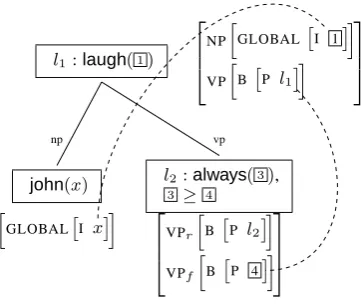
A semantic representation is equipped with a semantic feature structure description. Semantic computation is done on the derivation tree and consists of certain feature value equations between mother and daughter nodes in the derivation tree.
(1) John always laughs.
As an example, see Fig. 1 showing the deriva-tion tree for (1) with semantic representaderiva-tions and
l1:laugh(1)
Figure 1: LTAG semantics of (1)
semantic feature structure descriptions as node labels. The additional feature equations in this example are depicted using dotted lines. They arise from top-bottom feature identifications par-allel to the unifications performed in FTAG (Vijay-Shanker and Joshi, 1988) and from identifications of global features. They yield 1 =xand 4 =l1.
Applying these identities to the semantic represen-tations after having built their union leads to (2). The constraint 3 ≥ l1 states thatl1 : laugh(x)is
a component of 3.
(2) john(x),l2: always(3),l1:laugh(x),
3 ≥l1
Note that the feature structure descriptions do not encode the semantic expressions one is inter-ested in. They only encode their contributions to functional applications by restricting the argument slots of certain predicates in the semantic repre-sentations: They state which elements are con-tributed as possible arguments for other seman-tic expressions and which arguments need to be filled. They thereby simulate lambda abstraction and functional application while assembling the semantic representations. To achieve this, a re-stricted first order logic is sufficient.
Semantic computation is local on the derivation tree: The new feature equations that are added de-pend only on single edges in the derivation tree. Because of this, even with the extension to seman-tics, the formalism is still mildly context-sensitive.
3 LRS
In LRS the feature logic specifies the entire gram-mar, including well-formed Ty2 terms as seman-tic representations, and their mode of composi-tion. Instead of the lambda calculus of tradi-tional Montague Grammar, LRS crucially uses a
novel distinction between three aspects of the log-ical representations of signs (external content, in-ternal content, and parts). LRS constraints es-tablish sub-term relationships between pieces of semantic representations within and across signs, thereby specifying the combinatorial properties of the semantics. The subterm or component-of con-ditions (symbolized as /) are imposed by gram-mar principles. Since these principles are descrip-tions of object-language expressions, they permit the application of various underspecification tech-niques of computational semantics, although an LRS grammar does not employ underspecified mantic representations, in contrast to LTAG se-mantics.
Fig. 2 shows an HPSG description of the syn-tactic tree and the LRS specifications of (1). The syntactic trees in HPSG correspond to the derived trees of LTAG. Since HPSG does not have deriva-tion trees, the LRS principles refer to derived trees.
NP
Figure 2: LRS analysis of (1)
Each word lexically specifies its contribution to the overall meaning of the sentence (P(ARTS)), the part of its semantics which is outscoped by all signs the word combines with (INC(ONT)), and the overall semantic contribution of its maximal projection (EXC(ONT)). Feature percolation prin-ciples identify INC and EXC, respectively, along head projections and collect the elements of the
PARTS lists of the daughters at each phrase. The
combination of the adjunct with a verbal pro-jection introduces two component-of constraints: The EXC of always must be within the EXC of
laughs, and the INC of laughs must be in the
laughs (john) is identified by subcategorization (not shown in Fig. 2). A closure condition requires that the semantic representation of an utterance use up all and only thePARTScontributions of all signs, which yields 4 =always(laugh(john)).
4 Quantifier scope
4.1 Specifying a scope window
(3) Exactly one student admires every professor:
∃>∀,∀>∃
(4) John seems to have visited everybody: seem >∀,∀> seem
Quantificational NPs in English can in princi-ple scope freely (see (3) and (4)). An analysis of quantifier scope must guarantee only two things: 1. the proposition to which a quantifier attaches must be in its nuclear scope, and 2. a quantifier cannot scope higher than the next finite clause. One way to model this is to define a scope win-dow delimited by a maximal scope and a minimal scope for a quantifier. Both LTAG and LRS, spec-ify such scope windows for quantifiers. We will now outline the two analyses.
(5) Everybody laughs.
(Kallmeyer and Romero, 2005) use global fea-tures MAXS and MINS for the limits of the scope window. Fig. 3 shows the LTAG analysis of (5). The feature identifications (indicated by dotted lines) lead to the constraints 2 ≥ 5, 5 ≥ l1.
These constraints specify an upper and a lower boundary for the nuclear scope 5. With the
as-signments following from the feature identifica-tions we obtain the semantic representation (6):
(6)
l1 :laugh(x),
l2 :every(x,4, 5),l3 :person(x) 2 ≥l1,
4 ≥l3, 2 ≥ 5, 5 ≥l1
There is one possible disambiguation consis-tent with the scope constraints, namely 2 → l2, 4 → l3, 5 → l1. This leads to the semantics every(x,person(x),laugh(x)).
In LRS, the EXCONT value of the utterance is
the upper boundary while theINCONTvalue of the syntactic head a quantifier depends on is the lower boundary for scope, as illustrated in Fig. 4. The upper boundary is obtained through the interaction of 1) a PROJECTION PRINCIPLE stating that the
l1:laugh(1), 2 ≥ 3
np
l2 :every(x,4,5),
l3 :person(x), 4 ≥l3, 6 ≥ 5, 5 ≥ 7
GLOBAL
MINS l1
MAXS 2
NP
h
GLOBALI 1i
GLOBALI x
NP
"
GLOBAL
MINS 7 MAXS 6
#
Figure 3: LTAG analysis of (5) Everybody laughs
PARTSlist of a phrase contains all elements on the
PARTS lists of its daughters, and 2) the EXCONT
PRINCIPLE which states that a) the PARTS list of each non-head contains its ownEXCONT, and b) in an utterance, everything on the PARTS list is a
component of theEXCONT. This leads to the con-straint 4 6 in Fig. 4, among others. The lower
boundary is obtained from the SEMANTICSPRIN -CIPLEwhich states that if the non-head of a headed phrase is a quantifier, then theINCONTof the head is a component of its nuclear scope. This yields
1 βin Fig. 4.
S
EXC 6∀x personx→laughx
INC 1
P hx,1,1a,2,2a,4,4ai
NP VP
EXC 4∀x(α→β)
INC 2 personx
P hx,2,2aperson,
4,4aα→βi
EXC 6
INC 1 laughx
P h1,1alaughi
everybody laughs
Relevant subterm constraints: 2α(from the lexical entry of everybody), 1 β, 4 6
Figure 4: LRS analysis of (5) Everybody laughs
The striking similarity between the two anal-yses shows that, despite the fundamental differ-ences between the frameworks, central insights can be modelled in parallel.
4.2 Nested quantifiers
The use of the upper limit of the scope windows is, however, slightly different: EXCONTcontains the quantifier itself as a component whileMAXSlimits
than the MAXS limiting its nuclear scope but in
this case it takes immediate scope over theMAXS.
(7) Two policemen spy on someone from every city: ∀>∃>2(among others)
The LTAG analysis is motivated by nested quan-tifiers. In sentences such as (7), the embedded quantifier can take scope over the embedding one but if so, this must be immediate scope. In other words, other quantifiers cannot intervene. In (7), the scope order∀ > 2 > ∃ is therefore not pos-sible.1 The LTAG analysis is such that the max-imal nuclear scope of the embedded quantifier is the propositional label of the embedding quanti-fier.2
In LRS, the way the scope window is speci-fied, a corresponding constraint using theEXCONT
of the embedded quantifier cannot be obtained. The LRS principle governing the distribution of embedded quantifiers in complex NPs states di-rectly that in this syntactic environment, the em-bedded quantifier may only take direct scope over the quantifier of the matrix NP. This principle does not refer to the notion of external content at all. At this point it is an open question whether LRS could learn from LTAG here and adapt the scope window so that an analogous treatment of nested quantifiers would be possible.
5 LTAG’s extended domain of locality
Whereas the treatment of quantification sketched in the preceding section highlights the similarities between LTAG semantics and LRS, this and the following section will illustrate some fundamental differences between the frameworks.
In spite of the parallels mentioned above, even
INCONT and MINS differ sometimes, namely in
sentences containing bridge verbs. This is related to the fact that LTAG has an extended domain of locality whereas HPSG does not. Let us illustrate the difference with the example (8).
(8) Mary thinks John will come.
1(Joshi et al., 2003) propose an extra mechanism that
groups quantifiers into sets in order to derive these con-straints. (Kallmeyer and Romero, 2005) however show that these constraints can be derived even if the upper limitMAXS
for nuclear scope is used as sketched above.
2Note that this approach requires constraints of the form l ≥ n with l being a label, n a variable. This goes beyond the polynomially solvable normal dominance
con-straints (Althaus et al., 2003). This extension, though, is
probably still polynomially solvable (Alexander Koller, per-sonal communication).
In LTAG, the two elementary verb trees (for
thinks and will come) have different global MINS
features. The one for thinks is the label of thethink
proposition while the one for will come is the label of the embedded proposition. As a consequence, a quantifier which attaches to the matrix verb cannot scope into the embedded clause. This distinction of differentMINSvalues for different verb trees is natural in LTAG because of the extended domain of locality.
In LRS, all verbal nodes in the constituent struc-ture of (8) carry the sameINCONT value, namely the proposition of the embedded verb. Conse-quently, the minimal scope of quantifiers attaching either to the embedding or to the embedded verb is always the proposition of the embedded verb. However, due to the requirement that variables be bound, a quantifier binding an argument of the em-bedding verb cannot have narrow scope over the embedded proposition.
How to implement the LTAG idea of different
INCONTvalues for the embedding and the embed-ded verb in LRS is not obvious. One might intro-duce a new principle changing the INCONT value at a bridge verb, whereby the newINCONT would get passed up, and the embedded INCONT would
no longer be available. This would be problem-atic: Take a raising verb as in (9) (adjoining to the VP node in LTAG) instead of a bridge verb:
(9) Most people seem to everybody to like the film.
Here the minimal scope of most people should be the like proposition while the minimal scope of everybody is the seem proposition. In LTAG this does not pose a problem since, due to the ex-tended domain of locality, most people attaches to the elementary tree of like even though the seem tree is adjoined in between. If the INCONT treat-ment of LRS were modified as outlined above and
seem had anINCONT value that differed from the
INCONT value of the embedded like proposition, then the new INCONT value would be passed up and incorrectly provide the minimal scope of most
people. LRS must identify the twoINCONTs.
The difference between the two analyses illus-trates the relevance of LTAG’s extended domain of locality not only for syntax but also for semantics.
6 Negative Concord
in the respective implementation of underspeci-fication techniques in LTAG and LRS. Recall that both LTAG and LRS use component-of con-straints. But in LTAG, these constraints link ac-tual Ty2-terms (i.e., objects) to each other, while in LRS, these constraints are part of a description of Ty2-terms.
(10) Janek nie pomaga ojcu. Janek NM helps father
‘Janek doesn’t help his father.’
(11) a. Janek nie pomaga nikomu. Janek NM helps nobody
‘Janek doesn’t help anybody.’
b. ∗Janek pomaga nikomu.
(12) Nikt nie przyszedł. nobody NM came
‘Nobody came.’
The basic facts of sentential negation and nega-tive concord in Polish are illustrated in (10)–(12): The verbal prefix nie is obligatory for sentential negation, and it can co-occur with any number of n-words (such as nikt, ‘anybody’) without ever leading to a double negation reading. As a conse-quence, (12) expresses only one logical sentential negation, although the negation prefix nie on the verb and the n-word nikt can carry logical nega-tion alone in other contexts. LRS takes advantage of the fact that its specifications of semantic repre-sentations are descriptions of logical expressions which can, in principle, mention the same parts of the expressions several times. Fig. 5 shows that both nikt and the verb nie przyszedł introduce descriptions of negations (4 and 2, respectively).
The constraints of negative concord in Polish will then conspire to force the negations contributed by the two words to be the same in the overall logical representation 6 of the sentence.
Such an analysis is not possible in LTAG. Each negation in the interpretation corresponds to ex-actly one negated term introduced in the seman-tic representations. Therefore, the negative parti-cle nie necessarily introduces the negation while the n-word nikt requires a negation in the proposi-tion it attaches to. An analysis along these lines is sketched in Fig. 6 (“GL” stands for “GLOBAL”). The requirement of a negation is checked with a feature NEG indicating the presence of a nega-tion. The scope of the negation (featureN-SCOPE)
nikt nie przyszedł
Figure 5: LRS analysis of (12) Nikt nie przyszedł
marks the maximal scope of the existential quan-tifier of the n-word nikt (constraint 7 ≥ 6).3
S
Figure 6: LTAG analysis of (12) Nikt nie przyszedł
This example illustrates that the two frame-works differ substantially in their treatment of un-derspecification: 1. LRS employs partial descrip-tions of fully specified models, whereas LTAG generates underspecified representations in the style of (Bos, 1995) that require the definition of a disambiguation (a “plugging” in the terminol-ogy of Bos). 2. LRS constraints contain not Ty2 terms but descriptions of Ty2 terms. Therefore, in contrast to LTAG, two descriptions can denote the same formula. Here, LTAG is more limited com-pared to LRS. On the other hand, the way seman-tic representations are defined in LTAG guarantees
3
See (Lichte and Kallmeyer, 2006) for a discussion of
that they almost correspond to normal dominance
constraints, which are known to be polynomially
parsable. The difference in the use of underspecifi-cation techniques reflects the more general differ-ence between a generative rewriting system such as LTAG, in which the elements of the grammar are objects, and a purely description-based for-malism such as HPSG, in which token identities between different components of linguistic struc-tures are natural and frequently employed.
7 Summary and Conclusion
LTAG and LRS have several common characteris-tics: They both 1. use a Ty2 language for seman-tics; 2. allow underspecification (LTAG scope con-straints ≥ versus LRS component-of constraints
); 3. use logical descriptions for semantic
com-putation; 4. are designed for computational appli-cations. Due to these similarities, some analyses can be modelled in almost identical ways (e.g., the quantifier scope analyses, and the identification of arguments using attribute values rather than func-tional application in the lambda calculus). We take the existence of this clear correspondence as in-dicative of deeper underlying insight into the func-tioning of semantic composition in natural lan-guages.
Additionally, the differences between the frameworks that can be observed on the level of syntax carry over to semantics: 1. LTAG’s ex-tended domain of locality allows the localization within elementary trees of syntactic and seman-tic relations between elements far apart from each other on the level of constituent structure. 2. LTAG (both syntax and semantics) is a formalism with restricted expressive power that guarantees good formal properties. The restrictions, however, can be problematic. Some phenomena can be more easily described in a system such as HPSG and LRS while their description is less straightfor-ward, perhaps more difficult or even impossible within LTAG. The concord phenomena described in section 7 are an example of this.
A further noticable difference is that within the (Kallmeyer and Romero, 2005) framework, the derivation tree uniquely determines both syntac-tic and semansyntac-tic composition in a context-free way. Therefore LTAG semantics is mildly context-sensitive and can be said to be compositional. As far as LRS is concerned, it is not yet known whether it is compositional or not;
compositional-ity (if it holds at all) is at least less straightforward to show than in LTAG.
In conclusion, we would like to say that the sim-ilarities between these two frameworks permit a detailed and direct comparison. Our comparative study has shed some light on the impact of the dif-ferent characteristic properties of our frameworks on concrete semantic analyses.
Acknowledgments
For many long and fruitful discussions of various aspects of LTAG semantics and LRS, we would like to thank Timm Lichte, Wolfgang Maier, Mari-bel Romero, Manfred Sailer and Jan-Philipp Söhn. Furthermore, we are grateful to three anonymous reviewers for helpful comments.
References
Ernst Althaus, Denys Duchier, Alexander Koller, Kurt Mehlhorn, Joachim Niehren, and Sven Thiel. 2003. An efficient graph algorithm for dominance con-straints. Journal of Algorithms, 48(1):194–219.
Johan Bos. 1995. Predicate logic unplugged. In Paul Dekker and Martin Stokhof, editors, Proceedings of
the 10th Amsterdam Colloquium, pages 133–142.
Daniel Gallin. 1975. Intensional and Higher-Order
Modal Logic with Applications to Montague Seman-tics. North Holland mathematics studies 19.
North-Holland Publ. Co., Amsterdam.
Aravind K. Joshi, Laura Kallmeyer, and Maribel Romero. 2003. Flexible Composition in LTAG: Quantifier Scope and Inverse Linking. In Harry Bunt, Ielka van der Sluis, and Roser Morante, ed-itors, Proceedings of the Fifth International
Work-shop on Computational Semantics IWCS-5, pages
179–194, Tilburg.
Laura Kallmeyer and Maribel Romero. 2005. Scope and Situation Binding in LTAG using Semantic Uni-fication. Submitted to Research on Language and
Computation. 57 pages., December.
Timm Lichte and Laura Kallmeyer. 2006. Licensing German Negative Polarity Items in LTAG. In
Pro-ceedings of The Eighth International Workshop on Tree Adjoining Grammar and Related Formalisms (TAG+8), Sydney, Australia, July.
Frank Richter and Manfred Sailer. 2004. Basic con-cepts of lexical resource semantics. In Arnold Beck-mann and Norbert Preining, editors, ESSLLI 2003 –
Course Material I, (= Collegium Logicum, 5), pages
87–143. Kurt Gödel Society, Wien.
K. Vijay-Shanker and Aravind K. Joshi. 1988. Feature structures based tree adjoining grammar. In