Using LTAG-Based Features for Semantic Role Labeling
Yudong Liu and Anoop Sarkar
Computing Science Department Simon Fraser University British Columbia, Canada, V5A 1S6
yudongl,[email protected]
Abstract
Semantic role labeling (SRL) methods typically use features from syntactic parse trees. We propose a novel method that uses Lexicalized Tree-Adjoining Gram-mar (LTAG) based features for this task. We convert parse trees into LTAG deriva-tion trees where the semantic roles are treated as hidden information learned by supervised learning on annotated data de-rived from PropBank. We extracted var-ious features from the LTAG derivation trees and trained a discriminative decision list model to predict semantic roles. We present our results on the full CoNLL 2005 SRL task.
1 Introduction
Semantic role labeling (SRL) is a natural exten-sion of the syntactic parsing task. In SRL, par-ticular syntactic constituents in a parse tree for a sentence are identified with semantic roles. The labels assigned to various types of arguments and adjuncts differ in different annotation schemes. In this paper, we use the PropBank corpus of predicate-argument structures (Palmer, Gildea and Kingsbury, 2005). We assume we are given a syn-tactic parse tree and a particular predicate in the sentence for which we then identify the arguments and adjuncts and their labels. In this paper we compare two models for the identification of se-mantic role labels in a parse tree: A model that uses a path in the parse tree (or the derived tree in TAG terminology) and various associated features related to this, and we compare this model with a model that converts the syntactic parse tree into a Lexicalized Tree-Adjoining Grammar (LTAG) derivation tree and uses features extracted from the elementary trees and the LTAG derivation tree.
In each model the features of that model are used in a discriminative model for semantic role labeling. The model is a simple decision list
learner that uses tree patterns extracted from the LTAG derivation trees in order to classify con-stituents into their semantic roles. We present re-sults on the full CoNLL 2005 SRL task (Carreras and M`arquez, 2005) a dataset built by combining the Treebank and parser data with the PropBank annotations.
2 Background about SRL
A semantic role is defined to be the relationship that a syntactic constituent has with the predicate. For example, the following sentence, taken from the PropBank corpus, shows the annotation of se-mantic roles:
[A0 Late buying] [V gave] [A2 the Paris
Bourse] [A1 a parachute] [AM-TMP after its free fall early in the day].
Here, the arguments for the predicate gave are defined in the PropBank Frame Scheme (Palmer, Gildea and Kingsbury, 2005) as:
V: verb A2: beneficiary
A0: giver AM-TMP: temporal
A1: thing given
Recognizing and labeling semantic argu-ments is a key task for answering “Who”, “When”,“What”, “Where”, “Why”, etc. questions in Information Extraction, Question Answering, Summarization (Melli et al, 2005), and, in general, in all NLP tasks in which some kind of semantic interpretation is needed.
Most previous research treats the semantic role labeling task as a classification problem, and di-vides it into two phases: argument identification and argument classification. Argument identifi-cation involves classifying each syntactic element in a sentence into either an argument or a non-argument. Argument classification involves clas-sifying each argument identified into a specific se-mantic role. A variety of machine learning meth-ods have been applied to this task. One of the most important steps in building an accurate classifier is feature selection. Different from the widely used
feature functions that are based on the syntactic parse tree (Gildea and Jurafsky, 2002), we explore the use of LTAG-based features in a simple dis-criminative decision-list learner.
3 LTAG Based Feature Extraction
In this section, we introduce the main components of our system. First, we do a pruning on the given parse trees with certain constraints. Then we de-compose the pruned parse trees into a set of LTAG elementary trees. For each constituent in question, we extract features from its corresponding deriva-tion tree. We train using these features in a deci-sion list model.
3.1 Pruning the Parse Trees
Given a parse tree, the pruning component identi-fies the predicate in the tree and then only admits those nodes that are sisters to the path from the predicate to the root. It is commonly used in the SRL community (cf. (Xue and Palmer, 2004)) and our experiments show that 91% of the SRL targets can be recovered despite this aggressive pruning. There are two advantages to this pruning: the ma-chine learning method used for prediction of SRLs is not overwhelmed with a large number of non-SRL nodes; and the process is far more efficient as 80% of the target nodes in a full parse tree are pruned away in this step. We make two enhance-ments to the pruned Propbank tree: we enrich the sister nodes with their head information, which is a part-of-speech tag and word pair: ht, wiand PP nodes are expanded to include the NP complement of the PP (including the head information). Note that the target SRL node is still the PP. Figure 1 shows the pruned parse tree for a sentence from PropBank section 24.
3.2 LTAG-based Decomposition
As next step, we decompose the pruned tree around the predicate using standard head-percolation based heuristic rules1 to convert a Treebank tree into a LTAG derivation tree. We do not use any sophistical adjunct/argument or other extraction heuristics using empty elements (as we don’t have access to them in the CoNLL 2005 data). Also, we do not use any substitution nodes in our elementary trees: instead we exclu-sively use adjunction or sister adjunction for the attachment of sub-derivations. As a result the
1using http://www.isi.edu/∼chiang/software/treep/treep.html
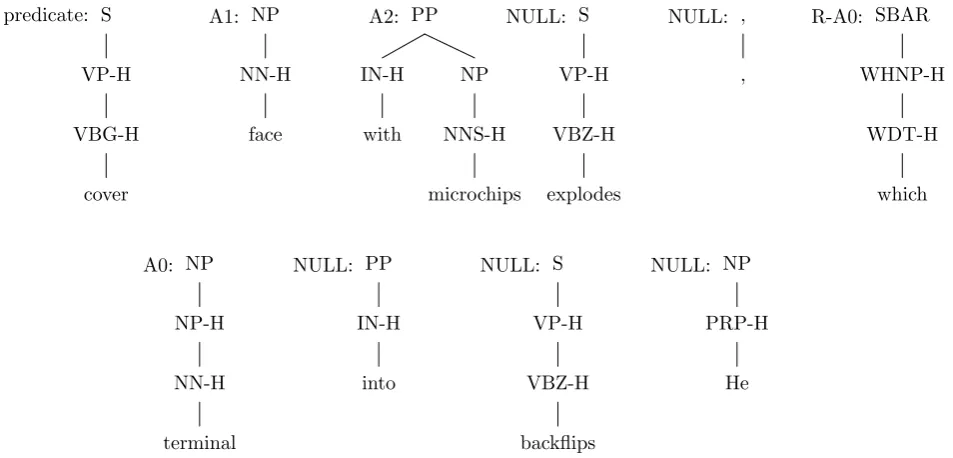
root node in an LTAG derivation tree is a spinal elementary tree and the derivation tree provides the path from the predicate to the constituent in question. Figure 2 shows the resulting elementary tree after decomposition of the pruned tree. For each of the elementary trees we consider their labeling in the derivation tree to be their semantic role labels from the training data. Figure 3 is the derivation tree for the entire pruned tree.
Note that the LTAG-based decomposition of the parse tree allows us to use features that are distinct from the usual parse tree path features used for SRL. For example, the typical parse tree feature from Figure 2 used to identify constituent (NP (NN
terminal)) as A0 would be the parse tree fragment: N P ↑ N P ↓ SBAR ↓ S ↓ V P ↓ S ↓ V P ↓
V BGcover (the arrows signify the path through
the parse tree). Using the LTAG-based decompo-sition means that our SRL model can use any fea-tures from the derivation tree such as in Figure 2, including the elementary tree shapes.
3.3 Decision List Model for SRL
Before we train or test our model, we convert the training, development and test data into LTAG derivation trees as described in the previous sec-tion. In our model we make an independence as-sumption that each semantic role is assigned to each constituent independently, conditional only on the path from the predicate elementary tree to the constituent elementary tree in the deriva-tion tree. Different elementary tree siblings in the LTAG derivation tree do not influence each other in our current models. Figure 4 shows the differ-ent derivation trees for the target constitudiffer-ent (NP
(NN terminal)): each providing a distinct semantic
S
NP
PRP-H
He
VP-H
VBZ-H
backflips
PP
IN-H
into
NP
NP-H
NN-H
terminal ,
,
SBAR
WHNP-H
WDT-H
which
S
VP-H
VBZ-H
explodes ,
,
S
VP-H
VBG-H
covering NP
NN-H
face
PP
IN-H
with
NP
NNS-H
microchips
Figure 1: The pruned tree for the sentence “He backflips into a desktop computer terminal, which
ex-plodes, covering Huntz Hall ’s face with microchips.”
S
VP-H
VBG-H
cover
NP
NN-H
face
PP
IN-H
with
NP
NNS-H
microchips
S
VP-H
VBZ-H
explodes
,
,
SBAR
WHNP-H
WDT-H
which
predicate: A1: A2: NULL: NULL: R-A0:
NP
NP-H
NN-H
terminal
PP
IN-H
into
S
VP-H
VBZ-H
backflips
NP
PRP-H
He
A0: NULL: NULL: NULL:
S(backflips)
NP(he) PP(into)
NP(terminal)
,(,) SBAR(which)
S(explodes)
,(,) S(cover)
NP(face) PP(with)
Figure 3: The LTAG derivation tree (with no semantic role labels) corresponding to the pruned tree.
A0: NP-NP(NN,terminal)
R-A0: SBAR-WHNP(WDT,which)
NULL: S-VP(VBZ,explodes)
predicate: S-VPH(VBG,cover)
A1: NP-NP(NN,terminal)
R-A0: SBAR-WHNP(WDT,which)
NULL: S-VP(VBZ,explodes)
predicate: S-VPH(VBG,cover)
A0: NP-NP(NN,terminal)
R-A0: SBAR-WHNP(WDT,which)
AM-ADV: S-VP(VBZ,explodes)
predicate: S-VPH(VBG,cover)
Figure 4: Different LTAG derivation trees corresponding to different assignments of semantic roles to constituents. The constituent in question is (NP (NN terminal)).
NP
NP
NN
terminal
SBAR
S
VP
S
VP
VBG
cover
VP
VBG
cover
PP
IN
with
NP
NNS
microchips
SBAR
WHNP
WDT
which S
VP
S
VP
VBG
cover
VP
VBZ
explodes S
VP
VBG
cover
The input to the learning algorithm is labeled examples of the form(xi, yi).yiis the label (either NULL for no SRL, or the SRL) of theith example. xi is a feature vector hP, A, Dist, P osition, R
-type, ti ∈ tI, Disttii, where P is the predicate
elementary tree, A is the tree for the constituent being labeled with a SRL, tI is a set of interme-diate elementary trees between the predicate tree and the argument tree. EachP, A, I tree consists of the elementary tree template plus the tag, word pair:ht, wi.
All possible combinations of fully-lexicalized/postag/un-lexicalized elementary trees are used for each example. DistandDistti
denote the distance to the predicate from the argument tree and the intermediate elementary tree respectively. P osition is interpreted as the position that the target is relative to the predicate.
R-type denotes the relation type of the predicate and the target constituent. 3 types are defined: if the predicate dominates (directly or undirectly) the argument in the derivation tree, we have the relation of type-1; if the other way around, the argument dominates (directly or undirectly) the predicate then we have the relation of type-2; and finally type-3 means that neither the predicate or the argument dominate each other in the derivation tree and instead are dominated (again, directly or indirectly) by another elementary tree.
The output of the learning algorithm is a func-tionh(x, y)which is an estimate of the conditional probability p(y | x) of seeing SRL y given pat-tern x. h is interpreted as a decision list of rules
x ⇒ y ranked by the score h(x, y). In testing, we simply pick the first rule that matches the par-ticular test examplex. We trained different mod-els using the same learning algorithm. In addition to the LTAG-based method, we also implemented a pattern matching based method on the derived (parse) tree using the same model. In this method, instead of considering each intermediate elemen-tary tree between the predicate and the argument, we extract the whole path from the predicate to the argument. So the input is more like a tree than a discrete feature vector. Figure 5 shows the patterns that are extracted from the same pruned tree.
4 Experiments and Results
We use the PropBank corpus of predicate-argument structures (Palmer, Gildea and Kings-bury, 2005) as our source of annotated data for the
dev = Sec24 p(%) r(%) f(%)
test = Sec23
M1: dev 78.42 77.03 77.72
M1: test 80.52 79.40 79.96
M2: dev 81.11 79.39 80.24
M2: test 83.47 81.82 82.64
M3: dev 80.98 79.56 80.26
M3: test 81.86 83.34 82.60
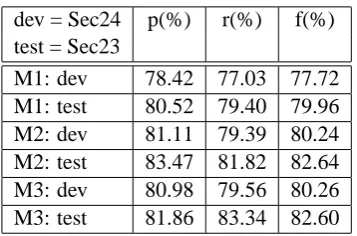
Table 1: Results on the CoNLL 2005 shared task using gold standard parse trees. M1 is the LTAG-based model, M2 is the derived tree pattern match-ing Model, M3 is a hybrid model
SRL task. However, there are many different ways to evaluate performance on the PropBank, leading to incomparable results. To avoid such a situation, in this paper we use the CoNLL 2005 shared SRL task data (Carreras and M`arquez, 2005) which provides a standard train/test split, a standard method for training and testing on various prob-lematic cases involving coordination. However, in some cases, the CoNLL 2005 data is not ideal for the use of LTAG-based features as some “deep” in-formation cannot be recovered due to the fact that trace information and other empty categories like PRO are removed entirely from the training data. As a result some of the features that undo long-distance movement via trace information in the TreeBank as used in (Chen and Rambow, 2003) cannot be exploited in our model. Our results are shown in Table 1. Note that we test on the gold standard parse trees because we want to compare a model using features from the derived parse trees to the model using the LTAG derivation trees.
5 Related Work
active) of the verb is often used and recovered us-ing a heuristic rule. We also use the passive/active voice by labeling this information into the parse tree. However, in contrast with other work, in this paper we do not focus on the problem of parse ac-curacy: where the parser output may not contain the constituent that is required for recovering all SRLs.
There has been some previous work in SRL that uses LTAG-based decomposition of the parse tree and we compare our work to this more closely. (Chen and Rambow, 2003) discuss a model for SRL that uses LTAG-based decompo-sition of parse trees (as is typically done for sta-tistical LTAG parsing). Instead of using the typi-cal parse tree features used in typitypi-cal SRL models, (Chen and Rambow, 2003) uses the path within the elementary tree from the predicate to the con-stituent argument. They only recover seman-tic roles for those constituents that are localized within a single elementary tree for the predicate, ignoring cases that occur outside the elementary tree. In contrast, we recover all SRLs regardless of locality within the elementary tree. As a result, if we do not compare the machine learning meth-ods involved in the two approaches, but rather the features used in learning, our features are a natural generalization of (Chen and Rambow, 2003).
Our approach is also very akin to the approach in (Shen and Joshi, 2005) which uses PropBank information to recover an LTAG treebank as if it were hidden data underlying the Penn Treebank. This is similar to our approach of having several possible LTAG derivations representing recovery of SRLs. However, (Shen and Joshi, 2005) do not focus on the SRL task, and in both of these instances of previous work using LTAG for SRL, we cannot directly compare our performance with theirs due to differing assumptions about the task.
6 Conclusion and Future Work
In this paper, we proposed a novel model for SRL using features extracted from LTAG deriva-tion trees. A simple decision list learner is applied to train on the tree patterns containing new fea-tures. This simple learning method enables us to quickly explore new features for this task. How-ever, this work is still preliminary: a lot of addi-tional work is required to be competitive with the state-of-the-art SRL systems. In particular, we do not deal with automatically parsed data yet, which
leads to a drop in our performance. We also do not incorporate various other features commonly used for SRL, as our goal in this paper was to make a direct comparison between simple pattern match-ing features on the derived tree and compare them to features from LTAG derivation trees.
References
X. Carreras and L. M`arquez 2005. Introduction to the CoNLL-2005 Shared Task. In Proc. of CoNLL 2005.
J. Chen and O. Rambow. 2003. Use of Deep Linguis-tic Features for the Recognition and Labeling of Se-mantic Arguments. In Proceedings of the 2003 Con-ference on Empirical Methods in Natural Language Processing, Sapporo, Japan, 2003.
D. Gildea and D. Jurafsky. 2002. Automatic Label-ing of Semantic Roles. Computational LLabel-inguistics, 58(3):245–288
M. Palmer, D. Gildea, and P. Kingsbury. 2005. The Proposition Bank: An Annotated Corpus of Seman-tic Roles. Computational LinguisSeman-tics, 31(1).
G. Melli and Y. Wang and Y. Liu and M. Kashani and Z. Shi and B. Gu and A. Sarkar and F. Popowich 2005. Description of SQUASH, the SFU Question An-swering Summary Handler for the DUC-2005 Sum-marization Task. In Proceeding of Document Un-derstanding Conference (DUC-2005)
S. Pradhan, K. Hacioglu, W. Ward, J. H. Martin, and D. Jurafsky. 2005. Semantic Role Chunking Com-bining Complementary Syntactic Views, In Pro-ceedings of the 9th Conference on Natural Language Learning (CoNLL 2005), Ann Arbor, MI, 2005.
V. Punyakanok, D. Roth, and W Yih. 2005. Gener-alized Inference with Multiple Semantic Role La-beling Systems (shared task paper). Proc. of the Annual Conference on Computational Natural Lan-guage Learning (CoNLL) pp. 181-184
Ruppenhofer, Josef, Collin F. Baker and Charles J. Fill-more. 2002. The FrameNet Database and Soft-ware Tools. In Braasch, Anna and Claus Povlsen (eds.), Proceedings of the Tenth Euralex Interna-tional Congress. Copenhagen, Denmark. Vol. I: 371-375.
L. Shen and A. Joshi. 2005. Building an LTAG Tree-bank. Technical Report MS-CIS-05-15, CIS Depart-ment, University of Pennsylvania.
K. Toutanova, A. Haghighi, and C. D. Manning. 2005. Joint learning improves semantic role labeling. ACL 2005