Chemical freeze-out parameters in Beam Energy Scan Program of STAR at
RHIC
Sabita Das (for the STAR collaboration)1,a 1Institute of Physics, Bhubaneswar-751005, India
Abstract.The STAR experiment at RHIC has completed its first phase of the Beam Energy Scan (BES-I) program to understand the phase structure of the quantum chromodynamics (QCD). The bulk properties of the system formed in Au+Au collisions at different center of mass energy √sNN=7.7, 11.5, 19.6, 27, and 39 GeV
have been studied from the data collected in the year 2010 and 2011. The centrality and energy dependence of mid-rapidity (|y|<0.1) particle yields, and ratios are presented here. The chemical freeze-out parameters are extracted using measured particle ratios within the framework of a statistical model.
1 Introduction
The heavy-ion collider experiments such as STAR at RHIC, ALICE at LHC were designed to investigate mat-ter similar to that formed at the very early stages of the universei.e.matter under extreme conditions of high tem-perature or density (or both) [1]. Similar to the matter in its primordial state, a deconfined state of quarks and gluons is created called Quark-Gluon Plasma (QGP) at both RHIC and LHC [2,3]. The QCD as the theory of strong interac-tions predicts a transition at sufficiently high temperature T or baryon chemical potentialμB from hadronic matter to QGP state. So, by varying theT andμB in laboratory we can study the phase transition associated with QCD matter [4–7]. The major part of the QCD phase diagram, which is generally known as the plot ofT as a function of
μB, consists of two phases [8]. These are the high tem-perature QGP phase, where the relevant degrees of free-dom are quarks and gluons, and the hadronic phase at low temperature. Other interesting phases related to neutron stars [9], color superconductivity [10], and the quarky-onia [11] phase also appear in the QCD phase diagram in addition to the confined and de-confined phases [12]. Par-ticle yields in high energy heavy-ion experiments at diff er-ent collision energies can be used to obtain theT andμB that set up the chemical freeze-out line in the QCD phase diagram. It appears to be very close to the phase bound-ary between QGP and hadronic phase, especially at low
μB. At high T and vanishingμB, finite temperature lat-tice QCD calculations has established the transition from QGP to a hadron gas is a cross-over [13]. The existence of a first-order phase transition has been predicted by sev-eral QCD-based calculations at lowerT andμB[14]. The QCD critical point is a feature of the phase diagram, where the nature of the transition changes from a discontinuous
ae-mail: [email protected]
(first-order) transition to an analytic crossover [15–19]. To explore the freeze-out diagram, i.e. search the possi-ble phase boundary line and search for the possipossi-ble QCD critical point, is a priority study at RHIC. For this, STAR has completed the first phase of the Beam Energy Scan (BES-I) program [20], collecting data from Au+Au colli-sions at center of mass energies of 7.7, 11.5, 14.5, 19.6, 27, and 39 GeV in the year 2010, 2011 and 2014. In this paper, we use the particle yields or ratios of the measured hadrons to find the experimentally accessible region of the QCD phase diagram by extractingT, μB within a statisti-cal model.
Here we will discuss the centrality dependence of identi-fied particles, pions (π±), kaons (K±), protons (p), and anti-protons (¯p) produced in Au+Au collisions at BES en-ergies √sNN =7.7, 11.5, 19.6, 27, and 39 GeV [22,23]. The experimental particle ratios obtained from the yields of π±, K±, p, ¯p, Λ, ¯Λ and Ξ−, ¯Ξ+ [24] have been used in a grand-canonical ensemble (GCE) of THERMUS model [25] to extract the freeze-out parameters like chem-ical freeze-out temperature (Tch), baryon chemical po-tential (μB), strangeness chemical potential (μS), charge chemical potential (μQ), and strangeness saturation factor (γS). The centrality and energy dependence of these pa-rameters will also be discussed.
2 Results
2.1 Particle Yields
The identified particle yields are measured using the STAR Time Projection chamber (TPC) and Time-Of-Flight (TOF) detectors in mid-rapidity (|y|<0.1) [26]. In the TPC, the particles are identified by measuring the spe-cific ionisation energy loss whereas in TOF, they are iden-tified using the particle velocities as a function of momen-tum. Figure1shows thedN/dynormalised to the average
part
N
0
100
200
300
part
0.5 N
dN/dy/
0
1
2
3
19.6 GeV
11.5 GeV
7.7 GeV 200 GeV
62.4 GeV
39 GeV
27 GeV
Au+Au
+
STAR Preliminary
part
N
0
100
200
300
part
0.5 N
dN/dy/
0
0.2
0.4
K
+
STAR Preliminary
part
N
0
100
200
300
part
0.5 N
dN/dy/
0
0.1
0.2
0.3
0.4
p
STAR Preliminary
Figure 1. dN/dyofπ±,K±, andpscaled by0.5Npartas a function ofNpartin Au+Au collisions at BES energies (solid symbols)
along with top RHIC energies (open symbols) [21]. Errors are statistical and systematic errors added in quadrature.
number of participated nucleon pair (dN/dy/0.5Npart) vs. Npart forπ+, K+, and p where Npart is the av-erage number of participating nucleons in a given cen-trality range. The errors on the points which include both statistical and systematic errors. For the comparison, the dN/dy/0.5Npart from the Au+Au system at RHIC energies are also shown [21]. The yield per participant pair for pions at BES energies is almost independent of
Npart. The particle production of pions therefore scales with the number of participant pairs. Kaon yields per par-ticipant pair increases with average parpar-ticipant number. The increase in proton yield per participating nucleon with the increasing collision centrality is possibly due to large baryon stopping at the lower energies.
2.2 Particle Ratios
Figure2show the centrality dependence of different par-ticle ratios in Au+Au collisions at BES energies and its comparison with other RHIC energies [21]. The errors
shown are the quadratic sum of statistical and systematic errors. Theπ−/π+ ratio shows no strong dependence on centrality. The flat K−/K+ratios vs. Npartindicate that the production mechanism does not change across central-ity.
The ratios ofK+/π+ andK−/π− gradually increase from peripheral to mid-central and saturate in mid-central to central collisions. The enhancement of the integrated K±/π± ratio in more central collisions is related to strangeness equilibration in various thermal models [27, 28]. Thermodynamic models explain the increase of the K/π ratios with the system size from peripheral to cen-tral based on the transition from the canonical to grand-canonical ensemble [29,30].
2.3 Chemical freeze-out
+
/
0
0.5
1
200 GeV 62.4 GeV 39 GeV 27 GeV
19.6 GeV
11.5 GeV
7.7 GeV
Au+Au
part
N
0
100
200
300
+
/K
-K
0.2
0.4
0.6
0.8
1
1.2
1.4
STAR Preliminary
/
-K
0
0.1
0.2
0.3
0.4
200 GeV62.4 GeV 39 GeV 27 GeV
19.6 GeV
11.5 GeV
7.7 GeV
Au+Au
part
N
0
100
200
300
+
/
+
K
0.1
0.2
0.3
STAR PreliminaryFigure 2.π−/π+,K−/K+,K−/π−, andK+/π+as a function ofN
partin Au+Au collisions at BES energies and top RHIC energies [21].
Errors are statistical and systematic errors added in quadrature.
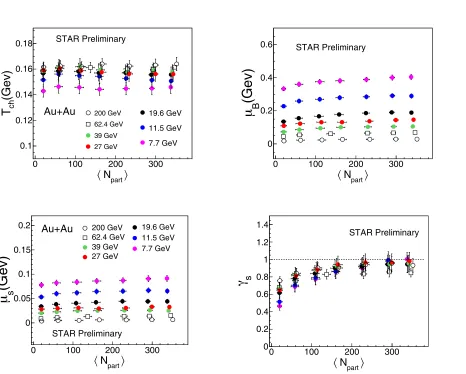
assuming chemical equilibrium to study chemical out dynamics for BES energies. The chemical freeze-out parameters,Tch, μB, μS, and γS, are extracted from the mid-rapidity particle ratios of different combinations which includes yields ofπ±,K±,p, ¯p,Λ, ¯Λ,Ξ−, ¯Ξ+[22– 24]. Experimentally, the proton yields have not been cor-rected for feed-down contributions. The yields ofπandΛ have been corrected for the feed-down from weak decays. Figure3 shows the centrality and energy dependence of freeze-out parameters as a function of average number of participants Npart, using THERMUS with GCE for Au+Au collisions at √sNN =7.7 - 200 GeV. The solid symbol represents the results for BES energies and the open symbol represents the results for top RHIC energies. Here we always useμQ=0 with unconstrained fit param-etersTch, μB, μS, and γS. TheTch is found to be inde-pendent of centrality and with increasing energy its value increases from lower energy 7.7 GeV up to 19.6 GeV and afterwards its value remain consistent within error with the top RHIC energy measurements. The values ofTchis close to the lattice QCD calculation of the cross-over tempera-ture between the de-confined phase and the hadronic phase suggesting that chemical freeze-out happens in the vicin-ity of the transition line shortly after hadronization. The baryon chemical potential,μB, decreases with increasing collision energy and it increases from peripheral to cen-tral collisions at all energies. We observe a cencen-trality de-pendence of the chemical freeze-out curve (Tchvs. μB) at BES energies which was not observed at higher energies of Au+Au 200 GeV [21,22]. The strangeness chemical po-tential,μS, seems to decrease with the increasing collision
energy, following the same type of behaviour asμB. The strangeness saturation factorγS increases from peripheral to central for all the energies studied. In central collisions,
γS is close to unity for top RHIC energies.
2.4 Summary
The centrality and energy dependence of identified parti-cle yields and ratios have been discussed in Au+Au col-lisions at BES energies √sNN = 7.7, 11.5, 19.6, 27, 39 GeV. The yields of identified hadrons increase with in-crease of beam energy. The freeze-out temperature and baryon chemical potential can be deduced from statistical fits of experimentally measured particle ratios to thermal model calculations assuming chemical equilibrium. The measurements at BES energies along with the top RHIC energies have extended the range of baryon chemical po-tential (μB) from 20 to 420 MeV corresponding to Au+Au collision at √sNN =200 down to 7.7 GeV. A centrality dependence of freeze-out parameters (Tch, μB) has been observed at BES energies.
References
[1] B. B. Backet al., Nucl. Phys. A757, 28 (2005); I. Arseneet al.(BRAHMS Collaboration, Nucl. Phys. A757, 1 (2005); J. Adamset al.(STAR Collabora-tion), Nucl. Phys. A757, 102 (2005) ; K. Adcoxet al.(PHENIX Collaboration), Nucl. Phys. A757, 184 (2005) M. Gyulassy and L. McLerran, Nucl. Phys. A
part
N
0 100 200 300
(Gev)
ch
T
0.1 0.12 0.14 0.16 0.18
200 GeV 62.4 GeV 39 GeV 27 GeV
19.6 GeV 11.5 GeV 7.7 GeV
Au+Au
STAR Preliminary
part
N
0 100 200 300
(Gev)
B
μ
0 0.2 0.4
0.6 STAR Preliminary
part
N
0 100 200 300
(Gev)
sμ
0 0.05 0.1 0.15
0.2 200 GeV
62.4 GeV 39 GeV 27 GeV
19.6 GeV 11.5 GeV 7.7 GeV
Au+Au
STAR Preliminary
part
N
0 100 200 300
s
0 0.2 0.4 0.6 0.8 1 1.2 1.4
STAR Preliminary
Figure 3.Chemical freeze-out temperatureTch, baryon chemical potentialμB, strangeness chemical potentialμS, strangeness saturation
factorγS are shown as a function of the average number of participating nucleonsNpartin Au+Au collisions at √sNN =7.7, 11.5,
19.6, 27, 39, 62.4, and 200 GeV obtained from particle ratios in grand-canonical ensemble.
[2] S. Chatrchyanet al., JHEP05, 063 (2012); B. Abelev et al., Phys. Rev. Lett.109, 072301 (2012).
[3] R. Singh et al., Advances in High Energy Physics
2013761474) (2013).
[4] X Luoet al.Science332(6037), 1525-1528, (2011). [5] B. Mohanty (STAR Collaboration), New J. Phys.13,
065031 (2011).
[6] B. Mohanty (STAR Collaboration), PoS
CPOD2013, 001, (2013).
[7] B. Mohanty (STAR Collaboration) EPJ Web Conf.
66, 04022 (2014).
[8] K. Fukushima and T. Hatsuda, Rept. Prog. Phys.74, 014001 (2011).
[9] J. M. Lattimer and M. Prakash, Phys. Rept.442, 109 (2007).
[10] M. G. Alford, A. Schmitt, K. Rajagopal, T. Schafer, Rev. Mod. Phys.80, 1455 (2008).
[11] L. McLerran, Nucl. Phys. A830, 709C (2009). [12] P. Braun-Munzinger et al., Rev. Mod. Phys. 81,
1031 (2009); B. Mohanty, New J.Phys.,13, 065031
(2011).
[13] Y. Aokiet al., Nature443, 675 (2006). [14] S. Ejiri, Phys. Rev. D78074507 (2008).
[15] K. Rajagopal and F. Wilczek, arXiv:hep-ph/0011333.
[16] M. Stephanov, Prog. Theor. Phys. Suppl. 153, 139 (2004); Int. J. Mod. Phys. A 20, 4387 (2005); E. S. Bowman and J I Kapusta, Phys. Rev. C 79 015202 (2009).
[17] Z. Fodor and S.D. Katz, JHEP50, 0404 (2004). [18] R. V. Gavai and S. Gupta, Phys. Rev. D78, 114503
(2008); Phys. Rev. D78, 14503 (2008); Phys. Rev. D
71, 114014 (2005).
[19] Anyi Liet al., arXiv:0908.1155.
[20] B. I. Abelevet al., (STAR Collaboration) STAR In-ternal Note - SN0493 (2009).
ration), Phys. Rev. Lett. 92, 112301 (2004); B. I. Abelevet al.(STAR Collaboration), Phys. Rev. C81, 024911 (2010).
[22] S. Das (STAR Collaboration), Nucl. Phys. A,
904-905, 891C, (2013); S. Das (STAR Collaboration), J. Phys.: Conf. Ser.509, 012066 (2014).
[23] L. Kumar (STAR Collaboration) ,J. Phys. G Nucl. Part. Phys.,38124145 (2011).
[24] X. Zhu (STAR Collaboration)Acta Phys. Polon.B, Proc. Supp.5, 213-218 (2012).
mun.180, 84 (2009).
[26] M. Andersonet al., Nucl. Instr. Meth. A499, 659 (2003); W. J. Llopeet al., Nucl. Instr. Meth. B241, 306(2005) .
[27] Masashi Kaneta and Nu Xu.. nucl-th/0405068, (2004).
[28] J. Cleymans, Burkhard Kampfer, M. Kaneta, S. Wheaton, and N. Xu, Phys. Rev., C 71, 054901, (2005).
![Figure 1. dNalong with top RHIC energies (open symbols) [/dy of π±, K±, and p scaled by ⟨0.5Npart⟩ as a function of ⟨Npart⟩ in Au+Au collisions at BES energies (solid symbols)21]](https://thumb-us.123doks.com/thumbv2/123dok_us/8181927.1366429/2.595.70.512.83.466/figure-dnalong-energies-symbols-function-collisions-energies-symbols.webp)
![Figure 2. π−/π+, K−/K+, K−/π−, and K+/π+ as a function of ⟨Npart⟩ in Au+Au collisions at BES energies and top RHIC energies [21].Errors are statistical and systematic errors added in quadrature.](https://thumb-us.123doks.com/thumbv2/123dok_us/8181927.1366429/3.595.59.538.71.339/figure-function-collisions-energies-energies-statistical-systematic-quadrature.webp)