ISSN 2348 – 7968
529
Study of Image Interpolation
Mrs. Amruta Savagave, Prof .A .P. Patil
Electronics & Telecommunication Department, Kolhapur, India Email: [email protected]
Electronics Engg. Dept., Dr. J. J. Magdum College of Engineering, India Email: [email protected]
Abstract
Interpolation is the process of transferring image from one
resolution to another without losing image quality. In Image
processing field, image interpolation is very important function
for doing zooming, enhancement of image, resizing any many
more. Conventional image interpolation methods suffer blurring
problems in edge regions, so it is hard to produce sharp and clear
visual effects. The traditional view of interpolation is to represent
an arbitrary continuous function as a discrete sum of weighted
and shifted synthesis functions in other words, a mixed
convolution equation. An important issue is the choice of
adequate synthesis functions that satisfy interpolation properties.
Examples of finite-support ones are the square pulse
(nearest-neighbor interpolation), the hat function (linear interpolation),
the cubic Keys' function, and various truncated or windowed
versions of the sinc function. On the other hand, splines provide
examples of infinite-support interpolation functions that can be
realized exactly at a finite, surprisingly small computational cost.
Keywords- Image Interpolation, Adaptive Interpolation, Non
adaptive interpolation.Nearest Neighbor Interpolation, Bilinear
Interpolation, Bicubic Interpolation
1. Introduction
Image interpolation addresses the problem of generating a
high-resolution image from its low-resolution version. The
model employed to describe the relationship between
high-resolution pixels and low-resolution pixels plays the
critical role in the performance of an interpolation
algorithm. Conventional linear interpolation schemes
(e.g., bilinear and bicubic) based on space-invariant
models fail to capture the fast evolving statistics around
edges and consequently produce interpolated images with
blurred edges and annoying artifacts. Linear interpolation
is generally preferred not for the performance but for
computational simplicity. Many algorithms have been
proposed to improve the subjective quality of the
interpolated images by imposing more accurate models.
Approximating continues function’s value using discrete
samples is called interpolation . Image interpolation is
nowadays available in many image processing tools like
Photoshop and other. Applications of image interpolation
methods are image enlargement, image reduction, subpixel
image registration, image decomposition and to correct
spatial distortions and many more. figure 1 shows the
basic concept of how can enlarge image using
interpolation. Image interpolation occurs in all digital
photos at some stage whether this be in Bayer
demosaicing or in photo enlargement. It happens anytime
you resize or remap (distort) your image from one pixel
grid to another. Image resizing is necessary when you
need to increase or decrease the total number of pixels,
whereas remapping can occur under a wider variety of
scenarios: correcting for lens distortion, changing
perspective, and rotating an image. Even if the same
image resize or remap is performed, the results can vary
ISSN 2348 – 7968
530
is only an approximation, therefore an image will alwayslose some quality each time interpolation is
performed.
Fig.1 Basic Interpolation Concept
Model based recovery of continuous data from discrete
data within a known range of abscissa. The reason for this
preference is to allow for a clearer distinction between
interpolation and extrapolation. The former postulates the
existence of a known range where the model applies, and
asserts that the deterministically recovered continuous data
is entirely described by the discrete data, while the latter
authorizes the use of the model outside of the known
range, with the implicit assumption that the model is
"good" near data samples, and possibly less good
elsewhere.
Three most important hypothesis for interpoltionare:
1) The underlying data is continuous defined
2) Given data samples, it is possible to compute a
data value of the underlying continuous function
at any abscissa
3) The evaluation of the underlying continuous
function at the sample points yields the same
value as the data themselves
Two main categories are there for image interpolation
algorithms called adaptive and non adaptive. In non
adaptive method same procedure is applied on all pixels
without considering image features while in a adaptive
method, image quality and it’s feature are considered
before applying algorithm.
2.Non Adaptive Interpolation Algorithm
Conventional interpolation methods include nearest
neighbor interpolation, bilinear interpolation and bicubic
interpolation algorithm. The bilinear interpolation and
bicubic interpolation smooth the data and keeping the low
frequency content of the source image. Because they are
not able to enhance the high frequencies or preserve the
edges equally well, they may produce some annoying
visual problems, such as aliasing, blurring or other artifact
effects. It also includes spline, sinc, lanczos. Depending on
their complexity, these use anywhere from 0 to 256 (or
more) adjacent pixels when interpolating. The more
adjacent pixels they include the more accurate they can
become, but this comes at the expense of much longer
processing time. These algorithms can be used to both
distort and resize a photo.
Various adaptive interpolation algorithms have already
been developed to solve the artifact effects. Without
thinking or considering the content of image, in this
method simply apply some computational. Normally
commercial product like Adobe Photoshop uses this kind
of interpolation methods.
2.1 Nearest Neighbor Interpolation
Nearest neighbor is the most basic and requires the least
processing time of all the interpolation algorithms because
it only considers one pixel, the closest one to the
interpolated point. This has the effect of simply making
each pixel bigger. This method is very simple and requires
less computation as it use nearest neighbor’s pixel to fill
interpolated point. This method is just copies available
ISSN 2348 – 7968
531
2.2 Bilinear InterpolationIn this method,,interpolated point is filled with four closest
pixel’s weighted average. In this method use two linear
interpolations, in horizontal direction and then linear
interpolation in vertical direction. So there is need to
calculate four interpolation function for grid point in
Bilinear Interpolation. This results in much smoother
looking images than nearest neighbor.
Fig.2 Bilinear Interpolation
Figure.2 is for a case when all known pixel distances are
equal, so the interpolated value is simply their sum divided
by four.
2.3 Bicubic Interpolation
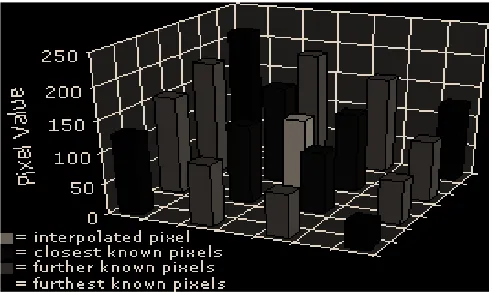
Bicubic goes one step beyond bilinear by considering the
closest 4x4 neighborhood of known pixels for a total of
16 pixels as shown in figure 3. Since these are at various
distances from the unknown pixel, closer pixels are given
Fig.3Bicubic Interpolation
2.4 Filtering-based (Re-sampling) Techniques
Transforming image pixel from one coordinate to another
(different resolution) is called Re-sampling process.
Digital image is discrete function in two dimensions so
there is need of 2D filtering or convolution. But it is
computationally costly. So separate 2D function and apply
it first row wise and then column wise on 1D. There is a
different filters used for interpolation algorithm. Filters are
used for blur and noise removal as well as edge
identification.
Figure 4 shows the comparison of three (Nearest neighbor,
Bilinear and Bicubic Interpolation) non adaptive methods.
a higher weighting in the calculation. Bicubic produces
noticeably sharper images than the previous two
methods, and is perhaps the ideal combination of
processing time and output quality. For this reason it is a
standard in many image editing programs (including
Adobe Photoshop), printer drivers and in-camera
interpolation
.
ISSN 2348 – 7968
532
3. Adaptive AlgorithmInclude many proprietary algorithms in licensed software
such as: Qimage, PhotoZoom Pro, Genuine Fractals and
others. Many of these apply a different version of their
algorithm (on a pixel-by-pixel basis) when they detect the
presence of an edge, aiming to minimize unsightly
interpolation artifacts in regions where they are most
apparent. These algorithms are primarily designed to
maximize artifact-free detail in enlarged photos, so some
cannot be used to distort or rotate an image. Adaptive
algorithm basically uses some of the image features and
improves interpolation result. Adaptive algorithm works
based ondifferent intensity present and local structure of
image. Many adaptive interpolation algorithms have been
proposed which enhance edges in images. Local gradient
information can also be used to enhance non adaptive
interpolation algorithm. Normal problem with
interpolation technique is blurring and blocking artifacts.
This can be solved using directional interpolation.
Adaptive interpolation techniques spatially adapt the
interpolation coefficients to better match the local
structures around the edges. Iterative methods such as
PDE-based schemes [6], [7] and projection onto convex
sets (POCS) schemes [8], [9], constrain the edge
continuity and find the appropriate solution through
iterations. Edge-directed interpolation techniques [10],
[11] employ a source model that emphasizes the visual
integrity of the detected edges and modify the
interpolation to fit the source model.
3.1 Recent interpolation Algorithms
It includes some recent algorithms for interpolation,
Xin Li, and Michael T. Orchard, hasgiven their ideas in
paper “New Edge-Directed Interpolation” A novel
noniterative orientation adaptive interpolation scheme for
natural-image sources. motivation This idea comes from
the fundamental property of an ideal step edge (known as
geometric regularity ), i.e., that the I mage intensity field
evolves more slowly along the edge orientation than
across the edge orientation. Geometric regularity has
important effects on the visual quality of a natural image
such as the sharpness of edges and the freedom from
artifacts. Since edges are presumably very important
features in natural images, exploiting the geometric
regularity of edges becomes paramount in many image
processing tasks. In the scenario of image interpolation,
an orientation-adaptive interpolation scheme exploits this
geometric regularity [12].
Xiao-feng Wang, He-fei Ling, proposed “An
Edge-Adaptive Interpolation Algorithm for Super-Resolution
Reconstruction” Here they construct high resolution
image using bilinear interpolation and detect edges. Then
edges are refined using geometric duality between the
low-resolution covariance and the high-resolution
covariance and local structure feature [1].
Bing Yang, Zhiyong Gao, Xiaoyun Zhang, proposed
“Principal Components Analysis-Based Edge-Directed
Image Interpolation” Here the gradient directions are
explicitly estimated with a statistical-based approach. The
local dominant gradient directions are obtained by using
principal components analysis (PCA) on the four nearest
gradients. The angles of the whole gradient plane are
divided into four parts, and each gradient direction falls
ISSN 2348 – 7968
533
one-dimension (1-D) cubic convolution interpolationperpendicular to the gradient direction [4].
Sanjay Kumar Maurya, Pavan Kumar Mishra, proposed
“Image Enhancement by Intensity Based Interpolation
and Selective Threshold”, It includes one technique
which determines edges by comparing the intensity
variations between center pixel and its neighboring pixels
of window size 55. On the basis of designed thresholds,
extrapolated blank pixels are filled [3].
Lei Zhang, Xiaolin Wu proposed, “An Edge-Guided
Image Interpolation Algorithm via Directional Filtering
and Data Fusion”, For edge information they have
partition pixels into two directional and orthogonal
subsets. Directional interpolation is made for each Subset
and two interpolated values are fused. Algorithm
presented in [5] work for gray scale images only. .
Sapan Naik, Viral Borisagar, proposed " A novel Super
Resolution Algorithm using Interpolation and LWT
based denoising method "Here they do the modification
so that algorithm works for RGB image also. They have
stored each R,G and B components of one image into
three different images of two dimension (same as
grayscale image) and give that as a input to original
algorithm. Finally they have merged all three output
arrays into single RGB image [2].
4. Application
Among biomedical applications where interpolation is
quite relevant, the most obvious are those where the goal
is to modify the sampling rate of pixels (picture elements)
or voxels (volume elements). This operation, named
rescaling, is desirable when an acquisition device say, a
scanner has a nonhomogeneous resolution, typically a
fine within-slice resolution and a coarse across-slice
resolution. In this case, the purpose is to change the
aspect ratio of voxels in such a way that they correspond
to geometric cubes in the physical space. Often, the
across-slice resolution is modified to match the
within-slice resolution, which is left unchanged. This results in a
volumetric representation that is easy to handle (e.g., to
visualize or to rotate) because it enjoys homogenous
resolution.
The relevance of interpolation is also obvious in more
advanced visualization contexts, such as volume
rendering. There, it is common to apply a texture to the
facets that compose the rendered object . Although
textures may be given by models (procedural textures),
this is generally limited to computer graphics
applications; in biomedical rendering, it is preferable to
display a texture given by a map consisting of true data
samples. Due to the geometric operations involved (e.g.,
perspective projection), it is necessary to resample this
map, and this resampling involves interpolation. In
addition, volumetric rendering also requires the
computation of gradients, which is best done by taking
the interpolation model into account.
In general, almost every geometric transformation
requires that interpolation be performed on an image or a
volume. In biomedical imaging, this is particularly true in
the context of registration, where an image needs to be
translated, rotated, scaled, warped, or otherwise
deformed, before it can match a reference image or an
atlas. Obviously, the quality of the interpolation process
has a large influence on the quality of the registration
ISSN 2348 – 7968
534
The data model associated to interpolation also affectsalgorithmic considerations. For example, the strategy that
goes by the name of multiresolution proposes to solve a
problem first at the coarse scale of an image pyramid, and
then to iteratively propagate the solution at the next finer
scale, until the problem has been solved at the finest
scale. In this context, it is desirable to have a framework
where the interpolation model is consistent with the
model upon which the image pyramid is based. The
assurance that only a minimal amount of work is needed
at each new scale for refining the solution, is only present
when the interpolation model is coherent with the
multiresolution mode.
References
[1] Xiao- feng Wang, He-fei Ling, “An Edge-Adaptive
Interpolation Algorithm for Super-Resolution Reconstruction”,
2010 International Conference on Multimedia Information
Networking and Security.
[2] Sapan Naik, Viral Borisagar," A novel Super Resolution Algorithm using Interpolation and LWT based denoising method ", IJIP journal, VOL. 6, issue 4,2012.
[3] Sanjay Kumar Maurya, Pavan Kumar Mishra, “Image Enhancement by Intensity Based Interpolation and Selective Threshold”,2012 International Conference on Communication Systems and Network Technologies.
[4] Bing Yang, Zhiyong Gao, Xiaoyun Zhang, “Principal Components Analysis-Based Edge-Directed Image Interpolation”, 2012 IEEE International Conference on Multimedia and Expo (ICME).
[5] Lei Zhang, Xiaolin Wu, “An Edge-Guided Image Interpolation Algorithm via Directional Filtering and Data Fusion”, IEEE TRANSACTIONS ON IMAGE PROCESSING, VOL. 15, NO. 8, AUGUST 2006.
[6] B. Ayazifar and J. S. Lim, “Pel-adaptive model-based interpolation of spatially subsampled images,” in Proc. IEEE Int. Conf. Acoustics, Speech,Signal Processing, vol. 3, 1992, pp. 181–184.
[7] B.S.Morse and D.Schwartzwald, “Isophote-based interpolation,” inProc. IEEE Int. Conf. Image Processing, vol. 3, 1998, pp. 227–231.
[8] K. Ratakonda and N. Ahuja, “POCS based adaptive image magnification,” in Proc. IEEE Int. Conf. Image Processing, vol. 3, 1998, pp. 203–207
.[9] D. Calle and A. Montanvert, “Superresolution inducing of an image,” inProc. IEEE Int. Conf. Image Processing, vol. 3, 1998, pp. 232–235.
[10] K. Jensen and D. Anastassiou, “Subpixel edge localization and the interpolation of still images,” IEEE Trans. On Image Processing, vol. 4, pp. 285–295, Mar. 1995.
[11] J.Allebach and P. W. Wong, “Edge-directed interpolation,” in Proc. IEEE Int. Conf. Image Processing, vol. 3, 1996, pp. 707– 710.
[12] X. Li et.al., "New edge-directed interpolation," IEEE trans. on Image Processing, Vol. 10, No 10, October 2001, pp.1521-1527