Available online: https://edupediapublications.org/journals/index.php/IJR/ P a g e | 597
Efficient Data Storage in Clouds Using Decentralised
Access Control with Anonymous Authentication
Ms. Pooja Gawali Qual: M. Tech.
Department: Computer Science & Technology
Shivaji University,Kolhapur
Maharashtra,
Email ID: [email protected]
Mr. H. P. Khandagale Designation: Asst. Professor Department: Computer Science &
Technology
Department of Technology Shivaji University,Kolhapur
Maharashtra,
Email ID: [email protected]
Abstract:
Cloud computing usage is progressively improving in recent times, which empowers adaptable, no-interest, and minimal effort utilization of processing assets, yet the information is outsourced to some cloud servers, and different protection concerns rise up out of it. In this report, we exhibit a synonymous benefit control plan AnonyControl to address the information protection, as considerably as the node security in existing access control programs. AnonyControl decentralizes the focal power to confine the Identity misuse and in this manner accomplishes semianonymity. Furthermore, it also tallies up the document access control to the benefit control, by which benefits of all operations on the cloud information can be overseen in a fine-grained way. In this manner, we exhibit the AnonyControl-F, which completely prevents the identity spillage and accomplish the full obscurity. Our security examination demonstrates that both AnonyControl and AnonyControl-F are secure under the delusional bilinear Diffie–Hellman supposition, and our execution assessment shows the practicality of our plans.
Available online: https://edupediapublications.org/journals/index.php/IJR/ P a g e | 598 Introduction: A secure server in addition
to giving an ensured establishment to facilitating your Web applications, and Web server design assumes a basic character in your Web application's security. A server can prompt unapproved access. Ignored client records can allow an attacker to hack your data without notice. Seeing the dangers to your Web server and having the capacity to distinguish proper countermeasures licenses you to suspect numerous assaults and upset the regularly developing quantities of aggressors.
This framework gives bidirectional encryption of correspondences between a client and server, which ensures against listening stealthily and messing with and/or manufacturing the substance of the correspondence [1].Much speaking, this gives a sense surety that one is corresponding with decisively.The situation that I purposed to speak with and also guaranteeing that the substance of agreements between the client and the site can't be perused or manufactured by any outsider. Secure Server Plus application has primarily twofold login security. That is, in the wake of signing
into the application client gets a hidden key on his enrolled gmail id. This private key must be inclosed in the pop-up box showed in the wake of signing into SSP Application. This application has two functionalities, Encryption and Decryption. Encoding is the usefulness in which the document to be institutionalized over the mail in firstly separated in 4 a balance of in byte configuration and afterward encoded utilizing distinctive encryption calculations. After Encryption records would be mailed to the beneficiary through Gmail At the beneficiary end, He will download the documents and utilizing SSP Application information as a part of documents would be unscrambled and blended.
Available online: https://edupediapublications.org/journals/index.php/IJR/ P a g e | 599 necessity for law authorization separated
from the specialized answers for guarantee security and protection. Numerous encryption systems have been practiced to put away information on cloud to peruse the data while doing calculations on the information. By utilizing Attribute based encryption plot, the cloud gets figure content of the information and performs calculations on the figure content and passes the encoded estimation of the final result to the client then the client can interpret the outcome, despite the fact that the cloud does not comprehend what information it has worked [2].
Different methods have been proposed to ensure the information substance protection by means of user control.Identity based encryption (IBE) was initially presented by Shamir, in which the sender of a message can indicate a character such that just a beneficiary with coordinating identity can unscramble it.A twosome of years after the fact, Fuzzy Identity-Based Encryption are proposed, which is otherwise called Attribute-Based Encryption (ABE).In such encryption
conspire, an identity is viewed as an arrangement of clear characteristics, and decoding is conceivable if a decrypter's character has a few covers with the one defined in the ciphertext.Before long, more broad tree-based ABE plans, Key-Policy Attribute-Based Encryption (KP-ABE) and Ciphertext-Policy Attribute-Based Encryption (CP-ABE), are introduced to express more broad condition than straightforward 'cover'.They are spouses to each other as in the choice of encryption strategy (who can or can't decode the message) is set by various gatherings [3].
Available online: https://edupediapublications.org/journals/index.php/IJR/ P a g e | 600 believe that the key generators issue keys
with the right structures to the right clients.Plus, when a re-encryption happens, most of the nodes in the same organization must hold their individual keys, re-issued keeping in mind the end goal to blend to the re-encoded discs, and this technique causes huge issues in the execution.Of course, those issues and operating expense are all rated in the CP-ABE.In the CP-ABE, ciphertexts are made with a passage structure, which indicates the encryption methodology, and private keys are created by qualities.A customer can disentangle the ciphertext if and only if his attributes in the private key satisfy the passage tree demonstrated in the ciphertext.In this way, the Encrypter holds a complete force about the encoding system.Furthermore, the starting now issued private keys will never be modified unless the whole system reboots.
Dissimilar to the information secrecy, less effort is paid to ensure clients' identity protection amid those intelligent conventions.Clients' identities, which are described with their properties, are by
and large unveiled two key guarantors, and the backers issue private keys as indicated by their traits.In any case, it comes out to be characteristic that clients are willing to keep their identity mystery while despite everything they get their private keys.Therefore, we propose AnonyControl and AnonyControl-F to permit cloud servers to control clients' entrance benefits without knowing their character data [4].
Research problem:
Available online: https://edupediapublications.org/journals/index.php/IJR/ P a g e | 601 our framework does not bid for any focal
power. In developing our framework, our biggest specialized obstacle is to make it arrangement safe. Earlier Attribute-Based Encryption frameworks accomplished agreement resistance when the ABE framework power "tied" together diverse parts (speaking to various qualities) of a client's private key by randomizing the key.Be that as it may, in our framework every part will produce from a conceivably distinctive power, where we accept no coordination between such forces.We create novel methods to tie key segments together and forestall intrigue assaults between clients with various worldwide identifiers.They demonstrate our framework secure utilizing the late double framework encryption technique where the security verification works by first changing over the test ciphertext and private keys to a semi-practical structure and afterward contending security.We assume after a recent variation of the double framework evidence procedure because of Lewko and Waters and assemble our framework utilizing bilinear gatherings of composite request. We demonstrate security under comparative static suppositions to the
LW, paper in the arbitrary prophetic model.
As indicated by Boneh, D., and Hamburg, M. (2008), give a general structure to building character based and telecast encryption frameworks. Specifically, we find a general encryption framework called spatial encryption from which numerous frameworks with a mixing of properties take after. The ciphertext size in every one of these frameworks is autonomous of the quantity of clients included and is only three gathering components. Private key size develops with the multifaceted character of the fabric. One purpose of these outcomes gives the principal show HIBE framework with short ciphertexts.Telecast HIBE takes care of a characteristic issue doing with identity based encrypted e-mail.
Algorithm:
Setup→ The setup calculation takes no info other than the certain security parameter. It renders people in general parameters PK and an expert key MK.
Available online: https://edupediapublications.org/journals/index.php/IJR/ P a g e | 602 in general parameters PK, a message M,
and an entrance structure An over the universe of attributes. The calculation will encode M and produce a ciphertext CT such that just a client that holds an arrangement of qualities that fulfills the entrance structure will hold the capability to decipher the message.We will demand that the ciphertext verifiable contains A.
Key Generation (MK, S) → The key era calculation takes as information the expert key MK and a arrangement of qualities S that depict the key. It affords a private key SK.
Decode (PK, CT, SK) →The unscrambling calculation takes as data the general population parameters PK, a ciphertext CT, which contains an entrance strategy A, and a private key SK, which is a private key for a set S of characteristics. In the case that the set S of traits fulfills the entrance structure A then the calculation will decode the ciphertext and return a message M.
Delegate (SK, S ̃) →The delegate calculation takes as info a mystery key SK for some system of properties S and a set S ̃ ⊆sit moves over a mystery key SK
for the arrangement of S ̃ characteristics S [5].
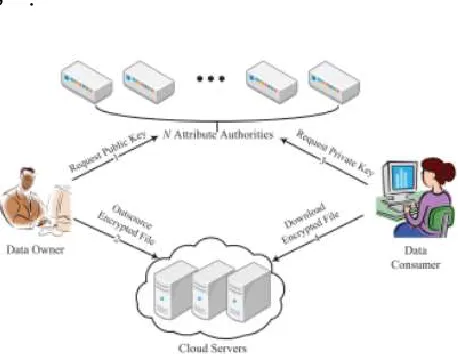
Figure 1: Architecture system
re-Available online: https://edupediapublications.org/journals/index.php/IJR/ P a g e | 603 scrambles it under various benefit trees.
This toolbox depends on the CP-ABE toolbox which is accessible on the mesh, and the entire framework is executed on a Linux framework with Intel i7 second Gen @ 2.7GHz and 2GB RAM.The calculation overhead brought about in the center calculations Setup, KeyGenerate, Encrypt, and Decrypt under different conditions.We moreover actualized three comparative works under the same condition (same security level and same environment) for the examination reason.
Especially we set stand out the benefit of the document access, and we quantified an ideal chance to get in at one benefit tree and count on its confirmation parameter.When all is said in done, the calculation overhead of Li is much higher than others in light of the fact that their plan includes numerous more exponentiations and bilinear mappings because of the responsibility.The encryption/unscrambling under various document sizes did not indicate enormous contrasts when record sizes are substantial (≥20MB), in light of the fact that the run times are kept in line by the symmetric encryption (AES-256) [6]. At
last, but our run times are plotted on the grounds that the benefit creation is the extra procedure in our design.
Research Method:
Available online: https://edupediapublications.org/journals/index.php/IJR/ P a g e | 604 This application has two functionalities,
Encryption and Decryption.Encoding is the usefulness in which the document to be institutionalized over the mail in firstly isolated into 4 equivalent amounts of in byte arrangement and afterward encoded utilizing diverse encryption calculations.After Encryption records would be mailed to the beneficiary through Gmail. At the beneficiary end he will download the records and utilizing SSP Application information as a part of documents would be unscrambled and consolidated [8].
Conclusion:
In this composition, the subject of the various encryption plan like IBE, ABE, KP-ABE, CP-ABE, Anonycontrol and AnonyControl-F is said with their favorable position and inconvenience. The diverse variants of this plan are contrasted and talked about and the current plan as per the ascent in the security issues in distributed computing. The correlations and investigation of those encryption plan are done by issues emerges and the arrangement on those the issues are fixed.Course for future workplace is to permit multi power
servers to overhaul client mystery key without unveiling client characteristic data.Additionally, in AnonyControl framework we made with multi power framework which permits playing with innovative methods to cover overhead.
Reference:
1. Lewko, A., & Waters, B. (2011). Decentralizing attribute-based encryption. In Advances in Cryptology–EUROCRYPT 2011 (pp. 568-588). Springer Berlin Heidelberg.
2. Boneh, D., & Hamburg, M. (2008). Generalized identity based and broadcast encryption schemes. In Advances in Cryptology-ASIACRYPT 2008 (pp. 455-470). Springer Berlin Heidelberg.
3. Waters, B. (2011). Ciphertext-policy attribute-based encryption: An expressive, efficient, and provably secure realization. In Public Key Cryptography–PKC 2011 (pp. 53-70). Springer Berlin Heidelberg. 4. Hajny, J., & Malina, L. (2012).
Available online: https://edupediapublications.org/journals/index.php/IJR/ P a g e | 605 on smart-cards (pp. 62-76). Springer
Berlin Heidelberg.
5. Li, J., Huang, Q., Chen, X., Chow, S. S., Wong, D. S., & Xie, D. (2011, March). Multi-authority ciphertext-policy attribute-based encryption with accountability. In Proceedings of the 6th ACM Symposium on Information, Computer and Communications Security (pp. 386-390). ACM.
6. Li, J., Ren, K., Zhu, B., & Wan, Z. (2009). Privacy-aware attribute-based encryption with user accountability. In Information Security (pp. 347-362). Springer Berlin Heidelberg. 7. Camenisch, J., Neven, G., & Rückert,
M. (2012). Fully anonymous attribute tokens from lattices. In Security and Cryptography for Networks (pp. 57-75). Springer Berlin Heidelberg. 8. Shahandashti, S. F., & Safavi-Naini,