ISSN(Online) : 2320-9801
ISSN (Print) : 2320-9798
I
nternational
J
ournal of
I
nnovative
R
esearch in
C
omputer
and
C
ommunication
E
ngineering
(An ISO 3297: 2007 Certified Organization)
Vol. 4, Issue 4, April 2016
Hard Decision Decoding of Multidimensional
Turbo Product Codes Using Iterative
Algorithm
Tasneem Sultana1, Ch.Ravi Kumar2
PG Scholar, Dept of ECE, Sir C.R. Reddy College of Engineering and Technology, Eluru, AP, India1
Sr.Assistant Professor, Dept of ECE, Sir C.R. Reddy College of Engineering and Technology, Eluru, AP, India2
ABSTRACT:-In this paper we mainly deals about low complexity decoding and reliable form of communication
system with less number of errors by using hard decision decoding with iterative algorithm .In this paper we also try to achieve the performance of soft decision decoding .The iterative algorithms we describe in this paper bit flip and modified bit flip algorithm with multidimensional turbo product codes with single parity.
KEYWORDS:-Multidimensional, Iterative Algorithm, Single Parity, Turbo Product Code, Hard Decision Decoder
I. INTRODUCTION
In coding scheme concatenation of codes came in to existence which increase the code gain and the error correction reliability of large code it was first introduced in 1993 Berrou et al [1].The major introduction to two decoding algorithm soft and hard decision decoding and their performance study. The possibility of error free communication was suggested by Elias [2].The decoding algorithm for turbo product codes introduced are not in iterative form of system so later it was developed a iterative decoding algorithm [3] .To lower the complexity of paper introduces are considering single parity turbo product codes with soft decision decoding algorithm [4] and the Maximum a posterior algorithm (MAP) [5].the single parity product codes was designed using interleavers for multidimensional codes using soft decoding algorithm[6].The chase decoder for turbo product codes decoding is done using the syndrome
Our project proposed a modified bit flip algorithm i.e. weighted bit flip algorithm to overcome the disadvantage of the bit flip algorithm and to give improved decoding performance of the system using multidimensional turbo product codes
The paper is describe as in the Section II multidimensional Turbo product code construction with a single parity codes with the same components of code. For these codes, a hard decision decoding with iterative modified algorithm and its modification with Sections III and IV. Simulations results are given in the Section V. Simulations have been performed in order to estimate the error-correcting performance in an AWGN channel for various single parity turbo product codes. The conclusions is in the last section.
II. MULTIDIMENSIONAL TURBO PRODUCT CODES
Fig 1 2Dm turbo product code
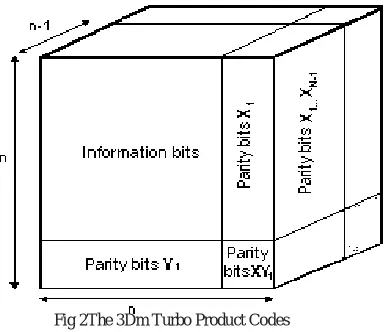
Similarly the 3Dm Turbo product codes represents the directions in X, Y and Z directions. The 3Dm turbo product codes represented in the Fig 2.This paper presents the performance of multidimensional codes with single parity
Fig 2The 3Dm Turbo Product Codes
III ENCODING OF TURBO PRODUCT CODES
Encoding turbo product codes consider the 2D codes with (n1, k1) and (n2, K2). The codes can be concatenated as the information bits having k1 row and K2 columns. The k1 row has the code words constructed by K2 bits and n2-k2 parity bits. Similarly the K2 columns has the code words constructed by k1 bits and (n1-k1) parity bits. The vertical and horizontal parity bits represented by Py and Px.
For the 3Dm codes it takes three encoding steps. The recursive procedure used to create any dimensional code .the d represents the dimension of the code the d dimensional code requires d encoding steps having the code rate R and dmin distance as follows
dmin=2 and R= (1)
ISSN(Online) : 2320-9801
ISSN (Print) : 2320-9798
I
nternational
J
ournal of
I
nnovative
R
esearch in
C
omputer
and
C
ommunication
E
ngineering
(An ISO 3297: 2007 Certified Organization)
Vol. 4, Issue 4, April 2016
x1,x2…xk . The channel noise used during modulation is an additive white Gaussian noise the noise components are n1,n2,……nk
The received code word is represented along with the additive noise component Yi=xi+ni (2)
The fig 3 shown below for the AWGN probability density function for condition of xi==1 or -1.The right part of the fig3 gives p(yi| xi = +1) for xi= +1 was transmitted. The left part gives the p (yi| xi = -1) when xi=-1 was transmitted and the pdfs of their random variables
Fig: 3 The AWGN likelihood functions
The hard decision decoding system only depend on the sign and threshold to decode the system it does not consider the LLR values in order to increase the reliability of decoding we are quantize the signals. The quantization done based on the levels of the signal. The three bit signal will produce 8 levels and similarly 4 bit will give 16 levels. Here each symbol represented by three bit based on levels
IV. DECODING OF TURBO PRODUCT CODES
This paper mainly worked on low complexity decoding and reliability of the system. We proposing the iterative algorithm of improving performance of the decoder when compared to soft decoding system.
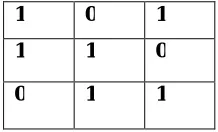
The decoding starts when the received signal identified as binary values 0 and 1 based on the values instead of the sign of the values. The received code words are represents in dimension as they encoded based on dimension d syndrome is calculated for 2Dm codes we calculate parity check operation in x direction and in y direction as in Fig2. Similarly the syndrome calculate for 3Dm codes
1 0 1
1 1 0
0 1 1
Fig: 4 (3,2)2Dm Turbo Product Code
Fig: 4 (3,2)3Dm Turbo Product Code
The syndrome calculation in three dimension like x,y and z. the syndrome for x direction obtained by parity check operation in yz direction and the syndrome for y direction obtain by parity check operation in xz direction simultaneously. Each syndrome in each direction has elementary value. The syndrome values in each direction summed to get the total no of errors.
For 3Dm code the syndrome calculation equation given by
Sm=Sx+Sy+Sz (3)
The hard decision decoding is based on the threshold. Therefore particular threshold chosen for efficient decoding. The threshold values are changes for reliable output based on the number of iterations. The bit flip if the syndrome value is greater than or equal to that threshold value at ith iteration
A .Iterative Bit Flip
The bit flip algorithm is one of simple algorithm to implement .it flips the bit when the condition id satisfied it will done until given iteration is completed . But this algorithm has some disadvantage it neglects channel reliability and flip the bits once the condition is satisfied. Even all bits are correct except parity check bit are it flips the entire symbol which increase the errors. The errors are more at lower SNR values and less no of error at high SNR values. Therefore it degrades the performance of the system. So to overcome this disadvantage and to increase the reliability of decoding we are going for the modified iterative algorithm and increasing the performance of the system
B. Modified iterative Bit Flip algorithm
The modified iterative bit flip algorithm is a weighted bit flip algorithm. In this algorithm instead of flipping all bits once the condition is satisfied it check the particular bit which has error. This can be achieved by using a reliability ratio. The term reliability ratio used to checks weight of each symbol to detect which particular bit is having error.
This paper propose that this algorithm can overcome the problems of bit flip algorithm The reliability term represented by
=β| | | | (4)
n, m represents the rows and columns of parity check operation based on the dimensions Represents the maximum magnitude value from received vectors from all other symbols
∑ : ∈ ( ) =1 (5) The error can be calculated as
=∑ ∈ ( )( ) (6)
is the syndrome calculation is the error check sum calculation,Normalized factor β
ISSN(Online) : 2320-9801
ISSN (Print) : 2320-9798
I
nternational
J
ournal of
I
nnovative
R
esearch in
C
omputer
and
C
ommunication
E
ngineering
(An ISO 3297: 2007 Certified Organization)
Vol. 4, Issue 4, April 2016
flip.Therefore by using the modified iterative bit flip algorithm we can able to make decoding reliable and keeping the same decoder complexity and near to soft decision decoding
V. SIMULATION RESULTS
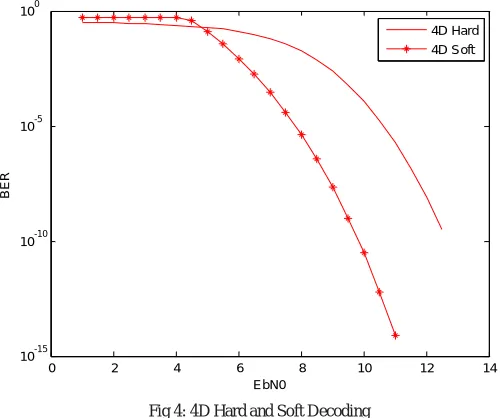
The simulation using matlab software has done. The decoding using multidimensional turbo product codes as follows the 4Dm codes gives the performance at 14dbat BER 10 in fig 4 and similarly the 5D improves the performance at 14db at BER 10 in Fig 5The 4D and 5D codes has undergone 20 and 30 iteration to analyse the correct threshold to improve the performance of the algorithm and it improves the performance as dimensions increases
Fig 4: 4D Hard and Soft Decoding
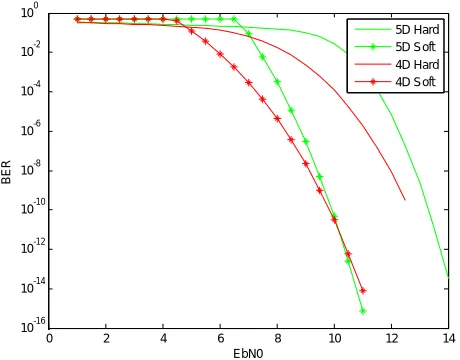
The Fig5 is the performance of 5D turbo product code which is improved Ber performance when compared to a 4D turbo product codes
Fig 5: 5D Hard and Soft Decoding
0 2 4 6 8 10 12 14
10-15 10-10 10-5 100
EbN0
B
E
R
4D Hard 4D Soft
0 2 4 6 8 10 12 14
10-16 10-14 10-12 10-10 10-8 10-6 10-4 10-2 100
EbN0
B
E
R
Hence the performance improved in multidimensional as dimension changes and also achieved the BER performance of soft decision decoding shown in Fig 6
Fig 6: 4D and 5D Hard and Soft Performance
VI. CONCLUSION
In this paper we proposed a new iterative algorithm to overcome the disadvantage of the existing algorithm .The algorithm is applied on the multidimensional turbo product codes to lower the complexity we are using single parity to achieve improved error performance. The hard decision low complexity kept same and also make decoding reliable without completely neglecting likelihood values. The results after simulation gives that the 5Dn codes with 4 bits and 16 level quantization gives the performance improvement in BER Hence we justify the algorithm performance has improved the decoding reliability and has come nearer to the performance to the soft decision decoding. Therefore we conclude the paper
REFERENCES
1. Burr, “Turbo-codes: the ultimate error control codes,” in Electronics & Communication EngineeringJournal, vol. 13, pp. 155–165, IEEE, August 2001. ISSN: 0954-0695.
2. C. Berrou, A.Glaxieux, and P. Thitimajhima, “Near Shannon limiterror-correcting coding and decoding: turbo codes (1),” in IEEE Int Conf.
Communications ICC’93, vol. 2/3, May 1993, pp.1064-1071.
3. P. Elias, “Error-free coding,” IRE Trans. Inform. Theory, vol IT-4, pp. 29-37, Sept. 1954.
4. R. M. Pyndiah, “Near-optimum decoding of product codes: block turbo codes,” IEEE Trans. Commun, vol 46, pp. 1003-1010, Aug 1998.
5. J. Lodge, R. Young, P. Hoeher, and J. Hagenauer, “Separable MAP ”filters” for the de-coding of product and concatenated codes,” in Proc.
IEEE International Conference on Communications, Geneva, Switzerland, May 1993, pp. 1740–1745.
6. J. Hagenauer, E. Offer, and L. Papke, “Iterative decoding of binary block and convolutional codes,” IEEE Trans. Inform. Theory, vol 42, pp.
429-445, Mar 1996.
7. D. M. Rankin and T. A. Gulliver, “Single Parity Check Product Codes”, IEEE Trans, on Commun., vol. 49, no. 8, pp. 1354-1362, August 2001.
8. C.Argon andW.McLaughlin, “An efficient Chase decoder for turbo product codes,” IEEE Trans. Commun., vol. 52, no. 6, pp. 896–898, Jun.
2004
9. L.Ying-Chang X.Changlong, and L.Wing Seng, “A low complexity decoding algorithm for turbo product codes”, IEEE Wireless. Commun.,
vol. 7, no.1, pp. 43-47, Jan. 2008
10. S.Zhiping, Z.Liang, F.Xiang, Y.Yang,HIHO Decoding Algorithms of Turbo Product Codes for High Rate Optical Communications, China
Communications 2012, Vol. 9, pp. 114-123
11. M. Baldi, F. Chiaraluce, G. Cancellieri, “Finite-Precision Analysis of Demappers and Decoders for LDPC-coded M-QAM Systems”, IEEE
Trans. on Broadcasting, Vol. 55, No. 2, pp. 239-250, June 2009
12. M. Hata., High-speed and robust error correcting code for future mobile communications of High-Dimensional Discrete Torus
Knot,International symposium WPMC’01, Aalborg, Denmark, September 2001,
0 2 4 6 8 10 12 14
10-16 10-14 10-12 10-10 10-8 10-6 10-4 10-2 100
EbN0
B
E
R
ISSN(Online) : 2320-9801
ISSN (Print) : 2320-9798
I
nternational
J
ournal of
I
nnovative
R
esearch in
C
omputer
and
C
ommunication
E
ngineering
(An ISO 3297: 2007 Certified Organization)
Vol. 4, Issue 4, April 2016
13. A. J. Al-Dweik, S.L. Goff, B. S.Sharif, A Hybrid Decoder for BlockTurbo Codes, IEEE Transactions on Comm, vol. 57, No. 5, pp. 1229- 1232,
May 2009
14. A. J. Al-Dweik, B. S.Sharif, Non-Sequential Decoding Algorithm for Hard Iterative Turbo Product Codes, IEEE Transactions on Comm,
vol.57, No. 6, pp. 1545-1549, June 2009
15. H. Xu and F. Takawira, “A New Structure of Single Parity Check Product Codes”, IEEE Africon, September 2004
16. D. M. Rankin and T. A. Gulliver, “Single Parity Check Product Codes”, IEEETrans, on Commun., vol. 49, no. 8, pp. 1354-1362, August 2001.
17. M. Rankin, T. A. Gulliver, “Parallel and Serial Concatenated Single Parity Check Product Codes”, EURASIP Journal on Applied Signal