Scholarship at UWindsor
Scholarship at UWindsor
Electronic Theses and Dissertations Theses, Dissertations, and Major Papers
1-1-1986
Development of a method for identifying the processes of contact
Development of a method for identifying the processes of contact
and confluence as defined by Gestalt therapy theory.
and confluence as defined by Gestalt therapy theory.
Terry W. Vallano University of Windsor
Follow this and additional works at: https://scholar.uwindsor.ca/etd
Recommended Citation Recommended Citation
Vallano, Terry W., "Development of a method for identifying the processes of contact and confluence as defined by Gestalt therapy theory." (1986). Electronic Theses and Dissertations. 6148.
https://scholar.uwindsor.ca/etd/6148
Contact and Confluence as Defined by Gestalt Therapy Theory
Terry W. Vallano
M.A. University of Dayton i B.S. University of Pittsburgh
A Dissertation submitted to the Faculty of Graduate Studies
through the Department of Psychology
in Partial Fulfillment of the
Requirements for the Degree
of Doctor of Philosophy at the
University of Windsor
Windsor, Ontario, Canada
INFORMATION TO USERS
The quality of this reproduction is dependent upon the quality of the copy
submitted. Broken or indistinct print, colored or poor quality illustrations
and photographs, print bleed-through, substandard margins, and improper
alignment can adversely affect reproduction.
In the unlikely event that the author did not send a complete manuscript
and there are missing pages, these will be noted. Also, if unauthorized
copyright material had to be removed, a note will indicate the deletion.
UMI Microform D C 53245 Copyright 2009 by ProQuest LLC
All rights reserved. This microform edition is protected against unauthorized copying under Title 17, United States Code.
ProQuest LLC
789 East Eisenhower Parkway P.O. Box 1346
Development of a Method for Identifying the Processed of Contact
and Confluence as Defined by Gestalt Therapy Theory
Terry W. Vallano
The primary purpose of the present study was to establish a means of
observing behaviors that identify contactful and confluent functioning
as defined by Gestalt therapy theorists. In Gestalt therapy, contact
and confluence refer to polar end points along a continuum that
describes how people organize their self-experience in relationship
to their environment. First, partner dyads performed a Gestalt awareness
exercise to obtain videotaped sairples of experiential organization in
an interactional context. Then, Gestalt therapy experts selected
relatively pure segments of contact and confluence frcm these videotaped
sairples. Last, independent raters scored these samples on a form that
described 15 specific behavior categories which had been derived from
literature descriptions of contactful and confluent functioning. These
data were subjected to a series of t-tests to determine whether the
ratings of the 15 specific behavior categories differentiated contact
from confluence. The results of these analyses indicated that only
one of the 15 items, "Interpersonal Risk," significantly differentiated
contactful from confluent functioning. In addition, only the "Interpersonal
Risk" category together with that of "Use of Speech" discriminated
contactful frcm confluent functioning in a discriminant function analysis.
Several factors of possible relevance are cited that may explain
this failure and may facilitate future research. First, there are
indications of the effects of a social desirability rating error.
Second, items that were chosen for the rating scale may not have
been described in adequate detail to enable the raters to discriminate
the subtle behavioral differences between contact and confluence.
There are also questions regarding the determination of adequately
It is very difficult to acknowledge all of the people that have
contributed to this project. So many people in both the United States
and Canada offered their time, technical assistance and moral support
so that this paper could be completed.
First, I'd like to thank ny committee for their perserverance.
Drs. Jim Porter, Frank Schneider, Mary Iou Dietz and Leslie Greenberg
read the manuscript and offered helpful suggestions. Dr. Marv Kaplan,
the chairman of this project, per servered, offering advice and motivating
me to finish writing.
Dr. Netta Kaplan and Ms. Elaine Le son sky offered valuable comments
at the inception of this project and added greatly to the quality of
this dissertation.
This project could not have been completed if I did not have the
willing participation of people frcm Mental Health Services, North
Central and Mental Health Services East in Cincinnati, Chio. I would
like to name them, but I need to protect their confidentiality. I can
thank iry experts in Gestalt therapy, Dr. Catherine Hand, Dr. Harris H alpem
and John Gallaher, M.S.W. Their assistance was invaluable. The raters,
Anne Khoury, M.B.A.; Maty Wright, M.A.; Sylvia Tilton, R.N. and
Mike Pomer gave their time and effort to accurately evaluate the
videotaped sequences.
From a technical standpoint, I was fortunate to receive valuable
statistical assistance from Mr. Reger Steubing, M.S. frcm the University
of Cincinnati. His help was concrete, clear and understandable 1 In
the videotape sequences and edited them for me. She did an excellent,
professional job.
Many of the aforementioned people read and helped me revise earl i pr
drafts of this paper. In addition, Mr. Tom Cblina, M.A. also reviewed
the paper and offered valuable suggestions. Ms. Pat Jury, M.S.W. offered
technical advice and helped in many ways during the entire length of this
project.
The typing of this manuscript was a monumental task. My gratitude
is warmly extended to Ceceila Dickerson, Darlene Tarvin and Barb Vallano
for the hours they devoted to this.
I definitely cannot adequately thank all of ity friends vho lent
moral support to me during this project. Tom Colina, Pat Jury,
Dr. Jude Meyer, Dr. Sharron I lor lick and Dr. /my Katz and my friends
from the American Society for Training and Development are just a few
who were there when I needed them.
Finally, I could not have ccnpleted this project without the support
and understanding of ity family. iy children, Heather, Elizabeth and
Jonathan lived through this trying time in good humor. However, ity
wife Barb, not only typed this paper, but used all of her many psychological
resources to insure that I finished this paper. I dedicate this
dissertation to her for she put in years worth of effort and understanding
that made the completion of this project a reality.
Page
Abstract... IV
Acknowledgements... VI
Table of Contents... VIII
List of Tables... X
Chapter I ... 1
Introduction ... 1
The Focus of the Present Study... 1
Theoretical Background... 4
Organismic self-regulation... 5
Gestalt field emphasis ... 7
Boundary processes... 8
Recent Theoretical Developments: Redefinition of Contact and Confluence... 10
Earlier Definitions of Contact and Confluence . . . . 11
Recent Development of the Constructs of Contact and Confluence... 14
The New Field Perspective... 18
Operationalizing the Oontact-Confluence Continuum . . 22
" Research in Gestalt Therapy Theory... 26
Greenberg's S t u d y ... 27
Lesonsky's Study... 27
Design of the Present S t u d y ... 31
Potential Usefulness of the Present Study... 32
Statement of the Problem and Hypotheses...33
Hypothesis 1 ... 34
Hypothesis 2 ... 34
Chapter II... 35
M e t h o d ... 35
Brief Overview of Phases of S t u d y ...35
Phase 1 ... 35
Phase I I ... 35
Phase III... 35
Experimental Subjects... 36
The dyads... 36
The experts... 36
The raters ... 36
Apparatus...37
Procedure... 37
Phase 1 ... 37
Phase I I ... 39
Phase III... 40
Rationale and Development of the Rating Form... 41
Emphasis on whole person functioning ... 43
Enphasis on exploratory-stable functioning . . . 44
Behaviors included in the rating s c a l e ... 44
Pilot Use of the Rating Form... 49
Data Analysis ... 50
Interrater agreement ... 50
Discriminating contact and confluence... 50
Chapter I I I ... 52
Results... 52
Expert Agreement... 52
Interrater Agreement... 53
Differences Between Contact and Confluence... 56
Order of Videotape Presentation...61
Effect on Ratings of the Subject's Activity Level . . 62
Sunmary of Results... 64
Chapter IV... 66
Discussion...66
Contact and Confluence May Not Be Operational!zable . 66 Examination of Difficulties and Errors in the Method Enployed... 68
The Length of the Videotape Segments. ... 68
Social Desirability Bias. . ...70
The Rating Form ... 72
Obtaining "Pure" Sairples of Contact and Confluence. . 74
Overview of Ifethodological Issues . ... 75
Comparison with Lesonsky's Study... 76
Directions for Future Research... 78
Appendix A Instructions for "Assumptions" Exercise... 80
B Guidelines for Processing the Awareness Exercise. . . 81
C Instructions to the E x p e r t s ... 82
D Verbatim Dialogue of the Dyads... 83
E Instructions to the Raters... 92
F The Rating F o r m ... 93
References... 97
Table Page
1 Percentage of Interrater Agreement on the Variables
Included on the Fating Form... 55
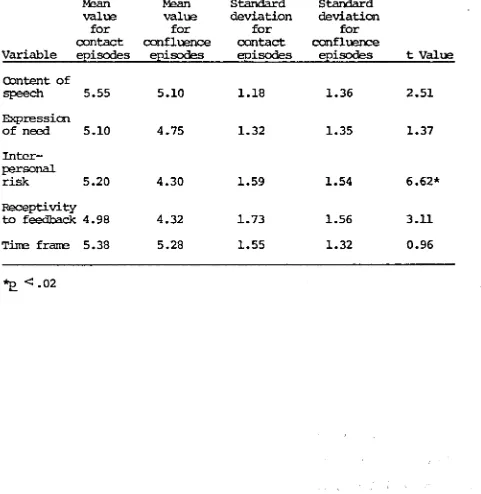
2 *fean Ratings, Standard Deviations and t-test Results
Related to Oorrparisons of Oontactful and Confluent
Episodes... 59
Introduction
The Focus of the Present Study
The purpose of the present study was to establish a means of
identifying observable behaviors that comprise contact and confluence
as described by Gestalt therapy theorists. These constructs define
the end points of a continuum of functioning that describes how a
person is organizing and regulating his or her ongoing experiential
functioning. While contact and confluence have been recognized as
central to Gestalt therapy theory, there have been few research
studies designed to examine these constructs. This is not a natter
of an outstanding omission in the development of Gestalt therapy
theory but rather it is typical of Gestalt therapy literature.
Gestalt therapy theory has not been carefully developed and little
research has been carried out in this area (Dollivar, 1981; Harman,
1984; Simkin, 1978). The lack of emphasis on formal theory and on
systematic research is due, in part, to the fact that Gestalt therapy
theory began as a basis for a therapeutic approach to be used in
clinical practice rather than as a comprehensive theory of personality.
The early Gestaltists were most concerned with developing and
describing new clinical methods and specific techniques rather than
attempting to demonstrate the scientific validity of the concepts which
they were using (Harman, 1984).
Not only have Gestalt therapists been clinically oriented, but
focussing on how people actually go about their experiential functioning.
Concepts and constructs that are used to "explain" human functioning
have been referred to by Gestalt therapists as "inventions" that do not
help in therapy, and attention to theory has been seen as interfering
with focussing attention on actual processes of functioning
(Smith, 1976). Moreover Peris, the principle founder of Gestalt
therapy, was critical of the rigid dogmatism of the established schools
of psychology and he opposed formalizing Gestalt therapy theory (Peris,
1969; Fagan & Shepherd, 1970).
In addition to the considerations posed above, it is possible that
in focussing on the process by which individuals actually function,
the early Gestalt therapy theorists were faced with the very difficult
task of conceptualizing in terms that were conparable to other
theoretical frameworks. VJhile previous psychological theories
focused on why individuals behave as they do, that is on presumed
causes, Peris attenpted to explain how individuals function, focussing
on processes that are active and changing as functioning precedes.
This was a radically new approach for which little precedent existed
in the psychological literature. Peris and his colleagues appear not
to have found existing scientific models that could be used to clearly,
consistently and systematically describe their radically new approach
to human behavior (Kaplan & Kaplan, 1986).
terms rather than in terms that would lend themselves to operational
definition and systematic study. These constructs are derived frcm
an underlying theoretical conception about how people are continually
engaging in a process of experiential self-organization. However,
in Gestalt literature they generally are used to refer to what is
occurring in a therapy session from the perspective of a therapist's
observations. For exaitple, the term contact is applied when people are
noted to be aware of their feelings, whereas confluence is used as a
general description of a process that is occurring when individuals
are not aware of their feelings. In addition, contact and confluence
are used by therapists to refer to different ways in which individuals
"reach" or "engage" their environments (Stephenson, 1975). Contactful
functioning refers to the individual functioning as recognizing the
environment relatively "clearly.'" Confluent functioning refers to a
blurring of the distinction between the individual's self-experience
and what the person attributes to the environment. Gestalt therapy
practitioners advocate that individuals focus more directly on
appreciating immediate concrete experiences in order to sharpen
distinctions between self and environment. In the present study
consideration is given to the theory in general, but the main focus
is on specifying and examining these central constructs of contact
Gestalt is a German word that has no direct English equivalent
but means a unique and whole configuration. Whereas the term was chosen
to describe a key aspect of human experience, it also seems remarkably
appropriate in describing the theory lit self as a new integration.
As noted earlier, the person who is recognized as the founder and
primary developer of Gestalt therapy theory and practice is Fritz Peris
( Latner, 1973; Zinker, 1977). Peris proposed a new perspective
that made use of and went beyond earlier theoretical approaches.
Gestalt therapy utilizes aspects of psychoanalysis, Beichian analysis,
existentialism, Gestalt psychology and Eastern philosophy. While all
of these perspectives influenced Peris, he did not merely combine
various elements from them. Instead, he used coirponents from each to
create a new and conprehensive psychological theory.
Summarizing Gestalt therapy's perspective, Smith (1976) described
the primary tenets as follows: (1) a focus on present functioning
rather than on the past or future, (2) a focus on what is concretely
expressed rather than what is conceptualized, (3) a focus on immediate
experience as opposed to talking about or discussing abstract references
to feelings^ and (4) a focus on the client taking responsibility for
his or her feelings, thoughts and behaviors. The focus on experiencing
in the present and taking full responsibility for ones thoughts,
beliefs and behaviors underlies the Gestalt eirphasis on the importance
their ongoing fmotioning.
Peris emphasized the importance of awareness as central to "change
and growth" (e.g., Peris, Hefferline & Goodman, 1951; Passons, 1975).
Awareness is attained and enhanced through focussing attention on present
functioning, especially with respect to how the individual recognizes how
he or she disregards or avoids recognition., of ongoing experience that
is aroused and unsatisfied (Peris, 1947). For example, a man must
first became aware of the sensation of his thirst and then he must
consider what is avMlable to him in the environment (e.g., water) in
order to satisfy this need. This basic formulation is extended to
functioning in general: a person's awareness of his or her needs is
seen as the critical variable in how he or she recognizes and acts on
meeting physical and psychological needs and fulfilling them in the
context of possibilities available in the environment.
In order to fully appreciate the importance of awareness in
Gestalt therapy theory, it is necessary to examine the concepts of
organismic self-regulation, field emphasis, and boundary processes.
Each of these concepts may be appreciated as describing awareness in
terms of its contextual functions. These concepts will also be
described in order to show how contact and confluence are derived from
basic Gestalt therapy theory.
Organismic self-regulation. Peris noted that the functioning of
Gestalt psychology principle that a strong "gestalt” has a greater
tendency to closure and stability than a weak one. That is, a
perceptual configuration varies in the quality of it's clarity and
cohesiveness. This idea became incorporated into his principle of
organismic self-regulation. Organismic self-regulation refers to
the assumption that the individual is continuously striving to attain
an equilibrium. The equilibrium is disturbed by the arousal of needs
and regained through their elimination or gratification (Peris, 1947).
The concept of organismic self-regulation was specifically adapted from
Gestalt psychology's "Law of Praegnanz" which states that individuals
maintain "the goal-directed tendency to restore cognitive equilibrium
after a disequilibrium has occurred in the perceptual field" (Smith,
1976, p. 26). For Peris, "cognitive" is broadened to "experiential;”
rather than referring only to the perceptual field, he assumes that
the disequilibrium is one of whole or organismic functioning.
However, the process of organismic self-regulation does not assume
that need satisfaction is guaranteed. Although individuals regulate
themselves in order to fulfill needs, they limit themselves by their own
restrictive ways of functioning as well as being limited by the
resources available to them in the environment. The premise underlying
the principle of organismic self-regulation, as this principle was
labelled, is the notion that individuals are capable of adaptive
functioning, they create and maintain maladaptive behavior. In order
to illustrate how self-regulation influences adaptive functioning,
Latner (1973) provides the following example:
....In the course of his maturation, a tall boy may learn to
stoop his back and shoulders to avoid humiliation and embarassment.
His perception is that his environment will not support him if
he stands up to his full height. His posture, of course, is poor,
but given what he feels are the circumstances, it is the best
that can be managed. Organismic self-regulation does not
ensure health, only that the organism does all it can with
what is available (p. 19).
Gestalt field enphasis. The Gestalt psychologists had referred
to a field to describe the manner in which the individual is continually
functioning in relationship to the environment (Smith, 1976). That is,
self-regulation occurs in relationship to the environment and its
possibilities as they are recognized in a se If-referential manner. Peris
and the other Gestalt therapists followed this view but emphasized the
ongoing fluctuating character of the' field. In this formulation,
experiential processes and corresponding behavior are viewed as functions
of a currently existing field which is defined as "the totality of the
co-existing, mutually inderdependent factors of the person and the
environment at the moment of the behavior" (Smith, 1976, p. 26).
recognized "parts" of experience are actually eirbedded in the whole.
Moreover, the field concept refers to the unity of the organism and
the environment. "...Qrjhe relationship between the organism and its
environment is a critical one. The organism and the environment
comprise an interdependent unity in which the organism is striving to
regulate itself... .The organism is embedded in the environment, as
much a part of it as a spoke is to a wheel" (Latner, 1973, pp. 19-20).
In essence, the field position as developed in Gestalt therapy, states that
the environmental possibilities are always considered by the individuals
from within their self-referential perspective as they are in a process
of organismic self-regulation. To take the example of a man who is thirsty,
he will have some perspective of the opportunities open (to him) to
satisfy the sensation of thirst (e.g., water, juice, etc.) in order to
fulfill his need to quench his thirst. In an interpersonal context,
individuals "see" and "hear" the functioning of other people frcm
within their current ongoing experiential functioning. They recognize
(or fail to recognize) possibilities for need satisfaction depending on
how they "read" the environment. Circularly, they "read" the
environment in terms of how they cue responding to their current "sense"
of what the environment will "allow""
Boundary processes. The field has been defined as the relationship
between the organism and the environment and special attention is focussed on
attention is directed to hew a person distinguishes what emerges as self
experience and what is recognized as "out there." The process of
creating and recognizing this distinction is referred to as a boundary
process. Gestalt therapy's emphasis on boundary processes is partly
derived from Buber's existential notions of I-thou and I-it
relationships. According to Buber, in the I-it relationship, at least
one of the individuals is treated as if he or she were an object, and
the relationship is characterized by unilateral decision making. By
contrast, the I-thou relationship is marked by mutual cooperation and
the co-existence of two individuals in a reciprocal dialogue (Smith,
1976).
The early Gestalt therapy theorists expanded on Buber's I-thou
and I-it concepts to create the "I-boundary." The I-boundary refers
to behaviors, feelings and thoughts that an individual distinguishes
as his or her personal point of reference as discrete from characteristics
that are enmeshed in and embedded in a process of global attribution
to another person. Pols ter and Polster (1973) described boundary
processes as the experience of the "one" in relation to that which
is "not one." The boundary (or I-boundary) determines the ideas,
values, behaviors, etc. in which an individual might fully engage
" ... with both the world outside himself and the reverberations within
himself that this engagement may awaken" (Polster & Polster, 1973, p. 108).
one's choice of friends, work, geography, fantasy, lovemaking, and
all of the other experiences with are psychologically relevant to
his existence" (Polster & Polster, 1973, p. 9) . The boundary process
represents what ideas, behaviors and values an individual will and
will not recognize as he or she functions. How individuals recognize
their environments and the choices that they make in order to fulfill
their needs will depend upon the flexibility or rigidity of their
boundaries.
Recent Theoretical Developments: Redefinition of QdritaCt and Confluence
It is important to note that the ideas that have been described
represent an approach to or perspective of human functioning but they
had not been formulated in a carefully developed, formalized theory of
Gestalt therapy. As the literature on Gestalt therapy theory has grown,
Gestalt theorists have focussed on certain assumptions that are offered
as general principles. The primary focus of much of the writing in
the area of Gestalt therapy concerns the development of clinical
application (Simkin, 1970). In describing therapy as an applied
approach, Gestalt theorists have written very little about their basic
theoretical position or how a particular technique is supported by
theory. It seems correct' to say thdt Gestaltists have not been
inclined to engage such issues as consistency, comprehensiveness, and
the validity of the premises that are employed.
Recently, writers such as the Kaplans (Kaplan, et al., 1985; Kaplan &
therapy theory in an attempt to find a consistent theoretical base for
the theory. Since the purpose of the present study was to operationalize
the Gestalt therapy constructs of contact and confluence, it is important
to examine recent theoretical advances in the theory that may lead to
clearer and more discriminating ways of operationalizing these constructs.
Cne of the theoretical problems that emerges out of Gestalt
therapy's formulations is how organismic self-regulation, field process,
and boundary functioning can be brought together in an integrated
framework. According to the theory, the organism is continually active
and all aspects of its functioning are simultaneously active. However,
Gestalt therapy theorists apparently have been unable to conceptualize
a framework that would describe an ongoing "whole" of activity in which
these various functions are embedded. The difficulty is of critical
concern in terms of an attempt to define the processes that are involved
in ongoing human functioning.
Earlier Definitions of Contact and Confluence
Earlier Gestalt therapy theorists have 'defined contact and
confluence in various descriptive ways. Peris, et al. (1951)
described contact as the forming of a figure of interest
against the context of the organism/environmental field. Contact is
viewed as a recognition that is clear and vivid; there is a clear image,
or insight, and motor behavior that is described as rhythmic, energetic
and graceful (Peris, et al., 1951, p. 231).
from increased self-awareness. The following statement illustrates
this kind of definition of contact: "In all contacting, there is an
underlying unity of perceptual, motor, and feeling functions: there
is no grace, vigor, dexterity or movement without orientation and
interest; no keen sight without focussing; no feeling of attraction
without reaching, etc." (Peris, et al., 1951, p. 417).
Contact is described as involving both a "...sense of one's self...",
and also the sense of whatever "...looms at the contact boundary..." or even
"...merges into it. Customary rules are out, and artful decisions become
a necessity..." (Peris, et al., 1951, p. 103). Contact has also been
described as a dynamic relationship that occurs at the boundaries of
two clearly differentiated figures of interest (Polster & Polster,
1973) . Contact is characterized by mutual respect of opinions and
tastes. Disagreements are seen as exciting possibilities for increased
awareness (Peris, et al., 1951).
Confluence, on the other hand, has been described as a lack of
recognized differentiation between people. When there is not a clear
sense of self and others, there is only a vague development of the
figure/ground relationship, relatively little awareness, minimal
excitement and therefore, minimal contact (Peris, et al., 1951). In
the words of these authors:
Persons who live in unhealthy confluence with one another do not
have personal contact. This, of course, is a common blight of
cannot conceive of any but the most momentary difference of
opinion or attitude. If a discrepancy in their views becomes
manifest, they cannot work it out to a point of reaching genuine
agreement or else agreeing to disagree. No, they must either
restore the disturbed confluence by whatever means they can or
else flee into isolation (Peris, et al., 1951, p. 121).
Sulking, withdrawing, being offended or becoming hostile are ways
in which individuals can act out confluence. In confluence, the person
attempts to adjust himself or herself to the other person or attempts
to have the other person change. In the former situation, the person becomes
a "Yes-man" who needs proof of his total acceptance. In the latter
case, the individual becomes a "bully" who attempts to get the other
person to bend to his will (Peris, et al., 1951).
Thus, confluent relationships are typified by feelings of guilt
and resentment. These feelings can increase confluence by leading
others to try to avoid guilt and resentment by excessively trying to
please others (Polster & Polster,1973). If an individual sees himself
or herself as capable, he or she will perceive environmental opportunities
that wall maintain his or her perception of himself or herself as a
capable individual. An individual who sees himself or herself as
capable will perceive the environment as being more amenable to change.
Frcm these descriptions, it appears that Peris and his colleagues have
a "sense" of what they are referring to and they try to convey their
impressions in emphatic and colorful language (Peris, et al., 1951).
operations.
Recent Development of the Constructs of Contact and Confluence
Is the difficulty in arriving at a clear, concise definition of
specific processes due only to the neglect by Gestaltists of engaging in
concise theorizing? A rather different possibility is offered by recent
theorists who suggest that there is something about the theory itself
that has contributed to this problem. Kaplan and Kaplan (1982; 1985)
suggest that Gestalt therapists have found it difficult to conceptualize
ongoing holistic organizational processes that are continually changing
yet maintaining organizational integrity. These writers have suggested
that an ongoing process perspective reflects the radical nature of
Gestalt therapy theory and implies a non-linear basis. As used in this
context, the term non-linear is used to describe functioning in non-cause
and effect terms and in language that describes processes that are
simultaneously and mutually interactive (Kaplan & Kaplan, 1985). According
to this conceptualization, the usual linear constructs that other theories
offer do not apply to Gestalt therapy.
Research involving linear constructs calls for the observation of
discrete "events" and evidence of a class of such events is taken as
evidence of a corresponding causal agent within persons. In a non-linear
theoretical perspective this kind of "event" specification is not possible
and thus it is not possible to describe the kinds of "operations" that
define such a class.
in a clear and testable manner when their non-linear basis is recognized,
that is, when the process basis of the concepts are operationalised. They
have suggested that an organizational whole can be understood to be
functioning as a self-maintaining systemic whole that is continually
relating self-referentially to its environment (Kaplan & Kaplan, 1985). In
this perspective, a person is seen as existing as an ongoing and continually
changing experiential organizational process that is continually regulating
itself. Hence, the ongoing process of functioning is self-referential
as well as self-maintaining (Kaplan & Kaplan, 1985).
This perspective may be seen as applying to how individuals perceive
and relate to other people. People perceive themselves, each other,
and the field, self-ref erentially, that is frcm within their own
current self-organization. For exaxiple, if a man observes his wife from
his own organizational process of "anger" he is unable to see that his
wife has a "hurt" expression on her face (an aspect of the field) as
he talks with her. This current boundary of the man's awareness could
be "expanded" if the man were able at this moment to perceive that the
look on his wife's face also included "hurt" (Kaplan & Kaplan, 1982).
Using this method of defining constructs in terms of ongoing
holistic activity, the principles of organismic self-regulation and
boundary processes of awareness can be seen as defining how the whole
of functioning is currently organized. Frcm an organization of the
whole perspective, Kaplan & Kaplan (1982) derive various aspects of
a process of mutual discovery and active exploration of experience.
Hie contact process involves taking risks when encountering new
experiences. Confluent functioning, on the other hand, is exemplified
when individuals see or hear others in terms of familiar, a priori,
expected, restricted formulations.
Contactful and confluent functioning can be seen as defining a
range or continuum of an organizational process. Cue end of this
dimension (defined as contact) describes functioning that is
characterized by recognition, discovery, exploration, and change as
a person functions in a flexible and optimally adaptive manner. The
other end (defined as confluent) is exemplified by functioning that is
restrictive and rigid as a person functions within a relatively narrow
framework of self-organization (Kaplan & Kaplan, 1982). In an
interactive context, when one individual is functioning confluently,
he or she acts on the field in a manner that "supports" confluent
functioning in the other individual. Likewise, if an individual
interacts with another by taking risks or exploring ideas, his or her
functioning supports contactful field processes in the other individual
(Kaplan & Kaplan, 1982). The following example illustrates a confluent
interaction:
The husband momentarily turns aside, his body seems to sag
and his face takes on a sad look. A moment later he straightens
up, his face now takes on a 'hard' look, and he resunes rebuttal
The wife's eyes moisten in a way that appears to express
sadness but the husband does not notice, or if he does, he sees
her 'glaring' at him. She herself does not seem to be attentive
to her own sadness as she quickly retorts to her husband (Kaplan,
Kaplan & Serok, 1985, p. 691).
In this example, the husband and wife relate to each other in ways
that appear narrow and restricted. The husband perhaps never noticed
that the wife's eyes moistened as the couple is engaged in a pattern
in which each person "sees" and "hears" from within his or her own
ongoing processes of experiential organization. Thus, the husband and
wife are interacting in a mutually supportive, self-maintaining manner.
They do not take the risk of seeking possibilities for changing their
relationship and so they mutually maintain their ongoing confluent
functioning.
(Contrast the above with the following example of contactful
functioning:
Two friends meet, exchange greetings, and begin to chat in a
casual manner. At one point, one friend looks at his colleague
and notices a worried, haggard look. He feels inclined to act
as if he has not made this observation. After all, his friend
has said that he is well and has not provided an opening for
such a personal observation. However, he tells himself that
this is a good friend, one whom he is concerned about. He
low. Is everything o.k.?' His friend scans taken aback,
hesitates, and seems about to deny any problem but seeing his
friend's concerned look he sighs and says, 'I guess I am upset
and worried,1 and then proceeds to confide in his friend (Kaplan,
et al., 1985, p. 691).
In this example, one participant can be described as venturing to
"risk" and simultaneously providing his colleague with the support
necessary for him to take a "risk" and to confide. Thus, contact
refers to any interactive process in which the participants function
in an exploratory manner, in which they are "open" to each other, and
where they move progressively toward a willingness to explore
unrecognized or unexpressed thoughts and feelings. Contact is
characterized by a recognizing and "letting go" of previously held
assumptions through the appreciation of one's own active participation
in creating one's personal experience, thoughts, feelings and behaviors.
The New Field Perspective
As indicated above the more recent Gestalt theorists have begun to
focus on the ongoing whole of the organization of experience process.
In this framework a person's process of regulating experience is
simultaneously one of self-organization and of relationship of self
to context. That is, the ongoing manner in which each person is
regulating himself or herself also involves the degree of contactful
or confluent functioning that occurs in the interaction. In this view,
process. As the holistic organizational process shifts so do contact
and confluence. The experience that two (or more) individuals have
during an interaction is seen as continually changing as the interaction
progresses so that the individuals can, for example, be contactful at
one moment and confluent at the next moment in a mutually interdependent
manner (Kaplan & Kaplan,1986).
This perspective develops the field concept somewhat more broadly
then previously. Earlier Gestalt thinkers, such as Peris, formulated
the field in terms of how each individual was functioning as an
individual. He or she was recognized as relating to his or her
environment but there was no allowance for a mutual process in which
two (or more) people could have an ongoing mutual effect on one another.
One difficulty with this limited perspective was the Gestaltists did
not develop the field concept as relevant to group or family therapy.
As the Kaplans point out (Kaplan & Kaplan, 1982, 1978? Kaplan, 1978),
various applications of Gestalt techniques to family and group therapies
came about but no method was developed that used the field concept directly
as an ongoing process perspective.
This more recent view of a field as involving mutual processes
has been described by Kaplan. & Kaplan (1982) as resting on systems
theory. A system can be described as a relationship that is continually
changing so that the whole is different at different points in time
yet retains its holistic, organized quality. The whole maintains its
process entity (Keeney, 1979; Dell, 1982; Leupnitz & Tulkin, 1980) .
Using a systems approach, the following example describes how experiential
functioning is viewed as a process that is actively engaged in :«
interactional functioning in the immediate environmental context (based
on Kaplan & Kaplan, 1982):
As her husband sits quietly by, a mother speaks to her teen-age
daughter in a wary probing manner and the girl "bristles" at what
she perceives to be her mother's insinuations about her behavior.
"Something" is occurring between these two that they experience
as familiar. We can say that each restrict!vely "sees" the
other (projects) and also that each experiences herself
restrictively (introjects) and these restrictions mutually
maintain an immediate "stuckness" in their current relationship.
However, in a field view, this activity is understood as embedded
in a broader context. Mother's self-organization is at this
moment embedded in the field and may include how she "sees" her
husband as subtly supportive of the girl's resentment. Mother
experiences herself in a field in which she feels isolated and
in which she has no support for recognizing her aloneness and
her vulnerability. The family members' functioning may be
portrayed as their clinging to current field supports. Each
participant perceives from within his or her immediate
self-organization, and that organization is currently embedded
The support processes of the field are seen here as iraintaining
an immediate, tenporary stability among the participants. At any
other point in time the family described here may be supporting a
different field organization. While the family appeared to be
functioning in a stable manner in this illustration, they later
appeared to be organized differently (i.e., with greater closeness,
warmth, and caring) . A field has a contenporary stability. It can
change its organizational character from a restrictive format to a
less restrictive one (or frcm a more flexible to a more restrictive
process). To the extent that the field is organized restrictively
at any moment, it supports the participants in maintaining their
restrictiveness and each individual is supported in maintaining a
"split or non-integration" of functioning that is embedded in how
the field is organized at the particular moment (Kaplan & Kaplan, 1982).
This view of a holistic process of experiential organization opens
the way for observing how the "whole of a person functions as embedded
in the irrmediate environmental whole, the context referred to by Peris
as the field" (Kaplan & Kaplan, 1982, p. 79). When restricted
functioning occurs in the field, it is supported by restricted
functioning among the individuals involved: "Fran an individual
perspective these stability seeking processes may be recognized as
the "manipulations of an individual;'' in the field context these processes
are recognized as mutual support processes embedded in the field" (Kaplan,&
Operationalizing the Qcntact-Oonfluence Oontinuum
As has been noted, earlier descriptions of Gestalt therapy fell
short of a formalized, ccrrprehensive theory of human functioning. An
analogy that seems appropriate are the maps that vfe re produced by early
explorers of a new land. These maps often show a loose collection of
specific areas that have been discovered, but they are incompletely or
inaccurately connected to other areas. In the earlier Gestalt therapy
writings, the major components of organismic regulation, field processes,
and boundary functioning were recognized, but the core of the theory
that would provide a cohesive framework for these constructs had not been
adequately developed. As noted above, some later developments have
provided aieans of integration. Kaplan. & Kaplan (1982, 1985) have added
an organization of experience construct that they suggest allows the
Gestalt perspective to be viewed as a comprehensive, holistic framework.
In this development, the constructs of contact and confluence
are viewed as not merely one or another way that the person functions
and relates to his or her environment, but as expressing how an ongoing
holistic organizational process is functioning. Thus, contact and
confluence describe a dimension that reflects the quality of functioning
in which a person engages as he or she maintains an ongoing process
of experiential organization. This process is described as functioning
holistically so that contact and confluence are reflected in all aspects
of ongoing functioning. Since the present study focussed on attempting
new theoretical developments have on these constructs will be examined.
Rather than addressing specific clinical or phenomenological
concerns in what may be described as a piecemeal basis, the dimension
of contact/confluence can be developed in terms of a comprehensive
perspective of organizational processes. This perspective can be
sutmarized as follows (derived from Kaplan, et al., 1985):
a. A whole of experience is continually being organized. The
organism is organizing and regulating itself as it knows how.
These processes may be described as being organized along a
range of familiar and known format to unfamiliar and novel
constructions. At the confluent end the person uses highly
familiar modes while at the contactful end the person is engaged
in relatively creative organizational processes.
b. The familiar/novel dimension represents a risk quality. As
the organism functions along familiar, known paths, it clings
to experiences that are predictable and anticipated as safe.
While as exploration proceeds along unknown paths of organization,
the organism is functioning in a risking manner.
c. Ongoing functioning is being self-regulated. Functioning
in terms of familiarity and low risk, people are relatively
unaware of how they are actively creating their ongoing
functioning (confluence). They can be increasingly aware of
their own processes as they recognize their own active
d. Self-recognition involves assunption of responsibility. With
greater self-recognition for their active role in how they
function, people assume a greater sense of self-responsibility
and "owning" of self-experience (contact) but with less
awareness there is a lesser degree of self-responsibility and
less "owning" (confluence).
These formulations of contact and confluence are more fully and
comprehensively developed than the earlier descriptions provided by
Peris, et al. (1951). Contact and confluence are seen as terminal
points of a more basic organizational dimension whose specific attributes
have been developed and clarified. The refining of the more specific
attributes is an important and necessary precondition for operationalizing
these processes.
In surrmary, earlier Gestalt therapists describe contact as a process
not unlike awareness. Contact is defined as the ability to focus
attention on what is happening at any given moment. Early Gestalt
therapy writers discussed contact as a basic boundary process between
figure and ground (Peris, et al., 1951; Kaplan & Kaplan, 1985).
Confluence, on the other hand, seems to be defined as the lack of
self-awareness about what is occurring at any given moment in time
(Peris, et al., 1951).
More recent Gestalt therapy theorists (eg., Kaplan & Kaplan,
1985; Lesonsky, et al., 1985) would not reject the way the
recent theorists define these concepts in a more encompassing framework
that involves an organization of experience perspective. Thus, contact
refers to the process of how a person is functioning as an organization
of experience process and is simultaneously involved in active
engagement with the environment. This perspective involves an
examination and exploration of experiential boundaries. Contact is
thus seen as a mode of self organization that allows recognition of
how one is organizing and how one is attenpting to reorganize his or
her experiential boundaries (Kaplan, et al., 1985). Confluence is then
seen as functioning in which individuals organize their experience of
themselves by resorting to their familiar assumptions or formulations
about themselves "...rather than by engaging in a process of exploration
and discovery at the moment of relating" (Kaplan, et al., 1985, p. 689).
Both earlier and more recent Gestaltists describe contact and
confluence as opposing processes on an experience continuum. Also,
both earlier and later emphasize the "here and now", immediate present
of the contact experience as opposed to the more routinized, low energy
associated with confluence. Later Gestalt therapy theorists differ
from earlier Gestaltists in describing how a person "is both experiencing
and creating self-experience" (Lesonsky, et al., 1985, p. 42). Early
Gestaltists described contact in terms of an individual being aware
whereas later Gestaltists define contactful functioning as how the
individual is ".. .organising self as the active experiencer of ongoing
Noting the difficulty that earlier Gestalt therapy theorists had
in identifying the nonlinear basis of their theory, we find
that later Gestaltists were able to expand upon the earlier definitions
of contact and confluence. In essence, later Gestaltists accepted the
basic (early) Gestalt tenets, of holism, importance of iirmediate
experience, etc., but provided a more carplete (nonlinear) theoretical
support for how these processes occur (and how individuals organize
their experience).
Research in Gestalt Therapy Theory
We have indicated that the early Gestaltists largely neglected
the formulations of the essential conceptual foundations of their
theory as they focussed on the application of new therapy techniques
(From, 1984). For reasons described earlier, this focus did not
situmulate a great deal of research in the field. Harman (1984)
recently reviewed the literature on Gestalt therapy research and found
that tie published articles fell into five categories: (1) the effect
of Gestalt "marathons"; (2) an analysis of the "Gloria" film; (3) outcome
studies comparing Gestalt therapy with other therapies; (4) doctoral
dissertations; and (5) an analysis of specific Gestalt therapy techniques *
Harman's evaluation of this range of research is rather pessimistic.
He suggests that little of it actually examines or tests Gestalt ideas.
He focussed attention on the last category that involves research
designed to study specific Gestalt therapy techniques, such as the
Greenberg (1983) and Greenberg and Rice (1981) found that the
two-chair technique was a valuable Gestalt technique for clients, leading
to a greater depth of experiencing and greater conflict resolution.
These studies examined the specific technique and in pursuing this goal
they developed a means of observing ongoing functioning from an
experiential perspective. Although this area of research does not
directly explore the nature of the constructs and processes that Gestalt
therapy assumes, the methodologies that are involved do begin to address
this concern. Greenberg (1983) and Greenberg and Rice (1981) translated
earlier methods of measuring experiential processes into the kinds of
observations that Gestalt thinking would presumably make. For exarrple,
the study by Rice :, et al. (1979) developed the Client Vocal Quality
Classification System as a process instrument that examines aspects of
interpersonal interactions such as perceived energy (which includes volume
of speech), accent (which examines pitch), and terminal contours (which
focuses on vocal energy). Greenberg's research used this classification
system as a means of focussing on the way in which individual experiential
x. processes proceed as opposed to how the content of what is expressed
is studied.
Lesonsky's Study
Lesonsky, influenced by Kaplan & Kaplan's (1982) descriptions of
boundary processes. This section discusses Lesonsky's research as it
was described in her masters thesis (Lesonsky, 1983) and in a later
publication (Lesonsky, Kaplan, & Kaplan, 1986). The goal of Lesonsky's
research was to develop a boundary process scale that would examine
moment-to-rtarent shifts in functioning that could be classified along a
five point scale of the contact-confluence continuum. Because
Lesonsky's work is an important precursor to the present study, her
vrork will be examined in detail.
Following the theoretical developments put forward by the Kaplans
(1982, 1985), Lesonsky specified specific qualities of functioning along
a contact/confluence continuum. In developing a rating method, Lesonsky
used the method of measuring ongoing experiential functioning as
developed by Greenberg (1983), but she specifically adapted this approach
to capture the nature of experiential processes as defined by the
organization of experience perspective developed by the Kaplans.
Lesonsky divided the contact-confluence continuum into five sub-categories,
i.e., contact, seeking, tentative, stable, and confluent, and described
the behaviors defining each shb-category. Each of these five categories
was described in detail in terms of the following qualities: how people
organize their experience (e.g., whether they are willing or not to
own their experience); the expressive style of speech (e.g., rapid
versus slower speech); and the language useage (e.g., vague and distant
In order to generate sanples of verbal expressive data, 20 couples
performed an interactional Gestalt awareness exercise which was recorded
on audio-tape. After performing the exercised/ the couples ware given
questions to answer about the exercises. The ensuing answers and
discussion about the exercises ware also audio recorded, and this
sairple of interpersonal communication constituted the data that raters
rated. Four trained raters then classified each unit or segment of the
recorded conversations into one of the five points along the
contact-conf luence continuum.
In general, the results of the study supported Lesonsky's
hypothesis that contact and confluence can be defined clearly enough
so that independent raters can agree in classifying vocal behavior.
However, Lesonsky noted that her results were hampered by the lack of
"spread" in the ratings. That is, the observed ratings ware heavily
skewed, showing a preponderance of confluent interactions. The
intermediate ratings as well as the contact category were not uniformly
represented. In addition, the relatively low incidence of contactful
activity may have been partially a function of the limited information
available on the audio-tapes (i.e., the inability to observe non-vocal
behavior such as body language, eye contact, etc.). Lesonsky also noted
that her subjects may have lacked motivation to express themselves in
at least showed promise that such urinary Gestalt concepts as
contact and confluence can be operationalized (Lesonsky, et al.,
1986).
This research has important ramifications for Gestalt therapy
theory* The research represented the first attempt to operationalize
and systematically test a Gestalt therapy construct. Lesonsky was
able to define and describe contact and confluence adequately so that
trained raters were able to reliably evaluate verbal and vocal behavior
and classify it according to the categories that she described. However,
it is important to note that while Lesonsky's study provided evidence
for contact and confluence, her results were limited in several ways.
Lesonsky used a priori definitions of contact and confluence and
trained raters to evaluate verbal and vocal behavior based upon five
pre-defined points along the contact-conf luence continuum. There are
two major drawbacks in this approach. First, the ratings were made
only on the basis of information available on audio-tapes: the
information available to raters did not include non-vocal aspects
of functioning that are also considered to be part of a person's holistic
process. Second, there is the possibility that Lesonsky trained her
raters to apply her definitions of contact and confluence. Thus, even
though her raters were able to achieve reliability in using the five
categories, there is a question as to whether they were actually
classifying valid instances of contactful and confluent functioning.
arrive at consensually valid sanples of contactful and confluent
functioning and then to subject these to a broader analysis involving
video as well as audio information.
Design of the Present Study
Hie major purpose of the present study was to operationalize and
test the Gestalt therapy constructs of contact and confluence. The
present study was designed to move beyond the work of Lesonsky by
developing relatively "pure" sanples of oontactful and confluent
functioning. Once these sanples were selected the objective was to
have independent raters identify the attributes of each mode of
functioning. To arrive at "pure" sanples, expert Gestalt therapists
were asked to agree on actual examples of contactful and confluent
functioning that raters subsequently evaluated.
The present study enployed a method of using video data as well
as audio data. Videotaped segments of people interacting were
obtained so that both auditory and visual information would be
available in discerning the attributes of contactful and confluent
functioning. Furthermore, in the present study contact and confluence
were examined sinply as dichotomous, bipolar constructs rather than
on the basis of the five-point scale described by Lesonsky (1983). The
results of Lesonsky's work suggests that her procedure did not
produce an adequate method of discriminating contact and confluence
throughout the proposed five-point range. Therefore, it was assumed
the end points of contact and confluence before attempting to identify
other possible positions along the continuum.
Potential Usefulness of the Present Study
The present study bears on some important theoretical issues and
also has relevance to issues of immediate practical importance. Fran
a theoretical perspective it is important to determine whether
experiential processes exist as directly observable phenomena. The
underlying issue is whether experience exists as a primary hurten process.
That is, do experiential processes actually exist, or is experience a
secondary, derived, epi-phenomenon? Gestalt therapy theory appears to
stand apart from other theories of human functioning in postulating
that the actual process of human functioning takes place at an experiential
level (Kaplan & Kaplan, 1985). That is, organizational processes function
in terms of hew a person experiences rather than in terms of the kinds of
discrete or specific functions that are generally observed. Evidence of
the existence of such experiential processes would encourage further
development of a non-linear view of human functioning as a valid
theoretical direction and would support Gestalt therapy theory in
particular.
The study also has relevance to diagnostic and training
procedures in the application of psychotherapy. In both diagnosis
and training, one of the greatest difficulties is that the generally
accepted concepts and methods are directed toward formulations based
of functioning. The theoretical formulations in carrmon use lend
themselves to gathering information and discovering how a great deal
of minutiae fit together to form the general "contours" of what is
to be observed and dealt with in psychotherapy (Kaplan & Kaplan, 1985).
There are no models or concepts that facilitate therapists in observing
"what is happening" in an immediate experiential sense even though
experienced diagnosticians and trainers report that this is the basis
of their actual work (Strupp, 1957). The validation of constructs
such as contact and confluence would support further work in this area,
and the scale being used in the present research might be further
developed for use in diagnostic and training methods.
Statement of the Problem and Hypotheses
The neglect of the empirical validation of Gestalt therapy constructs
in favor of developing therapy techniques has been a major problem in
the acceptance and utilization of Gestalt therapy theory. Gestalt
constructs such as contact and confluence have been described extensively
but there have been very few attempts to fomally specify and operationalize
these concepts. , The present research was undertaken in order to develop
a method for operationalizing the Gestalt therapy constructs of contact
and confluence which will lead to the further delineation of the
observable elements that comprise these processes.
This research is based upon the assumption that contact and
confluence exist as discrete and distinguishable phenomena, that is
are either followers of or at least well acquainted with Gestalt therapy.
Thus, it is assumed that experts in Gestalt therapy will arrive at
consensual agreement with respect to which segments of behavior exemplify
relatively clear sanples of contact and confluence.
The first hypothesis emerges out of this premise. Raters using
an appropriately derived rating scale, will rate the sanples that
experts have agreed on in a differentiated manner. That is, the
constructs of contact and confluence will be rated in a reliable
manner by the raters.
Hypothesis 1 ; Independent raters will agree on behavior
descriptions that apply to contact and those that apply to confluence.
The second hypothesis pertains to the validity of the concepts
involved. Do the ratings of the confluent segments and contact segments
differ along the behavioral dimensions as postulated by Gestalt therapy
theory?
Hypothesis 2 : Using a rating form based on Gestalt therapy
assunptions that describe and define contact and confluenct raters will
significantly differentiate between specific aspects of verbal and