• No results found

The Relationship between influencing Factors and the Implementation of Early Intervention Programme: The Possibility of Open Distance Learning

N/A
N/A
Protected

Academic year: 2020

Share "The Relationship between influencing Factors and the Implementation of Early Intervention Programme: The Possibility of Open Distance Learning"

Copied!
11
0
0

Loading.... (view fulltext now)

Full text

(1)

The Relationship between influencing Factors and the

Implementation of Early Intervention Programme: The

Possibility of Open Distance Learning

Rahil Mahyuddin (

Wawasan Open University, Malaysia)

(2)

1307

Author(s)

Rahil Mahyuddin

Wawasan Open University, Malaysia

Email: [email protected]

The Relationship between influencing Factors and the

Implementation of Early Intervention Programme: The

Possibility of Open Distance Learning.

Abstract

In Malaysia, there is a grave concern from various quarters

(educators, parents, the public and the Ministry of Education

(MOE) on the inability of children not acquiring the basic

skills (reading, writing and arithmetic). Evidence (Samsilah,

Abd Rahman, Sharifah, 2005) showed that there were grade

seven students who still could neither read nor write and it was

also found that 30 students in the same grade were illiterate

(STAR, 1997). Even with intervention programmes,

43.5% of

the students reworded

failed to acquire the basic skills. One

factor identified was teaching effectiveness. Related to this

factor is the lack of teachers. Due to the lack of teachers, in

some schools, teachers are asked to take on the task of teaching

in the intervention programme without proper training, hence,

the poor student performance outcome. Yet, there are a

number of individuals who would like to be teachers but had

no opportunity because of economic reasons or not meeting the

requirements post high school for entrance to higher

institutions. Therefore, Open Distance Learning (ODL) may

be the option for these individuals. This may perhaps also

solve the woe of the nation‟s lacking of teaching staffs.

The

basic philosophy of ODL promotes „inclusion‟ and

„openness‟. These two concepts ensure a place and space for

all those who were left out from the education mainstream but

have the motivation to be

corrected a teacher. But, with ODL

the academic system will demand a shift in pedagogical

paradigm, because ODL entails notably multimedia products

and services.

Therefore would-be ODL teachers and trainers

will be trained via the use of innovative methods and

techniques using multi media as the tool of instruction.

This

study suggests that with instructional innovations perhaps

Early Intervention Programme

(EIP) may have better prospect

for success. Other factors in influencing the implementation of

the EIP and implications for ODL are also discussed.

Background

Childhood education is a term used in this

study to encompass children from pre-school

through primary school ranging from 5 to 12

years. We hold to the assumption that all

children are ready to learn: that is, they must

become aware, explore, enquire, use and apply

information from their environment. However,

there are children who are normal in terms of

physical and intellectual development, yet they

experience learning difficulties, particularly the

acquisition of basic skills and related skills like

communication and literacy as well as

socio-emotional.

(3)

1308

the children and consequently did not attempt

to assist them in any way. Earlier in 2006, the

Berita Harian (local daily) reported that

approximately 10,000 primary school children

failed to acquire the reading skill. Without

assistance these children face almost school

failure (Badian, 1998). Acquisition of the basic

skills together with reading proficiency and

related skills like communication and literacy

are crucial to academic success in schools

(Palincsar & Perry, 1995). Longitudinal studies

have indicated that children with poor academic

performance in the early years continue to

demonstrate

difficulties

in

later

years

(Stanovich & Siegel, 1994).

In Malaysia, there is a grave concern from

various quarters (educators, parents, the public

and the

M

inistry of

E

ducation) on the inability

of children not acquiring the basic skills

(reading writing and arithmetic). Evidence

(Samsilah, Abd Rahman, Sharifah, 2005)

showed that there were grade seven students

who still could not read nor write and it was

also found that 30 students in the same grade

were illiterate (STAR, 1997). Some did not

even know how to write their own names.

Based on these concerns, an intervention

program focusing on reading and writing (KIA

2M) was launched in 2006. This was an early

intervention programme (EIP) designed to help

year 1 pupils to read and write. It was carried

out full-time (one year duration) and pupils had

to sit for the screening test. Only those who

scored less than 45% based on the scoring

system of the screening instrument would be

qualified for this programme. For those pupils

who scored between 0 – 9, would be referred to

the medical department for further tests to

determine other abnormalities while those

found to have learning difficulties will be sent

to special education classes.

In 2007, after a year of undergoing the

intervention programme, 43.5% of the pupils

still failed to acquire the basic skills. So what

went wrong? One of the factors cited was

teaching effectiveness. The teaching scope was

too wide and the teachers did not give specific

attention to pupils‟ weaknesses in particular

areas. Related to this factor is the lack of

teachers. In some schools, teachers were asked

to take on the task of teaching in the

intervention programme although they were not

trained. Currently in Malaysia, there are a

number of individuals who would like to be

teachers but had no opportunity because of

economic reasons or not meeting the

requirements for entrance to higher institutions.

The quest for teacher recruitment is currently

the main issue at all levels of education

(Danaher & Abdurrahman, 2010). The same

situation is also true in Malaysia. Therefore

Open Distance Learning (ODL) may be the

hope for these individuals. This may perhaps

also solve the woe of the lacking of teaching

staff. The basic philosophy of ODL promotes

„inclusion‟ and „openness‟.

These two concepts ensure a place and space

for all those who had been left out from the

educational mainstream. ODL is based on the

concept, where the learning situation is such

that the lecturers/educators are separated from

one another physically (Moore and Kersley,

1996) and hence the teaching and learning have

to cater to this kind of learning environment.

Besides, in ODL, the majority of students are

adult learners who are employed and have to

juggle their academic life with their jobs,

family and other social commitments. This

means a shift in pedagogical paradigm. ODL

can be done anywhere, everywhere and at any

time. The location and distance are not a

problem.

Students can get access to materials from the

Internet and the Learning Management System

(LMS). There will be remote interactions with

peers, lecturers and tutors and they can

communicate with experts. The learning

system can be designed such that students can

get information to cater for their needs and they

can select the appropriate materials to achieve

the learning outcomes. In fact, with the LMS,

students will get access to: learning courses,

e-learning catalogs, materials uploaded by tutors

and course coordinators, plus, the students

themselves will be able to upload their own

assignments to be assessed. For the tutors and

course coordinators they will develop skills in

competency

management,

assessments,

resource management, tracking and reporting.

(4)

1309

activities. ODL entails notably multimedia

products and services such as text, audio, video,

and computer-based materials, and usually this

is supported by face-to-face tutorial sessions.

There will be a team of experts such as media

and information specialists and for modules

there will be instructional designers, content

developers and external assessors. Therefore

would-be ODL teachers and trainers will be

trained in the use of innovative technologies

which provide easy access to those learning

materials although the technologies themselves

are not the main contribution to learning

success. However Clark (1983) had noted that

students had the advantage of learning from

audio-visual, however the design of the

instructional strategies employed in the learning

materials will make the difference. To support

Clark‟s view that although there is no denying

that technology does influence learning,

however, instructional strategies and content

are more important. Hence, online learning

must have challenging activities that can

enhance students‟ meta-cognitive abilities. So,

with instructional innovations via multi media,

perhaps EIP may have better prospect for

success.

Based on the constructivist theory, information

should be presented in different modes that can

facilitate information processing, which is the

main crux of this school of thought. So online

learning must provide meaningful and active

activities that will involve active processing of

information at a high level (Mohamed Alley,

2004). There should be good interactive online

instructions so that the students will be exposed

to first hand information. E-forum will

encourage students to interact with peers, tutors

and course coordinators (lecturers). Interactions

with

peers

involve

collaborative

and

cooperative learning, which will sharpen their

cognitive skills. Interaction in whatever mode is

important and it effects the achievements of

student. With interaction comes confidence.

Confidence will enhance the belief that peers,

tutors and course coordinators (lecturers) will

receive remarks or questions in a favorable

light and therefore increase participation (Malik

Muhammad Sohail, Babak Mahmood, Mumtaz

Ali, Sadia Rafi, 2012) and subsequently

increase cognitive skills.

On the other hand ODL can also incorporate

the behaviorist theory especially when modules

prepared for online learning have directly stated

the explicit learning outcomes the students are

supposed to achieve at the end of the course.

Students are guided to achieve that learning

outcomes through the tutorials, assignments,

activities, e-forums and the LMS. At the end of

the semesters students are evaluated to

determine whether the learning outcomes have

been achieved. ODL, if well designed and

efficiently delivered, will be a success for it is

catered for working adult learners. According

to the theory by Knowles (1980) adult learners

have distinct and unique characteristics. In his

theory, Knowles came up with a model based

on several assumptions. The assumptions are:

Adults are autonomous and

self-directed.

Adults are goal-oriented; when they

enroll in a course, they usually know

what goals they want to attain.

Adults are relevancy-oriented; they

need to see a reason for learning

something.

Adults have accumulated a foundation

of life experiences and knowledge that

may include work-related activities,

family responsibilities, and previous

education.

Adults are practical, focusing on the

aspects of a lesson most useful to them

in their work.

Adults are generally motivated to learn

due to internal or intrinsic factors as

opposed to external or extrinsic forces.

Therefore ODL is a perfect mode of learning

for working adults who want to upgrade

themselves in terms of knowledge and

profession as well as to EIP teachers.

Hence the objectives of this paper are: firstly to

find out the current practices for EIP, secondly,

what are the factors that contribute to the

ineffectiveness of the EIP in schools. Thirdly,

to suggest whether EIP can be offered as ODL.

Methodology

(5)

1310

were purposely chosen, and one district was

randomly chosen from each state. By using the

simple random sampling technique (Krejcie &

Morgan, 1970), 12 schools that conducted the

EIP were selected. From each school 4 teachers

who taught Language, Music, Arts Education,

and Physical and Health Education became the

respondents. These subject teachers were

chosen because the EIP was implemented

during these subject lessons. The total number

of respondents was 128 teachers. A set of

questionnaire designed by the researchers based

on the transcribed interview results (qualitative

data) was distributed. The answers to the

questionnaire were used to gauge factors that

influence the implementation of the EIP.

An interview schedule was employed by the

researchers to obtain information pertaining to

the implementation of the EIP. For the

qualitative data, four schools in Selangor were

purposely selected from the total number of

sample schools. Fourteen teachers from these

schools were interviewed. Hence the

qualitative analysis was based on the interview

results of these fourteen teachers.

A pilot study was conducted to test the

reliability of the questionnaire.

Seven schools

and 21 teachers from a district (not part of the

sample) were involved. By using Alpha

Cronbach, the reliability of the questionnaire

was 0.917 p<0.5.

The internal validity was

based on the existing literature of best practices

and three Educational Psychology experts who

validated the instrument.

Findings and Discussion

Based on literature, the factors chosen that may

influence

the

implementation

of

any

intervention programme were teacher training,

monitoring of the EIP, guidance and support,

students‟ success rate, discussion and

networking.

Table 1:

Correlations between Influencing

Variables and Implementation of Intervention

Programme

Variables

Correlations

Probability-Sig. at 0.05

level

(2-tailed)

Teacher

training

0.16

0.027*

Monitoring

0.55

0.000*

Guidance

and support

0.59

0.000*

Discussion

and

networking

0.06

0.539

Students‟

success

rate

0.53

0.000*

From Table 1, it can be seen that there are

positive but weak correlation between teacher

training and the implementation of intervention

programme (r=0.16, p<.05), positive correlation

between

monitoring

of

EIP

and

the

implementation of intervention programme

(r=.55, p<.05), positive correlation between

guidance and support with the implementation

of intervention programme (r=.59, p<.05) and

positive correlation between students‟ success

and the implementation of intervention

programme (r=5.23, p<.05). However, there

are no correlations between discussion and

networking with the implementation of the

intervention programme.

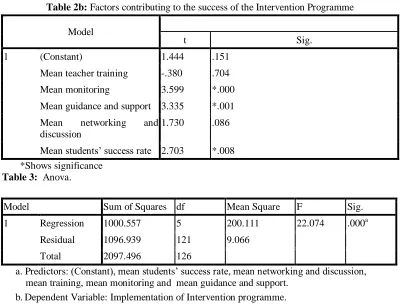
The ANOVA table indicates that the model as a

whole is significant [F (5,121) = 22.07,

P=0.000< α=0.05]

Using the regression analysis, the variables

monitoring of EIP, guidance and support as

(6)

1311

Table 2a:

Factors contributing to the success of the Intervention Programme

Table 2b:

Factors contributing to the success of the Intervention Programme

Model

t

Sig.

1

(Constant)

1.444

.151

Mean teacher training

-.380

.704

Mean monitoring

3.599

*.000

Mean guidance and support 3.335

*.001

Mean

networking

and

discussion

1.730

.086

Mean students‟ success rate 2.703

*.008

*Shows significance

Table 3:

Anova.

Hence, for the success of any intervention

programme, the most important variable should

be teacher training (Department of Education,

2010). Well-trained teachers are the backbone

for the success of students, be it for intervention

programme or even in academic performance.

Yet, this study, suggests that the correlation

between

teacher

training

and

the

implementation of the intervention programme

is weak and it is not a contributing factor

Model

Unstandardised Coefficients

Standardised

Coefficients

B

Std. Error

Beta

1

(Constant)

1.606

1.112

Mean teacher training

-.006

.016

-.026

Mean monitoring

.064

.018

.297

Mean guidance and support

.410

.123

.311

Mean networking

and discussion

.002

.001

.115

Mean students‟ success rate

.015

.006

.224

Dependent Variable:

mean implementation of intervention programme

Model

Sum of Squares df

Mean Square

F

Sig.

1

Regression

1000.557

5

200.111

22.074

.000

a

Residual

1096.939

121

9.066

Total

2097.496

126

a. Predictors: (Constant), mean students‟ success rate, mean networking and discussion,

a.

mean training, mean monitoring and mean guidance and support.

(7)

1312

according to the regression analysis, as seen in

Table 1. This is because the study uncovered

that only 21.1 % of local teachers underwent

training for the intervention programme,

making it a significant contributing factor for

non-performing teachers.

From the qualitative data, it was found that the

trainings of teachers were in two modes. First,

the teachers were trained via short courses,

in-house training, and workshops conducted by

the District Education Office. Second, some of

the teachers were not trained at all, but they

inherited the programme by virtue of taking

over the classes from former coordinators.

These

untrained

teachers

acquired

the

„knowledge‟ merely from discussions with the

actually trained teachers. Pitted against the

established

intervention

programmes

in

Australia, New Zealand and the United States,

the intervention programme in this study has a

lot

of

shortcomings, that

evidently

is

detrimental to the education system in

Malaysia.

Comparatively, teachers from the established

intervention programmes (Australia, New

Zealand and USA) were more immersed in

their profession, they were: trained by

university trainers, district or site-level teacher

leaders and school-based teachers who worked

with children. The teachers also participated in

a year of training with numerous observations

and multiple presentations behind one-way

mirror. Following the initial year of training,

teachers continued to participate in on-going

professional

development

sessions

called

continuing

contract

which

provided

collaborative opportunities for teachers to

respond to individual children, to question the

effectiveness of their practice, to get help from

their peers on hard-to-teach children, and to

consider new knowledge in the field of the

intervention programme. These aspects of

teacher training should be seriously looked into,

more so, if the intervention programme is to be

considered for ODL.

However, the explained above scenario reveals

that teacher training is pertinent for the

traditional learning environment, whereas in

ODL the learning environment may have to be

appropriately redesigned and there should be

more flexible access to learning opportunities.

For instance, the one-year training and the

professional development sessions can be done

through activities via face-to-face tutorial

sessions (the frequency of the tutorials to be

appropriately determined) and innovative

techniques,

such

as

computer/video

conferencing. The concept is activity based or

student-centered learning. The training should

encompass in-service and pre-service teachers.

Embedded in the course training is the

instructional design, which is most important as

stated by Clark (1983), and with it comes the

students‟ academic performance and the

success of EIP. The result of this study showed

that the group instructional method (25 - 30

children) was utilized which was obviously

ineffective against individualised one-to-one

lessons. For ODL learning environment then,

small group sessions are appropriate, which

could be more effective because children often

benefit from listening to their classmates‟

responses and receiving feedbacks from

someone other than the teacher.

This skill i.e. utilizing small group approach

should be emphasized among ODL would-be

teachers because it increases effectiveness.

This can be done through video/computer

conferencing by tutors and students. Besides,

in the face-to-face tutorial sessions, which

could be conducted on weekends, tutors can

participate in exchanging of ideas with students

based on study materials, textbooks and online

references; or to conduct activities where there

should be simulations or role-plays. These

should not be executed in forms of lectures.

The tutorial sessions can be once a month or

twice a semester or even thrice per semester for

more effective results.

It must be highlighted here that there is no

compulsion for students to attend tutorials in

ODL. However, tutors must device ways to

persuade and encourage students to consistently

(8)

1313

encourage the students to complete reading and

various activities for the topics to be discussed.

This would prepare the students in advance so

that they can participate meaningfully in the

tutorial discussions.

Additionally, it would be benefitting if the

course is supported by the LMS. Students can

find course materials and the latest course

information from the LMS. Through the LMS

the students can also communicate with their

fellow students, their tutors as well as the

Course Coordinators by utilising the e-forum.

The e-forum provides the foundation for

collaborative and cooperative learning. This

teaching and learning outlet, according to the

constructivist theory will sharpen the students‟

cognitive skills.

The current practices in terms of content for the

EIP are in the form of modules, which will fit

well for ODL. From the qualitative survey,

this study found out that the modules utilised

by KIA2M were divided into two parts: the

basic skills and the advanced skills. The Basic

Skills

(compulsory)

include

recognition,

reading and writing the alphabets from A – Z,

forming

and

differentiating

consonant

phonemes, forming, reading and writing words.

As for the advanced skills, the children were

taught to read and write effectively. The

teachers

paid

particular

attention

to

pronunciation,

word

recognition

and

identification, spelling, phonemes, reading and

writing. In this study it was also found that

there were a lot of drilling exercises and

literacy

was

not

stressed

(behaviorism

approach).

Compared to the current practices in USA,

Australia and New Zealand, (based on literature

studies) children are taught phonological

awareness, visual perception of letters, word

recognition, phonics and decoding skills and to

recognise structural analysis of words and learn

spelling patterns. The goal is to develop speed

and fluency in reading and writing and to teach

children how to construct meaning from print.

Children are taught that what they read must

make sense. Structured approach is intended to

provide a balanced approach so that literacy

develops along a broad front and children are

able to apply skills in reading and writing.

One-to-one assistance is provided for children

facing the most difficulty.

Hence, there is a need to relook into the current

practices of EIP in Malaysia and raising the

benchmark by troubleshooting the inefficiency

against what is working in USA, Australia and

New Zealand. This could be done under the

ODL mode.However applying the methodology

in ODL then can be challenging, so would-be

teachers should be more proactive. They must

take initiatives to read and apply current

research and practice knowledge when making

decisions that best fit the different children

under their charge.

In the ODL context at least, teachers have to

utilise the 'computer-supported collaborative

learning' approach, something more open, and

cooperative. Its main purpose is to promote a

shared understanding of intentions and allow

coordinated action. Teachers must constantly

be reminded that children need help and

guidance in both communication and literacy

constantly.

Even

with

ODL

computer

technology, the EIP is still likely to fail,

because the most effective way to achieve

success lies in the building of the interactive

skill among teachers. Without this interactive

skill,

the

children‟s

communicative

development will be affected.

Plus, the content of the module should be based

on events familiar to the children and the

techniques of presentation have to be in the

form of storytelling and role-playing.The

characters in the story must ignite excitement

among children. It should also be interspersed

with relevant children‟s folk songs. So, the

interactive and story telling skill should be

inculcated among ODL students planning to

embark in the teaching profession. This can be

done through videoconferencing, tutorials and

exercises via assignments.

(9)

1314

50% of the children who joined the main stream

still could not read or write. The reasons given

were: large student-teacher ratio, hence teachers

could not carry out courses for diagnosis and

literacy was not the focus. Children were only

taught correct pronunciations, spelling and

writing.

Later, KIA2M was discontinued and replaced by

another Reading, Numeracy and literacy

intervention programme. Again here, basically

the program was not at fault but instead the

recurring issue of lack of trained teachers. All

the more ODL is very relevant where the

pedagogical strategies be redesigned to suit the

needs of the students and they in turn will

possess the teaching strategies when they

become the EIP teachers.

In

the

established

Reading

Recovery

programme, in USA, Australia and New

Zealand, Reading Recovery children were the

only group who scored above average on all

tests, showing long-term improvements in

reading. The programme successfully reduced

the need for further remediation and reduced the

number of children classified as learning

disabled, with positive results. To be successful,

for any intervention programme, it has to follow

what was planned (albeit activities and

pedagogical approach can be modified or created

based on needs of children) and diligently

implemented. The programme has to be

continuously upgraded based on current research

findings of established programmes.

As stated earlier, the students‟ performance is

of utmost importance especially for ODL. The

learning activity is closely related to the

learning outcome. In the traditional method the

learners are the children but in ODL the

learners are the would-be teachers who

eventually will be teaching the children in the

EIP programme. So the success of the children

and the would-be teachers in the ODL

programme is crucial for the success of EIP.

Learning outcomes achievement, hence, has a

special significance in ODL because it is an

index to the success of the programme and the

effective use of the innovative educational

technologies. This approach subscribes to the

behaviorist theory. Perhaps with effective and

detailed planning, ODL may make the

difference in the success rates of the children. It

is hoped that the pedagogical designers and

students of ODL will emulate the lists of

success stories from the Reading Recovery

programmes in USA, AUSTRALIA and New

Zealand.

In

this

study,

the

administrative

staff

(headmasters and the evening coordinators) and

the officers from the District Education Office

conducted the monitoring of the intervention

programme. A report on every level of the

children‟s achievement was sent to the school

authorities and a report on the achievement of

each school of the KIA2M program was sent to

the

district

education

department.

This

monitoring system is also important for the

success of any intervention programme.

Similarly, in the ODL mode, this monitoring

system should also be carried out in the EIP

programme offered. The monitoring has to

carried out on the courses offered where the

effectiveness of the tutors who are involved in

the face-to-face tutorials with the students, are

evaluated based on observations by the

academic staff, the performance rate of the

students and students‟ feedbacks in the form of

surveys. A mechanism should also be

introduced where the progress and performance

of the LMS system and the e-forums can be

monitored. Besides, there should also be

reports from the external examiners on

examination questions. An analysis on the

examination questions should also be carried

out to find out and address the areas of

weaknesses.

(10)

1315

Conclusion

Reading proficiency and related skills like

communication and literacy are crucial to

academic success in schools. However, in

many developing countries like Malaysia and

even in developed countries there is a

concern

on the inability of children not acquiring these

basic skills

.

Without assistance these children

will certainly face school failure. The answer

to this problem is the EIP. However, there is a

lack of trained teachers to run this EIP and

hence the phenomenon of untrained teachers

taking on the task. ODL is a possible venue

where training in EIP will give the opportunity

to working individuals to be teachers or

teachers to specialize in EIP or teachers to

upgrade their professional qualification.

References

Badian, N. A. (1998) “

A validation of the role

of preschool phonological and orthographic

skills in the prediction of reading of learning

disabilities” Journal of Learning Disabilities

No. 31, pp. 427-481.

Berita Harian (2006)

“Reading disabilities”

Education: Kuala Lumpur pp 12.

Clark, R.E. (1983)

“Reconsidering research on

learning from media” Review of Educational

Research Vol.53, No.4, pp.445-459

Danaher, P.A. and Abdurrahman Umar

(2010)

Eds.

“Perspectives in Distance

Education: Teacher Education through open

and Distance Learning” Commonwealth of

learning: Vancouver

Department of Education Malaysia (2010)

“The Importance of Teaching: The Schools

White Paper” The Stationery Office Limited:

UK.

Krejcie,R.V. and Morgan,

D. W. (1970)

“Determining sample size for research

activities” Educational and Psychological

Measurement No.30, pp. 607 – 610

Knowles, M.S. (1980)

“The Modern Practice

of Adult Education: From Pedagogy to

Andrgogy”

Prentice

Hall/Cambridge:

Englewood Cliffs

Instructional strategies

based on Behaviorism and

Constructivism

Multimedia

technologies

Content

(modules, textbooks,

e-books, OER, e-journals,

websites)

Working Adult Students

(Knowles model)

(11)

1316

Malik Muhammad Sohail, Babak Mahmood,

Mumtaz Ali and Sadia Rafi (2012) “

The

Sociology

of

Classroom

and

Family

Background Influencing Students‟ Learning: A

Study At University Of Sargodha” International

Journal of Asian Social Science

Vol. 2, Issue 4.

pp.

513-529

Mohamed Ally (2004)

Designing effective

learning objects for distance learning education

in Online education using learning object by R.

McGreal, Ed., RoutledgePalmer: London

Moore, M.G. and Kearsley, G. (1996)

Distance

Education:

A

Systems

Views

Wadsworth Publishing Company: Belmont CA

Palincsar,

A.S.

and

Perry,N.E.(1995)

“Developmental, cognitive and sociocultural

perspectives on assessing and instructing

reading” School Psychological Review

Vol.24, No.3, pp.331-334

Rahil Mahyuddin and Habibah Elias (2008)

“Reading and literacy skills among early

schoolers”

International

Journal

of

Interdisciplinary Social Sciences Vol. 3, No. 3,

pp.309-315

Samsilah Roslan, Abd Rahman Aroff and

Sharifah Md Nor (2005)

Special remedial

programme: facing challenges and enhancing

potentials Proceedings CARE International

Conference Kuala Lumpur

Stanovich, K.E. and Siegel L.S. (1994)

“Phenotypic performance profile of children

with reading disabilities: A regression-based

test of phonological-core variable difference

model” Journal of Educational Psychology No.

86, pp.24-53

Figure

Table 1: Correlations between Influencing Variables and Implementation of Intervention    Programme
Table 2b: Factors contributing to the success of the Intervention Programme

References

Related documents

Following serum exposure for 5 days the mitogenic activity of FGF-2 plus forskolin is more potent in adult Schwann cells than in neonatal cells. The experiments

The program also offers 20 courses of Bachelor’s Degree in Education to students, namely Curriculum and Pedagogy, Malay Language Education, Islamic Education, TESL,

It was decided that with the presence of such significant red flag signs that she should undergo advanced imaging, in this case an MRI, that revealed an underlying malignancy, which

PTPN1 knock-down, cell proliferation and tyrosine phosphorylation analyses, and RT-qPCR mRNA expression was assessed on SH-SY5Y, SMS-KCNR, and IMR-32 human NB cell lines..

The projected gains over the years 2000 to 2040 in life and active life expectancies, and expected years of dependency at age 65for males and females, for alternatives I, II, and

In our study, consumption of high zinc biofortified wheat flour for 6 months compared to low zinc bioforti- fied wheat resulted in statistically significant reduction in days

The small premature infant who has undergone a sur gical procedure and would have to be fed by gavage is much more easily and safely fed through a gastrostomy tube (Fig. 2)..

Once you have played this game a few times and the children are familiar with the names of the trees, without using the cards get pairs or small groups of children to lead the rest