Wheel Chair Based Smart Trolley using Image
Processing
Amrutha Govind P1, Junu Jahana C2, Shincy Shibin 3, Vaisakh P 4, Faseen Kudukkengal 5
U.G. Student, Department of Electronics and Communication Engineering, Eranad Knowledge City Technical Campus,
Manjeri, Kerala, India 1,2,3,4
Assistant Professor, Department of Electronics and Communication Engineering, Eranad Knowledge City Technical
Campus, Manjeri, Kerala, India 5
ABSTRACT: The Wheel Chair Based Smart Trolley is a smart trolley system specially designed for differentially abled people to use in airports, railway stations, supermarkets etc. The user can carry the bags and luggage along with them without the need of any external help. In this smart innovative system, users can navigate the wheel chair based smart trolley simply by using their hand gestures, by pattern recognition or by using a virtual joystick available in the user’s smart phone. A Camera mounted on the trolley recognizes the person’s action and move according to it so that it reduces the human effort. The trolley can be automatically folded into an electric wheel chair so that disabled people can use it for transportation. This system utilizes the advanced machine learning algorithm to track the user’s hand gestures, face and postures. The camera can capture the color pattern and follows it by image processing and tracking .The smart trolley can be controlled even by sitting in the wheel chair with a virtual joystick which is available after simply scanning the QR code. The smart trolley also includes a security wallet so that user can keep his important belongings or documents safely. Available trolleys in airports and railway stations can be located using the mobile phone having internet facility. In all, this smart trolley system is highly user friendly so that it can be accessed easily without much manpower merely by using the hand gestures. The multiple accessibility definitely helps people especially in cases of old aged, children carrying, handicapped etc.
KEYWORDS: Image processing and tracking, Machine learning, QR code, Virtual joystick
I. INTRODUCTION
Nowadays people face a lot of problem in Airports, supermarkets, railway stations etc. to carry things using trolleys.Mostly we need to push the trolley that carry heavy luggage.Lot of differently abled people, old age people and women carrying babies found it difficult for them to use.
Thus there is need for an innovative product with social acceptance that aids comfort, convenience and efficiency in day-to-day life.Differently abled people often find it difficult to manage the heavy luggage in airports.Imagine that there is a smart trolley which follows you simply wherever you go and carry the things of yours.For those differently abled people, a built-in seating system within the trolley is provided. This seating system can be automatically stretched and folded as per user’s requirement. The user can simply navigate the trolley using a virtual joystick within their smart phones.It can also acts as an autonomous trolley which will follow the particular human using Image Processing and machine learning.Advanced machine learning algorithms are used to capture the gestures through a camera. This video feed is processed using a high performing CPU and commands the motors to drive as required. It can also capture the given color pattern and simply follows it by image processing and tracking technique.
II. RELATED WORK
Customers face many problems while shopping in supermarkets. They have to check the price of each productso that it gets matched with their budget, to locate the products, and they have to wait a long time in the queue to bill their products. Suganyaetal. [1] proposed an automated smart trolley with smart billing using Arduino. This paper gives a solution to these problems; a smart trolley is designed with a mobile application. This app helps the customers to find the location of the products. It also provides a centralized and automated billing system using RFID.This system has some disadvantages that the communication is not secured and the RFID tag cannot be provided on all the products.
Human-following robot using infrared camera proposed by QuocKhanh Dang et al. [2] is used to follow a human effectively. In this paper infrared cameras are used to detect the position of a mobile robot.A Wii camera which is attached on a human is used to capture 4 groups of IR-LEDs installed on the robot. Thus the robotsimply follows the user.
A smart wheel chair is designed by Sabin Adhikariet al. [3] aims to provide aid to differently abled people. This will help the user to move from one place toanother. This smart wheel chair is designed to have self-mobility with the help of the user commands. Thisreduces the user’s effort and force to drive the wheels for wheelchair. The user can simply navigate the wheel chair themselves by using a joystick or accelerometer or a voice command. Severaltypes of smart wheel chairs are being developing using artificial intelligence to make the user more comfortable while using a smart wheel chair.
III.SYSTEM DESIGN
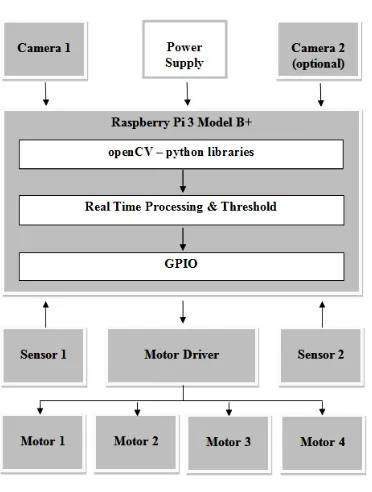
The main processing part of the system is the raspberry pi, in which all the codes and algorithms are defined. The camera captures the real time instant and feeds into the raspberry pi. The control signals are given into the motor drivers. The sensors are used to map the surroundings and provide additional information and to prevent collision. The HC-SR04 ultrasonic sensor provides non-contact range detection with high accuracy.
Fig.1.Overall system
Fig. 2. System block diagram
The system includes a camera, Raspberry pi, Motor drivers, Ultrasonic sensors, Power distribution boards, microcontroller and power source. The vision acquisition is done by a high definition camera as shown in Fig.2. The processing software used is openCV. The algorithm includes filtering, masking, tracking, pattern matching, hand gesture recognition, and object tracking etc. Most of the algorithms are developed using boosted Haar cascade transformation.
The system is preliminary tested with basic video acquisition and testing with designed algorithms. The desired output is noted and threshold values are adjusted. The important process in video acquisition part is training the haar cascade file. This is done by training numerous amounts of positive and negative images[4].
Basic steps in training include: Collecting positive and negative images, training each individual images using Haar transform, Building datasets and Feeding datasets into the main program. Positive images are the images which contain the object to be tracked and negative images are the images which has only background images. The object can be hand gestures or particular patterns.
The base structure is completed with good wheel base. Omni wheels and motors are the actuators part. The motor is wired to the motor driver. The GPIO pins of Raspberry Pi are connected to the motor driver. The PWM signals from the Pi are driven by the driver board. After completing the base structure, camera, boards and sensors are mounted on the trolley. The power sources used are lithium ion cells.
After implementing the system, it is tested in different real time situations. The change or abnormality is measured and necessary updates are given to the system. The system is maintained by using new real time trained datasets. Hence the system becomes more and more smart and intelligent.
IV.HARDWARE IMPLEMENTATION
A. Raspberry pi model B+
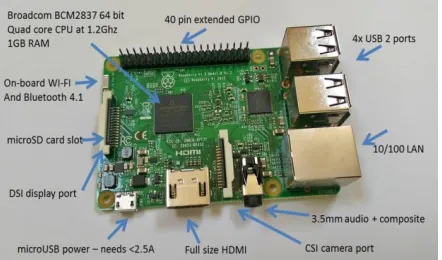
The main parts include main processing chip, power supply HDMI out (VGA display), memory, Ethernet port, and USB port as shown in Fig 3.
Fig.3. Raspberry pi board (Model B+)
Raspberry pi 3-model B+ with raspbian Operating System is used and it is the most important module of the whole embedded image capturing and processing. There is a 40-pin GPIO header found on all current pi boards. Any of these GPIO pins can be set as input or output pin as required.A high processing ARM 1.4GHz 64-bit quad-core processor is used here for all kinds of processing, It has a dual-band wireless LAN, Bluetooth 4.2/BLE, faster Ethernet and Power-over-Ethernet support (with separate PoE HAT)[5] and additional features which provides easy connectivity to other devices.
B. NodeMCU-ESP8266
NodeMCU is an open source platform developed for ESP8266 Wi-Fi chip as shown in Fig.4. It has Wi-Fi capability, analog pin, digital pins and serial communication protocols. In order to use NodeMCU for IoT applications one has to download NodeMCU firmware in NodeMCU development board.
It has 10 GPIO and every GPIO can be PWM [6]. It supports serial communication protocols i.e. UART, SPI, I2C etc. One has to code in C\C++ programming language for developing NodeMCU applications in Arduino IDE. NodeMCU has on board USB to serial chip to easily program and upload codes from Arduino IDE.
C. Servo motor
A servo motor is an electrical device which can push or rotate an object with great precision as shown in Fig.5.
Fig. 5.Servo motor
For a given electrical input, the wheels are rotated in a certain angle by means of Servo motor. It has a motor coupled to a sensor for position feedback. It is a simple DC motor that can be operated automatically up to a certain limit for a given command with the help of error-sensing feedback to correct the performance [7], [8]. This is called closed-loop operation. Servo motor with 200 RPM is used here.
D. Arduino Board
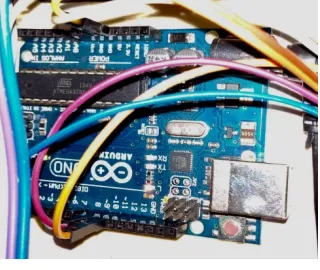
Arduino is an open source platform based on easy-to-use hardware and software. A typical Arduino UNO board is shown in Fig.6.
Fig. 6.Arduino UNO board
V. METHODOLOGY
A. Detection of a specific color and tracking using OpenCV with Python
A python program allows the detection of a specific color in a live stream video content. A video is composed of infinite frames using a webcam and will detect the color of every frame one by one. The infinite loop is used so that the web camera captures the frames in every instance and is open during the entire course of the program. After capturing the live stream frame by frame we convert each frame in BGR color space to HSV color space. We can use this to extract a colored object. In HSV, it is easier to representa color than RGB color-space [9]. Then using the threshold, needed color region is masked and other regions are removed. The mask is basically creating some specific region of the image following certain rules. Normally a circular color pattern is used so that the masked region will be a circle with a particular value of radius. The center of the circle is taken as the coordinate to estimate the position of the pattern in the frame. The trolley only follows the pattern if the radius value is in between the desired range. If the radius is small both motors are turned on towards the pattern. If the coordinate value is at the edge of the frame then values for motor PWM signals are varied to adjust the trolley position so that the pattern will always maintained on the center of the frame only for particular range of radius. This results the trolley to always track the pattern and if it moves away from it then the trolley follows it.
B. Hand Gesture Detection using OpenCV with Python
The skin color detection is one of the most popular methods to detect hand region. This method is simple and depends on skin color that can be white, black, or other colors, and the environment light conditions, as well as the background. Using this method different hand posters can be identified by counting number of contours of the fingers. For every particular contour we there are unique functions like forward,backward, left and right[10]. After capturing the live stream frame by frame we convert each frame in BGR color space to HSV color space and the skin color region is masked the region will be white color and other regions will be black[13]. Then the contours are marked on the boundary regions.
C. Virtual Joystick using NodeMCU
Trolley can be manually controlled using android smartphone through Wi-Fi. The user can scan the QR code available on the trolley to obtain the IP address of the NodeMCU. After browsing the ip, a joystick will be available on the browser so that the user can easily control the trolley without installing any application. The NodeMCU is connected to a local Wi-Fi and the output GPIO pins are connected to the motor driver.
VI.RESULTSANDDISCUSSIONS
Fig. 7.RGB color detection and tracking
In the hand gesture based tracking, the training process was done in normal computer using Haar cascade. The input hand image is segmented with skin color based segmentation by using HSV color model. In a real-time system,the hand gesture recognition depends on factors like varying lighting conditions. Hence the system could achieve 85% tracking efficiently.
Fig .8: Prototype of the system
VII. CONCLUSION
We implemented a fully operational smart trolley that simply follows the user’s command, carry luggage, and provides a built in seating system for differently abled people. It solves currently existing problems while using the ordinary trolleys in airport, supermarkets, etc. The trolley can be controlled in different modes; by color pattern recognition, by hand gesture recognition or by using a virtual joystick within the smart phone. Using advanced machine leaning algorithm the camera can capture the images and the images can be processed by the raspberry pi. Thus the autonomous trolley will simply follow the particular human using image processing. In future, we aim to improve the accuracy of the system further which can adapt in varying lighting conditions.
REFERENCES
[1] Suganya. R, Swarnavalli. N, Vismitha. S, Mrs. G. M. Rajathi, “Automated smart trolley with smart billing using Arduino”, International Journal for Research in Applied Science & Engineering Technology (IJRASET), Volume 4 Issue III, March2016
[2] QuocKhanh Dang, Young SooSuh, “Human-followin robot using infrared camera”, Institute of Electrical & Electronics Engineers (IEEE) [3] Sabin Adhikari, Rohit Singh, RamuRaut, “Smart Wheel Chair”,ResearchGate
[4] Saumya Nair , Aditya Nair, Nandita Nandi, “Object Recognition Using Cascade Classifier”, International Journal of Innovations & Advancement in Computer Science (IJIACS) ,Volume 7, Issue 4, April 2018
[5] https://www.raspberrypi.org/products/raspberry-pi-3-model-b-plus/ [6] https://www.nodemcu.com/index_en.html.
[7] https://www.instructables.com/id/Interfacing-Servo-Motor-With-NodeMCU/ [8] https://rpi.science.uoit.ca/lab/servo/
[9] Christian Plaza, Dario Amaya, “Identification of colors by means of image processing and HSV filtering”, Journal of Applied Sciences Research, 2016 September
[10] AashniHaria,ArchanasriSubramanian,NivedhithaAsokkumar, ShristiPoddar, JyothiSNayak, “Hand gesture recognition for human computer interaction”, ProcediaComputerScience Volume 115, 2017,