International Journal of Emerging Technology and Advanced Engineering
Website: www.ijetae.com (ISSN 2250-2459, Volume 2, Issue 8, August 2012)511
A Solution to Economic Dispatch Problem Using Augmented
lagrangian Particle Swarm Optimization
Vinod Puri
1, Yogesh K. Chauhan
21Department of Electrical and Electronics Engineering, SRM University, NCR Campus, Ghaziabad, India. 2School of Engineering, Gautam Buddha University, Greater Noida, Uttar Pradesh, India.
Abstract - The economic load dispatch plays an important role in the operation of power system, and several models by using different techniques have been used to solve these problems. Several traditional approaches like dynamic programming, lambda-iteration and gradient method are utilized to find out the optimal solution of non-linear problem. More recently, the soft computing techniques have received more attention and were used in a number of successful and practical applications. The purpose of this work is to find out the advantages of application of the evolutionary computing technique and Augmented lagrangian Particle Swarm Optimization (ALPSO) in particular to the economic load dispatch problem. Here, an attempt has been made to find out the minimum cost by using ALPSO using the data of three generating systems. All the techniques are implemented in MATLAB environment. ALPSO is applied to find out the minimum cost for different power demand.
Keywords - Particle Swarm Optimization, Economic Dispatch.
I. INTRODUCTION
The main objective of ELD problem is to decrease the fuel cost of generators, satisfying many equality and inequality constraints [1]. In the past, classical ELD problem is solved using classical mathematical optimization methods, such as Dynamic programming, lambda method, gradient method, and Newton method. Many experts used many optimization techniques for solving ELD problem such as fuzzy, GA, hybrid techniques etc [2]. PSO was acquainted by J. Kenedy and R. Eberhart in 1995. PSO is a type of modern optimization techniques and a kind of swarm intelligence [3]. PSO has been used for solving continuous nonlinear optimization problems by using its population based search technique [4]. This paper proposed the technique based on Augmented Lagrangian particle swarm optimization ,this algorithm guarantee for the global optimal solution [6].
The paper is organized as follows: Section II formulates the ELD problem.
Section III describes detail of particle swarm optimization and the proposed method applies for solving the economic load dispatch problem. Section IV shows the simulation results. Finally, Conclusion is given in Section V.
II. FORMULATION OF ECONOMIC LOAD DISPATCH
PROBLEM
The primary concern of an ELD problem is the minimization of its objective function [7]. The total cost generated that meets the demand and satisfies all other constraints associated is selected as the objective function [8]. In general, the ELD problem can be formulated mathematically as a constrained optimization problem with an objective function of the form [9].
Minimize
1
( )
n
T i i i
C
C P
(1)Where CT is total fuel cost, n is the number of online generating unit and Ci (Pi) is operating fuel cost of generating unit i.
The simplified fuel cost function of the generators in the economic load dispatch problem is most represented as quadratic function given as
2
( )
i i i i i i i
C P
a
b P c P
(2) Where ai, bi, ci are the cost coefficients of the generating ithunit, Pi is the real power output of ithunit.The minimization of ELD problem is subjected to the following constraints [10].
1. Inequality constraints ( Generator constraints) :
P
i,
min
P P
i i,
max (3)2. Equality constraints (Power balance Constraint):
1
n
i L
i
P D P
(4)International Journal of Emerging Technology and Advanced Engineering
Website: www.ijetae.com (ISSN 2250-2459, Volume 2, Issue 8, August 2012)512
III. PARTICLE SWARM OPTIMIZATION (PSO)
Particle swarm optimization is a stochastic, population-based search and optimization algorithm for problem solving [12]. It is a kind of swarm intelligence that is based on social-psychological principles and provides insights into social behaviour, as well as contributing to engineering applications. The particle swarm optimization algorithm was first described in 1995 by James Kennedy and Russell C. Eberhart [13]. The techniques have evolved greatly since then, and the original version of the algorithm is barely used at present. Social influence and social learning enable a person to maintain cognitive consistency [14]. People solve problems by talking with other people about them, and as they interacts their beliefs, attitudes and behaviour changes. The changes could typically be depicted as the individuals moving toward one another in a socio-cognitive space[15].
The particle swarm simulates a kind of social optimization. A problem is given, and some way to evaluate a proposed solution to it exists in the form of a fitness function [16]. A communication structure or social network is also defined, assigning neighbours for each individual to interact with a population of individuals defined as random guesses as the problem solutions is initialized [17]. These individuals are candidate solutions and are also known as the particles, hence the name particle swarm. An iterative process to improve these candidate solutions is set in motion. The particles iteratively evaluate the fitness of the candidate solutions and remember the location where they had their best success. The individual's best solution is called the particle best or the local best. Each particle makes this information available to their neighbours [18]. They are also able to see where their neighbours have had success. Movements through the search space are guided by these successes, with the population usually converging by the end of a trial[19].
A. Particle Swarm Optimization Algorithm
Initialize the swarm p(t) of particles such that the position xi(t) of each particle .p(t) is random within the hyperspace, with t = 0.
Evaluate the fitness function for each particle and find out the pbest.
For each individual particle, compare the particle’s fitness value with its pbest. If the current value is better than the pbest value, then set this value as
pbest and the current particle’s position xi as pi.
Identify the particle that has the best fitness value. The value of its fitness function is identified as
gbest and its position as pg.
Update the velocities and positions of all the particles[20].
1
2
i i i i i
v t v t l c xpbest x t c xgbest x t (5) Where c1and c2are random variables. The second term above is referred to as the cognitive component, while the last term is the social component[21].
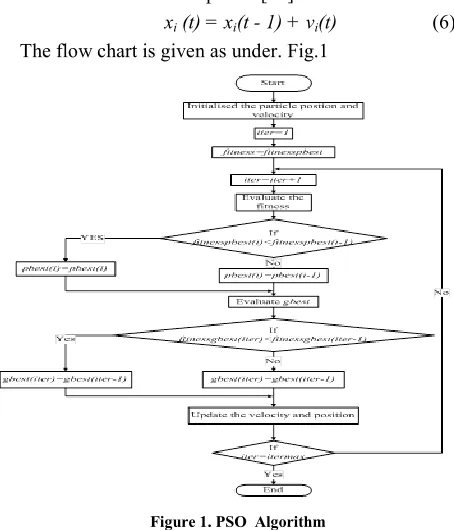
[image:2.612.325.552.253.518.2]xi (t) = xi(t - 1) + vi(t) (6) The flow chart is given as under. Fig.1
Figure 1. PSO Algorithm
B. Solving Economic Dispatch Using ALPSO
Our main aim is to minimise the operating cost, so (Augmented lagrangian method) ALM method is used for handling equality and in equality constraints and optimization is done by PSO technique [22].
The following steps are used by the ALPSO technique to solve the Economic dispatch problem.
1. Initialize a population of particles pi and other variables. Each particle is usually generated randomly with in allowable range.
min max
,
,
i i i
P
P
P
(7)International Journal of Emerging Technology and Advanced Engineering
Website: www.ijetae.com (ISSN 2250-2459, Volume 2, Issue 8, August 2012)513
2. Initialize the parameters such as the size ofpopulation, initial and final inertia weight, random velocity of particle, acceleration constant, the max generation, Lagrange’s multiplier(
i) etc3. Calculate the fitness of each individual in the population using the fitness function or cost function[23].
1 1
(
( )
T n
T i i t i
P
C
C
+ Equality constraints +Inequality constraints) (8)
Where Ci(Pi) is represented as
2
( )
i Pi ai b P c Pi i i i
C
(9)
With equality constraints as
1
n
i D i
P P
(10) Where Pi is the ith generator and is the load or demand. And inequality constraints as
min max
,
,
i i i
P
P
P
. (11) 4. Update each individual unit’s position andvelocity also update
i and
i corresponding to equality and inequality constraints.5. If the number of iteration reaches the maximum then go to step 6. Otherwise go to step 3.
6. The individual that generates the latest is the optimal generation power of each unit with the minimum total generation cost.
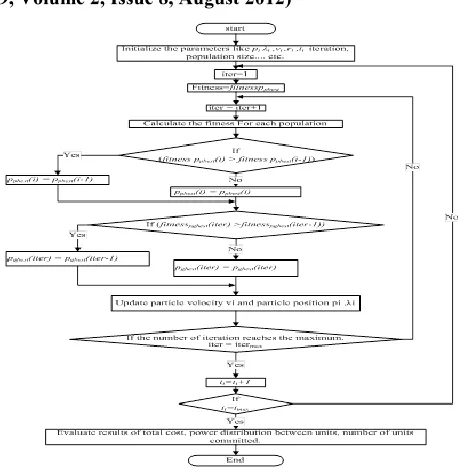
[image:3.612.322.551.126.363.2]The flow chart of the above mention steps is developed as under.Fig.2
Figure 2. Flow chart for solving Economic Load Dispatch using PSO
IV. RESULTS AND DISCUSSION.
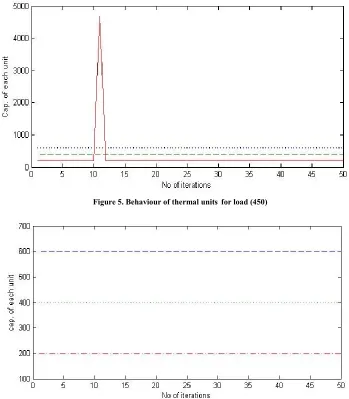
The results have been studied for three generators test data. Corresponding each load the different units operates for which an optimal solution is obtained, in ALPSO the different units reaches to their optimal solutions with less no of iteration.
The three generating units considered are having different characteristic. Their cost function characteristics are given by following equations
F1=0.00156P1 2+7.92P1+561 Rs/Hr (12)
F2=0.00194P22 +7.85P2+310 Rs/Hr
International Journal of Emerging Technology and Advanced Engineering
Website: www.ijetae.com (ISSN 2250-2459, Volume 2, Issue 8, August 2012)514
According to the constraints considered in this work among inequality constraints only active power constraints are constraints are considered. There operating limit of maximum and minimum power are also different. The unit operating ranges are:100 (MW) ≤ P1 ≤ 600 ( MW) (13) 100( MW) ≤ P2 ≤ 400 (MW)
50 (MW) ≤ P3 ≤ 200 (MW)
And load pattern is [450, 585, 700, 800, 900, 1050, 1000, 1200, 720, 850, 950 and 550]
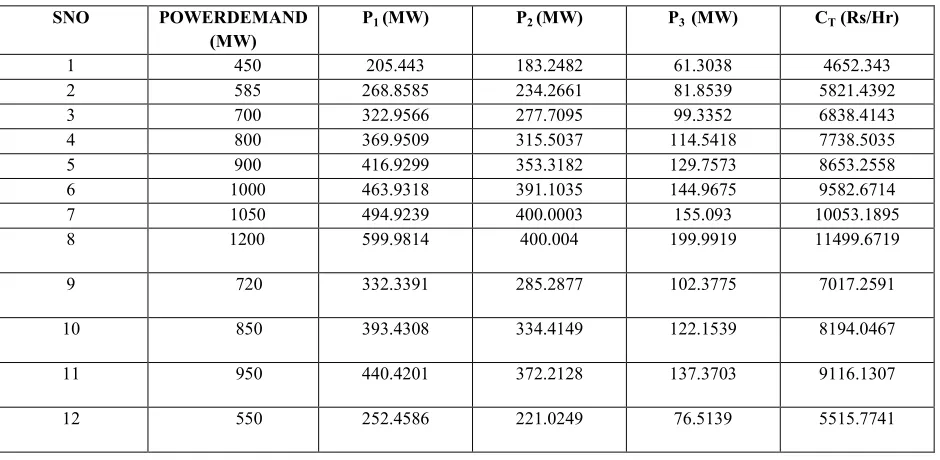
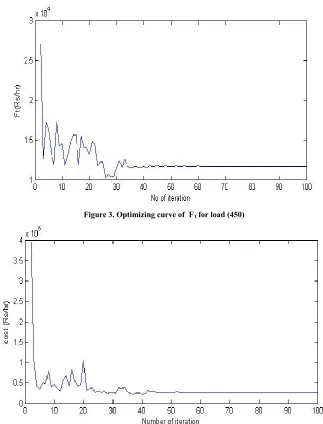
The results obtained for the test data for three units, using ALPSO are summarized below in Table.1while solving this particular problem following data is taken. The Fig.3, Fig.4 shows the optimizing curve of CT (objective function), and Fig.5, Fig.6 shows behaviour of thermal units, where one could easily analyse that the different units optimize to their optimal value for a particular load. Iterations= 100, Particles=50, C1=2.05, C2=2.05, wmax=
[image:4.612.74.544.303.533.2]0.9, wmin = 0.4, Upper Limit=1000, Lower Limit= (-)1000.
TABLE 1
THE RESULTS OF ECONOMIC DISPATCH FOR 3 UNITS USING ALPSO
SNO POWERDEMAND
(MW)
P1 (MW) P2 (MW) P3 (MW) CT (Rs/Hr)
1 450 205.443 183.2482 61.3038 4652.343
2 585 268.8585 234.2661 81.8539 5821.4392
3 700 322.9566 277.7095 99.3352 6838.4143
4 800 369.9509 315.5037 114.5418 7738.5035
5 900 416.9299 353.3182 129.7573 8653.2558
6 1000 463.9318 391.1035 144.9675 9582.6714
7 1050 494.9239 400.0003 155.093 10053.1895
8 1200 599.9814 400.004 199.9919 11499.6719
9 720 332.3391 285.2877 102.3775 7017.2591
10 850 393.4308 334.4149 122.1539 8194.0467
11 950 440.4201 372.2128 137.3703 9116.1307
International Journal of Emerging Technology and Advanced Engineering
Website: www.ijetae.com (ISSN 2250-2459, Volume 2, Issue 8, August 2012) [image:5.612.142.465.132.556.2]515
Figure 3. Optimizing curve of FT for load (450)
International Journal of Emerging Technology and Advanced Engineering
Website: www.ijetae.com (ISSN 2250-2459, Volume 2, Issue 8, August 2012) [image:6.612.126.475.146.545.2]516
Figure 5. Behaviour of thermal units for load (450)
Figure 6. Behaviour of thermal units for load (1200)
IV. CONCLUSION
It is recognized that the economic dispatch of thermal systems results in a great saving for electric utilities. Economic dispatch is the problem of determining the minimum cost for the given sequence of unit committed. The formulation of Economic dispatch has been discussed.
International Journal of Emerging Technology and Advanced Engineering
Website: www.ijetae.com (ISSN 2250-2459, Volume 2, Issue 8, August 2012)517
REFERENCES[1 ] A.Y. Saber, T. Senjyu, T. Miyagi, N. Urasaki and T. Funabashi, “Fuzzy unit commitment scheduling using absolutely stochastic simulated annealing”, IEEE Trans. Power System, 21 May 2006, pp. 955–964.
[2 ] A.J. Wood and B.F. Wollenberg, 1984, “Power Generation
Operation and Control”, John Wiley and Sons, New York.
[3 ] P. Aravindhababu and K.R. Nayar, “Economic dispatch based on optimal lambda using radial basis function network”, Elect. Power Energy System, 2002, pp. 551–556.
[4 ] IEEE Committee Report, “Present practices in the economic
operation of power systems”, IEEE Trans. Power Apparatus. Syst., 1971, PAS- 90.
[5 ] B.H. Chowdhury and S. Rahman ,”A review of recent advances in economic dispatch”, IEEE Trans. Power System, 1990, pp. 1248– 1259.
[6 ] J.A. Momoh, M.E. El-Hawary and R. Adapa, A review of selected
optimal power flow literature to 1993, Part I: Nonlinear and quadratic programming approaches, IEEE Trans. Power System, 1999, pp. 96–104.
[7 ] D.C. Walters and G.B. Sheble, “Genetic algorithm solution of economic dispatch with valve point loading”, IEEE Trans. Power Syst., August ,1993, pp. 1325–1332.
[8 ] J. Tippayachai, W. Ongsakul and I. Ngamroo, “Parallel micro genetic algorithm for constrained economic dispatch”, IEEE Trans. Power Syst., August, 2003, pp. 790–797.
[9 ] H.T. Yang, P.C. Yang and C.L. Huang, “Evolutionary programming
based economic dispatch for units with non-smooth fuel cost functions”, IEEE Trans. Power Syst., February 1996, pp.112–118.
[10 ]W.M. Lin, F.S. Cheng and M.T. Tsay, “An improved Tabu search for economic dispatch with multiple minima”, IEEE Trans. Power Systems, February ,2002, pp. 108–112.87.
[11 ]P. Attaviriyanupap, H. Kita, E. Tanaka and J. Hasegawa, “A hybrid EP and SQP for dynamic economic dispatch with non-smooth fuel cost function”, IEEE Trans. Power Syst., May 2002, pp. 411–416 .
[12 ]J.H. Park, Y.S. Kim, I.K. Eom and K.Y. Lee, “Economic load dispatch for piecewise quadratic cost function using Hopfield neural network”, IEEE Trans. Power Syst., August 1993, pp. 1030–1038.
[13 ]K.Y. Lee, A. Sode-Yome and J.H. Park, “Adaptive Hopfield neural
network for economic load dispatch”, IEEE Trans. Power Syst., May 1998, pp. 519–526.
[14 ][Zwe-Lee. Gaing, “Particle swarm optimization to solving the economic dispatch considering the generator constraints”, IEEE Trans. Power Syst., November 2004, pp. 1187–1195.
[15 ]D.N. Jeyakumar, T. Jayabarathi and T. Raghunathan, “Particle swarm optimization for various types of economic dispatch problems”, Elect. Power Energy System, 2006, pp. 36–42. [16 ]T.O. Ting, M.V.C. Rao and C.K. Loo, “A novel approach for unit
commitment problem via an effective hybrid particle swarm optimization”, IEEE Trans. Power System, February 2006, pp. 411– 418.
[17 ]A.I. Selvakumar and K. Thanushkodi, “A new particle swarm optimization solution to nonconvex economic dispatch problems,” IEEE Trans. Power System, February 2007, pp. 42-51.
[18 ]Y. H. Hou, L. J. Lu, X. Y. Xiong, and Y. W. Wu, “Economic dispatch of power systems based on the modified particle swarm optimization algorithm”, Transmission and Distribution Conference and Exhibition Asia and Pacific, 2005 IEEE/PES, 2005, pp. 1-6. [19 ]H. Happ, “Optimal power dispatch – A comprehensive survey”,
IEEE Trans. Power App. Syst., vol. PAS-96, 1977, pp. 841-854. [20 ]J. Kennedy and R. C. Eberhart, “Swarm Intelligence”. San
Francisco, CA : Morgan Kaufmann, 2001.
[21 ]Saumendras Sarangi , “Particle Swarm Optimization Applied To Economic Load Dispatch Problem”, N.I.T Raurkela,2009. [22 ]Vinod Puri, et al ,“Unit Commitment Using Particle Swarm