PLANNING AND IMPACT OF DISTRIBUTED GENERATION IN SESB EXISTING SYSTEM
KASMAWATI BINTI RASMIN
A project report submitted in partial
fulfillment of the requirement for the award of the Degree of Master of Electrical Engineering
Faculty of Electrical and Electronic Engineering UniversitiTun Hussein Onn Malaysia
ABSTRACT
ABSTRAK
CONTENTS
DECLARATION OF REPORT STATUS i
EXAMINERS’ DECLARATION ii
TITLE iii
STUDENT’S DECLARATION iv
DEDICATION v
ACKNOWLEDGEMENTS vi
ABSTRACT vii
CONTENTS viii
LIST OF TABLES ix
LIST OF FIGURES x
LIST OF SYMBOLS & ABBREVIATIONS xi LIST OF APPENDICES xii
CHAPTER 1 INTRODUCTION 1
1.1 Traditional Concept of Power Systems 1
1.2 New Concept of Power Systems 3
1.3 Distributed Generation 4
1.4 Problem statements 5
1.5 Project Objectives 7
1.6 Project Scope 7
1.7 Outline of report 8
CHAPTER 2 LITERATURE REVIEW 10
2.1 Introduction 10
2.2 Types of Distributed Generation 11
2.2.1 Photovoltaic Systems 11
2.2.3 Fuel Cells 14
2.2.4 Micro-Turbines 15
2.2.5 Induction and Synchronous Generator 16 2.3 Impact of Distributed Generation on Power system Grids 17 2.3.1 Impact of DG on Voltage Regulation 18
2.3.2 Impact of Dg on Losses 20
2.3.3 Impact of DG on Harmonics 21
2.3.4 Impact of Dg on Short Circuit Level of the
Network 23
2.4 Protection Coordination 25
2.5 Islanding of a Power Network 28
2.5.1 Intentional Islanding 29
2.5.2 Islanding Detection 30
2.6 Previous Study 32
CHAPTER 3 METHODOLOGY 34
3.1 Introduction 34
3.2 Classical Grid Search Algorithm 34
3.3 PSS ADEPT Software 38
3.4 Description Of Project Phases 38
3.4.1 Literature review on previous works about
Distribution Generation systems 39
3.4.2 Data collecting and modelling the distributed generation 39
3.4.3 Software Development 39
3.4.4 Results and Discussions 39
3.4.5 Conclusion and Recommendations 39
CHAPTER 4 RESULTS AND DISCUSSIONS 40
4.1 Introduction 40
4.2 Results and analysis 41
4.2.1 Impact of system with single DG 42
4.3 Summarized Result 51 CHAPTER 5 CONCLUSIONS AND RECOMMENDATIONS 53
5.1 Conclusions 53
5.2 Recommendations 54
REFERENCES 55
LIST OF TABLES
2.1 Size of DG 11
2.2 Harmonic current injection for DG per IEEE 519-1992 22 4.1 Different scenario cases considered in this project 41
4.2 Line Loss with Single DG (Case b) 42
4.3 Line Loss with double DGs (Case c) 45
4.4 Voltage profile 48
LIST OF FIGURES
1.1 Traditional industrial conception of the electrical
energy supply 2
1.2 New industrial conception of the electrical energy
supply 3
2.1 Schematic diagram of a photovoltaic system 12 2.2 Schematic operation diagram of a wind turbine 13
2.3 Schematic diagram of a fuel cell 14
2.4 Schematic diagram of a micro-turbine 15
2.5 Voltage profiles with and without DG 18
2.6 Comparison between pure sinusoidal wave and
distorted wave 21
2.7 Fault contributions due to DG units 1, 2 and 3 are
embedded in the system 24
2.8 Commonly transformer connections used with DG 26
2.9 Islanding of a DG system 28
3.1 Flowchart for DG Placement 37
4.1 PPU Batu Sapi distribution network system 40
4.3 Initial Line PLoss without DG VS PLoss with single DG 43 4.4 Initial Line QLoss (MVAr) without DG VS
QLoss (MVAr) with DG 44
4.5 Line PLoss (MW) with Single DG and Double DG 46 4.6 Line QLoss (MVAr) with Single and Double DG 47
4.7 12- Bus Voltage Profile (p.u) 49
4.8 12- Bus Optimum Size of DG (MW) 50
4.9 12 Bus Line Losses P Loss (MW) 50
LIST OF SYMBOLS AND ABBREVIATIONS
P - Active power
PLoss - Active power losses
S - Apparent power DG - Distributed Generation
PDG - Distributed Generation size (in power) PV - Generation Buses
≥ - Greater than or equal to KW - Kilo Watts
≤ - Less than or equal to X - Line reactance PQ - Load Buses
MW - Mega Watts
% - Percentage
p.u - Per Unit
Q - Reactive power
QLoss - Reactive power losses
∆ - Step Size
∑ - Sum
AC - Alternative Current DC - Direct Current
CHAPTER 1
INTRODUCTION
1.1 Traditional Concept of Power Systems
Currently, most of the power systems generate and supplies electricity having into account the following considerations [1],[2]:
(i). Electricity generation is produced in large power plants, usually located close to the primary energy source (for instance: coil mines) and far away from the consumer centers.
(ii). Electricity is delivered to the customers using a large passive distribution infrastructure, which involves high voltage (HV), medium voltage (MV) and low voltage (LV) networks.
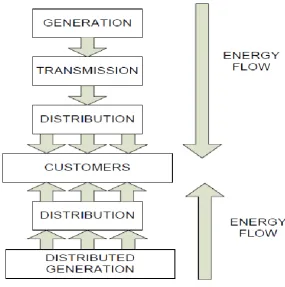
(iii). These distribution networks are designed to operate radially. The power flows only in one direction: from upper voltage levels down-to customers situated along the radial feeders.
Figure 1.1: Traditional industrial conception of the electrical energy supply
In the first stage the electricity is generated in large generation plants, located in non-populated areas away from loads to get round with the economics of size and environmental issues. Second stage is accomplished with the support of various equipment such as transformers, overhead transmission lines and underground cables. The last stage is the distribution, the link between the utility system and the end customers. This stage is the most important part of the power system, as the final power quality depends on its reliability [2].
1.2 New Concept of Power Systems
Nowadays, the technological evolution, environmental policies, and also the expansion of the finance and electrical markets, are promoting new conditions in the sector of the electricity generation [2].
New technologies allow the electricity to be generated in small sized plants. Moreover, the increasing use of renewable sources in order to reduce the environmental impact of power generation leads to the development and application of new electrical energy supply schemes.
[image:13.595.184.470.424.711.2]In this new conception, the generation is not exclusive to level 1. Hence some of the energy-demand is supplied by the centralized generation and another part is produced by distributed generation. The electricity is going to be produced closer to the customers.
Trends in energy consumption requirements, and in the evolution of electricity generation and storage technologies, will ultimately fuel a boom DG, a solution that offers the best long-term answer to questions of reliability, price, and pollution. DG is generally defined as generation, storage, or devices that are connected to, or injected into, the distribution lines of the electricity grid. They may be located at a customer‟s premises on either side of the meter or may be located at other points on the distribution line, such as a utility substation [1]. DG is integrated with different sizes and different technologies at distribution levels. The planning of electric systems with the presence of DG requires the definition of several factors, such as: the best technology to be used, the number and capacity of the units, the best location, the network connection way, etc. Large scale integration of distributed generators at either LV or MV is at the present the trend followed in power systems to cover the supply of some loads. These generators are of considerable smaller size than the traditional generators (thermal, nuclear, etc…) [3]. An overview of some common benefits and drawbacks of the DG are presented below:
(a) Benefits [4]
i. Connection of DG is intended to increase the reliability of power supply provided to the customers, using local sources, and if possible, reduce the losses of the transmission and distribution systems.
ii. The connection of DG to the power system could improve the voltage profile, power quality and support voltage stability. Therefore, the system can withstand higher loading situations.
portfolio obligation and green power certificates. This incentives investment in small generation plants.
iv. Some DG technologies have low pollution and good overall efficiencies like combined heat and power (CHP) and micro-turbines. Besides, renewable energy based DG like photovoltaic and wind turbines contribute to the reduction of greenhouse gases.
(b) Drawbacks [4]
i. Many DG are connected to the grid via power converters, which injects harmonics into the system.
ii. The connection of DG might cause over-voltage, fluctuation and unbalance of the system voltage if coordination with the utility supply is not properly achieved.
iii. Depending on the network configuration, the penetration level and the nature of the DG technology, the power injection of DG may increase the power losses in the distribution system.
iv. Short circuit levels are changed when a DG is connected to the network. Therefore, relay settings should be changed and if there is a disconnection of DG, relay should be changed back to its previous state.
1.4 Problem Statements
is 430.9 MW and the maximum demand is 760 MW.
The East Coast Grid 132kV Transmission Line connecting the major towns in the East Coast has an installed capacity of 333.02MW and the maximum demand is 203.3MW. The forecast demand growth of electricity is in a region of 7.7% per annum up to the year 2010 and the electricity demand is expected to reach 1,500 MW by the year 2020. In order to support the growing demand, various generations, transmission and distribution projects will be implemented. A fully integrated grid connecting the West Coast Grid to the East Coast Grid was completed on 2007, and about 90% of the customers are now connected to this integrated grid.
However, electricity interruption is one of the major problems that always been criticized by users in Sabah. At the end of September 2013 More than 500,000 consumers in Sabah and Labuan has been affected due to the insufficient generation power injected to grid while restoration works were being carried out by the three Independent Power Producer (IPP) stations in Sepanggar. Because of the unexpected incidents, SESB has been carried out staggered rationing for about one month, up to three hours on working days.
From this problem, it is a perfect time for SESB to consider applying a new technology that even more reliable called Distributed Generation scheme. DG could be considered as one of the most viable options to ease some of the problems (e.g. high loss, low reliability, poor power quality and congestion in transmission systems) faced by power systems, apart from meeting the energy demand of ever growing loads. In addition, the modular and small size of the DG will facilitate the planner to install it in a shorter time frame compared to the conventional solution. It would be more beneficial to install in a more decentralized environment where there is a larger uncertainty in demand and supply.
locations and the sizing of such DG installations. Thus, this project modified the economic dispatch method to determine the optimum size and location of DG in the distribution network, and to analyze the impact of DG in term of power losses and voltage profile.
1.5 Project Objectives
The major objective of this project is to perform a system study on the impact of load losses and voltage stability when connected to DG in different scenarios.
Its measurable objectives are as follows:
i. The main objective of this project is to present a simulation approach to study about distributed generation in term of to identify and determine the suitable size and location to install DG.
ii. The second objective is to analyse the impact of applying DG to the existing network in term of power losses and voltage profile in SESB distribution systems.
1.6 Project Scopes
The scopes of this project are:
i. To analysing the proper size and location to install DG in distribution system using PSS ADEPT.
This report contains 5 chapters and appendices. It is organized as follows:
Chapter 1: Introduction
This chapter gives a brief introduction to the concept of distributed generation reflecting the importance of DG systems to both the utility network and customers, besides the drawbacks occurring if DG is connected to the distribution systems.
Chapter 2: Literature Review
This chapter is divided into six sections: the first section is a brief introduction and a definition of DG, followed by the second section which discusses the various types of distributed generation technologies and their nature. The impacts of DG on power system grids are discussed in the third section. Section four high lights one of the most important issues to maintain a safe operation of the DG, the protection coordination. Section five is an overview of one of the major problems, islanding, that miss-protection can lead to and causes difficulties in system restoration. Finally the last section discusses the previous study about DG made by other.
Chapter 3: Methodology
This chapter is to present the method proposed to do the analysis about DG in terms of load power flow, voltage stability, active and reactive power losses.
Chapter 4: Results and Discussions
Chapter 5: Conclusions and Recommendations
CHAPTER 2
LITERATURE REVIEW
2.1 Introduction
Distributed Generation (DG) is one of the new trends in power systems used to support
the increased energy-demand. There is not a common accepted definition of DG as the
concept involves many technologies and applications. Different countries use different notations like “embedded generation”, “dispersed generation” or “decentralized generation”.
Furthermore, there are variations in the definition proposed by different organizations (IEEE, CIGRE…) that may cause confusion. Therefore in this project, the
following definition is used [8]:
Distributed generation is considered as an electrical source connected to the power
system, in a point very close to/or at consumer´s site, which is small enough compared
with the centralized power plants.
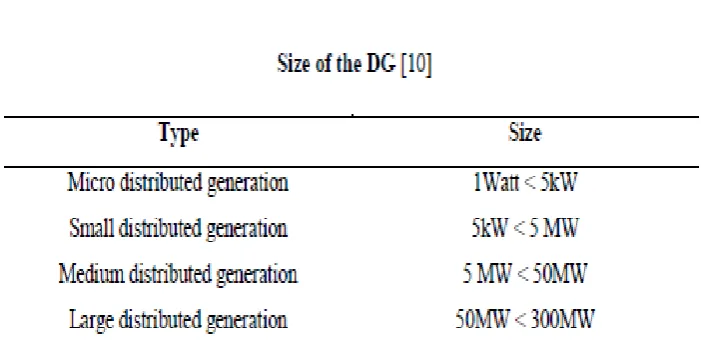
To clarify about the DG concept, some categories that define the size of the
Table 2.1: Size of DG
The different DG technologies and impacts of distributed generation are introduced in this chapter; besides, islanded operation and the impact of DG on distribution feeder protection are presented.
2.2 Types of Distributed Generation
DG can be classified into two major groups, inverter based DG and rotating machine DG. Normally, inverters are used in DG systems after the generation process, as the generated voltage may be in DC or AC form, but it is required to be changed to the nominal voltage and frequency. Therefore, it has to be converted first to DC and then back to AC with the nominal parameters through the rectifier [10]. In this chapter, some of the DG technologies, which are available at the present: photovoltaic systems, wind turbines, fuel cells, micro turbines, synchronous and induction generators are introduced.
2.2.1 Photovoltaic Systems
keep tracking the sun in order to generate the maximum power [9].
[image:22.595.178.480.261.501.2]These systems are environmental friendly without any kind of emission, easy to use, with simple designs and it does not require any other fuel than solar light. On the other hand, they need large spaces and the initial cost is high. In Figure 2.1, a photovoltaic panel is shown.
Figure 2.1: Schematic diagram of a photovoltaic system [11]
2.2.2 Wind Turbines
[image:23.595.147.505.239.465.2]Wind turbines transform wind energy into electricity. The wind is a highly variable source, which cannot be stored, thus, it must be handled according to this characteristic. A general scheme of a wind turbine is shown in Figure 2.2, where its main components are presented [9].
Figure 2.2: Schematic operation diagram of a wind turbine [12]
The principle of operation of a wind turbine is characterized by two conversion steps. First the rotor extract the kinetic energy of the wind, changing it into mechanical torque in the shaft; and in the second step the generation system converts this torque into electricity.
Fuel cells operation is similar to a battery that is continuously charged with a fuel gas with high hydrogen content; this is the charge of the fuel cell together with air, which supplies the required oxygen for the chemical reaction [9].
[image:24.595.181.475.346.579.2]
The fuel cell utilizes the reaction of hydrogen and oxygen with the aid of an ion conducting electrolyte to produce an induced DC voltage. The DC voltage is converted into AC voltage using inverters and then is delivered to the grid. In Figure 2.3 the operation characteristics of a fuel cell are presented.
Figure 2.3: Schematic diagram of a fuel cell [13]
hand, it is necessary to assess the impact of the pollution emissions and ageing of the electrolyte characteristics, as well as its effect in the efficiency and life time of the cell [10].
2.2.4 Micro-Turbines
[image:25.595.148.512.373.551.2]A micro-turbine is a mechanism that uses the flow of a gas, to covert thermal energy into mechanical energy. The combustible (usually gas) is mixed in the combustor chamber with air, which is pumped by the compressor. This product makes the turbine to rotate, which at the same time, impulses the generator and the compressor. In the most commonly used design the compressor and turbine are mounted above the same shaft as the electric generator. This is shown in Figure 2.4.
Figure 2.4: Schematic diagram of a micro-turbine [10]
emissions produced and good efficiency. On the other hand, its disadvantages are the high maintenance cost and the lack of experience in this field. Very little micro-turbines have been operated for enough time periods to establish a reliable field database. Furthermore, methods of control and dispatch for a large number of micro turbines and selling the remaining energy have not been developed yet [10].
2.2.5 Induction and Synchronous Generators
Induction and synchronous generators are electrical machines which convert mechanic energy into electric energy then dispatched to the network or loads.
Induction generators produce electrical power when their shaft is rotated faster than the synchronous frequency driven by a certain prime mover (turbine, engine). The flux direction in the rotor is changed as well as the direction of the active currents, allowing the machine to provide power to the load or network to which it is connected. The power factor of the induction generator is load dependent and with an electronic controller its speed can be allowed to vary with the speed of the wind. The cost and performance of such a system is generally more attractive than the alternative systems using a synchronous generator [14].
The induction generator needs reactive power to build up the magnetic field, taking it from the mains. Therefore, the operation of the asynchronous machine is normally not possible without the corresponding three-phase mains. In that case, reactive sources such as capacitor banks would be required, making the reactive power for the generator and the load accessible at the respective locations. Hence, induction generators cannot be easily used as a backup generation unit, for instance during islanded operation [14].
power factor characteristic and therefore is suitable for power factor correction applications. A generator connected to a very large (infinite bus) electrical system will have little or no effect on its frequency and voltage, as well as, its rotor speed and terminal voltage will be governed by the grid.
Normally, a change in the field excitation will cause a change in the operating power factor, whilst a change in mechanical power input will change the corresponding electrical power output. Thus, when a synchronous generator operates on infinite busbars, over-excitation will cause the generator to provide power at lagging power factor and during under-excitation the generator will deliver power at leading power factor [15]. Thus, synchronous generator is a source or sink of reactive power. Nowadays, synchronous generators are also employed in distribution generator systems, in thermal, hydro, or wind power plants. Normally, they do not take part in the system frequency control as they are operated as constant power sources when they are connected in low voltage level. These generators can be of different ratings starting from kW range up to few MW ratings [16].
2.3 Impact of Distributed Generation on Power System Grids
The introduction of DG in systems originally radial and designed to operate without any generation on the distribution system, can significantly impact the power flow and voltage conditions at both, customers and utility equipment.
Radial distribution systems regulate the voltage by the aid of load tap changing transformers (LTC) at substations, additionally by line regulators on distribution feeders and shunt capacitors on feeders or along the line. Voltage regulation is based on one way power flow where regulators are equipped with line drop compensation.
[image:28.595.147.502.369.592.2]The connection of DG may result in changes in voltage profile along a feeder by changing the direction and magnitude of real and reactive power flows. Nevertheless, DG impact on voltage regulation can be positive or negative depending on distribution system and distributed generator characteristics as well as DG location [3].
Figure 2.5: Voltage profiles with and without DG [3]
sufficient service. The DG reduces the load observed from the load compensation control side, which makes the regulator to set less voltage at the end of the feeder. This phenomenon has the opposite effect to which is expected with the introduction of DG (voltage support) [3].
There are two possible solutions facing this problem: the first solution is to move the DG unit to the upstream side of the regulator, while the second solution is adding regulator controls to compensate for the DG output.
The installation of DG units along the power distribution feeders may cause overvoltage due to too much injection of active and reactive power. For instance, a small DG system sharing a common distribution transformer with several loads may raise the voltage on the secondary side, which is sufficient to cause high voltage at these customers [3]. This can happen if the location of the distribution transformer is at a point on the feeder where the primary voltage is near or above the fixed limits.
During normal operation conditions, without DG, voltage received at the load terminals is lower than the voltage at the primary of the transformer. The connection of DG can cause a reverse power flow, maybe even raising the voltage somewhat, and the voltage received at the customer´s site could be higher than on the primary side of the distribution transformer.
One of the major impacts of Distributed generation is on the losses in a feeder. Locating the DG units is an important criterion that has to be analyzed to be able to achieve a better reliability of the system with reduced losses [3].
According to [3], locating DG units to minimize losses is similar to locating capacitor banks to reduce losses. The main difference between both situations is that DG may contribute with active power and reactive power (P and Q). On the other hand, capacitor banks only contribute with reactive power flow (Q). Mainly, generators in the system operate with a power factor range between 0.85 lagging and unity, but the presence of inverters and synchronous generators provides a contribution to reactive power compensation (leading current) [15].
The optimum location of DG can be obtained using load flow analysis software, which is able to investigate the suitable location of DG within the system in order to reduce the losses. For instance: if feeders have high losses, adding a number of small capacity DGs will show an important positive effect on the losses and have a great benefit to the system. On the other hand, if larger units are added, they must be installed considering the feeder capacity boundaries [3]. For example: the feeder capacity may be limited as overhead lines and cables have thermal characteristic that cannot be exceed.
2.3.3 Impact of DG on Harmonics
[image:31.595.179.471.212.396.2]A wave that does not follow a “pure” sinusoidal wave is regarded as harmonically distorted. This is shown in Figure 2.6.
Figure 2.6: Comparison between pure sinusoidal wave and distorted wave [17]
Harmonics are always present in power systems to some extent. They can be caused by for instance: non-linearity in transformer exciting impedance or loads such as fluorescent lights, AC to DC conversion equipment, variable-speed drives, switch mode power equipment, arc furnaces, and other equipment.
core non-linearity's, grounding and other factors that may result in significant harmonics propagation [3].
When comparing different synchronous generator pitches the best configuration encountered is with a winding pitch of 2/3 as they are the least third harmonic producers. Third harmonic is additive in the neutral and is often the most prevalent. On the other hand, 2/3 winding pitch generators have lower impedance and may cause more harmonic currents to flow from other sources connected in parallel with it. Thus, grounding arrangement of the generator and step-up transformer will have main impact on limiting the feeder penetration of harmonics. Grounding schemes can be chosen to remove or decrease third harmonic injection to the utility system. This would tend to confine it to the DG site only.
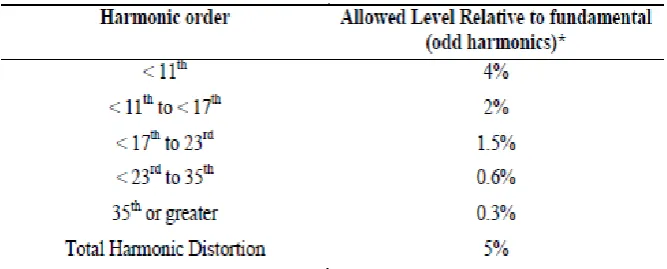
[image:32.595.162.496.631.765.2]Normally, comparing harmonic contribution from DG with the other impacts that DG may have on the power system, it is concluded that they are not as much of a problem [3]. However, in some instants problems may arise and levels can exceed the IEEE-519 standard (these levels are shown in table 2.2). These problems are usually caused by resonance with capacitor banks, or problems with equipment that are sensitive to harmonics. In the worst case, equipment at the DG may need to be disconnected as a consequence of the extra heating caused by the harmonics.
The design of a DG installation should be reviewed to determine whether harmonics will be confined within the DG site or also injected into the utility system. In addition, the installation needs to fulfill the IEEE-519 standard. According to [3], any analysis should consider the impact of DG currents on the background utility voltage distortion levels. The limits for utility system voltage distortion are 5% for THD (total harmonic distortion) and 3% for any individual harmonic.
2.3.4 Impact of DG on Short Circuit Levels of the Network
The presence of DG in a network affects the short circuit levels of the network. It creates an increase in the fault currents when compared to normal conditions at which no DG is installed in the network [3]. The fault contribution from a single small DG is not large, but even so, it will be an increase in the fault current. In the case of many small units, or few large units, the short circuits levels can be altered enough to cause miss coordination between protective devices, like fuses or relays.
Figure 2.7: Fault contributions due to DG units 1, 2 and 3 are embedded in the system. Fuse-breaker coordination may be no longer achieved
If the DG is located between the utility substation and the fault, a decrease in fault current from the utility substation may be observed. This decrease needs to be investigated for minimum tripping or coordination problems. On the other hand, if the DG source (or combined DG sources) is strong compared to the utility substation source, it may have a significant impact on the fault current coming from the utility substation. This may cause fail to trip, sequential tripping, or coordination problems [17].
REFERENCES
1. K Kauhaniemi, L. K. (2004). Impact of Distributed Generation on the Protection of Distribution Networks. „University of Vaasa, Finland, VTT Technical Research Centre of Finland, Finland.
2. Mario Vignolo, R. Z. (2002). Transmission Networks or Distributed Generation. Montevideo, Uruguay.
3. Philip P. Barker, R. W. (2000). Determining the Impact of Distributed Generation on Power Systems: Part 1 - Radial Distribution Systems. 12. IEEE. Retrieved 02 16, 2011, from IEEE.
4. Vu Van Thong, J. D. (2004, January). Interconnection of Distributed Generators and Their Influences on Power System. Katholieke Univeristeit Leuven, Belgium.
5. E. V. Mgaya, Z. M. (2007). The Impact of Connecting Distributed Generation to the Distribution System. Czech Technical University.
6. Falcão, C. L. (2003, June). Impact of Distributed Generation Allocation and Sizing on Reliability, Losses and Voltage Profile. Bologna, Italy.
7. J.Holmes, J. M. (2004). Protection of Electricity Distribution Networks. United Kingdom: Power and Energy Series 47.
Modeling New Forms of Generation and Storage.
10. Gonzalez-Longatt, F. M. (2008, Junio). Impacto de la Generación Distribuida en el Comportamiento de los Sistemas de Potencia. Universidad Central de Venezuela.
11. Ingenieros, A. M. (2011). grupoglobalgreen. Retrieved May 20, 2011, from grupoglobalgreen: www.grupoglobalgreen.es.
12. tutorvista. (n.d.). Retrieved February 18, 2011, from tutorvista: http://www.tutorvista.com/physics/wind-electric-power.
13. Energy OR Technologies Inc. (n.d.). Retrieved February 15, 2011, from Energy OR Technologies Inc:
http://www.energyor.com/energyor/fuel_cell.cfm.
14. Fladerer, T. (2004, March). The Asynchronous Generator in Small Power Plants. Ruhstorf.
15. Chan, T.-F. (2003). SYNCHRONOUS MACHINES. Encyclopedia of Life Support Systems, Polythecnic University, HONG KONG.
16. Walmir Freitas, J. C. (2006, February). Comparative Analysis Between Synchronous and Induction Machines for Distributed Generation Applications. IEEE Transaction on Power Systems.
17. Khan, U. N. (2008). Impact of Distributed Generation on Distributed Network. Wroclav, University of Technology, Poland.
19. M. Gandomkar, M. Vakilian, M. Ehsan, “Optimal distributed generation allocation in distribution network using Hereford Ranch algorithm”, Proceedings of the Eighth International Conference on Electrical Machines and Systems, 2005. Volume 2, Issue, 27-29 Sept. 2005, pp. 916-918.
20. T. Gozel, U. Eminoglu, M.H. Hocaoglu, “A tool for voltage stability and optimization (VS&OP) in radial distribution systems using matlab graphical user interface (GUI)”, Simulation Modelling Practice and Theory 16 (2008), pp 505-518, Elsevier, February 2008
21. T. Gozel, M.H. Hocaoglu, “An analytical method for the sizing and siting of distributed generators in radial systems”, Electric Power Systems Research, 2008
22. Huang, F.-S. P.-J. ( 2001, December). A Detection Algorithm for Islanding- Prevention of Dispersed Consumer-Owned Storage and Generating Units. IEEE.
23. Pukar Mahat, Z. C.-J. (2008, April). Review of Islanding Detection Methods for Distributed Generation
24. Ng H.N., Salama M.M.A. and Chikhani A.Y. ,“Capacitor allocation by approximate reasoning: fuzzy capacitor placement”, IEEE Transactions on Power Delivery, vol. 15, no.1, pp 393 – 398, January 2000.
25. Vladimiro Miranda, J.V. Ranito, L. M. Proenca, “Genetic Algorithms in Optimal Multistage Distribution Network Planning”, IEEE Trans. Power Systems, Vol. 9, no. 4, Nov. 1994, 1927-1933.
Sizing of Capacitors on Radial Distribution Systems Using Loss Sensitivity Factors and -Coefficients‟, IEEE PSCE, 2006.
28. Damodar Reddy M. and Veera Reddy V.C., “optimal capacitor placement using fuzzy and real coded genetic algorithm for maximum savings” Journal of Theoretical and Applied Information Technology,Vol-4, No-3, p.p 219- 226, March – 2008.
29. Das D., Kothari D.P. and Kalam A., “Simple and efficient method for load flow solution of radial distribution networks”, Electrical Power & Energy Systems, vol. 17, no. 5, pp. 335-346,1995.
30. Baran M. E. and Wu F. F., “Network reconfiguration in distribution systems for loss reduction and load balancing,” IEEE Transactions on Power Systems., vol. 4, no. 3, pp. 1401–1407, Aug. 1989.
31. Baran M.E. and Wu F.F., “Optimal capacitor placement on radial distribution systems”, IEEE Transactions on Power Delivery, vol.4
32. S.S. Rao, Engineering Optimization: Theory and Practice, third ed., Wiley-Interscience, New York, 1996.

![Figure 2.1: Schematic diagram of a photovoltaic system [11]](https://thumb-us.123doks.com/thumbv2/123dok_us/8770154.898488/22.595.178.480.261.501/figure-schematic-diagram-of-photovoltaic-system.webp)
![Figure 2.2: Schematic operation diagram of a wind turbine [12]](https://thumb-us.123doks.com/thumbv2/123dok_us/8770154.898488/23.595.147.505.239.465/figure-schematic-operation-diagram-wind-turbine.webp)
![Figure 2.3: Schematic diagram of a fuel cell [13]](https://thumb-us.123doks.com/thumbv2/123dok_us/8770154.898488/24.595.181.475.346.579/figure-schematic-diagram-fuel-cell.webp)
![Figure 2.4: Schematic diagram of a micro-turbine [10]](https://thumb-us.123doks.com/thumbv2/123dok_us/8770154.898488/25.595.148.512.373.551/figure-schematic-diagram-of-micro-turbine.webp)
![Figure 2.5: Voltage profiles with and without DG [3]](https://thumb-us.123doks.com/thumbv2/123dok_us/8770154.898488/28.595.147.502.369.592/figure-voltage-profiles-dg.webp)
![Figure 2.6: Comparison between pure sinusoidal wave and distorted wave [17]](https://thumb-us.123doks.com/thumbv2/123dok_us/8770154.898488/31.595.179.471.212.396/figure-comparison-pure-sinusoidal-wave-distorted-wave.webp)