International Journal of Emerging Technology and Advanced Engineering
Website: www.ijetae.com (ISSN 2250-2459, Volume 2, Issue 10, September 2012)513
Fingerprint Classification using Artificial Neural Network
S. R. Patil (Waghjale)
1, Prof. S. R. Suralkar
21, 2S.S.B.T’s College of Engineering Bambhori, Jalgaon (M.S.)
Abstract— This paper presents some intermediate results on fingerprint classification adopting a neural network as decision stage. The neural network is ready to perform matching process and is successfully developed to identify and classify the fingerprint using back propagation algorithm. The experimental results show the method proposed could improve fingerprint image quality classification accuracy more effectively than others.
Keywords — Fingerprint Classification, Edge Detection, Feature Extraction, Neural Network, Matlab.
I. INTRODUCTION
In last few years identification of fingerprint is widely used in many applications like identification of person. Fingerprint classification is the process of dividing a large amount of fingerprint database within which the input fingerprint is first determined and then a classification is carried out to observe the set of same class. A database usually contains a number of fingerprints with different number of individual features. The identification of input fingerprint within this database becomes an extremely long process. Therefore classification of fingerprint can help to increase the speed of identification. The input fingerprint is classified among the set of classes of fingerprint database. Thus each fingerprint is only need to match against the corresponding class contained in database. Many fingerprint classification methods have been proposed till now like orientation field flow curves method and quality based method [1] [2]. Few of them shows graph based representation and few of them shows structural representation [3]. In this paper we have use a standard fingerprint database to classify fingerprint images into six classes arch, tented arch, right loop, left loop, whorl and twin loop using back propagation algorithm.
II. METHODOLOGY
A Number of different techniques are used for automatic classification of fingerprint. These classifications based on:
•Singular Point [4]
•Syntactic or Grammar Based [5] •Mathematical Model [6]
The most natural topology for analysing fingerprint images is the topology of curves created by the ridge and valley structures.
This necessitates the use of the analysis of properties of the curves or curve features. The approach presented in this paper is combination of biometric and Gabor filter.
III. FINGERPRINT CLASSIFICATION
The approach for fingerprint classification involves (i) the extraction of features of given fingerprint image, (ii) Feature Orientation (iii) labelling of each oriented fingerprint in to six class like arch, tented arch, right loop, left loop, twin loop, whorl. The fingerprints have been traditionally classified into categories based on information in the global patterns of ridges. Fingerprint classification provides an important indexing mechanism in a fingerprint database. An accurate and consistent classification can greatly reduce fingerprint matching time from a large database. We present a fingerprint classification algorithm which is able to achieve an accuracy better Efforts in automatic fingerprint classification have been exclusively directed. Figure 2 shows fingerprint classification architecture that has shown classification of fingers into the six classes. It consist of user interface to provide interaction for user with system, the system database is the collections of the recorded data and enrolment module and authentication module is present for system input and verification of the fingerprint image given by user. A fingerprint classification system should be invariant to rotation, translation, and elastic distortion of the frictional skin. In addition, often a significant part of the finger may not be imaged (e.g., dabs frequently miss deltas) and the classification methods requiring information from the entire fingerprint may be too restrictive for many applications. A number of approaches for fingerprint classification have been developed.
A. Fingerprint sensing
There are two primary methods of capturing a fingerprint image:
1) Inked (off-line) and 2) Live scan
International Journal of Emerging Technology and Advanced Engineering
Website: www.ijetae.com (ISSN 2250-2459, Volume 2, Issue 10, September 2012)514
The laser light source illuminates the glass at a certain angle and the camera is placed such that it can capture the laser light reflected from the glass. The light touched by the ridges is randomly scattered while the light corresponding to valleys suffers total internal reflection. Consequently, the image formed on the plane of the CCD corresponding to ridges is dark and those corresponding to valleys are bright. More recently, capacitance-based solid state live-scan fingerprint sensors are gaining popularity since they are very small in size and inexpensive in the near future. A capacitance-based fingerprint sensor essentially consists of an array of electrodes. The fingerprint skin acts as the other electrode, forming a miniature capacitor. The capacitance due to the ridges is higher than those formed by valleys. This differential capacitance is the basis of operation of a capacitance-based solid state sensor.
B. Feature Extraction
A feature extractor finds the ridge endings and ridge bifurcations from the input the overall flowchart of a typical process is depicted in Figure 3. It mainly consists of three components.
1. Orientation field estimation, 2. Ridge extraction, and
3. Minutiae extraction and post processing.
C. Classification Algorithm
[image:2.612.325.578.134.324.2]The fingerprint classifications start with the orientation of input image followed by the Ridge Extraction. This image is used for Minutia Point extraction to train neural network by thinning
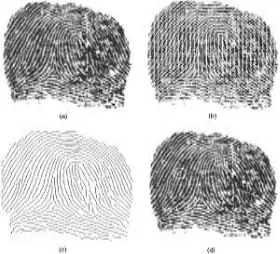
Fig. 1 Orientation field, thinned ridges, minutiae and singular points. (a) Gray scale image. (b) Orientation field. (c) Thinned ridges.
[image:2.612.99.239.508.635.2](d) Minutiae (.), Core (u), and Delta (D).
Fig 2. Fingerprint Classification algorithm.
D. Abbreviations and Acronyms
Admin login to Server with all system32 files control by wireless GSM with gives all system and network information from server to each client & Security on network. Total WCC handle by GSM handset, Wireless application so that best in their ways. Secure network working process with use in big organizations. WCC is wireless so that GSM is best way to used. Its new technology and global used of networking. Multicast VIOP is possible with secured network. MS messenger provide SMS into Voice SMS. Total application base on algorithms. SMS lib package is used for such application run on the multicasting technique.
IV. FUNCTIONAL SYSTEM
Fig 3. Fingerprint classification system
A. Image Acquisition
[image:2.612.336.579.509.575.2]International Journal of Emerging Technology and Advanced Engineering
Website: www.ijetae.com (ISSN 2250-2459, Volume 2, Issue 10, September 2012)515
Two types of degradation usually affect fingerprint images: 1) the ridge lines are not strictly continuous since they sometimes include small breaks (gaps); 2) parallel ridge lines are not always well separated due to the presence of cluttering noise. The resolution of the scanned fingerprints must be 500 dpi while the size is 300 x 300.
B . Edge Detection
An edge is the boundary between two regions with relatively distinct gray level properties. The idea underlying most edge-detection techniques is on the computation of a local derivative operator such as ‗Roberts‘, ‗Prewitt‘ or ‗Sobel‘ operators. In practice, the set of pixels obtained from the edge detection algorithm seldom characterizes a boundary completely because of noise, breaks in the boundary and other effects that introduce spurious intensity discontinuities. Thus, edge detection algorithms typically are followed by linking and other boundary detection procedures designed to assemble edge pixels into meaningful boundaries.
C. Thinning
An important approach to representing the structural shape of a plane region is to reduce it to a graph. This reduction may be accomplished by obtaining the skeleton of the region via thinning (also called skeletonising) algorithm.
The thinning algorithm while deleting unwanted edge points should not:
•Remove end points. •Break connectedness
•Cause excessive erosion of the region.
D. Feature Extraction
[image:3.612.342.556.145.212.2]A multilayer perceptron (MLP) of three layers is trained to detect the minutiae in the thinned fingerprint image of size 300x300. The first layer of the network has nine neurons associated with the components of the input vector. The hidden layer has five neurons and the output layer has one neuron. The network is trained to output a ―1‖ when the input window in cantered on a minutiae and a ―0‖ when it is not. Back propagation algorithm with momentum and learning rate is 0.3 and the Al-Alaoui back propagation algorithm. State the number of epochs needed for convergence as well as the training time for the two methods. Once the network is trained, the next step is to input the prototype fingerprint images to extract the minutiae.
Fig 5. Core points on different fingerprint pattern (a) tented arch (b) write loop (c) left loop (d) whorl.
E. Gabor Filter
Gabor filter based features have been successfully and widely applied to face recognition, pattern recognition and fingerprint enhancement. The family of 2-D Gabor filters was originally presented by Daugman (1980) as a framework for understanding the orientation and spatial frequency selectivity properties of the filter. Daugman mathematically elaborated further his work. In a local neighbourhood the gray levels along the parallel ridges and valleys exhibit some ideal sinusoidal shaped plane waves associated with some noise.
V. NEURAL NETWORK
In our study we have constructed a neural network for a classification of fingerprint images as an expert system which can classify the complicated fingerprint images. Fingerprints are then classified using neural network.
Fig 6. Neural Network Methodology
[image:3.612.333.563.457.583.2]International Journal of Emerging Technology and Advanced Engineering
Website: www.ijetae.com (ISSN 2250-2459, Volume 2, Issue 10, September 2012)516
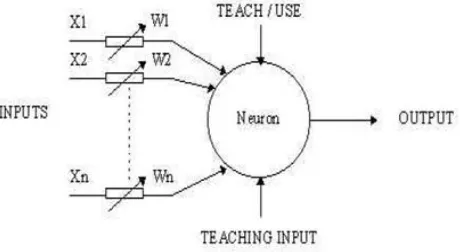
The activation function is also referred to as a squashing function in that it squashes (limits) the permissible range of the output signal to some finite value In mathematical terms, the neuron is fired when (X1 * W1 + X2 *W2 + ……+ Xn * Wn) >T, where T is a defined threshold value.
VI. MATLABIMPLEMENTATION
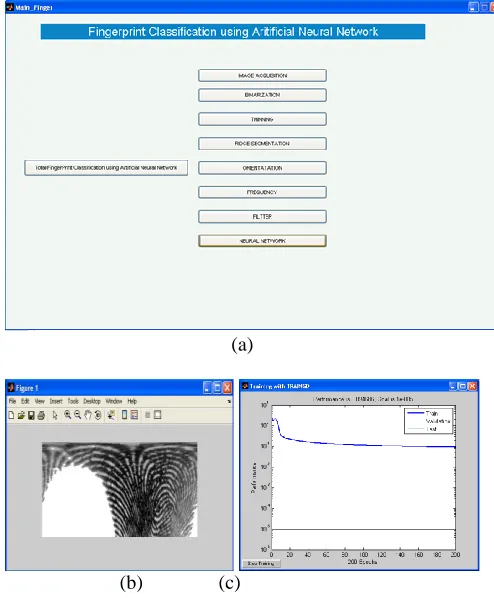
The design stage of the project involved developing cooperative classification algorithm using the MATLAB programming language and MATLAB GUI for the easy utilization of system. MATLAB was chosen as the design tool of choice, due to the high level nature in which MATLAB is developed.
(a)
[image:4.612.324.554.133.486.2](b) (c)
Fig 7. Software Implementation (a) GUI (b) Extraction (c) Training
VII. OUTPUT
(a) (b)
(b) (d)
(e) (f)
Fig 8. Output windows (a) Binarization (b) Thinning (c) Segmentation (d) Orientation (e) Frequency (f) Filter.
[image:4.612.47.294.296.595.2]
International Journal of Emerging Technology and Advanced Engineering
Website: www.ijetae.com (ISSN 2250-2459, Volume 2, Issue 10, September 2012)517
VIII. RESULT
The methodology presented in previous section was validated on standard database. The database contains total of 800 images which are classified in to six classes like arch, tented arch, right loop, left loop, whorl and twin loop successfully. The classification result given by the system with minimum of rejection ratio is very accurate. It is obvious that presented method has greatly improved fingerprint image classification accuracy. Simulation results verified that the proposed algorithm is accurate and effective.
Image Type
No of
Images Result
Whorl 20 89.6
Left Loop 20 89.75
Arch/ Tented 20 89.75
Twin Loop 2 56.5
Right Loop 5 75.4
Final Result 67*8=536 80.2
REFERENCES
[1] Fingerprint verification based on fixed length square finger code by Prof. S.R.Suralkar and Prof. P.M.Patil proceeding of 17th IEEE international conference on Tools with Artificial Intelligence 2005. [2] Matching of finger print using Minutiae and texture features by Prof.
S.R.Suralkar and Prof. P.M.Patil.
[3] Rotation invariant thinning algorithm to detect ridge bifurcation for finger print identification by Prof. S.R.Suralkar and Prof. P.M.Patil proceeding of 17th IEEE international conference on Tools with Artificial Intelligence 2005.
[4] A. K. Jain, R. Bolle, S. Pankanti (eds), Biometrics: Personal Identification in Networkedm Society, Kluwer Academic, December 1998.
[5] Fingerprint Classification with Neural Networks Hugo Vieira Neto Pyramidal Structure Algorithm for Fingerprint Classification Based
on Artificial Neural Networks Eug`ene C. Ezin May 13, 2009] [6] An Effective Fingerprint Classification and Search Method M H
Bhuyan† and D K Bhattacharyya††Dept of Computer Sc. & Engg., Tezpur University, Napaam, Tezpur, Assam,
[7] High Quality Cluster Generation of Feature Poin Fingerprint Using Neutral Network Bhupesh Gour Asst. Prof. Dept. of Computer Sc. & Engg T. K. Bandopadhyaya Professor, Bansal Institute of Science and Technology, Bhopal
[8] Gabor Filters Based Fingerprint Identification Using Spike Neural Networks Youssef ELMIR* and Mohammed BENYETTOU* [9] J. Canny, A Computational Approach to Edge Detection, IEEE
Transactions on PAMI, Vol.8, No. 6, pp. 679-698, 1986.
[10] R. Germain, A Califano, and S. Colville, Fingerprint matching using transformation parameterclustering, IEEE Computational Science and Engineering, Vol. 4, No. 4, pp. 42–49, 1997.
[11] Anil K. Jain, Salil Prabhakar, and Lin Hong, "A Multichannel Approach to Fingerprint Classification," in IEEE Transactions on Pattern Analysis and Machine Intelligence, vol. 21, no. 4, pp. 348– 359, April 1999 [NAT 10] National Institute of Standards and Technology (NIST), website: www.nist.gov/data/biomet.htm [12] ]H O Nyongesa, S Al-Khayatt, et al. ―Fast Robust Fingerprint
Feature Extraction and classification,‖ Journal of Intelligent and Robotic Systems, vol-40(1), Page(s): 103-112, 2004.
[13] Feng Zhao and Xiaoou Tang, ―Preprocessing and Postprocessing for skeleton-based fingerprint minutiae extraction,‖ Pattern Recognition, 40(1270-1281), 2007.
[14] Sharat Chikkerur et al, ―Systematic Approach for feature Extraction in Fingerprint Images‖ Centre for unified Biometric and Sensors, University at Buffalo, NY, USA, 2003.