4097
AN INTELLIGENT APPROACH FOR PREDICTING SOCIAL
MEDIA IMPACT ON BRAND BUILDING
1ALTYEB ALTAHER, 2AHMED HAMZA OSMAN
1,2Faculty of Computing and Information Technology in Rabigh, King Abdulaziz University, Jeddah, Saudi
Arabia
E-mail: 1[email protected], 2 [email protected]
ABSTRACT
Social media networks such as Twitter and Facebook plays important roles in many aspects of our lives and affects many of our decisions. This paper presents a data mining model consists of different five classification and regression algorithms to predict the significant performance metrics of posts announced in the Facebook pages of the brands. The algorithms utilized in the model include the Generalized Liner Regression (GLR), Normal Regression (NR), support Vector Machine, Neural Network, and CHAID decision tree classifier. Using a dataset contained a 790 published posts in the cosmetic brand, the Lifetime post consumers achieved the best posts performance metrics with an average accuracy of 0.82 among all the algorithms in the proposed model, followed by the Lifetime post total reach performance metric with an average accuracy of 0.79. The findings of this research potentially help the manager's in making the right decisions regarding whether to publish a post.
Keywords: Data Mining, Classification, Social Media, Brand Building, Performance Metrics
1. INTRODUCTION
The exponential increasing in the number of internet users coupled with the new enhances in the telecommunication technologies, have made the social media as suitable place for customers to discuss ideas and opinions about services and products [1]. According to Statista, the number of social network users is estimated to reach 2.95 billion users in 2020, with more than 1.86 billion users active each month, Facebook is considered as a market pioneer in terms of scope and reach [2]. Considering the fast development in the social media, it could become the potential media channel for companies to contact their customers [3].
Companies started to depend on the social media networks in their strategies to attract the customers [4]. Many Research efforts concentrated on exploring the relations between publishing on social networks and customers' interactions [5]. However, few researchers devoted their efforts to develop predictive approaches able to expect the impact of a post before the publication. An approach with ability to expect the influence of announced posts can offer a significant benefits, related to the suitability of the social media based
promotion of products and services. The social media publications have potential impact on the brand building [6]. Therefore, the findings of this research could help in making the right decisions related to improving trademark credit. Data mining techniques offer an important methodology for getting knowledge based on the available data [7]. The data mining techniques have been used to explore the market trends based on the inputs of the users [8]. However, most of the researches concentrated on evaluating the users opinions based on information gathered from different sources [9]. Our research focused on the prediction of the influence of announcing posts on the social media pages of the firm. The main contributions of this paper as follows:
• Developing a model for predicting the influence of posts based on their features
• Evaluating the developed model by measuring the dissimilarity between the predicted value and the real value.
4098 The rest of this paper is structured as follows: section 2 presented the related work, the proposed model is explained in section 3. Experimental Results and discussion presented in section 4. Section 5 concludes our paper.
2. RELATED WORK
The impact of brand advertisements in social media on the brand trust. According to [11], digital interactions are probably affecting 64 cents of each dollar paid in shopping starting from 2015, based on a survey of over 3000 US customers, showing the significant influence of social media on the incomes of the firms.
The establishment of online customer media may be initiated by social media networks such as Facebook and Twitter, offering an evolving concern about specific products, corporations and trademarks. Therefore, to build commercial importance, corporations should integrate the community development as portion of the of social media implementation [12]. Trademark societies based on social media improve spirits of community in the members and support making significance for firms and participants [13]
Hudson et al.[14] performed three studies to investigate the correlation between customers behavior and social media practice, the results indicated that attracting customers through social media was related to achieving high consumer– brand relationships. In [15], Griffiths and McLean assessed the adoption of social media in UK-based firm, they found that social media promotion had a optimistic influence on trademark reputation.
Most of the researches in the literature strongly signifies the impact of social media on trademark building. However, research in this area is still limited. Research studies are expected to be conducted in future, presenting innovative studies for satisfying the need for more investigation [16].
3. THE PROPOSED MODEL
The proposed model for consists of different five classification and regression algorithms to predict the significant performance metrics of posts announced in the Facebook pages of the brands. The algorithms utilized in the model include the Generalized Linear Regression (GLR), Normal Regression (NR), support Vector Machine, Neural Network, and CHAID decision tree classifier. The Generalized Linear model enlarges the general linear model, thus the dependent variable is linearly associated to the elements and
covariates through identified connection function. The Support Vector Machine (SVM) node allows the classification of data into two sets without over fitting. SVM performs better with large data sets. Neural network is a useful technique to cluster the data set into different sets. It consist of a big number of interconnected neurons working together to find solutions to certain problems. Neural networks need to be trained to learn. The CHAID method creates decision trees based on chi-square statistics to find best splits. In addition, CHAID has the ability to create non-binary trees [17].
4. CORPUS AND EXPERIMENTAL
RESULTS
This section presents the used corpus and the experimental results.
4.1 Corpus
The introduced method comprises a different classification and machine learning experimental techniques at its principal, resulting in a UCI Facebook dataset process. The UCI Facebook dataset [18] has been collected from the internet Facebook's side of the renowned cosmetic brand in 2014. The dataset contained a 790 published posts in the cosmetic brand. It is categorized into four main types includes; Identification features (the attributes that defining each single post); content features (represents the word-based part of the published post); Classification features (the attributes that can describe the published post); Performance features (the evaluation parameters that influence of the published post such as ‘Page total likes’ feature). Table 1 demonstrates the UCI Facebook Corpus that was used in this study.
4099
Table 1: The features and features types in the UCI Facebook Corpus .
4.2 The experimental results and discussion
[image:3.612.314.523.167.343.2]Our experiments models were conducted and performed in two main phases; training and testing stages as shown in figure 1 and figure 2.
Figure 1: Training Model
The dataset divided into 80% for training phase and 20 for the testing phase. In the training stage, all features are selected as an input of the suggested model except the target feature. The target features were selected based on the discretion of the dataset that was explained by Sérgio Moro and et.al [18]. Their proposed model can be selected one of the twelve attributes from feature 9 to 20 as ordered in Table 1. Actually, these features used for
computing the total interactions on the Facebook plus cosmetic brand site. In our proposed model, we used the important features that can affect the accuracy performance including feature number 9, 10, 12 and 14.
Figure 2: Testing Model
[image:3.612.90.311.481.601.2]4101
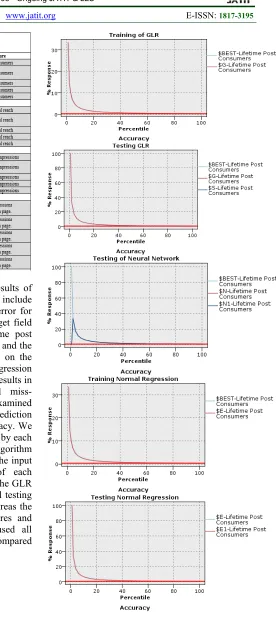
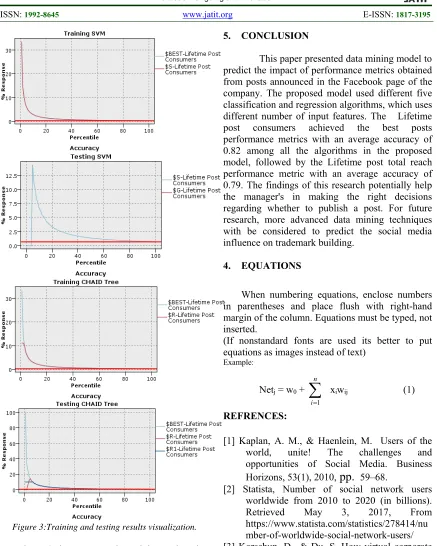
Figure 3:Training and testing results visualization.
Figure 3 demonstrates the training and testing results visualization. The Lifetime post consumers achieved the best posts performance metrics with an average accuracy of 0.82 among all the algorithms in the proposed model, followed by the Lifetime post total reach performance metric with an average accuracy of 0.79. The findings of this research potentially help the manager's in making the right decisions regarding whether to publish a post.
5. CONCLUSION
This paper presented data mining model to predict the impact of performance metrics obtained from posts announced in the Facebook page of the company. The proposed model used different five classification and regression algorithms, which uses different number of input features. The Lifetime post consumers achieved the best posts performance metrics with an average accuracy of 0.82 among all the algorithms in the proposed model, followed by the Lifetime post total reach performance metric with an average accuracy of 0.79. The findings of this research potentially help the manager's in making the right decisions regarding whether to publish a post. For future research, more advanced data mining techniques with be considered to predict the social media influence on trademark building.
4. EQUATIONS
When numbering equations, enclose numbers in parentheses and place flush with right-hand margin of the column. Equations must be typed, not inserted.
(If nonstandard fonts are used its better to put equations as images instead of text)
Example:
Netj = w0 +
n
i 1
xiwij (1)
REFRENCES:
[1] Kaplan, A. M., & Haenlein, M. Users of the world, unite! The challenges and opportunities of Social Media. Business Horizons, 53(1), 2010,
pp.
59–68.[2] Statista, Number of social network users worldwide from 2010 to 2020 (in billions). Retrieved May 3, 2017, From https://www.statista.com/statistics/278414/nu mber-of-worldwide-social-network-users/ [3] Korschun, D., & Du, S. How virtual corporate
social responsibility dialogs generate value: A framework and propositions. Journal of Business Research, 66(9), 2013,
pp.
1494– 1504.4102 [5] Cvijikj, I. P., Spiegler, E. D., & Michahelles, F.
The effect of post type, category and posting day on user interaction level on Facebook. In Privacy, Security, Risk and Trust (PASSAT) and 2011 IEEE Third International Conference on Social Computing (SocialCom), 2011 IEEE Third International
Conference on, 2011, pp. 810–813
[6] Edosomwan, S., Prakasan, S. K., Kouame, D.,Watson, J., & Seymour, T. The history of social media and its impact on business. Journal of Applied Management and Entrepreneurship, 16(3), 2011,
pp.
79–91. [7] Turban, E., Sharda, R., Delen, D., & Efraim, T.Decision support and business intelligence systems (9th ed.), 2011. Pearson.
[8] Trainor, K. J., Andzulis, J. M., Rapp, A., & Agnihotri, R. Social media technology usage and customer relationship performance: A capabilities-based examination of social CRM. Journal of Business Research, 67(6), 2014,
pp.
1201–1208.[9] Bianchi, C., & Andrews, L. Investigating marketing managers' perspectives on social media in Chile. Journal of Business Research, 68(12),2015,
pp.
2552–2559.[10] Laroche, M., Habibi, M. R., Richard, M. O., & Sankaranarayanan, R. The effects of social media based brand communities on brand community markers, value creation practices, brand trust and brand loyalty. Computers in Human Behavior, 28(5), 2012,
pp.
1755– 1767.[11] Digital, Deloitte .Navigating the new digital divide—capitalizing on digital influence in retail, 2015. Retrieved September 12, 2015, from
http://www2.deloitte.com/content/dam/Deloitt e/us/Documents/consumer-business/us-cb-navigating-thenew-
digital-divide-v2-051315.pdf
[12] Culnan,M. J.,McHugh, P. J., & Zubillaga, J. I. Howlarge US companies can use Twitter and other social media to gain business value. MIS Quarterly Executive, 9(4), 2010,
pp.
243–259.
[13] Laroche, M., Habibi, M. R., Richard, M. O., & Sankaranarayanan, R. The effects of social media based brand communities on brand community markers, value creation practices, brand trust and brand loyalty. Computers in Human Behavior, 28(5), 2012,
pp.
1755– 1767.[14] Hudson, S., Huang, L., Roth, M. S., & Madden, T. J. The influence of social media interactions on consumer–brand relationships: A three-country study of brand perceptions and marketing behaviors. International Journal of Research in Marketing, 2015. [15] Griffiths, M., & McLean, R. Unleashing
corporate communications via social media: A UK study of brand management and conversations with customers. Journal of Customer Behaviour, 14(2), 2015,
pp.
147– 162.[16] Okazaki, S., & Taylor, C. R. Social media and international advertising: Theoretical challenges and future directions. International Marketing Review, 30(1), 2013,
pp.
56–71. [17] Cortez, P. Data mining with neural networksand support vector machines using the R/rminer tool. Advances in data mining. Applications and theoretical aspects, 2010, pp. 572–583.