© 2017, IRJET | Impact Factor value: 5.181 | ISO 9001:2008 Certified Journal | Page 1530
AN EXPERIMENTAL STUDY ON PARTIAL REPLACEMENT OF FINE
AGGREGATES WITH MONTMORILLONITE
Asst. Prof K.N.LAKSHMAIAH
Civil Engineering department, Narasaraopeta Engineering College, Narasaraopeta, A.P, India
---***---ABSTRACT:Concrete is a composite material composed ofcoarse aggregate bonded together with fluid cement that hardens over time. The Concrete is the single most widely used material of concrete is predominant in present world; Concrete is used in such large amounts because it is simply, a awfully good building material. Aggregates generally occupy 60 - 80% of the volume of concrete and greatly influence its properties like mix proportions and economy. Use of Montmorillonite in concrete, enhances the crack resistance, shrinkage, fire resistance and reduces environmental impact and also reduces the cost. Some important properties and characteristics of aggregate are grading, abrasion, resistance to freeze/thaw action, resistance to sulphates, density, and compressive, tensile strength and flexural strength. Montmorillonite undergoes significant expansion when heated, Exfoliation occurs when the mineral is heated sufficiently, and the effect is routinely produced in commercial furnaces. In this paper discuss about the study the strength parameters such as compressive strength, tensile & flexural strength of concrete using Montmorillonite as partial replacement with 20%, 40% and 80% by weight. The main aim of this study is to make the concrete eco-friendly and economical for construction.
Key words- Montmorillonite, Concrete, Compressive strength,
Tensile strength and flexural strength
1. INTRODUCTION
Concrete is good building material; in present scenario the use of concrete is predominant for constructions. Many types of concrete are available, distinguished by the proportions of the main ingredients. In this way or by substitution for the cementitious and aggregate phases, the finished product can be tailored to its application. Strength, density, as well chemical and thermal resistance is variables. As concrete is the good building material it is used worldwide in various structural members such as slabs, beams, columns, foundation, etc. Due to its low thermal conductivity property, fine aggregates are replaced with Montmorillonite and compressive strength, tensile strength and flexural strength are tested. Generally Montmorillonite can resist the temperature up to 1500°C and it has high thermal Insulation co-efficient of λ>0.046 W/m° C. Because of this property Montmorillonite are added in concrete by replacing fine aggregates by 20%, 40% and 80% by weight and their strength parameters.
2. MATERIALS USED
2.1. CEMENT:
Cement is a binder, a substance used in construction that sets, hardens and adheres to other materials, binding them together. The most common use for Portland cement is in the production of concrete. Concrete is a composite material consisting of aggregate (gravel and sand), cement, and water. As a construction material, concrete can be cast in almost any shape desired, and once hardened, can become a structural (load bearing) element. Cement used to prepare the specimen was 53 grades Ordinary Portland cements, conforming to IS 12269:2013 with a fineness of 1%, standard consistency of 34% and Initial setting time 30 min.
Fig-1 Cement
2.2. WATER:
Portable water was used for mixing and curing of concrete specimens.
2.3. MONTMORILLONITE:
© 2017, IRJET | Impact Factor value: 5.181 | ISO 9001:2008 Certified Journal | Page 1531
inert chemical nature. Montmorillonite taken for concretepreparation which passes through 2.36mm sieve size.
Fig-2 Montmorillonite as a fine aggregate
2.4. FINE AGGREGATE (SAND):
Sand is a naturally occurring granular material composed of finely divided rock and mineral particles. The present scenario in the world, the availability of sand is very low as compared to olden days and cost is also very high due to lack availability of sand. So as to replace the sand with montmorillonite. It is defined by size, being finer than gravel. Fine aggregates are taken for concrete preparation which passes through 2.36mm sieve size.
Fig-3 Sand
2.5. COARSE AGGREGATE:
Coarse aggregates are an integral part of many construction applications, sometimes used on their own, such as a granular base placed under a slab or pavement, or as a component in a mixture, such as asphalt or concrete mixtures Course aggregates of 4.75mm to 12.5mm size aggregates were used.
Fig-4 Coarse aggregate
2.6. MIX DESIGN:
As per IS 10262:2008 design mix for M 30 grade of concrete was prepared by replacing fine aggregates by 20%,40% and 80% by weight.
Fig-5 Concrete mix
3. MATERIAL TEST RESULTS
Table-1 Physical properties of cement
Fineness
Modulus consistency Normal
Initial Setting
time
Final Setting
time
1% 34% 30min 260 min
Table-2 Physical properties of fine aggregates
Fineness
Modulus Specific gravity absorption Water
2.85 3.1 1.92
Table-3 Physical properties of montmorillonite
Fineness
Modulus Specific gravity absorption Water
© 2017, IRJET | Impact Factor value: 5.181 | ISO 9001:2008 Certified Journal | Page 1532
Table-4 Physical properties of coarse aggregatesFineness
Modulus Specific gravity absorption Water
7.82 2.4 2.57
4. LABORATORAY TEST RESULTS:
4.1. Compressive Strength
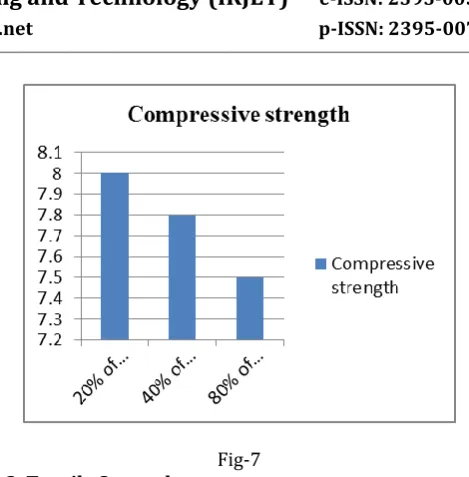
[image:3.595.62.265.121.190.2]Compressive strength was tested in compressive testing machine .Cube specimens of size 150mm x 150mm x 150mm were adopted for the test. Compressive strength was tested after 7, 14 and 28 days of curing. The results of the tests are tabulated below.
Fig-6 Compressive Strength test
Table-5 Compressive Strength results
S.
No Type of Mix (cube specimen)
Age of curin
g (day
s)
Average strength
1 montmorillo20% of nite
80% of sand
7 9
14 23
28 40
2 montmorillo40% of nite
60% of sand
7 14
14 20
28 38
3 montmorillo80% of nite
20% of sand
7 19
14 15
28 48
Fig-7 4.2. Tensile Strength
[image:3.595.52.272.319.487.2]The test was conducted in compression testing machine. Cylindrical specimens were 150 mm diameter and 300 mm height. The results of the tests conducted are tabulated below.
Fig-8 Tensile Strength test
Table 6 Tensile Strength results
S. N o
Type of Mix (cube specimen)
Age of curing (days)
Average strengt
h
1 montmorilloni20% of te
80% of sand
7 4.10
14 4.52 28 5.00
2 montmorilloni40% of te
60% of sand
7 4.00
14 4.20 28 4.80
3 montmorilloni80% of te
20% of sand
7 3.80
[image:3.595.334.531.374.497.2]© 2017, IRJET | Impact Factor value: 5.181 | ISO 9001:2008 Certified Journal | Page 1533
Fig-94.3. Flexural Strength
Flexural strength was tested in compression testing machine the test was carried out on beams of size 100x100x50mm.The results of tests are tabulated below.
Fig-10 Tensile Strength test
Table-6 Tensile Strength results
S. N o
Type of Mix (cube specimen)
Age of curing (days)
Averag e strengt
h
1 Montmorilloni20% of te
80% of sand
7 6.1
14 6.4
28 8
s
2 Montmorilloni40% of te
60% of sand
7 5.2
14 6.1
28 7.8
3 Montmorilloni80% of te
20% of sand
7 5.2
14 6.3
28 7.5
Fig-11
5. CONCLUSION
The strength parameters such as compressive strength, tensile strength test and flexural strength of Montmorillonite concretes of various percentages are found.
1. The optimum strength in comparing the strengths for different Montmorillonite was observed to be 40%.
2. Addition of Montmorillonite in concrete makes it heat resisting & resists shrinkage and cracks in concrete.
3. Because of inert chemical nature of Montmorillonite when it is used in concrete it will not undergo any chemical reaction and also it is an eco-friendly material.
6. REFERENCE
1. Montmorillonite Clay Benefits, Uses in Cat / Dog Food, Structure & Properties". DurableHealth. Retrieved 12 October 2015. 2. Dushyant R. Bhimani (2013) “A Study on
Foundry Sand: Opportunities for Sustainable and Economical Concrete” Journal of Building Physics
3. Manolia Abed Al-wahab Ali (2012) “The Possibility of Produce Self Compacted Polystyrene Concrete” Journal of Engineering and Development.
4. Eknath P.Salokhe, D.B.Desai (2012) “Application of Foundry Waste Sand In Manufacture of Concrete” Journal of Mechanical and Civil Engineering