ISSN: 1992-8645 www.jatit.org E-ISSN: 1817-3195
THE ROLE OF IT IN ENHANCING PRODUCTIVITY AT
HIGHER EDUCATION INSTITUTIONS FROM STAFF AND
STUDENTS’ PERSPECTIVE
- EVIDENCE FROM OMAN
1SAMIR HAMMAMI,2MANSOUR NASER ALRAJA, 3SYED AHSAN JAMIL
1,2
Asstt Prof., Department of Management Information Systems, Dhofar University
3
Associate Prof., Department of Accounting and Finance, Dhofar University
Email:
1[email protected], [email protected], [email protected]
ABSTRACT
The main goal of this research is to assess the factors affect the overall role of information technology to increase productivity of higher education institutes from staff and students’ perspective, as there is a strong need to involve other stakeholders such as employees and students besides top management in these institutes in overall assessment and development, this will help decision makers to get the needed practices through which these institutes can overcome the challenges which are facing such as rapid changing in education requirements, increasing complexity of the technology domain, which required solid and updated information and analytical systems, and IT staff and student skills.
In addition the new raising challenges, like infrastructure and applying project management concepts in order to gain a competitive advantage, which will lead these institutes to grow and attract more students while offering quality education.
A model was developed in order to support the research theoretical parts about the effects of IT infrastructure, IT system analysis, IT plan, IT systems, IT staff skills, students skills and library systems on increasing productivity at higher education institutes, for this purpose a survey was done and distributed among departments and students and there were (156) respondents.
Through the theoretical study, and based on the outputs of the research survey, the researchers found that the results indicated that higher institutes productivity can be enhanced, and this enhancement will be reflected in several sub factors of the tested model, like enhancing IT systems will seriously impact the higher institute productivity and this impact can be noticed in many fields like the incomplete, and limited information for decision-making, ineffective use of employee time, lack of accurate and real-time information in the right people’s hands when they need it and so on.
The findings present number of recommendations which aim to develop the awareness about the productivity of higher education institutes, from the perspective of their students.
This research clearly highlights the needs to build the right culture that keeps looking at technology as a main asset of the higher institute, in addition to pay attention to the employee factor, and try to develop their skills; all of these will make the needed results by building an IT strategy for wise investment in information technology.
Keywords: IT, Education, Productivity, Knowledge, Systems, Capabilities.
1. INTRODUCTION
Technology plays a great role in productivity of any organization to achieve the innovation management [1]. The main common use of IT in educational institutes is to provide students with access to online resources and enhancing educational experience, especially with the rise in student numbers and how to provide them with flexible learning opportunities[15]. Further, the use of web
ISSN: 1992-8645 www.jatit.org E-ISSN: 1817-3195 thinking and develop a more comprehensive
perspective, many students do not learn the skills needed to master technology as quickly as others. This is concerning because it supposed that students will enhance their skills when using technology frequently [2].
2. LITERATURE REVIEW
According to the aforesaid, the rapidly growing interest in use information technology in education sector over the world, due to several reasons like the neediness to create well educated generations to deal the rapid advancement of science and technology to build the country and modernize it. Also, the latest researches lead to recognize that technology as an asset. However, educational institutes can use it to improve students’ level by developing and maintaining the present and future
value of technology assets and increase
productivity of technology among the actors [1].
This study derive its importance as it is deals with one of the main issues that affects the productivity of the companies, and how to benefit from the technological assets, in other words; Higher education institutions can overpass the challenges that affect the productivity of the by implementing the wise investment strategy in information technology because it is recognized as an effective tool for improving the productivity at universities. The main objective of this study is to identify the extent to which the components of IT affecting the productivity. So, the researchers are trying to answer the following main question: To what extent these components (IT Infrastructures, IT Systems, IT Staff, Students’ IT skills and Electronic Library) in affecting the work productivity in higher education institutions.
2.1.Information Technology Pillars
The Information Technology pillars include it infrastructure, it systems, it staff capabilities, it students’ skills and e. library.
2.1.1. IT Infrastructure
The expenditures on building and maintaining information technology infrastructure, takes over 58 percent of an organization's information technology budget and the percentage is growing at 11 percent a year [11]. So, Infrastructure is the important base of technology innovations [5], [35]. However, many firms resort to overspend on
software, paying insufficient attention to data accuracy and integrity [7], [21].
2.1.2. IT Systems
Because of positive expects that the investment in information technology systems will lead to large outcomes for the firms [21]. Soto-Acosta & O'Cerdan [32] found that there is positive relationship between firm performance and business strategies, so companies should use the sense and respond strategy making in this turbulent environment of economic and businesses , especially under unpredicted future, and this planning needs joint efforts from all stakeholders in the organizations [27], [12], [34], [19]. However, the key success factor to avoid this turbulent environment is planning of the enterprise system [14]. Further, the most important key to achieve success for information systems managers is strategic information systems planning, and IT systems should be reliable and have good performance [10].
2.1.3. IT staff Capabilities
IT staff is one of the important success factors of the organizations, because they contribute to system analysis and design in addition to human resources planning [17], [33], [29]. For that, majority of organizations are seeking to acquire the people holding oriented approach in business [26, [33], [29]. Thereby, the existence of knowledge workers is the focal point of information system success, but they must be qualified in several skills, in addition to their IT skills, like ability to understand the vision and issues of business, self-development, and team working [8], [33].
2.1.4. IT Students’ skills
To accomplish the success of information technology in higher education institutions, students must have the know-how, capabilities, skills, and expertises [36]. Beyond that, higher
education institutions provide community
intellectual capital, so they try to align the students
ability with their overall strategy.[30], [13], [41].
2.1.5. E. Library
ISSN: 1992-8645 www.jatit.org E-ISSN: 1817-3195 of the subject contains, and these subjects should
be up to date, in addition to make sure that the e. library should be available 24/7/365 [21].
2.2.Higher Institute Productivity Pillars
The higher institute productivity pillars include efficiency, vision and missions, support decision makers, students and staff productivity
2.2.1. Efficiency
The success in information technology
implementation depends on the successful in
meeting the user(s) [21]. Moreover, any
organization must take in consider, during implementing information technology, both the technical and social systems that shaped the organization [22]. Many dimensions are used to assess information technology such as efficiency of execution, technical performance, and business performance, in addition to measurement tools like system usage estimation, cost analysis, employees, and incremental performance in decision-making effectiveness’ efficiency). Furthermore, appropriate frameworks are required to direct the specialists in education how to exploit advanced information and communication technologies, to significantly enhance the efficiency of traditional learning and training methods [4].
2.2.2. Vision and Missions
To help employees to aware what they are doing, and achieve organization's mission, organization have to build a shared vision' especially for the future desired goals [16]. So, in the company's plan, it is better to determine the necessary people involved to achieve the vision of the organization [31], including increase the relation with students and staff as both of them are considered as customers of the university [21].
2.2.3. Support Decision Makers
Obtaining good information technology
infrastructure will enhance the ability of decision makers by providing requested and accurate information; this will lead to faster problem solving and more rapid adaptation to organization requirements [20], [40], [24]. Moreover, managers are encouraged to include management values, to consider the experience, culture, structure, and processes to facilitate the implementation of information technology practices [23].
2.2.4. Students and Staff Productivity
Information technology helps people to improve variety skills [39]. In addition; if information technology taken in consider of organization management as a crucial factor to reach innovation and getting competitive advantage as a result of that, so organizations will interact with information
technology as a capability centred on
understanding the strategic advantage of
know-how, creating intellectual capital, and
understanding the strategic advantage of know-how [18], [38], [3], thereby, the firm can depend on information technology to establish information systems to improve the productivity of the staff, students and decision makers[21].
3. RESEARCH MODEL AND HYPOTHESES
Based on the literature review, a model was developed to be tested. The core elements of the Model which was build is the information technology and the higher institute’s productivity. The proposed model comprises of two constructs as described, the main elements of productivity which the researchers studied are “Efficiency, Vision, Decision makers and Performance”, while
ISSN: 1992-8645 www.jatit.org E-ISSN: 1817-3195
Figure 1 Main Research Model
4. RESEARCH METHODOLOGY AND
MEASUREMENT MODEL
The researchers used the survey technique to test the proposed model, the sample used in this study consists of 156 respondents representing higher
education’s institute in Oman. The sample was selected randomly from students and employees.
Excel was used for data entry, then the data will be exported to SPSS 21, for analysis; normality test will be done the factor analysis and finally regression check will be done to evaluate the effect of IT in higher institute’s productivity.
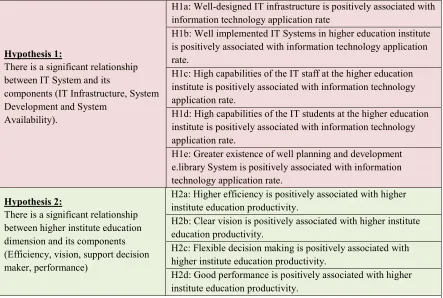
Hypothesis 1:
There is a significant relationship between IT System and its
components (IT Infrastructure, System Development and System
Availability).
H1a: Well-designed IT infrastructure is positively associated with information technology application rate
H1b: Well implemented IT Systems in higher education institute is positively associated with information technology application rate.
H1c: High capabilities of the IT staff at the higher education institute is positively associated with information technology application rate.
H1d: High capabilities of the IT students at the higher education institute is positively associated with information technology application rate.
H1e: Greater existence of well planning and development e.library System is positively associated with information technology application rate.
Hypothesis 2:
There is a significant relationship between higher institute education dimension and its components (Efficiency, vision, support decision maker, performance)
H2a: Higher efficiency is positively associated with higher institute education productivity.
H2b: Clear vision is positively associated with higher institute education productivity.
H2c: Flexible decision making is positively associated with higher institute education productivity.
H2d: Good performance is positively associated with higher institute education productivity.
Hypothesis 3: Information Technology applied in the organization will enhance the organizational strategic position.
[image:4.612.86.529.352.650.2]ISSN: 1992-8645 www.jatit.org E-ISSN: 1817-3195
5. DATA ANALYSIS AND ARESULTS
A descriptive data analysis showed distribution results.
5.1. Descriptive Data Analysis
After ensuring that the sample meets the normality conditions, the researchers started factor analysis for each construct.
Data was analysed using excel and distributed by role, sex, faculty and the program the results showed that 62% of the samples were from the bachelor level, 15% were postgraduate students and 23% were from the diploma level.
Figure 2: Sample Distribution By Education Level
Also the results showed that 29% of the samples were employees and 71% were students, and this gave the students perspective more weights in results, as the students are goal from each educational process.
Figure 3: Sample Distribution By Role
In addition, the sample was fairly balanced by males 49% and females 51%.
Figure 4: Sample Distribution By Sex
5.2. Information Technology Construct Factor Analysis
The initial factor analysis indicated the existence of one dimension (one-factor solution) of IT construct. All variables seen in below are the principal descriptors of first dimension.
The factor analysis showed sound validity. Loadings ranges from .518 to .815 showing a clear validity, as the measures greater than 0.5 are thought to reach the usual accepted range so the items loaded significantly on a one dimension.
Reliability was calculated based on Chronbach’s alpha for the systems construct, the result showed a reasonable reliability Chronbach’s Alpha equals to .699.
Table 2: Factor Analysis Results
Infrastructure 0.711
Systems 0.815
IT Staff Capabilities 0.685
Students IT skills 0.706
Electronic Library 0.518
Chronbach’s Alpha 0.699 N of Items 4
5.3. Productivity Dimension Factor Analysis
The initial factor analysis indicated the existence of one dimension (one-factor solution) of productivity construct. All variables seen in below are the principal descriptors of first dimension.
ISSN: 1992-8645 www.jatit.org E-ISSN: 1817-3195 thought to reach the usual accepted range so the
items loaded significantly on a one dimension.
Reliability was calculated based on Chronbach’s alpha for the systems construct, the result showed a reasonable reliability Chronbach’s Alpha equals to .739.
Table 3: Factor Analysis Results
Efficiency 0.797
Vision 0.837
Decision 0.836
Performance 0.755
Cronbach's Alpha 0.739 N of Items 4
5.4. Structural Model Testing
This proposed model comprises of two constructs as described below:
•Technology was modeled as a first order
construct comprised of the five first-order dimensions: (1) Infrastructure, (2) Systems, (3) IT Staff Capabilities (4) Student IT skills (5) e. Library
•Productivity was modeled as a second order
construct comprised of three first-order
dimensions: (1) Efficiency, (2) Vision, (3) Decision and (4) Performance.
•Through the theoretical study, and based on the
outputs of the research survey, the researcher found that the results indicated that higher
education institutes’ productivity can be
enhanced, and this enhancement will be reflected on all processes, in addition; poor information technology will seriously impact university productivity and this impact can be noticed in many fields like the incomplete or limited information for decision-making which means lack of accurate real-time information in the right people’s hands when they need it, ineffective student productivity.
•From other hand and it it’s clear that
infrastructures, IT Systems, IT Staff, Students IT skills and electronic library are very important factors that play a significant role in the Productivity but with different ratios. And it seems that higher education institutes’ IT staff have a serious problem regarding the Self-development and intention to share information in addition to problems regarding to e-library systems within the university.
•And it is noticeable also that all the relation
between the technology and its pillars
[image:6.612.88.522.69.294.2](Infrastructure, Systems, IT Staff, Students IT Skills, e.Library) are so weak.
Table 4: Information Technology Factors
Regression Beta (β)
Technology Construct
Infrastructure IT 0.285
Systems IT 0.295
IT_Staff IT 0.309
Stud_skills IT 0.279
e. Library IT 0.282
And it is noticeable also that all the relation between the productivity and its pillars (Efficiency, Achieving the university vision and missions, Support decision makers, Increasing student productivity) are also weak.
Table 5: Productivity Factors
Regression Beta (β)
Productivity Construct
Efficiency Productivity 0.317
Vision Productivity 0.306
Decision Productivity 0.322
Performance Productivity 0.294
5.5. Model Analysis
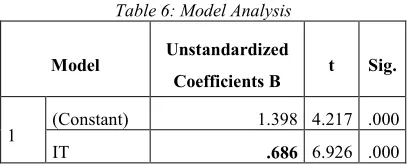
[image:6.612.316.520.595.678.2]According to analysis using SPSS, it can be concluded that information technology has a huge role in achieving productivity in higher education institutes.
Table 6: Model Analysis
Model Unstandardized
Coefficients B t Sig.
1 (Constant) 1.398 4.217 .000
IT .686 6.926 .000
Productivity = 0.686 * Information Technology
ISSN: 1992-8645 www.jatit.org E-ISSN: 1817-3195
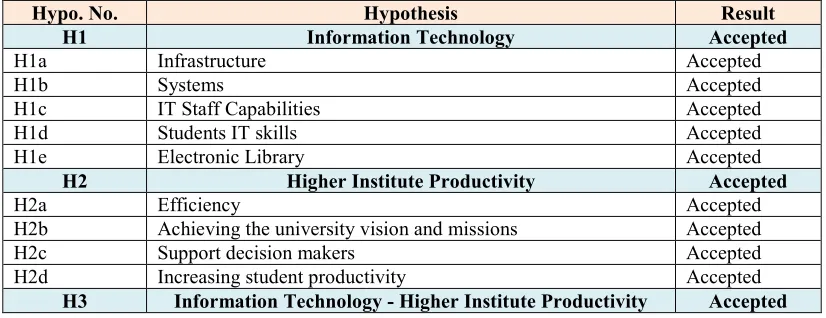
[image:7.612.100.513.139.298.2]According to analysis, results of hypotheses testing are listed in the following table:
Table 7: Hypotheses Testing Results
Hypo. No. Hypothesis Result
H1 Information Technology Accepted
H1a Infrastructure Accepted
H1b Systems Accepted
H1c IT Staff Capabilities Accepted
H1d Students IT skills Accepted
H1e Electronic Library Accepted
H2 Higher Institute Productivity Accepted
H2a Efficiency Accepted
H2b Achieving the university vision and missions Accepted
H2c Support decision makers Accepted
H2d Increasing student productivity Accepted
H3 Information Technology - Higher Institute Productivity Accepted
6. DISCUSSION AND RECOMMENDATIONS
The study aims to suggest a means to enhance the understanding of the concept of productivity at higher education institutes and its importance by using technology as a main tool as it is contributing as much as 0.686 of overall productivity, so the outcomes of the theoretical and statistical study are used to put a practical suggestions through which
higher education institutes can enhance its
productivity.
Based on the findings, number of recommendations are presented to use information technology as a main tool to develop and achieve good awareness about the productivity.
It is clear that higher education institutes should pay attention to IT staff and student factor regarding IT skills as their contribution values were (0.309, 0.279) respectively, and always tries to develop their IT skills and experience, so more focused training programs should be implemented to staff and students, in addition to developing of processes with proper technological tools and create a culture of collaboration and building systems which the can store the experiences and IT staff best practices.
In addition, Infrastructure (0.285), Systems implemented and used (0.295) and e. Library (0.282) are very important factors that upper management at these institutes identifies and use appropriate IT and e.library systems for internal work and enrich the contents of it
7. RESEARCH LIMITATIONS
There are several limitations, the first one is that this study was conducted in Oman, other higher institutes in other countries should be involved in the study to generalize the model and results, also the researchers’ opinion that the questions are really explain the theoretical ideas, these questions were from the point of view of the researchers, in adddition, structural equation modelling should be used to better analyze the collected data.
REFRENCES
[1] Adamides, E. D., & Karacapilidis, N. (2006). Information technology support for the knowledge and social processes of innovation management. Technovation , 26, 50–59. [2] Huffman, A. H., Whetten, J., & Huffman, W. H.
(2013). Using technology in higher education: The influenceof gender roles on technology self-efficacy. Computers in Human Behavior , 29, 1779–1786.
[3] Alavi, M., & Leidner, D. E. (2001). Knowledge Management And Knowledge Management Systems. MIS Quarterly , Vol. 25 No. 1, pp. 107-136.
[4] Angehrn , A., & Nabeth, T. (1997). Leveraging
Emerging Technologies in Management
Education: Research and Experiences.
European Management Journal , 275-285. [5] Avram, T. (2014). Innovative technology for
ISSN: 1992-8645 www.jatit.org E-ISSN: 1817-3195 using non-formal and informal education.
Procedia Technology , 598 – 603.
[6] Balaji, P., & Kumar, V. (2011). Use of web technology in providing information services by south Indian technological universities as displayed on library websites. Library Hi Tech , 29 (3), 470 - 495.
[7] Beasty. (2005). Retrieved from www.crm.com. [8] Bounabat, B. (2005). Rising to the Digital
Challenge: Lessons from Mediterranean
Enterprises. In B. Chapelet (Ed.), CentreTIME, Grenoble Ecole de Management (pp. 167-228). Grenoble, France: CentreTIME, Grenoble Ecole de Management.
[9] Brown, B., Found, C., & McConnell, M. (2007). Federal Science eLibrary Pilot: Seamless,
equitable desktop access for Canadian
government researchers. The Electronic
Library , 25 (1), 8 - 17.
[10] Brown, I. T. (2006). Testing and Extending Theory in Strategic Information Systems Planning Through Literature Analysis. In M.
Khosrow-Pour, Advanced Topics in
Information Resources Management (Vol. 5, pp. 282-318). Hershey, PA, USA: Idea Group Publishing.
[11] Byrd, T. A., & Turner, D. E. (2000). Measuring the Flexibility of Information
Technology Infrastructure: Exploratory
Analysis of a Construct. Journal of
Management Information Systems , 17 (1), 167-208.
[12] Chen, C.-J., & Huang, J.-W. (2006). How organizational climate and structure affect
knowledge management—The social
interaction perspective. International Journal of Information Management (27), 104–118. [13] Choi, L. &. (2003). Knowledge Management
Enablers,Processes, and Organizational
Performance: An Integrative View and
Empirical Examination. Journal of
Management tnformtUion System , Vol. 20. No. I. pp. 179-228.
[14] EMA. (2008). A Comprehensive Approach to Practicing ITIL Change Management. Boulder: Enterprise Management Associates, Inc. [15] Eynon, R. (2005). The use of the internet in
higher education: Academics’ experiences of using ICTs for teaching and learning. Aslib Proceedings , 57 (2), 168 - 180.
[16] Goh, S., & Gregory, R. (I997). Benchmarking the Learning Capability of Organizations. European Management Journa , Vo[. 15, No. 5, pp. 575-583.
[17] Grant, G., & Chen, Y. H. (2005). Measuring Enterprise Systems Capabilities: A Dynamic Capability Study. The Ninth Pacific Asia Conference on Information Systems, PACIS 2005 (pp. 1520-1526). Bangkok: Electronic Commerce Research Center, National Sun Yat-sen University.
[18] Guadamillas, F. G., & Donate, M. D. (2009).
Knowledge Management Strategies,
Innovation And Firm Performance - An Empirical Study. University of Castilla-La Mancha, Spain .
[19] Hamid, T., & Tarokh, M. J. (2006). Productivity outcomes of teamwork as an effect of information technology and team size. Int. J. Production Economics , 103, 610–615. [20] Hammami, S. (2012). Enhancing BI Systems
Application through the Integration of IT Governance and Knowledge Capabilities of the Organization. The International University for Science and Technology, Syria , chapter 8. [21] Hammami, S., AlSamman, H. M., & Alraja,
M. N. (2015). The Role of CRM System in Consolidating the Strategic Position of the Organization. Nternational Journal Of Applied Business And Economic Research, 13 (4), 1629-1640.
[22] Hersi, i., & Daima, T. (2007). Information technology diffusion in higher education. Technology in Society , 469–482.
[23] Hsu, C. (2006). Enhancing employee tendencies to share knowledge—Case studies of nine companies in Taiwan. International Journal of Information Management , 26–338. [24] Jeffrey, P., & Sutton, R. I. (2000). The
knowing-doing gap: How smart companies turn knowledge into action. Harvard Business School Press .
[25] Lindquist, T., & Long, H. (2011). How can
educational technology facilitate student
engagement with online primary sources?: A user needs assessment. Library Hi Tech , 29 (2), 224 - 241.
[26] Luftman, J. N., Bullen, C. V., Liao, D., Nash, E., & Neumann, C. (2004). Managing the
Information Technology Resource. New
Jersey: Pearson Printice Hall.
[27] McNurlin, & Sprague. (2006). Information Systems Management In Practice 7E. USA: Pearson Printice Hall.
ISSN: 1992-8645 www.jatit.org E-ISSN: 1817-3195 [29] Rao, S. S. (2000). Enterprise resource
planning: business needs and technologies. Industrial Management & Data Systems , 100 (2), pp. 81-88.
[30] Schehar, B., Rehman, K. U., & Aslam Khan, M. (2010). STUDY OF FACTORS THAT IMPACT KNOWLEDGE MANAGEMENT
FIT IN CORPORATE SCTOR OF
PAKISTAN. Far East Journal of Psychology and Business , Vol. 1 No 1, .
[31] Schloo, J. (2006). Retrieved from QIEM: www.qiem.com
[32] Soto-Acosta, P., & O'Cerdan, A. L. (2009). Evaluating Internet technologies business effectiveness. Telematics and Informatics , 26, 211–221.
[33] Timbrell, G. T., & Jewels, T. J. (2002). Knowledge Re-Use Situations in an Enterprise Systems Context. Issues and Trends of
Information Technology Management in
Contemporary Organisations, (pp. 296-299). Seattle.
[34] Tohidi, H. (2011). Human resources
management main role in information
technology project management. Procedia Computer Science , 3, 925–929.
[35] Tonn, B., & Dorian, S. (2012). The future of
governance and the use of advanced
information technologies. Futures , 44, 812– 822.
[36] Vinekar, V., Teng, J. T., & Chennamaneni, A.
(2009). The Interaction of Business
Intelligence and Knowledge. Journal of International Technology and Information Management , Volume 18, Number 2.
[37] WESTHEAD, P., & STOREY, D. (1995). Links Between Higher Education Institutions and High Technology Firms. Omega, Int. J. Mgmt Sci. , 23, 345-360.
[38] Wu, L.-C., & Chorng, S. O. (2008).
Management of information technology
investment: A framework based on a Real
Options and Mean–Variance theory
perspective. Technovation , 28, 122–134.
[39] Xiangqian, L., & Gao, F. (2012).
Development-Driven E-learning Education
Model and Application in Teaching
Information Technology. IERI Procedia , 2, 854 – 858.
[40] Xu, K. (2008). Engineering education and technology in a fast-developing China. Technology in Society , 30, 265– 274.