ISSN: 1992-8645 www.jatit.org E-ISSN: 1817-3195
A SPECIAL MATRIX POWER OPERATION DEVELOPMENT
FOR SIMULTANEOUS CALCULATION OF ALL
NETWORK'S SHORTEST PATH
1
HITAPRIYA SUPRAYITNO, 1INDRASURYA B. MOCHTAR, 2ACHMAD WICAKSONO 1
CiviI Engineering Department, Institut Teknologi Sepuluh Nopember (ITS), SURABAYA - INDONESIA
2Civil Engineering Department, Brawijaya University, MALANG - INDONESIA
E-mail: [email protected]
ABSTRACT
Network's shortest paths calculation is an important need in transportation network analysis. The Dijkstra algorithm has long been developed for the shortest path of a pair of nodes calculation individually. A more practical method to simultaneously calculate all shortest paths of all pair of nodes of a network needs to be developed. This paper presents the development of a method to calculate simultaneously all shortest paths of all pairs of nodes of a network. This calculation method, called a Min-Plus Algebra, is a modification of Max-Plus Algebra, having a special Matrix Power Operation, enable and easier to be executed in spread-sheet software.
Keywords: Simultaneous shortest path calculation, Matrix power operation, Min-Plus Algebra, Max-Plus
Algebra
1. INTRODUCTION
The shortest path of a network calculation is almost always needed in transportation network analysis and transportation network planning [1-5]. Algorithm for calculating Shortest Path, such as: Dijkstra Algorithm, Graph Theory Algorithm, and Enumeration Method, has been developed since long time ago. These algorithms had been developed mainly to calculate the shortest path for only for a pair of nodes at once [4], [6-10]. Subsequently a new algorithm designated to calculate the shortest paths of the whole pairs of node of a network at once, need to be developed. This paper is emphasized on a new mathematical algorithm development to calculate simultaneously the whole shortest paths of the whole pairs of node of a network.
2. REVIEW OF NETWORK SHORTEST
PATH
Shortest path is the shortest itinerary connecting two nodes of a network. Knowing the network's shortest path is important for traffic assignment modeling, vehicle armada routing calculation, transportation infrastructure optimal location calculation and other purposes [4], [11-12].
2.1 Shortest Path Algorithm
Algorithm shortest path calculation had been developed in operations research, network analysis,
and graph theory. The following, among others, algorithms used for that purpose are [1-4],[6], [13]:
• Dijkstra Algorithm
• Graph Theory Algorithm
• Taffe Algorithm
• Total Enumeration Method
2.2 Max-Plus Algebra
Max-Plus Algebra is a branch of mathematics which developed in system control for discrete event system calculation (Baccelli et al, 1992, Vries et al, 1998) Its mathematical operations are presented as follows.
In a set of real numbers with ε = -∞
Max-Plus Algebra Mathematical Operations are defined as follow [5],[14]:
a b = max (a,b) (1) a b = a + b (2)
These two mathematical operations can be used for matrix operation as follows [5],[14]:
A B = C | cij = max(aij, bij) (3)
A B = C | cij = ail b1j ai2 b2i …
ain bnj
= max ((ail + btj), (al2 + b2j), … ,
(ain + bnj)) (4)
ISSN: 1992-8645 www.jatit.org E-ISSN: 1817-3195
on Matrix as follows [5],[14]:.
(5)
2.3 Max-Plus Algebra For Network Analysis Utilisation
Max-Plus Algebra Power Operation on Matrix has been proved to be useful to investigate a tree graph existence. A connectivity matrix, powered in N degree, represents the existing connection between the pairs of node in N steps.
3. ALGORITHM DEVELOPMENT
3.1 Min-Plus Algebra Development
The experience of the Max-Plus Algebra Matrix Power Operation usage to investigate the existence of a tree graph had initiated a similar modified mathematical operation development for shortest path calculation. The new mathematical operation, developed as a modification of Max-Plus Algebra, instead of calculating the maximum value of an array of numbers, the method is designated to calculate the minimum value of an array of numbers. Then the s value will be defined as ε = ∞,
instead of ε = -∞.
In , a set of real numbers with ε = ∞, a Min-Plus
Mathematical Operation is defined as follows:
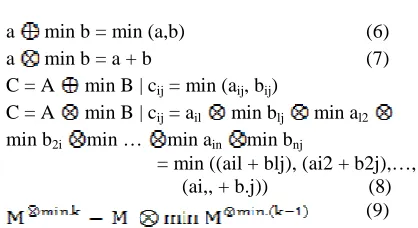
a min b = min (a,b) (6) a min b = a + b (7) C = A min B | cij = min (aij, bij)
C = A min B | cij = ail min blj min al2
min b2i min … min ain min bnj
= min ((ail + blj), (ai2 + b2j),…, (ai,, + b.j)) (8)
(9)
3.2 Example of Min-Pius Algebra Matrix Power Operation
To ease the presentation of a Min-Plus Algebra Matrix Multiplication Operation, an example of a multiplication of two 3 x 3 matrices is presented as follows.
C = A min B
cij = min ((ail + bij), (ai2 + b2j), …, (ain + bnj))
[image:2.612.87.296.464.578.2]The calculation on a spread-sheet software is presented as below.
Table 1: Min-Plus Algebra Matrix Multiplication
A 1 2 3
1 0 4 7
2 4 0 5
3 8 5 0
B 1 2 3
1 0 2 9
2 3 0 6
3 7 4 0
C 1 2 3
1 0 2 7
2 3 0 5
3 7 4 0
c23 = min ((a21+b13), (a22+b23), (a23+b33))
= min ((4+9), (0+6), (5+0)) = min (13, 6, 5)
= 5
3.3 Shortest Path Calculation Formula
The Min-Plus Algebra then can be used as below. The formula for Shortest Past Calculation can be formulated as follows:
(10)
Where :
MSP = matrix of shortest past distance between node i to node j
MLL = matrix of link length
N = number of nodes
4 ALGORITHM TEST CASE
4.1 Algorithm Test Case Method
The four following steps were used to evaluate the invented formula Firstly, a test case network has to be established. Secondly, the shortest path matrix is calculated. Then, the correctness of the formula is evaluated by comparing the calculation result against the shortest path from the visual observations. At last, calculation result connotation and behavior is investigated by observing the calculation result for each matrix power step.
4.2 Case Network and Shortest Path Calculation
ISSN: 1992-8645 www.jatit.org E-ISSN: 1817-3195
[image:3.612.103.513.71.272.2]
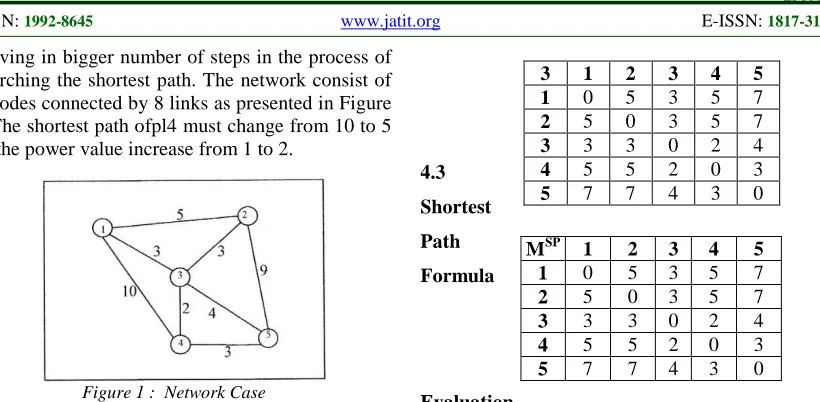
moving in bigger number of steps in the process of searching the shortest path. The network consist of 5 nodes connected by 8 links as presented in Figure 1 The shortest path ofpl4 must change from 10 to 5 as the power value increase from 1 to 2.
Figure 1 : Network Case
Network Shortest Path calculation is determined as follows. The MSP is calculated by using spreadsheet software.
Notation:
mNij = cellij value of a matrix power N
The MSP calculation is presented in Table 2 below.
Table 2 : Calculation om MSP
4.3
Shortest
Path
Formula
Evaluation
Shortest path evaluation is made for three pairs of nodes: spl4, sp24, sp25. By comparing the shortest
path indentified by visual observations to those resulted by the shortest calculation, the correctness of the shortest path formula can be investigated. The evaluation is presented in the following Table 3.
Table 3 : Shortest Past Comparaison: Observation against Calculation
It can be seen clearly that the visual observation is conform to the calculation result. This indicates that the formula is correct.
4.4 Assessment of Connotation and Behavior
Furthermore, assessment is made to investigate the connotation of calculation result and its behavior. The three paths above, spl4, sp24, sp25, are
investigated through the whole calculation process.
Power 1 investigation:
pll4 = 10
pl24 = ∞
pl25 = 9
All value indicates the length of the direct link connection between pair of nodes.
1 1 2 3 4 5
1 0 5 3 10 999
2 5 0 3 999 9
3 3 3 0 2 4
4 10 999 2 0 3
5 999 9 4 3 0
2 1 2 3 4 5
1 0 5 3 5 7 2 5 0 3 5 7 3 3 3 0 2 4 4 5 5 2 0 3 5 7 7 4 3 0
3 1 2 3 4 5
1 0 5 3 5 7
2 5 0 3 5 7
3 3 3 0 2 4
4 5 5 2 0 3
5 7 7 4 3 0
MSP 1 2 3 4 5
1 0 5 3 5 7
2 5 0 3 5 7
3 3 3 0 2 4
4 5 5 2 0 3
5 7 7 4 3 0
No Path Visual Observations Calculation Result
Conformity
[image:3.612.123.251.434.614.2]ISSN: 1992-8645 www.jatit.org E-ISSN: 1817-3195
Power 2 investigation:
p214 = min {(m l
11+m l
14), (m l
12+m l
24), (m l
13+m 1
34),
(ml14+m144), (m115+m154)
= min {(0+10), (5+999), (3+2), (10+0), (999+3)}
= min { 10, 999, 5, 10, 999} = 5
= (m113+ml34)
Calculation result indicates a 2 steps path through 3 points: n1, n2, n3, n4, therefore through 2 links: 113,
134.
p224 = min {(ml21+ml14), (m122+m124),
(m123+m134), (m124+m144), (m125+m154)}
= min {(5+10), (0+999), (3+2), (999+0), (9+3)}
= min {15,999, 5,999, 12} = 5
= (m123+m134)
Calculation result of p224 indicates a 2 steps path
through 3 points: n2, n3, n4 therefore through 2
links: 123,134.
p225 = min {(m121+mll5), (m122+m125),
(m123+m 1
35), (m 1
24+m 1
45), (m 1
25+m 1
55)}
= min {(5+999), (0+9), (3+4), (999+3), (9+0)}
= min {999, 9, 7, 999, 9} = 7
= (m123+m135)
Calculation result of p225 indicates a 2 steps path
through 3 points: n2, n3, n4 therefore through 2
links: 123,135.
Power 3 investigation :
p314 = min {(m 2
11+m 1
14), (m 2
12+m 1
24),
(m213+m134), (m214+m144), (m215+m154)}
= min {(0+10), (5+999), (3+2), (5+0), (7+3)}
= min {10, 999, 5, 5, 10} = 5
= (m213+m134), (m214+m144)
While :
m213 = (m 1
11+m 1
13)
m214 = (m113+m134)
Therefore :
p314 = (ml11+ml13+m134), (ml13+m134+m144)
Calculation result of p3~4 indicates a 2 steps path through 3 points : n1, n3, n4 therefore
through 2 links : 113,134.
P324 = min {(m221+m114), (m222+m124), (m223+m134),
(m224+m144), (m225+m154)}
= min {(5+10), (0+999), (3+2), (5+0), (7+3)} = (m213+m134), (m214+m144)
While :
m213 = (m111+m113)
m214 = (m 1
13+m 1
34)
Therefore :
P324 = (ml11+ml13+m134), (ml13+m134+m144)
Calculation result of p3~4 indicates a 2 steps path through 3 points : n1, n3, n4 therefore through 2
links : 113,134.
P324 = min {(m 2
21+m 1
14), (m 2
22+m 1
24), (m 2
23+m 1
34),
(m224+m144), (m225+m154)}
= min {(5+10), (0+999), (3+2), (5+0), (7+3)} = min {15,999, 5, 5, 10}
= 5
= (m223+m134), (m224+m144)
While:
m223 = (m122+m123),(m123+m133)
m224 = (m 1
23+m 1
34)
Therefore :
P324 = (m122+m123+m134), (m123+m133+m134)
(m123+m134+m144)
All 3 shortest path alternatives indicate 3 steps path through 3 points : n2, n3, n4 therefore through 2
links : 123, 134.
P325 = min {(m221+m115), (m222+m125), (m223+m135),
(m224+m 1
45), (m 2
25+m l
55)}
= min {(5+999), (0+9), (3+4), (5+3), (7+0)} = min {999, 9, 7, 8, 7}
= 7
= (m223+m135), (m225+m155) While :
m223 = (m122+m123), (m123+m133)
m225 = (ml23+ml35)
Therefore :
P325 = (m122+m123+m135), (m123+m133+m135)
(m123+m13s+mls5)
All 3 shortest path alternatives indicate 3 steps path through 3 points n2, n3, n5, therefore through 2 links
: 123, 135.
Power 4 investigation:
p414 = min {(m311+ml14), (m312+m124),
(m313+m134), (m314+m144),
(m315+ml54)}
ISSN: 1992-8645 www.jatit.org E-ISSN: 1817-3195
= min { 10, 999, 5, 5, 10} = 5 = (m313+m134), (m314+m144)
While.
m313 = (ml11+ml11+ml13),
(ml11+m l
13+m 1
33)
m134 = (ml11+m113+m134),
(m113+m134+m144)
Therefore: p414 = (m
1 11+m 1 11+m 1 13+m 1 34),
(m111+m113+m133+m134)
(m111+m113+m134+m144),
(m113+m 1 34+m 1 44+m 1 44)
All 4 shortest path alternatives indicate 4 steps path through 3 points: n1, n3, n4, therefore through 2
links: 113, 134.
P424 = min {(m321+m114), (m322+m124),
(m323+m134), (m324+m144), (m325+m154)}
= min {(5+10), (0+999), (3+2), (5+0), (7+3)}
= min {15, 999, 5, 5, 10} = 5
= (m323+m134), (m324+m144)
While.
m323 = (m122+m122+m123), (m122+m123+m133),
(m123+m133+m133)
m324 = (m 1
22+m 1
23+m 1
34), (m 1 23+m 1 33+m 1 34),
(m123+m134+m144)
Therefore :
P424 = (m122+m122+m123+m134),
(m122+m 1 23+m 1 33+m 1 34),
(m123+m133+m133+m134)
(m122+m123+m134+m144),
(m123+m133+m134+m144),
(m123+m 1 34+m 1 44+m 1 44)
All 6 shortest path alternatives indicate 4 steps path through 3 points : n2, n3, n4, therefore through 2
links : 123, 134.
P425 = min {(m321+m115, (m322+m125), (m323+m135),
(m324+m 1
45), (m 3
25+m 1
55)}
= min {(5+999), (0+9), (3+4), (5+3), (7+0)} = min {999, 9, 7, 8, 7}
= 7 = (m323+m
1 35), (m
3 25+m
1 55)
While.
m323 = (m122+m122+m123), (m122+m123+m133),
(m123+m133+m133)
m325 = (m 1
22+m 1
23+m 1
35), (m 1 23+m 1 33+m 1 35) Therefore :
P425 = (m122+m122+m123+m135), (m122+m123+m133+
m135), (m 1 23+m 1 33+m 1 33+m 1 35),
(m122+m123+m135+m155),
(m123+m133+m135+m155)
All 5 shortest path alternatives indicate 4 steps path through 3 points : n2, n3, n5, therefore through 2
links : 123, 135.
Comparison of all different power calculation result is presented in Table 4.
Table 4 Comparison of different power value calculation result
No Path
Power 1 Power 2 Power 3 Power 4
Evaluation
length links length links lengt
h links length
1 p14 10 113, 134 5 113, 134 5 113, 134 5 all the same
2 p24 ∞ 123, 134 5 123, 134 5 123, 134 5 all the same
3 p25 9 123, 135 7 123, 135 7 123, 135 7 all the same
As predicted during creation of network case, the Power 1 gives different results from the Power2. Calculation result remain the same for Power 2 to Power 4 in terms of' the same path, the same length, but give different number of steps, different order of steps, and different number of step alternatives. Thus, it can be concluded that The shortest path calculation formula is correct.
4.5 Connotation and Behavior of Shortest Path Calculation
The connotation and behavior of shortest path calculation result can be explained as follow:
• Cell values of Connectivity Matrix Power N
indicate the shortest path length in N steps connections.
• Once a shortest path of a pair of nodes has been gotten, the cell value remain the same through-out the incremental power value. Thus, once the whole shortest path value for all pairs of nodes has been gotten, the whole
• matrix cells values remain the same.
5 CONCLUSIONS
[image:5.612.104.513.483.555.2]ISSN: 1992-8645 www.jatit.org E-ISSN: 1817-3195
The shortest path calculation formula (eq.10), is proved to be correct. The cell value of Powered N Connectivuty Matrix, mNij indicate the shortest path
length between ni and nj for N steps. Once the
shortest path is gotten, it remains the same through the afterward calculation.
REFERENCES
[1] Ortuzar, J.D. & Willumsen, L.G., “Modelling
Transport”. Second Edition. John Wiley &
Sons. New York, 1994.
[2] Suprayitno, H., Mochtar, I.B. & Wicaksono, A., "Metoda Identifikasi Ketiadaan Graf Pohon berdasar Identifikasi Titik Terisolasl dan Busur Terisolasi dengan Busur Tak Berarah dan Tak Bebobot". Prosiding Seminar Nasional 7¢knik
Sipil V. Jurusan Teknik Sipil, Institut
Teknologi Sepuluh Nopember (ITS). Surabaya, 2008.
[3] Taaffe, E.J., Gauthier, H.L. & O'Kelly, M.E., “Geography of Transportation”. Second Edition. Prentice Hall. New Jersey, 1996. [4] Tamin, O.Z., “Perencanaan dan Pemodelan
Transportasi”. Edisi Kedua. Penerbit ITB.
Bandung, 2000.
[5] Vries, R. de; Schutter, B. de & Moor, B. De,
"On Max-Algebraic Models for Transportation
Networks". Proceeding of 4th International
Workshop on Discrete Event Systems (WODES '98). Cagliari, 1998.
[6] Bondy, J.A. & Murty, U.S.R, “Graph Theory
with Applications”. Fifth Printing.
North-Holland. New York, 1982.
[7] Chevalier, A. & Hirsch, G.,“Methodes
Quantitative pour le Management: Finance, Marketing, Production”. Entreprise Modeme
d'ldition. Paris, 1980
[8] Dimyati, T.T. & Dimyati A. (1994). Operation
Research - Model-Model Pengambilan
Keputusan. Sinar Baru Algesindo, Bandung.
[9] Goujet, C. & Nicolas, C., “Mathdmatiques
Apliqudes - Probabilitds, Initiation ~ la
Recherche Operationnelle”. Troisibme
I~dition. Masson. Pads, 1986.
[10] Hillier, P.S. & Lieberman, G.J,. Introduction
to Operation Research. Fifth Edition,
Holden-Day Inc.. San Francisco, 1990.
[11] Liu, Y., Lai, X. & Chang, G.L., "Two-Level Integrated Optimization System for Planning of Emergency Evacuation", Journal of Transportation Engineering, American Society
of Civil Engineers, Reston, Virginia, October 2006, Vol. 132 No. 10.
[12]Srivastava, A.K. & Nema, A.K., "Discussion of
Multi-objectives Vehicle Routing and Scheduling Problem with Time Window Constraints in Hazardous Material Transportation", Journal of Transportation
Engineering, , American Society of Civil
Engineers, Reston, Virginia, September 2006, vol. 132 No. 9.
[13]Suprayitno, Hitapriya, "Metoda Identifikasi Graf Pohon Berbasis Operasi Himpunan".
Inedit. Jurusan Teknik Sipil, Institut Teknologi
Sepuluh Nopember (ITS). Surabaya, 2007. [14]Baccelli, F., Cohen, G., Olsder, G.J. & Quadrat,
J-P. Synchronization and Linearity An Algebra
for Discrete Event Systems. John Wiley & Son.