USING D-S EVIDENCE THEORY TO EVALUATION OF
CONFIDENCE IN SAFETY CASE
1FUPING ZENG , 2MANYAN LU AND 3DEMING ZHONG
1School of Reliability and System Engineering, Beihang University, Beijing, 100191, China
E-mail: [email protected], [email protected], [email protected]
ABSTRACT
A safety case provides an explicit means for justifying the safety of a system through a reasoned argument and supporting evidence. However, the acceptance of a safety case requires the assessors to be confident, thus, there is some uncertainty of confidence in the safety case, and it becomes a key factor how to process the uncertainty in evaluating confidence in safety case. D-S evidence theory is fit for processing the subjective judgment and synthesizing the uncertain knowledge. So, this theory is applied to the uncertainty of assessment results. First, the related knowledge is given, including safety case and D-S evidence theory. Then the approach of evaluating confidence in safety case using D-S evidence theory is presented, and engine software is chosen as experimental example for proposed approach. At the same time, the experimental results based on the proposed approach are also presented. The algorithm has a strong versatility and an example is used to demonstrate its effectively in this text.
Keywords: Safety Case, Uncertainty, Confidence, D-S Evidence Theory.
1. INTRODUCTION
The concept of the ‘safety case’ has already been adopted across many industries[1-4], such as defense, aerospace, nuclear and railways. A safety case provides an explicit means for justifying the safety of a system through a reasoned argument and supporting evidence[5]. The problem is that it is always possible to find or produce evidence that something is safe, where there is no complete mathematical theory to base arguments and guarantee completeness[6]. So the acceptance of a safety case requires the assessors to be confident that the safety case meets the requirements. However, both the developers and the assessors can sometimes be uncertain that the safety case has high assurance. Because of lack of historical data, determining what amount or what types of evidence are sufficient can be extremely difficult. If we are uncertain about the sufficiency of the evidence, then our confidence in the safety case is reduced. Due to the existence of uncertainty, it becomes a key factor how to process the uncertainty in evaluating confidence in safety case.
Evidence theory is fit for processing the subjective judgment and synthesizing the uncertain knowledge. So, this theory is applied to the uncertainty of assessment results. In this paper, we explore the challenges of evaluating confidence in
safety cases; in particular, we propose an approach
for confidence evaluation by integrating
probabilistic reasoning with D-S evidence theory into safety arguments represented in the Goal Structuring Notation (GSN). An overarching motivation for this work is, eventually, to deal with uncertainty because of expert judgment.
This paper is arranged as follows: the related knowledge of safety case and D-S evidence theory is introduced in Part 2. The proposed approach is
further elaborated from three aspects of
experimental example, algorithm and analysis about experiment in Part 3. Part 4 discusses the conclusions.
2. RELATED KNOWLEDGE
2.1 Safety Case & GSN
A safety case[5] consists of explicit safety requirements, the evidence that the requirements have been met, and the argument links the evidence to the requirements. Both the argument and the evidence are essential.
main relationships: supported by and in context of, to form a goal structure.
2.2 D-S Evidence Theory
In the D-S evidence theory[7], the basic entity is
the identification of the framework Θ. A key point
of the D-S theory is the mass function m (basic probability assignment, or BPA) that is defined on
2Θ as m: 2Θ→[0, 1]. Belief function is used to
describe the results of uncertainty. From this BPA m, the credibility Bel(A) and plausibility Pl(A) can be computed from the following equations:
( ) ( ) ( ) ( )
B A B A
Bel A m B Pl A m B
⊆ ≠∅
=
∑
=∑
(1)
Bel(A) is expressed as the evidence to the results of the total support, or the decision-makers have reason to believe that the results of A.
D-S theory provides a method to combine the previous measures of evidence of different sources. If mi is the BPA provided by source (1<=i<=n), the
combination: m1 m2 ...mn, can also be called
as orthogonal sum, and it can be defined according to the Dempster’s combination rule, by
1 2
1 2
1 1 2 2
( )( )
1
( ) ( ) ( )
n
n
n n A A A A
m m m A
m A m A m A
K =
⊕ ⊕ ⊕
=
∑
⋅
(2)
Where
1
1
1 1 2 2
1 1 2 2
(
)
(
)
(
)
1
(
)
(
)
(
)
n
n
n n
A A
n n
A A
K
m A
m A
m A
m A
m A
m A
≠∅
=∅
=
⋅
= −
⋅
∑
∑
(3)In order to reduce the conflict influence between evidences, we assign different weight to different
evidences. Let the set of evidences be E={E1,
E2,...,En}. The weight coefficient of evidence Ei is
ωi, ωi ϵ[0,1] and the sum ωi is 1,which reflects the
importance of evidences during the combination.
Firstly, we assign bpa and build up weight vector
of evidences. let ωmax={ω1, ω2, …, ωn}, the
relatively weight vector is ω’=(ω1, ω2, …,
ωn)/ωmax. Second the “ratio” of BPA can be
obtained:
max
(0 1), (1 ) / , 1, 2,...
i i i i i n
α ≤α ≤ −α =ω ω = .Use the
“ratio” to adjust the BPA of evidences in the framework. The BPA function after adjustment is:
'(
)
(1
)
(
)
'( )
(1
) ( )
i k i i k
i i
m
A
m A
m
m
α
α
α
= −
Θ
= −
Θ +
(4) The BPA of evidences after adjustment are
mi’(Ak), mi’(Θ) substitutes in Eq.2, then we obtain
the new combination formula.
3. PROPOSED APPROACH
In our proposed approach for evaluating confidence in safety cases, we first construct the safety argument using GSN. Then we advance the process to evaluate the confidence in safety case by using D-S evidence theory. At the same time, this
proposed approach is detailed represented
combined with the example of safety case.
3.1 Experimental Example Of Safety Case A safety case has been constructed for safety-critical engine software as an experimental example for proposed approach. Figure1 shows a fragment of the safety case of engine software.
Engine software is part of engine control system, and the top level claim of software safety is acquired from the system. While the necessary risk reduction of the system can be determined after its total risk, and the tolerable risk is cleared, then, the system safety requirements can be obtained. Based on which, the safety claim for software related system may be preliminary identified. We have determined that G1 ‘Engine software contributions to system Level Hazards are acceptable’ is the top claim, supported by C1. G1 will be changed to software safety requirements. Thus, G1 can be argued over all identified software safety requirements S1, supported by C2 and software development to the integrity level appropriate to the hazards involved S2, supported by C3. Thus, C1 can be divided into two sub-goals G2 and G3. Engine software safety requirements were identified from the view of system, and four software safety requirements are acquired: start control, anti-asthma control, anti-ice control, and signal monitoring. Therefore G2 are divided into four sub-goals: G4, G5, G6 and G7. G3 can be classified into four process factors such as tool, method and environment and others. Thus, G3 are divided into four sub-goals: G8, G9, G10 and G11. Whether software safety requirement is satisfied can be confirmed on analysis and testing. Finally, the corresponding evidences may be selected and provided, that is, they are E1, E2, E3, E4, E5 and E6.
uncertainties and unknowns in evaluating confidence in safety case.
In this paper, we discuss ways to evaluate confidence in the argument and quantify the uncertainty in this claim.
G1:Engine software contributions to system Level Hazards are acceptable C1:1. Definition of
software 2.Contribution list to system hazards
S1:Argument over all identified software
safety requirements C2:1.safety requirement
definition 2.list of safety requirement(Ref X)
G4: Requirement ‘start control’
is satisfied
S2:Argument over software development to the integrity level appropriate
to the hazards involved
G5: Requirement ‘anti-asthma
control’ is satisfied
G6: Requirement
‘anti-ice control’ is
satisfied
G7: Requirement
‘signal monitoring’
is satisfied
G3:Engine software developed to Integrity Level 2
C3:Integrity level process guidelines defined by Ref Y
G2:All identified software safety requirements are satisfied
G8:Imp. of method or technology meets Integrity
Level 2
G9:Imp.
of tool meets Integrity
Level 2
G9:Imp. of
environment meets Integrity
Level 2
G9:Imp. of
other meets Integrity
Level 2
E1:analysis result
E2:system testing
result
E3:Metho d Evidence
E4:Tool Evidence
E5:Enviro nment Evidence
E6:Other Evidence
Figure1 Fragment Of The Safety Case Of Engine Software
3.2 Algorithm Of Evaluating Confidence In Safety Case Using D-S Evidence Theory The assessors are not easy given the direct results of the evaluation to the top level claim in safety case. In general, the evaluation results of sub-goals in the lowest layer are firstly obtained based on evidences. Then the evaluation results of sub-goals in the higher layer are given, till the top level claim. By dynamic real-time access to evidence data and the use of DS evidence theory, this paper uses the probability of a large synthetic as the qualitative results of the assessment, which makes its results more objective and credible.
Goals need to be extracted from the safety argument by using GSN. Then, take evaluation ranks and BPA represents goals of the safety case. Then the improved Dempster’s rule is used to combine the goals layer by layer, we can obtain the BPA value of the top level claim. The concrete algorithm is as follows:
3.2.1 Extraction goals
There exists the challenge of confidence only in the goals of safety case and the object of evaluation is the goals of safety case. Therefore, the first step is to extraction goals from safety case. In general, the structure of goals of safety case is a hierarchical inverted tree structure, in which, the top tier is software safety top level claim, the middle layer and the bottom layer is multi-layer sub-goals. Figure 2 shows the result of extraction from
fragment of the safety case of engine software, as shown in Figure1.
3.2.2 Result set
The result set is space of hypothesis which is the assessor make the results of the various elements of the assessment result. A set of result we defined and
denoted R as follows:
R
=
{ , ,..., }
r r
1 2r
nWhere ri represent the various possible evaluation results. Goal of confidence evaluation is derived from one of the best results of the evaluation that based on comprehensive consideration of all goals.
In the confidence evaluation in safety case, the results of the assessment can be classified as very low, low, medium, high and very high. So the result set
R
=
{
verylow low medium high veryhigh
,
,
,
,
}
. That is, the value of identification framework1 2 3
4 5
{
,
,
,
,
}
verylow
A low
A medium
A
high
A veryhigh
A
Θ =
=
=
=
=
=
3.2.3 BPA and weight
Ascertain all layers’ weights between goals in the
same layer and BPA mi(Aj) of sub-goals layer with
regard to Aj(j=1,2,…k), that is, A1 is very low, A2
is low, A3 is medium, A4 is high and A5 is very
high, where Θ represents the uncertainty. The BPA
addition, in the result set, we only interested in one result which identifying the framework of the element (such as a single hypothesis) rather than its subset (composed of a number of assumptions).
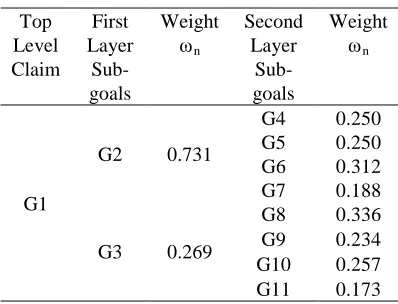
Table 1 shows the weights of goals in safety case of engine software and Table 2 shows its BPA
mi(Aj) of the second layer sub-goals.
Table 1 The Weights of All of Goals in Safety Case of Engine Software Top Level Claim First Layer Sub-goals Weight ωn Second Layer Sub-goals Weight ωn G1
G2 0.731
G4 0.250
G5 0.250
G6 0.312
G7 0.188
G3 0.269
G8 0.336
G9 0.234
G10 0.257
[image:4.612.98.297.209.361.2]G11 0.173
Table 2 The BPA mi(Aj) of .the Second Layer Sub-goals in Safety Case of Engine Software
Sub-goals
BPA mi(Aj)
A1 A2 A3 A4 A5 Θ
G4 0.03 0.1 0.48 0.34 0.05 0
G5 0.1 0.1 0.35 0.37 0.05 0.03
G6 0.02 0.1 0.46 0.36 0.05 0.01
G7 0.01 0.1 0.53 0.29 0.05 0.02
G8 0 0.05 0.31 0.47 0.17 0
G9 0 0.05 0.23 0.54 0.18 0
G10 0 0.05 0.28 0.58 0.08 0.01
G11 0 0.05 0.33 0.55 0.05 0.02
3.2.3.1improved bpa of the second layer sub-goals
Use Eq.4 to calculate BPA, Table 3 shows BPA after ratio. In this table the uncertainty increased, this is induced by inflicts of evidences. This situation is attributed to the using of Eq.4. Conflicts between evidences are ascribed to the uncertainty of the discernment.
Table 4 The BPA mi(Aj) of .the First Layer
Sub-goals
The Second Layer Sub-goals
G2(ω=0.731) G3(ω=0.269)
BPA mi(Aj)
A1 0.0041 0
A2 0.0262 0.0108
A3 0.6290 0.1913
A4 0.3303 0.7473
A5 0.0093 0.0506
[image:4.612.88.297.387.523.2]Θ 0.0011 0
Table 3 The Improved BPA mi(Aj) of .the Second Layer Sub-goals
Sub-goals
BPA mi(Aj)
A1 A2 A3 A4 A5 Θ
G4 0.0
2 0.0 8 0.3 9 0.2 7 0.0
4 0.2
G5 0.0
8 0.0
8 0.2
8 0.3
0.0 4
0.2 2
G6 0.0
2 0.1
0.4 6 0.3 6 0.0 5 0.0 1
G7 0.0
1 0.0 6 0.3 2 0.1 8 0.0
3 0.4
G8 0 0.0
5 0.3 1 0.4 7 0.1
7 0
G9 0 0.0
3 0.2 0 0.4 0 0.0 6 0.3 1
G10 0 0.0
4 0.2 1 0.4 5 0.0 6 0.2 4
G11 0 0.0
3 0.1 7 0.2 9 0.0 3 0.4 8
3.2.3.2 Calculation bpa of the first layer sub-goals of engine software
When the BPA of the second layer sub-goals is obtained, they are combined by using Eq.2 and Eq.3 in turn. The combination result of G4, G5, G6 and G7 is the BPA of G2, and the combination result of G8, G9, G10 and G11 by Eq.2 and Eq.3 is the BPA of G3, as shown in Table 4.
3.2.3.3 Calculation bpa of the top level claim of engine software
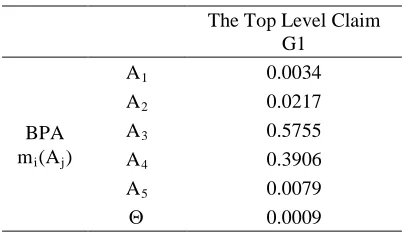
The combination result of G2 and G3 by Eq.2 and Eq.3 is the BPA of G1, as shown in Table 5
G1
G4
G2
G5 G6 G7 G8
G3
[image:4.612.316.538.557.683.2]G9 G10 G11
[image:4.612.100.302.661.744.2]3.2.3.4 Choose one of the largest number of synthetic probability as assessment result.
[image:5.612.97.299.204.321.2]From the table 5 shows that the probability of confidence for a maximum of 0.5755, so the result A3 of this assessment as confidence in safety case of engine software.
Table 5 The BPA Mi(Aj) Of .The Top Level Claim In Safety Case Of Engine Software
The Top Level Claim G1
BPA mi(Aj)
A1 0.0034
A2 0.0217
A3 0.5755
A4 0.3906
A5 0.0079
Θ 0.0009
3.2.3.5 Calculation bel(a) and pl(a)
We can obtain the belief value and plausibility
value of confidence from Eq.1. As the subset of Xi
is singleton sets, the belief value
is
Bel A
(
j)
=
m A
'(
j)[
j
=
1, 2, 3, 4, 5, 6]
.the beliefvalue isPl A( j)=m A'( j)+m'( )[Θ j=1, 2, 3, 4, 5, 6]. Therefore, for the proposition p “the confidence of ‘Engine software contributions to system Level Hazards are acceptable’ is above medium”, the certainty value Bel(p)=0.5755, the unknown value
m’(Θ)=0.009, and the belief interval [Bel(p),
Pl(p)]=[ 0.5755, 0.5764], the uncertainty value of the proposition p is 0.009.
So far, the task processing is complete.
3.3 Analysis About Experiment
Table 5 shows the BPA and the uncertainty of the evaluation rank of confidence. From the compare of table 4 and table 5 we can see that the various change of BPA value after the combination of Dempster’s rule of combination. The belief values which are high before combination become higher after combination; the belief values which are low
before combination become lower after
combination; the uncertainty become lower and lower during the combination process, at last it reduced to 0.009. In whole process, we can see G2 ‘All identified software safety requirements are satisfied’ is the more degree contributions to the confidence in safety case, which results are
consistent with common sense. Therefore
considered that D-S evidence theory in the application of qualitative assessment is valid, and
can better solve uncertainty of assessment result that come from the subjective and rigid division of the quantitative data.
4. CONCLUSIONS
Because of the deficiency of the historical data and the preference of experts while evaluating the acceptance of a safety case, there is some uncertainty of confidence in the safety case. So we use D-S evidence theory to deal with the problem of
subjective judgments and uncertainties of
knowledge synthesis advantages, and the improved Dempster’s rule of combination is adopted to combine the BPA. The characteristics of this proposed approach is that the certainty and uncertainty value can be distinguished of evaluating confidence in safety case. It is proved that D-S evidence theory has advantages in evaluating confidence in safety case which has some uncertainty. The usage of D-S evidence theory reduced the effect of the uncertainty, improved the precision and the validity of the evaluation, and reduced the blindness and the subjectivity of evaluation of confidence in safety case.
Sharp tools make good work. For this reason the next step is to develop the tool, to support the algorithm of evaluating confidence in safety case based on D-S theory.
ACKNOWLEDGMENTS
This work has been partially Project supported by the National Defense Pre-Research Foundation of China (Grant No. 513190801).
REFERENCES
[1] Liu, C. Sha, X.; Yan, F.; Tang, T.,A scenario-based safety argumentation for CBTC safety case architecture, WIT Transactions on the Built Environment, v 114, p 839-850, 2010.
[2] Feather, Martin S, Building a safety case for a safety-critical NASA space vehicle software system, the 4th IEEE International Conference on Space Mission Challenges for Information Technology, p10-17, 2011.
[3] Bardy. Mariana. Silveira, Paula Dias, Use of safety case to accomplish with Brazilian regulations for drilling units, Proceedings of the Annual Offshore Technology Conference, v 2, p 804-812, 2011.
[5] T. P. Kelly, Arguing Safety – A Systematic Approach to Safety Case Management, DPhil Thesis, YCST-99-05, Department of Computer Science, University of York, 1998.
[6] American Nuclear Society, "Risk-Informed and Performance-Based Regulations for Nuclear Power Plants," Position Statement 46, June 2004.