303
CHANNEL CODING SIMULATION RESEARCH OF
INTER-SATELLITE SPREAD SPECTRUM COMMUNICATION
SYSTEM
1GUOQIANG WU, 2DONGSHENG ZHAO, 1YUGUANG BAI, 3ZHAOWEI SUN, 3LILI WANG
1
State Key Laboratory of Structural Analysis for Industrial Equipment, School of Aeronautics and Astronautics, Dalian University of Technology, Dalian 116024, China
2 Research Center of Satellite Technology, Harbin institute Technology, Harbin 150001, China Received 3 January 2012; accepted 22 November 2012
ABSTRACT
This paper considers proposing the mathematical model and simulation mode of inter-satellite channel based on the reliability of inter-satellite communication system. The Monte Carlo method is adopted to develop the spread spectrum communication system of two consumers. In order to reduce the bit errors of inter-satellite communication, both spread spectrum communication technology and channel coding technology are brought forward under inter-satellite channel. A simulation is given to illustrate that the combined application of spread spectrum communication technology and channel coding technology can achieve ideal performance.
Keywords: Spread Spectrum Communication, Convolutional Code; Channel Coding; Sine Interference
1. INTRODUCTION
It is well known that satellite network has high civil value and great military value. In particular, satellite communication network can be independent of the ground through inter-satellite link in wartime. Since the satellite network has these advantages, the satellite communication link has become the weak link of satellite network system security and anti-jamming. With the increasingly fierce space electronic countermeasure, the satellite communication security and anti-jamming technology has been received intensive research [1-6]. Although the satellite communication system with spread spectrum technology could enhance system robustness and security, fading, noise, interference and delay are affected inevitably in satellite communication. Therefore, channel coding is the key technology to ensure the reliability of the communication satellite communication. For satellites, especially the small satellite, body weight and transmitting power is limited. When it joins the good channel coding, large channel coding gain will be obtained to relax the pressure of antenna and transmitting power. In this sense, investigation of the optimal channel coding method to obtain more coding gains, has great practical significance to reduce the satellite quality and power restriction [7].
304 Research is performed in the presence of sinusoidal interference cases.
2. INTER SATELLITE COMMUNICATION SIMULATION RESEARCH BETWEEN SPREAD SPECTRUM AND CHANNEL CODING
2.1Satellite Channel Model
Attenuation, time delay, Doppler frequency shift and noise and so on inevitably lead to decay in inter-satellite link channel. Therefore, it is necessary to summarize the spatial transfer properties of radio waves, inter-satellite link channel statistics, and then establish the statistical channel model [13]. According to wave propagation characteristics in space, the model is given in Figure 1. The model of the channel is divided into three modules: Doppler frequency shift module, module, space loss module and noise simulation module.
Informatio n source
Doppler frequency
shift
Space loss
Gauss noise
[image:2.612.95.294.350.401.2]Sink Channel model
Figure 1: Block Diagram Of Spatial Channel Transmission
2.1.1Mathematical model of satellite channel model
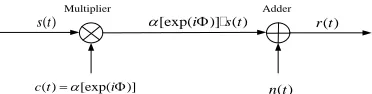
Because the impulse response of the channel is a stochastic process, the channel can be modeled as a time varying filter. The input modulation signal is denoted ass t( ), a signal received at the receiver for a filtered signal plus noise, noise variance is Gauss white noise ofN0/ 2, the receiving signal can be expressed as:
( ) c( ; ) ( ) ( )
r t +∞h tτ s t τ n t
−∞
=
∫
− + (1)Assuming that the channel is frequency selective channel, the time variable channel transfer functionh tc( ; )τ can be regarded as complex-valued
which is independent of the frequency. Channel impulse response h tc( ; )τ is simplified
ash tc( ; 0) ( )δ τ . Therefore receiving signal can be expressed as:
( ) c( ; 0) ( ) ( ) ( )
r t +∞h t δ τ s t τ τd n t
−∞
=
∫
− +( ; 0) ( ) ( ) ( )[exp( ( ))] ( ) ( )
c
h t s t n t αt i t s t n t
= + = Φ + (2)
The received signal can be expressed as: transmitting signal multiplyh tc( ;0)which represents
the complex-valued random process of the channel time-varying characteristics.
( ; 0) ( )[exp( ( ))]
c
h t =α t iΦt represents the channel fading process. α( )t represents the equivalent low-pass channel envelope process, Φ( )t represents the equivalent low-pass channel phase process, the two are the real random process.
Suppose that the channel fading varies very slowly, thus the channel fading process can be regarded as a constant by one symbol intervals. In this sense, the above formula can be further simplified to:
( ) [exp( )] ( ) ( ) 0
r t =α iΦ s t +n t ≤ ≤t T (3) Which: T is modulation code width; α andΦ indicated the equivalent low-pass channel amplitude and phase, both of which are the real random process. About characteristics of probability distribution of
α
andΦ , predecessors do a lot of transmission characteristic measurement by Olympus satellite, Italsat satellite and ACTS satellite, and have accumulated a large amount of data. Signal envelope and phase probability distributions are Gauss distribution, their probability density function are expressed as:2 1 2 1 1
( ) 1
( ) exp( ) 2 2
r m
p r
σ πσ
−
= − (4)
2 2 2 2 2
( ) 1
( ) exp( ) 2 2
m p
σ πσ
Φ −
Φ = − (5)
Which: p r( )is the probability density function of signal envelope; p( )Φ is the phase of signal probability density function; σ1 and σ2 are the signal envelope and phase variance; m1 and m2
corresponding to the mean value respectively.
( )
s t
( ) n t
( ) r t [exp(i )] ( )s t
α Φ
( ) [exp( )]
c t =α iΦ
[image:2.612.330.516.611.658.2]Multiplier Adder
Figure 2: Mathematical Channel Models Of Statistic Characteristics
2.1.2Inter satellite link simulation model
305 3 below. Gauss 1 and Gauss 2 are two independent band limited, zero mean Gauss random process in Figure 3. The variance are respectively equal to
1
σ andσ2. After Gauss 1 add with m1which is produced by constant generator 1, Gauss stochastic process α is generated by mean value m1 , variance σ1 . Similarly it can generate Gauss random processΦ .Φ generates exp(iΦ) through index of generator, and multipliesα , and obtain multiplicative disturbance vectorc t( )=α[exp(iΦ)]. AWGN expresses channel additive white Gauss noisen t( ). It represents a different channel, only needs to change the variance settings of the Gauss 1 and Gauss 2, or the parameter settings of real constant generator 1 and real constant generator 2.
Real number generator 1
Gauss 1
Real number generator 2
Gauss 2
AWGN
exp( )
1 m
2
m
Adder
Adder α
Φ
exp(iΦ)
Adder
Multipl ier Multipli
er ( )
s t
( )
c t n t( )
( )
r t
Figure 3 Channel Simulation Model Of Statistic Characteristics
The satellite channel model establishes the foundation for follow-up computer simulation, and saves time, at the same time, other inter satellite communication system can be further studied by the model.
2.2 Monte Carlo communications system simulation model
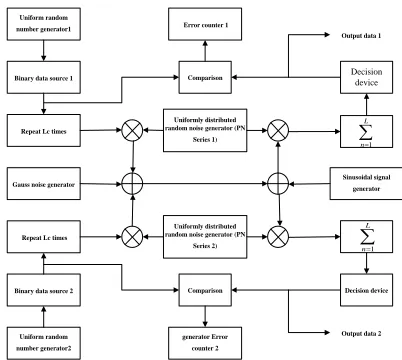
In this section we uses the Monte Carlo communication system model to carry out simulation analysis for anti-interference performance on direct spread spectrum system. In order to obtain more information, the simulation is implemented by dual subscriber. The simulation model is showed as Figure 4.
Single user simulation process is chosen to describe in Figure 4. A series of binary information (±1) are generated by random number generator, each bit of information to repeat Lc times,
c
L corresponds to each bit of information contained in the pseudo code number. Lcrepetitive sequences of every bit multiply with PN sequencec n( )which is generated by another random number generator. Then the sequence is superimposed by variance
2
0/ 2 N
σ = Gauss white noise and forms for the
0
( ) sin
i n =A ω n sinusoidal disturbances, while0<ω0<π, and sinusoidal interference signal amplitude satisfies the condition A<Lc . In the demodulator for PN sequence correlation operation, and Lcsamples of the composition information bits are added. The output of adder is send to decision device, the signal and the threshold 0 is compared, to determine the transmitted data for +1 or -1, error counter is used to record the number of erroneous for judgment device.
Gauss noise generator Sinusoidal signal generator Uniformly distributed
random noise generator (PN Series 1)
Uniformly distributed random noise generator (PN
Series 2) Uniform random
number generator1
Binary data source 2 Repeat Lc times
1
L
n=
∑
Decision device Comparison
Error counter 1
Repeat Lc times Binary data source 1
Uniform random number generator2
Comparison
generator Error counter 2
1
L
n=
∑
Decision device Output data 1
[image:3.612.315.516.239.419.2]Output data 2
Figure 4 Simulation Model Of Two-User DSSS Communication System
2.3 Satellite Communication System Simulation Research
2.3.1 Spread spectrum compare with convolutional code in inter satellite communication system
[image:3.612.95.297.302.387.2]306
Figure 5 BER Comparisons Between DSSS And Convolutional Code In Isls
The simulation results of Figure 5 show the spread spectrum technology and channel coding technology can reduce the system bit error rate. When sinusoidal interference amplitude value is zero, convolutional code improves system performance much better than the spread spectrum technology. When presenting sinusoidal interference, the spread spectrum technology is better than convolutional code. And with the sinusoidal interference amplitude increasing, the effect of convolutional code is reduced.
2.3.2 Spread spectrum and convolutional code in satellite communication combined application
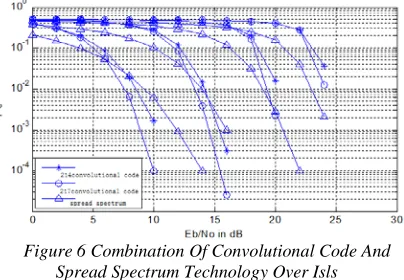
Spread spectrum technology and channel coding technology can improve the reliability of inter satellite communication. As seen in Figure 6 below, the bit error rate curve is given by combining different constraint length convolutional code with spread spectrum technology. Sinusoidal interference amplitude values takes 0, 3, 7 and 12, convolutional code chooses (2, 1, 4) and (2, 1, 7) respectively in the simulation. The simulations are given in Figure 6.
Figure 6 Combination Of Convolutional Code And Spread Spectrum Technology Over Isls
The four sets of curves of Map from left to right represent sinusoidal interference value 0, 3, 7 and 12. The simulation results show: with the
convolutional code constraint length increasing, the error rate improves significantly stronger.
Comprehensive considerations, the application of channel coding technology are advantage in real system. When the sinusoidal interference value is larger, we should consider whether add convolutional code to spread spectrum system, according to signal noise ratio which the actual system can provide.
3. CONCLUSION
In this paper, inter satellite channel mathematical model and simulation model are established. In addition, Monte Carlo method is used to establish spread spectrum communication system based on dual subscribers. Spread spectrum communication technology and channel coding technology are combined application, when sinusoidal interference exists in inter satellite channel. The simulation results show that the improvement effect of system BER increases in turn by using convolutional code, spread spectrum technology and combination of both. The combined application of spread spectrum and coding technology can achieve the best results in inter satellite communication system.
ACKNOWLEDGEMENTS
This work is supported by the National High Technology Research and Development Program of China (No.2012AA120601), National Natural Science Foundation of China (No. 11202044, No. 11072044) and the Fundamental Research Funds for the Central Universities.
REFERENCES:
[1] G.Y. Li, “Wavelet notch filter design of spread-spectrum communication systems for high-precision wireless positioning”, Circuits,
Systems, and Signal Processing, Vol. 31, No.
2, 2012, pp. 651-668.
[2] E. Andrea, Z. Francesca, B. Gabriele, L. Marco, “Spread-spectrum continuous-phase-modulated signals for satellite navigation”,
IEEE Transactions on Aerospace and
Electronic Systems, Vol. 48, No. 5, 2012, pp.
3234-3249.
[3] H.F. Cao, R.X. Zhang, F.L Yan, “Spread spectrum communication and its circuit implementation using fractional-order chaotic system via a single driving variable”,
[image:4.612.96.298.543.683.2]307
Numerical Simulation, Vol. 18, No. 2, 2012,
pp. 341-350.
[4] U. Rahat, L. Shahid, “Improving the security level in direct sequence spread spectrum using dual codes (DC-DSSS)” International Journal
of Security and its Applications, Vol. 6, No. 2,
2012, pp. 133-136.
[5] K. Jayanthi, P. Dananjayan, “Improving antijamming characteristics of spread spectrum communication systems”, International Journal of Autonomous and Adaptive
Communications Systems, Vol. 5, No. 1, 2012,
pp.77-87.
[6] M. Kuribayashi, “Interference removal operation for spread spectrum fingerprinting scheme”, IEEE Transactions on Information
Forensics and Security, Vol. 7, No. 2, 2012,
pp. 403-471.
[7] Y.C. Wu, “Error control coding application in satellite communication”, Telecommunication
Engineering, No. 1, 2001, pp. 3-7.
[8] M. Wei, Z.L. Li, F. Yin, “Analysis and simulation of AR-SESS system performance”,
Journal of University of Electronic Science and
Technology, Vol. 34, No. 5, 2005, pp. 585-588.
[9] H.K. Sun, J.L. Zhou, J. Mo, “Design and performance analysis of multi-user chaotic sequence spread-spectrum communication system”, Journal of Electronics & Information
Technology, Vol. 29, No. 10, 2007,
pp.2436-2440.
[10] M.F. Fei, K.C. Yi, “A M-Ary spreading spectrum system using FB-FDE”, Journal of
University of Electronic Science and
Technology, Vol. 37, No. 3, 2008, pp.382-385.
[11] J. Bas, A. Perez, A. Miguel, “Differential fuzzy filtering for adaptive line enhance in spread spectrum communications”, Signal Processing, Vol. 86, No. 5, 2006, pp. 984-1009.
[12] S. Seda, A. Aydin, Luis, “Time-frequency channel modeling and estimation of multi-carrier spread spectrum communication systems”, Journal of the Franklin institute, Vol. 342, 2005, pp. 776-792.
[13] M.J. Wang, S.B. Zhu, “Research on the inter-satellite link channel model”, Journal of
Institute of Command and Technology, Vol. 16,