http://dx.doi.org/10.4236/wjet.2015.33014
Simple General Purpose Ion Beam
Deceleration System Using a Single
Electrode Lens
J. Lopes
1, J. Rocha
21Instituto Superior de Engenharia de Lisboa, Rua Conselheiro Emídio Navarro, Lisbon, Portugal
2Instituto de Plasmas e Fusão Nuclear, Campus Tecnológico e Nuclear, Instituto Superior Técnico, Lisboa,
Portugal
Email: [email protected], [email protected]
Received 28 June 2015; accepted 3 August 2015; published 6 August 2015
Copyright © 2015 by authors and Scientific Research Publishing Inc.
This work is licensed under the Creative Commons Attribution International License (CC BY). http://creativecommons.org/licenses/by/4.0/
Abstract
Ion beam deceleration properties of a newly developed low-energy ion beam implantation system were studied. The objective of this system was to produce general purpose low-energy (5 to 15 keV) implantations with high current beam of hundreds of µA level, providing the most wide im-plantation area possible and allowing continuously magnetic scanning of the beam over the sam-ple(s). This paper describes the developed system installed in the high-current ion implanter at the Laboratory of Accelerators and Radiation Technologies of the Nuclear and Technological Cam- pus, Sacavém, Portugal (CTN).
Keywords
Deceleration, Low Energy, Positive Ion Beam
1. Introduction
2. System Description
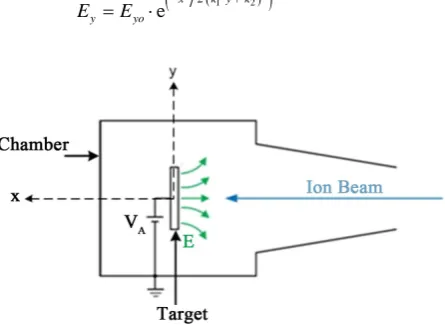
To produce ion implantations at low energies it is necessary to decelerate the beam, keeping it focused. Positive beam deceleration is performed by applying a positive voltage to the target (VA), in order to create an axial elec-tric field in the opposite direction of propagation of the ion beam (E). This is the method (Figure 1) used in most of ion implanters.
The difficulty in the deceleration process is the creation of a uniform axial field in order to decelerate the beam without defocus. The most common method is to use Einzel lenses [4]-[6] to focus the beam in the lens axis. This method restricts the implantation area to a small region. In a general purpose system where multiple samples of different dimensions and large beam scanning has preference over a sharp focus, a single electrode lens can be more useful.
In order to correct the dispersion of the ion beam allowing magnetic scanning to run continuously it was ne-cessary to study the behaviour of a positive ion beam in two aspects: in front of a charged target and in the re-gion inside a charged ring.
This study, using simple electromagnetism theory, showed that a positive ion beam deflection of length yi due
to a uniform electric field with opposite direction of the beam can be described by [7]-[9]
2 2 1 1 – 2 tan 4 tan i x y
K K α K α
= − +
⋅ ⋅ ⋅
⋅ (1)
where 2 4 x o E K
Ec senα −
× =
× (2)
being Eco the initial beam energy and α the incident angle and Ex the electric field on the x direction, given by
2 1 2 2
4 π a a x
a o a
C V x
E
R ε R x
= − ⋅ ⋅ + ⋅
⋅ (3)
where Va is the voltage applied to the target, Ca the self-capacitance and Ra the target radius.
As the field is non-uniform, the final deflection yf is given by the sum of elementary regions of uniform fields as in
1 n
f i
y =
∑
y (4)being n the number of considered uniform regions.
On the other hand, the study of a charged ring showed that the electric field in the y direction inside the ring, that forms the single electrode lens, can be given by
( )
(
2 2)
1 2
2
e x k y k
y yo
[image:2.595.204.427.542.705.2]E =E ⋅ − ⋅ ⋅ + (5)
where 3 2 1 1 8 2 ln yo l V E k
R R y R y
R r ⋅ = ⋅ − ⋅ + − ⋅
⋅ (6)
being V the voltage applied to the ring, l the ring length, R the ring radius, r the electrode radius and k1, k2 and k3
geometrical constants of the system.
Thus the beam deflection due to a charged ring is given by
(
1 2)
2π 2 yo y o d E
D k y k
Ec ⋅
= ⋅ +
⋅ ⋅
⋅ (7)
where d is the distance between the target and the lens.
Thus, using Equations (4) and (7) was possible to determine the voltage to apply to the electrostatic lens to compensate for the deflection of the ion beam caused by the charged target. The theoretical approach was also useful to determine the best overall geometry of the system.
To confirm these results, the simulation software Simion 3D 8.0 was used to simulate the performance of the electrostatic lens, enabling to verify the best target and lens dimensions and gap in between to subsequently build the system [5].
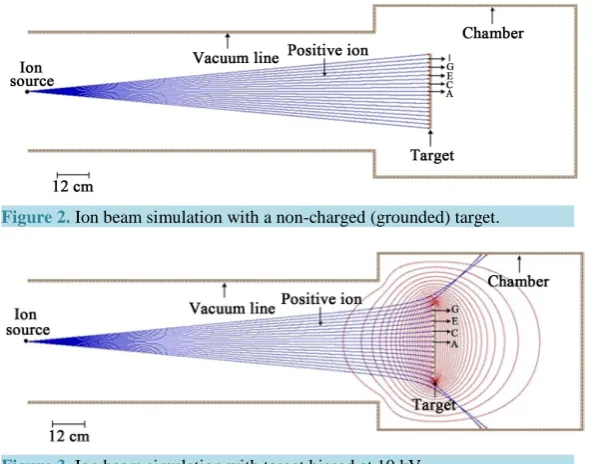
In Figure 2the non-charged target is showed, the lines in blue represent the various possible trajectories for a positive ion beam of 15 keV energy.
In Figure 3is represented one simulation with the same conditions but with a target potential of 10 kV (beam energy of 5 keV). In this situation deflection exists, as predicted in the theoretical study. The red lines represent the electric field equipotentials.
Through this figure is also possible to verify that the deflection increases as the target is biased at higher po-tentials, as expected i.e. as final energy becomes smaller, the beam becomes defocused.
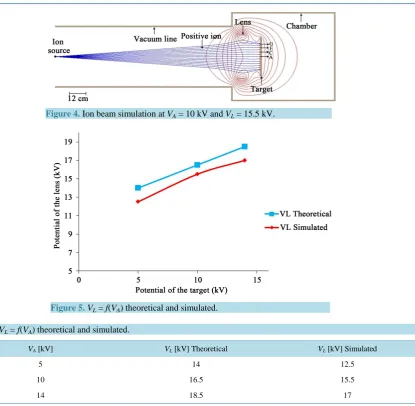
For subsequent simulations a lens was introduced. As shown inFigure 4, the simulation confirms the theo-retical prediction that, using a charged lens with only one electrode with a given potential, it is possible, for most trajectories, to compensate the deflection caused by the target, relaying the path of the beam to its original posi-tion. It is also shown that the outmost trajectories are over-deflected.
Table 1and Figure 5shows the theoretical and simulated values for the potential applied to the lens (VL) for which the most significant trajectories are better compensated for various values of the target potential (VA), us-ing the same geometry in both cases.
[image:3.595.166.462.482.714.2]Figure 2. Ion beam simulation with a non-charged (grounded) target.
Figure 4. Ion beam simulation at VA = 10 kV and VL = 15.5 kV.
Figure 5. VL = f(VA) theoretical and simulated.
Table 1. VL = f(VA) theoretical and simulated.
VA [kV] VL [kV] Theoretical VL [kV] Simulated
5 14 12.5
10 16.5 15.5
14 18.5 17
The equation for the deflection caused by the electric field (7), is in general terms in agreement with the si-mulations, as long it is applied to flat samples to avoid changes in the geometry of the target and consequently in the electric field.
3. Experimental Results
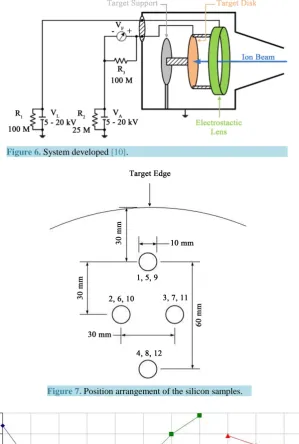
In Figure 6 is showed the circuit used for deceleration and focusing of the beam.
In this circuit, two high voltage (20 kV) power supplies are used, one to bias the lens (VL) and the other to bias the target (VA). Resistors R1 and R2 are used to improve voltage stability, while the resistor R3 is intended to
measure the beam current [10].
Three sets of tests were performed in order to proof homogeneity of implantations using the studied system. Each test consists of an implantation of four samples of silicon with an Argon beam with final energy of 5 keV. The implantation area was 10 × 10 cm2and beam current of 100 μA (Figure 7). The first test consists of an im-plantation without target bias and without lens (beam of 5 keV directly from source). The second test consists of an implantation with target bias but without lens (beam of 15 keV and target bias at 10 kV). The third test con-sists of an implantation with target bias and lens (beam of 15 keV, target bias at 10 kV at lens bias at 15.5 kV).
Figure 6.System developed [10].
[image:5.595.144.488.486.685.2]Figure 7. Position arrangement of the silicon samples.
Figure 8. Comparing fluences implanted in the different samples.
re-sult it was observed that there is a greater homogeneity in the samples 9 to 12 with the largest difference be-tween fluences of the order of 14% while in samples 1 to 4 and 5 to 8 are about 42% and 38% respectively.
Through this test, and taking into account the theory the simulation and the results, it is possible to confirm that the maximum limit that each sample can be within the edge of the target is about 6 cm (sweeping amplitude of 16 cm). This can be verified in Figure 7where sample 9 is distant 3 cm from the edge, which clearly over-comes the limitations of the system. This test also permits to verify that the trajectory correction due to the use of the lens is concentrated in the center of the target in an area of about 8 cm in radius, which allows implanta-tions of about 15 × 15 cm2 with acceptable homogeneity.
4. Conclusions
Using the developed system was possible to perform implantations at 5 keV energy continuously scanning of the ion beam over an area of 10 × 10 cm2 with accuracy for a general purpose low-energy implantation system. In addition it was possible to compare the differences between ion implantation based on energy and beam focus.
In this paper the results obtained for implantations at low energies (below 15 keV) were presented. These re-sults were achieved based on the system developed with an electrostatic lens of a single electrode, allowing per-forming implantations at low energies with a focused beam using the magnetic beam scanning over a large area, gaining versatility for research involving ion implantation.
The system developed and applied to the CTN implanter can be used in other implanters, for general purpose low energy implantations where a very high homogeneity and/or very high fluence control is not an issue.
References
[1] Ziegler, J.F. (2006) Ion Implantation: Science and Technology. 6th Edition, Academic Press, Inc., Yorktown Heights, New York.
[2] Kase, M., Kikuchi, Y., Kubo, T., Niwa, H. and Fukuda, T. (1998) Issues of Ultra Shallow Junction Formation Using Sub-1 keV Ion Implantation. 1998 International Conference on Ion Implantation Technology, Proceedings, Vol. 1 Kyoto, 22-26 June 1998, 110-113. http://dx.doi.org/10.1109/IIT.1999.812064
[3] Graf, M.A., Vanderberg, B., Benveniste, V. and Tieger, D.R. (2002) Low Energy Ion Beam Transport. Proceedings of the 14th International Conference on Ion Implantation Technology, New Mexico, 27-27 September 2002, 359-364. http://dx.doi.org/10.1109/IIT.2002.1258015
[4] Abdelrahman, M.M. (2008) Ion Beam Simulation Using a Three-Electrode Diaphragm Einzel Lens System. Journal of Nuclear and Radition Physics, 3, 93-100.
[5] Dahl, D.A. (2000) Simion 3D Version 8.0—Users’s Manual. Idaho National Engineering and Environmental Labora-tory, I D 3415.
[6] Sise, O., Ulu, M. and Dogan, M. (2005) Multi-Element Cylindrical Electrostatic Lens Systems for Focusing and Con-trolling Charged Particles. Nuclear Instruments and Methods in Physics Research Section A: Accelerators, Spectrome-ters, Detectors and Associated Equipment,554, 114-131. http://dx.doi.org/10.1016/j.nima.2005.08.068
[7] Purcell, E.M. (1973)Curso de Física de Berkeley Volume 2. Editora Edgard Blucher 1973.
[8] D. Halliday, D., Resnick, R. and Krane, K.S. (1995) Fundamentos de Física. Livros Técnicos e Científicos.
[9] Hong, S.N., Ruggles, G.A., Paulos, J.J., Wortman J.J. and Ozturk, M.C. (1988) Formation of Ultrashallow p+-n Junc-tions by Low-Energy Boron Implantation Using a Modified Ion Implanter. Applied Physics Letters, 53, 1741-1743. http://dx.doi.org/10.1063/1.100470
[10] Lopes, J.G., Rocha, J., Redondo, L.M. and Alegria, F.C. (2011) High Resolution Ion Beam Profile Measurement Sys-tem. 13th International Conference on Accelerator and Large Experimental Physics Control Systems - Proceedings, 10-14 October 2011, Grenoble, 164-167.
[11] Shimizu, S., Sasaki, N., Ogata, S. and Tsukakoshi, O. (1996) Ion Beam Deceleration Characteristics of a High-Current, Mass-Separated, Low-Energy Ion Beam Deposition System. Review of Scientific Instruments, 67,3664-3671. http://dx.doi.org/10.1063/1.1147132
[12] Ranganathan, R., Krull, W., Sundstrom, H. and Mack, M. (1998) Characterization of a High Current Ultra Low Energy Ion Implanter. 1998 International Conference on Ion Implantation Technology Proceedings, Kyoto, 22-26 June 1998, 618-621. http://dx.doi.org/10.1109/IIT.1999.812192
Advanced Science and Technology of Silicon Materials (JSPS Si Symposium), 10-14 November 2008, Kona, Hawaii. http://www.riam.kyushu-u.ac.jp/nano/hawaii2008/index.html
http://www.researchgate.net/publication/240632078_Formation_of_Ultra-shallow_Junction_with_%2A10_nm_in_Si_