N A N O E X P R E S S
Open Access
Microstructure and Phase Composition of
Cold Isostatically Pressed and Pressureless
Sintered Silicon Nitride
O. A. Lukianova
1, V. V. Krasilnikov
1, A. A. Parkhomenko
2*and V. V. Sirota
1Abstract
The microstructure and physical properties of new Y2O3and Al2O3oxide-doped silicon nitride ceramics fabricated by cold isostatic pressing and free sintering were investigated. The phase composition of produced material was also studied by X-ray diffraction at room and elevated temperature. The fabricated ceramics featured a
microstructure of Si5AlON7grains with a fine-grainedα-Si3N4with a small amount of Y2SiAlON5. Described ceramics is attractive for many high-temperature structural applications due to beneficial combination of fine-grained structure with improved mechanical properties and small weight loss.
Keywords:Silicon nitride, Microstructure, Grain size, Phase composition
Background
Silicon nitride is one of the most promising structural ma-terials for high-temperature applications because of its ex-cellent strength and toughness at elevated temperatures, good thermal shock resistance, low coefficient of thermal expansion, and chemical stability [1–3]. Silicon nitride ceramics are frequently used as structural materials espe-cially for high-temperature engineering applications. The high-temperature properties of Si3N4-based ceramics strongly depend on the oxide additives used for the densi-fication. However, its densification is rather difficult by classical sintering process due to the strongly covalent in Si–N bonds which results in low self diffusivity [4]. Such oxide additives as MgO, Al2O3, Y2O3, and Al2O3+ Y2O3 combination are considered as the most commonly used and ideal additives for Si3N4ceramics due to their high melting point and because of the possibility to control the
α→βphase transformation rates of the Si3N4, the aspect ratio of the β-Si3N4, and the grain growth anisotropy. These additives also lead to high mechanical properties at room temperature as well as at elevated temperatures [3]. The use of rare-earth oxide additives to provide a liquid phase for sintering is therefore required for obtaining
high-density Si3N4[5, 6]. The control of the grain size and its distribution is one of the most important issues in the processing of Si3N4 ceramics. Particularly, the design of duplex microstructure containing a few large elongatedβ -Si3N4 grains is quite important to ensure high fracture toughness [7–9]. One of the major problems of the silicon nitride processing is the high cost of such commercial methods as hot isostatic pressing (HIP), spark plasma sintering (SPS), and gas pressure sintering (GPS). Thus, it is important to find new and cheaper alternative process-ing methods while a relatively high strength can be acquired. To overcome this problem, we have developed a novel process involving cold isostatic pressing (CIP) and pressureless sintering in a nitrogen atmosphere.
The purpose of this work is to study the features of the microstructure and phase composition of new CIPed and pressureless sintered silicon nitride ceramics with Al2O3and Y2O3oxide.
Methods
Commercial α-Si3N4 powder (Starck, grade M11) was used as the starting powder, and Y2O3 (grade B) and Al2O3(A 16 SG Grade, Alcoa) were used as the sintering additives. The powder mixture was composed of 95 wt%
α-Si3N4powder and 15 wt% sintering additives (Table 1). The powder mixture was milled in an attritor mill for 20 min. After milling, the powder mixture was cold
* Correspondence:[email protected]
2Institute of Hydrobiology of the National Academy of Sciences of Ukraine, 2, Geroyev Stalingrada ave., 04210 Kyiv, Ukraine
Full list of author information is available at the end of the article
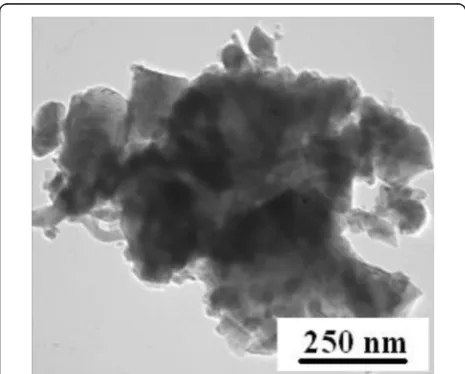
isostatically pressed to rectangular bars at 200 MPa (EPSI CIP 400 B-9140 press). The green bodies were sin-tered in a vacuum furnace (Nabertherm VHT 8/22-GR) under 0.1 MPa in a nitrogen atmosphere at 1650 °C (Table 1). For more details and properties, see [10–12]. Figure 1 shows the agglomerate of the initial commercial silicon nitride powder observed by TEM.
Phase composition of the sintered samples was deter-mined by the X-ray diffraction method (XRD, Rigaku Ultima IV diffractometer; Cu Kα—emission (radiation), Ni—filter). A scan rate of 10 °C/min was used to record the diffraction patterns in 2θrange between 10 and 60 °C. XRD analyses were carried out using a Rigaku Ultima IV automated diffractometer. The sintered material was analyzed in the solid form.
The microstructure was characterized by scanning elec-tron microscopy (SEM) and transmission elecelec-tron micros-copy (TEM). Structural characterization was performed using an FEI Quanta 200-3D (FEI Company, Hillsboro, OR) and Quanta 600 FEG (FEI Company, Hillsboro, OR) scanning electron microscopes. Since the silicon nitride material under investigation was non-conducting, it was necessary to coat it with a thin layer of carbon to prevent surface charging during examination. One specimen from batch was examined in a transmission electron micro-scope (JEOL-2100) at 200 kV. Foils for TEM were pre-pared from slices hand ground and finally ion-polished until perforation.
Thermogravimetric analysis (TGA)/differential thermal analysis (DTA) experiments were performed using an equipment STA 503 BÄHR model at a heating rate of 10 °C/min.
For surface examination, specimens were mechanically polished.
Results and Discussion
A lot of researches and developments indicated that high fracture toughness has been attributed to the elongatedβ -Si3N4grains and weak grain boundary, which favors crack bridging and deflection. It was reported that the materials having microstructure with the finest and coarsest elon-gated β-grains showed the high value of fracture tough-ness, whereas materials with the microstructure with the mixture of elongated thin and thick β-grains had lower facture toughness [13]. Figure 2 shows a microstructure of a polished specimen. Produced ceramics is characterized by the bimodal character of microstructure with a grain size distribution from 300 to 800 nm. The microstructure generally consisted of large and small equiaxed grains.
[image:2.595.57.292.110.146.2]The density of our material was 2.94 g/cm3, the flexural strength was 280 MPa, the Young’s modulus was 214 GPa, the microhardness was 1375 HV, and open porosity was 0.1 % as it described in our previous work [10]. Abe et.al described the correlation of CIP condition with structure and properties of both green and sintered bodies [5]. Hotta et al. described the microstructure and fracture strength of CIPed silicon nitride [6]. Sintered in a nitrogen atmosphere for 3 h, materials exhibit high mechanical properties, in particular, a high bending strength 607 and 686 MPa, respectively, and fracture toughness 5.6 MPa/m−1/2 [5, 6]. Furthermore, it should be noted that reported high strength ceramics have the same type of microstructure comparing with our ceramics.
Figure 3 presents the results of thermal analysis. The sample firstly starts losing weight at about 200 °C and ends at about 400 °C. The weight loss of the present ceramics was 0.003 % (Table 2).
Matovic and co-authors investigated pressureless sin-tered Si3N4with the Li2O–Y2O3additives. The density of this ceramics ranged from 83.8 to 98.0 % of the theoretical density depending on the amount and type of oxide additives. The weight loss was 3.7 and 4.1 %, respectively [8]. Cinibulk and Thomas described the same type of structure for sintered at 1850 and 1900 °C silicon nitride with a YSiAlON glass.β-Y2Si2O as a secondary phase was observed after the heat treatment at 1350 °C, while at a higher temperature of 1450 °C, primarily YSiO2N and Y4Si2O7N2in addition to small amounts of Y2SiOs were found [9].
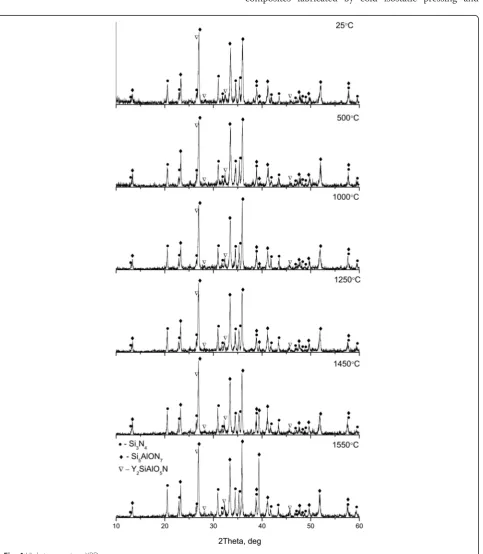
High-temperature XRD patterns of the sintered samples are shown in Fig. 4. The XRD analyses revealed β -Si5AlON7 as a major phase, α-Si3N4 phase, and
Table 1Chemical composition of the starting materials and physical properties Si3N4, wt% Al2O3 wt% Y2O3 wt% Pressure (CIP), MPa Powder bed Temperature, °C
85 9 6 200 Si3N4 1650
[image:2.595.57.290.524.711.2]Y2SiAlON5as a secondary phase in the produced ceram-ics. It should be noted that all specimens could be sintered to higher than 95 % of theoretical density. Free Si was not observed. Ling and coauthors described pressureless sin-tered silicon nitride with MgO as an additive. It was only
β-silicon nitride that existed in the as-sintered samples. Neither MgO or Y2O3 nor other crystalline phase was detected [6].
Yang et al. described porous silicon nitride with 5 wt% different rare-earth oxides sintering additives (Y, La, Lu, and Eu) fabricated by pressureless sintering. A β-Si3N4 phase was only found by XRD analysis. This ceramics showed a typical bimodal microstructure with a large elongated β-Si3N4 grains and small β-Si3N4 matrix grains. The porosity of the described material varied from 48 to 54 %, the bending strength ranged from 150
Fig. 2Microstructures of Si3N4sintered with yttrium and aluminum oxide additives.aSurface by SEM.bFracture by SEM.cThin specimen by TEM
[image:3.595.57.539.87.362.2] [image:3.595.57.540.524.717.2]to 188 MPa, the fracture toughness varied from 1.6 to 3.1 MPa/m−1/2, and the weight loss varied from 4 to 7 % [7]. Chen et al. also described silicon nitride ceramics with controlled porosity from 42 to 63 % and relatively high flexural strength from 50 to 120 MPa [14]. Luo and co-authors described 90 and 95 % dense Si2N2O/β-Si3N4 composites fabricated by cold isostatic pressing and Table 2Physical properties
Mass loss, %
Flexural strength,
MPa [10] ρ
, g/cm3[10] Open porosity, % [10]
0.003 280 2.94 0.01
sintering at 1700 and 1800 °C. This material consists of Si2N2O andβ-Si3N4phases and has a grain size of 2 and 0.5 μm, respectively, depending on the sintering temperature [15]. Sillapasa and others investigated uni-axially pressed and further cold isostatically pressed pre-sintered at argon atmosphere and then finally pre-sintered in a nitrogen atmosphere silicon nitride. The bulk density of described material ranged from 2.18 to 2.61 g/cm3, the porosity varied from 5.78 to 21.30 %, the Young’s modulus changed from 121.5 to 198.6 GPa, the bending strength ranged from 104.0 to 250.7 MPa, and the mi-crohardness varied from 403 to 971 HV [16].
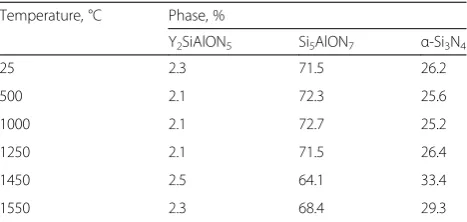
The content of all phases changes insignificantly with an increase in the temperature from 20 to 1550 °C (Table 3). In particular, the content of Si5AlON7varied from 64.1 to 72.7 %, the content ofα-Si3N4ranged from 25.2 to 33.4 %, and the amount of the Y2SiAlON5 varied from 2.1 to 2.5 %. Gonon with co-authors described in detail charac-teristics of the Y2SiAlON5 [17]. Further increase in the testing temperature up to 1500 °C is accompanied with a decrease in the β-SiAlON content up to 68.4 %. Some physical properties of the free sintered magnesium oxide doped ceramics were described in Sirota et al. [18].
Tables 2 to 4 summarize the variation of density, mass loss, phase content, and lattice parameter of the specimen after sintering. The data for the specimens referred from the previous paper are also listed in Table 2.
Conclusions
The fabrication of a fine-grained silicon nitride ceramics by cold isostatic pressing and pressureless sintering was reviewed. Commercial submicronic powders were used as raw materials. Al2O3 and Y2O3 additives lead to moderately high density and low weight loss.
The results can be summarized as follows:
1. The obtained ceramic has a fine-grained microstruc-ture with equiaxed grains with the average grain size that ranged from 0.3 to 0.8μm.
2. Investigated ceramics mainly consists ofα-Si3N4and
Si5AlON7phases and a small amount of the Y2SiAlON5
phase. Phase composition does not change in a wide temperature range up to 1500 °C.
3. Relatively high mechanical properties are successfully combined with the absence of porosity and low weight loss. Therefore, the proposed ceramics can be effectively used in many areas of high temperature applications.
Abbreviations
CIP:cold isostatic pressing; DTA: differential thermal analysis; HIP: hot isostatic pressing; SEM: scanning electron microscopy; SPS: spark plasma sintering; TEM: transmission electron microscopy; TGA: thermal gravimetric analysis; XRD: X-ray diffraction.
Competing Interests
The authors declare they have no competing interests.
Authors’Contributions
OAL performed the measurements and drafted the manuscript. AAP and VVK discussed the results. VVS helped to draft the manuscript. All authors read and approved the final manuscript.
Acknowledgements
The reported study was funded by RFBR according to the research project No. 16-32-00430мол_a.The authors acknowledge with gratitude the equipment support of the Advanced Ceramics Group from the University of Bremen.
Author details
1Belgorod National Research University, 85, Pobedy Str., 308015 Belgorod, Russia.2Institute of Hydrobiology of the National Academy of Sciences of Ukraine, 2, Geroyev Stalingrada ave., 04210 Kyiv, Ukraine.
Received: 6 January 2016 Accepted: 10 March 2016
References
1. Lu HH, Huang JL (2001) Effect of Y2O3 and Yb2O3 on the microstructure and mechanical properties of silicon nitride. Ceramics Int 27:621–628 2. Munz D, Fett T (1999) Ceramics: mechanical properties, failure behavior,
materials selection. Springer Berlin Heidelberg, Berlin, Heidelberg 3. Tatarko P, LojanováŠ, Dusza J,Šajgalík P (2010) Characterization of rare-earth
doped Si3N4/SiC micro/nanocomposites. Process Appl Ceramics 4:25–32 4. Lu HH, Huang JL (2000) Effect of a-Si3N4 initial powder size on the
microstructural evolution and phase transformation during sintering of Si3N4 ceramics. J Eur Ceramic Soc 20:1787–1794
5. Abe H, Hotta T, Naito M, Shinohara N, Okumiya M, Kamiya H, Uematsu K (2001) Origin of strength variation of silicon nitride ceramics with CIP condition in a powder compaction process. Powder Technol 119:194–200 6. Ling G, Yang H (2005) Pressureless sintering of silicon nitride with Magnesia
and Yttria. Mater Chem Phys 90:31–34
7. Yang J, Yang J, Shan S, Gao JQ, Ohji T (2006) Effect of sintering additives on microstructure and mechanical properties of porous silicon nitride ceramics. J Am Ceram Soc 89:3843–3845
8. Matovic B, Rixecker G, Aldinger F (2004) Pressureless sintering of silicon nitride with lithia and yttria. J Eur Ceramic Soc 24:3395–3398 9. Cinibulk MK, Thomas G, Johnson SM (1990) Grain-boundary-phase
[image:5.595.57.291.98.209.2]crystallization and strength of silicon nitride sintered with a YSlAlON glass. J Am Ceram Soc 73:1606–1612
Table 3Phase composition
Temperature, °C Phase, %
Y2SiAlON5 Si5AlON7 α-Si3N4
25 2.3 71.5 26.2
500 2.1 72.3 25.6
1000 2.1 72.7 25.2
1250 2.1 71.5 26.4
1450 2.5 64.1 33.4
[image:5.595.57.293.662.732.2]1550 2.3 68.4 29.3
Table 4Phase characteristics
Space group Lattice constant,Å
a c
Y2SiAlON5 P63/m (176) 3.818 9.980
Si5AlON7 P63(173) 7.629 2.927
10. Lukianova O (2015) Mechanical and elastic properties of new silicon nitride ceramics produced by cold isostatic pressing and free sintering. Ceramics Int 41:13716–13720
11. Krasil'nikov VV, Sirota VV, Ivanov AS, Kozlova LN, Luk'yanova OA, Ivanisenko VV (2014) Investigation of the structure of Si3N4-based ceramic with Al2O3 and Y2O3 additives. Glass Ceram 1:17–19
12. Sirota V, Krasilnikov V, Lukianova O (2013) Fabrication of the ceramics based on silicon nitride by free sintering and cold isostatic pressing. NANOCON 2013—conference proceedings, 5th international conference., pp 248–251 13. Hirao K, Nagaoka T, Brito ME, Kanzaki S (1994) Microstructure control of
silicon nitride by seeding with rodlikeβ-silicon nitride particles. J Am Ceram Soc 77:1857–1862
14. Chen F, Shen Q, Yan F, Zhang L (2007) Pressureless sintering ofα-Si3N4 porous ceramics using a H3PO4 pore-forming agent. J Am Ceram Soc 90: 2379–2383
15. Luo J, Zhang C, Ma H, Wang G (2012) Cold isostatic pressing–normal pressure sintering behavior of amorphous nano-sized silicon nitride powders. Adv Mater Res 454:17–20
16. Sillapasa K, Danchaivijit S, Sujirote K (2005) Effects of silicon powder size on the processing of reaction-bonded silicon nitride. J Met Mater Miner 15:97–102 17. Gonon MF, Descamps JC, Cambier F, Thompson DP (2000) Crystal structure
determination of Y2SiAlO5N“B-phase”by Rietveld analysis. Mater Sci Forum
325-326:325–334
18. Sirota V, Lukianova O, Krasilnikov V, Selemenev V, Dokalov V (2016) Microstructural and physical properties of magnesium oxide-doped silicon nitride ceramics. Results in Physics 6:82-83
Submit your manuscript to a
journal and benefi t from:
7 Convenient online submission 7 Rigorous peer review
7 Immediate publication on acceptance 7 Open access: articles freely available online 7 High visibility within the fi eld
7 Retaining the copyright to your article