Gravitational Search Algorithm for solving Unit
Commitment Problems
M. Ramu1, L. Ravi Srinivas2, S. Tara Kalyani3 1
Department of Electrical and Electronics Engineering, GITAM University, Visakhapatnam, India 2
Department of Electrical and Electronics Engineering, Gudlavalleru Engineering College, Gudlavalleru, India 3
Department of Electrical and Electronics Engineering, JNTU University, Hyderabad, India
Abstract: This paper proposes a new approach for solving unit commitment problem using gravitational search algorithm (GSA). The proposed search is based on law of gravity and mass interaction applied to determine the optimal unit commitment schedule includes with minimum up/down time and spinning reserve constraints. The GSA approach is useful to decide the optimal setting of control variables of unit commitment. The performance of the proposed approach initially examined and tested on 10 unit system later extended up to 40 unit system with 24-hr horizon. The results obtained from the proposed GSA approach indicate that GSA provides effective and robust solution of unit commitment.
Keywords: unit commitment, cost function, search space, gravitational search algorithm
I. INTRODUCTION
Unit commitment (UC) is the problem of formative schedule of generating units within a power system subject to device and operating constraints. This means the resultant UC schedule should get the most out of the profit, which can be regarded as to implying the minimization of the system production cost as well, during the period, given for a day and so longer time, while simultaneously satisfying the constraints of individual generator [1]. UC is a large scale optimization problem since it involves a large number of 0/1 scheduling variables that represent up/down time status of generators. Some techniques already have been applied to this problem [2-3], such as branch and bound [4], dynamic programming [5], lagrangian programming [6], genetic algorithm [7], differential evolution [8], hybrid methods [9-10].recently a new heuristic search algorithm namely gravitational search algorithm(GSA) motivated by gravitational law and law of motion have been proposed[11-12]. In this paper GSA method has been proposed for solving unit commitment problem.
II. MATHEMATICALPROBLEMFORMULATIONOF UC
The objective of unit commitment problem is to minimize the production cost over the scheduled time horizon (24hours) under the generator operational and spinning reserve constraints. The objective function to be minimized is
T
t N
i
t i t i t i t i i t
i t
i
U
F
P
ST
U
U
P
F
1 1
, 1 , ,
,
)
[
(
)
(
1
)]
,
(
(1)Subject to the following constraints Power balance constraint
N
i
t D t i t
i
U
P
P
1
, (2)
Spinning reserve constraint
N
i
t t D t i
i U P R
P
1
, max
, (3) Generator limit constraints
N
i
U
P
P
U
otherwise
or
T
T
if
T
T
if
U
ioff idownup i on i t i
,
1
0
,
,
0
,
,
1
, , , , , Startup cost
down i cold i off i i down i cold i off i down i i t iT
T
T
if
CSC
T
T
T
T
if
HSC
ST
, , , , , , , ,,
(5)III. GRAVITATIONALSEARCHALGORITHM
The gravitational search algorithm (GSA), is one of the newest heuristic search algorithm was developed by Rashedi et al. in 2009[11]. GSA is followed the physical law of gravity and the law of motion. The gravitational force between two particles is directly proportional to the product of their masses and inversely proportional to the square of the distance between them. In the proposed algorithm, agents are considered as objects and their performance is measured by their masses.
Pi= (pi….pid,…,pin),i=1,2,…..m (6) Where.pid is the position of the ith mass in the dth dimension and n is the dimension of the search space. At specific time ‘t’ a
gravitational force form mass j act on mass i and is defined as follows.
(7)
Where Mi is the mass of the of the object i,Mj is the mass of the object j , G(t) is the gravitational Constant at time t, Rij(t) is the Euclidian distance between the two objects i and j , and ε is a small constant.
2
)
(
),
(
)
(
t
p
t
p
t
R
ij
i j(8) The total force acting on the agent i in the dimension d is calculated as follows.
Fid(t)=
m i j i j j d ij
rand
F
, (9)where rand j is a random number in the interval [0, 1].
According to the law of motion, the acceleration of the agent i, at time t , in the dth dimension, αid(t) is given as follows:
)
(
)
(
)
(
t
M
t
F
t
n d i d i
(10)To find the velocity of a particle is a function of its current velocity added to its current acceleration. Therefore, the next position and next velocity of an agent can be calculated as follows.
)
1
(
)
(
)
1
(
)
(
)
(
)
1
(
t
t
p
t
p
t
t
p
rand
t
d i d i d i d i d i i d i
(11)where
rand
iis a uniform random variable in the interval [0, 1].The gravitational constant, G, is initialized at the beginning and will be decreased with the time to control the search accuracy. In other words, G is function of the initial value (G0) and time (t):
(12) t
e
G
t
G
1 0)
(
(13)The gravitational and inertial masses are updating by the following equations
)
(
)
(
)
(
)
(
)
(
t
worst
t
best
t
worst
t
fit
t
m
i i
(14))
(
)
(
)
(
1t
m
t
m
t
M
j m j i i
(15)Where represents the fitness value of the agent iat time t , and the best (t) and worst (t) in the population respectively indicate the strongest and the weakness agent according to their fitness value. For a minimization problem:
Best(t)=
min
(
)
} ,..., 1 {t
fit
m j (16)worst(t)=
max
(
)
} ,..., 1 {t
fit
m j (17)For a Maximization problem:
Best(t)=
max
(
)
} ,..., 1 {
t
fit
m j (18)Worst (t) =
min
(
)
} ,..., 1 {
t
fit
m j (19)IV. GRAVITATIONALSEARCHALGORITHMAPPLIEDTOUNITCOMMITMENTPROBLEM
In order to handle the constraints conveniently, the structure of solutions for UC problem has solved by the proposed method is composed of a set of real power output decision variables for each unit in all over the scheduling periods. The section provides the solution methodology to the above-mentioned Unit Commitment problems through gravitational search algorithm.
A. Initialization
In the initialization procedure, the candidate solution of each individual (generating unit’s power output) is randomly initialized within the feasible range in such a way that it should satisfy the constraint given by Eq. (4). A component of a candidate is initialized as Pit ~ U (Pimin , Pimax) ,where U is the uniform distribution of the variables ranging in the interval of (Pimin , Pimax).
B. Fitness evaluation (objective function)
The fitness evaluation in each agent in the population set is evaluated using the equation (4). Iteration count from this step, t=1. Update G (t), best (t), worst (t) and Mi for i=1, 2...m
C. Agent force calculation
The total force acting on the agent i in the dimension d is calculated in equation (7).
D. Evaluation of acceleration of an agent
The acceleration of an agent in dth dimension over T dispatch period has evaluated using equation (10).
E. Update the agents’ position
The next velocity of an agent is calculated by adding the acceleration of an agent to the current velocity and also position of an agent will updated.
F. M Stopping criterion
V. IMPLEMENTATIONOF GRAVITATIONALSEARCHALGORITHMTOUC
A new heuristic optimization algorithm based on Newton’s law of gravity and mass interactions for solving the UC problem is described as follows
A.Step 1: Search space identification.
B.Step 2: Generate initial population between minimum and maximum values of control variables of UC problem. C. Step 3: Calculate value of fitness function of each agent for the UC Problem.
D. Step4: Update G (t), best (t), worst (t) and Mi(t) for i=1, 2, ..N E.Step5: Calculate force in different directions.
F.Step6: Calculation of acceleration and velocity. G. Step7: Updating agent’s position.
H. Step8: Repeat steps 3-7 until the stop criteria are created. I.Step9: Stop
VI. NUMERICALRESULTS
In order to evaluate the performance of the proposed GSA method, its performance for solving unit commitment is tested and evaluated initially to 10 generator systems and later on extended to till 100 generator systems.
It should be noted that 20 runs of the proposed algorithm converges to unique results.
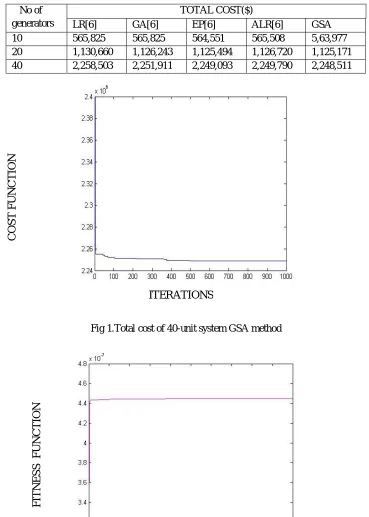
The unit commitment schedule of 40 generator system is presented in Table1.figure 1&2 shows the cost and convergence of proposed.
TABLE 1.
UNIT SCHEDULING OF 40 UNIT SYSTEM GSAMETHOD
hr Units On/Off Schedule
1 2 3 4 5 6 7 8 9 10 11 12 13 14 15 16 17 18 19 20 21 22 23 24
TABLE 2.COMPARISON OF VARIOUS METHODS
[image:6.612.193.418.439.655.2]Fig 1.Total cost of 40-unit system GSA method
Fig 2. Fitness for 40-unit system GSA method
VII. CONCLUSION
In this paper GSA method is proposed for solving unit commitment problem by considering constraints. in order to show the usefulness of the proposed method, its performance are compared with other methods shown in table2. The proposed algorithm uses
No of generators
TOTAL COST($)
LR[6] GA[6] EP[6] ALR[6] GSA 10 565,825 565,825 564,551 565,508 5,63,977 20 1,130,660 1,126,243 1,125,494 1,126,720 1,125,171 40 2,258,503 2,251,911 2,249,093 2,249,790 2,248,511
ITERATIONS
C
O
S
T
F
U
N
C
T
IO
N
F
IT
N
E
S
S
F
U
N
C
T
IO
N
to simplify unit commitment problems successfully. Further work will spotlight on together with hydro units in the UC problem. This approach of features also adapt to smart grid environments.
REFERENCES
[1] Wood, J., Wollenberg, B.F.: Power Generation, Operation, and Control, 2nd ed. Wiley, New York,1996.
[2] Corn, D., Dorigo, M., Glover, F.: New ideas in optimization. MaGraw- Hill 1999) [3] A. E. Eiben, J. E. Smith, Introduction to Evolutionary Computing, Springer, 2003.
[4] Cohen, A. I., and Yoshimura, M., “A branch-and-bound algorithm for unit commitment”, IEEE Trans.on Power Apparatus and Systems, Vol. PAS-102, pp.444-451, Feb. 1983.
[5] Lowery, P.G.: Generation unit commitment by dynamic programming. IEEE Trans Power Syst 102, 1218–1225,1983.
[6] Ongsakul, W., Petcharaks, “Unit commitment by enhanced adaptive lagrangian relaxation”, IEEE Trans. Power Syst, 19(1), 620–628, 2004
[7] Kazarlis, S.A., Bakirtzis, A.G., Petridis, V.: A genetic algorithm solution to the unit commitment problem. IEEE Trans. Power Syst., 11(1), 83–92, 1996. [8] Price KV, Storn R, Lampinen J. Differential evolution: a practical approach to global optimization. Berlin: Springer-Verlag; 2005
[9] J. P. Chiou and F. S. Wang, “Hybrid method of evolutionary algorithms for static and dynamic optimization problems with application to fed-batch fermentation process,” Comput. Chem. Eng., vol. 23, pp. 1277–1291, 1999.
[10] Estimation of monod parameters by hybrid differential evolution,” Bioprocess and Biosyst. Eng., pp. 109–113, 2001
[11] Rashedi, H. Nezamabadi-pour, S. Saryazdi, GSA: A gravitational search algorithm, Information Sciences, vol. 179,2009, pp. 2232-2248.
[12] R.K.Swain , N.C.Sahu , P.K.Hota , Gravitational Search Algorithm for Optimal Economic Dispatch ,2nd International Conference on Communication,