Reference & User Services Quarterly, vol. 57, no. 3, pp. 208–16
© 2018 American Library Association. All rights reserved.
Permission granted to reproduce for nonprofit, educational use.
The presidential election of 2016 and the ensuing forty-fifth presidential administra-tion have been marked by an increasingly polarized electorate, concerns about “fake news,” and a greater use of social media. President Trump and his administration have utilized the increased disintermedia-tion of informadisintermedia-tion consumpdisintermedia-tion by com-municating directly to the public and going around the “experts.” These phenomena raise issues for government information librarians concerned with the production, distribution, consumption, and preser-vation of government information, and impact the public’s understanding of— and trust in—government information. The government information issues we see today are not entirely new, as past governmental obfuscation has been well documented, but confronting these issues in the twenty-first century poses unique challenges. Fortunately, individuals, insti-tutions, and libraries across the country are responding to this unique moment with
a host of innovative solutions that promise to keep Americans informed in these tur-bulent times. Current engagement around these issues is reflected in educational programming at universities and public libraries, citizen actions such as the Data Rescue movement, and hybrid projects such as the End of Term Archive. The Gov-ernment Publishing Office (GPO) is due for modernization, and statutory reform of 44 U.S.C., chapter 19, is being debated by the Committee on House Administra-tion, library associations, and the Federal Depository Library Program (FDLP) com-munity. To meet the long-term needs of our users, librarians should advocate for the strengthening of existing structures for federal information such as the FDLP, LOCKSS-USDOCS, and the Hathi Trust Digital Library. Future initiatives must en-sure that official legal processes remain in place to protect government information, while leaving room for creative nongovern-mental collaborations as well.
Kian A. Flynn and
Cassandra J. Hartnett
Kian A. Flynn ([email protected]) is a geography and global studies librarian at the University of Washington Libraries in Seattle, Washington, and Cassandra J. Hartnett (cass@ uw.edu) is a US documents librarian at the University of Washington Libraries in Seattle, Washington.
Cutting through the Fog
websites, databases, and Twitter feeds. Our users are often enthusiastic about tracking down official documents, but how can government information librarians better equip these users to evaluate and analyze the government content that is pouring out across a variety of platforms, including nongovernmental platforms? Today’s information landscape provides a good reminder that to properly carry out GPO’s motto of “keeping America informed,” government informa-tion librarians need to go above and beyond merely provid-ing content and assist users in understandprovid-ing the informa-tion’s creation and context.
THE PRESIDENT’S OWN NEWSPAPER: DIRECT
COMMUNICATION TO THE AMERICAN
PEOPLE
To understand how we got where we are today—and where we may be headed next—it’s important to rewind back to the 2016 US presidential campaign. Donald Trump’s meteoric rise from political neophyte to the US presidency was aided, in part, by increased disintermediation in how information is produced, distributed, and consumed in the Internet—and, specifically, social media—era.3 In an in-depth study of
elec-tion coverage from ten major print and television sources, the Shorenstein Center at the Harvard Kennedy School found that 77 percent of news reports related to candidate Trump were deemed to be “negative” in tone (Hillary Clinton also received mostly negative coverage).4 Trump, however,
was able to circumvent this negative coverage by tweeting his message directly to his millions of followers during the campaign. Trump was not the first politician or president to effectively use social media (as of October 2017, former President Obama had over twice the number of Twitter fol-lowers as Trump), but his use of it has been unique in its ability to influence media narratives. The Shorenstein Cen-ter found that while both candidates tweeted heavily dur-ing the 2016 campaign, “journalists monitored [Trump’s] tweets more closely. . . . [He] met journalists’ story needs as no other presidential nominee in modern times.” As Trump wrote about his Twitter account in an especially prophetic tweet back in 2012: “it’s like having your own newspaper.”5
And as he campaigned, so has he governed. Unlike previous presidents, who have used more official channels to make policy announcements, Trump has frequently by-passed official government channels and delivered unex-pected announcements on his personal Twitter account or through other informal methods.
In one instance, Trump tweeted early one morning in July 2017 that he had decided the United States “will not accept or allow transgender individuals to serve in any capacity in the U.S. Military.”6 The announcement, however, blindsided
the Joint Chiefs of Staff, who had not been consulted prior to the tweet. Several weeks later, Secretary of Defense Jim Mattis noted that the White House still had not provided policy guidance on the ban and would not execute a policy
I would say to my friend that while this topic (public access to government information) may not be on the front page of tomorrow’s newspapers, it is vital to the continued health of a great democracy. And, to paraphrase . . . Thomas Jef-ferson: ‘If we are to remain free, it is the responsibility of every American to be informed’—and our responsibility is to assist them with that information.
—Senator Wendell H. Ford, speaking during a hearing on Public Access to Government
Informa-tion in the 21st Century, June 18th, 19961
W
hen Senator Wendell H. Ford of Kentuckychecked the next morning’s papers, he was probably not surprised to find no mention of the previous day’s senate hearings on public access to government information. The four days’ worth of congressional hearings on the topic in the summer of 1996, in fact, didn’t merit a mention in any of the major American newspapers. More than twenty years have passed since those hearings, yet the issues related to public access to govern-ment information in the digital age have not disappeared. In fact, the 2016 election and the first year of this new US presidential administration have brought to light for the general public a host of issues related to the production, distribution, consumption, and preservation of government information. While these issues have been bubbling under the surface over the last few decades, they have taken on a new urgency in an era when a presidential retweet can domi-nate a day’s news cycle, and thousands of ordinary citizens across the country gather together in computer labs to save government data they fear is threatened for partisan politi-cal reasons. Communication norms have been dramatipoliti-cally changing, but has the way government information librar-ians teach and preserve government information evolved with these shifting norms?2
In the middle of this historical moment, what is the unique perspective that government information librar-ians can bring to the table? How do we function when the integrity, reliability, and permanence of federal government information is itself in question? In this essay, we hope to establish that although government information has a unique flavor in this presidential administration, there are interest-ing and encouraginterest-ing developments underway at libraries, universities, and other institutions across the country that present a path forward for handling government information in these uncertain times.
I’ve been sitting here,” and then remarked that the assertion made in the tweet was a misrepresentation of his testimony.13
McKay Coppins remarked in the Atlantic, “This was not just campaign spin, or even presidential obfuscation. It was an official government communications arm of the executive branch with massive reach—something akin to a state-run media outlet—deliberately misreporting, in real time, what was happening on Capitol Hill.”14
Now, certainly, government obfuscation is not unique to the current administration or era. The Washington office of the American Library Association, for example, published a series titled Less Access to Less Information by and about the U.S. Government throughout the 1980s and 1990s, which documented efforts by the federal government to limit or restrict the creation, distribution, and preservation of gov-ernment information.15 However, the overwhelming amount
of government content that is being created today, without a reliable mechanism in place for its long-term access and preservation, makes this an especially perilous time for gov-ernment information and an especially important time for librarians to advocate for its preservation.
James A. Jacobs and James R. Jacobs estimate that 310 million website pages were harvested from government websites in 2016 (double the number that were harvested in 2008) as part of the End of Term Archive project, an effort organized by libraries and other organizations such as the Internet Archive to capture the online record at the end of each four-year presidential term; see http://eotarchive.cdlib .org/2016.html. In comparison, GPO distributed only 3 mil-lion items to FDLP libraries in the previous two hundred years combined.16 In 2013, GPO estimated that 97 percent
of federal government information was “born digital” and “not held, managed, organized, served, or preserved by libraries” since current GPO policy excludes nontangible materials from being deposited to libraries as part of the FDLP. Jacobs and Jacobs came to the sobering conclusion that “most government born-digital information is in dire straits of being lost.”17
This is especially concerning when an administration seems intent on erasing or rewriting government informa-tion from previous administrainforma-tions. In October, the Environ-mental Protection Agency (EPA) removed dozens of online resources meant to help local officials deal with the impacts of climate change from their “Energy Resources” website (which, under the Obama administration, had previously been named “Climate and Energy Resources”). Overnight, pages detailing the risks of climate change and plans to adapt to extreme weather were no longer accessible on the site, which has been reduced from 380 to 175 pages, according to a report from the Environmental Data and Government Initiative.18
And it’s not just old data and information that is at risk of being targeted for deletion. New data releases and reports under the Trump administration have been less complete and transparent than their predecessors. The first Crime in the United States report—an annual publication of the until it had done so. An official presidential memorandum
wasn’t drafted and signed until a month after Trump’s ini-tial tweet.7 Later that year, a federal judge barred the Trump
administration from executing the policy and “directed a return to the situation that existed before Trump announced his new policy.”8
In another instance, Trump told reporters on August 10, 2017, that “the opioid crisis is an emergency, and I’m say-ing officially right now it is an emergency. . . . It’s a national emergency.”9 But, as required by the National Emergencies
Act, in order to officially declare a national emergency, the president must notify Congress to stipulate what the emer-gency provisions are.10 Two months later, a national
emer-gency on opioids had still not officially been declared. On October 26, Trump officially declared the opioid crisis to be a “public health emergency”—a declaration that does not put into motion the same mechanisms as a “national emergency” declaration.11
ELUDING CAPTURE: THE SOCIAL MEDIA–
CENTRIC FEDERAL GOVERNMENT
INFORMATION OF THE LATE 2010s
For the public, our students, and our patrons, these can be disorienting policy developments to track and research. Following an election cycle that saw a huge proliferation of fake news across the web, patrons are approaching informa-tion with heightened skepticism and wariness. Skepticism is understandable in light of revelations that many of the hy-perpartisan “clickbait” stories that circulated around social media in the lead up to the 2016 election were traceable to a surprising source: very young hired workers in Veles, Mace-donia.12 There have been reference questions at our service
points from patrons trying to confirm the reliability of infor-mation they’ve read on their social media feeds or through different media outlets. Historically, librarians have relied on official government information as the “authoritative” record of the government’s doings, but when government informa-tion takes the form of unvetted tweets that can be instan-taneously deleted, where should librarians direct patrons?
of Law class Presidential Power and Its Limits, in which the public was encouraged to follow along with the assigned readings via a LibGuide and attend a related town-hall panel discussion with School of Law faculty.22
Scholarly projects feature exciting opportunities for new kinds of reading and new kinds of engagement with the material. One Data Science Institute project of Colum-bia University, the Declassification Engine, allows scien-tists to examine “millions of documents that have been [declassified], often in digital form, [that] create oppor-tunities to use Natural Language Processing (NLP) and statistical/machine learning to explore the historical re-cord in very new ways.”23 Legislative Explorer (http://legex
.org) allows users to follow the movement of bills from 1973 to the present: the bills are like tiny lights in a video game, with the option to filter them by topic, type of legislation, chamber, party, or specific bill. And several tools, like FOIA Machine (https://www.opengovva.org/blog/digital-tools -managing-foia-requests-0), help people generate Freedom of Information Act requests online. Such projects are ripe for highlighting in educational programming with the public.
Higher education alliances, such as the All-In Cam-pus Democracy Challenge and the broader thirty-year-old Campus Compact alliance for civic engagement, are other examples of higher education as spaces for intentional de-mocracy. K–12 students and teachers turn to iCivics.org, a suite of online games and tools that are the brainchild of Justice Sandra Day O’Connor. Public libraries also continue to take their role as sites for community discourse and edu-cation seriously: ALA’s Center for Civic Engagement offered seven webinars called “The Conversation Continues @ your library: The Place Where Democracy Happens” (http:// discuss.ala.org/civicengagement/). New user-friendly texts have emerged to help us with current practices, such as
Government Information Essentials (Chicago: ALA Editions, 2018), edited by University of Montana librarian Susanne Caro. And new professional networks are forming, such as the Digital Library Federation’s Interest Group on Govern-ment Records/Transparency (https://www.diglib.org/groups /transparency-accountability).
Radio shows and podcasts such as the Seattle area’s Un-packing Government from radio station KNKX (http://knkx .org/unpacking-government), the Radiolab spinoff More Per-fect (http://www.npr.org/podcasts/481105292/more-perfect), and the Center for Civic Education’s 60 Second Civics podcast (http://www.civiced.org/60-second-civics) are reaching new audiences with their engaging takes on government intrica-cies.
The dream of a government documents librarian would be that such venues would serve as springboards to greater engagement with government literature in general. Despite creative efforts like govbooktalk.gpo.gov and features like
Library Journal’s annual Notable Documents column, gov-ernment publications do not generally evoke an impassioned readership—or really any readership at all. Sometimes even lawmakers and their staff do not read government FBI—released by the Trump administration reduced the
number of data tables provided from eighty-one to twenty-nine from the previous year’s report.19 The report no longer
includes homicide data on the relationship between victims and offenders; the age, sex, and race of victims and offend-ers; and what types of weapons were used in the crimes. The data no longer included in the report is available upon request from the FBI, but FiveThirtyEight reported that the FBI only provided a raw data file upon request, which is less accessible and user friendly.20
There is a natural discomfort in navigating the federal web in the height of any administrative switchover, espe-cially WhiteHouse.gov; however, the Trump administration’s transition was notably rocky. In early 2017, days stretched to weeks as the public had to rely on frozen pages from the previous administration, particularly for agencies under the Executive Office of the President (https://www.whitehouse .gov/administration/eop), such as the Council on Environ-mental Quality and the Office of Science and Technology Policy. As of this writing, these pages have been updated by the current administration, but neither page is adequately populated relative to its cached equivalent from one year into the Obama presidency, and several others under the EOP are not yet restored, at least not in the WhiteHouse.gov directory.
In the early days of the Internet and social media, there was hope that these tools had the potential to, as Alphabet Inc. chairman Eric Schmidt argued in 2010, empower “indi-viduals to consume, distribute, and create their own content without government control.”21 But today, as this dream of
the disintermediation of information starts to come into focus, one has to wonder if the American public is using all the necessary analytic tools to consume and preserve this content—and specifically government content—in a rational and meaningful way.
SHINING A LIGHT: EDUCATIONAL
PROGRAMMING AND CITIZEN ACTION
While these have certainly been disturbing trends and devel-opments in the government information world, the modern era also offers up new opportunities for civic engagement and action with government information. Individuals, libraries, and other institutions have seized on these opportunities in different ways, hinting at promising paths toward keep-ing Americans informed about the inner workkeep-ings of their government.
Educational Programming about
Government Resources
STRENGTHENING EXISTING ACCESS POINTS:
STRUCTURES WORTH SAVING
The Federal Depository Library Program
and Proposed Statutory Changes
The past year also saw an effort to modernize the FDLP’s longtime system of federal information dissemination. The Committee on House Administration called for a new look at GPO’s underlying statutory authority, found in Title 44 of the United States Code, chapter 19.28 In a matter of weeks,
a broad representative sample of depository libraries came forward, submitting more than 130 comments to the Deposi-tory Library Council regarding specific statuDeposi-tory changes to Title 44. The 2017 Depository Library Council and Confer-ence featured an exchange of ideas on the future of govern-ment information and the developgovern-ment of a modern legal structure to grow a future system. It is helpful to position this exchange within the broader conversation about the public record (as curated by a wide variety of stakeholders, such as depository libraries, federal government libraries, and three very large cultural heritage organizations: GPO, the Library of Congress, and the National Archives and Records Administration). Exactly how (or if) the federal legal defini-tion of “government publicadefini-tion” will change, or how certain aspects of the FDLP will be modernized, remains to be seen at the time of this writing. These efforts coincide with GPO’s recent push to become a Trusted Digital Repository (TDR) in accordance with the ISO 16363 standard.29 With the
retirement of GPO executive director Davita Vance-Cooks in November 2017, the agency is again experiencing its ex-pected shift in leadership. As the position is a presidential documents thoroughly, simply because of
the overwhelming quantity of material. The Washington Post found that most gov-ernment reports mandated by Congress go unread.24 In the film Fahrenheit 9/11,
producer Michael Moore famously asked, “How could Congress pass this PATRIOT Act without even reading it?” to which Representative John Conyers replied, “Sit down, my son. We don’t read most of the bills.”25
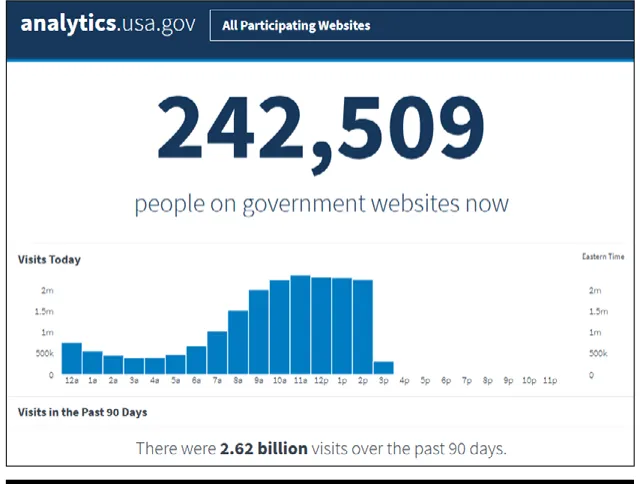
We can now see in real time how many Americans—and people from around the world—are reading WhiteHouse.gov, watching the president’s weekly video ad-dresses, or reading the Daily Compilation of Presidential Documents. Spending some time at https://analytics.usa.gov (select “All Participating Websites”) provides an illu-minating look at federal web readership. In figure 1, we get a sense of how many people interact with federal government websites over the course of a day. In fig-ure 2, we can see that the Postal Service,
National Library of Medicine, and Weather Service are by far the most viewed sites on the federal web. How can we use this information to create better services and program-ming? For these sites, and those that receive far fewer hits, is there any guarantee—or hope—that their content will be available for future generations to analyze and look back on? To raise awareness of the importance of preservation of this content, librarians should select some of the most popular examples of these official agency sites, and then use the opportunity to point out that long-term preservation of digital resources requires a more active approach than that for tangible materials.
Citizen Action about Government Resources
Another fascinating development of the past year is the Da-taRefuge/DataRescue movement, originally centered at the University of Pennsylvania’s Penn Program for the Environ-mental Humanities (PPEH) (www.ppehlab.org/datarefuge), which resulted in more than forty DataRescue events nation-ally.26 Typical DataRescue events were open to interested
members of the public, who, armed with laptops and a Wi-Fi connection, would find federal environmental and climate data and identify them as potential candidates for “rescue” and preservation in multiple trusted locations. As courts librarian Anna Russell points out, “It’s hard to imagine an-other period in history when socially motivated organiza-tions were excited about archiving information. Sure, people were excited about having information, but never were they excited about just the procedural process of preserving data. It is here that a librarian can engage patrons and inform them on an issue central to our profession.”27
which trustworthiness of the original content is paramount for long-term preservation. Corrupted or missing files can resolve over to locally stored versions. The larger LOCKSS Alliance Network has more than one hundred members, while GPO participates in a special iteration called LOCKSS-USDOCS, with thirty-six member institutions, that backs up FDSys/GovInfo.gov. Although this quiet network is likely not on public services librarians’ radar, LOCKSS-USDOCS is proving to be one of the most commonsense ways to ensure the integrity of digital federal government documents, with its simple, open-source platform, low maintenance for each institution, and use of existing content and systems.
Hathi Trust Digital Library
The Hathi Trust Digital Library is another reliable avenue for everyday government documents access, and has the poten-tial to provide basic access to far more documents than even those distributed by the FDLP. With its library catalog–like graphical user interface, Hathi provides access to usable— though not authenticated or in a strict sense “official”— full-text digital copies of 964,865 federal documents (as of October 2017) supplied mostly from Google digitizations.30
Its expansion and development into a trust of partner insti-tutions opened the door to further curation and collection growth as libraries continue to add digitized content (128 of the Trust members are FDLs, 17 of which are regional). It is interesting to note that in 2017, two out of Hathi Trust’s three primary collaboration areas (https://www.hathitrust .org/collaborative-programs) are print-retention programs and federal documents, both of which have a huge impact on everyday citizens’ access to government information.
Hathi’s print-retention agreements were first filed in 2017 as part of the Hathi Trust Shared Print Program (HTSPP). These agreements strengthen the Trust, underscoring the notion that the original tangible publications are commodi-ties not to be squandered. The HTSPP is developing at the same time that libraries are signing preservation steward agreements with GPO. As part of that agency’s Federal In-formation Preservation Network (FIPNET) strategy, deposi-tory libraries agree to permanently preserve certain tangible titles, filing memoranda of understanding (MOUs) with GPO. FIPNET, a coordinated effort to bring together diverse stakeholders in government, libraries, and consortia with the aim of preserving federal government information output, holds much promise as it looks beyond any one stakeholder’s particular “silo.”
Hathi’s US Federal Documents Program (https://www .hathitrust.org/usgovdocs) aims to “expand and enhance digital access to U.S. federal publications, including those issued by GPO and other federal agencies, through coor-dinated and collective action.” With an advisory board, a framework document for the collection (https://www.ha thitrust.org/hathitrust-federal-documents-collection-frame work), and a truly remarkable set of digitized, cataloged items, the program is an asset. Its potential for “big data” appointee, ultimately the next head will reflect the goals of
the new administration.
LOCKSS
Lots of Copies Keep Stuff Safe (LOCKSS) is a form of col-laborative digital preservation developed at Stanford in 1999 so that libraries could work together to save digital assets. It emphasizes geographic dispersion of redundantly deposited electronic files, which are then checked by au-tomatic file comparisons, a “tamper-evident” approach in
literature review on all kinds of topics, sometimes before a bill is drafted. Recent CRS reports include Justice Depart-ment’s Role in Cyber Incident Response and The “Islamic State” Crisis and U.S. Policy. Although CRS reports are not part of the FDLP, many are freely available online (http://guides.lib .uw.edu/law/crs).
Librarians should also supplement our government resources with those of nongovernmental organizations (NGOs), which have gained additional attention in the ac-quisitions world. Calls for librarians to collect more NGO literature in libraries have been around for fifteen years or more.32 NGOs can add value with their sharpened focus,
expertise, and perspective, providing a secondary view so desperately needed with government information. Publica-tions from intergovernment organizaPublica-tions (IGOs) also can add invaluable context, such as comparative reports on top-ics like telecommunication, transportation infrastructure, health outcomes, and energy use.
No matter the authoring agency or individual, however, librarians need to be teaching and advocating for the critical analysis of information, including government information, now more than ever. One helpful research guide, “Savvy Info Consumers” (http://guides.lib.uw.edu/research/evaluate), created by Jessica Albano at the University of Washington Libraries implores users to “evaluate sources before citing, posting, or tweeting them.” The guide provides evaluative criteria with handy acronyms to walk users through the process of determining the credibility of a given source and assessing the context of the information. The guide has reso-nated with users on campus, garnering more than twenty thousand views in a little under a year.
CONCLUSION
The late Senator Wendell Ford probably would not be sur-prised to hear that the recent congressional hearings on modernizing the GPO and revising Title 44 have not been front-page news; however, twenty years on, many of the fears expressed during the 1996 hearings on public access to government information in the twenty-first century have become realities.
At the conclusion of the 2014 Global Resources Forum on Libraries and Government in the Age of Big Data, also known as the Leviathan Conference, Center for Research Libraries President Bernard F. Reilly described a “fog” of technology, finance, and politics that conspires to keep gov-ernment information creation and maintenance from being transparent. Reilly reflected that librarians’ next task must be to better understand the production of born-digital informa-tion, working collectively to “drill down” and “act up” as we encounter government e-resources at risk.33
Going forward, librarians must face the present—and the future—state of government information in order to cut through this fog. We need to work together to pursue col-laborative partnerships to safeguard past, present, and future research (textual mining on specific sets of documents)
and the building of specialized collections makes it excit-ing. Existing separate collections include US Federal Docu-ments, Statistical Abstract of the United States, Bureau of Indian Affairs, Foreign Relations of the United States, US Congressional Serial Set, and US Environmental Protection Agency publications. Historians, journalists, students, and documents librarians revel in the digital runs of these se-ries, out behind vendor paywalls, held in trust by libraries. These Hathi specialized collections make the power of the FDLP quite evident. Hathi’s unauthenticated files will be perfectly acceptable to most users while GPO goes through its slower process of ingesting authenticated, official back files through its GovInfo.gov repository with the help of the depository community.
LIBRARIANS: COLLECTIONS WE SHOULD BE
HIGHLIGHTING
Another path through the government fog is for librarians to highlight the work of three legislative branch agencies that are especially valued for their dispassionate, scholarly, “just the facts” approach to government stories: Government Accountability Office (GAO), Congressional Budget Office (CBO), and Congressional Research Service (CRS).
The Government Accountability Office, established in 1921, is a watchdog agency for the entire federal government. GAO focuses on the need for government efficiency. Recently published titles include Opioid Use Disorders: HHS Needs Measures to Assess the Effectiveness of Efforts to Expand Access to Medication-Assisted Treatment (GAO-18-44, October 2017) and Syrian Refugees: U.S. Agencies Conduct Financial Oversight Activities for Humanitarian Assistance but Should Strengthen Monitoring (GAO-18-15, October 2017).
The Congressional Budget Office, established in 1979, produces nonpartisan, objective cost estimates and projec-tions for Congress. The CBO website lists thirteen different types of reports, such as federal mandates, sequestration reports, and scorekeeping for legislation. Late 2017 releases included Measuring the Adequacy of Retirement Income: A Primer and Approaches to Changing Military Health Care. CBO is out of the limelight for the most part but at various points becomes a focus of public and political scrutiny, such as dur-ing the “repeal and replace” legislative attempts regarddur-ing the Affordable Care Act. The agency’s health-care scoring was labeled “fake news” in a Washington Post op-ed written by two senior Trump aides, which prompted a former coun-selor to the Treasury secretary to note that he couldn’t “recall anything remotely like this criticism of the C.B.O.” coming from Washington politicians in forty years of observing the budgeting process.31
.org/stories/2016-11-16/kids-macedonia-made-and-circulated -many-false-news-stories-us-election.
13. “Full Transcript: FBI Director James Comey Testifies on Russian Interference in the 2016 Election,” Washington Post, March 20, 2017, https://www.washingtonpost.com/news /post-politics/wp/2017/03/20/full-transcript-fbi-director-james -comey-testifies-on-russian-interference-in-2016-election /?utm_term=.6e04a65ce522.
14. McKay Coppins, “Washington’s Split-Screen Reality,” Atlantic, March 20, 2017, https://www.theatlantic.com/politics/archive /2017/03/trump-split-screen-hearing/520209/.
15. Less Access to Less Information by and about the U.S. Government: A 1981–1987 Chronology, American Library Association, Washing-ton Office, February 1988, https://freegovinfo.info/less_access. 16. James A. Jacobs and James R. Jacobs, “Government Information:
Everywhere and Nowhere,” GPLNE, October 24, 2017, https:// freegovinfo.info/wp-content/uploads/2017/10/Disappearing -govt-info-GPLNE-notes.pdf.
17. James A. Jacobs, “Born Digital U.S. Federal Government Infor-mation: Preservation and Access,” Leviathan: Libraries and Gov-ernment Information in the Age of Big Data, April 24–25, 2014, https://www.crl.edu/sites/default/files/d6/attachments/pages /Leviathan%20Jacobs%20Report%20CRL%20%C6%92%20 %283%29.pdf.
18. Lisa Friedman, “E.P.A. Scrubs a Climate Website of ‘Climate Change,’” New York Times, October 20, 2017, https://www. nytimes.com/2017/10/20/climate/epa-climate-change.html?r=1. 19. “FBI Releases 2016 Crime Statistics,” FBI National Press Office,
September 25, 2017, https://www.fbi.gov/news/pressrel/press -releases/fbi-releases-2016-crime-statistics.
20. Clare Malone and Jeff Asher, “The First FBI Crime Report Issued under Trump Is Missing a Ton of Info,” FiveThirtyEight, October 27, 2017, https://fivethirtyeight.com/features/the-first-fbi-crime -report-issued-under-trump-is-missing-a-ton-of-info/.
21. Eric Schmidt and Jared Cohen, “The Digital Disruption: Connec-tivity and Diffusion of Power,” Foreign Affairs, October 16, 2010, https://www.foreignaffairs.com/articles/2010-10-16/digital -disruption.
22. Kathryn Watts and Sanne Knudsen (course professors), Mary Whisner (guide author). “Presidential Power in 2017,” last updated December 20, 2017, http://guides.lib.uw.edu/law/prespower/, streamed live February 1, 2017, https://youtu.be/G3if65utcMQ. 23. “Data, Media, and Society,” Data Science Institute, Columbia
Uni-versity, accessed February 23, 2018, https://industry.datascience .columbia.edu/center/new-media.
24. David Fahrenthold, “Unrequired Reading,” Washington Post, May 3, 2014, http://www.washingtonpost.com/sf/national/2014 /05/03/unrequired-reading/.
25. Michael Moore, Fahrenheit 9/11 (Culver City, CA: Columbia Tri-Star Home Entertainment, 2004), DVD.
26. Tom Avril, “Fearing Trump, Penn Scholars Move to Preserve Climate-Change Data,” Inquirer, December 14, 2016, http:// www.philly.com/philly/health/Fearing-Trump-Penn-scholars -move-to-preserve-climate-change-data.html.
27. Anna Russell, “The Egovernment Data Ship Has Set Sail: Law Librarians, Climb Aboard,” AALL Spectrum 22 (2017): 37. 28. “Hearings and Markups,” House Administration Committee, last
updated December 19, 2017, https://cha.house.gov/legislation /past-hearings-markups2. All four hearings contain the phrase “transforming GPO for the 21st century and beyond.”
29. “GPO’s Certification as a Trusted Digital Repository: Moving For-ward,” Federal Depository Library Program, October 13, 2017, https://www.fdlp.gov/news-and-events/3183-gpo-s-certifica tion-as-a-trusted-digital-repository-moving-forward?utm_ source=newsletter_1321&utm_medium=email&utm_cam paign=gpo-s-certification-as-a-trusted-digital-repository-mov ing-forward.
government information for the public’s long-term access and consumption, and to promote services that encourage our users to critically evaluate and interrogate all informa-tion. Our collaborations must move in two directions at once: (1) We need to ensure that official legal processes are in place to best manage government information (the hoped-for outcome of Title 44 reform). And (2) we need to create non-governmental solutions to preserve secondary “use copies” of government information as well (read: backups), holding the information in trust together. The solutions we create today need to be adaptable for the government information landscape of the future. Our next president may not release information in a torrent of presidential tweets but rather a mist of holographic videos. No matter the medium, we will assist others in navigating the content and work together to safeguard it. Going forward, we carry with us the first precept of ACRL’s Framework for Information Literacy, that authority is constructed and contextual, understanding it perhaps in these times as never before.34
References
1. Public Access to Government Information in the 21st Century, Hear-ing Before the Senate Comm. on Rules and Administration, S. Hrg. 104-543 (Washington, DC: GPO, 1997).
2. “Un-Presidential and Unprecedented,” Broadcasting and Cable
147, no. 20 (September 4–11, 2017): 40.
3. Eli Pariser, The Filter Bubble: What the Internet Is Hiding from You
(New York: Penguin Press, 2011).
4. Thomas E. Patterson, “Research: Media Coverage of the 2016 Election,” Shorenstein Center on Media, Politics, and Public Policy, accessed November 13, 2017, https://shorensteincenter .org/research-media-coverage-2016-election/.
5. Donald J. Trump (@realDonaldTrump), “My twitter followers will soon be over 2 million--& all the “biggies.” It’s like having your own newspaper,” Twitter, October 17, 2012, 8:07 a.m., https://twitter.com/realdonaldtrump/status/2585851272763924 49?lang=en.
6. Donald J. Trump (@realDonaldTrump), “After consultation with my Generals and military experts, please be advised that the United States Government will not accept or allow...,” Twitter, July 26, 2017, 5:55 a.m., https://twitter.com/realDonaldTrump /status/890193981585444864.
7. White House Office of the Press Secretary, Presidential Memoran-dum for the Secretary of Defense and the Secretary of Homeland Secu-rity. Subject: Military Service by Transgender Individuals, August 25, 2017, https://www.whitehouse.gov/the-press-office/2017/08/25 /presidential-memorandum-secretary-defense-and-secretary -homeland.
8. David Crary and Jessica Gresko, “US Court Bars Trump from Reversing Transgender Troops Policy,” AP News, October 30, 2017, https://apnews.com/31fe75346ad147ba9db0396d62aa741d. 9. Rajini Vaidyanathan, “Trump: Opioid ‘National Shame’ a Public
Health Emergency,” BBC News, October 27, 2017, http://www .bbc.com/news/world-us-canada-41756705.
10. National Emergencies Act, Pub. L. No. 94-412 (1976).
11. “Public Health Emergency Declaration,” US Department of Health and Human Services, last reviewed August 18, 2017, https://www.phe.gov/Preparedness/legal/Pages/phedeclaration .aspx.
33. Bernard Reilly, “A New Strategic Framework for North American Research Libraries,” Focus on Global Resources 33, no. 4 (2014), https://www.crl.edu/sites/default/files/d6/focus/pdf/FocusSum mer2014.pdf.
34. Framework for Information Literacy for Higher Education, Associa-tion of College and Research Libraries, filed by the ACRL board February 2, 2015, adopted by the ACRL board January 11, 2016, http://www.ala.org/acrl/standards/ilframework.
30. “Statistical Overview of HathiTrust’s Federal Documents Col-lection,” Hathi Trust Digital Library, accessed October 31, 2017, https://www.hathitrust.org/usdocs_registry/stat_overview. 31. Steven Rattner, “The Boring Little Budget Office That Trump
Hates,” New York Times, August 22, 2017, https://www.nytimes .com/2017/08/22/opinion/trump-cbo-republicans-hate.html?_r=0. 32. Jim Church, “NGOs and Libraries: Why Bother? A Call to