and Cost-Effectiveness Study
By Jie Chen
A Master’s Paper submitted to the faculty of the University of North Carolina at Chapel Hill in partial
fulfillment of the requirements for the degree of Master of Public Health in the Public Health
Leadership Program Chapel Hill
2013
________________________________________ Advisor
________________________________________ Date
________________________________________ Second Reader
Abstract
The scaphoid is the most commonly fractured of the carpal bones. Scaphoid fractures which do not heal are termed scaphoid nonunion. Scaphoid nonunions have been traditionally treated with nonvascularized bone grafting with or without bony fixation. In recent decades, vascularized bone grafting has gained popularity, particularly in cases of proximal pole involvement. We conducted a systematic review of recent experimental studies to determine the strength of evidence supporting one procedure over the other. We found just 3 randomized controlled trials in the literature, all of which were deemed to be at high risk of bias. In addition, these studies were inconsistent in their results with one supporting nonvascularized grafting and two supporting vascularized grafting. We conclude that the evidence is insufficient to definitively support the use of one procedure over the other.
We also performed a cost-effectiveness analysis comparing the two procedures from a societal perspective. We used primary data from three regional surgical centers to generate our effectiveness values and cost data derived from Medicare and the National Bureau of Labor and Statistics. We found that while neither technique had a significantly greater union rate than the other (vasc=0.75, nonvasc=0.73), vascularized grafting was the more cost-effective procedure primarily due to reduced costs from lost productivity. The average cost to society for one vascularized procedure was $31,968.45 compared to $35,111.18 for nonvascularized grafting. Each successful union for vascularized grafting costs $42,624.60 compared to $48,429.21 for nonvascularized grafting. The dominance of vascularized grafting also applied to proximal pole cases. In addition, we found that nonunions treated with vascularized grafting instead of nonvascularized grafting achieved radiographic union an average of 89 days earlier (P=0.06). We conclude that vascularized bone grafting is a more cost-effective alternative than
Vascularized vs nonvacsularized grafting for scaphoid nonunion: a systematic review of the experimental literature
1. Introduction
The scaphoid is the most commonly fractured of the carpal bones primarily due to its
precarious and unique anatomical position as the link between the two carpal rows. While the
incidence rate varies in the literature, a recent study using data from the National Electronic
Injury Surveillance System reports an incidence of 1.47 fractures per 100,000 person-years.1
Because the proximal scaphoid is almost completely covered by articular surface with very few
penetrating vessels, most of the vascularity is based on retrograde blood flow.2 Fractures of the
scaphoid which can compromise this poor blood supply may be characterized by slow or absent
healing. Scaphoid fractures that do not heal are termed scaphoid nonunions.
The percentage of scaphoid fractures which progress to nonunion varies from 5-50%
depending on fracture location and displacement.3-8 In addition to cases where recognized
acute scaphoid fractures fail to respond to non-operative treatment, scaphoid nonunions may
also arise secondary to unrecognized fractures which may be initially misdiagnosed as wrist
sprains.
In a scaphoid nonunion, the contacting faces of the two fragments cause instability,
which leads to improper wrist mechanics and edge on edge contact of the joint. This may
manifest in the patient as restricted wrist extension, dorsal swelling and tenderness in the
anatomical snuffbox, pain occurring at the extremes of motion, limitation of radial and ulnar
deviation, and decreased grip strength.9 If left untreated, the degenerative changes of a
nonunion may ultimately progress to a predictable and often debilitating form of arthritis known
as scaphoid nonunion advanced collapse, or “SNAC” wrist for which optimal treatment is no
Conventionally, scaphoid nonunion is treated using nonvascularized bone grafting, with
or without bony fixation. The Matti-Russe procedure is a traditional technique in which, using a
volar approach, the nonunion is excavated and subsequently packed with cortical struts and
cancellous bone with the additional option of fixating with Kirschner wires.11 Fisk and Fernandez
later described the addition of an anterior wedge graft to address the issue of alignment
restoration.12 Common sites of graft sources include the iliac crest and the dorsal side of the
distal radius.11
In the last few decades, vascularized bone grafting with or without internal fixation has
gained popularity, primarily based on the evidence of successful case reports and case series.
There are several locations from which grafts are taken including the superficial radial artery
pedicle, the volar pronator quadratus pedicle, a pedicle from the second dorsal intermetacarpal
artery, and a pedicle from the dorsal aspect of the distal radius including the 1,2
intercompartmental supraretinacular artery.11,13 Recently, grafts have also been taken from
more distant locations including the iliac crest and the medial femoral supracondylar region.
However, the role of vascularized bone grafting in the treatment of scaphoid nonunion remains
an area of controversy. While some believe that vascularized grafting leads to higher rates of
union than does traditional grafting, especially in cases with proximal pole involvement, reported
union rates vary from 27%-100%.13-16
Munk and Larsen (2004) attempted to address this controversy through a systematic
review and meta-analysis.17 After reviewing 147 publications encompassing 5,246 cases of
scaphoid nonunion, they concluded that the union rate for vascularized bone grafting with or
without internal fixation was significantly greater at 91% than the union rates of both
nonvascularized bone grafting without internal fixation at 80% and nonvascularized bone
grafting with internal fixation at 84%. In addition, they reported that the average immobilization
bone grafting without internal fixation and 7 weeks for nonvascularized bone grafting with
internal fixation.
However, as the authors noted, their study had several limitations. Most importantly, at
the time of the study they were unable to find any prospective randomized controlled trials and
only 12 of their studies compared the two different operative treatments; the rest of the included
studies were case series and reports. A meta-analysis using primarily observational data is at
high risk of both confounding and selection bias due to uncertain comparability of the groups.
Different surgeons may be more technically proficient at certain techniques, the backgrounds of
patient groups may be incomparable for factors influencing union rates such as gender and age,
and different authors may have differing criteria for measuring and defining both a nonunion and
a successful surgery. Another weakness was that studies ranging from 1928 to 2003 were all
used in the meta-analysis. Over this large time period, operative and diagnostic techniques are
almost sure to have changed, and given that vascularized bone grafting is a newer procedure
than nonvascularized bone grafting, there is a high risk of bias here as well which the authors
did not adequately stratify for. Finally, the authors also did not stratify their groups to account for
vascularization of the proximal pole. Compromise in the already tenuous blood supply of the
proximal pole is thought to play a major role in failed cases of nonvascularized bone grafting.11
A meta-analysis was done by Merrell, Wolfe, and Slade in 2002 which, in part, looked
specifically at whether vascularized bone grafting was superior to screw fixation and
nonvascularized wedge grafting for scaphoid nonunion cases characterized by avascular
necrosis of the proximal pole.18 They concluded that for these cases, vascularized bone grafting
was superior to the nonvascularized alternative with union rates of 88% and 47% respectively.
However, this study also suffers from many of the same limitations that the Munk and Larsen
study suffers from, primarily the use of observational data and a long time frame.
Given the limitations of these reviews, there remains a need to elucidate the proper role
studies may have been published in the literature, and given the continuing advances in
diagnostic imaging and surgical technique, these studies may be more relevant to current
surgical decision making. The purpose of this review is to identify these recent studies through a
systematic search and selection process and thoroughly analyze them in order to delineate the
differences in effectiveness of vascularized versus nonvascularized bone grafting for adult
scaphoid nonunion patients.
2. Methods
2.1 Inclusion/Exclusion Criteria
Prior to starting our search, we determined inclusion and exclusion criteria which were appropriate to our topic of interest (Appendix 1). Patients under the age of 17 were excluded because of different healing capacities of the pediatric versus adult population.19 Since the diagnosis of scaphoid nonunion is most often made using radiographs, studies must have stated their use of preoperative or diagnostic x-rays or, if x-rays were insufficient, computed tomography.20 Union rate was to be determined by radiographic follow-up of at least 12 months. This time frame was chosen because while most case reports demonstrate union within four months, there have been reports of nonunions taking up to six months or longer to heal.21,22 Although union rate is an intermediate outcome, it was chosen because of its common acceptance among authors as the measure of successful scaphoid nonunion surgery.11 Long-term follow-up studies suggest that the progression of arthrosis in patients who achieve union is slower than in those who do not.23-26 To be included, studies must have compared vascularized and nonvascularized bone grafting using a randomized controlled trial design. Randomized controlled trials are best able to reduce confounding and selection bias.
2.2 Search Strategy
using the following terms: ("scaphoid bone"[MeSH Terms] OR ("scaphoid"[All Fields] AND "bone"[All Fields]) OR "scaphoid bone"[All Fields] OR "scaphoid"[All Fields]) AND (nonunion[All Fields] OR nonunions[All Fields] OR non-union[All Fields] OR non-unions[All Fields]).
Two authors (JC and WC) independently reviewed titles and abstracts of all articles found using the aforementioned search terms. These authors then performed a full text review of the studies demonstrating potential for inclusion based on the initial title and abstract review. Final inclusion or exclusion of articles was to be agreed upon by both authors, and
disagreements were settled by consulting a senior author (DB). The reference list of studies that met inclusion criteria were also searched for additional studies.
2.3 Data Extraction and Risk of Bias Assessment
We designed a data extraction form which was completed for each study by one of the authors and later confirmed by a second author (Appendix B). Disagreements were resolved through discussion and, if needed, consultation with a senior author. The form includes information regarding study methods including design, interventions, inclusion criteria, population, outcome assessment, results, adverse events, and overall quality rating.
To assess the risk of bias for each individual study, we used a rating system based on the Delphi list for quality assessment of randomized clinical trials for conducting systematic reviews, modified for our own purpose.27 For instance, blinding of the care provider was not included because the surgeon must know the procedure being performed. Our list includes questions assessing population, treatment allocation, blinding, prognostic comparability, and analysis (Appendix C). For each item on the list, a rating of yes, no, or unsure was given. Taking all items into account, the overall potential for bias for each study was given a rating of high, moderate, or low.
2.4 Data synthesis and analysis
To analyze our data qualitatively, we composed a strength of evidence table (Appendix D) to address union rate, union rate of proximal pole cases, and consolidation time in which we took into account the risk of bias, consistency, directness, and precision of our studies as per recommendations of the Evidence-based Practice Center.28 Our assessment of the cumulative risk of bias took into account the individual risk of bias for each of the studies. Consistency took into account the direction of effect of each of the studies. Directness is a measure of how well the studies link to our outcome of interest which is union rate. Precision reflects the degree of certainty we have for our estimate of effect based off of the range of the studies’ results. For union rate and union rate of proximal pole cases, we also calculated an absolute risk difference for nonunion using data from all three studies. From these categories, we generated an overall strength of evidence score of robust, acceptable, or weak. Due to uncertain comparability of patient groups, we were unable to perform a quantitative meta-analysis.
3. Results
3.1 Search results
Our initial PubMed search resulted in 826 articles, 390 of which were published within our target time frame. Title and abstract review of these articles yielded 3 studies which possibly met our inclusion and exclusion criteria (Figure 1). These primary authors of these studies were Braga-Silva (2008), Ribak (2010), (Raju 2011).29-31 Full-text review of these three studies validated their inclusion in our systematic review. In addition, we searched the reference lists of these articles but found no additional studies.
3.2 Risk of bias assessment
patients underwent Herbert screw fixation without bone grafting. This arm was not included in the analysis.
All three studies were deemed to have a high risk of bias.29-31 The Braga-Silva study presented a table showing the comparability of the two groups, including information such as age, gender, and time from injury to surgery.29 Groups were comparable for the data presented. However, the study suffers from not assessing comorbidities of the groups which are known to affect healing rate such as smoking and diabetes. In addition, the study failed to stratify its results by proximal pole involvement. The Ribak study stratified their data by proximal pole involvement and smoking status.30 However, it failed to provide group comparisons for age, gender, and other comorbidities. Thus, it was impossible to tell whether or not groups were similar at baseline. The Raju study also failed to mention comparability of their groups for factors which can affect union rate including comorbidities.31 In addition, they failed to specify their method of randomization.
Because of these omissions in the three studies, all three have a high potential for selection bias. In the Raju study, in particular, the sample size was quite small.31 Thus, it was even more important to specify method of randomization and to include a table showing comparability of the groups. The discussion section of this particular paper did not provide any additional insight into their methods, choosing instead to focus on literature review.
3.3 Generalizability
In addition, an issue of generalizability that applies to many surgical studies is that it is difficult to discern whether or not the skill level of the surgeons involved is comparable to the average surgeon in the community. These studies could have addressed that issue by mentioning the experience level of the surgeons and their relative comfort level with the two compared techniques. However, because the studies did not include this assessment, it is not possible to generalize these results to the general community.
3.4 Union rate
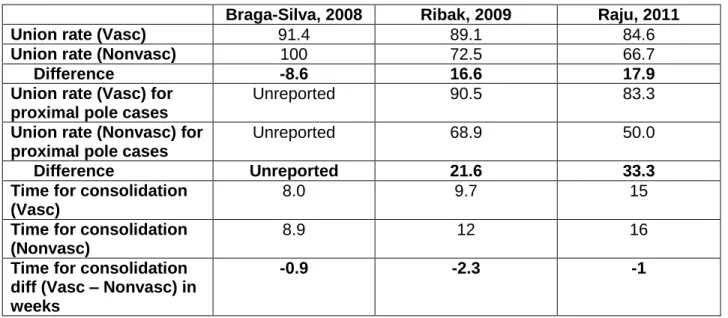
The studies were not in agreement for union rate (Table 1). Braga-Silva reported union for 32/35 (91.4%) cases treated with vascularized bone grafting and union for 45/45 (100%) cases treated with nonvascularized bone grafting.29 In contrast, both Ribak and Raju reported better union rates for vascularized bone grafting.30,31 Ribak achieved union in 41/46 (89.1%) cases using vascularized bone grafting but only 29/40 (72.5%) cases using nonvascularized bone grafting while Raju reported union in 11/13 (84.6%) cases using vascularized bone grafting but only 6/9 (66.7%) cases using nonvascularized bone grafting. There were no dropouts in any study and the follow-up time was adequate for all.
3.5 Union rate for proximal pole cases
Only Ribak and Raju reported union rates for cases with proximal pole involvement (Table 1).30,31 Ribak reported union in 19/21 (90.5%) cases using vascularized bone grafting and in 11/16 (68.9%) of cases using nonvascularized bone grafting. Raju reported union in 5/6 (83.3%) cases using vascularized bone grafting and in 2/4(50%) cases using nonvascularized bone grafting.
3.6 Time to consolidation
Time to consolidation was reported in all three studies and all suggested the superiority of vascularized bone grafting over nonvascularized bone grafting. Braga-Silva reported
statistically significant. Ribak reported that cases treated with vascularized bone grafting healed at 9.7 weeks while cases treated with nonvascularized bone grafting healed at 12 weeks.30 There were no comments on statistical significance. Raju, similarly, did not report on
significance and showed that vascularized cases healed at 15 weeks while nonvascularized cases healed at 16 weeks.31
3.7 Strength of evidence
The strength of evidence for the superiority of vascularized bone grafting over nonvascularized bone grafting is weak. The cumulative risk of bias for all three studies was high, mostly due to uncertain comparability of the treatment groups. In addition, the evidence was inconsistent; one study reported that nonvascularized bone grafting was superior while the other studies reported vascularized bone grafting as superior.29-31 In addition, the evidence was determined to be imprecise due to the wide variability of the results.
When looking at only cases with proximal pole involvement, the strength of evidence for the superiority of vascularized bone grafting was also weak. Only two of the studies reported this outcome and both had high risk of bias. While their results were consistent in favor of vascularized bone grafting and the magnitude of effect was impressive, one of the studies had a sample size of only 10 cases. Given the uncertain comparability of the groups in both of the studies, we could not conclude that vascularized bone grafting was the superior technique.
Finally, the strength of evidence for time to union was weak. While all three studies supported the superiority of vascularized bone grafting over nonvascularized bone grafting, there was high variability in the results leading to imprecision. For instance, Braga-Silva reported consolidation times of 8.0 and 8.9 weeks for vascularized and nonvascularized bone grafting, respectively while Raju reported consolidation times of 15 and 16 weeks.29,31 In addition, all three studies had high risk of bias.
This review was the first attempt in the literature to address the issue of vascularized vs nonvascularized bone grafting for the treatment of scaphoid nonunion using nonobservational studies. Based on our review, we are unable to conclude superiority of either technique over the other for all cases of scaphoid nonunion. In addition, while the evidence was more consistent and of a greater magnitude for cases involving proximal pole involvement, the strength of evidence was again insufficient to definitively favor one technique over the other. Finally, for time to union, we were also unable to conclude superiority of one technique over the other. The primary reason we could not make conclusions for these three outcomes was the high risk of bias present in all three studies we examined. Although they were all randomized controlled trials, they all failed to adequately show comparability of the treatment groups, particularly with regards to comorbidities.
Our results reflect the uncertainty in the literature. Case series for vascularized bone grafting show union rates from 27-100%.13-16 While the two previous systematic reviews done in 2004 and 2002 favored vascularized bone grafting over nonvascularized bone grafting, their use of observational data also puts their results into question.17,18
Over the last few decades, vascularized bone grafting has become increasingly popular among hand surgeons, in particular for cases of proximal pole involvement. This movement was primarily spurred on by theory and successful case reports and case series in the literature. However, as our review demonstrates, the evidence using high-quality comparative studies is currently lacking to support this practice.
The primary limitation of our review was the lack of robust randomized controlled trials in the literature. Although we were able to find three RCTs, all three were deemed to be at high risk of bias.29-31 As a result, we were unable to make any significant conclusions regarding union rates and consolidation time. Another limitation of our study was the lack of an
certainly questionable whether or not further modifications could have made it even more applicable for our review. A final limitation of our study is the use of an intermediate outcome rather than a functional outcome. While union rate is a commonly accepted and easy way for surgeons to measure the success of a surgery, the link to pain reduction and range of motion improvement is indirect.
For the problem of scaphoid nonunion, there is a need for more well-done RCTs to definitively determine whether vascularized bone grafting is superior to nonvascularized bone grafting. In addition, before widespread adoption of a new technique, there needs to be a cost-effectiveness study to assess whether the potential benefit of the new technique is worth the cost. Finally, more studies should be done to assess the link between union and functional outcomes.
Looking beyond scaphoid nonunion, the lack of well-done RCTs appears to be a
REFERENCES
1. Van Tassel DC, Owens BD, Wolf JM. Incidence estimates and demographics of scaphoid fracture in the U.S. population. J Hand Surg Am. 2010;35(8):1242-5. 2. Gelberman RH, Menon J. The vascularity of the scaphoid bone. J Hand Surg Am.
1980;5(5):508-13.
3. Russe O. Fracture of the carpal navicular. Diagnosis, non-operative treatment, and operative treatment. J Bone Joint Surg Am. 1960; 42:759-68.
4. Linschield RL, Dobyns JH, Beabout JW, Bryan RS. Traumatic instability of the wrist. Diagnosis, classification, and pathomechanics. J Bone Joint Surg Am. 1972;54(5):1612-32.
5. Leslie IJ, Dickson RA. The fractured carpal scaphoid. Natural history and factors influencing outcome. J Bone Joint Surg Br. 1981;63B(2):225-30.
6. Cooney WP, Dobyns JH, Linscheid RL. Fractures of the scaphoid: A rational approach to management. Clin Orthop. 1980;149:90-97.
7. Herbert TJ, Fisher WE. Management of the fractured scaphoid using a new bone screw.
J Bone Joint Surg Br. 1984;66(1):114-23.
8. Dias JJ, Brenkel IJ, Finlay DB. Patterns of union in fractures of the waist of the scaphoid.
J Bone Joint Surg Br. 1989;71(2):307-10.
9. Pao VS, Chang J. Scaphoid nonunion: diagnosis and treatment. Plast Reconstr Surg. 2003;112(6):1666-76.
10. Shah CM, Stern PJ. Scapholunate advanced collapse (SLAC) and scaphoid nonunion advanced collapse (SNAC) wrist arthritis. Curr Rev Musculoskelet Med. 2013;6(1):9-17. 11. Buijze GA, Ochtman L, Ring D. Management of scaphoid nonunion. J Hand Surg Am.
2012;37(5):1095-100.
12. Fernandez DL. A technique for anterior wedge-shaped grafts for scaphoid nonunions with carpal instability. J Hand Surg Am. 1984;9(5):733-7.
13. Zaidemberg C, Siebert JW, Angrigiani C. A new vascularized bone graft for scaphoid nonunion. J Hand Surg Am. 1991;16(3):474-8.
14. Mathoulin C, Haerle M, Vandeputte G. Vascularized bone graft in carpal bone reconstruction. Ann Chir Plast Esthet. 2005;50(1):43-48.
16. Straw RG, Davis TR, Dias JJ. Scaphoid nonunion: treatment with a pedicled
vascularized bone graft based on the 1,2 intercompartmental supraretinacular branch of the radial artery. J Hand Surg Br. 2002;27(5):413.
17. Munk B, Larsen CF. Bone grafting the scaphoid nonunion: a systematic review of 147 publications including 5,246 cases of scaphoid nonunion. Acta Orthop Scand.
2004;75(5):618-29.
18. Merrell GA, Wolfe SW, Slade JF 3rd. Treatment of scaphoid nonunion: quantitative meta-analysis of the literature. J Hand Surg Am. 2002;27(4):685-91.
19. Lindaman LM. Bone healing in children. Clin Podiatr Med Surg. 2001;18(1):97-108. 20. Trumble TE, Salas P, Barthel T, Robert KQ 3rd. Management of scaphoid nonunions. J
Am Acad Orthop Surg. 2003;11(6):380-91.
21. Chen CY, Chao EK, Lee SS, Ueng SW. Osteosynthesis of carpal scaphoid nonunion with interpositional bone graft and Kirschner wires: a 3- to 6-year follow-up. J Trauma. 1999;47(3):558-63.
22. Tsai TT, Chao EK, Tu YK, Chen AC, Lee MS, Ueng SW. Management of scaphoid nonunion with avascular necrosis using 1,2 intercompartmental supraretinacular arterial bone grafts. Chang Gung Med J. 2002;25(5):321-8.
23. Hooning van Duyvenbode JF, Keijser LC, Hauet EJ, Obermann WR, Rozing PM.
Pseudarthrosis of the scaphoid treated by the Matti-Russe operation. A long-term review of 77 cases. J Bone Joint Surg Br. 1991;73(4):603-606.
24. Stark A, Brostrom LA, Svartengren G. Scaphoid nonunion treated with the Matti-Russe technique. Long-term results. Clin Orthop Relat Res 1987;214:175–180.
25. Jiranek WA, Ruby LK, Millender LB, Bankoff MS, Newberg AH. Long-term results after Russe bone-grafting: the effect of malunion of the scaphoid. J Bone Joint Surg Am. 1992;74(8):1217–1228.
26. Reigstad O, Grimsgaard C, Thorkildsen R, Reigstad A, Rokkum M. Long-term results of scaphoid nonunion surgery: 50 patients reviewed after 8 to 18 years. J Orthop Trauma. 2012;26(4):241-5.
27. Verhagen AP, de Vet HC, de Bie RA, Kessels AG, Boers M, Bouter LM, Knipschild PG. The Delphi list: a criteria list for quality assessment of randomized clinical trials for conducting systematic reviews developed by Delphi consensus. J Clin Epidemiol. 1998;51(12):1235-41.
28. Owens DK, Lohr KN, Atkins D, Treadwell JR, Reston JT, Bass EB, Chang S, Helfand M. AHRQ series paper 5: grading the strength of a body of evidence when comparing medical interventions—agency for healthcare research and quality and the effective health-care program. J Clin Epidemiol. 2010;63(5):513-23.
the treatment of non-union of scaphoid fractures. J Hand Surg Eur Vol. 2008;33(5):636-40.
30. Ribak S, Medina CE, Mattar R Jr, Ulson HJ, Ulson HJ, Etchebehere M. Treatment of scaphoid nonunion with vascularized and nonvascularized dorsal bone grafting from the distal radius. Int Orthop. 2010;34(5):638-8.
31. Raju PK, Kini SG. Fixation techniques for non-union of the scaphoid. J Orthop Surg (Hong Kong). 2011;19(1):80-4.
32. Bhandari M, Richards RR, Sprague S, Schemitsch EH. The quality of reporting of randomized trials in the Journal of Bone and Joint Surgery from 1988 through 2000. J Bone Joint Surg Am. 2002;84-A(3):388-96.
33. Gummesson C, Atroshi I, Ekdahl C. The quality of reporting and outcome measures in randomized clinical trials related to upper-extremity disorders. J Hand Surg Am. 2004;29(4):727-34.
34. Dulai SK, Slobogean BL, Beauchamp RD, Mulpuri K. A quality assessment of
randomized clinical trials in pediatric orthopaedics. J Pediatr Orthop. 2007;27(5). 573-81. 35. McDonald PJ, Kulkarni AV, Farrokhyar F, Bhandari M. Ethical issues in surgical
Table 1. Outcome results
Braga-Silva, 2008 Ribak, 2009 Raju, 2011
Union rate (Vasc) 91.4 89.1 84.6
Union rate (Nonvasc) 100 72.5 66.7
Difference -8.6 16.6 17.9
Union rate (Vasc) for proximal pole cases
Unreported 90.5 83.3
Union rate (Nonvasc) for proximal pole cases
Unreported 68.9 50.0
Difference Unreported 21.6 33.3
Time for consolidation (Vasc)
8.0 9.7 15
Time for consolidation (Nonvasc)
8.9 12 16
Time for consolidation diff (Vasc – Nonvasc) in weeks
Figure 1. Flow diagram of search results
826 records identified through database search
390 articles published within time desired time frame
3 full-text articles assessed for eligibility
3 articles included in systematic review Identification
Screening
Appendix A. Inclusion/Exclusion Criteria
Inclusion Exclusion
Populations Adults diagnosed with scaphoid nonunion as determined by radiograph.
Patients under the age of 17. Studies that did not specify
method of diagnosing scaphoid nonunion. Intervention Vascularized bone grafting with or
without internal fixation.
Comparison Group Nonvascularized bone grafting with or without internal fixation.
Outcomes Union rate as measured by radiographs Union rate not measured or radiographs not used to
determine union.
Follow-up Time 12 months at least Under 12 months.
Time period for relevant studies
November 2002-April 2013 Prior to November 2002 Study designs Randomized controlled trials Cohort studies, case series,
case reports, case control studies
Appendix B. Data Extraction Form
Study: Braga-Silva J, Peruchi FM, Moschen GM, Gehlen D, Padoin AV. A Comparison of the Use of Distal Vascularized Bone Graft and Non-Vascularized Iliac Crest Bone Graft in the Treatment of Non-Union of Scaphoid Fractures. J Hand Surg Eu. 2008;33E(5):636-640.
Funding: Unreported
Design: Randomized Controlled Trial – A sealed envelope contained two envelopes, each one with the name of one of the procedures. Total sample size: 80
Intervention: Sample size: Graft site: Vascularized 35 Distal radius Nonvascularized 45 Iliac crest Inclusion criteria: Age range:
Method of diagnosing nonunion:
17-52 years
Pre-operative x-ray
Population: Mean age (years): %Male:
%Proximal pole involvement:
Mean period between injury and surgery (years):
Smoking status: Other comorbidities:
Vascularized 26.7 ± 8.1 69 (24/35) 34 (12/35) 2.5 ± 1.1
Unspecified Unspecified
Nonvascularized 25.2 ± 8.6 71 (32/45) 27 (12/45) 2.8 ± 1.3
Unspecified Unspecified Outcome assessment: Method for determining union rate:
Mean followup period:
Union was defined as disappearance of the non-union line and evidence of bone trabeculae crossing the bone graft interface in at least two incidences (Posteroanterior, true lateral, oblique and posterioranterior with ulnar and radial deviation view X-rays. ) and no sign of internal fixation failure.
2.8 years (range 1-5.2) years
Results: Union rate (%):
Union rate of proximal pole cases (%): Immobilization/return to full activity if reported:
Time to consolidation if reported:
Vascularized 91.4 (32/35) Unreported Unreported
8.0 ± 3.0 weeks
Nonvascularized 100.0 (45/45) Unreported Unreported
Loss to follow-up: None Adverse events: Unreported Quality rating: Poor
Groups seemed comparable; however no comparison of comorbidities. Did not stratify for proximal pole involvement
No disclosure of potential conflict of interest
Study: Ribak S, Medina CE, Mattar R Jr, Ulson HJ, Etchebehere M. Treatment of scaphoid nonunion with vascularised and
nonvascularised dorsal bone grafting from the distal radius. Int Orthop. 2010;34(5):683-8.
Funding: Unreported
Design: Randomized Controlled Trial – Use of sealed envelopes containing the name of one of the procedures.
Total sample size: 86 Intervention: Sample size: Graft site: Vascularized 46 Distal radius Nonvascularized 40 Distal radius Inclusion criteria: Age range:
Method of diagnosing nonunion:
Not specified
Diagnostic x-rays using posteroanterior with ulnar deviation, profile, lateral, and oblique views.
Population: Mean age (years): %Male:
%Proximal pole involvement:
Mean period between injury and surgery (years): Smoking status: Other comorbidities: Vascularized Unspecified Unspecified 46 (21/46) 2.1
10/46 smokers, 6 of whom stopped before surgery and did not resume during follow-up Unspecified Nonvascularized Unspecified Unspecified 40 (16/40) 1.9
8/40 smokers, 3 of whom stopped smoking Unspecified Outcome assessment: Method for determining union rate:
Mean follow-up period:
Nonunions bone consolidation was based on bridge trabeculae on both sides of the graft, with attenuation of the continuity solution lines in the scaphoid.
2 years Results:
Union rate (%):
Vascularized
89.1 (41/46), 2 of the nonunions occurred in those who continued to smoke
In nonsmokers and those who
Nonvascularized
72.5 (29/40), 4 of the nonunions occurred in those who continued to smoke
Union rate of proximal pole cases (%): Immobilization/return to full activity if reported:
Time to consolidation if reported:
quit, union rate was 92.9 (39/42) 90.5 (19/21)
Unreported
9.7 weeks
quit, union rate was 80 (28/35) 68.9 (11/16)
Unreported
12 weeks Loss to follow-up: None
Adverse events: Unreported Quality rating: Poor
No age range specified
Comparability of groups uncertain
No disclosure of potential conflict of interest
Study: Raju PK, Kini SG. Fixation techniques for non-union of the scaphoid. J Orthop Surg (Hong Kong). 2011;19(1):80-4.
Funding: Unreported
Design: Randomized Controlled Trial – Randomization method unspecified. 3 groups: Herbert screw fixation, Matti Russe bone grafting
(nonvascularized), Kohlman vascularized muscle pedicle grafting Total sample size: 33, 22 of which underwent bone grafting Intervention: Sample size: Graft site: Vascularized 13 Distal radius Nonvascularized 9 Iliac crest Inclusion criteria: Age range:
Method of diagnosing nonunion:
20-48 (mean 28) years
Pre-operative x-rays using anteroposterior, lateral, and 30˚ ulnar deviation views.
Population: Mean age (years): %Male:
%Proximal pole involvement:
Mean follow-up period: Results:
Union rate (%):
Union rate of proximal pole cases (%): Immobilization/return to full activity if reported:
Time to consolidation if reported:
Vascularized 84.6 (11/13) 83.3 (5/6) Unreported
15 weeks
Nonvascularized 66.7 (6/9)
50.0 (2/4) Unreported
16 weeks Loss to follow-up: None
Adverse events: One superficial infection, group unspecified Quality rating: Poor
Method of randomization not given Comparability of groups uncertain
Criteria for assessing union post-operation unspecified No disclosure of potential conflict of interest
Appendix C. Risk of bias assessment
Braga-Silva, 2008 Ribak, 2009 Raju, 2011 Was a method of
randomization performed?
Yes Yes Yes
Was the treatment allocation
concealed?
Yes Yes Unsure
Were the groups similar at baseline regarding the most important
prognostic indicators?
Unsure – no mention of comorbidities
Unsure – no table comparing groups, no
mention of age
Unsure – no table comparing groups, no
age or comorbidity comparison
Were the eligibility criteria specified?
No Yes No
Was the outcome assessor blinded?
Unsure Unsure Unsure
Was the patient blinded?
Unsure Unsure Unsure
Were point estimates and measures of
variability presented for the primary outcome measures?
Yes No No
Overall risk of bias High High High
Generalizability Uncertain generalizability. Although patient group characteristics
including age and gender are typical of
scaphoid nonunion patients, eligibility
criteria are unspecified and comorbidities are not
mentioned.
Not generalizable to those with previous
scaphoid nonunion surgery. Uncertain
generalizability otherwise due to no
Appendix D. Strength of evidence table Outcome (number of studies, sample size) Cumu lative Risk of bias Consistenc y Directnes s
Precision Combined magnitude of effect Strength of evidence Union rate (3, 188)
High Inconsistent Direct Imprecise -4 (range +8, -18)
Weak – high risk of bias, small magnitude, inconsistent results Union rate for proximal pole cases (2, 47)
High Consistent Direct Uncertain due to small sample size of one study
24 (range -21.6, -33.3)
Weak – results consistent, but high risk of bias and small sample size Time to
union (3, 188)
Cost Effectiveness of Vascularized vs Nonvascularized Bone Grafting for Treatment of Scaphoid Nonunion
Introduction
The scaphoid is the most commonly fractured of the carpal bones primarily due to its
precarious and unique anatomical position as the link between the two carpal rows. While the
incidence rate varies in the literature, a recent study using data from the National Electronic
Injury Surveillance System reports an incidence of 1.47 fractures per 100,000 person-years.1
Because the proximal scaphoid is almost completely covered by articular surface with very few
penetrating vessels, most of the vascularity is based on retrograde blood flow.2 Fractures of the
scaphoid which can compromise this poor blood supply may be characterized by slow or absent
healing. Scaphoid fractures that do not heal are termed scaphoid nonunions.
The percentage of scaphoid fractures which progress to nonunion varies from 5-50%
depending on fracture location and displacement.3-8 In addition to cases where recognized
acute scaphoid fractures fail to respond to non-operative treatment, scaphoid nonunions may
also arise secondary to unrecognized fractures which may be initially misdiagnosed as wrist
sprains.
In a scaphoid nonunion, the contacting faces of the two fragments no longer articulate
correctly, leading to improper wrist mechanics and edge on edge contact of the joint. This may
manifest in the patient as restricted wrist extension, dorsal swelling and tenderness in the
anatomical snuffbox, pain occurring at the extremes of motion, limitation of radial and ulnar
deviation, and decreased grip strength.9 If left untreated, the degenerative changes of a
nonunion may ultimately progress to a predictable and often debilitating form of arthritis known
as scaphoid nonunion advanced collapse, or “SNAC” wrist for which optimal treatment is no
longer possible and salvage techniques are used instead.10
Conventionally, scaphoid nonunion is treated using nonvascularized bone grafting, with
side of the distal radius.11 In the last few decades, vascularized bone grafting with or without
internal fixation has gained popularity, primarily based on the evidence of successful case
reports and case series. A common practice is to bone graft a pedicle from the dorsal aspect of
the distal radius which includes the 1,2 intercompartmental supraretinacular artery.11,12
However, the role of vascularized bone grafting in the treatment of scaphoid nonunion remains
an area of controversy. While some believe that vascularized grafting is a more effective
procedure than traditional grafting, especially in cases with proximal pole involvement, reported
union rates vary from 27%-100%.12-15 Munk and Larsen (2004) reported in a meta-analysis that
vascularized bone grafting had a union rate of 91% while nonvascularized bone grafting with
internal fixation had a union rate of 84%.16 However, no randomized controlled trials were used
in their analysis.
In addition to the lack of consensus regarding the use of vascularized and
nonvascularized bone grafting, there is even less literature addressing the economic differences
between the two procedures. Vascularized bone grafting is a more technically demanding
procedure which would theoretically require a longer operating time and therefore increased
anesthesia fees. In addition, longer procedures have been associated with an increased risk of
surgical site infections.17 However, these additional costs of vascularized bone grafting may be
offset by a potentially reduced immobilization period leading to a quicker return to work which
has been suggested in the literature.16 Given the lack of consensus in outcomes between the
different surgical techniques in addition to the unclear cost differences, the aim of this study is to
provide a cost-effectiveness analysis comparing vascularized and nonvascularized bone
grafting for the treatment of scaphoid nonunion.
Methods
Using decision-analytic methods, we created a model to determine the cost per
successful scaphoid nonunion surgery as measured by attainment of union for vascularized and nonvascularized bone grafting. In addition, due to the theoretical greater benefit of vascularized grafting for cases involving proximal pole fractures or sclerosis, we performed a separate analysis for proximal pole cases. Due to the lack of robust and reliable effectiveness and cost data in the literature, we decided to populate our model with primary data extracted from medical charts of scaphoid nonunion patients at participating surgical centers. The perspective considered was societal as this encompasses the entire public interest rather than a limited interest group.
Decision Tree
Figure 1 outlines the decision tree that was designed. Scaphoid nonunion patients received either vascularized pedicle grafting or nonvascularized grafting with or without internal fixation. Following surgery, the scaphoid bone either attained union or did not unite. In both cases, there could be no complications or complications of either a surgical site infection or loose hardware requiring removal. No other complications were seen in the data and no patients had both complications. Cases that do not unite undergo salvage procedures while cases which unite go onto recovery.
Patients
to patients in the last 15 years in order to increase the relevancy of our results to the present time.
We searched for patients who underwent surgery for the condition of scaphoid nonunion using CPT codes.18 While 25440 is the correct CPT code for scaphoid nonunion repair, it is not uncommon for other, similar codes to be incorrectly used, and so 25628, 25430, and 15750 were searched as well to generate our initial patient list. Our list was then scanned to exclude all patients not meeting our criteria outlined above.
Effectiveness
We reviewed the medical records of the patients to extract background and demographic data, the location of the scaphoid fracture, the procedure the patients underwent, the length of the procedure as measured by tourniquet time, whether or not union was achieved, the length of time it took to achieve radiographic union following surgery, the length of time it took from
surgery to release to unrestricted activity, and any complications from the procedure. This data was used to measure comparability of patients undergoing vascularized and nonvascularized grafting, to generate probabilities for the health states in our decision tree, and to obtain outcomes affecting cost such as length of time required for release to unrestricted activity. For our proximal pole analysis, we used proximal pole specific union rates and length of time from surgery to release to unrestricted activity. It was assumed that all other factors in the model would not be affected by proximal pole involvement. Patients for whom an outcome of union or nonunion was not recorded, often due to inadequate follow-up, were not included.
Cost
indirect cost down the line, we chose to include costs of lost productivity, costs from
complications, and costs of salvage procedures for cases which failed to unite. We chose to use Medicare data for medical costs because it represents a national and standardized cost
structure which is inclusive of multiple components such as overhead expenses and the cost of malpractice insurance.19 Costs which were identical for both groups of patients were not
included because they would not alter the overall result. For example, it was assumed that patients from both groups would undergo an equal amount of physical therapy sessions before continuing home therapy on their own. Discounting for time was not performed due to the short term outcomes focus of the study. For a surgical site infection, it was assumed that a 30 day supply of Cephalexin 500mg would be appropriate treatment, and the Walmart Pharmacy value of this medication was used since it is an easily accessible way for patients to procure the medication.20
Physician Fees
others.11 Thus, it was decided to use CPT code 25820 which codes for a limited wrist arthrodesis procedure without bone graft.18
Anesthesia Fees
The formula to determine reimbursement for Anesthesia services takes into account Base Units for an anesthetic procedure in addition to Time Units which is based on the length of the procedure.22 This total is then multiplied by a conversion factor.23 CPT code 01830, which codes for anesthesia for open or surgical/endoscopic procedures on distal radius, distal ulna, wrist, or hand joints, was used to determine the Base Units.18 The average tourniquet time for nonvascularized and vascularized bone grafting was divided by 15 to determine the Time Units for the procedures. For hardware removal and salvage techniques, we did not have literature data or adequate primary data to determine the length of operation. Thus, we made estimates which were deemed appropriate by participating hand surgeons.
Lost Productivity
To estimate the amount of lost productivity to society, we assumed that patients required return to unrestricted activity clearance in order to return to work. We used the average length of time in days from surgery to return to unrestricted activity for vascularized and
nonvascularized cases and divided this number by seven to obtain average weeks off of work for both scenarios. We used the average U.S. hourly wage for all occupations obtained from the U.S. Bureau of Labor Statistics for May 2012 and multiplied this value by 40 hours, thereby assuming a 40 hour work week.24 The resulting weekly wage was multiplied by the average weeks off of work to obtain a dollar amount of lost productivity. For cases of continued
Statistical Analysis
Microsoft Excel (Microsoft, Redmond, WA) and TreeAge (DATA, 2013; TreeAge Software, Inc., Williamstown, MA) were used for statistical and sensitivity analysis. For binary outcomes such as attainment of union, Fisher’s exact test was used to determine significance of vascularized compared to nonvascularized grafting at a p-value set to 0.05. For continuous outcomes such as mean length of time from surgery to union, unpaired t-testing was used to determine significance and to generate 95% confidence intervals for the mean difference between the procedures.
Sensitivity Analysis
Because of the limited sample size of our primary data, we used union rate data from the Munk and Larsen (2004) meta-analysis as a sensitivity analysis due to the impressive number of cases included, despite the methodological uncertainties in combining observational data into a meta-analysis.16 In addition, it is possible that the complication of loose hardware has more to do with the type and number of hardware used during a single operation than with the vascular status of the graft used. Thus, the model was run again without using hardware removal data. In addition, to test the significance of uncertainties in our outcomes, we conducted one-way
sensitivity analyses using 95% confidence intervals for union rates, lengths of procedures, complication rates for hardware removal, and time until release to unrestricted activity. Because of the anticipated insignificant effect of surgical site infections on cost, a sensitivity analysis was not run on this variable.
Results
Our initial search using CPT codes generated 271 patients in the last 15 years. Of these, a total of 68 were adults who underwent nonvascularized (n=40) or vascularized grafting (n=28) for scaphoid nonunion and had adequate followup. 14 of the 40 patients who underwent
nonvascularized grafting had fractures or sclerosis of the proximal pole of the scaphoid as determined by radiographs as opposed to 12 of 28 vascularized grafting patients who had proximal pole involvement. As shown in Table 1, groups were mostly comparable with the exception that the vascularized grafting group with proximal pole involvement had a higher percentage of males than the opposing nonvascularized proximal pole group (92% vs 71%), and the nonvascularized group had a higher percentage of smokers than the vascularized group (34% vs 23%).
Effectiveness of Nonvascularized and Vascularized Grafting
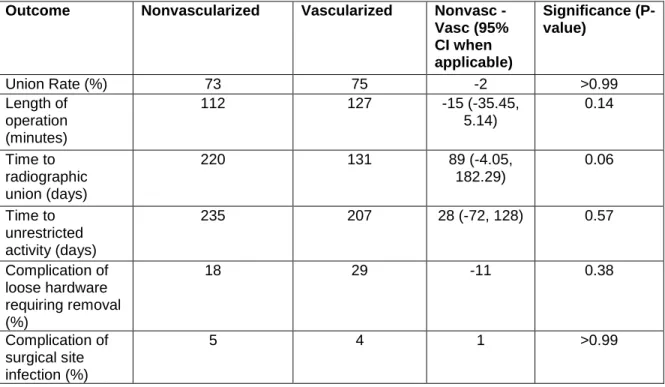
As shown in Table 2, union rates for nonvascularized and vascularized grafting were not clinically or statistically significant (73% and 75% respectively; P>0.99). Nonvascularized
grafting procedures took an average of 15 minutes shorter to complete than vascularized grafting procedures, although this was not statistically significant (P=0.14). Vascularized bone grafting cases reached radiographic union an average of 89 days before nonvascularized cases did which approached statistical significance (P=.06). In addition, patients who underwent vascularized bone grafting were released to unrestricted activity 28 days earlier than patients who underwent nonvascularized bone grafting, although this was not statistically significant (P=0.57). Patients who underwent nonvascularized grafting were less likely to have a
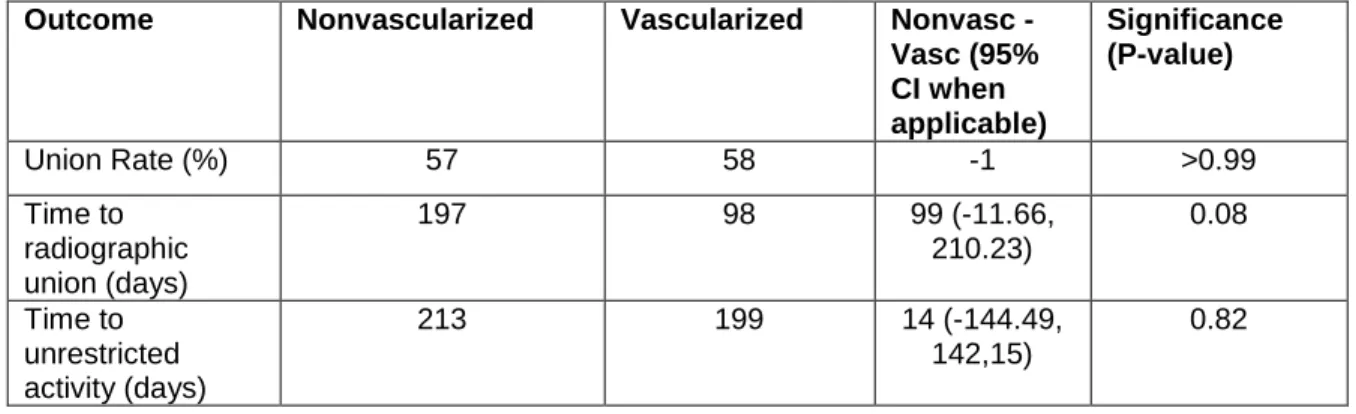
For cases characterized by proximal pole fractures or sclerosis, there was also no clinically or statistically significant difference in union rate between nonvascularized and vascularized grafting (57% and 58% respectively, P>0.99). Vascularized cases attained
radiographic union an average of 99 days earlier than nonvascularized cases which approached statistical significance (P=0.08). Finally, patients who underwent vascularized grafting were released to unrestricted activity an average of 14 days sooner than patients who underwent nonvascularized grafting although this was not statistically significant (P=0.82).
Costs of nonvascularized and vascularized grafting
The physician fees for nonvascularized and vascularized grafting were $773.00 and $1,487.82, respectively.19 The physician fees for hardware removal and the salvage procedure came out to be $639.29 and $622.28. Using the length of operation as determined by tourniquet time, the anesthesia fees for nonvascularized and vascularized bone grafting were $228.95 and $251.09, respectively.22,23 It was estimated that a hardware removal operation would require 30 minutes and a salvage procedure would require 3 hours of operating room time, giving
anesthesia fees of $109.62 and $328.86, respectively. The cost of a 30-day supply of cephalexin was $4.00.20
The national average weekly salary for May 2012 was $880.40 assuming a 40 hour work week.24 From this amount, we calculated that the average cost of lost productivity for a
nonvascularized procedure which attained union was $29,562.57. The average cost of lost productivity for a vascularized procedure which attained union was $26,004.50. Cases that failed to unite and required a salvage procedure cost society an additional $15,092.57 in lost productivity per case.
the average total cost of a vascularized surgery, regardless of outcome, was $31,968.45. Thus, the use of a vascularized grafting procedure instead of a nonvascularized procedure would save society an average of $3,142.73. Using average total costs and union rates, the
effectiveness ratio of nonvascularized surgery is $48,429.21/union compared to the cost-effectiveness ratio of vascularized surgery which is $42,624.60/union.
For proximal pole cases, the average cost of lost productivity for nonvascularized cases was $26,789.31 and the average cost of lost productivity for vascularized cases was
$25,049.90. Using these numbers and proximal pole specific union rates, the average total cost of proximal pole scaphoid nonunion surgery was $34,802.23 using nonvascularized grafting and $33,688.33 using vascularized grafting. Thus, the use of a vascularized grafting procedure instead of a nonvascularized grafting procedure for a proximal pole scaphoid nonunion would save society an average of $1,113.90. Using average total costs and union rates, the cost-effectiveness ratio of nonvascularized surgery for proximal pole cases is $60,903.75/union compared to the cost-effectiveness ratio of vascularized surgery for proximal pole cases which is $57,754.72/union.
Sensitivity analysis
Using one-way sensitivity analyses for important factors in our model, our results were found to be sensitive to vascularized union rate and both nonvascularized and vascularized time to release to unrestricted activity (table 5). A vascularized union rate of less than 0.55 causes vascularized grafting to be more costly than nonvascularized grafting. However, this threshold value approaches the lower limit of the 95% confidence interval for vascularized union rate. A nonvascularized time to release to unrestricted activity of less than 210 days causes
nonvascularized grafting to be the dominant procedure. This value is just 3 days more than the average time to release to unrestricted activity for vascularized grafting. Likewise, a
vascularized time to release to unrestricted activity of greater than 232 days causes
nonvascularized grafting to be the dominant procedure. However, this threshold value is just 3 days shorter than the average time to release to unrestricted activity of nonvascularized
grafting. All other variables tested using 95% confidence intervals did not alter the dominance of vascularized over nonvascularized grafting.
Discussion
In recent decades, vascularized bone grafting with or without internal fixation nonunion has become increasingly popular among hand surgeons in the treatment of scaphoid nonunion, especially for cases of proximal pole involvement.11 However, due to the lack of well-designed and robust randomized controlled trials, there remains uncertainty regarding which procedure is more effective. In addition, no studies have examined the costs, both direct and indirect, of the procedures to society. In this paper, we have provided a cost-effectiveness analysis in an effort to provide surgeons with the necessary information to make a more informed decision beneficial to the public.
option for all cases and for proximal pole-specific cases. The main reason for this is the large savings of reduced lost productivity costs. Those undergoing a vascularized grafting procedure were able to return to work 28 days earlier on average than those undergoing a nonvascularized grafting procedure, representing $3,521 saved in lost productivity. While the physician fees, anesthesia fees, and costs associated with hardware removal for vascularized grafting were higher than for nonvascularized grafting, these costs could not overcome the total lost productivity savings.
We also found that vascularized grafting procedures achieved radiographic union an average of 89 days before nonvascularized grafting procedures. This discrepancy was even more pronounced in proximal pole cases, where the difference was 99 days. These results correlate with the literature as the few published randomized controlled trials also show that vascularized grafts achieve union earlier than nonvascularized grafts.26-28
We found that vascularized bone grafting procedures had a higher complication rate of loose hardware requiring removal than nonvascularized grafting. Perhaps the technical
intricacies unique to the more complicated pedicle grafting procedure predispose the graft to the development of loose hardware. Another possibility is that the development of loose hardware is more related to the type and amount of hardware used than the vascularized status of the graft, and the perceived difference was an artifact of insufficient power. Regardless, our sensitivity analysis showed that removing this complication from our model does not alter the cost-effective dominance of vascularized grafting.
Somewhat unexpectedly, we did not find proximal pole cases to benefit from
important than physical location of the nonunion within the scaphoid is whether or not proximal pole necrosis is present.29 Unfortunately, we were unable to measure this due inconsistent reporting of necrotic state in the medical records.
A large limitation of our study was the sample size. We had a total of 68 patients and only 26 of these had proximal pole fractures. For many outcomes, we could not prove statistical significance due to wide confidence intervals, even if mean differences between the groups were large. However, in our cost analysis, we tried to account for this variability through sensitivity analyses. We found that our model was sensitive only to variations in the
vascularized graft union rate and both the nonvascularized and vascularized time to release to unrestricted activity. However, due to the closeness of the vascularized union rate threshold to the lower limit of the vascularized union rate 95% confidence interval, we believe our model to be robust to this variable as well. One-way analysis of costs of lost productivity indicated that nonvascularized grafting would dominate if vascularized grafting patients were released to unrestricted activity no more than 3 days sooner than nonvascularized grafting patients. However, given that the literature agrees with us that radiographic union is achieved
significantly earlier with vascularized grafting than nonvascularized grafting, it seems probable that vascularized grafting leads to a true shorter release to unrestricted activity time than nonvascularized grafting.26-28
possibility that surgeons might select vascularized grafting for nonunions they deem to be at higher risk of not healing, we acknowledge the possibility of selection bias and confounding.
A final limitation of our model, particularly common in cost-effectiveness studies, is that we could not account for every possible cost down the line. For instance, given that not all salvage techniques are successful, what are the possible costs of further surgical failure? Also, what is the complication rate for a hardware removal procedure? However, while this is not a perfect model, we do feel that we accounted for the majority of factors which could influence the result.
Despite the limitations, this study represents an important initial step in analyzing the cost-effectiveness of the different scaphoid nonunion treatments. Future research should focus on providing more well-designed randomized controlled trials comparing vascularized to nonvascularized grafting which could further clarify which procedure is more effective. The effectiveness of vascularized grafting for cases of proximal pole necrosis should also be explored in a randomized controlled setting.
Hand surgery is a rapidly evolving field with constant innovations. Surgeons often face difficult choices when deciding whether or not to implement a new procedure. With the recent public emphasis on reducing medical costs, increased consideration will be placed on the economic trade-offs of competing techniques. In this paper, we have provided an example demonstrating the possible role for cost-effectiveness research in hand surgery, answering the call for more economic evaluations in the field.30 While vascularized grafting may not
necessarily lead to improved union rates over nonvascularized grafting, the recovery process appears to be hastened, leading to a faster release to unrestricted activity time and,
REFERENCES
1. Van Tassel DC, Owens BD, Wolf JM. Incidence estimates and demographics of scaphoid fracture in the U.S. population. J Hand Surg Am. 2010;35(8):1242-5. 2. Gelberman RH, Menon J. The vascularity of the scaphoid bone. J Hand Surg Am.
1980;5(5):508-13.
3. Russe O. Fracture of the carpal navicular. Diagnosis, non-operative treatment, and operative treatment. J Bone Joint Surg Am. 1960; 42:759-68.
4. Linschield RL, Dobyns JH, Beabout JW, Bryan RS. Traumatic instability of the wrist. Diagnosis, classification, and pathomechanics. J Bone Joint Surg Am. 1972;54(5):1612-32.
5. Leslie IJ, Dickson RA. The fractured carpal scaphoid. Natural history and factors influencing outcome. J Bone Joint Surg Br. 1981;63B(2):225-30.
6. Cooney WP, Dobyns JH, Linscheid RL. Fractures of the scaphoid: A rational approach to management. Clin Orthop. 1980;149:90-97.
7. Herbert TJ, Fisher WE. Management of the fractured scaphoid using a new bone screw.
J Bone Joint Surg Br. 1984;66(1):114-23.
8. Dias JJ, Brenkel IJ, Finlay DB. Patterns of union in fractures of the waist of the scaphoid.
J Bone Joint Surg Br. 1989;71(2):307-10.
9. Pao VS, Chang J. Scaphoid nonunion: diagnosis and treatment. Plast Reconstr Surg. 2003;112(6):1666-76.
10. Shah CM, Stern PJ. Scapholunate advanced collapse (SLAC) and scaphoid nonunion advanced collapse (SNAC) wrist arthritis. Curr Rev Musculoskelet Med. 2013;6(1):9-17. 11. Buijze GA, Ochtman L, Ring D. Management of scaphoid nonunion. J Hand Surg Am.
2012;37(5):1095-100.
12. Zaidemberg C, Siebert JW, Angrigiani C. A new vascularized bone graft for scaphoid nonunion. J Hand Surg Am. 1991;16(3):474-8.
13. Mathoulin C, Haerle M, Vandeputte G. Vascularized bone graft in carpal bone reconstruction. Ann Chir Plast Esthet. 2005;50(1):43-48.
14. Steinmann SP, Bishop AT, Berger RA. Use of the 1,2 intercompartmental supraretinacular artery as a vascularized pedicle bone graft for difficult scaphoid nonunion. J Hand Surg Am. 2002;27(3):391-401.
15. Straw RG, Davis TR, Dias JJ. Scaphoid nonunion: treatment with a pedicled
16. Munk B, Larsen CF. Bone grafting the scaphoid nonunion: a systematic review of 147 publications including 5,246 cases of scaphoid nonunion. Acta Orthop Scand.
2004;75(5):618-29.
17. Leong G, Wilson J, Charlett A. Duration of operation as a risk factor for surgical site infection: comparison of English and US data. J Hosp Infect. 2006;63(3):255-62. 18. Current Procedural Terminology. Chicago: American Medical Association, 2013. 19. National Physician Fee Schedule Relative Value Units. Centers for Medicare and
Medicaid Services, April 2013.
20. Cephalexin. Walmart Pharmacy. Accessed at http://health.walmart.com/health-advice/cephalexin-500-mg/858/ on 6/10/2013.
21. Coding Corner. American Society for Surgery of the Hand. February 2005.
22. Anesthesia Base Units by CPT Code. Centers for Medicare and Medicaid Services, 2013.
23. Anesthesia Conversion Factors. Centers for Medicare and Medicaid Services, 2013. 24. U.S. Department of Labor and Statistics. National Compensation Survey: Occupational
Wages in the United States, May 2012.
25. Cooney WP. The Wrist: Diagnosis and Operative Treatment. 2nd ed. Lippincott Williams & Wilkins;2010:764.
26. Braga-Silva J, Peruchi FM, Moschen GM, Gehlen D, Padoin AV. A comparison of the use of distal radius vascularized bone graft and non-vascularized iliac crest bone graft in the treatment of non-union of scaphoid fractures. J Hand Surg Eur Vol. 2008;33(5):636-40.
27. Ribak S, Medina CE, Mattar R Jr, Ulson HJ, Ulson HJ, Etchebehere M. Treatment of scaphoid nonunion with vascularized and nonvascularized dorsal bone grafting from the distal radius. Int Orthop. 2010;34(5):638-8.
28. Raju PK, Kini SG. Fixation techniques for non-union of the scaphoid. J Orthop Surg (Hong Kong). 2011;19(1):80-4.
29. Waitayawinyu T, McCallister WV, Katolik LI, Schlenker JD, Trumble TE. Outcome after vascularized bone grafting of scaphoid nonunions with avascular necrosis. J Hand Surg Am. 2009;34(3):387-94.
Table 1. Baseline Characteristics of Patients
Characteristic Nonvascularized Vascularized Nonvascularized (Prox Pole)
Vascularized (Prox Pole)
Male (%) 85 86 71 92
Mean age (years) 27 24 22 26
Comorbiditya (%) 9 11 11 8
Smoking status (%) 34 23 20 27
a
Table 2. Effectiveness of nonvascularized and vascularized grafting
Outcome Nonvascularized Vascularized Nonvasc -
Vasc (95% CI when applicable)
Significance (P-value)
Union Rate (%) 73 75 -2 >0.99
Length of operation (minutes)
112 127 -15 (-35.45,
5.14)
0.14
Time to radiographic union (days)
220 131 89 (-4.05,
182.29)
0.06
Time to unrestricted activity (days)
235 207 28 (-72, 128) 0.57
Complication of loose hardware requiring removal (%)
18 29 -11 0.38
Complication of surgical site infection (%)
Table 3. Effectiveness of nonvascularized and vascularized grafting for cases with proximal pole involvement
Outcome Nonvascularized Vascularized Nonvasc -
Vasc (95% CI when applicable)
Significance (P-value)
Union Rate (%) 57 58 -1 >0.99
Time to radiographic union (days)
197 98 99 (-11.66,
210.23)
0.08
Time to unrestricted activity (days)
213 199 14 (-144.49,
142,15)
Table 4. Probabilities and costs for outcome scenarios
Scenario Probability (%) Cost (dollars) Probability (%)
-Prox pole cases
Cost (dollars) - Prox pole cases
Nonvascularized 35,111.18 34,802.23
Union – no compl 56 30,564.52 44 27791.26
Union – infection 4 30,568.52 3 27795.26
Union – hardware removal
13 31,313.43 10 28540.17
Nonunion – no compl
21 46,608.24 33 43834.98
Nonunion – infection
1 46,612.24 2 43838.98
Nonunion – hardware removal
5 47,357.15 8 44583.89
Vascularized 31,968.45 33,688.33
Union – no compl 51 27,743.41 40 26,788.81
Union – infection 3 27,747.41 2 26,792.81
Union – hardware removal
21 28,492.32 17 27537.72
Nonunion – no compl
17 43,787.13 28 42832.52
Nonunion - infection
1 43,791.13 2 42836.52
Nonunion – hardware removal
Table 5. One-way sensitivity analysis
Variable tested Mean (95% CI) Sensitivity (Y/N) Threshold Nonvascularized
union rate
0.725 (0.561, 0.864) N NA
Vascularized union rate
0.750 (0.551, 0.893) Y 0.554
Length of nonvascularized procedure
111.640 (98.642, 124.638)
N NA
Length of vascularized procedure
126.790 (110.372, 143.208)
N NA
Nonvascularized loose hardware requiring removal complication rate
0.180 (0.075, 0.335) N NA
Vascularized loose hardware requiring removal complication rate
0.286 (0.132, 0.487) N NA
Nonvascularized time to release to
unrestricted activity
235.050 (150.272, 319.828)
Y 210.062
Vascularized time to release to unrestricted activity
206.760 (166.882, 246.638)